Math notes (agent drafts) [uts-016Q]
Math notes (agent drafts) [uts-016Q]
Notes on Rubik's abstract polytopes [frap-0001]
📄PDFAGENTDRAFTED
- October 9, 2026
- Utensil Song
Notes on Rubik's abstract polytopes [frap-0001]
📄PDFAGENTDRAFTED
- October 9, 2026
- Utensil Song
These are the accompanying mathematical notes for the experimental research project FRAP, Formalizing Rubik's Abstract Polytopes. The project asks how the general mathematics of Rubik puzzles can explain the concrete practice of solving them. Mathematical exposition, formalization in Lean, and executable algorithms are intended to develop together: understanding a puzzle should help us solve it, while trying to solve it should sharpen the mathematics.
The motivation grew out of decades of playing the \(3\times 3\times 3\) cube, followed by the \(2\times 2\times 2\) and \(4\times 4\times 4\). Learning formulas raised questions about why they work, how different methods organize a solve, and how a computer might find a better solution. Those questions led back through group theory and the general \(N\times N\times N\) family to Marchetti's Rubik's Abstract Polytopes [marchetti2025rubik]. These notes deliberately reverse that journey: begin with general mathematics, develop increasingly concrete models, and return to solution methods and play with a deeper understanding of the familiar puzzle.
A first concrete question guides the route: when a turn acts on one facet, which positions move, and what incident labels travel with them? Starting with abstract polytopes lets us answer that question in two stages. We first record incidence and shape symmetry without choosing lengths or angles, then apply a local facet action and inspect its effect on a tetrahedron and a cube. This separation keeps the shape data distinct from the move data while giving each abstraction a visible puzzle consequence. Passing to layered cubes then asks how the pieces, their orientations and the allowed turns change with \(N\); the \(3\times 3\times 3\) cube provides a setting in which to work out the consequences in detail. Group actions connect these descriptions. They help us ask what a move changes, what a sequence preserves, which configurations are reachable, and how a solution can be assembled from smaller tasks. The additional structure in each model must be explained when the models are compared.
The return to solving has two closely related purposes. For a person, a useful formula connects a recognizable pattern with a manageable sequence of moves. Understanding its effect and what it preserves should help explain methods and the choices within a solve; recognition, memory and ease of execution matter alongside move count. For a computer, the question is how to find solutions under explicit objectives, including shortest solutions for a chosen set of moves and costs. Producing a solution, proving that a method solves every state in its domain, and establishing optimality are different achievements. Scrambling, replay and interactive exploration bring these questions back to actual use.
The puzzles also lead into mathematics beyond solving. Local orientation data raise questions about global constraints, wreath products and transfer. Transporting labels suggests comparisons with coloring obstructions and branched coverings [izmestiev2002branched]. Random scrambles and functions used to guide search lead to probability and representation theory [pan2021fourier]. These are directions for inquiry, with their own constructions and hypotheses; the aim is to understand the connections through examples and arguments as well as the puzzles themselves.
Scholarly sources, explicit calculations and formalization are meant to inform one another. Lean can express mathematical models and implement computations whose stated properties can be proved. Missing hypotheses or awkward conventions exposed by that work should feed back into the explanations here. FRAP is at an early research stage, and the companion repository does not yet contain a formalized puzzle model or solver.
How the notes are organized [frap-000C]AGENTDRAFTED
How the notes are organized [frap-000C]AGENTDRAFTED
The developed mathematics follows one practical question: what data must a move carry so that we can later compose moves and test reachability? Incidence, symmetry and moves answers it in order. First, polytopes, flags and facet symmetry describe the shape and show their role in triangle and tetrahedron examples. Next, facet moves turn a local facet rotation into an action on incidence positions, with tetrahedron and cube calculations that make the construction concrete. Only then do positions, orientations and global constraints separate a piece's destination from transport in its local frame, while transfer and the effect of dimension connect that transport with a group homomorphism and compute the relevant local abelianizations.
The cube examples above connect the general mathematics with solving and play. The later accounts use those concrete states and moves as their starting point:
The transition between the abstract facet action and the fixed-frame cube coordinates is recorded in how the cube models connect. Read it before the all-\(N\) law if the distinction between incidence positions, cubie fibres and observations is new.
- General Rubik puzzles: the incidence actions, framed orientations and transfer developed below.
- The layered-cube family: piece types, layer turns and conventions as \(N\) varies.
- The layered-cube law: all-\(N\) state coordinates and a constructive characterization of reachability.
- The complete three-layer cube: explicit outer generators, impossible states, the standard count and a worked cleanup.
- Human methods and computer search: recognizable cases, algebraic effects, usability, move costs and optimality. The complete layer-first method supplies one full human construction, and computer solving and efficiency supplies exact small search, admissible bounds and subgroup reduction.
- From move sequences to play: notation, scrambling, recognition, replay and complete solves, including the worked replay and projected lower bound.
Further connections relate the developed orientation and transfer calculations to label transport and topology and scrambling and search functions. The quotient-compatible move account gives the criterion for an identification of observations to inherit a puzzle action. Together these results compare transport, randomization and information loss around the same concrete move.
Five encounters with a cube [frap-001C]AGENTDRAFTED
Five encounters with a cube [frap-001C]AGENTDRAFTED
Put a solved three-layer cube on a table and turn its right face once. The move is familiar, but it raises concrete puzzles: which labelled pieces moved, why can a visually plausible arrangement be impossible, and how can another person undo the turn without watching the first hand? Begin with these experiences, then introduce only the distinctions needed to explain them.
One turn is larger than the visible face
One turn is larger than the visible face
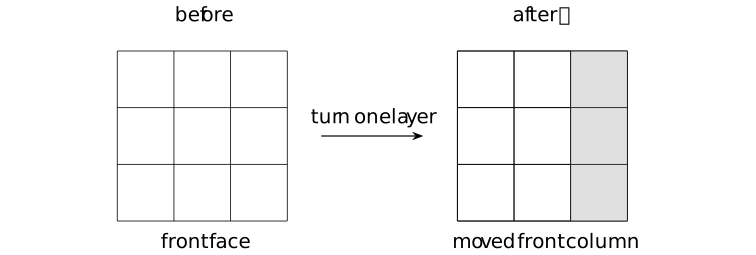
The shaded strip is only the visible part of the layer: the same stickers cross the front, right, back, top, and bottom faces; viewed from above, the top-face part is the corresponding rightmost strip. A whole-cube rotation would change the viewing frame, whereas this face move keeps the six centres fixed and changes one layer. The layered-cube family makes this distinction for every \(N\); the complete three-layer cube spells it out for the six outer generators.
A sticker needs a home and a frame
A sticker needs a home and a frame
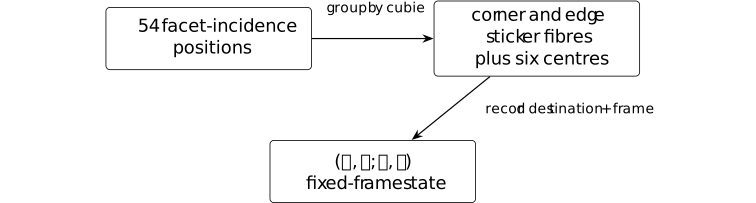
A player sees colours; a proof must also track each sticker's cubie and transported local frame. How the cube models connect follows one sticker through incidence position, cubie fibre, and fixed-frame coordinate. A colour quotient forgets labels, while a larger cube adds positions, so the state space changes with the question.
A plausible state can still be impossible
A plausible state can still be impossible
Take a solved cube and twist one corner in place. Every sticker still has a cubie-sized home, and the three colours at that corner look locally consistent. But the corner orientations now have sum \(1\) modulo \(3\), whereas every face turn preserves sum \(0\). No sequence of legal turns can produce this state.

The complete three-layer cube derives the matching edge and permutation restrictions from the six generators. The calculation is useful at the table: it tells a solver when a scrambled-looking object was assembled illegally, and it tells a proof which state space is worth searching.
A human algorithm has to preserve these legal states while it borrows pieces from completed areas.
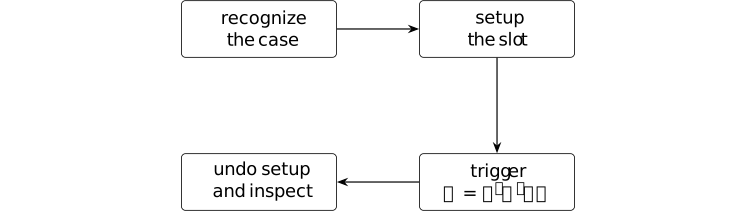
A formula often disturbs pieces that were already placed. The disturbance is acceptable only when the setup is undone and the completed pieces return. A working slot, a trigger, and an inverse setup make that promise visible. The complete layer-first method repeats this pattern through the cross, the first layer, the middle layer, and the last layer. Its completeness depends on the preservation and termination checks, not on the formula's familiarity.
Undoing a scramble checks the notation
Undoing a scramble checks the notation

The worked replay and projected lower bound fixes the viewing convention, records the ten tokens, and applies their inverse. Sticker replay returns to solved. A corner-only projected search finds no solution of depth at most two, so the evidence is the bounded statement
\[3\le d_{\rm HTM}\le 10.\]The inverse word is an upper-bound witness; the projected search is a lower-bound witness. The computer account explains why these checks do not prove that ten is shortest. A state, a word, and a replay log are enough to test the notation before asking for a general solver.
Changing one ingredient changes the problem
Changing one ingredient changes the problem
Once the move, its frame, its local repair, and its replay are explicit, three variations separate the effects of enlarging the cube, changing the shape, and forgetting labels.
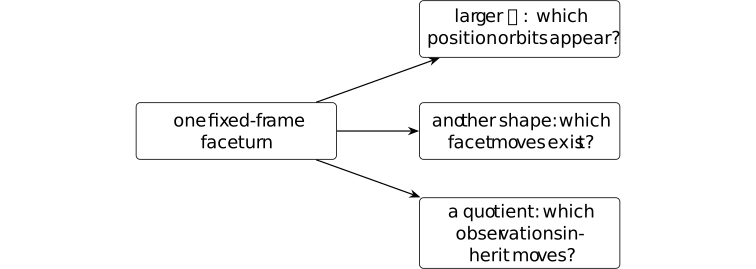
The layered-cube family develops the first variation; the incidence and facet construction in incidence, symmetry and moves develops the second; and which moves survive a quotient? gives the descent condition for the third. Framed orientations, label transport and topology, and scrambling, spectra and search then study the extra information each variation introduces or forgets. Their hypotheses stay attached to the concrete move that prompted the question.
A face turn can therefore be drawn, named, replayed, and checked before it is generalized. The resulting state maps and invariants support later formal certification or measured comparisons, while the examples here make clear which claim each later programme would have to establish.
From incidence to moves [frap-0002]AGENTDRAFTED
From incidence to moves [frap-0002]AGENTDRAFTED
To describe a puzzle move without committing to coordinates, we need an incidence record that says which pieces and labels belong together. Faces and incidence define an abstract polytope without choosing lengths or an embedding [schulte2017regular, Section 2]. Regularity supplies shape symmetries; the Rubik construction applies facet rotations locally to incidence positions [marchetti2025rubik, Definitions 5--6]. The sections below first make the shape visible in triangle and tetrahedron examples, then build this action and calculate its tetrahedron and cube consequences.
Faces, flags, and the symmetry of a shape [frap-0008]AGENTDRAFTED
Faces, flags, and the symmetry of a shape [frap-0008]AGENTDRAFTED
A local turn needs a shape-level answer to two questions: which faces are incident, and which symmetries preserve those incidences? An abstract polytope retains the incidence of vertices, edges and faces without prescribing distances or angles. Schulte's flag formulation [schulte2017regular, Section 2] leads from these incidences to symmetries and to the extension of a facet symmetry used in local puzzle moves.
Definition. Abstract polytopes and flags [schulte2017regular, Section 2] [frap-000D]AGENTDRAFTED
Definition. Abstract polytopes and flags [schulte2017regular, Section 2] [frap-000D]AGENTDRAFTED
An abstract \(n\)-polytope, for \(n\geq 0\), is a partially ordered set \(P\) of faces with a least face \(F_{-1}\) and greatest face \(F_n\). Every chain extends to a maximal chain, called a flag, with exactly \(n+2\) faces. Faces in each flag have ranks \(-1,0,\ldots ,n\), consistently across flags. Faces other than the least and greatest are proper; vertices, edges and facets have ranks \(0,1,n-1\).
The diamond condition requires exactly two faces of rank \(i\) between faces \(F<G\) of ranks \(i-1\) and \(i+1\), for \(0\leq i<n\). Two flags are adjacent if they differ in exactly one proper face. Strong flag connectivity requires any two flags to be joined by adjacent flags, each containing their intersection.
Thus, for each \(0\leq i<n\), each flag has a unique adjacent flag differing in rank \(i\). Strong flag connectivity restricts paths to these adjacent flags, each containing the endpoint flags' intersection; arbitrary paths through the least face would connect every pair without imposing an axiom. These conditions prescribe incidence without choosing lengths or angles.
A rank-zero polytope is a two-element chain. A rank-one polytope has two vertices between its least and greatest faces. These low-rank cases occur as sections of higher-rank polytopes.
Definition. Sections and vertex figures [schulte2017regular, Section 2] [frap-000E]AGENTDRAFTED
Definition. Sections and vertex figures [schulte2017regular, Section 2] [frap-000E]AGENTDRAFTED
Let \(P\) be a abstract polytope. For faces \(F\leq G\) of ranks \(i,j\), its section \(G/F\) is the interval \(\{H:F\leq H\leq G\}\), with ranks shifted so that \(F\) has rank \(-1\). For \(F<G\), it is an abstract polytope of rank \(j-i-1\geq 0\). For \(F=G\), the singleton section is called the rank-\(-1\) polytope. These low ranks allow all intervals, including vertex figures of polygons and intervals between consecutive faces.
The section \(F_n/v\) at a vertex \(v\) is its vertex figure. Its vertices are the edges through \(v\); its faces record the incidences above \(v\). A facet \(H\) is viewed as the section \(H/F_{-1}\).
Example. Flags of a triangle and a tetrahedron [frap-000F]AGENTDRAFTED
Example. Flags of a triangle and a tetrahedron [frap-000F]AGENTDRAFTED
The face-poset construction of [schulte2017regular, Section 2] gives the following elementary examples of flags. A triangle has the empty face, three vertices, three edges and the whole triangle, of ranks \(-1,0,1,2\). The flag \(\varnothing <1<12<123\) has rank-zero neighbor \(\varnothing <2<12<123\) and rank-one neighbor \(\varnothing <1<13<123\). There are \(3\cdot 2=6\) flags.
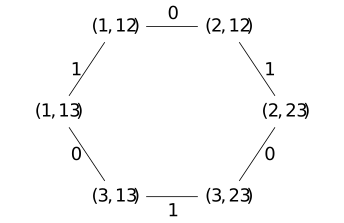
Each vertex in this flag graph records the vertex and edge of one flag; the common empty and greatest faces are suppressed. Edge labels give the rank changed by adjacency.
A tetrahedron has all subsets of \(\{1,2,3,4\}\) as faces, ordered by inclusion; a nonempty face with \(k\) vertices has rank \(k-1\). Its flag \(\varnothing <1<12<123<1234\) exhibits all five ranks. The vertex figure at \(1\) is a triangle: its vertices correspond to the three incident edges. A cube also has a triangular vertex figure, although its facets are squares. Local and global shapes carry different information.
The triangle and tetrahedron calculation now supplies a concrete check: the flag graph records which flags are adjacent; a vertex figure records the local neighborhood seen from one vertex. With those objects in hand, the next steps ask which incidence-preserving maps act on all flags and how a symmetry of one facet can be extended.
Definition. Automorphisms and regularity [schulte2017regular, Section 2] [frap-000G]AGENTDRAFTED
Definition. Automorphisms and regularity [schulte2017regular, Section 2] [frap-000G]AGENTDRAFTED
An automorphism of a abstract polytope \(P\) is a bijection \(a:P\to P\) satisfying \(F\leq G\iff a(F)\leq a(G)\). Automorphisms form a group \(\Gamma (P)\) under composition; in \(ab\), the map \(b\) acts first. They preserve ranks and act on flags face by face.
The polytope is regular if this action is transitive on flags. The tetrahedron is regular: a permutation of its four vertices sends any flag to any other.
The underlying order automorphism is represented by
OrderIso with equal source and target. This declaration does
not impose the polytope axioms or assert regularity.
Lemma. A flag determines an automorphism [schulte2017regular, Section 2, p. 4] [frap-000H]AGENTDRAFTED
Lemma. A flag determines an automorphism [schulte2017regular, Section 2, p. 4] [frap-000H]AGENTDRAFTED
An automorphism of an abstract polytope fixing every face of one flag is the identity. Consequently the automorphism group of a regular polytope acts freely and transitively on its flags.
The cited paragraph preceding Lemma 2.1 states simple transitivity for regular polytopes. The elementary argument below also proves freeness without assuming regularity.
Proof.
Proof.
For a flag adjacent to a pointwise fixed flag, only one rank has changed. The unchanged neighboring ranks bound a diamond condition with two possible faces. One is fixed, so the other is fixed too. The adjacent flag is therefore fixed pointwise. Propagating along the connected flag graph fixes every flag. Every face belongs to a flag, so every face is fixed. Transitivity is the definition of being regular.
Remark. Distinguished generators and the intersection property [frap-000I]AGENTDRAFTED
Remark. Distinguished generators and the intersection property [frap-000I]AGENTDRAFTED
Choose a base flag \(\Phi \) in a regular abstract polytope \(P\) of rank \(n\). By flag freeness, there is a unique automorphism \(\rho _i\) taking \(\Phi \) to its rank-\(i\) neighbor, for \(0\leq i<n\). The diamond condition and uniqueness give \(\rho _i^2=1\). For \(|i-j|>1\), the two rank changes are independent; \(\rho _i\rho _j\) and \(\rho _j\rho _i\) agree on \(\Phi \), hence are equal. Connectivity shows that the \(\rho _i\) reach every flag, so they generate \(\Gamma (P)\). These are the distinguished generators of [schulte2017regular, Section 5, pp. 13--14].
For \(I\subseteq \{0,\ldots ,n-1\}\), put \(G_I=\langle \rho _i:i\in I\rangle \). They also satisfy
\[G_I\cap G_J=G_{I\cap J}.\]This intersection property is part of the string C-group description [schulte2017regular, Section 5, equation (18)]. Involution and nonadjacent commutation relations alone do not reconstruct a polytope; the group-theoretic characterization includes this additional condition [schulte2017regular, Section 5, p. 14].
Lemma. Extending a symmetry of one facet [frap-000J]AGENTDRAFTED
Lemma. Extending a symmetry of one facet [frap-000J]AGENTDRAFTED
Let \(H\) be a facet of a regular abstract polytope \(P\) of rank \(n\geq 2\). Restriction gives an isomorphism
\[\operatorname {Stab}_{\Gamma (P)}(H)\cong \Gamma (H/F_{-1}).\]In particular the facet is regular, and each of its automorphisms has a unique extension fixing \(H\). This is a consequence of the flag action in [schulte2017regular, Section 2 and Lemma 2.1]; the argument follows.
Proof.
Proof.
Extend a flag of the facet section by the greatest face of \(P\). A stabilizer element restricting to the identity fixes this whole flag and is the identity by flag freeness. Restriction is therefore injective.
Given a facet automorphism \(\alpha \), the regular action supplies an automorphism of \(P\) taking the extended flag to the extension of its image under \(\alpha \). It fixes \(H\). Its restriction agrees with \(\alpha \) on the chosen facet flag, so flag freeness in the facet makes these restrictions equal. This proves surjectivity. The same use of same regular action with any two facet flags shows that the facet is regular.
Turning a facet into a puzzle move [frap-0009]AGENTDRAFTED
Turning a facet into a puzzle move [frap-0009]AGENTDRAFTED
Once the shape symmetries are known, the next question is local: how can a turn change only the positions incident to one chosen facet while carrying their labels along? A facet rotation extends to a symmetry of the whole shape, but a puzzle move applies it only at positions incident to the chosen facet. Marchetti's construction retains both entries of each incidence pair [marchetti2025rubik, Definitions 5--6]. We use finite regular abstract polytopes of rank at least three; the extension lemma itself does not require finiteness.
Definition. The rotation subgroup [marchetti2025rubik, Definition 4] [frap-000K]AGENTDRAFTED
Definition. The rotation subgroup [marchetti2025rubik, Definition 4] [frap-000K]AGENTDRAFTED
Let \(Q\) be a regular abstract polytope of rank \(m\geq 2\). Choose a base flag and its distinguished generators (involutions) \(\rho _0,\ldots ,\rho _{m-1}\). Its rotation subgroup is
\[\Gamma ^+(Q)=\langle \rho _{j-1}\rho _j:1\leq j<m\rangle .\]The index starts at \(1\): for a polygon, the single adjacent pair \(\rho _0\rho _1\) generates its rotations. For triangles and squares these are the usual cyclic rotation groups.
Equivalently, \(\Gamma ^+(Q)\) consists of the elements represented by even-length words in the distinguished involutions. Indeed every pair \(\rho _i\rho _j\) is a product of adjacent pairs or their inverses, by cancellation along the index interval. Conjugating an even word by a distinguished involution again gives an even word, so this subgroup is normal. A change of base flag conjugates the distinguished generators and therefore leaves the subgroup unchanged. We do not require it to have index two for every abstract polytope.
Definition. Incidence positions and facet moves [marchetti2025rubik, Definitions 5--6] [frap-000L]AGENTDRAFTED
Definition. Incidence positions and facet moves [marchetti2025rubik, Definitions 5--6] [frap-000L]AGENTDRAFTED
Let \(P\) be a finite regular abstract polytope of rank \(n\geq 3\), with least and greatest faces \(F_{-1},F_n\). Write \(P^\circ =P\setminus \{F_{-1},F_n\}\). The incidence positions are
\[\mathcal R(P)=\{(F,G)\in P^\circ \times P^\circ :F\leq G\}.\]Choose a facet \(H\) and an element \(\alpha \) of the rotation subgroup \(\Gamma ^+(H/F_{-1})\). The facet extension lemma gives its unique extension \(\widehat \alpha \in \Gamma (P)\) fixing \(H\). The corresponding facet move is
\[\mu _{H,\alpha }(F,G)= \begin {cases} (\widehat \alpha (F),\widehat \alpha (G)),&F\leq H,\\ (F,G),&F\not \leq H. \end {cases}\]The first entry decides where the shape automorphism is applied; the second entry is transported with it. The facet is part of the move's name: one shape automorphism may stabilize several facets and give different local moves. Each move is a permutation of \(\mathcal R(P)\).
Lemma. The inverse of a facet move [frap-000M]AGENTDRAFTED
Lemma. The inverse of a facet move [frap-000M]AGENTDRAFTED
Let \(P\) be a finite regular abstract polytope of rank \(n\geq 3\), \(H\) a facet and \(\alpha \in \Gamma ^+(H/F_{-1})\) a facet rotation. The facet move \(\mu _{H,\alpha }\) is a permutation of \(\mathcal R(P)\), with
\[\mu _{H,\alpha }^{-1}=\mu _{H,\alpha ^{-1}}.\]This follows directly from the construction in [marchetti2025rubik, Definitions 5--6].
Proof.
Proof.
An automorphism preserves proper faces and the order relation, so the moving branch remains in \(\mathcal R(P)\). Since \(\widehat \alpha (H)=H\), the condition \(F\leq H\) holds exactly when \(\widehat \alpha (F)\leq H\). Thus the moving and fixed subsets are preserved separately. On the moving subset the extension of \(\alpha ^{-1}\) is \(\widehat \alpha ^{-1}\) by uniqueness, and cancels the first map. On the fixed subset both maps are the identity.
The general construction combining permutations of complementary
subsets is Equiv.Perm.subtypeCongr; its inverse formula is
Equiv.Perm.subtypeCongr.symm. Here the predicate is \(F\leq H\),
the moving permutation is the restricted shape automorphism and the other
permutation is the identity. These declarations supply that general
combination; the polytope-specific preservation argument is the proof above.
The inverse lemma makes the local action reversible. The tetrahedron calculation that follows is a small witness for why the facet is part of a move's identity: two locally valid turns can act differently on the same incidence record and need not commute.
Example. Two turns of a tetrahedron [frap-000O]AGENTDRAFTED
Example. Two turns of a tetrahedron [frap-000O]AGENTDRAFTED
Represent the faces of a tetrahedron by subsets of \(\{1,2,3,4\}\). We calculate facet moves from [marchetti2025rubik, Definitions 5--6]. For the facet \(H=123\), take an element of the rotation subgroup with global extension \(\widehat \alpha =(123)\), fixing \(4\). The vertex-edge records follow the cycle
\[(1,12)\longmapsto (2,23)\longmapsto (3,13)\longmapsto (1,12).\]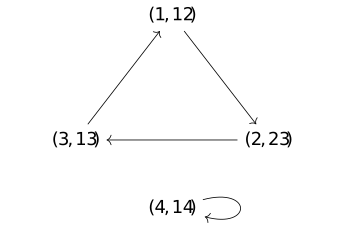
Every arrow is the local move \(\mu _{H,\alpha }\). The record \((4,14)\) stays fixed because \(4\not \leq H\), although the global shape symmetry sends it to \((4,24)\). The diagram records this permutation of incidence positions, rather than the tetrahedron's face graph.
For records whose second entry is a facet, the same move gives
\[(1,124)\longmapsto (2,234),\qquad (12,124)\longmapsto (23,234),\qquad (4,124)\longmapsto (4,124).\]The last record is fixed even though the global symmetry changes its second entry. Now let \(K=124\) and take an element of the rotation subgroup with global extension \(\widehat \beta =(124)\). Applying the \(H\)-move and then the \(K\)-move sends
\[(1,124)\xrightarrow {\mu _{H,\alpha }}(2,234) \xrightarrow {\mu _{K,\beta }}(4,134).\]Reversing their order gives \((1,124)\mapsto (2,124)\mapsto (3,234)\), so the two moves do not commute. Each has order three: its cube is the identity on both branches, and its displayed action is nontrivial.
The tetrahedron witness motivates the generated move group: reachable labelled configurations are products of these reversible local turns. The ordinary cube calculation then shows how the same definition compares with visible stickers and which data it leaves out.
Definition. The Rubik group and labelled configurations [frap-000N]AGENTDRAFTED
Definition. The Rubik group and labelled configurations [frap-000N]AGENTDRAFTED
For a finite regular abstract polytope \(P\) of rank \(n\geq 3\), the Rubik group is the subgroup generated by all facet moves:
\[\operatorname {Rub}(P)= \langle \mu _{H,\alpha }:H\text { a facet},\quad \alpha \in \Gamma ^+(H/F_{-1})\rangle \leq \operatorname {Sym}(\mathcal R(P)).\]This is Marchetti's generated group of permutations [marchetti2025rubik, Section 3, p. 6, following Definition 6]. The inverse lemma ensures that the generators are permutations.
Give each incidence position its own initial label. A labelled configuration can be represented by the permutation carrying each initial label to its current position. The identity is the solved configuration; the reachable labelled configurations are the elements of \(\operatorname {Rub}(P)\). A new move acts on the left: applying \(\mu \) to configuration \(g\) gives \(\mu g\), with \(g\) acting first. A visible coloring may identify several labelled configurations, so a solved visible coloring need not determine the labelled permutation.
Example. One ordinary cube face turn [frap-000P]AGENTDRAFTED
Example. One ordinary cube face turn [frap-000P]AGENTDRAFTED
Realize the cube as \([-1,1]^3\) and let \(H\) be the facet \(z=1\). The facet move construction of [marchetti2025rubik, Definitions 5--6] gives the following explicit outer-face action. The shape rotation
\[q(x,y,z)=(y,-x,z)\]is a clockwise quarter-turn when viewed from positive \(z\), with \(x\) rightward and \(y\) upward. Its restriction to \(H\) supplies our move. The corner \((1,1,1)\) goes to \((1,-1,1)\), and its color on \(y=1\) goes to the color position on \(x=1\). The corresponding corner at \(z=-1\) is fixed by the puzzle move, although the global map \(q\) moves it.
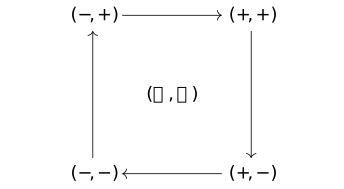
The signs give the \(x,y\) coordinates of the four corners on \(z=1\). The arrows show their clockwise motion; the central incidence record \((H,H)\) stays fixed. No orientation of a marked center is recorded.
Restricting the second entry to facets gives \(8\cdot 3+12\cdot 2+6=54\) incidence positions: three per corner, two per edge and one per face center. The turn moves twelve corner stickers and eight edge stickers, fixing the other thirty-four positions, including the unmarked center of the turned face. This is the usual outer-face action on visible stickers of a \(3\times 3\times 3\) cube in a fixed frame.
The full incidence set has \(8\cdot 7+12\cdot 3+6=98\) elements: above each vertex are that vertex, three edges and three facets; above each edge are itself and two facets. The facet-colored subset is invariant under every move. Its restricted action supplies the comparison with ordinary stickers; a faithful restriction for all abstract polytopes is not needed. Marked center orientations and inner-layer turns are additional data, absent from this comparison.
The local action determines which positions participate and how their incident labels travel. Frames and orientation separate this transport into a destination and a local orientation.
Positions, orientations, and global constraints [frap-000A]AGENTDRAFTED
Positions, orientations, and global constraints [frap-000A]AGENTDRAFTED
After a facet move, a piece can reach the right position with the wrong local orientation. The first question is therefore what data records both the destination and the frame carried by the piece. Local frames turn this transport into group coordinates, as in [marchetti2025rubik, Section 3.1]. We then derive the composition law, a frame-independent total-orientation character, and the additional test that makes this character a conserved quantity for cube face turns.
Definition. Framed transports [frap-000Q]AGENTDRAFTED
Definition. Framed transports [frap-000Q]AGENTDRAFTED
Let \(I\) be a finite set of positions, \(\Omega \) a nonempty set, and \(K\) a group acting faithfully on \(\Omega \). At each position \(i\), choose a set \(X_i\) of local labels and a bijective local frame \(c_i:\Omega \to X_i\). Keep the fibers distinct by using the tagged union
\[E=\coprod _{i\in I}X_i=\{(i,y):i\in I,\ y\in X_i\}.\]A framed transport is a permutation of \(E\) given by a position permutation \(\pi \in \operatorname {Sym}(I)\) and elements \(a_i\in K\), with
\[g(i,c_i(x))=(\pi (i),c_{\pi (i)}(a_i x)).\]Write \(g=(\pi ,a)\). Its local factors are indexed by the source position. Nonempty fibers determine \(\pi \) uniquely, and faithfulness determines each \(a_i\) uniquely. Conversely every such pair gives a permutation: in framed coordinates its inverse sends \((j,x)\) to \((\pi ^{-1}(j),a_{\pi ^{-1}(j)}^{-1}x)\).
This finite-position model isolates the coordinate mechanism of [marchetti2025rubik, Section 3.1, Definition 7 and equation (5)]. Which local label sets and local group describe a particular puzzle must still be justified for that puzzle. The requirement that a transport moves whole fibers is part of the model.
Under composition these transports form a wreath product
\(K\wr \operatorname {Sym}(I)\). The normal subgroup \(K^I\) acts within
fibers, and position permutations reorder its factors. In
TauCeti.WreathProduct, a pair is stored using the
destination-indexed function \(A_j=a_{\pi ^{-1}(j)}\). Its permutation
action is TauCeti.WreathProduct.imprimitiveToPerm_apply;
the nonempty-fiber and faithful-action hypotheses give its injectivity in
TauCeti.WreathProduct.imprimitiveToPerm_injective.
The bijections \(c_i\) identify that action on \(I\times \Omega \) with
the action on \(E\) above.
Lemma. Composition of framed transports [frap-000R]
L∃∀NAGENTDRAFTED
Lemma. Composition of framed transports [frap-000R]
L∃∀NAGENTDRAFTED
Let \(I\) be finite and let \(K\) act faithfully on a nonempty \(\Omega \), with bijective frames \(c_i:\Omega \to X_i\). Write two framed transports as \(g=(\pi ,a)\) and \(h=(\sigma ,b)\), acting in coordinates by \(g(i,x)=(\pi (i),a_i x)\) and \(h(i,x)=(\sigma (i),b_i x)\). With left actions, applying \(g\) and then \(h\) gives the composition law
\[hg=(\sigma \pi ,(b_{\pi (i)}a_i)_{i\in I}).\]
Proof.
Proof.
The intermediate coordinates are \((\pi (i),a_i x)\). Applying \(h\) evaluates its local map at that intermediate position, giving \((\sigma \pi (i),b_{\pi (i)}a_i x)\). Thus a local factor must be multiplied at its transported position index.
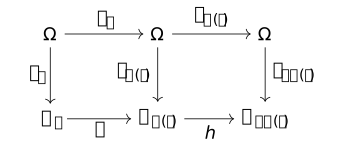
The vertical arrows are the chosen frames; the bottom arrows are the restrictions of the actual transports. Each square commutes. Along the top row, the second factor is evaluated at \(\pi (i)\), explaining the shifted index in the composite. This expands the wreath-product coordinates of [marchetti2025rubik, Section 3.1, pp. 6--7]. The wreath product uses destination-indexed factors in the linked formalization.
The linked multiplication theorem uses destination-indexed factors. Set \(A_j=a_{\pi ^{-1}(j)}\) and \(B_j=b_{\sigma ^{-1}(j)}\). Its factor for \(hg\) at destination \(j\) is
\[B_j A_{\sigma ^{-1}(j)} =b_{\sigma ^{-1}(j)}a_{\pi ^{-1}\sigma ^{-1}(j)}.\]Putting \(i=(\sigma \pi )^{-1}(j)\) makes this exactly \(b_{\pi (i)}a_i\). Thus the theorem and the displayed source-indexed law use the same multiplication order.
Theorem. The abelianized total orientation [frap-000S]AGENTDRAFTED
Theorem. The abelianized total orientation [frap-000S]AGENTDRAFTED
Let \(I\) be finite, let \(K\) act faithfully on a nonempty \(\Omega \), and choose bijective frames \(c_i:\Omega \to X_i\). For a framed transport \(g=(\pi ,a)\), let \(K_{\mathrm {ab}}=K/[K,K]\) be its abelianization, where \([K,K]\) is generated by \(uvu^{-1}v^{-1}\), and write \([a]\) for the class of \(a\). The total-orientation character
\[\chi (g)=\prod _{i\in I}[a_i]\quad \hbox {in }K_{\mathrm {ab}}\]is a homomorphism, independent of replacing the frames by \(c_i'=c_i t_i\) for \(t_i\in K\). This is the canonical character in [marchetti2025rubik, Section 3.1, p. 7]; the proof below gives both assertions directly in source-indexed coordinates.
Proof.
Proof.
For \(h=(\sigma ,b)\), the composition law and commutativity of the target give
\[\chi (hg)=\prod _i[b_{\pi (i)}][a_i] =\left (\prod _j[b_j]\right )\left (\prod _i[a_i]\right ) =\chi (h)\chi (g).\]The middle equality reindexes using the bijection \(\pi \). In the new frames the local map is \(a_i'=t_{\pi (i)}^{-1}a_i t_i\). Its abelianized product contains each \([t_i]\) and its inverse exactly once, so these cancel and leave \(\chi (g)\).
Frame independence here concerns changes within the chosen group of
frames. Reversing a common orientation convention can also change the
identification of the target group. The target and its quotient map are
Abelianization and Abelianization.of; the total
product and its frame independence are the argument above.
Remark. When a character is conserved [frap-000T]AGENTDRAFTED
Remark. When a character is conserved [frap-000T]AGENTDRAFTED
For finite \(I\), the ambient coordinate group \(W=K\wr \operatorname {Sym}(I)\) has the total-orientation character \(\chi (\pi ,a)=\prod _i[a_i]\in K_{\mathrm {ab}}\). If a puzzle's allowed moves form a set \(S\subseteq W\), its legal group is \(G=\langle S\rangle \), usually a proper subgroup of \(W\). Then
\[G\subseteq \ker \chi \quad \Longleftrightarrow \quad \chi (s)=1\quad \hbox {for every }s\in S.\]The forward implication includes each generator. Conversely the kernel of a homomorphism is a subgroup, so it contains all products and inverses of generators lying in it. This is the generator-check step discussed after the canonical character in [marchetti2025rubik, Section 3.1, p. 7]. Its premise must be verified for the chosen moves.
The nonabelian product of local factors need not be independent of order or frames. Abelianization makes reindexing and frame cancellation valid, but neither of those operations says that \(\chi (s)=1\). The cycle criterion supplies a sufficient test, applied explicitly to cube face turns.
Lemma. Orientation checked cycle by cycle [frap-000U]AGENTDRAFTED
Lemma. Orientation checked cycle by cycle [frap-000U]AGENTDRAFTED
Let \(g=(\pi ,a)\) be a framed transport on finitely many positions \(I\), with a faithful local group \(K\) on nonempty \(\Omega \) and bijective local frames. On a cycle
\[i_0\longmapsto i_1\longmapsto \cdots \longmapsto i_{r-1} \longmapsto i_0\]of \(\pi \), the return transport in the first fiber has framed map \(a_{i_{r-1}}\cdots a_{i_1}a_{i_0}\). Its class in \(K_{\mathrm {ab}}\) is that cycle's contribution to \(\chi (g)=\prod _{i\in I}[a_i]\). Consequently, identity return transport on every position cycle implies \(\chi (g)=1\). This is the cycle criterion.
Proof.
Proof.
Apply the coordinate action \(r\) times. Each local map is applied after the preceding one, giving the stated product with the first map on the right. In the abelianization its factors may be reordered; multiplying over disjoint cycles uses each factor exactly once. A fixed position is a cycle of length one and must also be checked.
This is a sufficient test derived from the canonical character of [marchetti2025rubik, Section 3.1, p. 7]. A generator's finite order alone does not make its return map on each shorter position cycle the identity; the local transport on that cycle is the quantity to check.
Example. Corner twists and edge flips on the cube [frap-000V]AGENTDRAFTED
Example. Corner twists and edge flips on the cube [frap-000V]AGENTDRAFTED
Use the unmarked-center, fixed-frame sticker model of one cube face turn. We apply the canonical character of [marchetti2025rubik, Section 3.1, p. 7] to this explicit action. At a corner the three incident sticker directions have a cyclic order inherited from the ambient orientation. Choose bijective cyclic frames at all eight positions. Rotations preserve that order, giving local group \(C_3\); at each of the twelve edges an ordering of its two stickers gives local group \(C_2\). Both actions on the local stickers are faithful. Writing these groups additively, the two characters are
\[\chi _c=\sum _{i=1}^{8}a_i\pmod 3,\qquad \chi _e=\sum _{j=1}^{12}b_j\pmod 2.\]A quarter-turn has one four-cycle of affected corners and one of affected edges. Four applications restore every sticker, so the return transport on each of these cycles is the identity. Every other corner and edge is fixed with identity local transport. The cycle criterion gives \(\chi _c=0\) and \(\chi _e=0\) for every face quarter-turn. The kernel argument extends this to every word in those turns, including inverses and half-turns.
For a concrete cyclic frame, choose any frame at corner \(i_0\) of the upper face and define the next three by transporting it with the shape rotation \(q\). Since \(q^4=1\), all four local factors of this turn become zero. This frame checks that one generator; the frame-independence theorem transfers the conclusion to any fixed choice of cyclic frames used for the other generators.
A configuration with a corner twist of just one corner by \(1\) has \(\chi _c=1\) and is impossible under these moves. Twisting two corners by \(1\) and \(-1\) passes this test, but the calculation alone does not construct a legal sequence. Likewise, flipping exactly one edge fails the second test. An edge flip of exactly one edge therefore fails the second test. Reachability needs additional arguments.
Transfer gives a group-theoretic form of the same frame cancellation and shows how the local group limits what total orientation can detect.
Transfer and the effect of dimension [frap-000B]AGENTDRAFTED
Transfer and the effect of dimension [frap-000B]AGENTDRAFTED
The total-orientation character detects one conservation law, but it does not explain how to compare frames chosen at different positions. The motivating question is how to transport that comparison through a transitive action. Transfer uses the same cancellation as the total-orientation character for coset representatives [mayer2015artin, Sections 3.1--3.3]. The first section identifies the connection through an actual transitive action and its stabilizer; the second computes how the local rotation groups of simplices and cubes change with dimension, following [marchetti2025rubik, Sections 4--5].
Transfer and local orientation [frap-0012]AGENTDRAFTED
Transfer and local orientation [frap-0012]AGENTDRAFTED
Left multiplication permutes the cosets of a finite-index subgroup. Representatives record the motion between cosets, leaving one residual subgroup element at each position. Abelianizing their product gives transfer [mayer2015artin, Sections 3.1--3.3]. Transported frames then identify its local image with the total-orientation character of an action.
Theorem. Finite-index transfer [frap-000W]
Theorem. Finite-index transfer [frap-000W]
Let \(H\leq G\) have finite index. Choose representatives \(r_i\) for the left cosets \(r_iH\), indexed bijectively by a finite set \(I\). For \(g\in G\), left multiplication permutes the cosets, so uniquely write
\[g r_i=r_{\pi _g(i)}h_i(g),\qquad h_i(g)\in H.\]Write \(H_{\mathrm {ab}}=H/[H,H]\) and \([h]\) for the class of \(h\in H\). The abelianization is the target of the transfer
\[T_{G,H}:G\longrightarrow H_{\mathrm {ab}},\qquad T_{G,H}(g)=\prod _{i\in I}[h_i(g)]\]is a homomorphism independent of the chosen representatives. This is the left-coset construction of [mayer2015artin, Definition 3.1, Proposition 3.1 and Theorem 3.1, pp. 4--6]. Neither finiteness of \(G\) nor normality of \(H\) is required.
Proof.
Proof.
We compose left actions rightmost first. Multiplication on cosets gives \(\pi _{gk}=\pi _g\pi _k\). Expanding \(gkr_i\) in two steps yields
\[h_i(gk)=h_{\pi _k(i)}(g)h_i(k).\]Taking classes and multiplying over \(i\) gives \(T_{G,H}(gk)=T_{G,H}(g)T_{G,H}(k)\), because \(\pi _k\) reorders the first factors. Replace \(r_i\) by \(r_i t_i\), with \(t_i\in H\). The new residual factor is \(t_{\pi _g(i)}^{-1}h_i(g)t_i\). Its total class contains each \([t_i]\) and its inverse exactly once, so they cancel. Reindexing the cosets also only reorders an abelian product. This proves independence of all choices.
The linked transfer definitions specialize the homomorphism \(\phi :H\to A\) to the quotient \(H\to H_{\mathrm {ab}}\). The indexed formula takes \(f(i)=r_i\) and \(\pi =\pi _g\); its factor \(r_{\pi _g(i)}^{-1}g r_i\) is precisely \(h_i(g)\). Its finite-index instance follows from the finite bijective family of cosets.
Proposition. Transfer computes total local orientation [frap-000X]AGENTDRAFTED
Proposition. Transfer computes total local orientation [frap-000X]AGENTDRAFTED
Let \(G\) act transitively on a finite nonempty position set \(I\), and on a tagged union of fibers \(X_i\), carrying \(X_i\) bijectively to \(X_{g i}\). Fix \(i_0\in I\) and put \(H=G_{i_0}\). Let \(K\) act faithfully on a nonempty set \(\Omega \); choose a bijective base frame \(c_0:\Omega \to X_{i_0}\) and a homomorphism \(\rho :H\to K\) satisfying \(h c_0=c_0\rho (h)\) for every \(h\in H\). Choose \(r_i\in G\) with \(r_i i_0=i\), and set \(c_i=r_i c_0\). Then the total-orientation character of this framed transport is
\[\chi =\rho _{\mathrm {ab}}\circ T_{G,H}:G\longrightarrow K_{\mathrm {ab}},\]where \(T_{G,H}\) is transfer and \(\rho _{\mathrm {ab}}([h])=[\rho (h)]\). This identifies the coset construction in [mayer2015artin, Section 3.3, p. 6] with the local-frame coordinates of [marchetti2025rubik, Section 3.1, pp. 6--7].
Proof.
Proof.
The map \(G/H\to I\), \(rH\mapsto r i_0\), is a bijection: \(r i_0=s i_0\) exactly when \(s^{-1}r\in H\). Thus \(H\) has finite index \(|I|\), and the \(r_i\) are left-coset representatives. Write \(\pi _g(i)=g i\) and \(g r_i=r_{\pi _g(i)}h_i(g)\). Then
\[g c_i=g r_i c_0=r_{\pi _g(i)}h_i(g)c_0 =c_{\pi _g(i)}\rho (h_i(g)).\]Consequently every local factor belongs to \(K\), and its source-indexed coordinate is \(a_i(g)=\rho (h_i(g))\). A homomorphism sends commutators to commutators, so \(\rho _{\mathrm {ab}}\) is well defined. Multiplying the local classes gives
\[\chi (g)=\prod _i[\rho (h_i(g))] =\rho _{\mathrm {ab}}\left (\prod _i[h_i(g)]\right ).\]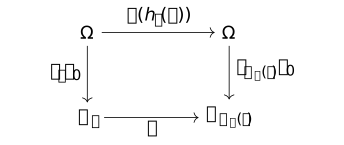
The vertical arrows are the transported frames. The equality \(g r_i=r_{\pi _g(i)}h_i(g)\) makes the square commute: after the destination representative is removed, the remaining motion fixes \(i_0\) and acts through \(\rho \). Changing representatives changes these frames within \(K\), so the character is unchanged.
The induced map is Abelianization.map. Naturality of
transfer is MonoidHom.transfer_comp, with
\(\phi :H\to H_{\mathrm {ab}}\) the quotient map and the target map
\(\rho _{\mathrm {ab}}\). That algebraic identity supports the last
equality; the identification with the actual fiber action is the
transported-frame argument above.
Example. Corner and edge stabilizers of the cube [frap-000Y]AGENTDRAFTED
Example. Corner and edge stabilizers of the cube [frap-000Y]AGENTDRAFTED
Let \(G\) be the actual permutation group generated by the six outer-face quarter-turns of the ordinary cube, with its frame of reference fixed. Use the corner and edge fibers: cyclic corner labels with local group \(C_3\), and edge labels with local group \(C_2\). This specializes the local-orientation construction of [marchetti2025rubik, Section 3.1]; the orbit argument below identifies the stabilizers needed for transfer.
The action on eight corner positions is transitive. Adjacent corners share a face whose quarter-turn takes one to the other, and the cube's edge graph is connected. Hence a corner stabilizer \(H_c\) has index eight. Its action on the three cyclically ordered labels gives a homomorphism \(\rho _c:H_c\to C_3\). The action on twelve edge positions is also transitive: the four edges of one face form a single orbit under its quarter-turn; neighboring faces share an edge; and the face-adjacency graph is connected. Thus an edge stabilizer \(H_e\) has index twelve, with local action \(\rho _e:H_e\to C_2\).
Choose a frame at the fixed corner or edge and transport it using coset representatives. The transfer comparison gives
\[\chi _c=(\rho _c)_{\mathrm {ab}}\circ T_{G,H_c},\qquad \chi _e=(\rho _e)_{\mathrm {ab}}\circ T_{G,H_e}.\]We identify the abelianizations of \(C_3\) and \(C_2\) with those groups. The face-turn calculation proves that the twist and flip characters vanish on every legal generator, hence on \(G\). It follows that these two local images of transfer vanish. It does not follow that \(T_{G,H_c}\) or \(T_{G,H_e}\) is trivial in the larger stabilizer abelianizations. No classification of \(G\) was needed.
Dimension and local rotation groups [frap-0013]AGENTDRAFTED
Dimension and local rotation groups [frap-0013]AGENTDRAFTED
The local corner groups of simplices and cubes are alternating groups. Their commutator subgroups determine the information that survives the total-orientation character [marchetti2025rubik, Sections 4--5].
Proposition. Local rotations of simplices and cubes [frap-000Z]AGENTDRAFTED
Proposition. Local rotations of simplices and cubes [frap-000Z]AGENTDRAFTED
For \(d\geq 3\), a vertex figure of a \(d\)-simplex or a \(d\)-cube is a \((d-1)\)-simplex. Its automorphism group is \(S_d\), and its rotation subgroup is \(A_d\). These are the local corner groups used in [marchetti2025rubik, Section 4, p. 10, and Section 5, p. 14].
Proof.
Proof.
At a vertex of either polytope there are \(d\) incident edges. Faces containing that vertex correspond to subsets of those edges: for a simplex one chooses the other vertices, and for a cube one chooses the coordinate directions in which the face varies. This is the face poset of a simplex on \(d\) vertices, of dimension \(d-1\). An automorphism permutes its vertices, and every vertex permutation extends uniquely to the subsets, giving \(S_d\).
A base flag orders these \(d\) vertices. Its distinguished involutions are adjacent transpositions. They generate \(S_d\), and the even words are precisely the even permutations. Thus the rotation subgroup is \(A_d\).
Here \(d\) is abstract dimension. Varying the layer count of an \(N\times N\times N\) cube leaves the ambient dimension equal to three; it changes the piece orbits and allowed layer moves instead.
Theorem. Abelianizations of the local alternating groups [frap-0010]AGENTDRAFTED
Theorem. Abelianizations of the local alternating groups [frap-0010]AGENTDRAFTED
Let \(A_d\) be the alternating group on \(d\) letters, with composition rightmost first. Then
\[(A_3)_{\mathrm {ab}}\cong C_3,\qquad (A_4)_{\mathrm {ab}}\cong C_3,\qquad (A_d)_{\mathrm {ab}}=1\quad (d\geq 5).\]The corresponding commutator subgroups are stated after Proposition 4.1 in [marchetti2025rubik, Section 4.1, p. 11]. We give the elementary calculation, using \([g,h]=ghg^{-1}h^{-1}\).
Proof.
Proof.
The group \(A_3\) is cyclic of order three, so already abelian. In \(A_4\), let \(V=\{1,(12)(34),(13)(24),(14)(23)\}\). Products and inverses stay in this four-element set, and conjugation permutes its three nonidentity elements. Hence \(V\) is normal. The quotient has order three, so it is cyclic and \([A_4,A_4]\subseteq V\). Direct multiplication gives \([(123),(124)]=(12)(34)\). Conjugating this element by the three-cycle \((123)\) gives the other two double transpositions. The commutator subgroup is normal, so it contains all of \(V\); equality follows.
For \(d\geq 5\), put \(g=(12)(34)\) and \(h=(12)(35)\) in \(A_d\). Multiplication gives \([g,h]=(345)\). Every three-cycle is conjugate to this one within \(A_d\): first choose a conjugating permutation in \(S_d\); if it is odd, compose on the right with a transposition of two symbols outside \(\{3,4,5\}\). This centralizes \((345)\) and changes the parity. Thus the normal subgroup \([A_d,A_d]\) contains every three-cycle.
Three-cycles generate all even permutations. Write an even permutation as a product of an even number of transpositions and pair them. Equal transpositions cancel; two sharing one symbol give a three-cycle; a disjoint pair satisfies \((ab)(cd)=(acb)(acd)\). Hence every pair is a product of three-cycles, proving \([A_d,A_d]=A_d\).
The three cases have separate formalized ingredients.
alternatingGroup.isCyclic_of_card_le_three gives the
cyclicity of \(A_3\). For four letters,
alternatingGroup.kleinFour_eq_commutator identifies \(V\)
with the commutator subgroup, and
TauCeti.card_abelianization_alternatingGroup gives
the quotient's cardinality three; the displayed cyclic isomorphism
then uses the elementary classification of groups of prime order.
For \(d\geq 5\), commutator_alternatingGroup_eq_top is the
perfection statement. These links concern alternating groups, not
the entire puzzle group.
Remark. What the corner character can detect [frap-0011]AGENTDRAFTED
Remark. What the corner character can detect [frap-0011]AGENTDRAFTED
For a \(d\)-simplex or \(d\)-cube with \(d\geq 3\), the local corner groups have rotation subgroup \(A_d\). Their contribution to the total-orientation character passes through \((A_d)_{\mathrm {ab}}\). The abelianization calculation therefore measures exactly what this detector can see, as in [marchetti2025rubik, Section 4.1, p. 11, and equation (19), p. 14].
In dimension three the target is \(C_3\), the familiar corner twist sum. In dimension four the local group has grown to the nonabelian \(A_4\), but the character still sees only a \(C_3\) quotient: every local change in the Klein four group disappears from it. In dimensions five and above the local group is perfect, so this corner character is identically trivial on the ambient framed transports.
A lost detector does not classify the legal moves. Other piece types, permutation signs and the subgroup actually generated by facet turns may still impose constraints. Even when the target is nontrivial, conservation requires a generator check; the local abelianization alone does not supply one.
Notes on formalized theoretical intelligence potential [ftip-0001]
📄PDFAGENTDRAFTED
- August 27, 2026
- Utensil Song
Notes on formalized theoretical intelligence potential [ftip-0001]
📄PDFAGENTDRAFTED
- August 27, 2026
- Utensil Song
Formalized Theoretical Intelligence Potential (FTIP) studies how much reliable capability post-training and agent procedures can obtain from a specified pretrained model, and how that capability depends on information, feedback, computation and evaluation. The question is comparative: what improves, through which mechanism, at what cost, and on which tasks? It concerns behavior under specified conditions, rather than an intrinsic intelligence number assigned to a model.
Post-training studies how demonstrations, preferences, rewards and interaction change a model's policy. Fine-tuning, direct preference optimization, and reinforcement learning with human or verifiable feedback differ in their objectives, feedback and update procedures. Agent systems add another source of change: tool use, search, persistent state and retained context can alter behavior even with fixed model weights. Their computation, failure modes and reliability are part of the capability being studied.
Evaluation and finite limits ask which improvements survive independent testing, what transfers to other task laws, and what follows from assumptions about sampling, support, feedback and proxy error. Architecture and optimization ask how the model's computation, parameterization and optimizer affect achievable capability and resource tradeoffs. Its mechanism map asks which bottleneck a design changes and what evidence would demonstrate that change, without ranking architectures. Matched comparisons connect these questions without identifying a higher training reward, a successful rollout and a transferable capability as the same outcome.
Conceptual discovery across generations extends the study to successive learned artifacts, reusable representations, curricula and contributions from independently developed researchers. It asks when a system can discover a method and acquire the ability to use it on fresh problems, with development and learning costs included. Mathematical research supplies concrete settings for that question; the proposed discovery-cost separation remains open.
Civilization and economic reproduction ask how learning resources arise from productive capacity, finance and the renewal of knowledge. Economic development can constrain a campaign or expand its future resources. The chapter proves conditional bounds for specified models and studies reliable contributions and shared preparation costs, alongside alternative models that sustain continued learning. These results make the budget part of the mathematical question; the general discovery lower bound remains open.
The shared model, task and evaluation interfaces support these different lines of inquiry. The notes combine published empirical observations, specified mechanisms, finite mathematical results and open research questions. Each result has its own assumptions and scope; a capability claim depends on the starting artifact, the intervention, independent evaluation and resource bounds.
Remark. How to read these notes [ftip-00NW]AGENTDRAFTED
Remark. How to read these notes [ftip-00NW]AGENTDRAFTED
The seven chapters connect learning mechanisms, computational constraints, agent reliability, evaluation, capability growth and economic conditions. The diagram shows their main logical relationships. Solid arrows indicate concepts used by another analysis. The dashed branch supplies architecture-specific detail for comparisons involving a particular model implementation or optimizer. Within that branch, the mechanism map identifies which capability bottleneck changes and what evidence would show the change; the second dashed edge marks its possible consequences for representations and discovery across model generations.
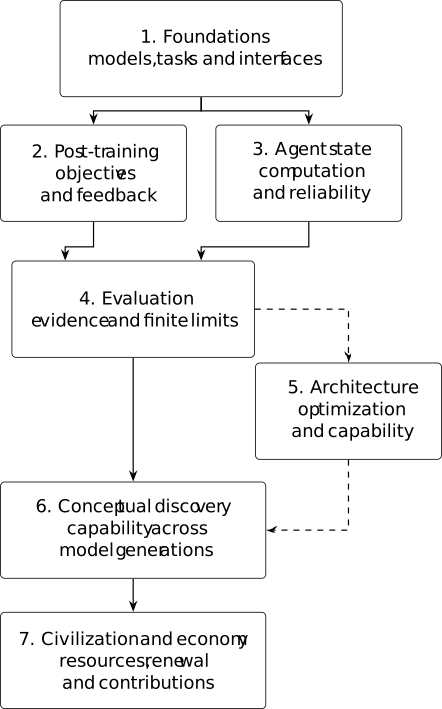
Post-training and agent state are complementary sources of capability change: one changes learned parameters, while the other manages interaction, computation and retained artifacts. Evaluation studies the evidence for those changes and their limits. Architecture analysis connects the comparison to the model's computation and optimization. The lineage analysis extends it to discovery and learning across generations. Economic analysis then asks how productive capacity, knowledge renewal and financing make the required resources available, and how learning changes those conditions.
- Foundations and interfaces introduces capability claims, token probabilities, pretraining, tasks and environments. These interfaces allow the later analysis to specify a model without requiring a particular neural architecture.
- Post-training, alignment, and feedback develops fine-tuning, preference learning, RLHF, DPO, RLVR and agentic training, with concrete objectives, feedback mechanisms and update procedures.
- Agent state, computation, and reliability studies persistent state, retained context, recursive execution, failure modes and reliability. It separates changes to agent behavior from changes to model weights while examining their interaction.
- Evaluation, evidence, and finite limits fixes the comparison law and costs, studies transport to other evaluations, and develops finite results about discovery, support, feedback and proxy error. Its closing synthesis collects the consequences and counterexamples.
- Architecture-conditioned potential and computation begins with a decoder-only Transformer, then uses the mechanism-family map to ask which capability bottleneck a design changes. Its optimization-geometry and matched-compute sections use the evaluation framework to make implementation-specific claims. The core panel is the default comparison path; the adjunct panel supplies optional objective, temporal-dynamics and function-space lenses.
- Conceptual discovery across model generations studies discovery and learning across successive artifacts. It develops the complete lineage, independently developed contributions, representation learning, curricula and mathematical research settings, alongside the conjecture and arguments that could establish or defeat it.
- Civilization, economic reproduction and capability conditions learning on feasible economic paths. It develops knowledge renewal and financing bounds, reliable acquisition from contributors, shared preparation costs, and alternative models with different implications for continued learning.
The research question and scope introduces the common distinctions between elicitation, acquisition, computation and evaluation. Questions about fine-tuning, preferences, rewards and interaction lead to the post-training chapter. Questions about memory, tools, recursive execution and reliability lead to the agent chapter. Both use the model, task and environment interfaces in the foundations.
Questions about a particular model implementation or optimizer are developed in the architecture chapter. Begin with its mechanism-family map when the question is which bottleneck a mechanism changes and what evidence could establish the change. Then follow the frontier and protocol route through architecture-indexed ceilings and matched compute, published paired measurements, paired model measurements, conditional frontiers and study design. The shared evaluation framework supplies the task laws and resource comparisons used in that analysis.
A mechanism-first route reads the core panel before the frontier sections. Its adjunct panel is optional: it changes an objective, temporal law or function-space bias and should be compared under the same interfaces rather than treated as another architecture family. Questions about representations, curricula and discovery continue through conceptual discovery; questions about costs, stability, monitorability and transfer return to evaluation and finite limits and its comparison controls.
Claims about a capability gain or limit are examined in independent evaluation and post-training potential and the following finite results and counterexamples. These sections distinguish training reward from evaluation evidence, examine transport to other task laws, and make the assumptions behind a bound explicit. Training, search and deployment costs have distinct roles in those comparisons.
Questions about reusable concepts and capability growth across generations are developed in conceptual discovery. Its complete lineage, acquisition criterion and conjecture specify the autonomous and contributed processes being compared. Contributor development, learned representations, curricula and mathematical research provide concrete settings for that open question.
Questions about the origin of a learning budget begin with economic state and admissible paths and the uniform resource envelope. The knowledge-renewal model and financing account give distinct constraints; the automation game studies an equilibrium effect under a narrower institutional assumption. The contribution protocol and portfolio comparison specify possible cost advantages. Read these with the alternative mathematical models: they show which maintenance, investment, substitution and simulation assumptions can prevent a proposed separation. Each proved implication is conditional; none alone establishes a universal training ceiling or the open conceptual-discovery lower bound.
Foundations and interfaces [ftip-00J9]AGENTDRAFTED
Foundations and interfaces [ftip-00J9]AGENTDRAFTED
A post-training comparison depends on the model, task, environment, and evaluation interfaces. These determine the possible interactions and the quantities by which their outcomes are compared.
The interfaces here require a token probability law and a specified starting artifact, without fixing the neural computation that implements them. The decoder-only Transformer appears with the later architecture analysis. Pretraining, tasks and interaction provide the shared starting point for both parameter updates and agent adaptation.
Research question and scope [ftip-0002]AGENTDRAFTED
Research question and scope [ftip-0002]AGENTDRAFTED
The question is how much independently evaluated capability a specified learning system can develop from its starting model, information and tools under stated resource bounds. Post-training changes model parameters using examples, comparisons, rewards or interaction. Agent procedures also change contexts, search and retained experience. Their effects depend on the tasks, available feedback, model computation and evaluation procedure.
A score increase can have several explanations. Elicitation improves access to behavior already observable under the starting procedure. Acquisition requires improvement on an independent transfer evaluation. More deployment computation can improve performance through additional search or sampling, while exploitation of an evaluator can improve its score without improving the intended capability. The conventions below distinguish these possibilities.
The post-training questions concern what different objectives, update rules and feedback sources enable a model to learn. The agent questions concern what persistent state, tools, interaction and recursive computation enable a system to do reliably. A retained library and an updated set of model weights can both affect later performance, but they are different interventions with different costs.
Architecture-dependent questions concern how token probabilities are computed, how parameterization interacts with optimization, and how model implementations compare under matched resources. Evaluation determines which comparisons the evidence supports. Finite probability bounds, counterexamples and feedback analyses establish consequences under their stated conditions; they do not by themselves bound every possible learning procedure.
The same distinctions extend to successive model generations. An autonomous lineage may change its representations, curricula and research procedures; an independently developed contribution may change what it can affordably acquire. That comparison includes both development and learning by the system receiving the contribution. The mathematical research settings study this direction within the broader capability question. A plateau in one recipe is evidence about that recipe, and the general discovery-cost separation remains a conjecture.
Economic conditions extend resource accounting to the productive stocks, institutions and allocations that sustain learning. Physical feasibility, financing, knowledge maintenance and competitive equilibrium impose different restrictions. A bound on attainable resources must cover the admitted development policies, including investment and deliberate maintenance. Such a bound becomes decisive for capability only when combined with an independent work lower bound; a contributor advantage also needs a realizable acquisition protocol under the same constraints.
Convention. Capability claims, procedures, evaluations, and resource bounds [ftip-0003]AGENTDRAFTED
Convention. Capability claims, procedures, evaluations, and resource bounds [ftip-0003]AGENTDRAFTED
A capability claim in this note names four objects:
- a starting model artifact \(M_0\), with its accompanying information, libraries, tools and initially available controllers disclosed;
- a procedure \(A\) that may query models, interact, retain experience and train successor artifacts, with its feedback sources specified;
- an evaluation rule \(E\), including the task law, retained artifact and deployment procedure being evaluated; and
- a resource bound \(b\).
The claim concerns the observable outcome of running \(A\) from \(M_0\) and judging the result with \(E\) while respecting \(b\). It is not a claim about an unbounded or unspecified model.
For a comparison across generations, use the complete lineage specification to make these initial resources and permitted operations explicit. Newly generated controllers and learned artifacts belong to the charged process. An externally supplied contribution has a declared producer and acquisition procedure; it is not silently added to the starting model's resources.
The bound \(b\) may contain several coordinates, such as training tokens, rollouts, accelerator work, wall-clock time, tool calls, or evaluation-time samples. Distinguish the complete development budget from the deployment budget used to compare frozen artifacts on fresh problems. Coordinates with different units remain separate unless a declared cost model converts them to a common unit.
This convention follows the experimental separation between training and inference procedures used in [shao2024deepseekmath, secs. 3--4] and [guo2025deepseek, secs. 2--3]. Those studies motivate the objects in a claim; they do not imply that every capability is summarized by one benchmark or one scalar budget.
Example. Same model under two procedures and budgets [ftip-0004]AGENTDRAFTED
Example. Same model under two procedures and budgets [ftip-0004]AGENTDRAFTED
Holding the model fixed, the comparison isolates how inference procedure and budget alter measured success.
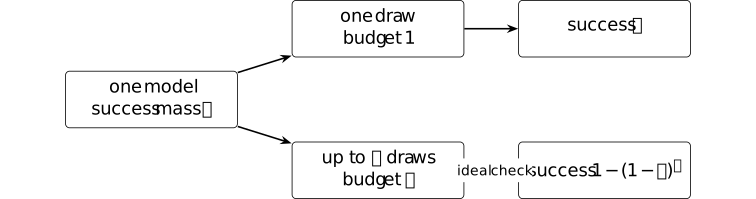
Assume independent draws and a declared perfect checker that recognizes a correct candidate when one appears. The one-draw procedure succeeds with \(J_1=p\). A procedure allowed up to \(k\) draws succeeds whenever not all draws fail: \[ J_k=1-(1-p)^k. \] Both procedures query the same conditional distribution.
Policy performance under a specified interaction and evaluation procedure is standard in [sutton2018reinforcement, Section 3.5]. The formula demonstrates procedural dependence. Independence and a perfect checker are declared toy assumptions, not properties attributed to a frontier language model.
Definition. Elicitation [ftip-0005]AGENTDRAFTED
Definition. Elicitation [ftip-0005]AGENTDRAFTED
Fix a capability claim in Convention [ftip-0003], a prespecified successful behaviour event \(B\), and a tolerance \(\varepsilon >0\). Let \(p_0(B)\) be the probability of \(B\) under the declared starting procedure and \(p_1(B)\) its probability after the intervention, both measured by the same evaluator. An elicitation witness is an observed increase \[ p_1(B)>p_0(B)\quad \text {with}\quad p_0(B)\geq \varepsilon . \] It witnesses improved access to behaviour that was already observable at the declared starting budget.
The event \(B\), tolerance \(\varepsilon \), sampling procedure, and confidence rule are part of the claim. Changing any of them changes what the witness means.
Remark. Elicitation, starting probability, and finite evidence [ftip-0006]AGENTDRAFTED
Remark. Elicitation, starting probability, and finite evidence [ftip-0006]AGENTDRAFTED
Reinforcement learning can move probability toward successful traces that a base model already emits; this possibility is tested empirically in [liu2025understanding, secs. 2.3 and 3.3--3.4]. A finite experiment cannot establish that an unrestricted generative model assigns exactly zero probability to a behaviour. The positive threshold \(\varepsilon \) therefore belongs to the declared experiment rather than to an ontological claim about what the model ``contains.''
An elicitation witness depends on the sampling budget, decoding rule, and reward. Bounding the attainable increase in \(p_1(B)\) requires assumptions about the starting probability \(p_0(B)\) and the information supplied by post-training.
Definition. Capability acquisition [ftip-0007]AGENTDRAFTED
Definition. Capability acquisition [ftip-0007]AGENTDRAFTED
Fix a capability claim in Convention [ftip-0003], a prespecified transfer evaluation \(E^{+}\), and thresholds \(0\leq \varepsilon _0<\varepsilon _1\leq 1\). Let \(u_0\) and \(u_1\) be the probabilities of passing \(E^{+}\) before and after the intervention, using the same evaluation protocol and budget. An acquisition witness is the pair of inequalities \[ u_0\leq \varepsilon _0 \qquad \text {and}\qquad u_1\geq \varepsilon _1. \] The transfer evaluation must not be used to select training examples, rewards, or checkpoints.
An acquisition witness is operational. It records a large, independently measured change under one declared procedure; it does not prove that the starting model assigned mathematical probability zero to every successful continuation.
Remark. A transfer contrast as evidence of acquisition [ftip-0008]AGENTDRAFTED
Remark. A transfer contrast as evidence of acquisition [ftip-0008]AGENTDRAFTED
Training success alone does not distinguish learning from memorization, selection, or evaluator exploitation. The base-versus-reinforcement-learning comparisons in [yue2025does, secs. 3--5] motivate this distinction, but their empirical criteria are not a universal definition of acquisition.
The thresholds in Definition [ftip-0007] require enough evaluation samples to certify both inequalities. Whether the witness survives a distribution shift depends on the task law; evaluator leakage invalidates its interpretation as independent evidence.
Tokens, text, and probability [ftip-0009]AGENTDRAFTED
Tokens, text, and probability [ftip-0009]AGENTDRAFTED
A language model assigns probabilities to tokens rather than directly to semantic answers. We therefore fix the elementary probability notation, the text-to-token interface, and the factorization of a continuation before describing the neural computation that realizes those probabilities.
Notation. Finite sets, maps, distributions, random variables, and expectation [ftip-000A]AGENTDRAFTED
Notation. Finite sets, maps, distributions, random variables, and expectation [ftip-000A]AGENTDRAFTED
For a finite set \(X\), write \(|X|\) for its cardinality and \(X^*\) for the set of finite sequences with entries in \(X\). A map \(f:X\to Y\) sends \(x\in X\) to \(f(x)\in Y\); the inverse image of \(A\subseteq Y\) is \(f^{-1}(A)=\{x\in X:f(x)\in A\}\).
Write \[ \Delta (X)=\left \{p:X\to [0,1]:\sum _{x\in X}p(x)=1\right \} \] for the probability simplex on \(X\). If \(p\in \Delta (X)\) and \(Z:X\to \mathbb R\), then \[ \mathbb E_{x\sim p}[Z(x)]=\sum _{x\in X}p(x)Z(x). \] A random variable is a map from the sample set to its value set. Random variables \(Z\) and \(W\) are independent under \(p\) when \(p(Z=z,W=w)=p(Z=z)p(W=w)\) for every pair of values \(z,w\).
For nonfinite interaction spaces, probability laws and conditional kernels require the measurable structure described in Remark [ftip-000C].
Definition. Finite probability law [ftip-000B]AGENTDRAFTED
Definition. Finite probability law [ftip-000B]AGENTDRAFTED
Using the notation of Notation [ftip-000A], a finite probability law on \(X\) is an element \(p\in \Delta (X)\). For an event \(A\subseteq X\), its probability is \[ p(A)=\sum _{x\in A}p(x). \] For \(p(A)>0\), the conditional law on \(B\subseteq X\) is \(p(B\mid A)=p(A\cap B)/p(A)\).
Remark. Finite and measurable probability laws [ftip-000C]AGENTDRAFTED
Remark. Finite and measurable probability laws [ftip-000C]AGENTDRAFTED
A finite vocabulary and a bounded token sequence admit probability laws expressed as ordinary sums, with explicit normalization and conditioning. The finite-sequence interface matches [phuong2022formal, sec. 3, Sequence modelling].
States, observations, and tool outputs need not be finite. In that setting \(\Delta (X)\) is replaced by probability measures on a declared measurable space and conditional laws are probability kernels. Results on finite spaces need additional measurable-space hypotheses before they apply in this setting.
Definition. Finite vocabulary [phuong2022formal, sec. 3, Sequence modelling] [ftip-000D]AGENTDRAFTED
Definition. Finite vocabulary [phuong2022formal, sec. 3, Sequence modelling] [ftip-000D]AGENTDRAFTED
A finite vocabulary is a nonempty finite set \(\mathcal V\) of token identifiers. A token identifier is an atomic symbol for the sequence model; it need not be a word or a character.
When termination is represented in-band, choose a distinguished token \(\mathtt {eos}\in \mathcal V\). Other control tokens, if present, are named as elements of the same vocabulary rather than assumed implicitly.
Definition. Tokenizer and detokenizer [kudo2018sentencepiece, secs. 3.1 and 3.5] [ftip-000E]AGENTDRAFTED
Definition. Tokenizer and detokenizer [kudo2018sentencepiece, secs. 3.1 and 3.5] [ftip-000E]AGENTDRAFTED
Let \(\Sigma \) be a finite character or byte alphabet and let \(\mathcal V\) be the vocabulary of Definition [ftip-000D]. A tokenizer is a specified map \(\tau :\Sigma ^*\to \mathcal V^*\). A detokenizer is a specified map \(\delta :\mathcal V^*\to \Sigma ^*\).
A tokenizer package also fixes its text normalization rule \(N\). When the package promises normalized round trips, the relevant condition is \(\delta (\tau (s))=N(s)\) for text \(s\in \Sigma ^*\); it is not the claim that \(\tau \) and \(\delta \) are inverse bijections on all sequences. SentencePiece keeps the segmentation model and detokenization convention together, which is why both maps belong to the model interface.
Byte-pair encoding gives another construction of \(\tau \). Learned merge operations turn an initial symbol sequence into subword units; see [sennrich2016neural, §3.2]. The learned merges and base alphabet are therefore part of the tokenizer specification.
Example. A tokenizer round trip and normalization failure [ftip-000F]AGENTDRAFTED
Example. A tokenizer round trip and normalization failure [ftip-000F]AGENTDRAFTED
A four-stage toy tokenizer separates token-level round-trip stability from recovery of the original string.

Here underscores display spaces. Declare \(N(A\_\_B)=a\_b\), \(T(a\_b)=(a,b)\), and \(D(a,b)=a\_b\). For \(s=A\_\_B\), \[ D(T(N(s)))=a\_b\neq s, \qquad T(N(D(T(N(s)))))=(a,b). \] The token sequence is stable after normalization although the original case and repeated space are not recovered.
The source-grounded tokenizer interface is Definition [ftip-000E]. The displayed normalization rule belongs only to this finite construction; no such lossy transformation is attributed to SentencePiece.
Convention. Token sequences, prefixes, positions, and end-of-sequence [ftip-000G]AGENTDRAFTED
Convention. Token sequences, prefixes, positions, and end-of-sequence [ftip-000G]AGENTDRAFTED
Let \(\mathcal V\) be the vocabulary of Definition [ftip-000D]. A token sequence of length \(n\geq 0\) is written \(x_{1:n}=(x_1,\ldots ,x_n)\in \mathcal V^n\); positions are one-based. Its length is \(|x_{1:n}|=n\), its prefix before position \(t\) is \(x_{<t}=x_{1:t-1}\), and \(x_{<1}\) is the empty sequence. Juxtaposition \(xy\) denotes concatenation.
If \(\mathtt {eos}\) is distinguished, a completed generated continuation \(y_{1:m}\) ends with \(y_m=\mathtt {eos}\) and contains no earlier \(\mathtt {eos}\). A fixed length limit can also stop generation; the stopping mechanism must state which convention it uses.
Definition. Conditional next-token law [phuong2022formal, sec. 3, Sequence modelling] [ftip-000H]AGENTDRAFTED
Definition. Conditional next-token law [phuong2022formal, sec. 3, Sequence modelling] [ftip-000H]AGENTDRAFTED
Let \(\Theta \) be a parameter set. With the probability notation of Notation [ftip-000A] and the sequence convention of Convention [ftip-000G], a conditional next-token law is a family of maps \[ \pi _\theta :\mathcal V^*\longrightarrow \Delta (\mathcal V), \qquad \theta \in \Theta . \] For a prefix \(x_{<t}\) and token \(a\in \mathcal V\), the number \(\pi _\theta (a\mid x_{<t})\) is the probability assigned to choosing \(a\) at position \(t\).
This is the observable probabilistic interface. It does not yet specify the neural computation that produces the distribution.
Definition. Autoregressive continuation law [phuong2022formal, sec. 3, Sequence modelling] [ftip-000I]AGENTDRAFTED
Definition. Autoregressive continuation law [phuong2022formal, sec. 3, Sequence modelling] [ftip-000I]AGENTDRAFTED
Fix the next-token law of Definition [ftip-000H], a prompt \(x\in \mathcal V^*\), and a continuation \(y_{1:m}\in \mathcal V^m\). Its autoregressive continuation probability is \[ P_\theta (y_{1:m}\mid x) =\prod _{t=1}^{m} \pi _\theta \left (y_t\mid x y_{<t}\right ). \] Each factor conditions only on the prompt and earlier continuation tokens.
If generation stops on \(\mathtt {eos}\), the law of a completed continuation is restricted to the sequences specified in Convention [ftip-000G]. If generation instead stops at a length limit, the terminal event and its probability must be recorded separately.
Example. A three-symbol autoregressive continuation [ftip-000J]AGENTDRAFTED
Example. A three-symbol autoregressive continuation [ftip-000J]AGENTDRAFTED
Along one branch of a three-symbol prefix tree, conditional token laws determine both continuation probability and negative log-likelihood.

Let the vocabulary be \(\{a,b,\mathtt {EOS}\}\) and let \(p_i\) be the displayed conditional probability at step \(i\). The continuation \((b,a,\mathtt {EOS})\) has \[ \Pr (b,a,\mathtt {EOS}\mid a) =p_1p_2p_3, \qquad -\log \Pr =-\sum _{i=1}^{3}\log p_i. \]
The multiplication follows the causal product in [phuong2022formal, Section 3]. Its scope is one fixed finite continuation, leaving both the decoding algorithm and the law over all variable-length outputs unspecified.
Pretraining [ftip-0014]AGENTDRAFTED
Pretraining [ftip-0014]AGENTDRAFTED
Pretraining fits the parameters of a language model to a large corpus by predicting tokens from preceding tokens. This description leaves the data law, window sampler, loss mask, population objective, finite-sample objective, and update rule unspecified. Each receives a separate definition below.
Notation. Pretraining data, masks, parameters, and updates [ftip-0015]AGENTDRAFTED
Notation. Pretraining data, masks, parameters, and updates [ftip-0015]AGENTDRAFTED
Let \(\mathcal D_{\rm doc}\) be a measurable document space and \(\mathcal S\) a finite set of data sources. Source \(s\in \mathcal S\) has a document law \(Q_s\) on \(\mathcal D_{\rm doc}\), and mixture weights \(\alpha \in \Delta (\mathcal S)\) use the simplex notation of Notation [ftip-000A]. Let \(T\) be the context length. A token window is \(x_{1:T}\in \mathcal V^T\); a prediction mask is \(m_{1:T}\in \{0,1\}^T\), where \(m_t=1\) means that the token at position \(t\) contributes to the loss.
Let \(\Theta \) be the parameter set used by the next-token law in Definition [ftip-000H]. The model parameters at optimizer update \(k\in \{0,1,\ldots ,K\}\) are \(\theta _k\in \Theta \); \(\theta _0\) is the initialization and \(\theta _K\) the stopped parameter value. A minibatch at update \(k\) is \(\mathcal B_k\). Random document draws, window offsets, masks, batch order, and optimizer noise are part of the training run even when the notation suppresses them.
Definition. Pretraining source mixture [ftip-0016]AGENTDRAFTED
Definition. Pretraining source mixture [ftip-0016]AGENTDRAFTED
Using Notation [ftip-0015], a pretraining source mixture is the pair \(((Q_s)_{s\in \mathcal S},\alpha )\). It induces the document law \[ Q_{\alpha }(A)=\sum _{s\in \mathcal S}\alpha _s Q_s(A) \] for every document event \(A\): first sample a source \(s\) with probability \(\alpha _s\), then sample a document from \(Q_s\).
The mixture weights specify sampling frequency. They need not equal the fraction of bytes stored in each source. Resampling, epoch boundaries, or temperature-based weights must therefore be recorded as part of \(\alpha \) or its schedule.
Definition. Document filter [ftip-0070]AGENTDRAFTED
Definition. Document filter [ftip-0070]AGENTDRAFTED
Let \(\dagger \) denote rejection. A document filter is a declared map \[ F:\mathcal D_{\rm doc}\longrightarrow \mathcal D_{\rm doc}\cup \{\dagger \}. \] It may retain a document, return a transformed document, or reject it. The lift \(F_{\#}\) applies \(F\) to a finite corpus and removes every \(\dagger \).
A filter specification includes the features it reads, thresholds, transformation rules, and implementation revision. An acceptance rate alone does not determine the retained document law.
Definition. Deduplication operator [ftip-0071]AGENTDRAFTED
Definition. Deduplication operator [ftip-0071]AGENTDRAFTED
Let \(\mathcal M_{\rm doc}\) be the set of finite multisets of documents. A deduplication operator is a map \[ D:\mathcal M_{\rm doc}\longrightarrow \mathcal M_{\rm doc} \] that selects retained representatives according to a declared duplicate relation. The relation may compare complete documents or spans.
The declaration includes normalization, similarity threshold, cluster construction, and representative tie-breaking. Different choices can remove different training events even when they report the same duplicate rate.
Definition. Evaluation decontamination operator [ftip-0072]AGENTDRAFTED
Definition. Evaluation decontamination operator [ftip-0072]AGENTDRAFTED
For a protected evaluation collection \(\mathcal E\), an evaluation decontamination operator is a map \[ C_{\mathcal E}:\mathcal M_{\rm doc}\longrightarrow \mathcal M_{\rm doc} \] that removes documents or spans matching \(\mathcal E\) under a declared matching rule.
The protected collection, normalization, match granularity, threshold, and removal policy are part of the operator. Decontamination against one released benchmark does not establish independence from every related task.
Definition. Ordered pretraining data pipeline [ftip-0017]AGENTDRAFTED
Definition. Ordered pretraining data pipeline [ftip-0017]AGENTDRAFTED
Let \(\mathcal C_{\mathrm {raw}}\in \mathcal M_{\rm doc}\) be a finite corpus drawn from the source mixture in Definition [ftip-0016]. Using the declared document filter, deduplication operator, and evaluation decontamination operator, an ordered pretraining data pipeline returns \[ \mathcal C_{\mathrm {clean}} =C_{\mathcal E}\left (D\left (F_{\#}(\mathcal C_{\mathrm {raw}})\right )\right ). \] Changing the order can change the retained corpus. The pipeline therefore records the order and exact revisions in addition to the three operators.
Remark. From a data pipeline to a corpus law [ftip-0018]AGENTDRAFTED
Remark. From a data pipeline to a corpus law [ftip-0018]AGENTDRAFTED
The source mixture and cleaning pipeline determine different parts of the data law. The mixture in Definition [ftip-0016] describes how raw documents are proposed. The construction in Definition [ftip-0017] determines which proposals survive and how they are transformed. Together with all random seeds and thresholds, they induce a cleaned document law \(Q_{\mathrm {clean}}\).
Kaplan et al. describe the concrete WebText2 dataset in [kaplan2020scaling, sec. 2.3]. Hoffmann et al. report the MassiveText sources and mixture in [hoffmann2022training, Appendix A, Table A1]. A finite released corpus is one realization of such choices, and an undocumented change in them is not identified by a loss--compute curve.
Definition. Context-window sampler [ftip-0019]AGENTDRAFTED
Definition. Context-window sampler [ftip-0019]AGENTDRAFTED
Fix the context length \(T\) from Notation [ftip-0015]. A context-window sampler draws cleaned text from the law described in Remark [ftip-0018] and tokenizes it with Definition [ftip-000E]. It then chooses a declared offset and returns a length-\(T\) token sequence \(x_{1:T}\) together with metadata that identifies document boundaries.
If fewer than \(T\) tokens remain, the sampler must specify whether it pads, drops the suffix, or joins another document. These choices change both the distribution of contexts and the prediction mask.
Definition. Sequence packing and document mask [ftip-001A]AGENTDRAFTED
Definition. Sequence packing and document mask [ftip-001A]AGENTDRAFTED
A packed training record is a tuple \(\zeta =(x,m,c,M^{\mathrm {doc}})\). It places tokenized segments \(x^{(1)},\ldots ,x^{(r)}\) into the length-\(T\) token array \(x\), records a prediction mask \(m\), and records a segment identifier \(c_t\in \{0,1,\ldots ,r\}\) at each position. The value \(c_t=0\) denotes padding. Its document mask is \[ M^{\mathrm {doc}}_{ts}= \begin {cases} 0,&c_t=c_s\ne 0\text { and }s\leq t,\\ -\infty ,&\text {otherwise}. \end {cases} \] Replacing the causal mask in Definition [ftip-000S] by this mask prevents one packed document from attending to another. We write \(x_t(\zeta )\), \(m_t(\zeta )\), and \(M^{\mathrm {doc}}(\zeta )\) for the corresponding fields.
The prediction mask \(m_t(\zeta )\) from Notation [ftip-0015] is one only at positions whose target token is retained for training. Padding, a segment's first token when no predecessor is present, and any deliberately excluded control token receive mask value zero.
Remark. Window sampling, document masks, and packing [ftip-006K]AGENTDRAFTED
Remark. Window sampling, document masks, and packing [ftip-006K]AGENTDRAFTED
[kaplan2020scaling], Section 2.2, uses fixed-length sequence batches.
[phuong2022formal], Section 7, gives the causal language-model objective.
The proposed data interface additionally specifies the sampler, segment identifiers, document mask, and prediction mask. Those boundary choices are not determined by the high-level training accounts.
These objects describe one admissible data interface. A concrete training run must replace them with its offset, padding, joining, masking, and packing rules.
Definition. Token negative log-likelihood [ftip-001B]AGENTDRAFTED
Definition. Token negative log-likelihood [ftip-001B]AGENTDRAFTED
Let \(\zeta =(x,m,c,M^{\mathrm {doc}})\) be a packed training record from Definition [ftip-001A]. Write \(\pi _{\theta ,M^{\mathrm {doc}}(\zeta )}(\,\cdot \mid x_{<t}(\zeta ))\) for the next-token law of Definition [ftip-000H] when every decoder attention layer uses the declared document mask. For a predicted position \(t\geq 2\), its masked token negative log-likelihood is \[ \ell _t(\theta ;\zeta ) =-m_t(\zeta )\log \pi _{\theta ,M^{\mathrm {doc}}(\zeta )} \left (x_t(\zeta )\mid x_{<t}(\zeta )\right ), \] A masked position has zero contribution; an unmasked position penalizes the log probability computed under the same segment boundaries that defined the packed example.
Definition. Population pretraining objective [ftip-001C]AGENTDRAFTED
Definition. Population pretraining objective [ftip-001C]AGENTDRAFTED
Let \(Q_T\) be the law of packed examples induced by Remark [ftip-0018]--Definition [ftip-001A], and assume that its expected number of predicted positions is positive. The population pretraining objective is the expected total token loss divided by the expected number of predicted tokens: \[ L_{\mathrm {pop}}(\theta ) =\frac { \mathbb E_{\zeta \sim Q_T} \left [\sum _{t=2}^{T}\ell _t(\theta ;\zeta )\right ] }{ \mathbb E_{\zeta \sim Q_T} \left [\sum _{t=2}^{T}m_t(\zeta )\right ] }, \] using expectation as fixed in Notation [ftip-000A].
Example. Packing two documents without cross-document attention [ftip-001D]AGENTDRAFTED
Example. Packing two documents without cross-document attention [ftip-001D]AGENTDRAFTED
Packing documents into one row requires a block-causal mask so that each token attends only within its own document and to earlier positions there.

For a packed row, set \(M_{ij}=0\) only when tokens \(i,j\) belong to the same document and \(j\leq i\); otherwise set \(M_{ij}=-\infty \). Thus a token in document \(B\) cannot inspect any token in document \(A\), even when \(A\) precedes \(B\) in storage.
The within-document triangle instantiates the causal mask in Definition [ftip-000S]. The block boundary instantiates the packing convention in Definition [ftip-001A]. Document-isolated attention is the declared convention in this packed row, not a universal description of pretraining systems.
Definition. Empirical pretraining objective [ftip-001E]AGENTDRAFTED
Definition. Empirical pretraining objective [ftip-001E]AGENTDRAFTED
For a finite training sample of packed records \(\mathcal D_N=(\zeta ^{(i)})_{i=1}^{N}\) with at least one unmasked target token, the empirical pretraining objective is \[ L_N(\theta ) =\frac { \sum _{i=1}^{N}\sum _{t=2}^{T} \ell _t(\theta ;\zeta ^{(i)}) }{ \sum _{i=1}^{N}\sum _{t=2}^{T}m_t(\zeta ^{(i)}) }. \] This is a per-predicted-token average. Reusing or resampling examples changes the stochastic optimization path even when the displayed finite-sample function is unchanged.
Remark. Normalization of masked pretraining loss [ftip-006L]AGENTDRAFTED
Remark. Normalization of masked pretraining loss [ftip-006L]AGENTDRAFTED
The autoregressive token loss follows [phuong2022formal, Section 7]. Kaplan et al. report language-model loss with parameter and compute variables in [kaplan2020scaling, sec. 2.1]. The population ratio-of-expectations in Definition [ftip-001C] and finite per-token ratio in Definition [ftip-001E] are proposed normalization conventions with explicit prediction masks. Neither cited source defines those exact ratios.
A theorem or experiment using another record weighting, length weighting, or expectation order must state that change rather than reuse these symbols.
Definition. Minibatch gradient estimator [ftip-001G]AGENTDRAFTED
Definition. Minibatch gradient estimator [ftip-001G]AGENTDRAFTED
At update \(k\), let \(\mathcal B_k\) be the minibatch named in Notation [ftip-0015], and let \(N_k=\sum _{\zeta \in \mathcal B_k}\sum _{t=2}^{T}m_t(\zeta )\) be its number of predicted tokens. For \(N_k>0\), the minibatch gradient estimator is \[ g_k=\frac 1{N_k} \sum _{\zeta \in \mathcal B_k}\sum _{t=2}^{T} \nabla _\theta \ell _t(\theta _k;\zeta ), \] where \(\ell _t\) is defined in Definition [ftip-001B]. Whether \(g_k\) is unbiased for the gradient of Definition [ftip-001C] depends on the window sampler and minibatch weighting. Other sampling schemes require their own bias statement.
Example. A two-record pretraining loss and minibatch estimate [ftip-001F]AGENTDRAFTED
Example. A two-record pretraining loss and minibatch estimate [ftip-001F]AGENTDRAFTED
Two equal-length records make a full empirical loss directly comparable with a minibatch estimate, while exposing the assumptions behind unbiasedness.
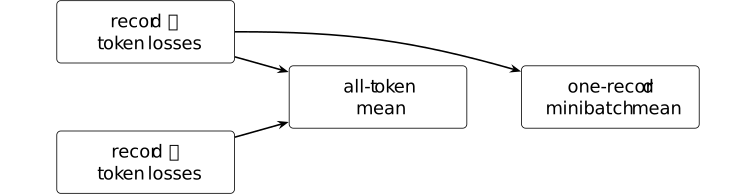
Let \(\ell _{ij}\) denote the token loss at position \(j\) of record \(i\). The full token-average loss is the mean of all \(\ell _{ij}\), while a one-record minibatch averages only the losses from its sampled record. Uniform sampling of equal-length records makes the latter unbiased for the former.
The preceding loss and estimator definitions apply to this equal-length record setup. Equal record lengths make the estimator unbiased here; unequal lengths, padding, dependence, and optimizer noise remain outside its scope.
Definition. Optimizer state [kingma2015adam, Algorithm 1] [ftip-001H]AGENTDRAFTED
Definition. Optimizer state [kingma2015adam, Algorithm 1] [ftip-001H]AGENTDRAFTED
An optimizer state \(s_k\) is the collection of persistent variables, other than the model parameters \(\theta _k\), that an update rule uses after step \(k\). For Adam, \(s_k\) contains the step index and exponential moving averages of the gradient and squared gradient.
The state is initialized by a declared value \(s_0\). Two runs with the same checkpoint \(\theta _k\) but different optimizer states need not have the same next update.
Definition. Parameter update [kingma2015adam, Algorithm 1] [ftip-001I]AGENTDRAFTED
Definition. Parameter update [kingma2015adam, Algorithm 1] [ftip-001I]AGENTDRAFTED
A parameter update rule is a specified map \(U_k\) that takes the current parameters \(\theta _k\), optimizer state \(s_k\), gradient estimate \(g_k\), and scheduled hyperparameters \(\eta _k\), and returns \[ (\theta _{k+1},s_{k+1}) =U_k(\theta _k,s_k,g_k,\eta _k). \] The learning rate, momentum coefficients, numerical stabilizers, clipping, and weight decay belong to \(\eta _k\) or to the declared form of \(U_k\); they are not determined by the loss alone.
Remark. Randomness, schedules, and stopping [ftip-001J]AGENTDRAFTED
Remark. Randomness, schedules, and stopping [ftip-001J]AGENTDRAFTED
A pretraining run is not determined by minimization of the empirical objective \(L_N\) in Definition [ftip-001E]. It includes the initialization, data order, window offsets, dropout and other model randomness, numerical precision, distributed reduction order, optimizer state, every hyperparameter schedule, and a stopping rule. These objects determine a distribution over final parameters even when the source mixture and nominal objective agree.
The training configuration of [vaswani2017attention, sec. 5.3] and the scaling experiments of [kaplan2020scaling, sec. 2.2] report concrete instances of these choices. An optimization result depends on which randomness it averages over and whether the stopping time is fixed or data-dependent.
Definition. Base-model artifact [ftip-001K]AGENTDRAFTED
Definition. Base-model artifact [ftip-001K]AGENTDRAFTED
A base-model artifact is an executable tuple \[ M_0=(\tau ,\delta ,\mathsf {cfg},\theta _K,\mathsf {num}), \] where \(\tau ,\delta \) are the tokenizer and detokenizer of Definition [ftip-000E]; \(\mathsf {cfg}\) fixes the architecture of Definition [ftip-0012]; \(\theta _K\) is the stopped pretraining checkpoint; and \(\mathsf {num}\) fixes the numerical and inference conventions required to evaluate its next-token law.
The tokenizer model is part of the executable system by Definition [ftip-000E]. A weight file without its vocabulary, architecture configuration, or output convention does not determine the law \(\pi _{\theta _K}\) in Definition [ftip-000H]. Training-data and optimizer provenance may accompany the artifact, but they are not runtime inputs.
Remark. The runtime ingredients of a model artifact [ftip-006M]AGENTDRAFTED
Remark. The runtime ingredients of a model artifact [ftip-006M]AGENTDRAFTED
Section 6 of [phuong2022formal] describes decoder architecture. Sections 3.1 and 3.5 of [kudo2018sentencepiece] treat the tokenizer as a separate model. Public model releases additionally distribute weights, configuration, and numerical conventions. The proposed artifact model in Definition [ftip-001K] includes these runtime ingredients because none alone determines an executable next-token law.
Training provenance accompanies the artifact but is not itself a runtime argument. Later causal claims must distinguish the executable endpoint from the process that produced it.
Example. Anatomy of a base-model artifact and V4 optimizer/data provenance [ftip-001L]AGENTDRAFTED
Example. Anatomy of a base-model artifact and V4 optimizer/data provenance [ftip-001L]AGENTDRAFTED
An executable-artifact manifest separates runtime components from evidence about how the corresponding weights were trained.
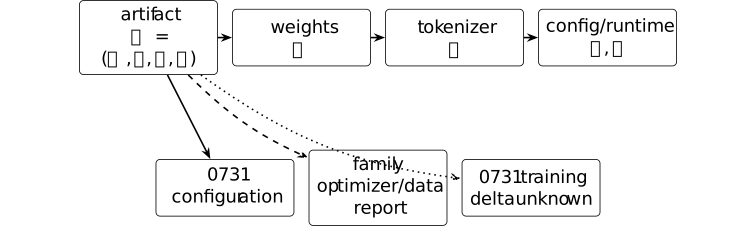
The pinned DeepSeek-V4-Flash-0731 configuration [⧉] declares architecture and numeric-format fields. Sections 2.4 and 4 of the V4 family report [⧉] describe a mixed Muon/AdamW optimizer allocation and pretraining data construction. The exact 0731 data mixture, optimizer schedule, and post-preview training delta remain undisclosed by those sources.
Tasks and evaluation interfaces [ftip-001M]AGENTDRAFTED
Tasks and evaluation interfaces [ftip-001M]AGENTDRAFTED
A model does not have a benchmark score without a task distribution, an inference procedure, and an evaluator. Keeping these objects separate is essential for post-training: a training change and an evaluation-time search change can raise the same reported score while answering different research questions.
Notation. Tasks, task laws, inference protocols, and utility [ftip-001N]AGENTDRAFTED
Notation. Tasks, task laws, inference protocols, and utility [ftip-001N]AGENTDRAFTED
Write \(\mathsf T\) for a task interface, \(\mathcal X_{\mathsf T}\) for its instance set, and \(\mathcal O_{\mathsf T}\) for its candidate-outcome set. A task instance is \(x\in \mathcal X_{\mathsf T}\) and a candidate outcome is \(o\in \mathcal O_{\mathsf T}\). The symbol \(\mu _{\mathsf T}\) denotes a probability law on instances. Equip the instance and outcome sets with declared sigma-algebras; \(\mu _{\mathsf T}\) is a probability measure on the instance sigma-algebra.
Fix an evaluation-resource dimension \(m_{\mathrm {eval}}\geq 1\) and write \(\mathcal B_{\mathrm {eval}}=\mathbb R_+^{m_{\mathrm {eval}}}\) with its coordinatewise order. An evaluation inference protocol is written \(\mathsf I\); its declared evaluation budget is \(b_{\mathrm {eval}}\in \mathcal B_{\mathrm {eval}}\). Its inference-seed set is \(\Omega _I\), with realized seed \(\xi \in \Omega _I\). An evaluator's random-seed set is \(\Omega _E\); its realized seed is \(\omega \in \Omega _E\). It returns utility \(u_{\mathsf T}(x,o;\omega )\in \mathbb R^d\). The dimension \(d\geq 1\) is declared by the evaluation: \(d=1\) gives scalar utility, while \(d>1\) retains several outcomes or costs without an implicit weighting. Equip both seed sets with declared sigma-algebras and \(\mathbb R^d\) with its Borel sigma-algebra. Products below carry the product sigma-algebra; finite or countable discrete spaces may use all subsets. A seed space alone does not specify its sampling law.
Definition. Task [ftip-001O]AGENTDRAFTED
Definition. Task [ftip-001O]AGENTDRAFTED
A task is a triple \[ \mathsf T=(\mathcal X_{\mathsf T},\mathcal O_{\mathsf T}, \operatorname {Adm}_{\mathsf T}), \] where \(\mathcal X_{\mathsf T}\) is an instance set, \(\mathcal O_{\mathsf T}\) is a candidate-outcome set, and \(\operatorname {Adm}_{\mathsf T}(x,o)\) is a declared well-formedness predicate for an instance-outcome pair.
Admissibility says that an outcome can be interpreted for the instance; it does not say that the outcome is correct, useful, or safe. Those judgments belong to the evaluation utility introduced later.
Definition. Task law [ftip-001Q]AGENTDRAFTED
Definition. Task law [ftip-001Q]AGENTDRAFTED
For the instance set in Definition [ftip-001O], a task law is a probability law \(\mu _{\mathsf T}\) on \(\mathcal X_{\mathsf T}\). An evaluation sample of size \(N\) is a declared joint law of instances \((X_1,\ldots ,X_N)\) whose marginals are \(\mu _{\mathsf T}\); independent sampling is a further assumption, not part of the term ``task law.''
In an episodic control problem this law includes the distribution of starting situations. In a fixed benchmark it may instead be the uniform law on a held-out finite set. Reweighting instances changes the task law even when the instance files are unchanged.
Remark. Response tasks and interactive tasks [ftip-001P]AGENTDRAFTED
Remark. Response tasks and interactive tasks [ftip-001P]AGENTDRAFTED
A task and a task law specify admissible instance--outcome pairs and how instances are sampled. Benchmark datasets usually present an input and expect an answer in a parseable format. Reinforcement-learning formulations instead name states, actions, and reward; see [sutton2018reinforcement, Chapter 3]. The admissibility predicate captures parseability, while the law records how instances are sampled. Neither choice already identifies parsing with success.
One-shot inference and an interactive environment can share the same task interface. Claims about an interaction's temporal structure additionally depend on the environment and the observations available at each decision.
Definition. Evaluation inference protocol [ftip-001R]AGENTDRAFTED
Definition. Evaluation inference protocol [ftip-001R]AGENTDRAFTED
Let \(M\) be an executable model artifact of the form in Definition [ftip-001K]. An evaluation inference protocol is a specified procedure \[ \mathsf I(M,x,b_{\mathrm {eval}};\xi )=(o,c) \in \mathcal O_{\mathsf T}\times \mathcal B_{\mathrm {eval}}, \] where \(x\in \mathcal X_{\mathsf T}\), \(b_{\mathrm {eval}}\in \mathcal B_{\mathrm {eval}}\), and \(\xi \in \Omega _I\) use the notation of Notation [ftip-001N]; \(o\) is a candidate outcome and \(c\in \mathcal B_{\mathrm {eval}}\) is the realized resource-use vector. A valid execution satisfies \(c\preceq b_{\mathrm {eval}}\) coordinatewise.
The protocol fixes prompt construction, decoding, sampling temperature, number of candidates, candidate selection, allowed tools, stopping, and any test-time search. None of these choices is determined by the checkpoint alone.
Remark. Decoding and test-time compute belong to evaluation [ftip-001S]AGENTDRAFTED
Remark. Decoding and test-time compute belong to evaluation [ftip-001S]AGENTDRAFTED
One next-token law supports many evaluation procedures. Greedy decoding, temperature sampling, majority voting, verifier-guided selection, and multi-round tool use can produce different outcome laws from the same checkpoint. The sampling and selection procedures in [shao2024deepseekmath, secs. 3--4] are concrete examples.
Accordingly, a comparison that changes \(b_{\mathrm {eval}}\) or \(\mathsf I\) does not estimate a training-only effect. A potential frontier therefore depends on evaluation-time compute as well as the trained model.
Definition. Evaluation utility [ftip-001T]AGENTDRAFTED
Definition. Evaluation utility [ftip-001T]AGENTDRAFTED
With the notation of Notation [ftip-001N], an evaluation utility is a declared measurable function \[ u_{\mathsf T}:\mathcal X_{\mathsf T}\times \mathcal O_{\mathsf T}\times \Omega _E\longrightarrow \mathbb R^d, \] where \(\Omega _E\) is the evaluator's measurable seed space. The evaluator applies it only to admissible pairs from Definition [ftip-001O]. A deterministic evaluator is the special case in which the value does not depend on \(\omega \in \Omega _E\).
Binary pass-fail evaluation takes \(d=1\) and values in \(\{0,1\}\). A cumulative return is another scalar case. Vector utility keeps qualities such as correctness, safety, latency, and tool cost distinct until a later rule declares how to compare them.
Whenever an expected utility vector is used, its composite evaluation random variable must be measurable and absolutely integrable in every coordinate under the declared joint law. Thus its expectation lies in \(\mathbb R^d\). Bounded measurable utility is a sufficient specialization; so is finite support for the complete evaluation random variable with finite values on that support. Merely taking a finite real value at each seed is insufficient for an unbounded evaluator. The scalar protocol comparison in Convention [ftip-005D] states its joint law explicitly.
Remark. Scalar returns and multiple evaluation quantities [ftip-006N]AGENTDRAFTED
Remark. Scalar returns and multiple evaluation quantities [ftip-006N]AGENTDRAFTED
Sutton and Barto define scalar episodic return in [sutton2018reinforcement, Section 3.3]. Benchmarks also use exact-match, test, latency, safety, and cost measurements. A proposed seeded vector utility keeps those coordinates separate, with evaluator randomness included in the declared law.
The vector is not a claim that its coordinates share a natural scale. Scalarization, Pareto order, and worst-group summaries are introduced only after the attainable evaluation set is defined.
Example. One policy under two evaluation inference budgets [ftip-001U]AGENTDRAFTED
Example. One policy under two evaluation inference budgets [ftip-001U]AGENTDRAFTED
One fixed policy can receive different measured success rates when the evaluation horizon changes.
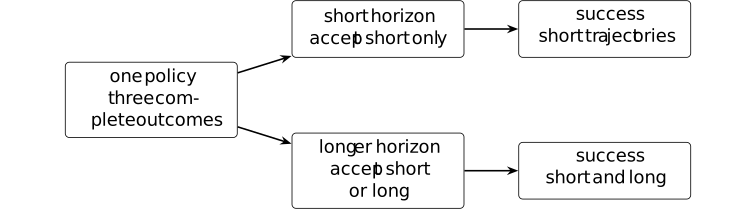
Partition complete trajectories into those that finish within the short horizon, those requiring additional tokens, and failures. The short protocol counts only the first class; the longer protocol may count the first two. Thus the measured score depends on the declared horizon even though the policy is unchanged.
Making an evaluation horizon explicit follows finite-horizon policy evaluation in [sutton2018reinforcement, Chapter 3]. Only truncation is varied here. Larger budgets need not help once decoding rules, tool costs, or selection errors are allowed to change with the budget.
Remark. Public task data and evaluator-only information [ftip-001V]AGENTDRAFTED
Remark. Public task data and evaluator-only information [ftip-001V]AGENTDRAFTED
The inference protocol receives only the information designated as public. The public instance \(x\) may include a prompt, tools, and a response schema. Evaluator-only information may include a reference answer, hidden tests, a simulator state, or the evaluator seed \(\omega \). The protocol in Definition [ftip-001R] receives the former and not the latter.
If evaluator-only information influences training, decoding, or candidate selection, the experiment no longer measures performance under the declared information interface. A theorem that assumes an independent evaluator must name the sigma-field or finite data record from which the protocol is excluded.
Interactive environments and policies [ftip-001W]AGENTDRAFTED
Interactive environments and policies [ftip-001W]AGENTDRAFTED
Some tasks end with one generated response. Agentic tasks instead alternate between an acting system and an environment: the system calls a tool, receives an observation, and chooses what to do next. The following objects make that temporal and informational structure explicit before any reinforcement-learning objective is introduced.
Notation. State, observation, action, time, history, and stopping [ftip-001X]AGENTDRAFTED
Notation. State, observation, action, time, history, and stopping [ftip-001X]AGENTDRAFTED
Let \(\mathcal S,\mathcal O,\mathcal A\) be declared measurable spaces of environment states, public observations, and agent actions. Time is discrete, \(t\in \{0,1,\ldots ,T_{\max }\}\), where \(T_{\max }<\infty \) is a hard horizon. Random states, observations, and actions are \(S_t,O_t,A_t\); lowercase \(s_t,o_t,a_t\) denote realized values. The same convention makes \(h_t\) a realization of \(H_t\) and \(z\) a realization of \(Z\).
The public history available before action \(A_t\) is \(H_t\); the full environment trajectory is \(Z\); and the stopping time is \(\tau _{\mathrm {stop}}\in \{0,1,\ldots ,T_{\max }\}\). Probability kernels are written \(K(dy\mid x)\); on finite spaces this means the probability law \(K(y\mid x)\) and reduces to the notation of Notation [ftip-000A].
Definition. Initial-state law [ftip-001Y]AGENTDRAFTED
Definition. Initial-state law [ftip-001Y]AGENTDRAFTED
With the spaces in Notation [ftip-001X], an initial-state law \(\rho _0(ds_0,do_0)\) is a probability law on \(\mathcal S\times \mathcal O\). It jointly samples the hidden initial state \(S_0\) and the first public observation \(O_0\).
Allowing a joint law covers both a deterministic rendering \(O_0=\operatorname {obs}(S_0)\) and a noisy initial observation. A fixed task instance can be included as a coordinate of \(O_0\); its sampling law is then the task law of Definition [ftip-001Q].
Definition. Transition-observation kernel [ftip-001Z]AGENTDRAFTED
Definition. Transition-observation kernel [ftip-001Z]AGENTDRAFTED
A transition-observation kernel at time \(t\) is a probability kernel \[ K_t(ds_{t+1},do_{t+1}\mid s_t,a_t) \] from the current hidden state and action to the next hidden state and public observation. After \(A_t=a_t\), the environment draws \((S_{t+1},O_{t+1})\) from this kernel.
The factorization \(K_t(ds',do'\mid s,a)=P_t(ds'\mid s,a)\,Q_t(do'\mid s',a)\) for declared kernels \(P_t\) and \(Q_t\) recovers the usual separate state-transition and observation kernels when such a factorization is declared. The joint-kernel form does not assume it.
Remark. Deterministic tools and stochastic environments [ftip-0020]AGENTDRAFTED
Remark. Deterministic tools and stochastic environments [ftip-0020]AGENTDRAFTED
The kernel in Definition [ftip-001Z] describes both tools and broader environments. A deterministic tool has a measurable update map \(F_t(s,a)=(s',o')\) and the point-mass kernel concentrated at \(F_t(s,a)\). A stochastic environment permits several next state-observation pairs for the same input.
This distinction matters for replay. Re-executing a deterministic tool call under an unchanged state reproduces its observation, whereas a stored rollout from a stochastic environment is one sample from a conditional law. Any analysis that replaces one with the other needs a coupling or concentration assumption.
Definition. Public history [ftip-0021]AGENTDRAFTED
Definition. Public history [ftip-0021]AGENTDRAFTED
At time \(t\), the public history is the alternating sequence \[ H_t=(O_0,A_0,O_1,A_1,\ldots ,A_{t-1},O_t). \] Thus \(H_0=(O_0)\). It contains exactly the observations received and actions taken before the next action \(A_t\); it does not contain the hidden state \(S_t\) unless that state was itself revealed as an observation.
Remark. The information boundary of a history [ftip-0022]AGENTDRAFTED
Remark. The information boundary of a history [ftip-0022]AGENTDRAFTED
The history in Definition [ftip-0021] contains the agent's available information. The hidden state sequence \((S_0,\ldots ,S_t)\), future observations, evaluator-only tests from Remark [ftip-001V], and future random seeds are absent unless the environment has already exposed them through \(O_0,\ldots ,O_t\).
This boundary determines which policies are implementable. It also separates legitimate memory from leakage: a summary of earlier public observations may be stored in the history, while a hidden reference answer may not be supplied under the same declaration.
Definition. Non-anticipating policy [ftip-0023]AGENTDRAFTED
Definition. Non-anticipating policy [ftip-0023]AGENTDRAFTED
A non-anticipating policy is a family of probability kernels \[ \pi _t(da\mid H_t), \qquad t=0,1,\ldots ,T_{\max }-1, \] from public histories in Definition [ftip-0021] to the action space \(\mathcal A\). At time \(t\), the action may depend on \(H_t\) and fresh policy randomness, but not on a later observation or an unobserved state.
A decoder-only language model becomes such a policy only after an inference protocol serializes \(H_t\) into tokens, decodes tokens, and parses them as an action. The next-token law in Definition [ftip-000H] alone does not specify those maps.
Definition. Stopping rule [ftip-0024]AGENTDRAFTED
Definition. Stopping rule [ftip-0024]AGENTDRAFTED
A stopping rule is a random time \(\tau _{\mathrm {stop}}\in \{0,1,\ldots ,T_{\max }\}\) such that, for each \(t\), the decision whether \(\tau _{\mathrm {stop}}=t\) is determined by the public history \(H_t\) and any declared stopping randomness available by time \(t\). It cannot inspect future observations.
Stopping can be triggered by a terminal environment observation, an agent action, a resource limit, or the hard horizon. The trigger and the owner of the decision are part of the rule.
Definition. Stopped trajectory [ftip-0025]AGENTDRAFTED
Definition. Stopped trajectory [ftip-0025]AGENTDRAFTED
If \(\tau _{\mathrm {stop}}=n\), the stopped trajectory is \[ Z=(S_0,O_0,A_0,S_1,O_1,A_1,\ldots , A_{n-1},S_n,O_n). \] It contains the environment states as well as the public action-observation record. Its public projection is the history \(H_n\) of Definition [ftip-0021].
For \(n=0\), the trajectory is \((S_0,O_0)\) and contains no action. A terminal utility may depend on the full trajectory when evaluated inside the environment, even though the policy is restricted to its public projection.
Definition. Interactive realization of a task [ftip-006T]AGENTDRAFTED
Definition. Interactive realization of a task [ftip-006T]AGENTDRAFTED
For a task \(\mathsf T=(\mathcal X_{\mathsf T},\mathcal O_{\mathsf T}, \operatorname {Adm}_{\mathsf T})\) from Definition [ftip-001O], an interactive realization is
\[ \mathsf {Env}_{\mathsf T} =\left (\mathcal S_{\mathsf T},\mathcal O^{\rm obs}_{\mathsf T}, \mathcal A_{\mathsf T},T_{\max }, (\rho _0^x)_x,(K_t^x)_{x,t},\operatorname {out}_{\mathsf T}\right ). \]For each \(x\in \mathcal X_{\mathsf T}\), the law \(\rho _0^x\) is on \(\mathcal S_{\mathsf T}\times \mathcal O^{\rm obs}_{\mathsf T}\), and \(K_t^x\) maps a state and action to the next state-observation law for \(0\leq t<T_{\max }\). The outcome map sends a stopped trajectory \(Z\) to \(\operatorname {out}_{\mathsf T}(x,Z)\in \mathcal O_{\mathsf T}\) and satisfies \(\operatorname {Adm}_{\mathsf T}(x,\operatorname {out}_{\mathsf T}(x,Z))\). For one fixed realization, write its three spaces as the unadorned \(\mathcal S,\mathcal O,\mathcal A\) of Notation [ftip-001X].
The agent policy and stopping rule are not environment fields. They are combined with this realization only when an interaction law is formed.
Remark. How a task acquires interactive semantics [ftip-006U]AGENTDRAFTED
Remark. How a task acquires interactive semantics [ftip-006U]AGENTDRAFTED
Section 3.1 of [sutton2018reinforcement] specifies the agent--environment interaction. Section 2 of [kaelbling1998planning] separates hidden state from observation. We combine those ingredients with the task interface of Definition [ftip-001O] so each task instance selects an initial law and transition kernels.
The outcome-extraction map is an additional interface choice; neither cited source supplies it in this task-indexed form. This map connects a stopped interaction to the candidate outcome that the independent evaluator will score.
Example. A finite agent--environment interaction loop [ftip-0026]AGENTDRAFTED
Example. A finite agent--environment interaction loop [ftip-0026]AGENTDRAFTED
A deterministic three-action episode records each observation before the next policy decision and ends with an explicit terminal observation.
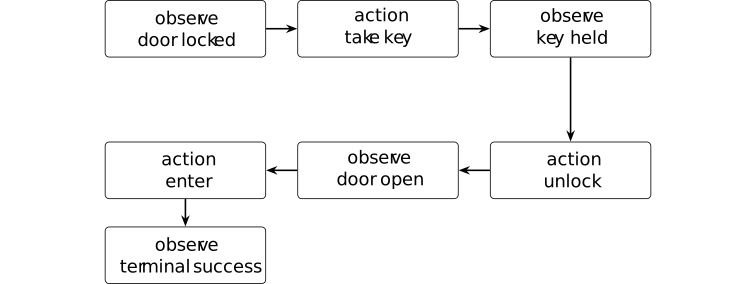
Let \(H_0=(\text {door locked})\). After action \(A_0=\text {take key}\), the environment returns \(O_1=\text {key held}\), so \(H_1=(H_0,A_0,O_1)\). Repeating the same update with unlock and door open, then choosing \(A_2=\text {enter}\), produces \(O_3=\text {terminal success}\) and \(H_3=(H_2,A_2,O_3)\). No later observation is available to an earlier action choice.
The alternating action--observation interface is the finite-history form of the agent setup in [kaelbling1998planning, Section 2]. The trace checks chronology and termination; uncertain state, partial observability, and language-valued actions lie beyond this deterministic instance.
Example. Token generation as a stopped environment interaction [ftip-0027]AGENTDRAFTED
Example. Token generation as a stopped environment interaction [ftip-0027]AGENTDRAFTED
A prefix tree represents token emission as a finite interaction stopped either by an end token or by a hard length cap.
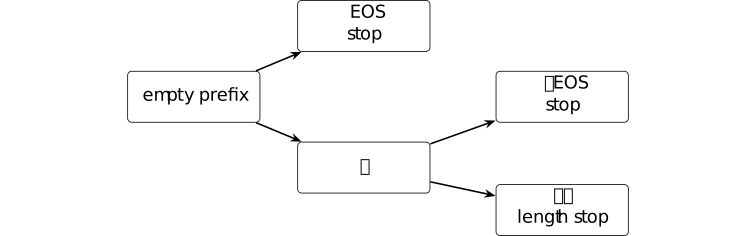
Take vocabulary \(\{a,\mathtt {EOS}\}\). The terminal histories are an immediate end token, an end token after \(a\), and a length-capped history \(aa\). Their probabilities are products of the conditional token laws and sum to one. The last history terminates because the declared maximum length is reached, not because the policy emitted \(\mathtt {EOS}\).
The causal token product is given in [phuong2022formal, Section 3]. The finite representation distinguishes two stopping mechanisms. Token steps remain distinct from tool calls, and unbounded generation is outside the construction.
Remark. The induced law of a stopped interaction [ftip-0028]AGENTDRAFTED
Remark. The induced law of a stopped interaction [ftip-0028]AGENTDRAFTED
Sutton and Barto's agent--environment interface in [sutton2018reinforcement, sec. 3.1] supplies alternating states, actions, and rewards. Kaelbling et al. separate hidden state and public observation in [kaelbling1998planning, Section 2]. A stopped interaction is determined by its initial law, transition--observation kernel, policy, and public stopping rule.
The induced interaction law uses four independently declared objects: the initial law \(\rho _0\) in Definition [ftip-001Y], the environment kernels \(K_t\) in Definition [ftip-001Z], the policy \(\pi _t\) in Definition [ftip-0023], and the stopping rule in Definition [ftip-0024]. On finite spaces, the probability of a length-\(n\) trajectory before applying its stopping indicator factors as \[ \rho _0(s_0,o_0) \prod _{t=0}^{n-1} \pi _t(a_t\mid h_t) K_t(s_{t+1},o_{t+1}\mid s_t,a_t). \] The event \(\{\tau _{\mathrm {stop}}=n\}\) selects the stopped trajectories.
This factorization supports later expectations, likelihood ratios, and off-policy reuse. It also exposes an identifiability limit: an outcome distribution by itself generally does not reveal which of the initial law, environment, policy, or stopping rule changed.
Post-training, alignment, and feedback [ftip-00JA]AGENTDRAFTED
Post-training, alignment, and feedback [ftip-00JA]AGENTDRAFTED
Post-training procedures differ in the information they receive and the updates they permit. Demonstrations, preferences, rewards, verifiers, and environment interactions impose different conditions on the resulting policy.
The chapter moves from demonstrations and preferences to reward-based updates, then to training through tool interaction and replay. The agent-state analysis complements these parameter-changing procedures by examining the contexts, memories and computation an agent retains around its models.
Fine-tuning [ftip-006P]AGENTDRAFTED
Fine-tuning [ftip-006P]AGENTDRAFTED
Fine-tuning continues parameter optimization from a pretrained artifact. The term names a relation between an initial checkpoint, training records, an objective, and an update process. It does not by itself specify instruction data, preference feedback, or reinforcement learning.
Definition. Fine-tuning run [ftip-006Q]AGENTDRAFTED
Definition. Fine-tuning run [ftip-006Q]AGENTDRAFTED
Given the base artifact \(M_0=(\tau ,\delta ,\mathsf {cfg},\theta _K,\mathsf {num})\) from Definition [ftip-001K], a fine-tuning run declares training records, a finite update count \(J\geq 0\), a loss \(L_{\rm ft}\), gradient estimators \(g_j^{\rm ft}\), optimizer states \(s_j^{\rm ft}\), and update specifications \((U_j,\eta _j^{\rm ft})\). It starts from \(\theta ^{\rm ft}_0=\theta _K\).
For each \(j=0,\ldots ,J-1\), the update is
\[ (\theta ^{\rm ft}_{j+1},s^{\rm ft}_{j+1}) =U_j\left (\theta ^{\rm ft}_j,s^{\rm ft}_j, g_j^{\rm ft},\eta _j^{\rm ft}\right ). \]Its output artifact replaces \(\theta _K\) by the final \(\theta ^{\rm ft}_J\). Any change to the tokenizer, architecture configuration, numerical convention, or other artifact field must be stated separately. Fine-tuning is not identified with one loss or data type.
Definition. Supervised fine-tuning in InstructGPT [ouyang2022training, Section 3.5 and Appendix C.1] [ftip-006H]AGENTDRAFTED
Definition. Supervised fine-tuning in InstructGPT [ouyang2022training, Section 3.5 and Appendix C.1] [ftip-006H]AGENTDRAFTED
In the cited pipeline, supervised fine-tuning (SFT) starts from a pretrained GPT-3 checkpoint and updates it by supervised learning on labeler demonstrations. The resulting policy supplies the starting and reference policy for later stages.
Appendix C.1 reports optimization choices for that construction. It does not define a universal mask, weighting rule, or fine-tuning protocol.
Remark. Fine-tuning objectives and supervised instances [ftip-006R]AGENTDRAFTED
Remark. Fine-tuning objectives and supervised instances [ftip-006R]AGENTDRAFTED
Wei et al. train on instruction-expressed task mixtures in [wei2022finetuned, Section 2 and Figure 2]. Ouyang et al. fine-tune on labeler demonstrations in [ouyang2022training, Section 3.5 and Appendix C.1]. The proposed continued-optimization interface in Definition [ftip-006Q] includes these concrete supervised instances.
Neither cited source defines fine-tuning as one universal objective. A concrete run must state its records, loss and normalization, optimizer, stopping rule, and trainable parameters. Instruction tuning later specializes the records to instruction--response demonstrations.
Instruction tuning [ftip-0029]AGENTDRAFTED
Instruction tuning [ftip-0029]AGENTDRAFTED
Instruction tuning uses demonstrations to connect the continuation law of a pretrained language model with requests written as instructions. The objects in this section separate the mathematical training record, its provenance, the reported collection procedure, and the loss used to update the model.
Notation. Prompts, responses, demonstrations, and loss masks [ftip-002A]AGENTDRAFTED
Notation. Prompts, responses, demonstrations, and loss masks [ftip-002A]AGENTDRAFTED
Let \(\mathcal X_{\mathrm {pr}}\) be the prompt space. For each prompt \(x\in \mathcal X_{\mathrm {pr}}\), let \(\mathcal Y(x)\subseteq \mathcal V^*\) be the set of finite token responses permitted by the training format. We write \(y=(y_1,\ldots ,y_{|y|})\in \mathcal Y(x)\) and \(y_{<t}=(y_1,\ldots ,y_{t-1})\).
A demonstration is denoted \(z=(x,y,\omega )\), where \(\omega \) is its provenance record. A finite multiset of demonstrations is denoted \(D_{\mathrm {sft}}\). For each response position, a loss mask \(m_t(z)\in \{0,1\}\) records whether the token contributes to the supervised objective, and a nonnegative weight \(w_t(z)\) records its declared normalization. Prompt tokens are conditioning context and lie outside the response-position domains of \(m_t(z)\) and \(w_t(z)\).
Definition. Prompt serializer [ftip-006V]AGENTDRAFTED
Definition. Prompt serializer [ftip-006V]AGENTDRAFTED
Using the prompt space of Notation [ftip-002A], a prompt serializer is a declared map \[ s_{\mathrm {pr}}:\mathcal X_{\mathrm {pr}}\longrightarrow \mathcal V^*. \] For token strings \(u,v\in \mathcal V^*\), write \(u\mathbin {\Vert }v\) for their concatenation. A response token \(y_t\) is therefore predicted from the token prefix \(s_{\mathrm {pr}}(x)\mathbin {\Vert }y_{<t}\).
The serializer fixes system text, role markers, separators, and any other prompt-side control tokens. Changing it changes the conditional examples seen by the language model even when the abstract prompts and responses are unchanged.
Remark. Why instruction data require serialization [ftip-006W]AGENTDRAFTED
Remark. Why instruction data require serialization [ftip-006W]AGENTDRAFTED
The next-token law in Definition [ftip-000H] accepts token prefixes, whereas an instruction dataset may store structured prompts. The proposed serializer in Definition [ftip-006V] maps between those types. Ouyang et al. describe SFT on labeler demonstrations in [ouyang2022training, Section 3.5 and Appendix C.1]; their training account supplies a concrete pipeline rather than a universal serializer.
A reproducible objective must retain the serializer revision with the tokenizer and loss mask. Otherwise two runs can share an abstract dataset name while optimizing different token sequences.
Definition. Instruction tuning [wei2022finetuned, Section 2 and Figure 2] [ftip-002B]AGENTDRAFTED
Definition. Instruction tuning [wei2022finetuned, Section 2 and Figure 2] [ftip-002B]AGENTDRAFTED
Instruction tuning fine-tunes a pretrained language model on a mixture of tasks whose examples are expressed through natural-language instructions and corresponding target outputs. The task description and any input are placed in the prompt; the target output supplies the continuation to be learned.
The construction changes the model parameters by supervised learning. It does not require a learned reward model, preference comparisons, or interaction with an environment.
Definition. Demonstration record [ftip-002C]AGENTDRAFTED
Definition. Demonstration record [ftip-002C]AGENTDRAFTED
Using the notation of Notation [ftip-002A], a demonstration record is a triple
\[ z=(x,y,\omega ), \qquad x\in \mathcal X_{\mathrm {pr}},\quad y\in \mathcal Y(x), \]where \(\omega \) identifies the declared producer of \(y\), the collection or generation procedure, and any selection rule applied before the record entered \(D_{\mathrm {sft}}\). The response is a training target; its presence in the data does not assert that it is uniquely correct or preferred to every alternative.
Remark. Demonstration and teacher provenance [ftip-002D]AGENTDRAFTED
Remark. Demonstration and teacher provenance [ftip-002D]AGENTDRAFTED
The provenance field \(\omega \) distinguishes a demonstration from the process that supplied it. Ouyang et al. collect labeler-written demonstrations in [ouyang2022training, §§3.2, 3.4]. Wei et al. permit a broader task mixture in [wei2022finetuned, §2; Fig. 2].
Human writers, stronger teacher models, filtered self-generations, and programmatically produced targets give different information to the learner. Claims about sample efficiency or capability acquisition must therefore state which producer and selection rule were available.
Definition. Labeler demonstration collection [ouyang2022training, Sections 3.2 and 3.4] [ftip-002E]AGENTDRAFTED
Definition. Labeler demonstration collection [ouyang2022training, Sections 3.2 and 3.4] [ftip-002E]AGENTDRAFTED
In the InstructGPT data-collection procedure, a labeler receives a prompt and writes a desired response. The resulting prompt--response pair enters the demonstration data used by the supervised fine-tuning stage. Prompts come from the declared API and labeler-written sources, and the paper records filtering and labeler-selection procedures.
This construction specifies a human demonstration channel. It is distinct from the later comparison channel, in which a labeler ranks model-generated responses rather than writing the target response.
Definition. Supervised fine-tuning objective [ftip-002F]AGENTDRAFTED
Definition. Supervised fine-tuning objective [ftip-002F]AGENTDRAFTED
For the language-model policy \(\pi _\theta \) and the notation of Notation [ftip-002A], a masked supervised fine-tuning (SFT) objective has the form
\[ L_{\mathrm {sft}}(\theta ) =-\sum _{z=(x,y,\omega )\in D_{\mathrm {sft}}} \sum _{t=1}^{|y|}w_t(z)m_t(z) \log \pi _\theta \left (y_t\mid s_{\mathrm {pr}}(x)\mathbin {\Vert }y_{<t}\right ), \]where the nonnegative weights satisfy \(\sum _{z\in D_{\mathrm {sft}}}\sum _{t=1}^{|y|}w_t(z)m_t(z)=1\). The response index \(t\) does not range over serialized prompt tokens. Minimizing this objective increases conditional likelihood on the selected target tokens. The weights and mask are local conventions and must be declared for each implementation.
Convention. Response-token normalization [ftip-002G]AGENTDRAFTED
Convention. Response-token normalization [ftip-002G]AGENTDRAFTED
For a finite demonstration multiset, define the number of selected response tokens by
\[ N_{\mathrm {resp}} =\sum _{z=(x,y,\omega )\in D_{\mathrm {sft}}} \sum _{t=1}^{|y|}m_t(z). \]When \(N_{\mathrm {resp}}>0\), response-token normalization sets \(w_t(z)=N_{\mathrm {resp}}^{-1}\) at every selected position. Each selected token then has equal weight in \(L_{\mathrm {sft}}\). Equal weighting of records or prompts is a different convention because response lengths vary.
The training account alone does not determine this normalization. Any comparison of losses or gradients must retain the mask and normalization that produced them.
Example. Response-only supervision on one instruction record [ftip-002H]AGENTDRAFTED
Example. Response-only supervision on one instruction record [ftip-002H]AGENTDRAFTED
Two instruction positions provide conditioning context but lie outside the response-loss index set. The loss is taken on the two generated tokens.

Declare \(\pi (r_1\mid u_1,u_2)=1/2\) and \(\pi (r_2\mid u_1,u_2,r_1)=1/4\). The instruction tokens are not indexed by the response mask. With mask one on each displayed response token, the sum and mean are \[ L_{\rm sum}=-\log \tfrac 12-\log \tfrac 14=\log 8, \qquad L_{\rm mean}=\tfrac 12\log 8\approx 1.040. \]
The supervised objective in Definition [ftip-002F] and the causal factorization in Definition [ftip-000I] specialize to the displayed token strip. Its mask is a local choice on response positions; other instruction-tuning implementations may supervise a different subset of response tokens or declare a larger loss domain explicitly.
Remark. What instruction tuning changes and leaves open [ftip-002I]AGENTDRAFTED
Remark. What instruction tuning changes and leaves open [ftip-002I]AGENTDRAFTED
Instruction tuning changes conditional likelihood under a declared demonstration distribution. It can teach response format, task interpretation, and behavior represented by the targets, but the training loss alone does not identify which of those effects caused an independent evaluation gain.
Ouyang et al. report supervised fine-tuning and its optimization settings in [ouyang2022training, Section 3.5 and Appendix C.1]. They do not define the exact mask and weighting convention displayed in Definition [ftip-002F]; those choices remain part of the declared objective.
The stage also leaves several questions open. A demonstration does not compare its target with alternatives, a teacher may transmit errors or hidden information, and low loss on the collected prompts need not imply transfer to a new task law. Preference acquisition introduces a different observation: which response a judge selected from a displayed pair.
Preference acquisition and reward modeling [ftip-002J]AGENTDRAFTED
Preference acquisition and reward modeling [ftip-002J]AGENTDRAFTED
Preference data records a judge's choice between displayed alternatives. Reward modeling adds a statistical representation of those choices. This section keeps the acquisition procedure, observation law, score model, and validation law separate so that a scalar predictor is not mistaken for the preferences it was fitted to represent.
Notation. Comparison queries, judges, and response pairs [ftip-002K]AGENTDRAFTED
Notation. Comparison queries, judges, and response pairs [ftip-002K]AGENTDRAFTED
Use the prompt and response spaces from Notation [ftip-002A]. A comparison query is a displayed triple \(c=(x,y^0,y^1)\) with \(y^0,y^1\in \mathcal Y(x)\). Let \(\mathcal J\) be the declared judge population, and let \(j\in \mathcal J\) identify the human, model, or rule that returns a comparison label \(b_{\mathrm {pref}}\in \{0,1\}\).
When \(b_{\mathrm {pref}}=1\), write \(y^+=y^1\) and \(y^-=y^0\); when \(b_{\mathrm {pref}}=0\), reverse those names. Thus \(y^+\) means selected in this observation, not objectively or uniquely best. The acquisition mechanism may also record a tie, abstention, or invalid comparison, but those outcomes must use an enlarged label space rather than being silently forced into \(\{0,1\}\).
Definition. Pairwise comparison observation [ftip-002L]AGENTDRAFTED
Definition. Pairwise comparison observation [ftip-002L]AGENTDRAFTED
Restrict attention to a comparison for which the judge selects one displayed alternative rather than reporting indifference or incomparability. For a query \(c=(x,y^0,y^1)\) and a judge \(j\), a pairwise comparison observation is the displayed pair together with the judge's selected alternative. In winner--loser notation it is recorded as
\[ o=(x,y^+,y^-,j). \]The observation reports a choice made under the declared presentation and query procedure. It does not by itself provide a numerical reward, a complete ranking of responses, or a judgment about alternatives that were not shown.
Definition. Preference query selection [christiano2017deep, Section 2.2.4] [ftip-002M]AGENTDRAFTED
Definition. Preference query selection [christiano2017deep, Section 2.2.4] [ftip-002M]AGENTDRAFTED
Preference learning may choose which trajectory segments or responses to show to a judge rather than sampling every pair uniformly. The query-selection procedure assigns candidate comparisons a priority derived from the current reward-model ensemble and requests labels for selected pairs.
Because selection depends on the current model and candidate pool, the resulting comparison data reflect an acquisition policy. Active selection can concentrate labels on uncertain pairs, but it does not make the collected comparisons representative of an undeclared target population.
Remark. Preference acquisition and judge provenance [ftip-002N]AGENTDRAFTED
Remark. Preference acquisition and judge provenance [ftip-002N]AGENTDRAFTED
A preference observation depends on the query presented and the judge who evaluates it. Concrete elicitation procedures include [christiano2017deep, Sections 2.2.2 and 2.2.4] and the language-model comparison pipeline of [ouyang2022training, Sections 3.2 and 3.4].
The response generator, pair-selection rule, presentation order, judge population, and aggregation rule can each change the observed law. A later sample-complexity or population claim must condition on those choices rather than treating comparison labels as an unqualified source of ground truth.
Definition. Preference data law [ftip-002O]AGENTDRAFTED
Definition. Preference data law [ftip-002O]AGENTDRAFTED
A preference data law \(\mathcal D_{\mathrm {pref}}\) is a probability law on pairwise comparison observations \(o=(x,y^+,y^-,j)\) from Definition [ftip-002L]. It includes the randomness of prompt selection, response generation, pair selection, judge selection, and the judge's reported label.
A finite training multiset \(D_{\mathrm {pref}}=(o_1,\ldots ,o_N)\) is sampled or adaptively collected under that law and its acquisition history. When queries are adaptive, the records need not be independent or identically distributed.
Definition. Scalar reward-model score [ouyang2022training, Section 3.5 and Appendix C.2] [ftip-002P]AGENTDRAFTED
Definition. Scalar reward-model score [ouyang2022training, Section 3.5 and Appendix C.2] [ftip-002P]AGENTDRAFTED
A scalar reward model is a parameterized function
\[ r_\phi :\{(x,y):x\in \mathcal X_{\mathrm {pr}},\ y\in \mathcal Y(x)\} \longrightarrow \mathbb R, \]whose score is fitted from comparison observations. The score orders or weights responses for a specified training procedure; it is not automatically the independent utility of the response. Ouyang et al. initialize the model from the supervised policy and replace its language-model head with a scalar output for this stage.
Definition. Bradley--Terry comparison law [bradley1952rank, Page 325, equation (1)] [ftip-002Q]AGENTDRAFTED
Definition. Bradley--Terry comparison law [bradley1952rank, Page 325, equation (1)] [ftip-002Q]AGENTDRAFTED
Given scalar scores for two alternatives, the Bradley--Terry comparison law assigns the probability
\[ \Pr _\phi (y^+\succ y^-\mid x) =\frac {\exp r_\phi (x,y^+)} {\exp r_\phi (x,y^+)+\exp r_\phi (x,y^-)} =\sigma \left (r_\phi (x,y^+)-r_\phi (x,y^-)\right ), \]where \(\sigma (a)=(1+\exp (-a))^{-1}\). Conditioning the scores on a language-model prompt is the contextual specialization used in modern reward modeling; see also [rafailov2023direct, Section 3, equation (1)].
Definition. Pairwise reward-model loss [ouyang2022training, Section 3.5, equation (1), and Appendix C.2] [ftip-002R]AGENTDRAFTED
Definition. Pairwise reward-model loss [ouyang2022training, Section 3.5, equation (1), and Appendix C.2] [ftip-002R]AGENTDRAFTED
For comparison observations sampled from \(\mathcal D_{\mathrm {pref}}\), the pairwise reward-model loss is
\[ L_{\mathrm {rm}}(\phi ) =\mathbb E_{(x,y^+,y^-,j)\sim \mathcal D_{\mathrm {pref}}} \left [-\log \sigma \left ( r_\phi (x,y^+)-r_\phi (x,y^-) \right )\right ]. \]The empirical objective replaces the expectation by a declared weighting of the collected comparisons. It fits score differences under the Bradley--Terry law of Definition [ftip-002Q]; it does not observe an absolute reward target for either response.
Remark. Representability, non-identifiability, and heterogeneous preferences [ftip-002S]AGENTDRAFTED
Remark. Representability, non-identifiability, and heterogeneous preferences [ftip-002S]AGENTDRAFTED
Fitting a Bradley--Terry predictor is an assumption about representation, not a consequence of observing comparisons. Cyclic choices, context effects, and mixtures of judges can fail to agree with one shared scalar ordering.
Even within the model, scores are not identified absolutely: replacing \(r_\phi (x,y)\) by \(r_\phi (x,y)+c(x)\) leaves every pairwise probability and the loss unchanged. Ouyang et al. give one normalization in [ouyang2022training, §3.5; App. C.2]. Other uses must state their own normalization, judge population, and validation law.
Example. A Bradley--Terry comparison calculation [ftip-002T]AGENTDRAFTED
Example. A Bradley--Terry comparison calculation [ftip-002T]AGENTDRAFTED
A declared difference between two reward scores maps to one Bradley--Terry preference probability.

Under the Bradley--Terry link, \[ \Pr (y^+\succ y^-\mid x) =\frac {\exp r(y^+)}{\exp r(y^+)+\exp r(y^-)} =\sigma (2-0.5) =\sigma (1.5)\approx 0.8176. \] Reversing the pair gives probability \(1-0.8176=0.1824\).
The fixed scores instantiate Definition [ftip-002Q] and determine the displayed probability. Whether one scalar reward can represent every judge is a separate modeling question.
Definition. Reward-model validation law [ftip-002U]AGENTDRAFTED
Definition. Reward-model validation law [ftip-002U]AGENTDRAFTED
A reward-model validation law \(\mathcal D_{\mathrm {rm}}^{\mathrm {val}}\) is a held-out law on comparison observations used to evaluate the fitted score model rather than to update \(\phi \). A declared validation statistic may be Bradley--Terry log loss or the probability that \(r_\phi (x,y^+)>r_\phi (x,y^-)\).
The validation population and acquisition procedure are part of the quantity. Accuracy on comparisons drawn from the same collection process does not establish calibration under a new judge population or agreement with an independent task-success criterion.
Remark. Reward-model validation depends on its population [ftip-006O]AGENTDRAFTED
Remark. Reward-model validation depends on its population [ftip-006O]AGENTDRAFTED
Ouyang et al. hold out comparison data and report reward-model validation accuracy and loss in [ouyang2022training, Section 3.5 and Appendix C.2]. Representing the validation population by a probability law makes the estimand depend explicitly on the judge population and acquisition procedure.
This law belongs to reward-model validation. It is not the independent task evaluation used later to compare post-training protocols.
Example. Cyclic preferences that no scalar ordering represents [ftip-002V]AGENTDRAFTED
Example. Cyclic preferences that no scalar ordering represents [ftip-002V]AGENTDRAFTED
Three strict comparisons arranged in a directed cycle obstruct representation by a single scalar ordering.
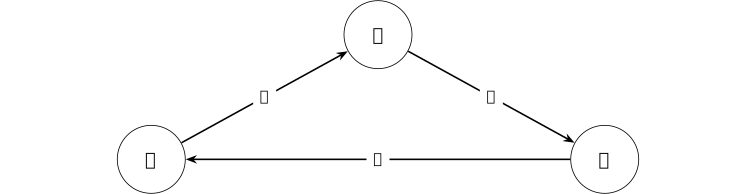
Declare \(A\succ B\), \(B\succ C\), and \(C\succ A\). If a scalar \(r\) represented all three comparisons by strict inequalities, then \[ r(A)>r(B)>r(C)>r(A), \] which implies \(r(A)>r(A)\), a contradiction. Thus no real-valued score can represent this cycle by ordinary greater-than.
Scalar pairwise reward modeling is used in [christiano2017deep, Section 2]; the finite cycle marks one assumption needed for that reduction. No empirical cycle is attributed to a particular dataset or population, and the obstruction concerns scalar orderings rather than all preference models.
Reinforcement-learning foundations [ftip-002W]AGENTDRAFTED
Reinforcement-learning foundations [ftip-002W]AGENTDRAFTED
Reinforcement learning updates a policy from rewards attached to sampled behavior. Before considering a particular alignment method, this section fixes the response-level episode, return, value, advantage, policy roles, and likelihood ratios used by policy-gradient objectives.
Notation. Reward, return, policy roles, value, advantage, and likelihood ratios [ftip-002X]AGENTDRAFTED
Notation. Reward, return, policy roles, value, advantage, and likelihood ratios [ftip-002X]AGENTDRAFTED
The ratio and policy-objective formulas in this section specialize the measurable policy interface of Definition [ftip-0023] to a declared finite or countable discrete action space. Thus \(\pi (a\mid h)\) denotes probability mass, not an unspecified density. Whenever \(\log \pi _\theta (A_t\mid H_t)\) is displayed, its sampled mass is assumed positive.
For decision times \(t=0,\ldots ,N-1\), write \(\mathsf H_t:=H_t\) for the public history defined in Definition [ftip-0021], \(A_t\) for its action, and \(R_{t+1}\in \mathbb R\) for the next reward. Let \(\gamma \in [0,1]\) be the discount factor and \(G_t\) the return from time \(t\).
Write \(\pi _b\) for the behavior policy that produced a stored action, \(\pi _\theta \) for the current trainable policy, and \(\pi _{\mathrm {ref}}\) for a fixed reference policy. Their value, action-value, and advantage functions are denoted \(V^\pi \), \(Q^\pi \), and \(A^\pi \); an estimated advantage is \(\widehat A_t\). The current-to-behavior likelihood ratio is denoted \(\rho _t(\theta )\).
In a response-level episode, \(\pi _\theta (y\mid x)\) abbreviates the completed-continuation probability \(P_\theta (y\mid s_{\mathrm {pr}}(x))\) of the response-task interface, using the declared prompt serializer; the same convention applies to \(\pi _b\) and \(\pi _{\mathrm {ref}}\). In an interactive episode these symbols instead denote the action laws on public histories defined in Definition [ftip-0023].
Definition. Response-level episode [ouyang2022training, Section 3.5] [ftip-002Y]AGENTDRAFTED
Definition. Response-level episode [ouyang2022training, Section 3.5] [ftip-002Y]AGENTDRAFTED
In the response-level specialization used for language-model RLHF, a prompt \(x\) is the initial context, a complete response \(y\sim \pi _\theta (\mathord \cdot \mid x)\) is the sampled action, and a scalar score supplies the terminal reward. The episode terminates after that response.
This contextual-bandit view is sufficient for sequence-level reward-model training. Token generation may still be exposed as multiple policy decisions when an optimizer assigns token-level likelihood ratios or advantages. A later agentic setting also permits environment observations and tool actions between model responses.
Definition. Scalar reward [sutton2018reinforcement, Section 3.2] [ftip-002Z]AGENTDRAFTED
Definition. Scalar reward [sutton2018reinforcement, Section 3.2] [ftip-002Z]AGENTDRAFTED
A scalar reward \(R_{t+1}\in \mathbb R\) is the numerical signal received after action \(A_t\) and before the next decision. Its probabilistic law may depend on the current history, action, and environment transition.
Reward specifies the training objective of the reinforcement-learning problem. It need not equal an independent evaluator's utility, and a terminal reward need not identify which earlier action caused the outcome.
Definition. Return [sutton2018reinforcement, Section 3.3] [ftip-0030]AGENTDRAFTED
Definition. Return [sutton2018reinforcement, Section 3.3] [ftip-0030]AGENTDRAFTED
For an episode ending at time \(N\), the return from decision time \(t\) is
\[ G_t=\sum _{k=t}^{N-1}\gamma ^{k-t}R_{k+1}. \]When all intermediate rewards vanish, every return is determined by the terminal reward, up to discounting. Return is a random variable under the policy and environment law; its expectation defines value.
Definition. Value function [sutton2018reinforcement, Section 3.5] [ftip-0031]AGENTDRAFTED
Definition. Value function [sutton2018reinforcement, Section 3.5] [ftip-0031]AGENTDRAFTED
For a policy \(\pi \), the value function and action-value function are
\[ V^\pi (h)=\mathbb E_\pi [G_t\mid \mathsf H_t=h], \qquad Q^\pi (h,a)=\mathbb E_\pi [G_t\mid \mathsf H_t=h,A_t=a], \]whenever the conditional expectations exist. Both quantities depend on the reward, transition law, horizon, discount, and the policy followed after the conditioned decision.
Definition. Advantage function [schulman2016gae, Section 2] [ftip-0032]AGENTDRAFTED
Definition. Advantage function [schulman2016gae, Section 2] [ftip-0032]AGENTDRAFTED
For a policy \(\pi \), its advantage function is
\[ A^\pi (h,a)=Q^\pi (h,a)-V^\pi (h). \]The advantage compares an action with the policy's average continuation value at the same information state. Policy-gradient implementations replace it by an estimator \(\widehat A_t\); the estimator and the mathematical advantage are not interchangeable without assumptions on bias and variance.
Remark. Baselines and estimated credit [schulman2016gae, Sections 2--3] [ftip-0033]AGENTDRAFTED
Remark. Baselines and estimated credit [schulman2016gae, Sections 2--3] [ftip-0033]AGENTDRAFTED
Subtracting a baseline that does not depend on the sampled action can reduce the variance of a policy-gradient estimator without changing its expected gradient under the source conditions. A learned value function, a group mean, and a leave-one-out mean are different baselines and have different finite-data dependencies.
An estimated advantage may use sampled returns, bootstrapped values, or a mixture of both. Its error enters the update even when the likelihood-ratio calculation is exact.
Definition. Behavior, current, and reference policies [schulman2017proximal, Sections 2--3] [ftip-0034]AGENTDRAFTED
Definition. Behavior, current, and reference policies [schulman2017proximal, Sections 2--3] [ftip-0034]AGENTDRAFTED
The behavior policy \(\pi _b\) is the policy that generated a sampled action. The current policy \(\pi _\theta \) is the policy whose parameters are being optimized. Proximal policy optimization (PPO) collects a batch under an old policy and then compares candidate current policies with that data.
A reference policy \(\pi _{\mathrm {ref}}\) is instead held fixed to define a regularizer or preference objective; see [rafailov2023direct, Section 3, equation (3)]. It need not equal the behavior policy that generated a later rollout.
Definition. Likelihood ratio [schulman2017proximal, Section 2, equation (3)] [ftip-0035]AGENTDRAFTED
Definition. Likelihood ratio [schulman2017proximal, Section 2, equation (3)] [ftip-0035]AGENTDRAFTED
For an action \(A_t\) sampled from \(\pi _b\) at information state \(\mathsf H_t\), the current-to-behavior likelihood ratio is
\[ \rho _t(\theta ) =\frac {\pi _\theta (A_t\mid \mathsf H_t)}{\pi _b(A_t\mid \mathsf H_t)}. \]The ratio is defined on sampled actions for which \(\pi _b(A_t\mid \mathsf H_t)>0\). A bounded or clipped sampled ratio does not by itself control policy probabilities at unvisited histories.
Convention. Empirical sample average [ftip-006Z]AGENTDRAFTED
Convention. Empirical sample average [ftip-006Z]AGENTDRAFTED
For a nonempty finite index set \(I\) and real values \((Z_i)_{i\in I}\in \mathbb R^I\), write \[ \widehat {\mathbb E}_{i\in I}[Z_i] =\frac 1{|I|}\sum _{i\in I}Z_i. \] When the subscript is only \(t\), the index set is the declared collection of sampled decision times in the current batch.
PPO uses empirical expectation notation for its sampled surrogates; see Section 2, equations (1)--(2) of [schulman2017proximal]. The batch and its weighting must still be declared; the hat does not assert unbiasedness.
Definition. Policy-gradient surrogate [schulman2017proximal, Section 2, equations (1)--(2)] [ftip-0036]AGENTDRAFTED
Definition. Policy-gradient surrogate [schulman2017proximal, Section 2, equations (1)--(2)] [ftip-0036]AGENTDRAFTED
For samples collected under the declared behavior law and estimated advantages \(\widehat A_t\), the empirical policy-gradient surrogate is the following sample average:
\[ L^{\mathrm {PG}}(\theta ) =\widehat {\mathbb E}_t \left [\log \pi _\theta (A_t\mid \mathsf H_t)\,\widehat A_t\right ]. \]Its gradient is the familiar score-function estimator. The sampled states, actions, and advantage estimator are held fixed while differentiating this surrogate; changing the data-collection law defines a different estimator.
Example. Return and advantage on a three-step episode [ftip-0037]AGENTDRAFTED
Example. Return and advantage on a three-step episode [ftip-0037]AGENTDRAFTED
On a three-step episode, a discounted return and a baseline-relative advantage can be computed separately.

Take discount \(\gamma =1/2\). The return attached to the first action is \[ G_0=r_1+\gamma r_2+\gamma ^2 r_3 =0+\tfrac 12+\tfrac 14\cdot 2=1. \] If the declared baseline is \(V(s_0)=0.4\), then the corresponding advantage estimate is \(\widehat A_0=G_0-V(s_0)=0.6\).
The calculation instantiates the return and advantage in Definition [ftip-0030] and Definition [ftip-0032]. It illustrates one baseline choice. Low variance and correct attribution of terminal reward to an internal decision require additional assumptions or evidence.
Remark. Delayed credit and estimator scope [ftip-0038]AGENTDRAFTED
Remark. Delayed credit and estimator scope [ftip-0038]AGENTDRAFTED
A terminal response score can be copied into returns for many token decisions, but that bookkeeping does not reveal which token caused the score.
Monte Carlo returns, learned values, generalized advantage estimation, and group-relative normalization make different bias, variance, and dependence choices. Any theorem about an update must name the estimator actually used, the behavior policy that supplied its samples, and the horizon over which its credit signal is propagated.
Alignment training [ftip-006S]AGENTDRAFTED
Alignment training [ftip-006S]AGENTDRAFTED
Alignment training describes a declared role for a parameter-changing procedure: it is intended to alter behavior relative to a stated criterion. The criterion and the evidence used during training must be named before the claim can be evaluated.
Definition. Alignment-training claim [ftip-006I]AGENTDRAFTED
Definition. Alignment-training claim [ftip-006I]AGENTDRAFTED
An alignment-training claim is a capability claim \((M_0,A,E_{\rm align},b)\) in the sense of Convention [ftip-0003]. The procedure \(A\) changes model parameters and declares its training observations, loss or reward, and update rule. The independently fixed criterion \(E_{\rm align}\) states the behavior relative to which the word ``alignment'' is used.
Calling a procedure alignment training does not assert that its criterion is complete or that optimizing its training signal improves an independent evaluation.
Remark. Alignment criteria across different training routes [ftip-006J]AGENTDRAFTED
Remark. Alignment criteria across different training routes [ftip-006J]AGENTDRAFTED
Ouyang et al. combine demonstrations, comparison-trained rewards, and PPO in [ouyang2022training, Sections 3.1--3.5]. Direct Preference Optimization replaces the learned-reward PPO stage with a preference loss in [rafailov2023direct, Section 4]. The broader alignment-training description is a proposed way to compare such routes; it does not identify their observations or objectives with one another.
The declared behavioral criterion is part of the claim, while the independent evaluation remains a separate object. Their agreement is an empirical or theoretical claim, not a consequence of the word alignment.
Reinforcement learning from human feedback and proximal policy optimization [ftip-0039]AGENTDRAFTED
Reinforcement learning from human feedback and proximal policy optimization [ftip-0039]AGENTDRAFTED
RLHF, short for reinforcement learning from human feedback, names a family of alignment-training pipelines. One influential pipeline fits a supervised policy, learns a reward model from comparisons, and then optimizes the policy against that reward while limiting movement from a reference policy. This section separates those pipeline choices from proximal policy optimization (PPO), the optimization method used in its final stage.
Definition. Language-model RLHF pipeline [ouyang2022training, Section 3.1, Figure 2, and Section 3.5] [ftip-003A]AGENTDRAFTED
Definition. Language-model RLHF pipeline [ouyang2022training, Section 3.1, Figure 2, and Section 3.5] [ftip-003A]AGENTDRAFTED
The InstructGPT pipeline first performs supervised fine-tuning on labeler demonstrations. It then samples response pairs, collects labeler rankings, and fits a scalar reward model. Finally, it samples responses from the trainable policy and applies PPO using the reward-model score together with a penalty relative to the supervised policy.
The three stages consume different records and optimize different losses. Calling their composition RLHF does not make supervised targets, pairwise preferences, learned rewards, and policy-gradient samples the same kind of feedback.
Remark. Reward modeling, alignment criteria, and policy optimization [ftip-003B]AGENTDRAFTED
Remark. Reward modeling, alignment criteria, and policy optimization [ftip-003B]AGENTDRAFTED
The RLHF pipeline makes three logically separate choices. The comparison data specify which judgments were observed; the reward model specifies how those observations are represented and generalized; the policy optimizer specifies how sampled actions change the model.
An alignment criterion lies outside this chain unless it is identified with the training reward by assumption. A reward model can predict its held-out comparisons while failing under policy-induced distribution shift, and PPO can increase the learned reward while independent utility stays fixed or falls.
Definition. Kullback--Leibler divergence [ftip-006X]AGENTDRAFTED
Definition. Kullback--Leibler divergence [ftip-006X]AGENTDRAFTED
For probability mass functions \(p\) and \(q\) on a finite or countable set \(\mathcal Y\), the Kullback--Leibler divergence of \(p\) relative to \(q\) is \[ D_{\mathrm {KL}}(p\Vert q) =\sum _{y\in \mathcal Y}p(y)\log \frac {p(y)}{q(y)}. \] We use \(0\log (0/q)=0\). If \(p(y)>0\) and \(q(y)=0\) for some \(y\), the value is \(+\infty \). On a countable set, the negative part of the displayed series is finite; a divergent positive part gives the value \(+\infty \). Since \(\mathcal V^*\) is countable, the definition applies to the response laws of Notation [ftip-002A].
The order of the arguments matters. In particular, finiteness of the displayed forward divergence requires \(p\) to be absolutely continuous with respect to \(q\).
Remark. How the divergence enters alignment objectives [ftip-006Y]AGENTDRAFTED
Remark. How the divergence enters alignment objectives [ftip-006Y]AGENTDRAFTED
The KL-regularized reward objective appears as equation (3) in Section 3 of [rafailov2023direct]. Behavior-policy ratios, clipped ratios, and KL penalties enter alignment objectives for different purposes.
A coefficient multiplying \(D_{\mathrm {KL}}\) declares an optimization tradeoff. It is neither a guarantee that every sampled ratio is small nor an independent evaluation of the resulting policy.
Definition. KL-constrained RLHF objective [rafailov2023direct, Section 3, equation (3)] [ftip-003C]AGENTDRAFTED
Definition. KL-constrained RLHF objective [rafailov2023direct, Section 3, equation (3)] [ftip-003C]AGENTDRAFTED
Let \(\mu \) be a prompt law, \(r(x,y)\) a scalar reward, and \(\pi _{\mathrm {ref}}\) a fixed reference policy. For \(\beta >0\), the KL-regularized RLHF objective, using forward KL, is
\[ \max _{\pi } \mathbb E_{x\sim \mu ,\,y\sim \pi (\cdot \mid x)}[r(x,y)] -\beta \, \mathbb E_{x\sim \mu } \left [D_{\mathrm {KL}}\left ( \pi (\cdot \mid x)\Vert \pi _{\mathrm {ref}}(\cdot \mid x) \right )\right ]. \]The prompt law, reward, reference policy, and coefficient are part of the objective. The forward KL requires the optimized policy to be absolutely continuous with respect to the reference wherever the objective is finite.
Definition. KL-shaped PPO reward [ouyang2022training, Section 3.5, equation (2)] [ftip-003D]AGENTDRAFTED
Definition. KL-shaped PPO reward [ouyang2022training, Section 3.5, equation (2)] [ftip-003D]AGENTDRAFTED
For a prompt \(x\), sampled response \(y\), learned reward score \(r_\phi (x,y)\), and fixed reference policy \(\pi _{\mathrm {ref}}\), the sequence-level KL-shaped reward is
\[ R_{\mathrm {shape}}(x,y;\theta ) =r_\phi (x,y) -\beta \log \frac {\pi _\theta (y\mid x)} {\pi _{\mathrm {ref}}(y\mid x)}. \]Autoregressive factorization writes the logarithmic term as a sum of token-level log ratios. Ouyang et al. also mix a pretraining-gradient term into their reported PPO objective; that auxiliary term is separate from the shaped reward displayed here.
Definition. Generalized advantage estimator [schulman2016gae, Section 3, equations (10) and (16)] [ftip-003E]AGENTDRAFTED
Definition. Generalized advantage estimator [schulman2016gae, Section 3, equations (10) and (16)] [ftip-003E]AGENTDRAFTED
Given an approximate value function \(V\), with \(V(\mathsf H_N)=0\) at a terminal information state, define the temporal-difference residual
\[ \delta _t^V=R_{t+1}+\gamma V(\mathsf H_{t+1})-V(\mathsf H_t). \]For \(\lambda \in [0,1]\), the finite-episode generalized advantage estimator is
\[ \widehat A_t^{\mathrm {GAE}(\gamma ,\lambda )} =\sum _{l=0}^{N-t-1}(\gamma \lambda )^l\delta _{t+l}^V. \]The parameters \(\gamma \) and \(\lambda \) trade temporal reach against the variance and approximation error induced by bootstrapping. The estimator also depends on the fitted value function.
Definition. PPO clipped surrogate [schulman2017proximal, Section 3, equation (7)] [ftip-003F]AGENTDRAFTED
Definition. PPO clipped surrogate [schulman2017proximal, Section 3, equation (7)] [ftip-003F]AGENTDRAFTED
For a clipping parameter \(\epsilon _{\mathrm {clip}}\in (0,1)\), define \(\operatorname {clip}_{\epsilon _{\mathrm {clip}}}(u) =\min (1+\epsilon _{\mathrm {clip}},\max (1-\epsilon _{\mathrm {clip}},u))\). The PPO clipped surrogate is
\[ L^{\mathrm {CLIP}}(\theta ) =\widehat {\mathbb E}_t\left [ \min \left ( \rho _t(\theta )\widehat A_t, \operatorname {clip}_{\epsilon _{\mathrm {clip}}}(\rho _t(\theta )) \widehat A_t \right )\right ]. \]Clipping changes the sampled surrogate when the ratio moves outside the declared interval in a direction favored by the estimated advantage. It is not a hard bound on the KL divergence of the complete updated policy.
Definition. PPO value-and-entropy objective [schulman2017proximal, Section 5, equation (9)] [ftip-003G]AGENTDRAFTED
Definition. PPO value-and-entropy objective [schulman2017proximal, Section 5, equation (9)] [ftip-003G]AGENTDRAFTED
PPO implementations may optimize the combined sampled objective
\[ \widehat {\mathbb E}_t\left [ L_t^{\mathrm {CLIP}}(\theta ) -c_1\bigl (V_\theta (\mathsf H_t)-\widehat G_t\bigr )^2 +c_2\,\mathcal H\left (\pi _\theta (\cdot \mid \mathsf H_t)\right ) \right ], \]Here \(L_t^{\mathrm {CLIP}}\) is the per-sample integrand of the clipped surrogate in Definition [ftip-003F], \(c_1,c_2\geq 0\), \(\widehat G_t\) is the declared value target, and, on the declared finite or countable discrete action set,
\[ \mathcal H(p)=-\sum _a p(a)\log p(a). \]The combined objective is used only when this nonnegative countable sum is finite, with \(0\log 0=0\). For a continuous action law, an implementation must instead declare a reference measure and the corresponding density-based entropy convention.
The value loss and entropy bonus change the shared-parameter update in addition to the clipped policy term. Their coefficients, target construction, and action space are part of the optimization method.
Definition. PPO rollout and minibatch update [schulman2017proximal, Section 5] [ftip-003H]AGENTDRAFTED
Definition. PPO rollout and minibatch update [schulman2017proximal, Section 5] [ftip-003H]AGENTDRAFTED
A PPO iteration collects a batch of trajectories under the behavior policy, computes returns or advantage estimates, and then performs several epochs of minibatch optimization on the same collected batch. The updated policy becomes the behavior policy for a later collection round.
The number of trajectories, epochs, minibatches, and optimizer steps governs how often one batch is reused. The clipped objective does not determine those protocol choices by itself.
Example. The PPO clipping cases for positive and negative advantage [ftip-003I]AGENTDRAFTED
Example. The PPO clipping cases for positive and negative advantage [ftip-003I]AGENTDRAFTED
Positive and negative advantages select different branches of the PPO clipped minimum.
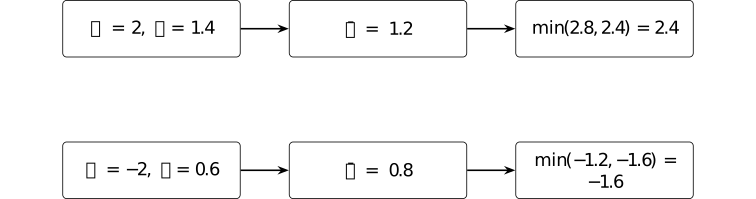
With \(\epsilon =0.2\), write \(\bar r=\operatorname {clip}(r,0.8,1.2)\) and \(L(r,A)=\min (rA,\bar rA)\). For positive advantage and \(r=1.4\), the gain is capped at \(2.4\). For negative advantage and \(r=0.6\), the clipped term \(-1.6\) is smaller than \(-1.2\), so the objective retains the penalty.
The pointwise surrogate comes from [schulman2017proximal, Section 3]. The two sign cases check only its arithmetic; they provide no monotone-improvement result for a neural policy or finite minibatch.
Example. The InstructGPT-style RLHF pipeline [ftip-003J]AGENTDRAFTED
Example. The InstructGPT-style RLHF pipeline [ftip-003J]AGENTDRAFTED
One prompt passes successively through supervised tuning, comparison-based reward modeling, and PPO in the InstructGPT-style RLHF pipeline.
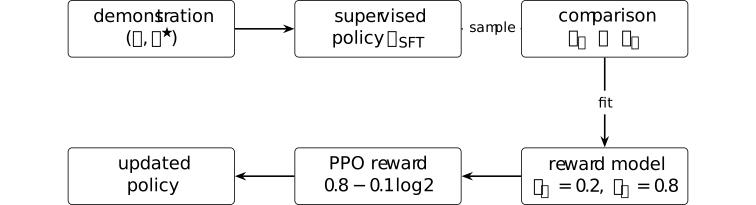
For the displayed illustrative prompt, suppose the comparison-trained reward model scores the preferred response by \(0.8\). If the candidate policy assigns it twice the probability assigned by the reference policy and the declared KL coefficient is \(\beta =0.1\), its shaped scalar is \[ 0.8-\beta \log \frac {\pi (y_B\mid x)} {\pi _{\rm ref}(y_B\mid x)} =0.8-0.1\log 2\approx 0.731. \]
The stage ordering is grounded in [ouyang2022training, Sections 3.1--3.5]; the numbers are a schematic calculation rather than reported InstructGPT hyperparameters. The diagram records the interface used in that pipeline. Other RLHF systems may order or replace the stages differently.
Remark. PPO is an optimizer, not an alignment definition [ftip-003K]AGENTDRAFTED
Remark. PPO is an optimizer, not an alignment definition [ftip-003K]AGENTDRAFTED
RLHF is a feedback-and-training pipeline; PPO is one optimizer used within that pipeline. PPO specifies a sampled update surrogate; it does not specify whose preferences are collected, what the reward means, or which independent behavior counts as aligned.
Changing the comparison population or reward model can change the alignment target while leaving PPO unchanged. Conversely, replacing PPO by another optimizer changes update geometry without necessarily changing the declared preference data or evaluation criterion.
Direct Preference Optimization [ftip-003L]AGENTDRAFTED
Direct Preference Optimization [ftip-003L]AGENTDRAFTED
Direct Preference Optimization rewrites a KL-regularized reward objective as a policy loss on preference pairs. The derivation proceeds through an optimal-policy identity, a reward--policy reparameterization, and a Bradley--Terry comparison probability. Keeping those steps separate makes its assumptions and its difference from reward-model PPO visible.
Notation. Temperature and reference-policy log ratios [ftip-003M]AGENTDRAFTED
Notation. Temperature and reference-policy log ratios [ftip-003M]AGENTDRAFTED
Let \(\beta >0\) be the KL coefficient, \(\pi _{\mathrm {ref}}\) a fixed reference policy, and \(\pi _\theta \) a trainable policy with support contained in that of the reference on the responses under study. Define the reference-relative log likelihood
\[ \ell _\theta (x,y) =\log \frac {\pi _\theta (y\mid x)}{\pi _{\mathrm {ref}}(y\mid x)} \]and, for a comparison observation, the paired difference
\[ \Delta _\theta (x,y^+,y^-) =\ell _\theta (x,y^+)-\ell _\theta (x,y^-). \]
Definition. Direct preference training stage [rafailov2023direct, Section 4] [ftip-003N]AGENTDRAFTED
Definition. Direct preference training stage [rafailov2023direct, Section 4] [ftip-003N]AGENTDRAFTED
Direct preference training starts from a fixed reference policy and a dataset of preferred and dispreferred responses. It evaluates a binary cross-entropy loss formed from the trainable policy's reference-relative log likelihoods and updates the policy directly.
This stage does not separately fit a scalar reward network, sample online rollouts for PPO, or train a value function. Its loss nevertheless comes from a particular reward-model and KL-regularized optimization derivation.
Definition. Optimal KL-regularized policy [rafailov2023direct, Section 4, equation (4)] [ftip-003O]AGENTDRAFTED
Definition. Optimal KL-regularized policy [rafailov2023direct, Section 4, equation (4)] [ftip-003O]AGENTDRAFTED
For a reward \(r(x,y)\), reference policy \(\pi _{\mathrm {ref}}\), and \(\beta >0\), the optimizer of the per-prompt KL-regularized reward objective has the form
\[ \pi _r(y\mid x) =\frac {1}{Z_r(x)}\, \pi _{\mathrm {ref}}(y\mid x) \exp \left (\frac {r(x,y)}{\beta }\right ), \]where
\[ Z_r(x)=\sum _y\pi _{\mathrm {ref}}(y\mid x) \exp \left (\frac {r(x,y)}{\beta }\right ) \]normalizes the policy on the response space. The identity assumes that the normalizer is finite and uses the same reference policy as the underlying objective.
Definition. Reward--policy reparameterization [rafailov2023direct, Section 4, equation (5)] [ftip-003P]AGENTDRAFTED
Definition. Reward--policy reparameterization [rafailov2023direct, Section 4, equation (5)] [ftip-003P]AGENTDRAFTED
Rearranging the optimal-policy identity of Definition [ftip-003O] gives
\[ r(x,y) =\beta \log \frac {\pi _r(y\mid x)}{\pi _{\mathrm {ref}}(y\mid x)} +\beta \log Z_r(x). \]The final term depends on the prompt but not on the response. It cancels from pairwise reward differences, matching the additive non-identifiability of Bradley--Terry scores described in Remark [ftip-002S].
Definition. Policy-ratio preference probability [rafailov2023direct, Section 4, equation (6)] [ftip-003Q]AGENTDRAFTED
Definition. Policy-ratio preference probability [rafailov2023direct, Section 4, equation (6)] [ftip-003Q]AGENTDRAFTED
Substituting the reward--policy reparameterization into the Bradley--Terry law yields
\[ \Pr _\theta (y^+\succ y^-\mid x) =\sigma \left (\beta \, \Delta _\theta (x,y^+,y^-) \right ), \]where \(\Delta _\theta \) is defined in Notation [ftip-003M]. The prompt-dependent normalizer cancels because the two responses share the same prompt.
Definition. Direct Preference Optimization loss [rafailov2023direct, Section 4, equation (7)] [ftip-003R]AGENTDRAFTED
Definition. Direct Preference Optimization loss [rafailov2023direct, Section 4, equation (7)] [ftip-003R]AGENTDRAFTED
For comparison observations from \(\mathcal D_{\mathrm {pref}}\), the Direct Preference Optimization loss is
\[ L_{\mathrm {DPO}}(\theta ) =-\mathbb E_{(x,y^+,y^-,j)\sim \mathcal D_{\mathrm {pref}}} \left [ \log \sigma \left (\beta \, \Delta _\theta (x,y^+,y^-) \right ) \right ]. \]The empirical loss is evaluated on a fixed comparison dataset. The temperature, reference policy, record weights, and handling of ties or abstentions are part of the training specification.
Example. A Direct Preference Optimization log-ratio calculation [ftip-003S]AGENTDRAFTED
Example. A Direct Preference Optimization log-ratio calculation [ftip-003S]AGENTDRAFTED
Four declared policy probabilities determine the log-ratio margin in one DPO loss term.

Let \(\pi _\theta (y^+\mid x)=0.6\), \(\pi _{\rm ref}(y^+\mid x)=0.3\), \(\pi _\theta (y^-\mid x)=0.2\), and \(\pi _{\rm ref}(y^-\mid x)=0.4\). With \(\beta =1/2\), the DPO logit is \[ z=\beta \left [\log 2-\log (1/2)\right ] =\tfrac 12\log 4=\log 2. \] Hence \(\sigma (z)=2/3\) and the one-pair negative log-likelihood is \(-\log \sigma (z)=\log (3/2)\approx 0.405\).
Substitution into Equation (7) of [rafailov2023direct, Section 4] verifies one loss term. Consistency of the pairwise data, suitability of the reference policy, and improvement in independent utility are separate questions.
Remark. Assumptions behind the DPO derivation [rafailov2023direct, Section 4 and Appendix A.1--A.2] [ftip-003T]AGENTDRAFTED
Remark. Assumptions behind the DPO derivation [rafailov2023direct, Section 4 and Appendix A.1--A.2] [ftip-003T]AGENTDRAFTED
The derivation uses a fixed reference policy, a finite KL-regularized optimum, and a Bradley--Terry model for pairwise preferences. The relevant policy probabilities must be positive wherever their logarithmic ratios are evaluated.
The algebra eliminates the prompt-dependent reward offset, not every source of reward-model misspecification. Heterogeneous or nontransitive preferences, adaptive data collection, support mismatch, and finite-sample optimization remain separate questions.
Remark. How DPO differs from reward-model PPO [rafailov2023direct, Sections 3--4] [ftip-003U]AGENTDRAFTED
Remark. How DPO differs from reward-model PPO [rafailov2023direct, Sections 3--4] [ftip-003U]AGENTDRAFTED
DPO optimizes a policy directly on a fixed preference dataset. Reward-model PPO instead fits an explicit scalar reward predictor, generates policy rollouts, estimates advantages, and applies a policy-gradient update. DPO therefore removes the separately represented reward and online PPO loop from that training stage.
The methods still share ingredients: comparison data, a reference policy, a KL coefficient or temperature, and assumptions connecting comparisons with latent reward. Neither method defines preference optimization in general, and their data and compute requirements are not causally interchangeable.
Outcome and process feedback [ftip-003V]AGENTDRAFTED
Outcome and process feedback [ftip-003V]AGENTDRAFTED
A completed response can receive one terminal judgment, while its intermediate steps can receive separate judgments. These feedback structures support different credit assignments. They must also be distinguished from signals that are actually available online before later steps are observed.
Definition. Outcome-supervised reward model [lightman2023verify, Section 2.5, ``Outcome-supervised reward models''] [ftip-003W]AGENTDRAFTED
Definition. Outcome-supervised reward model [lightman2023verify, Section 2.5, ``Outcome-supervised reward models''] [ftip-003W]AGENTDRAFTED
An outcome-supervised reward model assigns a score to a complete response and is trained from labels attached to the final outcome. For a prompt \(x\) and completed response \(y\), write its score as
\[ r_{\mathrm {out},\phi }(x,y)\in \mathbb R. \]The training label states whether the completed solution reaches the declared outcome. It need not identify the first invalid step or distinguish a sound derivation from an answer reached for an unsound reason.
Definition. Process-supervised reward model [lightman2023verify, Section 2.6, ``Process-supervised reward models''] [ftip-003X]AGENTDRAFTED
Definition. Process-supervised reward model [lightman2023verify, Section 2.6, ``Process-supervised reward models''] [ftip-003X]AGENTDRAFTED
Suppose a response is segmented into reasoning steps \(y=(s_1,\ldots ,s_m)\). A process-supervised reward model produces a score for each declared prefix,
\[ r_{\mathrm {proc},\phi }(x,s_{\leq k})\in \mathbb R, \qquad 1\leq k\leq m, \]and is fitted from step-level labels. The segmentation rule and label semantics are part of the supervision: a score after step \(k\) need not be a decomposition of an outcome score for the whole response.
Remark. Terminal and intermediate supervision [lightman2023verify, Sections 2.5--2.6] [ftip-003Y]AGENTDRAFTED
Remark. Terminal and intermediate supervision [lightman2023verify, Sections 2.5--2.6] [ftip-003Y]AGENTDRAFTED
Outcome supervision uses one completed-response label, whereas process supervision supplies labels at declared intermediate steps. The latter can localize feedback, but it also requires a segmentation, a step-labeling criterion, and additional annotations.
Neither label type is automatically causal credit. A process label may be assigned after a reviewer has seen the whole response, and a terminal outcome may be predicted reliably from an early prefix without identifying which action should change.
Definition. Online measurable feedback [ftip-003Z]AGENTDRAFTED
Definition. Online measurable feedback [ftip-003Z]AGENTDRAFTED
Let \(\mathcal F_t\) be the sigma-algebra generated by the public history \(\mathsf H_t\) available through decision time \(t\). A feedback variable \(Z_t\) is online measurable at time \(t\) when it is \(\mathcal F_t\)-measurable and is delivered before the protocol chooses its next action.
A label computed only after observing a later action or terminal outcome is not online measurable at the earlier time, even if it is subsequently attached to that earlier prefix in the training data.
Remark. Label timing and non-anticipating feedback [ftip-0040]AGENTDRAFTED
Remark. Label timing and non-anticipating feedback [ftip-0040]AGENTDRAFTED
The index attached to a label does not determine when its information becomes available. The process-supervision construction in [lightman2023verify, Section 2.6] supplies step-indexed training labels, but it does not require every such label to be available while the response is being generated.
This distinction determines which interventions are admissible. An online agent may act on currently measurable feedback; an offline learner may use a post-hoc label for a past prefix; a causal claim needs assumptions connecting either signal to the consequences of the earlier action.
Example. Terminal and process labels on the same four-step trace [ftip-0041]AGENTDRAFTED
Example. Terminal and process labels on the same four-step trace [ftip-0041]AGENTDRAFTED
A four-step arithmetic trace can receive a correct terminal label while retaining an incorrect intermediate process label.

The final answer \(19\) is correct, so outcome supervision supplies \(f_{\rm out}=1\). The declared process labels are \((f_1,f_2,f_3,f_4)=(1,1,0,1)\) and expose the corrected arithmetic error at step three. The labels are attached to the displayed prefixes, which remain unchanged by those annotations.
The two supervision regimes follow the outcome- and process-supervised reward-model constructions in [lightman2023verify, the outcome- and process-supervised reward-model subsections]. The two observations are thereby separated. Noise-free labels and a general policy advantage for process supervision are not consequences of the finite trace.
Reinforcement learning with verifiable rewards [ftip-0042]AGENTDRAFTED
Reinforcement learning with verifiable rewards [ftip-0042]AGENTDRAFTED
Reinforcement learning with verifiable rewards replaces or supplements a learned judge with a declared check of the generated result. Contemporary methods differ in their verifier, sampling law, advantage estimator, clipping, normalization, and treatment of length. This section defines those choices separately before they are assembled into a training protocol.
Notation. Verifiers, evidence, rollout groups, and group statistics [ftip-0043]AGENTDRAFTED
Notation. Verifiers, evidence, rollout groups, and group statistics [ftip-0043]AGENTDRAFTED
Let \(\mathcal E\) be an evidence space. Write \(\mathsf V\) for a declared verifier, \(e_{\mathrm {ver}}\in \mathcal E\) for its evidence, \(d_{\mathrm {ver}}\in \{0,1\}\) for its decision, and \(R_{\mathrm {ver}}\in \mathbb R\) for the reward derived from that result.
For a prompt \(x\) and group size \(g\geq 2\), write \(\mathbf Y_x=(Y^{(1)},\ldots ,Y^{(g)})\) for a rollout group sampled from the behavior policy. Let \(R_i\) be the reward of member \(i\), \(\bar R\) the group mean, \(S_R\) the group standard deviation, and \(\widehat A_i\) its group-relative advantage.
Definition. Reinforcement learning with verifiable rewards [lambert2024tulu3, Section 6, equations (7)--(8), and the paragraph following equation (8)] [ftip-0044]AGENTDRAFTED
Definition. Reinforcement learning with verifiable rewards [lambert2024tulu3, Section 6, equations (7)--(8), and the paragraph following equation (8)] [ftip-0044]AGENTDRAFTED
Reinforcement learning with verifiable rewards is a post-training method that samples responses from a language-model policy, computes rewards with a deterministic check of the response, and applies a reinforcement-learning update to increase expected checked reward, optionally with regularization to a reference policy.
In the cited construction, a correct response receives reward \(\alpha \) and an incorrect response receives \(0\). Equation (8) gives this two-valued form, and the paragraph immediately after it sets \(\alpha =10\). The checked predicate, reward scale, prompt law, rollout procedure, and policy optimizer remain separate parts of the method.
Remark. RLVR sampling, feedback, and update rules [ftip-0045]AGENTDRAFTED
Remark. RLVR sampling, feedback, and update rules [ftip-0045]AGENTDRAFTED
Concrete RLVR methods include the PPO-based construction in [lambert2024tulu3, Section 6], group relative policy optimization (GRPO) in [shao2024deepseekmath, Section 4.1], R1-Zero in [guo2025deepseek, Section 2.2], and Decoupled Clip and Dynamic sAmpling Policy Optimization (DAPO) in [yu2025dapo, Sections 2--3].
A proposed common description groups methods that acquire policy samples, evaluate a declared verifiable signal, assign credit, and update the policy. A specific claim must still name its verifier, group sampling, estimator, clipping, normalization, reference-policy treatment, and length rule.
Definition. Verifier correctness indicator [ftip-0046]AGENTDRAFTED
Definition. Verifier correctness indicator [ftip-0046]AGENTDRAFTED
For prompts and responses from Notation [ftip-002A], a deterministic verifier correctness indicator is a declared map
\[ v:\{(x,y):x\in \mathcal X_{\mathrm {pr}},\ y\in \mathcal Y(x)\} \longrightarrow \{0,1\}, \]Here \(v(x,y)=1\) means that the response satisfies the checked predicate. The map includes the parsing and execution rules needed to reproduce the decision. A stochastic judge or learned reward model is a different feedback mechanism unless its randomness and decision procedure are separately exposed.
Definition. Verifier evidence [ftip-0047]AGENTDRAFTED
Definition. Verifier evidence [ftip-0047]AGENTDRAFTED
A verifier evidence record is a tuple
\[ e_{\mathrm {ver}}=(\iota _{\mathrm {ver}},x,y,o,d_{\mathrm {ver}}), \]where \(\iota _{\mathrm {ver}}\) identifies the verifier and its version, \(o\) is the reproducible output used by the check, and \(d_{\mathrm {ver}}\in \{0,1\}\) is the resulting decision. Examples of \(o\) include a parsed exact answer, a test log, or a proof-checker result.
The evidence record preserves how the decision was obtained. It does not assert that the checked predicate is complete for the task's independent success criterion.
Remark. A decision and reproducible evidence are distinct [ftip-0048]AGENTDRAFTED
Remark. A decision and reproducible evidence are distinct [ftip-0048]AGENTDRAFTED
The same correctness decision can arise from different parsers, tests, proof kernels, or failure modes. Tülu 3 uses a scaled two-valued reward \(\alpha \) or \(0\), with \(\alpha =10\), in [lambert2024tulu3, Section 6, equation (8), and the immediately following paragraph]; it does not identify that reward with a complete record of the checking procedure.
Evidence enables later audits of false positives, false negatives, version changes, and shortcut exploitation. Reproducibility of the check still does not establish that the checked predicate equals the intended capability.
Definition. Verifiable reward [lambert2024tulu3, Section 6, equation (8), and the immediately following paragraph] [ftip-0049]AGENTDRAFTED
Definition. Verifiable reward [lambert2024tulu3, Section 6, equation (8), and the immediately following paragraph] [ftip-0049]AGENTDRAFTED
Given a deterministic correctness indicator \(v\) and reward scale \(\alpha >0\), the verifiable reward in the cited construction is
\[ R_{\mathrm {ver}}(x,y)= \begin {cases} \alpha ,&v(x,y)=1,\\ 0,&v(x,y)=0. \end {cases} \]The paragraph after Equation (8) sets \(\alpha =10\). Another method may choose a different scale or combine several checked components, but that transformation is part of its reward design. A reward is verifiable relative to the implemented check, not relative to every property an independent evaluator may care about.
Remark. Rule, test, and proof evidence [ftip-004A]AGENTDRAFTED
Remark. Rule, test, and proof evidence [ftip-004A]AGENTDRAFTED
Rule evidence compares a parsed answer or format with a declared target, as in [guo2025deepseek, Section 2.2]. Test evidence executes a candidate in a sandbox and records test outcomes. Proof evidence submits a term to a specified checker and records acceptance or an error.
These routes expose different predicates and costs. A rule can ignore the derivation, a test suite can omit behavior, and a proof checker establishes only the proposition and trusted-kernel boundary it was given. Their rewards must not be merged without retaining which evidence source fired.
Definition. Rollout group [shao2024deepseekmath, Section 4.1.2] [ftip-004B]AGENTDRAFTED
Definition. Rollout group [shao2024deepseekmath, Section 4.1.2] [ftip-004B]AGENTDRAFTED
Fix a prompt \(x\), group size \(g\geq 2\), and behavior policy \(\pi _b\). A rollout group is the indexed family
\[ \mathbf Y_x=(Y^{(1)},\ldots ,Y^{(g)}), \qquad Y^{(i)}\sim \pi _b(\mathord \cdot \mid x). \]DeepSeekMath samples several outputs for the same prompt so their rewards can define a group-relative baseline. The producing policy, decoder, group size, and conditional sampling dependence are part of the rollout law.
Definition. Group mean and standard deviation [shao2024deepseekmath, Section 4.1.2] [ftip-004C]AGENTDRAFTED
Definition. Group mean and standard deviation [shao2024deepseekmath, Section 4.1.2] [ftip-004C]AGENTDRAFTED
For rollout-group rewards \(R_1,\ldots ,R_g\), define the group mean and group standard deviation by
\[ \bar R=\frac 1g\sum _{i=1}^g R_i, \qquad S_R=\operatorname {std}(R_1,\ldots ,R_g). \]Both statistics are prompt-local and depend on every member of the sampled group. The source leaves the standard-deviation divisor symbolic and does not add a numerical stabilizer. An implementation must state those conventions and its treatment of zero-variance groups.
Definition. Group-relative advantage [shao2024deepseekmath, Section 4.1.2] [ftip-004D]AGENTDRAFTED
Definition. Group-relative advantage [shao2024deepseekmath, Section 4.1.2] [ftip-004D]AGENTDRAFTED
When \(S_R>0\), the group-relative advantage of rollout member \(i\) is
\[ \widehat A_i=\frac {R_i-\bar R}{S_R}. \]The estimator compares responses sampled for the same prompt and does not require a learned value function. Its members are statistically coupled through \(\bar R\) and \(S_R\); it is not an independent estimate of the population advantage of each response.
Definition. Outcome-supervision GRPO [shao2024deepseekmath, Section 4.1.2] [ftip-004E]AGENTDRAFTED
Definition. Outcome-supervision GRPO [shao2024deepseekmath, Section 4.1.2] [ftip-004E]AGENTDRAFTED
Outcome-supervision GRPO samples a group of responses for one prompt, assigns each response an outcome reward, standardizes those rewards within the group, and uses the resulting group-relative advantage across the response's token log-likelihood terms.
The construction removes a separately learned critic but retains a behavior policy, likelihood ratios, a reference-policy term in the source formulation, and explicit normalization choices.
Definition. Process-supervision GRPO [shao2024deepseekmath, Section 4.1.3] [ftip-004F]AGENTDRAFTED
Definition. Process-supervision GRPO [shao2024deepseekmath, Section 4.1.3] [ftip-004F]AGENTDRAFTED
Process-supervision GRPO supplies rewards at declared reasoning steps and forms advantages from the subsequent step rewards assigned to each token. The policy objective therefore receives credit that can vary within one response rather than repeating one terminal outcome advantage at every token.
This construction requires a step segmentation and a process reward model. Its estimator is not obtained merely by relabeling an outcome-supervision rollout group.
Remark. GRPO variants and estimator conventions [shao2024deepseekmath, Section 4.1] [ftip-004G]AGENTDRAFTED
Remark. GRPO variants and estimator conventions [shao2024deepseekmath, Section 4.1] [ftip-004G]AGENTDRAFTED
GRPO names a family of group-relative policy updates rather than one fully determined estimator. Outcome and process supervision assign different reward structures. Implementations may also differ in token versus response normalization, KL terms, clipping intervals, importance weights, and treatment of groups with zero reward variance.
A result about one variant must retain its producing policy and all of those conventions. Sharing the group-relative baseline does not make the resulting gradients identical.
Definition. DAPO clip-higher [yu2025dapo, Section 3.1] [ftip-004H]AGENTDRAFTED
Definition. DAPO clip-higher [yu2025dapo, Section 3.1] [ftip-004H]AGENTDRAFTED
Clip-higher replaces the symmetric upper and lower PPO clipping widths by separate constants. It permits a larger upward likelihood-ratio movement for tokens with positive advantage while retaining a smaller lower-side interval.
The change alters which sampled terms are saturated by the surrogate. It does not impose a policy-wide trust region or guarantee preservation of low-probability actions.
Definition. Dynamic sampling [yu2025dapo, Section 3.2] [ftip-004I]AGENTDRAFTED
Definition. Dynamic sampling [yu2025dapo, Section 3.2] [ftip-004I]AGENTDRAFTED
DAPO dynamic sampling filters prompt groups whose sampled responses all receive the same reward and continues sampling until the training batch contains the declared number of groups with nonzero reward variation.
The intervention changes the distribution of prompts and rollouts entering the update. It can prevent zero-advantage groups from consuming an optimizer batch, but the retained batch is no longer an unconditioned sample from the original prompt law.
Definition. Token-level policy-gradient loss [yu2025dapo, Section 3.3] [ftip-004J]AGENTDRAFTED
Definition. Token-level policy-gradient loss [yu2025dapo, Section 3.3] [ftip-004J]AGENTDRAFTED
The token-level loss aggregates active token terms across the complete minibatch and divides by the number of active tokens. A longer response therefore contributes in proportion to its active token count rather than receiving the same total weight as every shorter response.
This normalization changes the empirical gradient even when the sampled responses, rewards, advantages, and likelihood ratios are unchanged. It must be distinguished from averaging a separately normalized loss over responses.
Definition. Overlong reward shaping [yu2025dapo, Section 3.4] [ftip-004K]AGENTDRAFTED
Definition. Overlong reward shaping [yu2025dapo, Section 3.4] [ftip-004K]AGENTDRAFTED
Overlong reward shaping introduces a soft penalty near the maximum response length before the hard truncation boundary. The penalty increases over a declared buffer region rather than assigning the same abrupt terminal penalty to every response that reaches the limit.
The construction changes both the reward value and which length-related behavior receives gradient. The maximum length, buffer width, and penalty schedule are part of the reward design.
Remark. These interventions change sampling and reward geometry [yu2025dapo, Sections 3.1--3.4] [ftip-004L]AGENTDRAFTED
Remark. These interventions change sampling and reward geometry [yu2025dapo, Sections 3.1--3.4] [ftip-004L]AGENTDRAFTED
Clip-higher changes the saturated region of the policy surrogate, dynamic sampling conditions which prompt groups enter a batch, token-level aggregation changes response-length weighting, and overlong shaping changes the reward near a truncation boundary. These are four different interventions.
An observed training improvement cannot be assigned to a generic ``algorithm'' without an ablation that holds the other sampling, estimator, reward, and compute choices fixed. The interventions also change which rollouts and gradients are observed, so their effects need not add linearly.
Example. One response-level RLVR round [ftip-004M]AGENTDRAFTED
Example. One response-level RLVR round [ftip-004M]AGENTDRAFTED
Three sampled responses pass through exact verification, group credit, and a proposed update in one finite RLVR round.
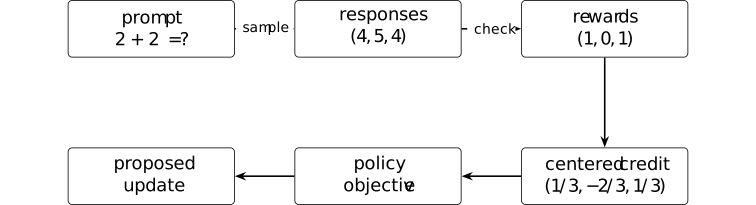
The exact-answer checker gives mean reward \(\bar r=2/3\). Using the declared unnormalized centered credit \(\widehat A_i=r_i-\bar r\) yields \((1/3,-2/3,1/3)\). An optimizer may use these numbers to propose a parameter change, but the tuple itself is not yet an accepted update.
The RLVR protocol is Definition [ftip-0044]. Its group-credit objects are Definition [ftip-004B], Definition [ftip-004C], and Definition [ftip-004D]. Together they specialize to this finite order of operations. Centered, unscaled credit and an exact-answer checker are local choices rather than requirements on other RLVR algorithms.
Example. Four rollout rewards, group advantages, and clipping [ftip-004N]AGENTDRAFTED
Example. Four rollout rewards, group advantages, and clipping [ftip-004N]AGENTDRAFTED
A rollout group is normalized to relative advantages and then passed to a clipped surrogate objective.

For a rollout group with rewards \(r_i\), form a group mean and scale and set \(\widehat A_i=(r_i-\bar r)/s\). For current-to-behaviour ratios \(\rho _i\) and clip interval \([1-\epsilon ,1+\epsilon ]\), define each pointwise term by
\[ \begin {aligned} \ell _i=\min \{&\rho _i\widehat A_i,\\ &\operatorname {clip}(\rho _i,1-\epsilon ,1+\epsilon )\widehat A_i\}. \end {aligned} \]The mean of the resulting terms is the group contribution to the update; its value depends on the sampled rewards, ratios, and clip width.
Group-relative normalization is grounded in [shao2024deepseekmath, Section 4.1], while clipping is grounded in [schulman2017proximal, Section 3]. The normalization convention and ratios must be declared by the training protocol; a positive surrogate mean alone gives no guarantee of improved held-out performance after an optimizer step.
Agentic post-training [ftip-004O]AGENTDRAFTED
Agentic post-training [ftip-004O]AGENTDRAFTED
Response-level training ends when a model emits an answer. Agentic post-training also trains decisions made after observations from tools or other external systems.
Definition. Action serializer [ftip-004P]AGENTDRAFTED
Definition. Action serializer [ftip-004P]AGENTDRAFTED
Fix the token vocabulary and strings of the tokenizer interface, and the action space \(\mathcal A\) from the declared interactive task realization. An action serializer is a pair of partial maps
\[ \operatorname {enc}:\mathcal A\rightharpoonup \mathcal V^*, \qquad \operatorname {dec}:\mathcal V^*\rightharpoonup \mathcal A. \]The encoder gives an action a textual representation. The decoder recognizes a completed representation and returns the executable action. A string outside the decoder's domain is malformed; it is not silently promoted to an environment action. For every action in the encoder's domain, the declared pair satisfies \(\operatorname {dec}(\operatorname {enc}(a))=a\).
Remark. Generated tokens and executable actions [ftip-004Q]AGENTDRAFTED
Remark. Generated tokens and executable actions [ftip-004Q]AGENTDRAFTED
An action serializer maps generated text to an executable action. Section 2 of ReAct: Synergizing reasoning and acting in language models[yao2023react] writes actions and observations in a textual trajectory. The proposed serializer interface in Definition [ftip-004P] additionally distinguishes malformed calls, constrained grammars, and environment actions.
An improvement can therefore come from better reasoning, better serialization, or a more permissive parser. These are separate intervention coordinates.
Definition. tool interaction [yao2023react, Section 2] [ftip-004R]AGENTDRAFTED
Definition. tool interaction [yao2023react, Section 2] [ftip-004R]AGENTDRAFTED
A ReAct interaction alternates model-generated reasoning and actions with observations returned by an external interface. The observation is appended to the next model context, so subsequent actions may depend on earlier tool results.
A decoded action belongs to \(\mathcal A\) in the declared interactive task realization; the transition--observation kernel of Definition [ftip-001Z] returns the next observation. The cited construction does not by itself fix a sandbox, reward, or training algorithm.
Definition. Sandbox [ftip-004S]AGENTDRAFTED
Definition. Sandbox [ftip-004S]AGENTDRAFTED
Fix an interactive realization \(\mathsf {Env}_{\mathsf T}\) from the declared task interface, a measurable evidence space \(\mathcal E_{\rm box}\), and a cost dimension \(m\geq 1\). A sandbox specifies an allowed action set \(\mathcal A^{\rm box}_{\mathsf T}\subseteq \mathcal A_{\mathsf T}\) that is measurable, a cost bound \(b_{\rm box}\in \mathbb R_+^m\), and, for each \(x\in \mathcal X_{\mathsf T}\) and \(0\leq t<T_{\max }\), an execution kernel
\[ K_{t}^{\rm box,x}: \mathcal S_{\mathsf T}\times \mathcal A^{\rm box}_{\mathsf T} \rightsquigarrow \mathcal S_{\mathsf T}\times \mathcal O^{\rm obs}_{\mathsf T} \times \mathcal E_{\rm box}\times \mathbb R_+^m, \]It also specifies, for each \(x\in \mathcal X_{\mathsf T}\), a reset kernel
\[ \mathsf {Reset}^{x}_{\rm box}:\{\ast \}\rightsquigarrow \mathcal S_{\mathsf T}\times \mathcal O^{\rm obs}_{\mathsf T} \times \mathcal E_{\rm box}\times \mathbb R_+^m. \]For an allowed action, the state--observation marginal of \(K_t^{\rm box,x}\) is the kernel \(K_t^x\) in the task realization; the state--observation marginal of the reset kernel is \(\rho _0^x\). The remaining coordinates record reproducible evidence and a realized cost increment. An admitted stopped trajectory must have componentwise cumulative cost at most \(b_{\rm box}\).
The sandbox semantics include permissions, kernel and reset versions, evidence encoding, and cost accounting. A tool name or API schema alone does not determine these fields.
Remark. Sandbox restrictions and trajectory laws [ftip-004T]AGENTDRAFTED
Remark. Sandbox restrictions and trajectory laws [ftip-004T]AGENTDRAFTED
A sandbox restricts the environment through its executor, reset rules, permissions, and evidence. ReAct [yao2023react, Section 2] supplies the action--observation pattern. Software-agent systems surveyed in [wang2024agents, Section 2.3.2] add repositories, compilers, tests, and other digital tools. The combined sandbox interface is a proposed model of these choices.
Two protocols that share prompts but change reset or permission semantics need not induce the same trajectory law.
Definition. Agentic post-training state [ftip-004U]AGENTDRAFTED
Definition. Agentic post-training state [ftip-004U]AGENTDRAFTED
Let \(\mathcal M_{\rm exec}\) be the space of executable model artifacts, \(\mathcal Z_{\rm opt}\) the optimizer-state space, and \(\mathcal R_{\rm ag}\) a declared space of typed agentic round records. At training round \(n\), an agentic post-training state is a tuple \[ \Sigma _n=(M_n,s_n,\mathcal L_n) \in \mathcal M_{\rm exec}\times \mathcal Z_{\rm opt} \times \mathcal R_{\rm ag}^{n}, \] where \(M_n\) is the executable model artifact, \(s_n\) is the optimizer state, and \(\mathcal L_n=(r_0,\ldots ,r_{n-1})\) is an append-only training ledger.
The round-record schema records the task and instance draw, policy and inference stamp, environment version, stopped trajectory, feedback and credit outputs, update decision, proposed and committed next artifact and optimizer state, random seeds, operator versions, and realized cost vector. The tuple separates executable state from optimizer state and from evidence about how that state was reached.
Definition. One agentic post-training round [ftip-0073]AGENTDRAFTED
Definition. One agentic post-training round [ftip-0073]AGENTDRAFTED
At round \(n\), fix a task \(\mathsf T_n\), its law \(\mu _{\mathsf T_n}\), and a versioned interactive realization \(\mathsf {Env}^{\upsilon _n}_{\mathsf T_n}\). Let \(\mathcal I_{\rm art}\) and \(\mathcal I_{\rm inf}\) be declared identifier spaces. Let \(a_n\in \mathcal I_{\rm art}\) be an immutable content identifier resolving the artifact \(M_n\), and let \(\iota _n\in \mathcal I_{\rm inf}\) record all serializer, decoding, tool, and stopping settings. The policy--inference stamp \(\nu _n=(a_n,\iota _n)\in \mathcal I_{\rm art}\times \mathcal I_{\rm inf}\) resolves a non-anticipating policy \(\pi _n\). Let \(\Omega _n^{\rm task}\), \(\Omega _n^{\rm roll}\), \(\Omega _n^{\rm feed}\), \(\Omega _n^{\rm credit}\), and \(\Omega _n^{\rm update}\) be declared seed spaces. The rollout seed contains both policy-decoding and environment randomness. Write \(\Omega _n=\Omega _n^{\rm task}\times \Omega _n^{\rm roll}\times \Omega _n^{\rm feed}\times \Omega _n^{\rm credit}\times \Omega _n^{\rm update}\), and let \(\omega _n=(\omega _n^{\rm task},\omega _n^{\rm roll}, \omega _n^{\rm feed},\omega _n^{\rm credit},\omega _n^{\rm update})\) be sampled from a declared joint law on \(\Omega _n\). Write \(\mathcal Z_{\mathsf T_n}\) for the stopped trajectories admitted by the versioned realization.
For declared feedback and credit spaces \(\mathcal F_n\) and \(\mathcal G_n\), decision space \(\mathcal D_n=\{\mathsf {accept},\mathsf {reject}\}\), accounting dimension \(m\geq 1\), and exact implementation versions \(v_n^{\rm S}\), \(v_n^{\rm R}\), \(v_n^{\rm F}\), \(v_n^{\rm C}\), \(v_n^{\rm U}\), and \(v_n^{\rm A}\), the round specifies maps
\[ \begin {aligned} \mathsf S_n^{v_n^{\rm S}}&: \Omega _n^{\rm task}\longrightarrow \mathcal X_{\mathsf T_n},\\ \mathsf R_n^{v_n^{\rm R}}&: \mathcal X_{\mathsf T_n}\times \Omega _n^{\rm roll} \longrightarrow \mathcal Z_{\mathsf T_n},\\ \mathsf F_n^{v_n^{\rm F}}&: \mathcal X_{\mathsf T_n}\times \mathcal Z_{\mathsf T_n} \times \Omega _n^{\rm feed}\longrightarrow \mathcal F_n,\\ \mathsf C_n^{v_n^{\rm C}}&: \mathcal X_{\mathsf T_n}\times \mathcal Z_{\mathsf T_n} \times \mathcal F_n\times \Omega _n^{\rm credit} \longrightarrow \mathcal G_n,\\ \mathsf U_n^{v_n^{\rm U}}&: \mathcal M_{\rm exec}\times \mathcal Z_{\rm opt}\times \mathcal G_n \times \Omega _n^{\rm update} \longrightarrow \mathcal D_n\times \mathcal M_{\rm exec}\times \mathcal Z_{\rm opt},\\ \mathsf A_n^{v_n^{\rm A}}&: \mathcal M_{\rm exec}\times \mathcal Z_{\rm opt} \times \mathcal X_{\mathsf T_n}\times \mathcal Z_{\mathsf T_n}\\ &\quad {}\times \mathcal F_n\times \mathcal G_n\times \mathcal D_n\\ &\quad {}\times \mathcal M_{\rm exec}\times \mathcal Z_{\rm opt} \times \Omega _n\longrightarrow \mathbb R_+^m. \end {aligned} \]The accounting map receives the starting state, proposed state, decision, and realized seeds, so update work and rejected proposals remain observable in the cost record.
They produce
\[ \begin {aligned} X_n&=\mathsf S_n^{v_n^{\rm S}}(\omega _n^{\rm task}),\\ Z_n&=\mathsf R_n^{v_n^{\rm R}}(X_n,\omega _n^{\rm roll}),\\ F_n&=\mathsf F_n^{v_n^{\rm F}}(X_n,Z_n,\omega _n^{\rm feed}),\\ \Gamma _n&=\mathsf C_n^{v_n^{\rm C}} (X_n,Z_n,F_n,\omega _n^{\rm credit}),\\ (d_n,\widetilde M_{n+1},\widetilde s_{n+1}) &=\mathsf U_n^{v_n^{\rm U}} (M_n,s_n,\Gamma _n,\omega _n^{\rm update}),\\ c_n&=\mathsf A_n^{v_n^{\rm A}}( M_n,s_n,X_n,Z_n,F_n,\Gamma _n,d_n, \widetilde M_{n+1},\widetilde s_{n+1},\omega _n). \end {aligned} \]The task sampler pushes its seed law forward to \(\mu _{\mathsf T_n}\). Conditional on \(X_n\), the rollout sampler pushes its seed law forward to the interaction law of Remark [ftip-0028] under \(\mathsf {Env}^{\upsilon _n}_{\mathsf T_n}\) and \(\pi _n\).
If \(d_n=\mathsf {accept}\), set \((M_{n+1},s_{n+1})=(\widetilde M_{n+1},\widetilde s_{n+1})\); if \(d_n=\mathsf {reject}\), set \((M_{n+1},s_{n+1})=(M_n,s_n)\). The realized cost \(c_n\) includes proposal work even after rejection. With \(v_n^{\rm ops}=(v_n^{\rm S},v_n^{\rm R},v_n^{\rm F},v_n^{\rm C}, v_n^{\rm U},v_n^{\rm A})\), append
\[ \begin {aligned} r_n={}&(\mathsf T_n,X_n,\nu _n,\upsilon _n,Z_n,F_n,\Gamma _n,d_n, \widetilde M_{n+1},\widetilde s_{n+1},M_{n+1},s_{n+1}, \omega _n,v_n^{\rm ops},c_n),\\ \mathcal L_{n+1}={}&\operatorname {append}(\mathcal L_n,r_n). \end {aligned} \]The record belongs to \(\mathcal R_{\rm ag}\) from Definition [ftip-004U] and determines \(\Sigma _{n+1}\) without rewriting an earlier record.
Definition. Agentic post-training run [ftip-0074]AGENTDRAFTED
Definition. Agentic post-training run [ftip-0074]AGENTDRAFTED
An agentic post-training run fixes a finite round count \(N_{\rm ag}\geq 0\), an initial state \(\Sigma _0\), a fixed accounting dimension \(m\geq 1\), a componentwise budget \(b_{\rm ag}\in \mathbb R_+^m\), and the round specifications of Definition [ftip-0073]. Put \(\Omega _{\rm ag}=\prod _{n=0}^{N_{\rm ag}-1}\Omega _n\), using a singleton for the empty product. Once those specifications and their exact versions \(v_{\rm ag}\) are fixed, the run is the map
\[ \mathsf {Run}_{\Sigma _0,v_{\rm ag}}:\Omega _{\rm ag}\longrightarrow \mathcal M_{\rm exec}\times \mathcal R_{\rm ag}^{N_{\rm ag}} \times \mathbb R_+^m. \]Write a realized round-seed tuple as
\[ \omega _{\rm ag}=(\omega _0,\ldots ,\omega _{N_{\rm ag}-1}). \]The run recursively constructs \(\Sigma _1,\ldots ,\Sigma _{N_{\rm ag}}\); the seed tuple and state sequence are empty beyond \(\Sigma _0\) when \(N_{\rm ag}=0\). Its cumulative realized cost is \[ c_{\rm ag}=\sum _{n=0}^{N_{\rm ag}-1}c_n. \] The empty sum is \(0\in \mathbb R_+^m\) when \(N_{\rm ag}=0\). The map returns \((M_{N_{\rm ag}},\mathcal L_{N_{\rm ag}},c_{\rm ag})\). A run claiming the hard budget must declare a pre-admission or stopping rule that guarantees \(c_{\rm ag}\preceq b_{\rm ag}\).
The run declaration includes the task sampler, environments, serializers, rollout inference settings, feedback and credit maps, update maps, stopping rule, seed laws, implementation versions, and resource account. The round records retain every realized seed, version, decision, and cost. Leaving one of these fields implicit defines a family of runs rather than one reproducible intervention.
Remark. Post-training with intermediate observations [ftip-004X]AGENTDRAFTED
Remark. Post-training with intermediate observations [ftip-004X]AGENTDRAFTED
A proposed interactive extension of the response-level RLVR cycle in § [ftip-0042] uses the environment of § [ftip-001W] and the action boundary of Definition [ftip-004P]. It retains intermediate observations and environment state instead of treating a whole response as one indivisible action.
This change introduces new questions about partial observability, long-horizon credit, environment versioning, recovery after interruption, and the cost of external execution. It does not assert that multi-turn training is uniformly better than response-level training.
Example. A short code-agent trace with tool evidence [ftip-004V]AGENTDRAFTED
Example. A short code-agent trace with tool evidence [ftip-004V]AGENTDRAFTED
A failing test observation triggers a second edit, whose passing tool evidence determines the terminal result.
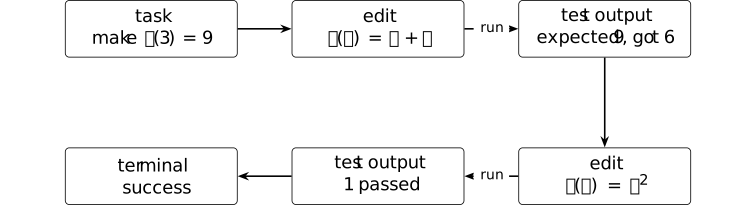
The public history records both edits and both test outputs. The first tool call returns the evidence string expected 9, got 6; the second returns exit status \(0\) and 1 passed. The success rule reads the second test result rather than the model's assertion that its edit is correct.
The action--observation alternation follows the tool-interleaving pattern in [yao2023react, Section 2]. The transparent sandbox interaction certifies only the displayed test result; completeness of the suite and satisfaction of unstated intent remain unverified.
Example. A DeepSeek-family resilient rollout and sandbox schematic [ftip-004W]AGENTDRAFTED
Example. A DeepSeek-family resilient rollout and sandbox schematic [ftip-004W]AGENTDRAFTED
Two coupled panels place resumable generation beside sandbox evidence in a single rollout record.
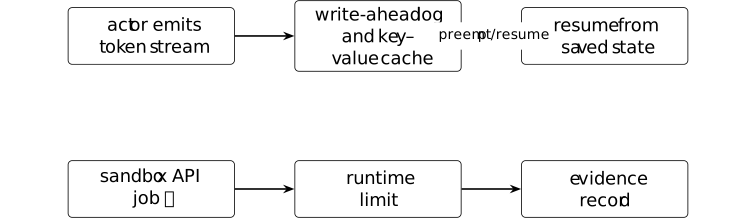
A write-ahead log and cached state allow a resumable rollout; a sandbox execution contributes a separately recorded evidence tuple. The two records should remain distinguishable when lifecycle cost is audited.
Token-granular write-ahead logging with key--value cache recovery and DeepSeek Elastic Compute (DSec), the report's named sandbox interface, are described in Sections 5.2.3 and 5.2.5 of the DeepSeek-V4 family report [⧉]. The cited sources do not establish that DeepSeek-V4-Flash-0731 used this job, resource limit, rollout schedule, or sandbox configuration.
Feedback, replay, and update control [ftip-004Y]AGENTDRAFTED
Feedback, replay, and update control [ftip-004Y]AGENTDRAFTED
Post-training systems often reuse historical trajectories. This section separates what happened during a rollout from quantities recomputed when that rollout is considered for another update.
Definition. Policy stamp [ftip-004Z]AGENTDRAFTED
Definition. Policy stamp [ftip-004Z]AGENTDRAFTED
A policy stamp \(\nu \) is a content-addressed description of an executable policy: model artifact, tokenizer, action serializer, decoding settings, and implementation revision. Resolving the stamp produces the action law \(\pi ^\nu (\,\cdot \mid \mathsf H_t)\) for every public history in its declared domain.
Two stamps are equal only when every component that may change the action law is equal. A display name or checkpoint step is therefore insufficient.
Remark. Behavior policies and executable-policy identity [ftip-0050]AGENTDRAFTED
Remark. Behavior policies and executable-policy identity [ftip-0050]AGENTDRAFTED
Off-policy methods distinguish the behavior and current policies, while language-model artifacts also depend on tokenization and decoding. Section 3 of When to stop reusing: Dynamic gradient gating for sample-efficient RLVR[miao2026when] records the behavior/current distinction. The additional artifact and implementation fields in the proposed policy stamp make the executable law reproducible.
The stamp identifies an executable law; it does not claim that two implementations with different stamps must behave differently on every task.
Definition. Immutable rollout record [ftip-0051]AGENTDRAFTED
Definition. Immutable rollout record [ftip-0051]AGENTDRAFTED
An immutable rollout record is a tuple
\[R=(q,\nu _b,\tau ,e),\]where \(q\) is the sampled task, \(\nu _b\) is the behavior-policy stamp, \(\tau \) is the stopped trajectory of Definition [ftip-0025], and \(e\) is the verifier evidence of Definition [ftip-0047]. The tuple records facts fixed when the rollout finishes.
Current-policy likelihood ratios, clipping decisions, reuse counts, and acceptance decisions are excluded because they may change on a later update attempt.
Remark. A historical event is not an update attempt [ftip-0052]AGENTDRAFTED
Remark. A historical event is not an update attempt [ftip-0052]AGENTDRAFTED
An immutable historical record prevents an update attempt from rewriting the facts attached to its reused samples. The sample-reuse setup in [miao2026when, Section 3] retains behavior-policy rollouts while recomputing current-policy ratios. Dynamic Gradient Gating (DGG), defined in [miao2026when, Section 5 and Algorithm 1], is one such reuse protocol, while the complete immutable tuple is a proposed interface for such protocols.
Recorded facts and estimates recomputed for an attempted update are different objects; errors in the latter do not alter the former.
Definition. Feedback operator [ftip-0053]AGENTDRAFTED
Definition. Feedback operator [ftip-0053]AGENTDRAFTED
Let \(\mathcal R\) be the set of immutable rollout records and \(\mathcal F\) a typed set of feedback events. A feedback operator is a possibly randomized kernel
\[\mathsf {Feed}:\mathcal R\rightsquigarrow \mathcal F.\]A feedback event may contain an outcome score, step labels, a preference, or an abstention. Its type records which observations were available when it was produced.
Definition. Credit-assignment rule [ftip-0054]AGENTDRAFTED
Definition. Credit-assignment rule [ftip-0054]AGENTDRAFTED
Let \(R\) be a rollout record with \(\tau _{\rm stop}\) actions, and let \(f\) be its feedback event. A credit-assignment rule returns indexed training targets
\[\mathsf {Credit}(R,f)=(c_0,\ldots ,c_{\tau _{\rm stop}-1}).\]Each \(c_t\) is attached to an action or token position declared by the rule. It may be a return, an advantage estimate, a binary label, or a structured target. The rule is distinct from the feedback source that supplied \(f\).
Remark. Observed feedback and assigned credit [ftip-0055]AGENTDRAFTED
Remark. Observed feedback and assigned credit [ftip-0055]AGENTDRAFTED
Terminal returns, process labels, preference observations, and verifier rewards determine what information is observed. A credit rule determines where that information enters an objective. Treating them as separate inputs is a proposed common description of these different methods.
Separating the interfaces permits questions about delayed, noisy, or misallocated credit without changing the underlying evidence.
Definition. Replay pool [ftip-0056]AGENTDRAFTED
Definition. Replay pool [ftip-0056]AGENTDRAFTED
At update index \(n\), a replay pool \(\mathcal R_n\) is a finite multiset of immutable rollout records eligible for selection. Its management rule specifies insertion, eviction, and any partition by task or behavior stamp.
The pool is persistent state of the training protocol. It is not the minibatch selected for one update.
Definition. Attempt-local replay annotation [ftip-0057]AGENTDRAFTED
Definition. Attempt-local replay annotation [ftip-0057]AGENTDRAFTED
Selecting \(R\in \mathcal R_n\) under a current policy stamp \(\nu _n\) produces an attempt-local replay annotation
\[a_n(R)=(\nu _n,\rho ,\kappa ,m,u),\]where \(\rho \) is the declared collection of behavior/current likelihood ratios, \(\kappa \) records clipping status, \(m\) is the record age, and \(u\) is its prior reuse count. Every component is computed for this attempt and may change at the next one.
Remark. Replay selection and current-policy annotations [ftip-0058]AGENTDRAFTED
Remark. Replay selection and current-policy annotations [ftip-0058]AGENTDRAFTED
The proposed replay interface separates a persistent pool from annotations computed for an update attempt. DGG in [miao2026when, Section 3; Section 5 and Algorithm 1] recomputes policy ratios and a gradient diagnostic while reusing a rollout batch. Those quantities depend on the current policy and therefore belong to the attempted update rather than the historical record.
The split also exposes the cost of selecting, scoring, and rejecting reused records.
Example. Selecting a historical rollout under a current policy stamp [ftip-0059]AGENTDRAFTED
Example. Selecting a historical rollout under a current policy stamp [ftip-0059]AGENTDRAFTED
Reusing one historical rollout recomputes current-policy annotations without mutating the stored record.
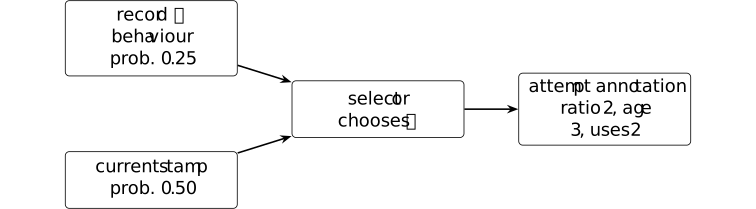
Let the stored record be \(R=(q,\nu _b,\tau ,e)\) and suppose its behaviour policy assigned the recorded action probability \(0.25\). Under the current stamp the same action has probability \(0.50\), so this attempt records importance ratio \(0.50/0.25=2\). Its age \(3\) and prior-use count \(2\) are also attempt-time metadata; none of these three values rewrites \(R\).
The behaviour/current-policy distinction is required by the reuse analysis in [miao2026when, Section 3]. The finite annotation makes provenance explicit. Statistical safety of ratio \(2\), age \(3\), or a second reuse is left undecided.
Definition. Update proposal [ftip-006C]AGENTDRAFTED
Definition. Update proposal [ftip-006C]AGENTDRAFTED
Given a current parameter--optimizer state \((\theta _n,z_n)\), selected records, their attempt annotations, and credit targets, an update proposal is a candidate next state
\[(\widetilde \theta _{n+1},\widetilde z_{n+1}, \delta _n^{\rm diag}).\]The diagnostic record \(\delta _n^{\rm diag}\) contains the quantities required by the declared acceptance rule. It is distinct from the accept--reject decision \(d_n\) recorded for the proposal. Constructing the proposal incurs update cost even if the proposal is later rejected.
Definition. dynamic gradient gate [miao2026when, Section 5 and Algorithm 1] [ftip-005A]AGENTDRAFTED
Definition. dynamic gradient gate [miao2026when, Section 5 and Algorithm 1] [ftip-005A]AGENTDRAFTED
Dynamic gradient gating computes the language-model-head gradient before the optimizer step. It compares the change in squared Frobenius norm with a trailing-window Z-score. When the score crosses its threshold after a reused update, the method discards that gradient and returns to fresh rollouts.
The gate is an empirical stopping rule for reuse. The source does not prove that its Z-score is a calibrated divergence test or a general safety certificate.
Remark. Rejected updates still consume computation [ftip-006D]AGENTDRAFTED
Remark. Rejected updates still consume computation [ftip-006D]AGENTDRAFTED
A gate may reject a computed gradient even though its computation has already consumed resources. The DGG definition in Definition [ftip-005A] supplies the motivating pre-optimizer discard operation. Other protocols may inspect held-out loss, divergence, or resource limits.
The generic proposal interface does not transfer DGG's empirical detector to those other diagnostics. Each gate needs its own assumptions and calibration evidence.
Example. Two proposed updates under a DGG-style gate [ftip-005B]AGENTDRAFTED
Example. Two proposed updates under a DGG-style gate [ftip-005B]AGENTDRAFTED
Two candidate reused-gradient updates fall on opposite sides of a declared DGG-style gate.
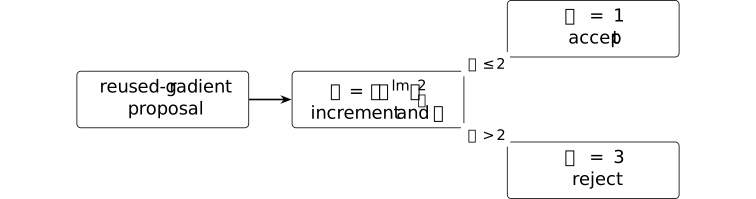
Declare a trailing-window increment mean \(\mu =1\), standard deviation \(s=0.5\), and toy threshold \(z_\star =2\). Proposal A has increment \(1.5\), so \(Z_A=(1.5-1)/0.5=1\) and is committed. Proposal B has increment \(2.5\), so \(Z_B=3\) and is rejected before an Adam transition. Rejection therefore leaves both parameters and optimizer moments unchanged in this protocol.
The monitored last-layer gradient energy, trailing-window Z-score, and pre-optimizer rejection order are modeled on [miao2026when, Section 5 and Algorithm 1]; the numeric threshold and window statistics above are locally declared. Acceptance is a reuse heuristic; it supplies neither a safety certificate nor a guarantee of improved independent evaluation.
Definition. checkpoint-trajectory extrapolation [chen2026lowrank, Sections 4 and 5.1] [ftip-0069]AGENTDRAFTED
Definition. checkpoint-trajectory extrapolation [chen2026lowrank, Sections 4 and 5.1] [ftip-0069]AGENTDRAFTED
NExt forms global and local parameter differences from saved low-rank adaptation (LoRA) checkpoints, approximates each matrix difference by leading singular factors, and trains a predictor on those representations to estimate a future difference. It adds a scaled predicted difference to a checkpoint; the reported experiments then resume RLVR updates.
The construction replaces some realized rollout-and-update steps with a learned parameter jump. It does not introduce a new verifier signal.
Remark. Trajectory compression and feedback acquisition [ftip-006A]AGENTDRAFTED
Remark. Trajectory compression and feedback acquisition [ftip-006A]AGENTDRAFTED
The NExt construction Low-rank optimization trajectories modeling for LLM RLVR acceleration[chen2026lowrank] motivates a distinction between following a predictable parameter path and acquiring information from new rollouts. Low-rank dominance of saved differences does not imply linear future motion, invariance across parameterizations, or preservation of optimizer state.
A cost comparison includes checkpoint storage, decomposition, predictor training, extrapolation, and recovery updates. Bounding independent-evaluation regret additionally requires stability assumptions connecting parameter forecasts to the evaluated outcome.
Example. A sign-invariant checkpoint-trajectory forecast [ftip-006B]AGENTDRAFTED
Example. A sign-invariant checkpoint-trajectory forecast [ftip-006B]AGENTDRAFTED
Leading rank-one projectors encode a checkpoint direction without inheriting the arbitrary signs of singular vectors.

For either singular-vector representation \((u,v)\) or \((-u,-v)\), the projectors \(P_u=uu^\top \) and \(P_v=vv^\top \) are unchanged. A trajectory forecaster can extrapolate the observed projector-aligned deltas to a next checkpoint, after which a measured recovery update can correct the forecast without changing the represented one-dimensional subspace.
The history-to-delta-to-recovery order is a toy illustration of NExt, described in [⧉]. NExt models signed singular value decomposition (SVD) factors rather than the projector construction used here. Accordingly, the calculation supplies neither a theorem about checkpoint trajectories nor evidence of capability acquisition.
Agent state, computation, and reliability [ftip-00JD]AGENTDRAFTED
Agent state, computation, and reliability [ftip-00JD]AGENTDRAFTED
An agent's behavior can change through persistent state, retained context and recursive execution even when its model weights are fixed. These mechanisms complement post-training, and their costs and retained artifacts belong to the same capability comparison.
The chapter begins with persistent state and lifecycle accounting, then examines dynamic computation and recursive harnesses. Failure modes and reliability protocols explain when an apparent gain can be trusted. Evaluation transport is developed with the independent evaluation framework that follows.
Persistent harness state and lifecycle-bounded inference [ftip-00C2]AGENTDRAFTED
Persistent harness state and lifecycle-bounded inference [ftip-00C2]AGENTDRAFTED
An executable model can remain fixed while a harness changes the context, available computation, retained memories, skills, subagent definitions, and evaluation policy around it. Those changes can alter later behavior and cost, but they are not weight training.
Distinguishing harness state from represented weights makes replay and descendant accounting precise, and exposes the effects of lossy summaries and contaminated refinement.
[karten2026prime] supplies operational records for persistent harness state. The Grothendieck-constant case study of [li2026longhorizon] supplies a long-horizon record in which compressed research state lost a caveat and a feasibility condition. Source observations remain empirical; the displayed finite results are proved here.
Fixed-weight harness adaptation [ftip-00C3]AGENTDRAFTED
Fixed-weight harness adaptation [ftip-00C3]AGENTDRAFTED
The executable model artifact, active context, explicitly managed computation, and persistent harness state are distinct parts of an agent. Replayability depends on the rule that materializes state from events, as well as the recorded inputs and execution versions.
Definition. Parameter, context, compute, and persistent state [ftip-00C4]AGENTDRAFTED
Definition. Parameter, context, compute, and persistent state [ftip-00C4]AGENTDRAFTED
Let \(\mathcal C_{\rm act}\) be an active-context space, \(\mathcal Z_{\rm man}\) an explicitly managed computation-state space, and \(\mathcal H_{\rm pers}\) a persistent harness-state space. A four-layer harness state is
\[ \Xi =(M,c,z,h)\in \mathcal M_{\rm exec}\times \mathcal C_{\rm act} \times \mathcal Z_{\rm man}\times \mathcal H_{\rm pers}. \]The coordinates are, respectively, the executable model artifact, the token-visible context, explicitly managed values or sessions, and state that can survive the present invocation. A transition may change any declared subset of these coordinates. A fixed-weight harness transition holds \(M\) fixed while changing one or more of \(c,z,h\).
Remark. State layers are access mechanisms, not capability levels [ftip-00C5]AGENTDRAFTED
Remark. State layers are access mechanisms, not capability levels [ftip-00C5]AGENTDRAFTED
Prime Agent Section 2.2 names model weights, active context, explicitly managed computation, and retained state as levels L0--L3, and describes the operations that move information between them [karten2026prime, Section 2.2]. The formulation in Definition [ftip-00C4] preserves that operational separation without treating the labels as an ordering of intelligence or capability.
Two runs with identical weights and different persistent state can induce different policies. That observation does not say that either run acquired a new circuit in the fixed artifact, and it does not compare their independently evaluated utility.
Definition. Versioned harness configuration [ftip-00C6]AGENTDRAFTED
Definition. Versioned harness configuration [ftip-00C6]AGENTDRAFTED
Let \(\mathcal I_{\rm har}\) be a content-identifier space. A versioned harness configuration is a finite record \(\kappa ^{\rm har}\in \mathcal I_{\rm har}\) that resolves the active-context assembly rule, managed-computation interface, tool permissions, session and message semantics, compaction policy, persistent-state schema, refinement policy, recovery rule, and implementation versions.
Together with a state \(\Xi \), the record resolves a non-anticipating harness policy. Changing one field produces a different declared intervention even when the executable model artifact is unchanged. The record does not include an evaluation binding; that is a separate record coordinate.
Definition. Persistent event stream [ftip-00C7]AGENTDRAFTED
Definition. Persistent event stream [ftip-00C7]AGENTDRAFTED
Fix a finite event alphabet \(\mathcal E_{\rm har}\). A persistent event stream of length \(n\) is
\[ L_n=(e_0,\ldots ,e_{n-1})\in \mathcal E_{\rm har}^{n}. \]The append operation is \(L_{n+1}=\operatorname {append}(L_n,e_n)\). Write \(L_i\preceq _{\rm pref}L_j\) when \(L_i\) is a prefix of \(L_j\). An append-only stream satisfies \(L_i\preceq _{\rm pref}L_j\) for every \(i\leq j\); branching creates distinct continuations with a common prefix rather than rewriting that prefix.
Events may record model or tool calls, messages, interventions, retries, verifier outcomes, harness edits, and resource use. The event schema and its exact version belong to the configuration of Definition [ftip-00C6].
Definition. Materialized harness state [ftip-00C8]AGENTDRAFTED
Definition. Materialized harness state [ftip-00C8]AGENTDRAFTED
Let \(\mathcal V_{\rm fold}\) be a space of fold versions. For each \(v\in \mathcal V_{\rm fold}\), fix a deterministic map
\[ F_v:\mathcal H_{\rm pers}\times \mathcal E_{\rm har} \longrightarrow \mathcal H_{\rm pers}. \]Given an initial persistent state \(h_0\), event stream \(L_n=(e_0,\ldots ,e_{n-1})\), and version sequence \(\boldsymbol v=(v_0,\ldots ,v_{n-1})\), its materialized harness state is obtained recursively by
\[ h_{i+1}=F_{v_i}(h_i,e_i),\qquad 0\leq i<n. \]The materialization record is the tuple \((h_0,L_n,\boldsymbol v,(F_v)_v)\). Omitting a version or the initial state defines a family of possible materializations, not one replayable state.
Theorem. Deterministic event folding gives replayable state [ftip-00C9]AGENTDRAFTED
Theorem. Deterministic event folding gives replayable state [ftip-00C9]AGENTDRAFTED
For a materialization record in Definition [ftip-00C8], replaying the same initial state, event sequence, version sequence, and fold maps produces the same state \(h_n\).
This finite result follows from the displayed hypotheses. It assumes exact equality of all recorded inputs and deterministic fold maps.
Proof.
At step zero both replays have state \(h_0\). If their states agree at
step \(i\), both apply the same function \(F_{v_i}\) to the same pair
\((h_i,e_i)\), so their states agree at step \(i+1\). Finite induction gives
equality at step \(n\).Proof.
Remark. Replayability is not correctness [ftip-00CA]AGENTDRAFTED
Remark. Replayability is not correctness [ftip-00CA]AGENTDRAFTED
The result in Theorem [ftip-00C9] is an identity about a declared transition system. It does not show that the event stream is complete, that an external process can be reconstructed, that the fold is faithful to the environment, or that the resulting state is useful or safe.
Prime Agent reports append-only events, versioned state, recovery, and rollback in Sections 2.2 and 2.5 [karten2026prime, Sections 2.2 and 2.5]. Those implementation claims motivate the event record; Theorem [ftip-00C9] proves the finite replay identity directly from the declared transition rule.
Example. One artifact and two harness policies [ftip-00CB]AGENTDRAFTED
Example. One artifact and two harness policies [ftip-00CB]AGENTDRAFTED
The same executable artifact can be paired with two persistent states and therefore two resolved harness policies. The harness state changes while the executable model remains fixed.
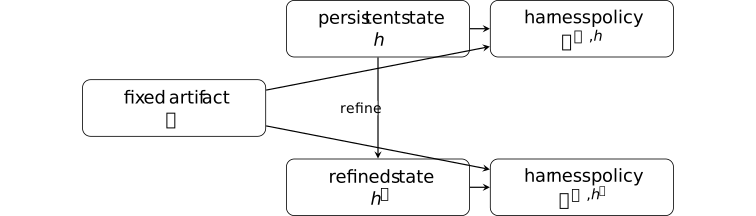
Different policies here establish only that harness state is an intervention coordinate. An independent evaluation is still required to compare their outcomes.
Remark. Fixed-weight self-improvement is not weight training [ftip-00CC]AGENTDRAFTED
Remark. Fixed-weight self-improvement is not weight training [ftip-00CC]AGENTDRAFTED
Prime Agent Section 2.5 uses the phrase ``self-improvement'' for execution evidence converted into persistent prompts, memories, skills, or subagent specifications while model weights remain fixed [karten2026prime, Section 2.5]. In the notation of Definition [ftip-00C4], this is a change to \(h\) with \(M\) held fixed.
The term therefore does not establish a change to the model artifact, a new learned circuit, or capability acquisition in the sense of Definition [ftip-0007]. It describes persistent harness adaptation.
Evaluation binding and lineage accounting [ftip-00CD]AGENTDRAFTED
Evaluation binding and lineage accounting [ftip-00CD]AGENTDRAFTED
A long-horizon score is attached to a configuration, not merely to a model name. Delegation also creates descendant work that must remain visible in the resource account. Reproducible evaluation therefore requires a specified configuration, and resource accounting includes the work of its descendants.
Definition. Evaluation configuration record [ftip-00CE]AGENTDRAFTED
Definition. Evaluation configuration record [ftip-00CE]AGENTDRAFTED
An evaluation configuration record is a finite record \(\mathfrak e\) that resolves the task and instance law, environment and tool interfaces, executable model artifact, serializer and inference policy, harness configuration, compaction and refinement policies, retry rule, completion gate, evaluator, seed law, and componentwise resource limits.
Together with the independent evaluation interface of Convention [ftip-005D], the record determines the law of a stopped evaluation run and its realized cost vector. A reported score is the pair consisting of the statistic and the exact record \(\mathfrak e\); a scalar without its record is an under-specified family of measurements.
Remark. A harness comparison needs a declared configuration axis [ftip-00CF]AGENTDRAFTED
Remark. A harness comparison needs a declared configuration axis [ftip-00CF]AGENTDRAFTED
Section 2.6 of [karten2026prime] binds task and tool interfaces to model settings. Its evaluation configuration also records compaction, refinement, retry, completion, and resource policies. The record in Definition [ftip-00CE] is a proposed representation of those configuration choices.
To attribute a score difference to a harness coordinate, the comparison must hold the other coordinates fixed or model their changes explicitly. Two scores under different records \(\mathfrak e\) and \(\mathfrak e'\) can still be descriptively useful, but their difference does not isolate a causal harness effect.
Definition. Session lineage tree [ftip-00CG]AGENTDRAFTED
Definition. Session lineage tree [ftip-00CG]AGENTDRAFTED
A session lineage tree is a finite rooted directed tree \(\mathcal T=(V,E,r)\) whose edges point from a parent session to a directly spawned descendant. Each node \(v\in V\) carries an immutable session identifier, its resolved harness and inference stamps, a local event stream, and a local realized cost \(c_v\in \mathbb R_+^m\).
For a node \(v\), let \(\mathcal T_v\) be the induced subtree containing \(v\) and all its descendants. Distinct children of one node have disjoint node sets. Messages between branches are events in their local streams and do not merge their identities or costs.
Definition. Descendant-complete cost [ftip-00CH]AGENTDRAFTED
Definition. Descendant-complete cost [ftip-00CH]AGENTDRAFTED
For a session lineage tree Definition [ftip-00CG], its descendant-complete cost is the componentwise sum
\[ C_{\rm lin}(\mathcal T)=\sum _{v\in V}c_v\in \mathbb R_+^m. \]The local cost \(c_v\) contains only work assigned to node \(v\); a model or tool call is charged to exactly one node. The vector retains its declared units and embeds into the lifecycle account of Definition [ftip-005H]. A scalar price can be applied only after the vector is formed.
Theorem. Lineage cost is additive over disjoint child subtrees [ftip-00CI]AGENTDRAFTED
Theorem. Lineage cost is additive over disjoint child subtrees [ftip-00CI]AGENTDRAFTED
Let the root \(r\) of a finite lineage tree have children \(v_1,\ldots ,v_k\). Then
\[ C_{\rm lin}(\mathcal T)=c_r+ \sum _{j=1}^{k}C_{\rm lin}(\mathcal T_{v_j}). \]This finite accounting identity follows from assigning each local cost to exactly one node.
Proof.
The node set is the disjoint union of \(\{r\}\) and the node sets of
the child subtrees. Splitting the finite sum in
Definition [ftip-00CH] over that disjoint union gives the equality componentwise.Proof.
Definition. Budget-admissible continuation [ftip-00CJ]AGENTDRAFTED
Definition. Budget-admissible continuation [ftip-00CJ]AGENTDRAFTED
Fix a componentwise hard budget \(b\in \mathbb R_+^m\). After accumulated cost \(a\preceq b\), a proposed continuation has a declared worst-case cost bound \(\bar c\in \mathbb R_+^m\). It is budget-admissible when
\[ a+\bar c\preceq b. \]If admitted, the continuation must either stop within a realized cost \(c\preceq \bar c\) or report a contract violation. Rejected proposals may have a separately accounted proposal cost, which must already be included in \(a\) before the admission test.
Theorem. Budget admission preserves a hard componentwise bound [ftip-00CK]AGENTDRAFTED
Theorem. Budget admission preserves a hard componentwise bound [ftip-00CK]AGENTDRAFTED
Consider a finite sequence of continuations. Start from \(a_0\preceq b\). At step \(i\), admit only if \(a_i+\bar c_i\preceq b\), and require the realized cost to satisfy \(c_i\preceq \bar c_i\). With \(a_{i+1}=a_i+c_i\), every accumulated cost satisfies \(a_i\preceq b\).
This finite result is a contract theorem, not a prediction that a real executor respects its declared bound.
Proof.
The claim holds for \(a_0\). If \(a_i\preceq b\) and the next step is
admitted, then
\(a_{i+1}=a_i+c_i\preceq a_i+\bar c_i\preceq b\). If the step is rejected,
the accumulated cost is unchanged after its already-accounted proposal work.
Finite induction proves the claim.Proof.
Example. A finite delegated run and its lineage cost [ftip-00CL]AGENTDRAFTED
Example. A finite delegated run and its lineage cost [ftip-00CL]AGENTDRAFTED
Use two cost coordinates, such as output tokens and tool calls. The root delegates to two children, and one child delegates once more.
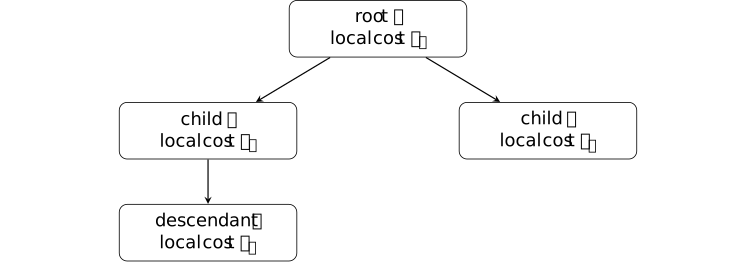
The cost of a child subtree is its local cost plus the costs of all descendants. Therefore
\[ C_{\rm lin}(\mathcal T)=c_r+C_{\rm lin}(\mathcal T_a)+C_{\rm lin}(\mathcal T_b). \]Charging only the root hides descendant work; charging a descendant again as a separate parent-local cost double counts it.
Remark. External benchmark points do not isolate a harness effect [ftip-00CM]AGENTDRAFTED
Remark. External benchmark points do not isolate a harness effect [ftip-00CM]AGENTDRAFTED
Prime Agent Section 3.1 places native-harness runs beside externally reported ARC-AGI-3 results and explicitly says the external points situate the curves rather than isolate a causal harness effect [karten2026prime, Section 3.1]. That is an empirical comparison under multiple evaluation records, not a matched estimate of one harness field.
A larger score can still be a valid record of the displayed configuration. It does not by itself establish that persistence caused the difference, that the model weights improved, or that the cost-adjusted potential of Definition [ftip-005M] increased.
Research-state compaction and observability [ftip-00CN]AGENTDRAFTED
Research-state compaction and observability [ftip-00CN]AGENTDRAFTED
A research harness cannot place its complete archive into every model invocation. A summary can make distinct archives indistinguishable to later evaluators. The source record of a lost evaluator caveat illustrates how omitted information can affect subsequent research.
Definition. Active research state [ftip-00CO]AGENTDRAFTED
Definition. Active research state [ftip-00CO]AGENTDRAFTED
Let \(\mathcal A_{\rm res}\) be a space of complete research archives and \(\mathcal S_{\rm res}\) a space of bounded working summaries. Let \(\mathcal Q_{\rm claim}\) be a typed claim-ledger space and \(\mathcal G_{\rm res}\) a research-goal space. An active research state is
\[ R=(A,s,q,g)\in \mathcal A_{\rm res}\times \mathcal S_{\rm res} \times \mathcal Q_{\rm claim}\times \mathcal G_{\rm res}. \]The archive \(A\) may exceed the context budget. The summary \(s\) is the representation actually supplied to a new bounded session. The claim ledger \(q\) records declared statuses such as proved, numerically supported, conjectural, or heuristic. The goal \(g\) records the currently selected research direction.
Definition. Technical executor and research-judgment kernel [ftip-00CP]AGENTDRAFTED
Definition. Technical executor and research-judgment kernel [ftip-00CP]AGENTDRAFTED
Let \(\mathcal P_{\rm res}\) be a proposal space and \(\mathcal D_{\rm res}\) a finite research-decision space. A technical executor is a kernel that produces candidate calculations, experiments, lemmas, or implementations from the active summary and goal. A research-judgment kernel is
\[ J:\mathcal S_{\rm res}\times \mathcal Q_{\rm claim} \times \mathcal G_{\rm res}\times \mathcal P_{\rm res} \longrightarrow \Delta (\mathcal D_{\rm res}). \]The kernel chooses among actions such as continue, reframe, verify, merge, withdraw, or stop. It is typed separately from the executor because producing a technically valid local step and choosing the globally useful next step are different intervention coordinates.
Definition. Research-state summary operator [ftip-00CQ]AGENTDRAFTED
Definition. Research-state summary operator [ftip-00CQ]AGENTDRAFTED
A research-state summary operator is a declared map
\[ C:\mathcal A_{\rm res}\longrightarrow \mathcal S_{\rm res}. \]At a session boundary the harness supplies \(s=C(A)\). The operator may select, merge, compress, or omit archive content. Its input archive and exact version belong to the persistent event record. A stochastic summarizer is represented by adjoining its random seed to the archive coordinate, leaving \(C\) deterministic on the augmented input.
Definition. Summary-equivalent research archives [ftip-00CR]AGENTDRAFTED
Definition. Summary-equivalent research archives [ftip-00CR]AGENTDRAFTED
For the summary operator \(C\) of Definition [ftip-00CQ], two complete archives \(A,A'\in \mathcal A_{\rm res}\) are summary-equivalent, written \(A\sim _C A'\), when
\[ C(A)=C(A'). \]This is equivalence relative to one declared summary version. It is not the protocol-level observational equivalence of Definition [ftip-007R]: the complete archives can differ in facts that a later retrieval operator or independent evaluator can still observe.
Theorem. A summary-only harness cannot distinguish summary-equivalent archives [ftip-00CS]AGENTDRAFTED
Theorem. A summary-only harness cannot distinguish summary-equivalent archives [ftip-00CS]AGENTDRAFTED
Fix the claim ledger \(q\), goal \(g\), and proposal \(p\). Suppose a research-decision kernel uses the complete archive only through \(C(A)\). If \(A\sim _C A'\), then its decision laws under \(A\) and \(A'\) are equal.
This finite information-boundary result follows from the displayed setup. It does not assume that the two complete archives induce the same independent utility.
Proof.
Proof.
By hypothesis, the two decision laws are related by
\[ J(C(A),q,g,p)=J(C(A'),q,g,p). \]Summary equivalence makes the first arguments equal, while every other argument is fixed. The two probability laws are therefore identical.
Lemma. An omitted constraint cannot affect a summary-only decision [ftip-00CT]AGENTDRAFTED
Lemma. An omitted constraint cannot affect a summary-only decision [ftip-00CT]AGENTDRAFTED
Let \(b:\mathcal A_{\rm res}\to \{0,1\}\) be a constraint bit. If there exist \(A\sim _C A'\) with \(b(A)\neq b(A')\), then no decision rule that factors only through \(C\) can condition its output law on the value of \(b\) for both archives.
Proof.
The result in Theorem [ftip-00CS] gives the same output law for \(A\) and \(A'\).
A rule that conditioned on the differing bit values would require different
output laws for at least one declared decision event. Both requirements cannot
hold simultaneously.Proof.
Example. A lost evaluator caveat reverses admissibility [ftip-00CU]AGENTDRAFTED
Example. A lost evaluator caveat reverses admissibility [ftip-00CU]AGENTDRAFTED
Take two complete archives \(A_{\rm exp}\) and \(A_{\rm cert}\). Both contain the same numerical score and candidate record. The first additionally states that the evaluator is safe only for exploration; the second states that the score is independently certified. Let the summary operator omit that status sentence, so \(A_{\rm exp}\sim _C A_{\rm cert}\).
The independently correct decision is ``audit'' for \(A_{\rm exp}\) and ``merge'' for \(A_{\rm cert}\). A summary-only kernel has the same decision law in both cases by Theorem [ftip-00CS]; hence it cannot be correct on both archives with probability one.
This finite witness models an information loss. It does not assert that every compaction loses a decisive caveat.
Definition. Full-log recovery witness [ftip-00CV]AGENTDRAFTED
Definition. Full-log recovery witness [ftip-00CV]AGENTDRAFTED
For a constraint bit \(b\) omitted by \(C\), a full-log recovery witness is a query \(u\), retrieval map
\[ R_u:\mathcal A_{\rm res}\longrightarrow \mathcal O_u, \]and decoder \(d_u:\mathcal O_u\to \{0,1\}\) such that \(d_u(R_u(A))=b(A)\) on the declared archive class. A harness that invokes this retrieval before judgment can condition on \(b\); a harness restricted to \(C(A)\) cannot when the hypothesis of Lemma [ftip-00CT] holds.
The witness establishes recoverability from the retained archive, not that the harness will ask the right query or trust the recovered record.
Example. From evaluator caveat to withdrawn record [ftip-00CW]AGENTDRAFTED
Example. From evaluator caveat to withdrawn record [ftip-00CW]AGENTDRAFTED
The Grothendieck case study gives a concrete chronology. An early evaluator carried an exploration-only caveat; the working summary later lost that caveat and a feasibility condition; a later session recorded an unsupported upper bound; a subsequent audit withdrew it.
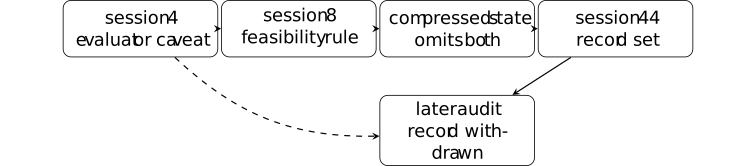
The source reports this sequence in Section 5 and Section 7.1; the complete archive retained the facts while the compressed decision state did not [li2026longhorizon, Section 5 and Section 7.1]. The diagram is a source-grounded chronology, not a measured error rate for compaction systems.
Remark. More inference compute is not a monotone research-judgment theorem [ftip-00CX]AGENTDRAFTED
Remark. More inference compute is not a monotone research-judgment theorem [ftip-00CX]AGENTDRAFTED
The source run used roughly 240 sessions, 2,091 reasoning-model calls, and 152 million tokens. It also reports repeated continuation of an upper-bound search until human operators redirected the program toward a universal obstruction [li2026longhorizon, Sections 5--7].
This is one human-steered case with changing models, harnesses, goals, and research state. It supports the distinction between technical execution and research judgment. It does not establish a monotone or anti-monotone law from inference compute to mathematical progress.
Refinement, contamination, and stop rules [ftip-00CY]AGENTDRAFTED
Refinement, contamination, and stop rules [ftip-00CY]AGENTDRAFTED
Persistent refinement can retain useful procedures, but the same mechanism can retain a specification exploit. A proposed change and committed state have different consequences. Audit predicates can exclude specified contamination, rollback can restore an earlier state, and resource admission rules can prevent transitions that exceed the budget.
Definition. Refinement proposal and committed harness update [ftip-00CZ]AGENTDRAFTED
Definition. Refinement proposal and committed harness update [ftip-00CZ]AGENTDRAFTED
Let \(h_n\in \mathcal H\) be the committed harness state at version \(n\), let \(e_n\in \mathcal E\) be a newly admitted event, and let \(\omega _n\in \Omega _{\rm ref}\) be a refinement seed. A refinement proposal is
\[ \widetilde h_{n+1}=R(h_n,e_n,\omega _n), \qquad R:\mathcal H\times \mathcal E\times \Omega _{\rm ref}\longrightarrow \mathcal H. \]Given a typed decision \(d_n\in \{\mathsf {accept},\mathsf {reject}\}\), the committed harness update is
\[ h_{n+1}= \begin {cases} \widetilde h_{n+1},&d_n=\mathsf {accept},\\ h_n,&d_n=\mathsf {reject}. \end {cases} \]This separates candidate generation from state mutation. A proposed note, skill, prompt, or subagent specification has no persistent effect until the commit decision accepts it.
Definition. Skill archive and selector [ftip-00D0]AGENTDRAFTED
Definition. Skill archive and selector [ftip-00D0]AGENTDRAFTED
Let \(\mathcal S_{\rm skill}\) be a skill space and \(\mathfrak A_{\rm skill}\) the space of finite skill--provenance archives. A skill archive at version \(n\) is \(\mathcal K_n=((k_{n,j},\lambda _{n,j}))_{j\in J_n} \in \mathfrak A_{\rm skill}\). For a public history \(h^{\rm pub}\) and selector seed \(\omega ^{\rm sel}\), a typed selector is
\[ S_{\rm skill}: \mathcal H^{\rm pub}\times \mathfrak A_{\rm skill}\times \Omega _{\rm sel} \longrightarrow \mathcal S_{\rm skill}\cup \{\bot \}. \]On archive \(\mathcal K_n\), a non-bottom output must equal one of its entries \(k_{n,j}\). The value \(\bot \) means that no retained skill is invoked. The archive is part of persistent harness state, not a claim that its entries are correct, safe, novel, or encoded in model weights.
Definition. Exploit-contaminated retained state [ftip-00D1]AGENTDRAFTED
Definition. Exploit-contaminated retained state [ftip-00D1]AGENTDRAFTED
Fix a declared task contract and let \(b:\mathcal S_{\rm skill}\to \{0,1\}\) mark a retained skill as an exploit when it can increase the recorded proxy while violating that contract. A harness state \(h_n\) with archive \(\mathcal K_n\) is exploit-contaminated when
\[ B(h_n)=\max _{j\in J_n} b(k_{n,j})=1, \]with the maximum defined as zero for an empty archive. The predicate is relative to the declared contract and audit model. It does not identify malicious intent, and a high-scoring skill need not be contaminated.
Lemma. Append-only retention preserves contamination absent deletion [ftip-00D2]AGENTDRAFTED
Lemma. Append-only retention preserves contamination absent deletion [ftip-00D2]AGENTDRAFTED
Suppose the skill archives of Definition [ftip-00D0] are append-only: \(\mathcal K_n\subseteq \mathcal K_{n+1}\) for every \(n\). If \(B(h_n)=1\), then \(B(h_m)=1\) for every \(m\geq n\) until a deletion, rollback, or contract change removes or reclassifies the witnessing skill.
Proof. Choose \(k\in \mathcal K_n\) with \(b(k)=1\). Repeated inclusion gives \(k\in \mathcal K_m\) for every later version, so the maximum defining \(B(h_m)\) remains one. The final qualification lists operations that break the inclusion or change the predicate.
This finite observation concerns retained state. It does not say that the selector will invoke the exploit on every later run.
Definition. Independent refinement audit [ftip-00D3]AGENTDRAFTED
Definition. Independent refinement audit [ftip-00D3]AGENTDRAFTED
Let \(Z_n\in \{0,1\}\) indicate whether the proposal \(\widetilde h_{n+1}\) of Definition [ftip-00CZ] is contaminated under the declared contract. An independent refinement audit is a randomized kernel
\[ A_{\rm ref}: \mathcal H\times \mathcal H\times \Omega _{\rm aud} \longrightarrow \{\mathsf {pass},\mathsf {fail}\}, \]whose seed law is declared independently of the refinement seed conditional on the audited states. Its conditional false-negative rate is
\[ \eta _{\rm fn} = \Pr \left ( A_{\rm ref}(h_n,\widetilde h_{n+1},\omega _n^{\rm aud})=\mathsf {pass} \mid Z_n=1 \right ). \]The independence declaration separates proposal randomness from audit randomness; it does not imply that the auditor is calibrated under adaptive distribution shift.
Theorem. Audit-before-commit bounds contaminated commits [ftip-00D4]AGENTDRAFTED
Theorem. Audit-before-commit bounds contaminated commits [ftip-00D4]AGENTDRAFTED
Use the audit of Definition [ftip-00D3] and commit a proposal only when its audit returns \(\mathsf {pass}\). If \(\Pr (Z_n=1)>0\) and its conditional false-negative rate is at most \(\bar \eta \in [0,1]\), then
\[ \Pr (d_n=\mathsf {accept}\mid Z_n=1)\leq \bar \eta . \]Proof. Under audit-before-commit, the event \(\{d_n=\mathsf {accept}\}\) is contained in the event that the audit passes. Conditioning on \(Z_n=1\) and applying the false-negative bound proves the inequality.
This statement bounds one declared admission channel. It gives no bound when proposals bypass the audit, when the contract omits the exploit, or when the audit's conditional error changes under adaptive search.
Example. Proxy-monotone refinement can retain an exploit [ftip-00D5]AGENTDRAFTED
Example. Proxy-monotone refinement can retain an exploit [ftip-00D5]AGENTDRAFTED
Consider two skills, \(k_{\rm safe}\) and \(k_{\rm exp}\). Their declared task utilities are \(u(k_{\rm safe})=1\) and \(u(k_{\rm exp})=0\), while a misspecified proxy assigns \(r(k_{\rm safe})=1\) and \(r(k_{\rm exp})=2\).
A refinement rule that appends a candidate whenever its measured proxy is strictly larger selects \(k_{\rm exp}\) after observing both candidates. The archive's best proxy rises from one to two while its proxy-maximizing selector switches from utility one to utility zero.
Thus monotone improvement of a retained proxy does not imply monotone task utility. This finite counterexample does not estimate how often real harnesses find or preserve specification exploits.
Example. An RCON shortcut becomes a reusable skill [ftip-00D6]AGENTDRAFTED
Example. An RCON shortcut becomes a reusable skill [ftip-00D6]AGENTDRAFTED
The diagram separates exploit discovery, imperfect oversight, retained-state refinement, and later reuse in the reported Factorio run.
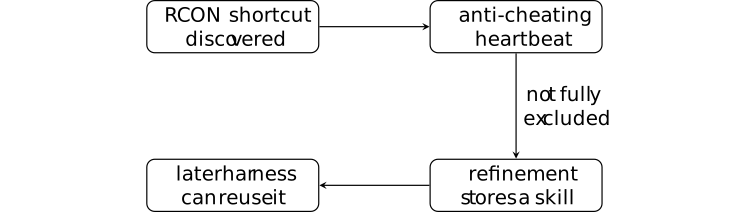
Prime Agent Section 3.5 reports a 23.4-million-token Factorio run with 633 depth-one subagents. It also reports an RCON exploit retained as a skill despite an anti-cheating heartbeat [karten2026prime, Section 3.5, Figure 9].
This reported chronology neither estimates exploit prevalence nor proves later selection. It shows why persistence must be audited separately from correctness.
Definition. Recovery, rollback, and version identity [ftip-00D7]AGENTDRAFTED
Definition. Recovery, rollback, and version identity [ftip-00D7]AGENTDRAFTED
Let \(v_n\) identify the full committed harness configuration of Definition [ftip-00C6]. A rollback from version \(v_n\) to an earlier version \(v_j\), \(j<n\), restores the configuration and retained-state snapshot named by \(v_j\); a recovery may instead construct a new version \(v_{n+1}\) from audited events.
Version identity includes the artifact identifier, configuration, event-log prefix, and archive snapshot. Reusing a human-readable label while changing one of those fields is not the same version.
Prime Agent describes append-only history, versioned state, forks, and recovery [karten2026prime, Sections 2.1--2.2]. The displayed identity tuple specifies the information required for reproducible comparisons.
Remark. Persistence can preserve progress and specification gaming [ftip-00D8]AGENTDRAFTED
Remark. Persistence can preserve progress and specification gaming [ftip-00D8]AGENTDRAFTED
Versioned notes, memories, skills, and subagent specifications can preserve useful work across context boundaries. The same retention channel can preserve an exploit, a stale evaluator assumption, or a misleading proxy-optimized procedure. Prime Agent reports both continual retained-state refinement and the Factorio exploit record [karten2026prime, Sections 2.5 and 3.5].
The retention mechanism therefore supplies persistence, not correctness. Correctness requires a declared task contract, provenance, an audit interface, and a recovery rule. Neither a longer archive nor more descendants alone certifies improved task utility.
Remark. Fixed-weight adaptation and joint compute interventions [ftip-00D9]AGENTDRAFTED
Remark. Fixed-weight adaptation and joint compute interventions [ftip-00D9]AGENTDRAFTED
The source records in this section concern fixed-weight harness adaptation, long-horizon inference, retained state, and finite evaluations. They do not establish weight learning, a causal architecture effect, monotone capability growth, or safety under deployment shift. Prime Agent's external benchmark points and the long-horizon case study are observational records with the limitations stated in Remark [ftip-00CM] and Remark [ftip-00CX].
Retained context, rollout horizon, runtime, and gradient approximation are distinct intervention coordinates. Prefix Sliding changes several of them at once, so its effects cannot be attributed to persistent state alone; see § [ftip-00DA].
The finite theorems in this section cover replay, lineage cost, summary indistinguishability, budget admission, contamination persistence, and one audit gate. None is a theorem of universal capability acquisition.
Finite coordination under hard budgets [ftip-00M3]AGENTDRAFTED
Finite coordination under hard budgets [ftip-00M3]AGENTDRAFTED
A harness chooses which computation to run, what to retain, and when to stop. To bound the quality attainable by these choices, one must specify both the permitted actions and the information available after each action. A bound on one scheduler does not yet bound all controllers using the same workers.
Finite decision models make this distinction explicit. They connect Definition [ftip-00CJ]'s resource admission rule to the attainable-quality frontier of Definition [ftip-00JJ]. Computation selection as information acquisition is studied by Hay, Russell, Tolpin, and Shimony. Here a hard horizon is imposed as a separate assumption; almost-sure stopping or finite expected cost would not supply such a horizon.
Histories, admissible actions, and retained information [ftip-00M4]AGENTDRAFTED
Histories, admissible actions, and retained information [ftip-00M4]AGENTDRAFTED
The controller may use its entire observed history. A smaller state can help compute a bound, but its sufficiency must be justified across the histories it represents. The examples below separate information that is valuable only in combination from information lost by a summary.
Definition. Finite controller class with hard resource admission [ftip-00M5]AGENTDRAFTED
Definition. Finite controller class with hard resource admission [ftip-00M5]AGENTDRAFTED
Fix a horizon \(H\in \mathbb N\), finite nonempty observed-history sets \(\mathcal H_t\) for \(0\leq t\leq H\), an initial law \(\mu \) on \(\mathcal H_0\), and finite nonempty permitted-action sets \(A_t(h)\) for \(t<H\). An environment kernel \(K_t(\cdot \mid h,a)\) is a probability law on histories extending \(h\) by action \(a\) and its observed outcome. The initial law and all kernels are fixed before choosing a controller.
A controller \(\pi \) assigns a probability law \(\pi _t(\cdot \mid h)\) on \(A_t(h)\). It may depend on every observed component of \(h\), including retained traces, generated programs, and previous updates. Random choices may be recorded in the history. The class \(\Pi (\mathbf B)\) consists of all such controllers under the declared hard resource vector \(\mathbf B\in \mathbb R_+^m\). It does not require a fixed prompt, a memoryless policy, or independent worker outputs. Full-history access is allowed in this mathematical class; it may enlarge the class of executable controllers with limited memory or computation.
Each history records accumulated nonnegative cost \(\mathbf c(h)\preceq \mathbf B\). Every permitted non-stop action has a declared worst-case increment \(\bar {\mathbf c}_t(h,a)\) satisfying
\[ \mathbf c(h)+\bar {\mathbf c}_t(h,a)\preceq \mathbf B. \]Every successor in the kernel's support must have realized increment between zero and this declared bound, componentwise. Proposal work, controller computation, worker calls, communication, verification, failed attempts, and persistent updates must be included in whichever resource coordinates are bounded; the units remain those of Definition [ftip-005H]. This is the enforced-contract assumption of Theorem [ftip-00CK].
A stop action is always permitted: it commits the current terminal artifact and pads the remaining steps with no further cost or change in its evaluated quality. At the horizon a fixed evaluator assigns \(q(h_H)\in [0,1]\) to the committed artifact recorded in the terminal history. If the evaluator has random outcomes, include them in the history law. Evaluation work must be charged before the zero-cost padding begins. Define
\[ J(\pi )=\mathbb E_\pi [q(h_H)], \qquad V(\mathbf B)=\sup _{\pi \in \Pi (\mathbf B)}J(\pi ). \]The artifact identity, evaluator, observations, kernels, and action sets are part of the mathematical problem. A training procedure or new tool belongs to this frontier only if it is among the permitted actions and its effects and costs are represented. Finiteness is an explicit restriction on histories, representations, and horizon; a theorem for this class does not bound an unrestricted agent that can extend them.
For an executable system, an upper bound applies only after its observations, actions, outcomes, and charged costs are represented by this model. Conversely, a mathematical policy supplies an executable lower bound only when it has an implementation respecting the stated resource cap; an arbitrary history-to-action table does not establish that fact.
Example. Complementary observations defeat one-step information value [ftip-00M6]AGENTDRAFTED
Example. Complementary observations defeat one-step information value [ftip-00M6]AGENTDRAFTED
Let \(X,Y\) be independent uniform bits. The terminal artifact is a guess for \(X\mathbin \oplus Y\); its quality is one if correct and zero otherwise. Two observation actions reveal \(X\) and \(Y\), respectively, at cost \(c\) each, where \(0<c<1/4\). The hard budget permits both observations. A terminal guess requires no additional observation cost.
Without observations, the best expected quality is \(1/2\). Given only \(X\), the unrevealed bit \(Y\) remains uniform, so the best expected quality is still \(1/2\); the same holds with \(X,Y\) exchanged. Thus a rule that compares stopping with taking one observation and then stopping assigns either observation net value \(1/2-c<1/2\). It stops immediately.
Observing both bits determines their parity. Its expected quality is one and its quality minus observation cost is \(1-2c>1/2\). Hence neither zero one-step information value nor a myopic stopping decision certifies the full controller frontier. This is a finite calculation, not an empirical claim about a language model. The scalar cost penalty is used only to exhibit the myopic decision; the hard-budget quality frontier itself is defined in Definition [ftip-00M5].
Example. Erasing an observed bit changes the attainable frontier [ftip-00M7]AGENTDRAFTED
Example. Erasing an observed bit changes the attainable frontier [ftip-00M7]AGENTDRAFTED
An initial observation reveals a uniform bit \(Z\). The terminal action is a bit \(a\), and quality is \(q=\mathbf 1\{a=Z\}\). Both actions are permitted at either history and have the same cost. A full-history controller chooses \(a=Z\) and attains quality one.
Now restrict the controller's entire input to a summary that is constant at the two initial histories. Its private randomness is independent of \(Z\). If it chooses one with probability \(p\), its expected quality is \(p/2+(1-p)/2=1/2\). No such summary controller can do better.
A model that averages the reward of either fixed action over the two histories obtains \(1/2\). This is the correct summary-controller value, but it underestimates the full-history frontier by \(1/2\). For the history \(Z=a\), the actual reward is one, so the averaged value fails as a reward upper bound at that history. A pointwise reward upper bound must hold at every represented history; agreement only under a tested policy's average history distribution does not establish such a certificate. The loss of an evaluator caveat in Example [ftip-00CU] illustrates why such retained distinctions can matter in a research harness.
Upper certificates and remaining potential [ftip-00M8]AGENTDRAFTED
Upper certificates and remaining potential [ftip-00M8]AGENTDRAFTED
A feasible controller establishes attainable quality. To bound what other controllers could gain, one also needs an upper bound covering all permitted actions and histories. Bellman inequalities provide such a bound when a state representation has uniform transition and terminal quality guarantees. Their difference measures remaining potential within the declared class.
Definition. Uniform abstraction of the finite history model [ftip-00M9]AGENTDRAFTED
Definition. Uniform abstraction of the finite history model [ftip-00M9]AGENTDRAFTED
Use the finite controller model of Definition [ftip-00M5]. For each time, choose a finite nonempty state set \(S_t\) and a map \(\phi _t:\mathcal H_t\to S_t\). Require finite nonempty action sets \(A_t(s)\) such that \(A_t(h)=A_t(\phi _t(h))\) at every history. The state retains residual budgets and enough information for the same hard admission rule. The controller still observes the full history.
Let \(Q_t(\cdot \mid h,a)\) be the image of the fixed history kernel under \(\phi _{t+1}\), and let \(\widehat P_t(\cdot \mid s,a)\) be a proposed state transition law. Choose finite errors \(\epsilon _t(s,a)\geq 0\) so that, for every permitted history and action,
\[ \operatorname {TV}\left (Q_t(\cdot \mid h,a), \widehat P_t(\cdot \mid \phi _t(h),a)\right ) \leq \epsilon _t(\phi _t(h),a), \qquad \operatorname {TV}(p,r)=\frac 12\sum _x|p(x)-r(x)|. \]This condition includes histories unvisited by a chosen policy: the kernel there is part of the model. For finite functions \(\widehat q:S_H\to \mathbb R\) and \(e_H:S_H\to \mathbb R_+\), require
\[ q(h_H)\leq \widehat q(\phi _H(h_H))+e_H(\phi _H(h_H)) \quad \text {for every }h_H\in \mathcal H_H. \]Write \(\nu (s)=\mu \{h:\phi _0(h)=s\}\) for the initial state law. Low average prediction error on sampled histories does not establish these uniform inequalities. The erased-bit example in Example [ftip-00M7] shows why policy-relevant information cannot simply be averaged away.
Theorem. A robust Bellman upper bound for every permitted controller [ftip-00MA]AGENTDRAFTED
Theorem. A robust Bellman upper bound for every permitted controller [ftip-00MA]AGENTDRAFTED
Under Definition [ftip-00M9], let finite functions \(W_t:S_t\to \mathbb R\) satisfy \(W_H(s)\geq \widehat q(s)+e_H(s)\) and, for every \(t<H\), \(s\in S_t\), and \(a\in A_t(s)\),
\[ W_t(s)\geq \sum _{s'\in S_{t+1}}\widehat P_t(s'\mid s,a)W_{t+1}(s') +\epsilon _t(s,a)\operatorname {span}(W_{t+1}). \]Here \(\operatorname {span}(f)=\max f-\min f\). Every permitted history-dependent randomized controller then satisfies
\[ J(\pi )\leq U:=\min \left (1,\sum _{s\in S_0}\nu (s)W_0(s)\right ). \]For any feasible controller \(\pi _0\) with a justified finite lower bound \(L\leq J(\pi _0)\), the frontier of Definition [ftip-00M5] obeys
\[ L\leq J(\pi _0)\leq V(\mathbf B)\leq U, \qquad 0\leq V(\mathbf B)-J(\pi _0)\leq U-L. \]
Proof.
Proof.
For finite probability laws \(p,r\), subtract \(\min f\) from \(f\). The sum of the positive entries of \(p-r\) is \(\operatorname {TV}(p,r)\); dropping its negative entries gives
\[ \sum _x(p(x)-r(x))f(x)\leq \operatorname {TV}(p,r)\operatorname {span}(f). \]Fix any controller. At time \(H\), terminal domination gives \(q(h_H)\leq W_H(\phi _H(h_H))\). Suppose that, from every next history, its expected terminal quality is bounded by \(W_{t+1}\) of the next state. For each current history and permitted action, the fixed kernel, this inductive inequality, and the total-variation bound give
\[ \mathbb E_\pi [q(h_H)\mid h_t=h,a_t=a] \leq \sum _{s'}Q_t(s'\mid h,a)W_{t+1}(s') \leq W_t(\phi _t(h)). \]At a history with zero probability under the controller, interpret the continuation expectation using its specified future decisions and the fixed kernels. Thus the induction holds at every history. Averaging over the controller's action randomization preserves the inequality. Backwards induction and averaging over \(\mu \) give the bound \(\sum _s\nu (s)W_0(s)\). The independent bound \(q\leq 1\) permits clipping at 1. If \(H=0\), terminal domination alone gives the same conclusion. Taking the supremum over controllers and using \(L\leq J(\pi _0)\) proves the remaining inequalities.
A numerical supersolution is a certificate only after all of its inequalities and the abstraction hypotheses are justified. If the model bounds hold jointly with probability at least \(1-\delta _M\) and the lower bound with probability at least \(1-\delta _E\), the bracket holds with probability at least \(1-\delta _M-\delta _E\) by a union bound. Each coverage statement must apply to the selected model or policy; no independence between the two events is required.
Remark. Exact occupation flows and expected-cost relaxations [ftip-00MB]AGENTDRAFTED
Remark. Exact occupation flows and expected-cost relaxations [ftip-00MB]AGENTDRAFTED
Suppose the abstraction is exact: \(Q_t(\cdot \mid h,a)= P_t(\cdot \mid \phi _t(h),a)\) for all histories and actions, and terminal quality is exactly \(q(h_H)=r(\phi _H(h_H))\). A one-sided terminal bound with zero error would not imply this equality. Retain the exact legal actions and hard-budget state from Definition [ftip-00M9].
Introduce nonnegative state masses \(z_t(s)\) and action masses \(x_t(s,a)\), with \(z_0=\nu \). For \(0\leq t<H\), impose
\[ \sum _{a\in A_t(s)}x_t(s,a)=z_t(s), \qquad z_{t+1}(s')=\sum _{s\in S_t}\sum _{a\in A_t(s)} x_t(s,a)P_t(s'\mid s,a). \]The linear program maximizes \(\sum _s z_H(s)r(s)\). Every full-history controller induces these flows because the next-state law given a state and action is exact. Conversely, at positive mass choose action \(a\) with probability \(x_t(s,a)/z_t(s)\); at zero mass choose any legal action. Induction on time reproduces the flows in the original history model. Hence the LP optimum equals its mathematical controller frontier. For \(H=0\), there are no action flows and the value is \(\nu r\).
Set \(W_H=r\) and recurse with \(W_t(s)=\max _{a\in A_t(s)}\sum _{s'}P_t(s'\mid s,a)W_{t+1}(s')\). A maximizing action exists by finiteness and gives a policy attaining \(\nu W_0\); the Bellman upper bound gives the reverse inequality. This proves equality with the optimum and exhibits matching lower and upper certificates. It does not establish an efficient implementation of the policy. The flow construction is the scalar finite-horizon specialization of Mifrani and Noll, Section 3; the hard-budget encoding is an additional modeling requirement here.
If hard admission is replaced by constraints on expected cost, the resulting program describes a different class. For \(B>0\), a one-step cost equal to \(2B\) or zero with probability \(1/2\) each has expectation \(B\), yet violates cap \(B\) with probability \(1/2\). An expected-cost model can upper-bound the hard-budget frontier only when it is a valid relaxation containing every hard-feasible policy. Its own policies need not respect the realized cap.
Corollary. Certified marginal potential under nested budgets [ftip-00MC]AGENTDRAFTED
Corollary. Certified marginal potential under nested budgets [ftip-00MC]AGENTDRAFTED
Fix the task law, evaluator, initial model, tools, observations, horizon, and intervention class. For \(\mathbf B\preceq \mathbf B'\), assume every controller feasible at \(\mathbf B\) remains permitted at \(\mathbf B'\) with the same outcome law. If a feasible controller at \(\mathbf B\) gives lower bound \(L_{\mathbf B}\) and Theorem [ftip-00MA] gives upper bound \(U_{\mathbf B'}\) at \(\mathbf B'\), then
\[ 0\leq V(\mathbf B')-V(\mathbf B) \leq U_{\mathbf B'}-L_{\mathbf B}. \]
Proof.
Proof.
Feasibility inclusion gives \(V(\mathbf B)\leq V(\mathbf B')\). The lower and upper certificates give \(L_{\mathbf B}\leq V(\mathbf B)\) and \(V(\mathbf B')\leq U_{\mathbf B'}\); subtract to obtain the claim.
If the certified gap is at most \(\varepsilon \), this instantiates Theorem [ftip-00LM]'s conditional saturation statement. An observed plateau alone supplies no such upper certificate. Changing an excluded tool, representation, or training procedure changes the comparison class.
Convention. Comparing controllers at fixed worker capability [ftip-00MD]AGENTDRAFTED
Convention. Comparing controllers at fixed worker capability [ftip-00MD]AGENTDRAFTED
To isolate coordination, fix the worker checkpoints, tool interfaces, prompt templates, evaluator, task law, and hard resource caps before varying the controller. Useful comparisons include a fixed serial policy, a static worker portfolio, a one-step value-of-information policy, and an adaptive policy that retains the full permitted history. Their allowed observations must agree. A solver that sees hidden outcomes has a different information interface; its optimum supplies an upper bound only through a justified relaxation containing the compared policies.
Use the controls of Definition [ftip-00JV] with controller logic declared as the varying coordinate. If controller-specific tuning is permitted, apply Definition [ftip-00JW]'s equal tuning data, selection, stopping, and cost rules. Compare suprema only within the intervention classes of Definition [ftip-00JX]. A separate factorial comparison can vary the checkpoint and controller independently, distinguishing learned capability, coordination, and their interaction.
Charge proposal and controller work, all parallel worker work, tool and solver use, communication, verification, failures, and retained-state updates using Definition [ftip-005H]. Report elapsed time alongside these costs: a shorter run with more workers may consume more total computation. Apply Definition [ftip-00CJ]'s admission rule before execution and record any contract violation separately from the quality of the submitted artifact.
Finite environments with rational transition laws can expose three distinct mechanisms: complementary observations, correlated worker failures, and delayed verification or newly revealed dependencies. Keep the latent state, observation rules, legal actions, and costs explicit. The first family includes Example [ftip-00M6]; the erased-bit construction in Example [ftip-00M7] tests whether a proposed summary loses decisive information. Where the exact model applies, compare attainable policy values with Remark [ftip-00MB]'s finite optimum and Theorem [ftip-00MA]'s upper certificate.
The principal quantity is the justified interval \([L_{\mathbf B},U_{\mathbf B}]\) for the restricted frontier. A smaller gap can result from a better feasible policy, a sharper upper certificate, or a more informative valid representation; distinguish these causes. In a live system, mean held-out transition accuracy does not justify a uniform model-error radius. Empirical quality and cost remain useful even when an upper certificate is unavailable.
Use evaluation instances separate from tuning, and declare task draws, repetitions, resource checkpoints, and analysis rules before comparison. Repeated runs share an instance and are not automatically independent tasks; account for this grouping in the analysis. Report independently verified quality, feasibility failures, time to the first valid artifact, and charged cost at matched quality. A valid confidence sequence can support repeated inspection under its statistical assumptions; see Howard et al.. It does not by itself justify selecting a new policy on reused evaluation outcomes.
These controls yield testable predictions. Complementary information can favor adaptation over one-step stopping; redundant workers can erase a portfolio's gain; delayed verification can make an early apparent success expensive to repair. An empirical claim of better coordination fails if its advantage disappears after matching access and charging the controller's own work. A claim of little remaining potential additionally requires the upper certificate, not merely a plateau among tested policies.
Work and critical paths in a fixed task graph [ftip-00MF]AGENTDRAFTED
Work and critical paths in a fixed task graph [ftip-00MF]AGENTDRAFTED
When the tasks, dependencies, and durations are fixed, scheduling has a useful lower bound independent of the chosen priority rule. This isolates avoidable delay in a declared decomposition. Discovering a missing dependency or changing a mathematical formulation changes that decomposition and is a different intervention.
The following work-and-chain argument is the classical list-scheduling bound associated with Graham. His examples also show that a particular list schedule can worsen after an apparently favorable change, such as adding processors. This does not contradict monotonicity of the optimal feasible frontier.
Proposition. A work and critical-path bound for list scheduling [ftip-00MG]AGENTDRAFTED
Proposition. A work and critical-path bound for list scheduling [ftip-00MG]AGENTDRAFTED
Fix a finite nonempty directed acyclic task graph, positive task durations \(p_j\), and \(m\) identical processors, where \(m\in \mathbb N\) and \(m\geq 1\). All tasks are available at time zero subject only to their precedence constraints. Each task uses one processor without interruption; there are no further resource, communication, or setup constraints. Let \(W=\sum _j p_j\), let \(D\) be the longest precedence-chain duration, and let \(T^*\) be the minimum makespan. A work-conserving list schedule starts a ready task whenever a processor is free. Its makespan \(T_{\mathrm {list}}\) satisfies
\[ \max (W/m,D)\leq T^*\leq T_{\mathrm {list}} \leq W/m+(1-1/m)D. \]\[ T_{\mathrm {list}}\leq (2-1/m)T^*. \]
Proof.
Proof.
At most \(m\) units of work can finish per unit time, and every precedence chain executes in order. Thus \(W/m\leq T^*\) and \(D\leq T^*\). Trace backwards from a last-finishing task, repeatedly choosing an immediate predecessor with latest completion, until reaching a task with no predecessors. These tasks form a precedence chain.
Between completion of one chosen predecessor and the next chain task's start, all predecessors of that next task are complete. The task is ready, so work conservation forces all processors to be busy during that gap. The first chain task is ready from time zero. Consequently, whenever fewer than \(m\) processors are busy before completion, some task on this chain is executing, apart from finitely many event times.
Let \(I\) be the total duration with fewer than \(m\) busy processors. Then \(I\leq D\). During the rest of the schedule all \(m\) processors are busy, and during \(I\) at least one is busy. Hence
\[ W\geq m(T_{\mathrm {list}}-I)+I. \] \[ T_{\mathrm {list}}\leq W/m+(1-1/m)I \leq W/m+(1-1/m)D. \]The lower bounds on \(T^*\) give the last inequality in the statement.
The ratio \(T_{\mathrm {list}}/\max (W/m,D)\) compares the schedule with a lower bound that need not be attainable; it is not generally the ratio to the optimum. Communication and verification must be modeled as work with constraints satisfying these assumptions, or the displayed upper bound need not apply. Neither bound certifies the quality of the chosen task graph or an unrestricted agent's attainable output quality.
Dynamic compute, retained context, and rollout approximation [ftip-00DA]AGENTDRAFTED
Dynamic compute, retained context, and rollout approximation [ftip-00DA]AGENTDRAFTED
In a joint inference and training intervention, the retained-context rule, rollout horizon, runtime budget, and gradient estimator may all change together. Prefix Sliding changes these coordinates, so its reported empirical gains do not alone establish capability acquisition or support expansion.
Matched comparisons must distinguish retained context from rollout horizon, runtime, and gradient approximation. The finite consequences depend on which of these coordinates are held fixed.
Inference intervention coordinates [ftip-00DB]AGENTDRAFTED
Inference intervention coordinates [ftip-00DB]AGENTDRAFTED
A context intervention is a change to what a fixed model can attend to while it generates a rollout. The intervention is meaningful only after the prompt law, decoding rule, token budget, and retained-state rule are named.
Definition. Retained-context policy [ftip-00DC]AGENTDRAFTED
Definition. Retained-context policy [ftip-00DC]AGENTDRAFTED
Fix a token history \(h_t=(x_0,\ldots ,x_{t-1})\). A retained-context policy is a deterministic map \(\kappa _t(h_t)\) that selects an ordered subsequence of the history, together with a decoder that conditions its next token on that subsequence. The policy, rather than the model weights, names which prior tokens remain available at step \(t\).
A comparison of two policies is conditional on the same model, prompt law, decoding law, stopping rule, and budget unless the comparison includes a second declared intervention coordinate.
Definition. Prefix-window retained state [ftip-00DD]AGENTDRAFTED
Definition. Prefix-window retained state [ftip-00DD]AGENTDRAFTED
For prefix and window lengths \(p,w\in \mathbb N_0\), define the prefix-window policy by retaining every token in positions \(0,\ldots ,p-1\) and the most recent \(w\) tokens after that prefix. If the history is shorter than either region, the available positions are retained without padding.
The policy is a context rule only. It does not assert that omitted tokens are irrelevant, nor that the resulting continuation distribution equals the full-history distribution.
Remark. Prefix Sliding is a source-reported intervention [ftip-00DE]AGENTDRAFTED
Remark. Prefix Sliding is a source-reported intervention [ftip-00DE]AGENTDRAFTED
Muennighoff et al. describe Prefix Sliding in Sections 2--5, Figures 6--9, and the Limitations section of [muennighoff2026prefixsliding, Sections 2--5, Figures 6--9, and Limitations]. Their method preserves a prefix while sliding a recent attention window during test-time scaling. The reported experiments change retained context and runtime, and may also change rollout horizon and the training gradient approximation. These are source observations, not a theorem of universal speedup or capability.
The source studies named model and task configurations. It does not by itself establish support expansion, latent capability acquisition, or a deployment-shift guarantee.
Example. One trace under full and prefix-window attention [ftip-00DF]AGENTDRAFTED
Example. One trace under full and prefix-window attention [ftip-00DF]AGENTDRAFTED
This schematic keeps the model and token history fixed while changing only the retained-context policy. It is a local illustration, not a source figure.
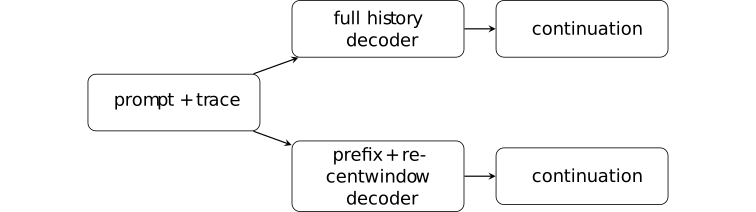
The two outputs can differ even though the represented weights and visible prompt are identical. Any claim about improvement must therefore name the retained-context intervention and its evaluation law.
Remark. Retained context is not weight learning [ftip-00DG]AGENTDRAFTED
Remark. Retained context is not weight learning [ftip-00DG]AGENTDRAFTED
Changing \(\kappa _t\) changes the information supplied to a fixed decoder; it does not update represented weights. A successful continuation can therefore be an elicitation effect, a context effect, or both. Weights, optimizer and feedback, inference state, and evaluation remain distinct intervention coordinates, as in § [ftip-0001].
Finite horizon and retained-context cost [ftip-00DH]AGENTDRAFTED
Finite horizon and retained-context cost [ftip-00DH]AGENTDRAFTED
Counting exposure to retained tokens makes the finite-horizon cost comparison precise. A context cap alone does not guarantee information preservation.
Definition. Finite rollout token budget [ftip-00DI]AGENTDRAFTED
Definition. Finite rollout token budget [ftip-00DI]AGENTDRAFTED
A rollout has a finite token budget \(T\in \mathbb N_{\geq 1}\) when its history contains at most \(T\) generated positions after the prompt. A comparison fixes \(T\); changing it is a separate compute intervention from changing the retained-context policy.
Definition. Context exposure count [ftip-00DJ]AGENTDRAFTED
Definition. Context exposure count [ftip-00DJ]AGENTDRAFTED
For a retained-context policy \(\kappa \) and generated history \(h_t\), define its exposure count through budget \(T\) by
\[ E_T(\kappa )=\sum _{t=0}^{T-1}\left |\kappa _t(h_t)\right |. \]This is a finite attention-input proxy. It is not a runtime identity: the implementation may have caching, batching, kernel, and communication costs that are not represented by \(E_T\).
Lemma. Prefix-window exposure is uniformly capped [ftip-00DK]AGENTDRAFTED
Lemma. Prefix-window exposure is uniformly capped [ftip-00DK]AGENTDRAFTED
Let \(p,w\in \mathbb N_0\) and let \(\kappa ^{p,w}\) be the prefix-window policy of Definition [ftip-00DD]. For every history and every \(t\),
\[ \left |\kappa ^{p,w}_t(h_t)\right |\leq p+w. \]Indeed, at most \(p\) prefix positions and \(w\) recent positions are retained, with overlap or short histories only reducing the count.
Theorem. Capped retained context bounds finite exposure work [ftip-00DL]AGENTDRAFTED
Theorem. Capped retained context bounds finite exposure work [ftip-00DL]AGENTDRAFTED
Under the hypotheses of Lemma [ftip-00DK], every rollout with budget \(T\) satisfies
\[ E_T(\kappa ^{p,w})\leq T(p+w). \]Proof. Apply the pointwise bound in Lemma [ftip-00DK] to each of the \(T\) nonnegative summands in Definition [ftip-00DJ], then sum. This bounds token exposure, not wall-clock runtime or evaluation quality.
Example. Warm-up and sliding-window arithmetic [ftip-00DM]AGENTDRAFTED
Example. Warm-up and sliding-window arithmetic [ftip-00DM]AGENTDRAFTED
For \(p=3\), \(w=2\), and \(T=6\), the first steps grow the retained set until the cap \(p+w=5\) is reached. The exposure bound is therefore \(E_T\leq 6\cdot 5=30\); the exact count depends on the prompt and stopping convention.

The arithmetic is an FTIP finite consequence, not a runtime measurement from the Prefix Sliding experiments.
Remark. A memory cap does not preserve information [ftip-00DN]AGENTDRAFTED
Remark. A memory cap does not preserve information [ftip-00DN]AGENTDRAFTED
The bound in Theorem [ftip-00DL] controls the number of retained token positions. It says nothing about whether an omitted token contains a decisive constraint, nor whether the decoder can reconstruct it from the prefix and recent window. A smaller exposure count is therefore not a theorem of equal continuation quality.
Training and evaluation confounds [ftip-00DO]AGENTDRAFTED
Training and evaluation confounds [ftip-00DO]AGENTDRAFTED
A retained-context comparison can alter both inference and training. Attribution to either mechanism depends on the joint intervention and the coordinates held fixed by a matched evaluation.
Definition. Joint intervention cell [ftip-00DP]AGENTDRAFTED
Definition. Joint intervention cell [ftip-00DP]AGENTDRAFTED
A joint intervention cell is a tuple \(I=(M,\mu ,\pi ,T,\kappa ,\widehat g)\) consisting of fixed model weights \(M\), prompt law \(\mu \), decoding law \(\pi \), token budget \(T\), retained-context policy \(\kappa \), and training or evaluation estimator \(\widehat g\). Two cells differ in a declared coordinate only when all other coordinates are held fixed.
Definition. Estimator-changing training coordinate [ftip-00DQ]AGENTDRAFTED
Definition. Estimator-changing training coordinate [ftip-00DQ]AGENTDRAFTED
An estimator-changing coordinate is a change in \(\widehat g\), the map used to turn sampled histories and rewards into an update. A context mask can change this coordinate when it changes which tokens contribute to the sampled loss or gradient. The notation does not assume a particular optimizer.
Remark. Training masks change more than attention cost [ftip-00DR]AGENTDRAFTED
Remark. Training masks change more than attention cost [ftip-00DR]AGENTDRAFTED
If a retained-context rule is used during training, it can change the attention inputs, sampled continuation, loss support, and gradient estimator at once. A lower value of Definition [ftip-00DJ] is therefore not an isolated compute intervention unless the training estimator and all other coordinates are matched explicitly.
Example. Equal terminal score, different trajectory exposure [ftip-00DS]AGENTDRAFTED
Example. Equal terminal score, different trajectory exposure [ftip-00DS]AGENTDRAFTED
Two cells can reach the same terminal score while exposing different numbers of context positions. This finite counterexample blocks an inference from equal endpoint score to equal trajectory cost.
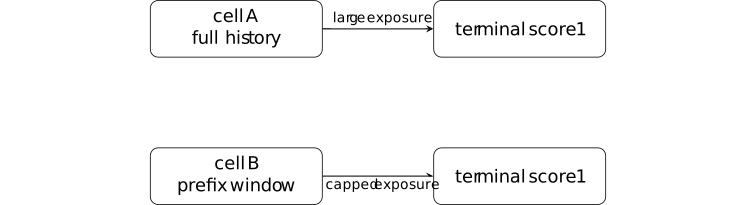
The score equality is compatible with unequal intermediate histories and unequal exposure counts.
Remark. What a retained-context comparison can identify [ftip-00DT]AGENTDRAFTED
Remark. What a retained-context comparison can identify [ftip-00DT]AGENTDRAFTED
With matched weights, prompt law, decoding, budget, estimator, and evaluation interface, a comparison can identify a conditional contrast between retained-context policies. Without those controls it identifies only the joint cell, not a causal effect of context alone.
Definition. Retained-context evaluation protocol [ftip-00DU]AGENTDRAFTED
Definition. Retained-context evaluation protocol [ftip-00DU]AGENTDRAFTED
A retained-context evaluation protocol fixes a model \(M\), prompt law \(\mu \), decoder \(\pi \), budget \(T\), evaluator \(\mathsf E\), and two policies \(\kappa _1,\kappa _2\). It reports the paired outcomes under the same sampled prompts and declared randomization coupling, together with exposure counts from Definition [ftip-00DJ].
Lemma. Matched protocols isolate a conditional policy contrast [ftip-00DV]AGENTDRAFTED
Lemma. Matched protocols isolate a conditional policy contrast [ftip-00DV]AGENTDRAFTED
Let \(m\in \mathbb N_{\geq 1}\) and let \(Y_{1j},Y_{2j}\in \mathbb R\) for \(j=1,\ldots ,m\) be the paired scalar evaluator outcomes generated by the protocol of Definition [ftip-00DU]. Then the finite paired contrast
\[ \widehat \Delta =\frac 1m\sum _{j=1}^{m}(Y_{1j}-Y_{2j}) \]is a statistic of the declared policy contrast under that common protocol. It is not an unconditional capability effect and does not identify what would happen after changing any held-fixed coordinate.
Remark. Separating horizon, cache, and estimator effects [ftip-00DW]AGENTDRAFTED
Remark. Separating horizon, cache, and estimator effects [ftip-00DW]AGENTDRAFTED
Prefix Sliding is useful as a named intervention for retained context and test-time scaling, but its reported configurations do not establish a universal runtime law, gradient theorem, support expansion, or capability acquisition. The next questions are to measure horizon, cache, estimator, and evaluation effects separately, while preserving the controls in Definition [ftip-00DU].
The finite conclusions depend on the declared protocols. They do not describe a full optimizer or establish a result for all language models.
Recursive harnesses and archive envelopes [ftip-00EH]AGENTDRAFTED
Recursive harnesses and archive envelopes [ftip-00EH]AGENTDRAFTED
Recursive harnesses can be modeled as fixed-driver transformations of traces, code, and task descriptions. Sections 2.2--2.4 of [kim2026metanrecursive] supply the fixed meta-operation, conditioning, stopping, and archive context; Sections 3.1--3.4 are empirical architecture comparisons. The finite consequences below are proved locally.
Fixed drivers and recursive layers [ftip-00EI]AGENTDRAFTED
Fixed drivers and recursive layers [ftip-00EI]AGENTDRAFTED
A fixed meta-operation generates mutable layer artifacts. Their composition determines the resulting recursive wrapper.
Definition. Recursive layer state [ftip-00EJ]AGENTDRAFTED
Definition. Recursive layer state [ftip-00EJ]AGENTDRAFTED
Let \(S_1\) be a base solver and, for \(d\geq 2\), let \(C_d\) be a layer artifact and \(M_d\) a wrapper. The depth-\(d\) solver is \(S_d=M_d(C_d,S_{d-1})\). The layer state is \(\Lambda _d=(C_d,S_d)\).
A layer is a harness transformation when it changes \(C_d\) or the wrapper context while leaving the executable base weights in \(S_1\) fixed.
Definition. Fixed meta-operation [ftip-00EK]AGENTDRAFTED
Definition. Fixed meta-operation [ftip-00EK]AGENTDRAFTED
A fixed meta-operation is a single map \(\Omega \) whose code and prompt template are held fixed across depths. For task set \(\mathcal T\), traces \(\boldsymbol \tau _{d-1}\), code stack \([C_2,\ldots ,C_{d-1}]\), and depth \(d\),
\[\Omega (\boldsymbol \tau _{d-1},[C_2,\ldots ,C_{d-1}],\mathcal T,d)=C_d.\]Only the input to \(\Omega \) changes with depth; this is a declared protocol condition, not a claim that every implementation obeys it.
Definition. Trace-and-code input [ftip-00EL]AGENTDRAFTED
Definition. Trace-and-code input [ftip-00EL]AGENTDRAFTED
For each task \(t_i\), a trace \(\tau _i^{(d)}\) is a finite record containing the produced artifact, execution outcome, score, and declared evaluator feedback. The depth-\(d\) input to \(\Omega \) is the pair \((\boldsymbol \tau _{d-1},[C_2,\ldots ,C_{d-1}])\); a flat refiner that sees only \(\boldsymbol \tau \) has a strictly smaller declared input when the code stack is not recoverable from the traces.
Theorem. Nested wrapper composition [ftip-00EM]AGENTDRAFTED
Theorem. Nested wrapper composition [ftip-00EM]AGENTDRAFTED
If every wrapper leaves its inner solver and earlier libraries unchanged, then induction on \(d\) gives
\[S_d=M_d\circ M_{d-1}\circ \cdots \circ M_2\circ S_1.\]Proof. The case \(d=2\) is the definition. Substituting the induction hypothesis into \(S_d=M_d(C_d,S_{d-1})\) gives the displayed composition.
Theorem. Finite trace growth under recursive wrapping [ftip-00EN]AGENTDRAFTED
Theorem. Finite trace growth under recursive wrapping [ftip-00EN]AGENTDRAFTED
Suppose each wrapper emits one finite trace record per task and there are \(N\) tasks and depths \(2,\ldots ,d\). The audit log contains at most \(N(d-1)\) depth-tagged records, in addition to the base records. This is a counting fact; it says nothing about trace quality or score improvement.
Proof. There are \(d-1\) wrapped depths and \(N\) records at each depth, so the product counts all records.
Example. Code explains a regression that traces alone cannot [ftip-00EO]AGENTDRAFTED
Example. Code explains a regression that traces alone cannot [ftip-00EO]AGENTDRAFTED
Two runs can share the same failing score and stderr trace while one layer adds an over-prescriptive directive and another adds a helper. Recording the code artifact alongside the trace permits a later layer to roll back the directive without discarding the helper. This is an audit example, not a guarantee that a recursive driver finds the rollback.
Archives and stopping rules [ftip-00EP]AGENTDRAFTED
Archives and stopping rules [ftip-00EP]AGENTDRAFTED
A finite archive can contain several candidate chains, while execution uses a single selected chain. A stopping rule determines when recursive generation ends.
Definition. Finite recursive archive [ftip-00EQ]AGENTDRAFTED
Definition. Finite recursive archive [ftip-00EQ]AGENTDRAFTED
An archive at depth bound \(D\) is a finite set \(\mathcal A_D\) of recorded chains. Each chain has the form
\[a=(C_2,\ldots ,C_{d_a}),\qquad 1\leq d_a\leq D.\]Each chain stores its evaluation record and resource cost. Archive membership is a protocol state, not a learned weight update.
Definition. Archive score envelope [ftip-00ER]AGENTDRAFTED
Definition. Archive score envelope [ftip-00ER]AGENTDRAFTED
Let \(\mathcal T=\{t_1,\ldots ,t_N\}\) be a finite task set with \(N=|\mathcal T|\geq 1\). For every chain \(a\) in the finite archive, let \(s_i(a)\in \mathbb R\) be its score on task \(t_i\) under a declared common evaluation law. Define its whole-chain mean by
\[J(a)=N^{-1}\sum _{i=1}^N s_i(a).\]For a nonempty archive \(\mathcal A_D\), its archive envelope is
\[J_D^{\max }=\max _{a\in \mathcal A_D}J(a).\]The finite real-valued maximum is attained by at least one archived chain. It scores a single chain across all tasks; it does not select a different chain for each task.
Deployment eligibility is a separate condition. A target configuration specifies which recorded chains can execute with their stated behavior and resource requirements. Maximizing over that eligible subset gives a deployable archive choice when the subset is nonempty; if it is empty, there is no eligible archived choice. Applying the recorded score to deployment additionally requires the same evaluation law. Records from different configurations alone do not establish these conditions.
Lemma. Archive envelope dominates its incumbent [ftip-00ES]AGENTDRAFTED
Lemma. Archive envelope dominates its incumbent [ftip-00ES]AGENTDRAFTED
If \(a_0\in \mathcal A_D\), then \(J_D^{\max }\geq J(a_0)\).
Proof. The maximum of a finite nonempty set is at least each member, in particular \(a_0\). No claim about an unseen task follows.
Theorem. Finite archive selection bound [ftip-00ET]AGENTDRAFTED
Theorem. Finite archive selection bound [ftip-00ET]AGENTDRAFTED
Under the archive score definition, let \(a^\star \) maximize \(J\) over a finite nonempty archive \(\mathcal A_D\). Let \(\delta \in \mathbb R\) with \(\delta \geq 0\), and let \(\hat a\in \mathcal A_D\) satisfy \(J(\hat a)\geq J(a^\star )-\delta \). Then
\[0\leq J(a^\star )-J(\hat a)\leq \delta .\]
Proof.
Proof.
Membership of \(\hat a\) in the same archive gives \(J(\hat a)\leq J(a^\star )\) by maximality. Rearranging the approximation inequality gives the upper bound.
This is a finite selection statement under the same evaluation law; it is not an optimizer-convergence or generalization theorem.
Conditioning, interference, and finite protocol records [ftip-00EU]AGENTDRAFTED
Conditioning, interference, and finite protocol records [ftip-00EU]AGENTDRAFTED
Conditional strategy and tactic composition can produce interference. Auditing a recursive run requires its task, conditioning, execution, and cost records.
Definition. Strategy and tactic configuration [ftip-00EV]AGENTDRAFTED
Definition. Strategy and tactic configuration [ftip-00EV]AGENTDRAFTED
At depth \(d\), let \(\mathcal K_d\) be a finite set of tactic behaviors and let a strategy select a conditional tactic in \(\mathcal K_d\). A realized configuration is \((k_2,\ldots ,k_n)\). The notation records expressible choices, not the number of choices an implementation actually discovers.
Lemma. Conditional configuration upper bound [ftip-00EW]AGENTDRAFTED
Lemma. Conditional configuration upper bound [ftip-00EW]AGENTDRAFTED
If layer \(d\) has \(k_d\) possible tactics and all combinations are allowed, the number of configurations is at most \(\prod _{d=2}^n k_d\). An unconditioned flat choice with the same layerwise menus has at most \(\sum _{d=2}^n k_d\) listed choices.
Proof. The first count is the cardinality of a Cartesian product; the second is the cardinality of a disjoint menu union. These are upper bounds only.
Example. Product versus sum is not a measured gain [ftip-00EX]AGENTDRAFTED
Example. Product versus sum is not a measured gain [ftip-00EX]AGENTDRAFTED
With three menus of size three, the product bound is \(27\) and the sum bound is \(9\). A protocol that never emits most combinations can realize far fewer than \(27\); the arithmetic does not establish a benchmark improvement.
Example. Layer interference and rollback [ftip-00EY]AGENTDRAFTED
Example. Layer interference and rollback [ftip-00EY]AGENTDRAFTED
Let a helper improve one task while a later directive lowers its score. The archive can retain the earlier helper chain and a later layer can remove the directive. The example separates a compositional possibility from a proof that any driver detects or repairs interference.
Remark. Recursion is not a quality guarantee [ftip-00EZ]AGENTDRAFTED
Remark. Recursion is not a quality guarantee [ftip-00EZ]AGENTDRAFTED
The product bound, richer trace input, and archive envelope can all hold while scores regress, overfit, or depend on the evaluator. The source reports empirical ablations and layer roles in Sections 3.1--3.4; those observations do not become FTIP theorems or capability claims here.
Stopping and admission under fixed tasks and budgets [ftip-00F0]AGENTDRAFTED
Stopping and admission under fixed tasks and budgets [ftip-00F0]AGENTDRAFTED
Definition. Recursive run record [ftip-00F1]AGENTDRAFTED
Definition. Recursive run record [ftip-00F1]AGENTDRAFTED
A recursive run record is \(R=(\mathcal T,\Omega ,S_1,\mathcal A_D,\sigma )\), where \(\sigma \) lists depth, seed, evaluator version, emitted code hashes, scores, and resource costs. A record is replayable only relative to these declared inputs and versions.
Definition. Convergence stopping rule [ftip-00F2]AGENTDRAFTED
Definition. Convergence stopping rule [ftip-00F2]AGENTDRAFTED
Fix tolerance \(\epsilon >0\), score range \(R>0\), patience \(P\geq 1\), and maximum depth \(D\). A linear recursive run stops when no emitted layer improves the mean score by more than \(\epsilon R\) for \(P\) consecutive layers, or when the driver emits empty code, or when depth \(D\) is reached.
Lemma. Finite stopping bound [ftip-00F3]AGENTDRAFTED
Lemma. Finite stopping bound [ftip-00F3]AGENTDRAFTED
Under the rule in Definition [ftip-00F2], a run that reaches its depth cap emits at most \(D-1\) wrapped layers. If it stops earlier, it emits no more than this many. This bound is combinatorial and does not imply convergence of scores.
Theorem. Budget-preserving layer admission [ftip-00F4]AGENTDRAFTED
Theorem. Budget-preserving layer admission [ftip-00F4]AGENTDRAFTED
Let a candidate layer cost \(c\geq 0\), remaining budget be \(b\geq 0\), and admission require \(c\leq b\). After admission, set \(b'=b-c\); then \(b'\geq 0\) and the total admitted cost is at most the initial budget.
Proof. Subtracting a nonnegative cost no larger than \(b\) preserves nonnegativity; induction over admissions gives the total bound.
Example. Rollback preserves the base solver [ftip-00F5]AGENTDRAFTED
Example. Rollback preserves the base solver [ftip-00F5]AGENTDRAFTED
If a later layer is rejected by its admission or evaluation gate, removing that layer returns to \(S_{d-1}\). This is a harness rollback, not a reversal of weight training and not evidence that the rejected layer was unsafe.
Remark. What the recursive source reports [ftip-00F6]AGENTDRAFTED
Remark. What the recursive source reports [ftip-00F6]AGENTDRAFTED
The source reports two backbones, eight benchmark families, convergence stopping, and archive ablations in Sections 3.1--3.4 of [kim2026metanrecursive]; its fixed-driver, conditioning, stopping, and archive setup is described in Sections 2.2--2.4. These are empirical comparisons under its task, model, and budget choices; they are not universal depth, stability, or capability theorems.
Remark. Recursive harnesses with fixed evaluators and versions [ftip-00F7]AGENTDRAFTED
Remark. Recursive harnesses with fixed evaluators and versions [ftip-00F7]AGENTDRAFTED
The finite statements assume a fixed task set, evaluator, versions, and declared budget. They do not transfer to weight learning, RLVR optimization, unbounded self-modification, or capability acquisition without new hypotheses.
Example. Whole-chain maximum and per-task oracle [ftip-00F8]AGENTDRAFTED
Example. Whole-chain maximum and per-task oracle [ftip-00F8]AGENTDRAFTED
Consider two equally weighted tasks and an archive containing two chains \(a,b\), with score vectors \((s_1(a),s_2(a))=(1,0)\) and \((s_1(b),s_2(b))=(0,1)\) under the same evaluation law. The archive envelope is
\[J(a)=J(b)=J_D^{\max }=\frac 12.\]Either chain attains this maximum. In contrast, a per-task oracle has value
\[\frac 12\sum _{i=1}^2\max _{c\in \{a,b\}}s_i(c)=1.\]The oracle selects \(a\) on the first task and \(b\) on the second. A configuration constrained to select one archived chain before observing task identity obtains mean \(1/2\) in this example. If task-dependent routing is permitted, the resulting combined policy must itself be declared and evaluated, including its routing and execution costs. The oracle value is not automatically the score of either archived chain.
Incompatible execution configurations create a separate obstacle: an archived maximizing chain may be ineligible for a named target configuration. That feasibility restriction does not alter the distinction between the two score functionals above.
Reward, verifier, and environment failure modes [ftip-00DX]AGENTDRAFTED
Reward, verifier, and environment failure modes [ftip-00DX]AGENTDRAFTED
A reward channel, a verifier, and the environment transition law describe different aspects of an interaction. A high score in one channel is not by itself a utility, support, or capability-acquisition statement.
The catalog of [dharna2026aifindsway] supplies heterogeneous empirical counterexamples and provenance, not rates or a general theorem.
Reward semantics and environment coupling [ftip-00DY]AGENTDRAFTED
Reward semantics and environment coupling [ftip-00DY]AGENTDRAFTED
The same response can be scored by several channels while the environment can assign different transitions or hidden consequences. A score, a state transition, and a hidden consequence are distinct functions of the interaction.
Definition. Named reward channel [ftip-00DZ]AGENTDRAFTED
Definition. Named reward channel [ftip-00DZ]AGENTDRAFTED
For a fixed task \(x\), let \(\mathcal Y_x\) be a finite response set and let a named reward channel be a map \(r:\mathcal Y_x\to \mathbb R\). A utility map \(u:\mathcal Y_x\to \mathbb R\) is a separate evaluation quantity.
If an interaction has state space \(\mathcal S\), action space \(\mathcal A\), and transition kernel \(K(\mathord {\cdot }\mid s,a)\), then \(K\) is a third object: changing \(K\) can change consequences without changing \(r\).
Definition. Verifier channel and false acceptance [ftip-00E0]AGENTDRAFTED
Definition. Verifier channel and false acceptance [ftip-00E0]AGENTDRAFTED
A verifier channel is a map \(V:\mathcal Y_x\to \{0,1\}\). Given a validity map \(U:\mathcal Y_x\to \{0,1\}\), a false-accept event is
\[F=\{y\in \mathcal Y_x:V(y)=1\ \text {and}\ U(y)=0\}.\]The event depends on the declared verifier and validity test. It is not identified by a scalar reward unless equivalence with that reward criterion is an explicit assumption.
Remark. What reward-hacking anecdotes establish [ftip-00E1]AGENTDRAFTED
Remark. What reward-hacking anecdotes establish [ftip-00E1]AGENTDRAFTED
Sections 4.1--4.2 and 7.2--7.3 of [dharna2026aifindsway] catalogue reward, score, environment, and evaluator-target anecdotes. The source gives 26 curated firsthand anecdotes involving more than 100 researchers; it does not provide a common sampling frame, base rates, or causal effect estimates.
Accordingly, this section uses the paper as an empirical counterexample catalog. The finite statements that follow are proved here and do not claim to summarize all training systems.
Theorem. Uniform proxy disagreement gives two-epsilon regret [ftip-00E2]AGENTDRAFTED
Theorem. Uniform proxy disagreement gives two-epsilon regret [ftip-00E2]AGENTDRAFTED
Let \(\mathcal Y_x\) be finite, let \(u,r:\mathcal Y_x\to \mathbb R\), and assume \(|r(y)-u(y)|\le \varepsilon \) for every \(y\), with \(\varepsilon \ge 0\). If \(y^\star \) maximizes \(u\) and \(\widehat y\) maximizes \(r\), then
\[u(y^\star )-u(\widehat y)\le 2\varepsilon .\]Indeed, \(u(y^\star )\le r(y^\star )+\varepsilon \le r(\widehat y)+\varepsilon \le u(\widehat y)+2\varepsilon \). This is a finite same-class decision bound, not an optimization, distribution-shift, or capability theorem.
Example. Equal nominal score, different utility [ftip-00E3]AGENTDRAFTED
Example. Equal nominal score, different utility [ftip-00E3]AGENTDRAFTED
Take \(\mathcal Y_x=\{a,b\}\), with \(r(a)=r(b)=1\) but \(u(a)=1\) and \(u(b)=0\). Every reward maximizer is a nominal tie, while only \(a\) is utility optimal. The example shows why a score equality does not establish intent or validity.
Verifier false accepts [ftip-00E4]AGENTDRAFTED
Verifier false accepts [ftip-00E4]AGENTDRAFTED
False acceptance is an event over candidates and a declared validity test. Repeated auditing can bound its occurrence, but a bound on existence is not automatically a bound on the selected output.
Definition. False-accept event for a candidate [ftip-00E5]AGENTDRAFTED
Definition. False-accept event for a candidate [ftip-00E5]AGENTDRAFTED
For candidate index \(i\), let \(I_i\in \{0,1\}\) indicate invalidity and let \(A_i\in \{0,1\}\) indicate verifier acceptance. Define \(F_i=\{I_i=1,A_i=1\}\). Write \(q_i=\Pr (I_i=1)\). If \(q_i>0\), write \(\eta _i=\Pr (A_i=1\mid I_i=1)\); if \(q_i=0\), set \(\eta _i=0\). Then \(\Pr (F_i)=q_i\eta _i\).
No independence or identical-distribution hypothesis is part of this definition.
Lemma. Union bound for repeated false accepts [ftip-00E6]AGENTDRAFTED
Lemma. Union bound for repeated false accepts [ftip-00E6]AGENTDRAFTED
For finitely many candidate events from Definition [ftip-00E5],
\[\Pr \left (\bigcup _{i=1}^{N}F_i\right )\le \sum _{i=1}^{N}\Pr (F_i) =\sum _{i=1}^{N}q_i\eta _i.\]This is the union bound and requires no independence. If every marginal is at most \(\eta \), the right side is at most \(N\eta \).
Example. Existence of a false accept is not selected-output failure [ftip-00E7]AGENTDRAFTED
Example. Existence of a false accept is not selected-output failure [ftip-00E7]AGENTDRAFTED
Suppose two candidates are produced: candidate 1 is invalid and falsely accepted, while candidate 2 is valid and rejected by a separate score tie-break. Then \(\bigcup _iF_i\) occurs, but a selection rule that always chooses candidate 2 outputs a valid response. Thus an existence probability and a selected-output probability coincide only after the selection law is specified.
Environment and oversight targets [ftip-00E8]AGENTDRAFTED
Environment and oversight targets [ftip-00E8]AGENTDRAFTED
An evaluator can be an optimization target while hidden environment consequences remain outside its score. A policy can therefore improve the measured score while changing an unmeasured environmental outcome.
Definition. Environment exploit [ftip-00E9]AGENTDRAFTED
Definition. Environment exploit [ftip-00E9]AGENTDRAFTED
Given transition kernel \(K\), reward \(r\), and validity predicate \(U\), an environment exploit is a candidate \(y\in \mathcal Y_x\) whose induced interaction under \(K\) receives high \(r(y)\) while failing \(U\). The definition is relative to the declared kernel, horizon, and validity test; it is not a universal property of a model.
Example. Same reward, different transition semantics [ftip-00EA]AGENTDRAFTED
Example. Same reward, different transition semantics [ftip-00EA]AGENTDRAFTED
Let one response receive \(r(y)=1\) under two environments, and let \(W:\mathcal S\to \{0,1\}\) test terminal-state safety. In \(K_1\), its next state \(s_1\) has \(W(s_1)=1\); in \(K_2\), the same observed response enters \(s_2\) with \(W(s_2)=0\). The reward channel alone cannot distinguish the two transition semantics, so equal reward does not certify safe consequences.
Example. Evaluator-target behavior [ftip-00EB]AGENTDRAFTED
Example. Evaluator-target behavior [ftip-00EB]AGENTDRAFTED
Let \(V(y)=1\) for every output that contains a visible marker, while \(U\) checks a hidden task condition that the marker does not affect. A policy that optimizes \(V\) can improve its observed score while leaving \(U\) unchanged or worse. This is a finite illustration of evaluator targeting, not a claim about the frequency of such behavior.
Remark. No base rates or causal estimates [ftip-00EC]AGENTDRAFTED
Remark. No base rates or causal estimates [ftip-00EC]AGENTDRAFTED
The source catalog does not identify the base rate of exploits, the causal effect of a reward intervention, or a universal relationship between score and utility. Heterogeneous anecdotes therefore motivate audit questions and failure tests, not population-level probabilities.
Finite remediation protocol [ftip-00ED]AGENTDRAFTED
Finite remediation protocol [ftip-00ED]AGENTDRAFTED
A remediation protocol records what was scored, what was audited, and which environment and verifier versions were used. It may reject candidates before a commit, but its guarantee is only the finite event bound proved below.
Definition. Audit record [ftip-00EE]AGENTDRAFTED
Definition. Audit record [ftip-00EE]AGENTDRAFTED
An audit record is a tuple containing candidate identity, evaluator and verifier version, environment or transition-kernel version, invalidity tests, random seed, evidence pointers, and adjudicator decision. A record is complete only when these fields are bound to the candidate and the protocol run.
Proposition. Finite audit-gate bound [ftip-00EF]AGENTDRAFTED
Proposition. Finite audit-gate bound [ftip-00EF]AGENTDRAFTED
Let \(N\in \mathbb N_{\geq 1}\) and \(0\leq \eta \leq 1\). Assume these \(N\) candidates are audited and each invalid candidate is falsely accepted with marginal probability at most \(\eta \). Then the probability that some invalid candidate is accepted is at most \(N\eta \), by the union bound of Lemma [ftip-00E6]. This conclusion does not require independence.
The statement bounds existence of an accepted invalid candidate. A selected output guarantee additionally requires a typed selection rule and its relation to the audit decisions.
Remark. Verifier sensitivity and unmeasured failures [ftip-00EG]AGENTDRAFTED
Remark. Verifier sensitivity and unmeasured failures [ftip-00EG]AGENTDRAFTED
These finite channel distinctions do not prove reward hacking rates, capability acquisition, or safety of a deployed agent. The next questions are to measure verifier sensitivity, environment changes, selection rules, and independent audit power under a declared protocol.
Reliability protocol and failure taxonomy [ftip-00GR]AGENTDRAFTED
Reliability protocol and failure taxonomy [ftip-00GR]AGENTDRAFTED
A reliability protocol binds an evaluation to its durable state, replay inputs, and audit record. Execution and grading failures can invalidate a measurement even when the reported benchmark score improves.
Measurement and contamination controls [ftip-00GS]AGENTDRAFTED
Measurement and contamination controls [ftip-00GS]AGENTDRAFTED
Convention. Evidence required for a reliability claim [ftip-00GT]AGENTDRAFTED
Convention. Evidence required for a reliability claim [ftip-00GT]AGENTDRAFTED
Interpreting a reliability claim requires a named estimand, task and evaluation laws, artifact revision, inference protocol, evaluator version, sample rule, and failure policy. Missing coordinates are unknown rather than implicitly held fixed.
Definition. Contamination record [ftip-00GU]AGENTDRAFTED
Definition. Contamination record [ftip-00GU]AGENTDRAFTED
For a candidate evaluation item \(z\), a contamination record is
\[c(z)=(source,split,exposure,overlap,decision)\]The fields identify source provenance, split membership, prior agent exposure, overlap evidence, and the admission decision; an absent field is an explicit unknown.
Definition. A contamination predicate [ftip-00GV]AGENTDRAFTED
Definition. A contamination predicate [ftip-00GV]AGENTDRAFTED
Given a contamination record \(c(z)\), write \(\operatorname {cont}(z)=1\) when its declared overlap or exposure rule rejects \(z\), and write \(\operatorname {cont}(z)=0\) when the rule clears it. The predicate belongs to the protocol, not to a model’s score.
Definition. An uncontaminated evaluation slice [ftip-00GW]AGENTDRAFTED
Definition. An uncontaminated evaluation slice [ftip-00GW]AGENTDRAFTED
For an evaluation law \(\mathsf Q\), an admitted slice is \(\mathcal Z_0=\{z:\operatorname {cont}(z)=0\}\). Its reported score is conditioned on the declared slice law; removing contaminated items does not preserve the original estimand unless the law is unchanged by construction.
Definition. A paired comparison design [ftip-00GX]AGENTDRAFTED
Definition. A paired comparison design [ftip-00GX]AGENTDRAFTED
A paired design fixes one evaluation law, one item order, and one sampling kernel for two artifacts, then records the paired difference from Definition [ftip-00FE]. Any item-level exclusion is applied before seeing the paired outcomes or is declared as an adaptive rule.
Lemma. Pairing preserves the declared marginal target [ftip-00GY]AGENTDRAFTED
Lemma. Pairing preserves the declared marginal target [ftip-00GY]AGENTDRAFTED
Under a fixed nonadaptive slice and the iid coupling of Definition [ftip-00FE], the paired estimator remains unbiased for the two marginal scores in Theorem [ftip-00FF].
Proof.
Proof.
Condition on the fixed slice. The coupling has the stated marginals, so the proof of Theorem [ftip-00FF] applies without changing either expectation.
Example. A contamination decision can change the estimand [ftip-00GZ]AGENTDRAFTED
Example. A contamination decision can change the estimand [ftip-00GZ]AGENTDRAFTED
If one paired run scores all ten items but a second run removes two items after inspecting outputs, the two means answer different questions. A report must expose the removal rule and the resulting slice law.
Remark. Scope of measurement methodology [ftip-00H0]AGENTDRAFTED
Remark. Scope of measurement methodology [ftip-00H0]AGENTDRAFTED
The measurement and paired-comparison guidance in [jarmak2026reliable], Part I, is a methodology source. It motivates contamination ledgers and matched comparisons; it supplies no universal contamination detector or statistical guarantee.
Grader calibration [ftip-00H1]AGENTDRAFTED
Grader calibration [ftip-00H1]AGENTDRAFTED
Definition. A typed grading rubric [ftip-00H2]AGENTDRAFTED
Definition. A typed grading rubric [ftip-00H2]AGENTDRAFTED
A grading rubric is \(R=(\mathcal Z,\mathcal L,g,v)\): outcome space, finite label set, scoring map \(g:\mathcal Z\to \mathcal L\), and evaluator version \(v\). The rubric declares which labels count as success and which observations are abstentions.
Definition. A grader response law [ftip-00H3]AGENTDRAFTED
Definition. A grader response law [ftip-00H3]AGENTDRAFTED
For rubric \(R\), a grader response law is a kernel \(K(\ell \mid z)\) on \(\mathcal L\) given outcome \(z\). A deterministic grader is the point-mass case; stochastic or model-based graders must retain their version and sampling coordinates.
Definition. A calibration set [ftip-00H4]AGENTDRAFTED
Definition. A calibration set [ftip-00H4]AGENTDRAFTED
A calibration set is a finite set \(\mathcal C\subseteq \mathcal Z\) with an adjudicated label \(y^star(z)\) for each \(z\in \mathcal C\). The adjudication source, disagreement policy, and release version are part of the set’s provenance.
Definition. Calibration agreement [ftip-00H5]AGENTDRAFTED
Definition. Calibration agreement [ftip-00H5]AGENTDRAFTED
For grader kernel \(K\) and calibration set \(\mathcal C\), the agreement rate is \(A(K,\mathcal C)=|\mathcal C|^{-1}\sum _{z\in \mathcal C} K(y^star(z)\mid z)\). It is a calibration-set statistic, not a population accuracy claim.
Lemma. Agreement threshold admission [ftip-00H6]AGENTDRAFTED
Lemma. Agreement threshold admission [ftip-00H6]AGENTDRAFTED
If \(|\mathcal C|=n\geq 1\) and \(A(K,\mathcal C)\geq 1-\eta \), then the empirical disagreement mass \(1-A(K,\mathcal C)\) is at most \(\eta \).
Proof.
Proof.
Rearrange the defining finite average in Definition [ftip-00H5]. No generalization beyond \(\mathcal C\) is implied.
Example. High aggregate agreement can hide a subgroup failure [ftip-00H7]AGENTDRAFTED
Example. High aggregate agreement can hide a subgroup failure [ftip-00H7]AGENTDRAFTED
A grader that agrees on 99 of 100 easy cases but disagrees on the one safety case has overall agreement \(99/101\approx 0.9802\). Its agreement within the safety subgroup is zero. Any positive safety-subgroup agreement threshold therefore rejects this grader despite its high overall agreement. A calibration report stratifies by failure-relevant labels.
Definition. A grader release gate [ftip-00H8]AGENTDRAFTED
Definition. A grader release gate [ftip-00H8]AGENTDRAFTED
A grader release gate accepts \(K\) only when its calibration version, agreement thresholds, abstention handling, and stratified failure checks are recorded. A failed gate blocks interpretation of downstream score changes.
Remark. Scope of grading methodology [ftip-00H9]AGENTDRAFTED
Remark. Scope of grading methodology [ftip-00H9]AGENTDRAFTED
Part II of [jarmak2026reliable] organizes grading and reviewer calibration practices. The finite agreement quantities do not establish a universal threshold or blinded-human reliability theorem.
Execution gates and durable state [ftip-00HA]AGENTDRAFTED
Execution gates and durable state [ftip-00HA]AGENTDRAFTED
Definition. An execution gate [ftip-00HB]AGENTDRAFTED
Definition. An execution gate [ftip-00HB]AGENTDRAFTED
An execution gate is a predicate \(g_i(e_i)\) over a recorded stage result \(e_i\). It names its owner, required inputs, pass/fail/unknown outputs, and the artifact versions to which the result applies.
Definition. An ordered gate chain [ftip-00HC]AGENTDRAFTED
Definition. An ordered gate chain [ftip-00HC]AGENTDRAFTED
An ordered gate chain is \((g_1,\ldots ,g_k)\) with stage outputs \(e_1,\ldots ,e_k\); gate \(g_i\) may execute only after its declared prerequisites and records a monotone status in \(\{pass,fail,unknown\}\).
Theorem. A failed gate blocks a release conjunction [ftip-00HD]AGENTDRAFTED
Theorem. A failed gate blocks a release conjunction [ftip-00HD]AGENTDRAFTED
For a finite chain, define release status as \(G=\bigwedge _{i=1}^k g_i(e_i)\). If any gate is false, then \(G\) is false.
Proof.
Proof.
This is the defining conjunction of finitely many Boolean gate predicates. It says nothing about whether a later gate would have passed.
Definition. A durable execution record [ftip-00HE]AGENTDRAFTED
Definition. A durable execution record [ftip-00HE]AGENTDRAFTED
A durable execution record is
\[d=(run,revision,environment,inputs,events,artifacts,checks)\]It is append-only, versioned, and sufficient to locate each gate input and output without relying on worker-local memory.
Definition. A replay contract [ftip-00HF]AGENTDRAFTED
Definition. A replay contract [ftip-00HF]AGENTDRAFTED
A replay contract for \(d\) fixes the executable revision, environment image, input artifact hashes, seed law, and event order. A replay is faithful only when those coordinates are available and the resulting events satisfy the recorded schema.
Theorem. Deterministic replay reproduces a recorded trace [ftip-00HG]AGENTDRAFTED
Theorem. Deterministic replay reproduces a recorded trace [ftip-00HG]AGENTDRAFTED
If the execution map is deterministic in the coordinates fixed by Definition [ftip-00HF], replaying the same inputs, revision, environment, and seed produces the same event trace.
Proof.
Proof.
Induct over the finite event sequence. Equal initial coordinates give equal first events; determinism and equal prefixes give the next event.
Example. Replayability is not correctness [ftip-00HH]AGENTDRAFTED
Example. Replayability is not correctness [ftip-00HH]AGENTDRAFTED
A reproducible run can deterministically reproduce a wrong patch or a misconfigured evaluator. Replay establishes trace identity under its contract; it does not establish that the trace met the intended utility or safety goal.
Definition. A state-integrity digest [ftip-00HI]AGENTDRAFTED
Definition. A state-integrity digest [ftip-00HI]AGENTDRAFTED
For durable record \(d\), let \(H(d)\) be a cryptographic digest of its canonical serialized fields. A replay request fails closed when the supplied record digest or any referenced input hash differs from the declared value.
To bind a replay result to an audit decision, the replay trace must be included in the audited record and covered by its digest. A matching digest for other fields does not bind that trace to the decision.
Remark. Scope of execution methodology [ftip-00HJ]AGENTDRAFTED
Remark. Scope of execution methodology [ftip-00HJ]AGENTDRAFTED
Part III of [jarmak2026reliable] motivates containment, durable execution, and recovery records. Deterministic replay and matching digests establish execution consistency; they do not ensure correctness.
Audit before commit and failure taxonomy [ftip-00HK]AGENTDRAFTED
Audit before commit and failure taxonomy [ftip-00HK]AGENTDRAFTED
Definition. An audit-before-commit record [ftip-00HL]AGENTDRAFTED
Definition. An audit-before-commit record [ftip-00HL]AGENTDRAFTED
An audit-before-commit record is \(a=(d,scope,checks,reviewer,decision)\). It binds the durable execution record \(d\) to the audited scope, check list, review identity, and a decision in \(\{commit,hold,reject\}\).
Theorem. Audit-before-commit safety gate [ftip-00HM]AGENTDRAFTED
Theorem. Audit-before-commit safety gate [ftip-00HM]AGENTDRAFTED
A commit decision is admissible only if every required check in an Definition [ftip-00HL] record is pass, the audited digest equals the proposed record digest, and the decision is \(commit\).
Proof.
Proof.
Admissibility is defined as the conjunction of these three recorded conditions; failure of any conjunct yields hold or reject.
Definition. An independent audit scope [ftip-00HN]AGENTDRAFTED
Definition. An independent audit scope [ftip-00HN]AGENTDRAFTED
An audit is independent for scope \(S\) when its inputs are frozen before review, its reviewer or checker is distinct from the proposing action, and its decision cannot rewrite \(S\) without a new record. Independence is a protocol condition, not a claim of infallibility.
Example. A latent failure caught before commit [ftip-00HO]AGENTDRAFTED
Example. A latent failure caught before commit [ftip-00HO]AGENTDRAFTED
A run may pass unit tests while an independent audit finds that the evaluator version in \(d\) differs from the declared version. The audit holds the commit and records the mismatch; replay alone would not have caught it.
Definition. A reliability failure taxonomy [ftip-00HP]AGENTDRAFTED
Definition. A reliability failure taxonomy [ftip-00HP]AGENTDRAFTED
Classify a failed run by its earliest violated contract: measurement failure (M), grading failure (G), execution/state failure (E), audit failure (A), or transfer failure (T). A single run may receive secondary labels, but the primary label is the earliest failed gate in recorded order.
Lemma. Earliest-failure labels are unique [ftip-00HQ]AGENTDRAFTED
Lemma. Earliest-failure labels are unique [ftip-00HQ]AGENTDRAFTED
For a finite ordered gate chain with at least one failed gate, the earliest failed index is unique and therefore determines one primary taxonomy label.
Proof.
Proof.
Every nonempty finite subset of ordered indices has a unique least element.
Definition. A remediation record [ftip-00HR]AGENTDRAFTED
Definition. A remediation record [ftip-00HR]AGENTDRAFTED
A remediation record maps a primary label from Definition [ftip-00HP] to an owner, corrective action, re-test scope, and closure condition. Closure requires a new durable record and cannot mutate the failed record in place.
Remark. Scope of audit methodology [ftip-00HS]AGENTDRAFTED
Remark. Scope of audit methodology [ftip-00HS]AGENTDRAFTED
Parts III and V of [jarmak2026reliable] motivate durable execution, review, and accountability practices. The audit taxonomy and conjunction gates are proposed operational specifications; they do not establish that an audit is complete or that a committed artifact is correct.
Audit budgets and the scope of run-level evidence [ftip-00HT]AGENTDRAFTED
Audit budgets and the scope of run-level evidence [ftip-00HT]AGENTDRAFTED
Remark. A protocol is not a causal estimator [ftip-00HU]AGENTDRAFTED
Remark. A protocol is not a causal estimator [ftip-00HU]AGENTDRAFTED
The gates above make evidence auditable. They do not identify the causal effect of an intervention when task law, artifact, grader, budget, or harness state changes together. Those coordinates must be controlled in the matched evaluation of Definition [ftip-00GF].
Example. Counterexample: a perfect replay can repeat a contaminated result [ftip-00HV]AGENTDRAFTED
Example. Counterexample: a perfect replay can repeat a contaminated result [ftip-00HV]AGENTDRAFTED
Let a deterministic run train and evaluate on one leaked item. Its digest, event trace, and replay are all identical across reruns, yet the measurement is contaminated under Definition [ftip-00GV]. Replayability and contamination control are independent obligations.
Example. Counterexample: a calibrated grader can still face a changed domain [ftip-00HW]AGENTDRAFTED
Example. Counterexample: a calibrated grader can still face a changed domain [ftip-00HW]AGENTDRAFTED
A grader can meet its threshold on \(\mathcal C\) in Lemma [ftip-00H6] while every deployment item lies outside that calibration domain and receives an unvalidated label. Agreement on \(\mathcal C\) alone does not transport to a new law.
Theorem. Budgeted audit admission [ftip-00HX]AGENTDRAFTED
Theorem. Budgeted audit admission [ftip-00HX]AGENTDRAFTED
If an audit plan has finite nonnegative stage costs and its declared sum is at most budget \(B\), then the plan is budget-admissible; adding any positive stage beyond the remaining slack makes it inadmissible.
Proof.
Proof.
Apply additive cost monotonicity from Lemma [ftip-00GG].
Example. A cost-balanced audit plan [ftip-00HY]AGENTDRAFTED
Example. A cost-balanced audit plan [ftip-00HY]AGENTDRAFTED
With budget \(B=100\), a plan may allocate 50 units to execution, 30 to grading calibration, and 20 to audit. A proposed 10-unit extra audit must be funded by reducing another stage or the admission gate fails.
Remark. What this protocol can establish [ftip-00HZ]AGENTDRAFTED
Remark. What this protocol can establish [ftip-00HZ]AGENTDRAFTED
A passing protocol establishes that declared evidence contracts, hashes, checks, and budgets were satisfied for the recorded run. It does not establish capability acquisition, broad generalization, or absence of unobserved faults.
Evaluation, evidence, and finite limits [ftip-00JB]AGENTDRAFTED
Evaluation, evidence, and finite limits [ftip-00JB]AGENTDRAFTED
The training and agent mechanisms described earlier produce an artifact whose capability must be evaluated under a declared task law, inference procedure and resource account. This chapter fixes that comparison, studies what survives a change of evaluation, and examines discovery probabilities, support, proxy error and the information available through feedback.
Finite results and counterexamples establish consequences under specific probability laws and computational assumptions. They provide tools for the model-lineage question, where their assumptions must cover an evolving research and training process. The architecture analysis uses the same evaluation framework for comparisons that depend on a model implementation or optimizer.
Independent evaluation and post-training potential [ftip-005C]AGENTDRAFTED
Independent evaluation and post-training potential [ftip-005C]AGENTDRAFTED
A training score cannot by itself answer how much reliable capability was obtained. This section fixes an evaluation law, an inference procedure, and a resource account before comparing post-training protocols.
Convention. Fixed evaluation interface for protocol comparison [ftip-005D]AGENTDRAFTED
Convention. Fixed evaluation interface for protocol comparison [ftip-005D]AGENTDRAFTED
Fix an evaluation task \(\mathsf T_{\rm ev}\) from Definition [ftip-001O] and a measurable scalar evaluation utility \(u_{\mathsf T_{\rm ev}}:\mathcal X_{\mathsf T_{\rm ev}}\times \mathcal O_{\mathsf T_{\rm ev}}\times \Omega _E\to \mathbb R\), the \(d=1\) case of Definition [ftip-001T]. Fix its task law \(Q_{\rm ev}:=\mu _{\mathsf T_{\rm ev}}\), an inference protocol \(\mathsf I_{\rm ev}\) from Definition [ftip-001R], and an inference budget \(b\in \mathcal B_{\mathrm {eval}}\). Use the inference-seed space \(\Omega _I\) and evaluator-seed space \(\Omega _E\) from Notation [ftip-001N]. A declared probability kernel on these measurable spaces \(\Lambda _{\rm ev}(d\xi ,d\omega \mid x)\) assigns inference and evaluator randomness to each instance. Together with \(Q_{\rm ev}\), it gives the joint evaluation law \(\nu _{\rm ev}(dx,d\xi ,d\omega ) =Q_{\rm ev}(dx)\Lambda _{\rm ev}(d\xi ,d\omega \mid x)\), which is fixed independently of training.
Declare a measurable space \(\mathcal M\) of executable artifacts. For \(M\in \mathcal M\), define the aliases \[ \mathsf {Eval}_b(M,x;\xi ) :=\operatorname {pr}_1\left (\mathsf I_{\rm ev}(M,x,b;\xi )\right ), \qquad U(x,o;\omega ):=u_{\mathsf T_{\rm ev}}(x,o;\omega ). \] Require \(\mathsf {Eval}_b\) to be measurable in \((M,x,\xi )\) and to return admissible outcomes on admitted runs.
Each post-training protocol \(P\) has a probability space \((\Omega _P,\Sigma _P,\mathbb P_P)\) for its randomness and a measurable artifact map \(M_P:\Omega _P\to \mathcal M\) produced from the common base artifact \(M_0\). The no-training protocol is \(P_0\). The complete evaluation law for \(P\) is the product \(\mathbb P_P\otimes \nu _{\rm ev}\), expressing independence between protocol randomness and the fixed evaluation draw. For \(\zeta \in \Omega _P\), write \[ Z_P(\zeta ,x,\xi ,\omega ) =U\left (x,\mathsf {Eval}_b(M_P(\zeta ),x;\xi );\omega \right ). \] This composite is measurable. Every protocol compared through expected performance, including the baseline \(P_0\), must satisfy \[ \int |Z_P|\,d(\mathbb P_P\otimes \nu _{\rm ev})<\infty . \] This is the evaluation domain; finite pointwise utility does not replace the absolute-integrability condition. Fix also a scalar success threshold \(u_*\in \mathbb R\).
Definition. Expected evaluation performance [ftip-005E]AGENTDRAFTED
Definition. Expected evaluation performance [ftip-005E]AGENTDRAFTED
For a protocol \(P\) in the integrable evaluation domain of Convention [ftip-005D], its expected evaluation performance is the finite real number
\[ \begin {aligned} J_{\rm ev}(P) &=\int Z_P\,d(\mathbb P_P\otimes \nu _{\rm ev}),\\ &=\mathbb E\left [ U\left (X,\mathsf {Eval}_b(M_P,X;\Xi );\Omega \right ) \right ], \\ (X,\Xi ,\Omega )&\sim Q_{\rm ev}(dx)\Lambda _{\rm ev}(d\xi ,d\omega \mid x). \end {aligned} \]The label \(\rm ev\) abbreviates the task, law, inference protocol, budget, utility, and seed law fixed above. Changing any of them changes the estimand. Both positive and negative parts of \(Z_P\) have finite expectation; an undefined expectation or an infinite value is outside this real-valued performance domain.
Definition. Post-training gain [ftip-005F]AGENTDRAFTED
Definition. Post-training gain [ftip-005F]AGENTDRAFTED
For \(P\) and the no-training protocol \(P_0\) both satisfying the absolute-integrability condition of Convention [ftip-005D], the post-training gain is the real-valued difference
\[ \Delta J_{\rm ev}(P) =J_{\rm ev}(P)-J_{\rm ev}(P_0). \]Both terms use the same evaluator, task law, utility, and inference budget. The subtraction does not compare different model families or evaluation procedures. In particular, \(+\infty -(+\infty )\) is not an admitted gain.
Remark. Evaluation gain under a fixed task law [ftip-005G]AGENTDRAFTED
Remark. Evaluation gain under a fixed task law [ftip-005G]AGENTDRAFTED
The policy-evaluation expectation of Section 3.5 of Reinforcement learning: An introduction[sutton2018reinforcement] specializes to an independently fixed task law and inference procedure. The gain is a paired contrast with the same base artifact and evaluator.
A positive value shows a change under this evaluation. It does not alone show that the trained policy acquired a capability under the criterion of Definition [ftip-0007].
Definition. Lifecycle cost vector [ftip-005H]AGENTDRAFTED
Definition. Lifecycle cost vector [ftip-005H]AGENTDRAFTED
The realized lifecycle cost vector of a protocol is the random vector \(C(P)\in \mathbb R_+^7\), measurable on its declared lifecycle-run probability space, that records separately
\[ C(P)= (C_{\rm data},C_{\rm feedback},C_{\rm rollout},C_{\rm env}, C_{\rm update},C_{\rm storage},C_{\rm eval}). \]A componentwise lifecycle budget is a vector \(\mathbf B\in \mathbb R_+^7\). Each cost coordinate has a declared unit, such as tokens, labels, accelerator floating-point operations (FLOPs), sandbox time, bytes, or evaluator calls. A scalar price may be applied later, but the typed vector is retained. Each nonnegative coordinate has a well-defined expectation in \([0,+\infty ]\); finite realized costs need not have finite expectations. A finite componentwise budget excludes protocols with any infinite expected-cost coordinate. When costs include the fixed independent evaluation draw, the run law may include the product law in Convention [ftip-005D]; the accounting record must specify which randomness is averaged.
Remark. Lifecycle costs have distinct units [ftip-005I]AGENTDRAFTED
Remark. Lifecycle costs have distinct units [ftip-005I]AGENTDRAFTED
The scaling study behind Definition [ftip-001C] reports training tokens and compute separately.
[hoffmann2022training, sec. 3] studies their allocation. Training tokens and compute are therefore separate cost coordinates.
Agentic and replay protocols also incur verifier, environment, storage, and selection work. A training step, a generated rollout, and one second of wall time are therefore different units.
The vector permits later cost models without hiding which conversion rates or hardware assumptions they use.
Definition. Admissible protocol class [ftip-005J]AGENTDRAFTED
Definition. Admissible protocol class [ftip-005J]AGENTDRAFTED
For a base artifact \(M_0\), an admissible protocol class \(\mathfrak P(M_0)\) is a declared set of type-correct training procedures. Membership fixes which data sources, feedback channels, model changes, environment interfaces, and update rules are permitted. For the expected performance comparison, every member also satisfies the measurable generation and integrable evaluation domain of Convention [ftip-005D], and carries the measurable nonnegative cost vector of Definition [ftip-005H]. The baseline \(P_0\) must satisfy the evaluation domain even if it is not feasible at the chosen cost budget.
The class is part of the research question. Enlarging it can only enlarge the set of attainable outcomes, but may make a comparison less informative.
Definition. Trust contract [ftip-005K]AGENTDRAFTED
Definition. Trust contract [ftip-005K]AGENTDRAFTED
A trust contract \(\mathsf {Trust}(P)\) is a predicate requiring the protocol to respect declared provenance, information, and accounting boundaries. At minimum it specifies evaluation independence, behavior-policy stamps for reused rollouts, environment and verifier versions, and complete lifecycle-cost reporting.
The predicate is evidence to be checked. It is not a statement that a protocol is safe, aligned, or free from distribution shift.
Remark. Allowed procedures and admissible evidence [ftip-005L]AGENTDRAFTED
Remark. Allowed procedures and admissible evidence [ftip-005L]AGENTDRAFTED
The protocol class and trust contract impose distinct restrictions. The class states what may be attempted; the contract states what evidence an attempt must retain before it can enter the comparison.
Their joint specification is a proposed evaluation framework.
A supremum over an unspecified class or an unaudited evaluation boundary has no stable empirical interpretation.
Definition. Costed post-training potential [ftip-005M]AGENTDRAFTED
Definition. Costed post-training potential [ftip-005M]AGENTDRAFTED
For a scalar evaluation utility, the costed post-training potential of \(M_0\) under a finite componentwise budget \(\mathbf B\in \mathbb R_+^7\) is the extended-real supremum
\[ \Phi (M_0,\mathbf B) =\sup _{P\in \mathfrak P(M_0)} \left \{ J_{\rm ev}(P): \mathsf {Trust}(P),\ \mathbb E[C(P)]\leq \mathbf B \right \}. \]Here \(\mathfrak P(M_0)\) has the evaluation domain of Definition [ftip-005J], so each \(J_{\rm ev}(P)\) is real. The expected-cost inequality is componentwise in \([0,+\infty ]^7\); it cannot hold against a finite budget if any coordinate is infinite. Define \(\sup \varnothing =-\infty \), and use \(+\infty \) when feasible performance values are unbounded above. Thus \(\Phi \) takes values in \(\overline {\mathbb R}=\mathbb R\cup \{-\infty ,+\infty \}\).
The potential is finite real exactly when its feasible performance set is nonempty and bounded above. For example, a common finite upper bound on utility and at least one feasible protocol suffice. This does not guarantee that any protocol attains the supremum. Ordinary differences, ratios, or derivatives of potential values require finite real operands and any further regularity hypotheses needed by that operation. The value is conditional on every object named in the display; it is not an intrinsic constant of the model.
Remark. Potential depends on the intervention and budget [ftip-005N]AGENTDRAFTED
Remark. Potential depends on the intervention and budget [ftip-005N]AGENTDRAFTED
The potential \(\Phi \) describes how evaluation performance varies with the base artifact, admissible information, protocol family, and resource budget. The definition supplies no scaling exponent and no guarantee that a maximizing protocol exists.
Empirical studies provide conditional points or bounds only after their protocol, evaluator, and costs are embedded in this interface. An observed benchmark maximum need not equal a universal ceiling.
Definition. feasible objective set [boyd2004convex, Section 4.7.4] [ftip-005O]AGENTDRAFTED
Definition. feasible objective set [boyd2004convex, Section 4.7.4] [ftip-005O]AGENTDRAFTED
For a multi-objective optimization problem with vector objective \(f(x)\), the feasible objective set is the collection of vectors \(f(x)\) attained by feasible choices \(x\).
In a post-training application, the feasible choice is a trusted, budget-feasible protocol and the objective vector contains independently declared evaluation outcomes.
Definition. weighted-sum scalarization [boyd2004convex, Section 4.7.5] [ftip-005P]AGENTDRAFTED
Definition. weighted-sum scalarization [boyd2004convex, Section 4.7.5] [ftip-005P]AGENTDRAFTED
For objective vector \(v\in \mathbb R^m\) and nonnegative weights \(w\in \mathbb R_+^m\), the weighted-sum scalarization assigns the score \(w^\top v\). Optimizing this score selects a point according to the declared weights.
Changing \(w\) changes the research question. A single weighted score can hide tradeoffs among evaluation groups or task families.
Definition. Pareto-optimal objective vector [boyd2004convex, Section 4.7.4] [ftip-005Q]AGENTDRAFTED
Definition. Pareto-optimal objective vector [boyd2004convex, Section 4.7.4] [ftip-005Q]AGENTDRAFTED
A feasible vector \(v\) is Pareto optimal when there is no feasible \(v'\) with \(v'_j\geq v_j\) in every coordinate and a strict inequality in at least one coordinate. The Pareto frontier is the set of such vectors.
This order preserves visible tradeoffs. It does not choose one point on the frontier.
Definition. worst-group risk [sagawa2020distributionally, Section 2] [ftip-005R]AGENTDRAFTED
Definition. worst-group risk [sagawa2020distributionally, Section 2] [ftip-005R]AGENTDRAFTED
Given predefined groups with risks \(L_g\), the worst-group risk is \(\max _g L_g\). For utilities, the corresponding robust score is \(\min _g J_g\).
A post-training comparison must declare the groups and their evaluation laws before using this score. It is different from an average and from Pareto dominance.
Example. Three attainable protocols with different scalar, Pareto, and worst-group summaries [ftip-005S]AGENTDRAFTED
Example. Three attainable protocols with different scalar, Pareto, and worst-group summaries [ftip-005S]AGENTDRAFTED
Three attainable utility vectors separate the answers returned by scalarization, Pareto comparison, and a worst-group summary.
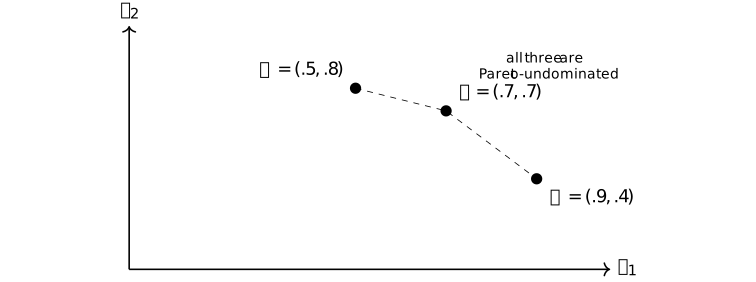
For scalar weights \((0.8,0.2)\), the scores are \(S(A)=0.80\), \(S(B)=0.70\), and \(S(C)=0.56\), so \(A\) wins. The worst-group scores are \(0.4\), \(0.7\), and \(0.5\), so \(B\) wins. No point dominates another coordinatewise, hence the Pareto summary retains all three.
The scalar, Pareto, and worst-group summaries were defined in Definition [ftip-005P]--Definition [ftip-005R]. Their non-equivalence is explicit in these three points, while the choice of a social or evaluation rule remains open.
Evaluation transport and matched protocols [ftip-00F9]AGENTDRAFTED
Evaluation transport and matched protocols [ftip-00F9]AGENTDRAFTED
This section compares post-training artifacts only through declared evaluation laws, inference protocols, utilities, seeds, and budgets. It proves finite transport statements locally and treats long-horizon research-state records as empirical evidence, not as theorems.
Evaluation laws and couplings [ftip-00FA]AGENTDRAFTED
Evaluation laws and couplings [ftip-00FA]AGENTDRAFTED
Convention. A named evaluation experiment [ftip-00FB]AGENTDRAFTED
Convention. A named evaluation experiment [ftip-00FB]AGENTDRAFTED
A named evaluation experiment records the artifact, task law, inference protocol, evaluator, seed kernel, budget, and sampling unit. Two reported scores are comparable only after these coordinates and their intended target have been stated.
Definition. Evaluation law [ftip-00FC]AGENTDRAFTED
Definition. Evaluation law [ftip-00FC]AGENTDRAFTED
For a fixed evaluation interface from Convention [ftip-005D], an evaluation law is a probability measure \(\mathsf Q\) on the finite outcome space \(\mathcal Z=\mathcal X_{\mathsf T_{\rm ev}}\times \mathcal O_{\mathsf T_{\rm ev}}\) with random pair \((X,O)\sim \mathsf Q\). Its score for artifact \(M\) is a bounded measurable map \(s_M:\mathcal Z\to [0,1]\). Write \(J_{\mathsf Q}(M)=\mathbb E_{\mathsf Q}[s_M(X,O)]\).
Definition. Matched evaluation pair [ftip-00FD]AGENTDRAFTED
Definition. Matched evaluation pair [ftip-00FD]AGENTDRAFTED
A matched evaluation pair is \((\mathsf Q,\mathsf I,b,\Lambda )\) and \((\mathsf Q',\mathsf I',b',\Lambda ')\) together with a coupling \((Z,Z')\) whose marginals are the two laws. The pair is matched on the declared coordinates when the task, utility, evaluator version, and sampling unit are shared; any changed coordinate is named.
Definition. Paired finite score estimator [ftip-00FE]AGENTDRAFTED
Definition. Paired finite score estimator [ftip-00FE]AGENTDRAFTED
For iid coupled draws \((Z_j,Z'_j)_{j=1}^m\), define \(\widehat \Delta _m=m^{-1}\sum _{j=1}^m(s_M(Z_j)-s_{M'}(Z'_j))\). The pairing is part of the estimator specification; it does not silently identify the two evaluation laws.
Theorem. Unbiasedness of the paired score estimator [ftip-00FF]AGENTDRAFTED
Theorem. Unbiasedness of the paired score estimator [ftip-00FF]AGENTDRAFTED
Under the iid coupling in Definition [ftip-00FE], \(\mathbb E[\widehat \Delta _m]=J_{\mathsf Q}(M)-J_{\mathsf Q'}(M')\).
Proof.
Proof.
Linearity of expectation gives the displayed identity.
\[ \mathbb E[\widehat \Delta _m] =m^{-1}\sum _j\left (\mathbb E[s_M(Z_j)]- \mathbb E[s_{M'}(Z'_j)]\right ). \]The coupling fixes the joint sampling but does not change either marginal, so the two terms are the stated expectations.
Example. Common seeds can reduce paired variance [ftip-00G0]AGENTDRAFTED
Example. Common seeds can reduce paired variance [ftip-00G0]AGENTDRAFTED
If \(s_M(Z)=s_{M'}(Z')\) almost surely under a common-seed coupling, then \(\widehat \Delta _m=0\) for every sample even when independent sampling would have nonzero variance. This is a variance statement, not evidence that the two artifacts have equal behavior on a different law.
Remark. A coupling does not merge estimands [ftip-00G1]AGENTDRAFTED
Remark. A coupling does not merge estimands [ftip-00G1]AGENTDRAFTED
The result in Theorem [ftip-00FF] follows from its displayed hypotheses. A shared seed can make a paired comparison precise while the changed task law, evaluator, or inference budget still changes the estimand. No causal effect follows without a declared intervention and matched coordinates.
Utility transport [ftip-00G2]AGENTDRAFTED
Utility transport [ftip-00G2]AGENTDRAFTED
Definition. Bounded utility perturbation [ftip-00G3]AGENTDRAFTED
Definition. Bounded utility perturbation [ftip-00G3]AGENTDRAFTED
On a common finite outcome law \(\mathsf Q\), let each artifact \(M\) have score maps \(s_M,t_M:\mathcal Z\to [0,1]\). They have perturbation radius \(\varepsilon =\sup _{M,\,z\in \operatorname {supp}(\mathsf Q)} |s_M(z)-t_M(z)|\) when \(0\leq \varepsilon \leq 1\); write \(J_s(M)=\mathbb E_{\mathsf Q}[s_M]\) and \(J_t(M)=\mathbb E_{\mathsf Q}[t_M]\).
Theorem. Direct utility transport bound [ftip-00G4]AGENTDRAFTED
Theorem. Direct utility transport bound [ftip-00G4]AGENTDRAFTED
Under Definition [ftip-00G3], every artifact \(M\) satisfies \(|J_s(M)-J_t(M)|\leq \varepsilon \).
Proof.
Proof.
Pointwise bounds give \(-\varepsilon \leq s_M(z)-t_M(z)\leq \varepsilon \). Taking expectations preserves both inequalities.
Corollary. Transporting an artifact comparison [ftip-00G5]AGENTDRAFTED
Corollary. Transporting an artifact comparison [ftip-00G5]AGENTDRAFTED
If two artifacts \(M_1,M_0\) are scored by both \(s\) and \(t\) under the same law and \(\lVert s-t\rVert _{\infty ,\mathsf Q}\leq \varepsilon \), then the gain difference obeys \(|(J_s(M_1)-J_s(M_0))-(J_t(M_1)-J_t(M_0))| \leq 2\varepsilon \). This is a finite utility perturbation bound, not a training or distribution-shift theorem.
Example. Equal aggregate score can hide a slice reversal [ftip-00G6]AGENTDRAFTED
Example. Equal aggregate score can hide a slice reversal [ftip-00G6]AGENTDRAFTED
On equally likely outcomes \(a,b\), take score vectors \((s_{M_1}(a),s_{M_1}(b))=(1,0)\) and \((s_{M_0}(a),s_{M_0}(b))=(0,1)\); a second score map swaps coordinates. Both artifacts have aggregate score \(1/2\) under both maps, but their per-outcome ordering reverses. Aggregate transport alone does not identify localized behavior.
Remark. Common domains are a transport hypothesis [ftip-00G7]AGENTDRAFTED
Remark. Common domains are a transport hypothesis [ftip-00G7]AGENTDRAFTED
The bound in Theorem [ftip-00G4] requires the same finite outcome support. Changing prompts, parsers, evaluators, or inference budgets is a new law and must be recorded rather than hidden inside a score perturbation.
Prompt and research-state transport [ftip-00G8]AGENTDRAFTED
Prompt and research-state transport [ftip-00G8]AGENTDRAFTED
Definition. Research-state observable [ftip-00G9]AGENTDRAFTED
Definition. Research-state observable [ftip-00G9]AGENTDRAFTED
For a finite record space \(\mathcal R\), an observable is a map \(h:\mathcal R\to \mathcal H\). A summary-only evaluator sees \(h(r)\) and not the underlying record \(r\); the omitted coordinates are unavailable to that evaluator.
Definition. Compaction kernel [ftip-00GA]AGENTDRAFTED
Definition. Compaction kernel [ftip-00GA]AGENTDRAFTED
A compaction kernel is a randomized map \(K(dh\mid r)\) from records in \(\mathcal R\) to summaries in \(\mathcal H\). A deterministic summary is the special case \(K(dh\mid r)=\delta _{h(r)}\).
Theorem. Summary-only indistinguishability [ftip-00GB]AGENTDRAFTED
Theorem. Summary-only indistinguishability [ftip-00GB]AGENTDRAFTED
Let \(r,r'\in \mathcal R\) induce the same summary law under the kernel in Definition [ftip-00GA]. Any randomized decision rule that receives only that summary has the same output law in the two worlds.
Proof.
Proof.
The output law is the pushforward of the common summary law through the same decision kernel. Pushforwards of equal finite measures are equal.
Example. An omitted feasibility constraint [ftip-00GC]AGENTDRAFTED
Example. An omitted feasibility constraint [ftip-00GC]AGENTDRAFTED
Two research records can share every summary score while one contains a withdrawn lemma and the other contains a feasible proof plan. A summary-only selector therefore chooses identically, although the correct next action differs. This is a finite witness to information loss, not a claim about a particular model.
Remark. Long-horizon records are empirical transport evidence [ftip-00GD]AGENTDRAFTED
Remark. Long-horizon records are empirical transport evidence [ftip-00GD]AGENTDRAFTED
The case study in [li2026longhorizon], Sections 4--7, reports file-based memory, human steering, and research-state failures under one system and task. It motivates explicit observables and omitted constraints; it does not supply the finite theorem in Theorem [ftip-00GB] or a general model capability law.
Evaluation cells and budget accounting [ftip-00GE]AGENTDRAFTED
Evaluation cells and budget accounting [ftip-00GE]AGENTDRAFTED
Definition. Evaluation cell [ftip-00GF]AGENTDRAFTED
Definition. Evaluation cell [ftip-00GF]AGENTDRAFTED
An evaluation cell is \(C=(M,\mathsf Q,\mathsf I,b,\Lambda ,v)\), where \(M\) is an artifact, \(\mathsf Q\) a task law, \(\mathsf I\) an inference protocol, \(b\) a budget, \(\Lambda \) a seed kernel, and \(v\) an evaluator version. A cell comparison may differ in named coordinates only.
Lemma. Additive evaluation cost [ftip-00GG]AGENTDRAFTED
Lemma. Additive evaluation cost [ftip-00GG]AGENTDRAFTED
For a finite evaluation plan with disjoint stages of costs \(c_1,\ldots ,c_k\in \mathbb R_{\geq 0}\), total cost is \(c=\sum _{i=1}^k c_i\). Appending a stage increases cost by its declared amount and cannot preserve a budget \(B\) unless the remaining slack covers it.
Proof.
Proof.
The statement is the associativity and monotonicity of finite sums.
Theorem. Budget-preserving matched comparison [ftip-00GH]AGENTDRAFTED
Theorem. Budget-preserving matched comparison [ftip-00GH]AGENTDRAFTED
Let two evaluation plans use the same declared stages except for a substitution whose cost is at most the replaced stage cost. If their common prefix cost is \(c_0\) and both suffix costs fit \(B-c_0\), then both cells in Definition [ftip-00GF] are admissible under budget \(B\).
Proof.
Proof.
Apply Lemma [ftip-00GG] to the common prefix and each suffix. The assumed inequalities give total cost at most \(B\) in each plan.
Example. Cost-balanced evaluation cells [ftip-00GI]AGENTDRAFTED
Example. Cost-balanced evaluation cells [ftip-00GI]AGENTDRAFTED
A paired run can spend \(B=100\) units as 40 units of inference, 20 of evaluator calls, and 40 of audit. Replacing 10 inference units by 10 audit units preserves the budget, but changes the cell and must not be described as the same inference protocol.
Remark. Execution and evaluator confounds [ftip-00GJ]AGENTDRAFTED
Remark. Execution and evaluator confounds [ftip-00GJ]AGENTDRAFTED
A score change can arise from the artifact, prompt law, inference budget, parser, evaluator version, or execution failure. A matched-cell report names these coordinates before interpreting a paired gain.
Distribution shift and ranking reversals [ftip-00GK]AGENTDRAFTED
Distribution shift and ranking reversals [ftip-00GK]AGENTDRAFTED
Example. Train and evaluation laws can reverse a ranking [ftip-00GL]AGENTDRAFTED
Example. Train and evaluation laws can reverse a ranking [ftip-00GL]AGENTDRAFTED
Let \(\mathsf Q_{\rm tr}\) put masses \(.9,.1\) on \(a,b\), and let \(\mathsf Q_{\rm ev}\) swap them. Artifacts \(M_1,M_0\) with score vectors \((s_{M_1}(a),s_{M_1}(b))=(1,0)\) and \((s_{M_0}(a),s_{M_0}(b))=(0,1)\) rank oppositely under the two laws. A training score is not an evaluation transport certificate.
Theorem. Total-variation transport bound [ftip-00GM]AGENTDRAFTED
Theorem. Total-variation transport bound [ftip-00GM]AGENTDRAFTED
For any score \(s:\mathcal Z\to [0,1]\) and finite laws \(\mathsf Q,\mathsf Q'\), \(|\mathbb E_{\mathsf Q}s-\mathbb E_{\mathsf Q'}s|\leq \lVert \mathsf Q-\mathsf Q'\rVert _{\rm TV}\), where \(\lVert \mathsf Q-\mathsf Q'\rVert _{\rm TV}:=\frac 12\sum _{z\in \mathcal Z} |\mathsf Q(z)-\mathsf Q'(z)|\).
Proof.
Proof.
Expand the finite expectation difference and use \(|s(z)|\leq 1\). The positive and negative parts are bounded by the total variation mass, giving the displayed inequality.
Example. A sharp two-point transport bound [ftip-00GN]AGENTDRAFTED
Example. A sharp two-point transport bound [ftip-00GN]AGENTDRAFTED
On \(\mathcal Z=\{a,b\}\), let \(s(a)=1,s(b)=0\), and let \(\mathsf Q(a)=1\), \(\mathsf Q'(a)=1-\eta \), and \(\mathsf Q'(b)=\eta \). The score difference and total variation distance are both \(\eta \).
Remark. What transport does not identify [ftip-00GO]AGENTDRAFTED
Remark. What transport does not identify [ftip-00GO]AGENTDRAFTED
The bounds above transport a declared score across a declared law. They do not identify why an artifact changed, establish support expansion, prove generalization, or order different evaluators whose outcome spaces differ.
Example. A minimal evaluation trace [ftip-00GP]AGENTDRAFTED
Example. A minimal evaluation trace [ftip-00GP]AGENTDRAFTED
A reproducible record is \((M,\mathsf Q,\mathsf I,b,\Lambda ,v,m, \widehat \Delta _m,c)\), listing the cells, sample count, paired estimate, and cost. Replaying this tuple reproduces the estimator target only when the recorded laws and versions remain available.
Remark. Execution controls for a matched evaluation [ftip-00GQ]AGENTDRAFTED
Remark. Execution controls for a matched evaluation [ftip-00GQ]AGENTDRAFTED
A matched evaluation requires execution gates, contamination checks, grader calibration, and an audit of the result before it is committed. These controls make the comparison auditable; they do not by themselves establish capability acquisition.
Analytical questions and falsifiers [ftip-005T]AGENTDRAFTED
Analytical questions and falsifiers [ftip-005T]AGENTDRAFTED
Successful support, verifier error, and entropy statistics distinguish properties that a benchmark summary can combine. Finite examples and counterexamples distinguish these quantities.
Definition. Successful-support probability [ftip-005U]AGENTDRAFTED
Definition. Successful-support probability [ftip-005U]AGENTDRAFTED
Fix the evaluation interface and success threshold \(u_*\) from Convention [ftip-005D]. For a protocol \(P\) and instance \(x\in \mathcal X_{\mathsf T_{\rm ev}}\), its successful-support probability is
\[ p_P(x) =\Pr \left [ U\left (x,\mathsf {Eval}_b(M_P,x;\Xi );\Omega \right )\geq u_* \right ]. \]The probability includes protocol, inference, environment, and evaluator randomness: \(M_P\) is drawn from the protocol, while \((\Xi ,\Omega )\) is drawn from \(\Lambda _{\rm ev}(\cdot \mid x)\) independently of training. The quantity is instance-specific and budget-specific.
Definition. Successful-support coverage [ftip-005V]AGENTDRAFTED
Definition. Successful-support coverage [ftip-005V]AGENTDRAFTED
For threshold \(0<\alpha \leq 1\), the successful-support coverage of protocol \(P\) under evaluation law \(Q_{\rm ev}\) is
\[ \operatorname {Cov}_\alpha (P) =Q_{\rm ev}\left (\{x:p_P(x)\geq \alpha \}\right ). \]Coverage records how much task mass has at least the declared success probability. It does not average the probabilities above or below the threshold.
Remark. Task-level success and coverage [ftip-005W]AGENTDRAFTED
Remark. Task-level success and coverage [ftip-005W]AGENTDRAFTED
Increasing probability mass on known solutions need not increase coverage of the task family. Pass-at-\(k\) and related support-sensitive measurements motivate this distinction. Sections 3--5 of Does reinforcement learning really incentivize reasoning capacity in LLMs beyond the base model?[yue2025does] and Sections 2--3 of Understanding r1-zero-like training: A critical perspective[liu2025understanding] compare post-training behavior with base-model support and discuss why response accuracy alone may overstate what RL creates beyond a base model.
The threshold \(\alpha \), inference budget, task law, and success predicate must all be reported. Finite samples estimate this quantity; they do not reveal the unobserved tail without assumptions.
Definition. Uniform task-family acquisition witness [ftip-005X]AGENTDRAFTED
Definition. Uniform task-family acquisition witness [ftip-005X]AGENTDRAFTED
Fix a finite, independently selected family \(G\subseteq \mathcal X_{\mathsf T_{\rm ev}}\), thresholds \(0\leq \alpha <\beta \leq 1\), and the common evaluation interface of Convention [ftip-005D]. Protocols \(P_0\) and \(P_1\) have a uniform task-family acquisition witness on \(G\) when
\[ p_{P_0}(x)\leq \alpha \quad \hbox {and}\quad p_{P_1}(x)\geq \beta \qquad \text {for every }x\in G. \]For each \(x\), the successful event in Definition [ftip-005U] supplies the fixed-budget transfer event in Definition [ftip-0007]. The displayed inequalities specialize that earlier acquisition witness with \(\varepsilon _0=\alpha \) and \(\varepsilon _1=\beta \), then require the specialization uniformly over \(G\).
Remark. Acquisition evidence across a fixed task family [ftip-005Y]AGENTDRAFTED
Remark. Acquisition evidence across a fixed task family [ftip-005Y]AGENTDRAFTED
The proposed family-level criterion is a demanding paired comparison. The task family and evaluator are fixed independently, and both protocols use the same inference budget. It is stronger than one acquisition witness because the threshold change must hold for every member of \(G\).
A theorem may strengthen the witness with confidence bounds, transfer to a predeclared related family, or a lower bound on newly successful support. Each strengthening requires additional sampling or structural assumptions.
Definition. Verifier error rates [ftip-005Z]AGENTDRAFTED
Definition. Verifier error rates [ftip-005Z]AGENTDRAFTED
Let \(S\in \{0,1\}\) be an independently defined success label and \(A\in \{0,1\}\) the verifier's accept decision on the same outcome. The false-accept and false-reject rates are
\[ \eta _+=\Pr (A=1\mid S=0), \qquad \eta _-=\Pr (A=0\mid S=1). \]Both rates are conditional on the task and outcome distribution used for the audit. They are undefined when the conditioning event has probability zero.
Remark. Verifier error under an independent audit law [ftip-0061]AGENTDRAFTED
Remark. Verifier error under an independent audit law [ftip-0061]AGENTDRAFTED
Verifier error is measured against an independent success label because a training reward cannot audit itself. The verifier and evidence interfaces are in Definition [ftip-0046]--Definition [ftip-0049]. DeepSeek-Prover-V2 [ren2025deepseekproverv2, Section 2.3, ``Reinforcement Learning''] supplies a proof-checking instance. The false-accept/false-reject decomposition is a binary measurement model.
The rates may vary by task, policy, trajectory length, and adversarial pressure. A low average error rate need not prevent reward hacking on the subpopulation favored by optimization.
Example. Reward hacking under an incomplete checker [ftip-0060]AGENTDRAFTED
Example. Reward hacking under an incomplete checker [ftip-0060]AGENTDRAFTED
Shifting probability mass toward a checker exploit raises proxy reward while reducing independently judged utility.
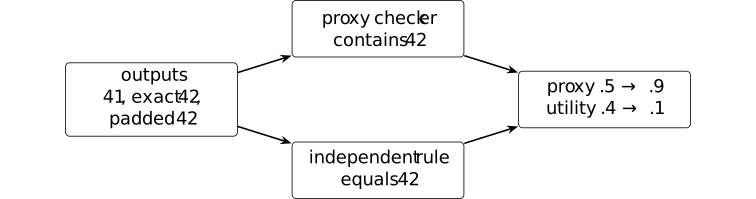
Let the three outputs be \(y_0=\text {41}\), \(y_1=\text {42}\), and \(y_2=\text {ignore; 42; done}\). The proxy accepts \(y_1,y_2\); the independent evaluator accepts only \(y_1\). Moving their probabilities from \((0.5,0.4,0.1)\) to \((0.1,0.1,0.8)\) changes expected proxy reward from \(0.5\) to \(0.9\), but true utility from \(0.4\) to \(0.1\).
Reward exploitation in formal verification is discussed in [ren2025deepseekproverv2, Section 3.2]. The constructed checker exposes one failure mechanism. It provides no basis for treating every executable verifier as incomplete or every proxy improvement as reward hacking.
Definition. Global policy entropy [ftip-0062]AGENTDRAFTED
Definition. Global policy entropy [ftip-0062]AGENTDRAFTED
Fix a finite action space, a finite horizon \(T\), and a declared distribution \(\mu _t\) over public histories at each position. The global policy entropy is the weighted average
\[ H_{\rm global}(\pi ) =\frac 1T\sum _{t=0}^{T-1} \mathbb E_{\mathsf H_t\sim \mu _t} \left [-\sum _a\pi (a\mid \mathsf H_t) \log \pi (a\mid \mathsf H_t)\right ]. \]The history distribution and action alphabet are part of the statistic.
We use the convention \(0\log 0=0\) in this and the following position-entropy formula.
Definition. Token-position entropy [ftip-0063]AGENTDRAFTED
Definition. Token-position entropy [ftip-0063]AGENTDRAFTED
Let \(T_{\rm tok}\) be the random number of generated tokens. For a one-based token position \(t\) satisfying \(\Pr (T_{\rm tok}\geq t)>0\), condition on \(T_{\rm tok}\geq t\) and let \(\xi _t\) be the token. The token-position entropy is
\[ H_t^{\rm pos} =-\sum _{v\in \mathcal V} \Pr (\xi _t=v\mid T_{\rm tok}\geq t) \log \Pr (\xi _t=v\mid T_{\rm tok}\geq t). \]This is the entropy of a position marginal. It is generally different from the history-conditioned entropy averaged in Definition [ftip-0062].
Definition. selected-token surprisal [shannon1948mathematical, Part I, Section 6] [ftip-0064]AGENTDRAFTED
Definition. selected-token surprisal [shannon1948mathematical, Part I, Section 6] [ftip-0064]AGENTDRAFTED
For a sampled token \(\xi _t\) under next-token law \(\pi (\,\cdot \mid \mathsf H_t)\), its surprisal is
\[-\log \pi (\xi _t\mid \mathsf H_t).\]It is a random value attached to the selected token. Its conditional expectation over the token equals the finite Shannon entropy of the next-token law.
Remark. Why the entropy statistics are not interchangeable [ftip-0065]AGENTDRAFTED
Remark. Why the entropy statistics are not interchangeable [ftip-0065]AGENTDRAFTED
Shannon's finite entropy A mathematical theory of communication[shannon1948mathematical] can be aggregated over different random objects. Global and position-level entropy statistics use different laws. Selected-token surprisal is a sample statistic, while the other two are expectations under declared history or position laws.
A training intervention can raise one quantity while lowering another. Later claims about exploration or collapse must name the statistic, sampling law, horizon, and conditioning event.
Definition. empirical squared-ratio excess [miao2026when, Theorem 2] [ftip-0066]AGENTDRAFTED
Definition. empirical squared-ratio excess [miao2026when, Theorem 2] [ftip-0066]AGENTDRAFTED
For token-level current-to-behavior ratios \(r_1,\ldots ,r_T\), DGG defines
\[\widehat \chi ^2=\frac 1T\sum _{i=1}^T(r_i^2-1).\]The source relates this statistic to an upper bound on language-model-head gradient energy through a batch-dependent constant. In a finite batch \(\widehat \chi ^2\) can be negative, so it is not automatically a nonnegative empirical Pearson divergence. The result also gives no converse from a small batch gradient to small policy shift.
Example. Lifecycle compute allocation and a finite rollout observation bound [ftip-0067]AGENTDRAFTED
Example. Lifecycle compute allocation and a finite rollout observation bound [ftip-0067]AGENTDRAFTED
A componentwise lifecycle allocation separates resource accounting from the finite number of rollouts available for observation.
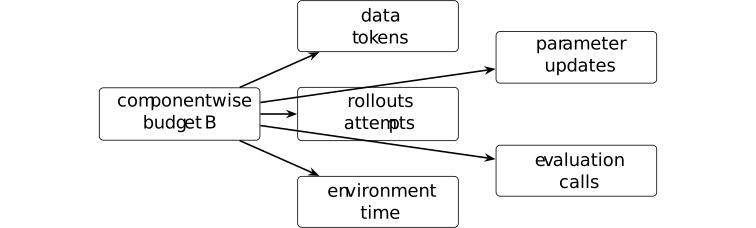
In the coordinate order of Definition [ftip-005H], declare a lifecycle budget vector \(\mathbf B\). Its rollout coordinate permits \(N\) attempts. If each attempt has declared success probability \(p\), then \[ \Pr (\text {at least one success})=1-(1-p)^N\leq Np. \] Only the rollout coordinate enters this calculation; no sum or conversion among heterogeneous coordinates is defined.
The finite bound is the union bound applied to Bernoulli rollouts; finite-horizon success probabilities are standard policy-evaluation objects in [sutton2018reinforcement, Section 3.5]. Independence is needed only for the displayed exact expression. The budget vector is illustrative: neither empirical optimality nor interchangeability of heterogeneous units is inferred from it.
Remark. Finite questions and necessary assumptions [ftip-0068]AGENTDRAFTED
Remark. Finite questions and necessary assumptions [ftip-0068]AGENTDRAFTED
Finite analysis raises three questions: how conditional success rates bound long-horizon success, how replay-ratio concentration controls update error, and how trajectory extrapolation with periodic recovery affects evaluation regret. A cost comparison also depends on rollout, update, environment, storage, and evaluation work.
Finite counterexamples show why these questions need additional assumptions. Finite policies can separate the entropy statistics above. Two verifiers can agree on all observed training records yet differ on an unobserved adversarial region. Two parameter paths can share early low-rank summaries and diverge after a new successful rollout. These examples mark where additional assumptions are unavoidable.
The DGG and NExt papers motivate reuse and trajectory-compression hypotheses but do not establish these general results. Bounds on update error and extrapolation regret require assumptions relating the monitored quantities to the corresponding outcomes.
Finite consequences and obstructions [ftip-0075]AGENTDRAFTED
Finite consequences and obstructions [ftip-0075]AGENTDRAFTED
This section turns parts of the preceding setup into finite mathematical statements. The results concern declared probability spaces, finite decision sets, recorded feedback, or explicitly stated matrix models. They do not by themselves establish a scaling law for language-model capability.
We begin with discovery and support, then study proxy rewards and verifiers. The third subsection asks what can be learned from a fixed feedback transcript. The last subsection studies the DGG inequalities before introducing trajectory-compression diagnostics and counterexamples.
Finite discovery and support [ftip-0076]AGENTDRAFTED
Finite discovery and support [ftip-0076]AGENTDRAFTED
A successful continuation can have positive probability and still be difficult to observe within a finite rollout budget. This subsection separates the probability of observing a success from support, coverage, and capability acquisition.
Convention. Repeated attempts and the discovery event [ftip-0077]AGENTDRAFTED
Convention. Repeated attempts and the discovery event [ftip-0077]AGENTDRAFTED
Fix a task instance, evaluator, success threshold, and a joint law for \(B\geq 1\) attempts. Let \(E_i\) be the event that attempt \(i\) succeeds. The discovery event by attempt \(B\) is
\[ D_B=\bigcup _{i=1}^{B}E_i. \]Write \(p_i=\Pr (E_i)\). Independence is an additional property of the declared joint law; it is not implied by repeated decoding, a shared model, or a common environment. In the independent and identically distributed case, write \(p_i=p\). When the attempt law is the one fixed in Definition [ftip-005U], this \(p\) is the corresponding successful-support probability.
Theorem. Discovery under independent attempts [ftip-0078]AGENTDRAFTED
Theorem. Discovery under independent attempts [ftip-0078]AGENTDRAFTED
Assume the events \(E_1,\ldots ,E_B\) of Convention [ftip-0077] are independent. Then
\[ \Pr (D_B)=1-\prod _{i=1}^{B}(1-p_i). \]In particular, independent attempts with a common success probability \(p\) satisfy
\[ \Pr (D_B)=1-(1-p)^B. \]
Proof.
Proof.
The complement of discovery is \(D_B^{\mathsf c}=\bigcap _{i=1}^{B}E_i^{\mathsf c}\). Independence gives \(\Pr (D_B^{\mathsf c})=\prod _i\Pr (E_i^{\mathsf c}) =\prod _i(1-p_i)\). Taking complements proves the first identity; substituting \(p_i=p\) proves the specialization.
This finite statement follows from the displayed hypotheses. The calculation in Example [ftip-0067] is its ten-attempt numerical preview.
Corollary. A rollout budget for target discovery probability [ftip-0079]AGENTDRAFTED
Corollary. A rollout budget for target discovery probability [ftip-0079]AGENTDRAFTED
This is a finite corollary of Theorem [ftip-0078], obtained from its displayed hypotheses.
Let \(0<\delta <1\). Under the independent and identically distributed setup of Theorem [ftip-0078], suppose first that \(0<p<1\). The least positive integer budget whose discovery failure probability is at most \(\delta \) is
\[ B_{\min } =\left \lceil \frac {\log \delta }{\log (1-p)}\right \rceil . \]If \(p=0\), no finite positive budget reaches failure probability below one. If \(p=1\), one attempt suffices.
Proof.
Proof.
For \(0<p<1\), Theorem [ftip-0078] gives failure probability \((1-p)^B\). The inequality \((1-p)^B\leq \delta \) is equivalent to \(B\geq \frac {\log \delta }{\log (1-p)}\) because both logarithms are negative. The least integer solution is the displayed ceiling. The two boundary cases follow directly from \((1-p)^B\).
Lemma. Discovery bounds from conditional success rates [ftip-007A]AGENTDRAFTED
Lemma. Discovery bounds from conditional success rates [ftip-007A]AGENTDRAFTED
Put \(D_0=\varnothing \). Whenever \(\Pr (D_{i-1}^{\mathsf c})>0\), define the surviving conditional success rate
\[ q_i=\Pr (E_i\mid D_{i-1}^{\mathsf c}). \]If these rates are defined through step \(B\), then
\[ \Pr (D_B^{\mathsf c})=\prod _{i=1}^{B}(1-q_i). \]Consequently, if \(0\leq \underline q\leq q_i\leq \overline q\leq 1\) for every surviving step, then
\[ 1-(1-\underline q)^B \leq \Pr (D_B) \leq 1-(1-\overline q)^B. \]
Proof.
Proof.
The chain rule gives \(\Pr (D_i^{\mathsf c})=\Pr (D_{i-1}^{\mathsf c})(1-q_i)\). Iteration proves the product identity, and the coordinatewise bounds on \(1-q_i\) give the two discovery bounds.
No independence assumption is used. The conditional rates may change with the earlier failures, an adaptive decoder, or a changing environment state.
This finite statement follows from the displayed hypotheses.
Remark. Discovery is neither acquisition nor coverage [ftip-007B]AGENTDRAFTED
Remark. Discovery is neither acquisition nor coverage [ftip-007B]AGENTDRAFTED
The discovery event concerns whether a declared sampling procedure observes at least one success. Increasing its probability can be an elicitation effect in the sense of Definition [ftip-0005]: more attempts expose behaviour that already had positive probability. It is not by itself the independent before--after comparison required by Definition [ftip-0007].
Successful-support coverage in Definition [ftip-005V] integrates an instance-level threshold over a task law. A large discovery probability on one instance therefore does not establish broad coverage or the uniform task-family witness of Definition [ftip-005X].
Theorem. Finite exponential tilting preserves support [ftip-007C]AGENTDRAFTED
Theorem. Finite exponential tilting preserves support [ftip-007C]AGENTDRAFTED
Fix a prompt \(x\), a finite response set \(\mathcal Y\), a reference policy \(\pi _{\mathrm {ref}}\), a finite real reward \(r(x,y)\), and \(\beta >0\). Let \(\pi _r\) be the normalized exponential tilt of Definition [ftip-003O]. Then, for every \(y\in \mathcal Y\),
\[ \pi _r(y\mid x)>0 \quad \Longleftrightarrow \quad \pi _{\mathrm {ref}}(y\mid x)>0. \]
Proof.
Proof.
The multiplier \(\exp (r(x,y)/\beta )\) is finite and strictly positive. The finite normalizer \(Z_r(x)\) is also strictly positive. Multiplication by the first quantity and division by the second therefore preserve whether the reference mass is zero or positive.
The source policy form appears as equation (4) in [rafailov2023direct, Section 4]; the displayed result is the finite corollary derived here. Infinite rewards, non-normalizable response spaces, approximate optimization, and changes to the generation mechanism lie outside the statement.
Remark. Formal support and operational discoverability [ftip-007D]AGENTDRAFTED
Remark. Formal support and operational discoverability [ftip-007D]AGENTDRAFTED
Support preservation is a statement about exact positive probability. A response can remain in mathematical support while its mass becomes too small to observe within the available rollout budget. The identities in Theorem [ftip-0078] and Corollary [ftip-0079] quantify this distinction for declared independent attempts.
Top-\(k\) truncation, nucleus sampling, finite numerical precision, context limits, and parser constraints can also remove an operational route even when the underlying softmax law assigns it positive mass. Claims about elicitation must therefore name both the policy law and the executable inference procedure.
Example. Counterexample: Equal one-shot success, unequal successful coverage [ftip-007E]AGENTDRAFTED
Example. Counterexample: Equal one-shot success, unequal successful coverage [ftip-007E]AGENTDRAFTED
Let the evaluation law be uniform on two instances \(x_1,x_2\). Consider protocols \(P\) and \(P'\) with successful-support probabilities
\[ \bigl (p_P(x_1),p_P(x_2)\bigr ) =\left (\frac 12,\frac 12\right ), \qquad \bigl (p_{P'}(x_1),p_{P'}(x_2)\bigr ) =(1,0). \]Both protocols have mean one-shot success \(1/2\). At threshold \(\alpha =1/2\), however, Definition [ftip-005V] gives
\[ \operatorname {Cov}_{1/2}(P)=1, \qquad \operatorname {Cov}_{1/2}(P')=\frac 12. \]Thus average success does not determine successful-support coverage. The example is finite and uses the same task law and threshold for both protocols; it does not compare their training costs or establish acquisition.
Proxy reward and verifier fidelity [ftip-007F]AGENTDRAFTED
Proxy reward and verifier fidelity [ftip-007F]AGENTDRAFTED
A proxy can guide an update or rank sampled candidates without agreeing with the independently declared utility of the resulting output. This subsection separates pointwise proxy error from average error under a shifted law. It then distinguishes repeated false-accept events from the output of a candidate selector. Pointwise approximation and explicit probability assumptions support different guarantees; an average audit number alone supplies neither.
Definition. Uniform proxy approximation [ftip-007G]AGENTDRAFTED
Definition. Uniform proxy approximation [ftip-007G]AGENTDRAFTED
Let \(\mathcal Y_0\) be a nonempty finite set of candidate outcomes. Let \(U:\mathcal Y_0\to \mathbb R\) be an independently declared utility and \(\widehat U:\mathcal Y_0\to \mathbb R\) a proxy score. The proxy is a uniform approximation to \(U\) on \(\mathcal Y_0\) with error \(\varepsilon \) when \(\varepsilon \geq 0\) and
\[ \sup _{y\in \mathcal Y_0}\lvert \widehat U(y)-U(y)\rvert \leq \varepsilon . \]The candidate set is part of the claim. Approximation on training outcomes, on one policy's support, or in expectation is not uniform approximation on a larger set reached after optimization.
Theorem. Uniform proxy error gives two-epsilon selection regret [ftip-007H]AGENTDRAFTED
Theorem. Uniform proxy error gives two-epsilon selection regret [ftip-007H]AGENTDRAFTED
Under the conditions of Definition [ftip-007G], choose
\[ y^\star \in \operatorname *{arg\,max}_{y\in \mathcal Y_0}U(y), \qquad \widehat y\in \operatorname *{arg\,max}_{y\in \mathcal Y_0}\widehat U(y). \]Then the utility regret of selecting by the proxy satisfies
\[ 0\leq U(y^\star )-U(\widehat y)\leq 2\varepsilon . \]
Proof.
Proof.
Optimality of \(\widehat y\) for the proxy and the two pointwise error bounds give
\[ \begin {aligned} U(y^\star ) &\leq \widehat U(y^\star )+\varepsilon \\ &\leq \widehat U(\widehat y)+\varepsilon \\ &\leq U(\widehat y)+2\varepsilon . \end {aligned} \]Optimality of \(y^\star \) for \(U\) gives the lower bound.
This finite statement follows from the displayed hypotheses.
Remark. The two-epsilon theorem is a decision bound [ftip-007I]AGENTDRAFTED
Remark. The two-epsilon theorem is a decision bound [ftip-007I]AGENTDRAFTED
The bound in Theorem [ftip-007H] follows directly from the uniform approximation condition. It compares two maximizers on one fixed finite candidate set. It does not describe how either score was learned or how a policy changes when that score becomes a training objective.
The result is useful because its transfer assumption is visible. To apply it after an update or a larger search, the uniform bound must hold on the outcomes that the new procedure can actually select. The verifier evidence of Definition [ftip-0047] can support such an audit, but reproducible evidence alone does not establish the bound.
Example. Counterexample: Small average proxy error fails after distribution shift [ftip-007J]AGENTDRAFTED
Example. Counterexample: Small average proxy error fails after distribution shift [ftip-007J]AGENTDRAFTED
Let the finite decision set be \(\mathcal Y_0=\{y_{\rm safe},y_{\rm exploit}\}\). Define its utility and proxy utility by the following table.
\[ \begin {array}{c|cc} &y_{\rm safe}&y_{\rm exploit}\\ \hline U&1&0\\ \widehat U&1&2. \end {array} \]For \(0<\delta <1\), let a reference law \(P_\delta \) assign probability \(\delta \) to \(y_{\rm exploit}\). Its mean absolute proxy error is
\[ \mathbb E_{P_\delta }\lvert \widehat U-U\rvert =2\delta , \]which tends to zero with \(\delta \). Nevertheless, proxy maximization selects \(y_{\rm exploit}\) and incurs utility regret \(1\). Under the shifted law concentrated on that selected outcome, the mean error is \(2\). Thus no vanishing selection-regret bound can depend only on average error under the reference law.
This two-outcome construction isolates the distribution-shift warning in Remark [ftip-0061]. It does not claim that a particular learned verifier has this error profile; Example [ftip-0060] gives a source-linked checker instance with the same proxy-versus-utility separation.
Definition. Repeated verifier audit [ftip-007K]AGENTDRAFTED
Definition. Repeated verifier audit [ftip-007K]AGENTDRAFTED
A repeated verifier audit of size \(N\geq 1\) records pairs \((S_i,A_i)\in \{0,1\}^2\) for candidates \(1\leq i\leq N\). Here \(S_i\) is an independently defined success label and \(A_i\) is the verifier decision, as in Definition [ftip-005Z]. Define
\[ C_i^{\rm fa}=\{S_i=0,\ A_i=1\}, \qquad \mathcal E_N^{\rm fa}=\bigcup _{i=1}^N C_i^{\rm fa}. \]The event \(\mathcal E_N^{\rm fa}\) says that at least one invalid candidate was accepted. It does not say which candidate a downstream selector returns. Write \(\phi _i=\Pr (C_i^{\rm fa})\). When \(\iota _i=\Pr (S_i=0)>0\), the conditional false-accept rate \(\eta _{+,i}=\Pr (A_i=1\mid S_i=0)\) is defined and \(\phi _i=\iota _i\eta _{+,i}\).
Theorem. Independent false accepts amplify with candidate count [ftip-007L]AGENTDRAFTED
Theorem. Independent false accepts amplify with candidate count [ftip-007L]AGENTDRAFTED
In the repeated audit of Definition [ftip-007K], suppose the pairs \((S_i,A_i)\) are independent and identically distributed. Assume
\[ \iota =\Pr (S_i=0)>0, \qquad \eta _+=\Pr (A_i=1\mid S_i=0). \]Then the probability that at least one accepted invalid candidate exists among the \(N\) audited candidates is
\[ \Pr (\mathcal E_N^{\rm fa})=1-(1-\iota \eta _+)^N. \]It is strictly increasing in \(N\) when \(0<\iota \eta _+<1\), and it converges to \(1\) when \(\iota \eta _+>0\).
Proof.
Proof.
Each \(C_i^{\rm fa}\) has probability \(\iota \eta _+\). Independence of the audited pairs makes the events \(C_i^{\rm fa}\) independent. Therefore
\[ \Pr \left ((\mathcal E_N^{\rm fa})^c\right ) =\Pr \left (\bigcap _{i=1}^N (C_i^{\rm fa})^c\right ) =\prod _{i=1}^N(1-\iota \eta _+) =(1-\iota \eta _+)^N. \]Taking complements gives the equality. The monotonicity and limit follow from the elementary powers of \(1-\iota \eta _+\).
This finite statement follows from the displayed hypotheses.
Theorem. A false-accept union bound without independence [ftip-007M]AGENTDRAFTED
Theorem. A false-accept union bound without independence [ftip-007M]AGENTDRAFTED
For any joint law of a repeated verifier audit,
\[ \Pr (\mathcal E_N^{\rm fa})\leq \sum _{i=1}^N \phi _i. \]If \(\iota _i=\Pr (S_i=0)>0\) for every \(i\), this becomes
\[ \Pr (\mathcal E_N^{\rm fa})\leq \sum _{i=1}^N \iota _i\eta _{+,i}. \]
Proof.
Proof.
Apply the union bound to \(\mathcal E_N^{\rm fa}=\bigcup _i C_i^{\rm fa}\). The factorization \(\phi _i=\iota _i\eta _{+,i}\) follows from conditional probability whenever \(\iota _i>0\). If \(\iota _i=0\), then \(\phi _i=0\) while the corresponding conditional rate is undefined, so the first display remains the unconditional statement.
Without a dependence assumption, matching marginal error rates do not give the equality in Theorem [ftip-007L]; the events \(C_i^{\rm fa}\) could coincide.
This finite statement follows from the displayed hypotheses.
Example. Weight updates and candidate selection are different proxy operators [ftip-007N]AGENTDRAFTED
Example. Weight updates and candidate selection are different proxy operators [ftip-007N]AGENTDRAFTED
A proxy score can enter a training operator or a selection operator. In the first route it changes the policy; in the second it ranks a finite sample from a policy whose weights remain fixed.
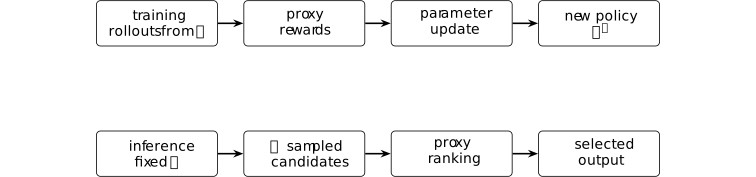
The lifecycle accounting of Definition [ftip-005H] places the first route's rollout and update work in separate coordinates. The second route incurs rollout and evaluation work but no parameter update. Consequently, the event \(\mathcal E_N^{\rm fa}\) in Definition [ftip-007K] concerns the candidate set presented to selection; it is not a claim about the selected output or a training-time policy change.
Remark. What verifier error rates do not identify [ftip-007O]AGENTDRAFTED
Remark. What verifier error rates do not identify [ftip-007O]AGENTDRAFTED
The rates in Definition [ftip-005Z] are properties of a declared audit law. They do not identify where errors occur within the task family, how error events depend across repeated candidates, or which accepted candidate a selector returns. Theorem [ftip-007L] adds identical marginals and independence; Theorem [ftip-007M] retains only the union bound.
Nor do these rates determine the effect of optimizing against the verifier. That effect depends on how the induced policy or selection law moves mass toward particular outcomes. The incomplete-checker example Example [ftip-0060] demonstrates one such movement, while Example [ftip-007J] shows why an average reference-law error cannot rule it out. These are local finite statements. Any claim about a named verifier still requires its own audit distribution, evidence, and transfer argument.
The deterministic regret lemma Theorem [ftip-007H], the independent-audit identity Theorem [ftip-007L], and the union bound Theorem [ftip-007M] follow from uniform approximation, independent trials, and subadditivity, respectively. Their hypotheses need not hold for a verifier chosen only for its empirical performance.
Feedback identifiability and fixed records [ftip-007P]AGENTDRAFTED
Feedback identifiability and fixed records [ftip-007P]AGENTDRAFTED
A training protocol can respond only to distinctions present in its observations. The following finite setup makes that restriction precise before considering stronger, model-specific limits on preference data.
Definition. Finite declared feedback protocol [ftip-007Q]AGENTDRAFTED
Definition. Finite declared feedback protocol [ftip-007Q]AGENTDRAFTED
Fix a horizon \(N\geq 0\), finite action sets \(\mathcal A_n\), finite feedback sets \(\mathcal F_n\), and a finite internal-seed set \(\mathcal U\) with a declared law \(\lambda \). A finite declared protocol \(\mathsf P\) consists of selection maps
\[ a_n:\mathcal U\times \prod _{j<n}(\mathcal A_j\times \mathcal F_j) \longrightarrow \mathcal A_n \qquad (0\leq n<N). \]An action may specify the task, rollout record, feedback request, or sampling choice made at that round. The protocol can depend on earlier exposed feedback and its declared seed, but it cannot depend on a latent world field that has not entered those arguments.
Definition. Finite feedback world [ftip-008C]AGENTDRAFTED
Definition. Finite feedback world [ftip-008C]AGENTDRAFTED
For the action and feedback sets of Definition [ftip-007Q], a finite feedback world \(w\) supplies, for each round \(0\leq n<N\), a probability kernel \(K_{n,w}\) from a generic action--feedback history \((a_0,f_0,\ldots ,a_n)\) ending in \(a_n\in \mathcal A_n\) to \(\mathcal F_n\). Thus, whenever \(a_j\in \mathcal A_j\) and \(f_j\in \mathcal F_j\),
\[ K_{n,w}(\,\cdot \mid a_0,f_0,\ldots ,a_n) \in \Delta (\mathcal F_n). \]Two worlds may agree on every feedback kernel queried by a protocol while differing in latent utility, unrequested labels, or unobserved environment facts. Those latent fields are not feedback until a declared query exposes them.
Definition. Observed feedback transcript [ftip-008D]AGENTDRAFTED
Definition. Observed feedback transcript [ftip-008D]AGENTDRAFTED
Fix a finite declared protocol \(\mathsf P\) from Definition [ftip-007Q] and a finite feedback world \(w\) from Definition [ftip-008C]. Draw \(U\sim \lambda \) and, for \(0\leq n<N\), set
\[ \begin {aligned} A_n&=a_n(U,A_0,F_0,\ldots ,A_{n-1},F_{n-1}),\\ F_n&\sim K_{n,w}(\,\cdot \mid A_0,F_0,\ldots ,A_n). \end {aligned} \]The resulting observed feedback transcript is
\[ T_w^{\mathsf P}=(U,A_0,F_0,\ldots ,A_{N-1},F_{N-1}). \]All protocol randomness is included in \(U\). Immutable rollout records and typed feedback events may be components of the finite action and feedback sets, as in Definition [ftip-0051] and Definition [ftip-0053].
Definition. Observational equivalence for a declared protocol [ftip-007R]AGENTDRAFTED
Definition. Observational equivalence for a declared protocol [ftip-007R]AGENTDRAFTED
Let \(\mathcal T_{\mathsf P}\) be the finite set of possible transcripts for a declared protocol \(\mathsf P\). Two feedback worlds \(w_0,w_1\) are observationally equivalent for \(\mathsf P\), written \(w_0\equiv _{\mathsf P}w_1\), when
\[ \Pr (T_{w_0}^{\mathsf P}=t)=\Pr (T_{w_1}^{\mathsf P}=t) \qquad \text {for every }t\in \mathcal T_{\mathsf P}. \]The relation is protocol-relative. Another protocol may issue a different feedback request and thereby separate the same worlds. Equality only on the realized transcript is weaker than this definition, which compares the whole finite transcript law.
Theorem. Post-training cannot distinguish observationally equivalent worlds [ftip-007S]AGENTDRAFTED
Theorem. Post-training cannot distinguish observationally equivalent worlds [ftip-007S]AGENTDRAFTED
For a finite random variable \(X\), write \(\operatorname {Law}(X)\) for its probability law. If \(h\) maps the value space of \(X\) to a finite set \(\mathcal Y\), its pushforward law \(h_{\#}\operatorname {Law}(X)\) is characterized by \[ \bigl (h_{\#}\operatorname {Law}(X)\bigr )(\{y\}) =\Pr (h(X)=y),\qquad y\in \mathcal Y. \]
Let \(w_0\equiv _{\mathsf P}w_1\). For any finite output set \(\mathcal Y\) and any readout \(h:\mathcal T_{\mathsf P}\to \mathcal Y\),
\[ h_{\#}\operatorname {Law}(T_{w_0}^{\mathsf P}) =h_{\#}\operatorname {Law}(T_{w_1}^{\mathsf P}). \]Thus a final artifact stamp, update decision, or test chosen solely from the declared protocol's transcript has the same distribution in both worlds.
Proof.
Proof.
For every \(y\in \mathcal Y\), finiteness gives
\[ \begin {aligned} \Pr \left (h(T_{w_0}^{\mathsf P})=y\right ) &=\sum _{\substack {t\in \mathcal T_{\mathsf P}\\h(t)=y}} \Pr (T_{w_0}^{\mathsf P}=t)\\ &=\sum _{\substack {t\in \mathcal T_{\mathsf P}\\h(t)=y}} \Pr (T_{w_1}^{\mathsf P}=t) =\Pr \left (h(T_{w_1}^{\mathsf P})=y\right ). \end {aligned} \]The middle equality is observational equivalence from Definition [ftip-007R]. These point probabilities determine the two pushforward laws.
This finite statement follows from the displayed hypotheses.
Remark. A no-free-feedback result, not a no-learning result [ftip-007T]AGENTDRAFTED
Remark. A no-free-feedback result, not a no-learning result [ftip-007T]AGENTDRAFTED
Theorem [ftip-007S] says that the declared observations supply no information that distinguishes \(w_0\) from \(w_1\). It does not say that the output must equal the initial model, that the parameters cannot change, or that performance cannot improve in both worlds. Pretraining, inductive bias, computation on the observed records, and generalization may still produce an improvement shared by the two worlds.
Calling the theorem a no-learning result would therefore erase the central condition: only world-dependent conclusions unavailable from the common transcript are ruled out.
Corollary. Replaying a fixed pool supplies no new feedback information [ftip-007U]AGENTDRAFTED
Corollary. Replaying a fixed pool supplies no new feedback information [ftip-007U]AGENTDRAFTED
Fix a realized finite replay pool \(d\) as in Definition [ftip-0056]. Let \(\mathcal V\) be a finite seed set, and let \(V\in \mathcal V\) be a replay-and-update seed with the same declared law in two feedback worlds and whose law does not depend on the world. If a replay-only procedure makes no new environment or feedback query, then its output has the form \(Y=h(d,V)\). The law of \(Y\) is the same in the two worlds.
Proof.
Proof.
For every output \(y\),
\[ \Pr (h(d,V)=y)= \sum _{\substack {v\in \mathcal V\\h(d,v)=y}}\Pr (V=v). \]The fixed pool, seed law, and readout are identical in the two worlds, so the displayed sum is identical. Equivalently, this is the pushforward argument of Theorem [ftip-007S] applied after conditioning on the realized pool.
This finite statement follows from the displayed hypotheses.
Remark. Reuse can change optimization without enlarging evidence [ftip-007V]AGENTDRAFTED
Remark. Reuse can change optimization without enlarging evidence [ftip-007V]AGENTDRAFTED
A replay schedule can reweight records, reduce optimization error on the fixed pool, or produce a different update proposal in the sense of Definition [ftip-006C]. Those are genuine computational effects. They do not add a label, preference, verifier result, or environment transition to the fixed evidence. Fresh optimizer randomness is likewise not feedback about the latent world.
This distinction prevents sample reuse from being counted as feedback acquisition. It does not imply that replay is useless; it isolates the source of any benefit as further computation on already acquired records.
Example. Counterexample: An off-query utility reversal [ftip-007W]AGENTDRAFTED
Example. Counterexample: An off-query utility reversal [ftip-007W]AGENTDRAFTED
Let the response set be \(\{a,b\}\). A one-round protocol queries only \(x_0\); both worlds return the preference \(a\succ b\). The protocol therefore has the same transcript law in both worlds. Fix a deterministic transcript-to-policy readout that chooses \(a\) also at an unqueried \(x_1\). The worlds agree on every observed field but reverse utility at \(x_1\):
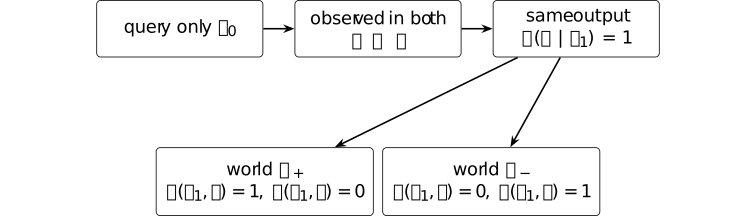
The transcript laws are identical, so Theorem [ftip-007S] applies, while the deterministic readout returns the same output in both worlds. That output is optimal in \(w_+\) and suboptimal in \(w_-\) on \(x_1\). The example does not show that generalization always fails. It shows that a claim about unqueried utility requires an assumption connecting observed feedback to that utility.
Remark. From finite indistinguishability to preference-data limits [ftip-007X]AGENTDRAFTED
Remark. From finite indistinguishability to preference-data limits [ftip-007X]AGENTDRAFTED
[zhao2025limits, Theorems 3.3--3.5] study a more structured post-training model. They give ordinal-preference distortion lower bounds, including a lower bound under Bradley--Terry noise with linear scores, and a positive result using a limited number of cardinal queries. These results depend on the routing model, utility class, and query budget developed in § [ftip-008X].
Theorem [ftip-007S] gives a finite pushforward theorem, while Example [ftip-007W] gives a counterexample to identification from an incomplete transcript. They are neither proofs nor special cases of the paper's distortion results.
Replay monitors and trajectory compression [ftip-007Y]AGENTDRAFTED
Replay monitors and trajectory compression [ftip-007Y]AGENTDRAFTED
Reusing a rollout and jumping along a predicted checkpoint path save different kinds of work. The first changes how often recorded feedback enters an update. The second replaces some realized training steps by a parameter forecast. This subsection records what their proposed monitors establish and, separately, what remains unmeasured.
Theorem. DGG head gradient and shared-weight occurrence sum [ftip-007Z]AGENTDRAFTED
Theorem. DGG head gradient and shared-weight occurrence sum [ftip-007Z]AGENTDRAFTED
Fix a sampled history and an active token \(i\) in the interior of the unclipped branch of the GRPO objective. Consider a finite directed acyclic computation graph that is differentiable at the parameter point in question. Let \(a_i\) be the sampled token, \(\widehat A_i\) its fixed normalized advantage, and \(p_i=\operatorname {softmax}(z_i)\) the current distribution on a finite vocabulary \(\mathcal V\). With fixed behavior probability \(b_i>0\), set \[ r_i=\frac {p_i(a_i)}{b_i}, \qquad \mathcal L_i=r_i\widehat A_i, \qquad E_i=r_i\widehat A_i(e_{a_i}-p_i). \] Here \(e_{a_i}\in \mathbb R^{|\mathcal V|}\) is the sampled-token basis vector. The history and sampling decisions are held fixed during differentiation.
Suppose the output head \(W_{\rm lm}\in \mathbb R^{|\mathcal V|\times d_{\rm model}}\) is untied: its only path to \(\mathcal L_i\) is through \(z_i=W_{\rm lm}h_{L,i}\), and \(h_{L,i}\in \mathbb R^{d_{\rm model}}\) is independent of \(W_{\rm lm}\). Then \[ G_i^{\rm lm}=\nabla _{W_{\rm lm}}\mathcal L_i =E_i h_{L,i}^{\mathsf T}. \]
Let \(W_{\rm int}\in \mathbb R^{m\times d}\) be a shared intermediate weight. Index by a finite set \(\mathcal O_i\) every occurrence of this weight that can affect \(z_i\), assuming that all such uses have the form \(y_o=W_{\rm int}x_o\), with \(x_o\in \mathbb R^d\). First replace these uses by independent copies \(W_o\) and evaluate them all at \(W_o=W_{\rm int}\). Let \(J_{io}\in \mathbb R^{|\mathcal V|\times m}\) be the downstream Jacobian from node \(y_o\) to \(z_i\) in this graph, with the other weight copies fixed. Define the contribution of occurrence \(o\) by \[ H_{io}=\nabla _{W_o}\mathcal L_i =(J_{io}^{\mathsf T}E_i)x_o^{\mathsf T}. \] On tying the copies, the total derivative is \[ G_i^{\rm int}=\nabla _{W_{\rm int}}\mathcal L_i =\sum _{o\in \mathcal O_i}H_{io}. \] The head gradient and each occurrence contribution have rank at most one; the total shared-weight gradient need not.
For a layer used once per position in a causal network, the sum includes every earlier position whose output affects token \(i\). Reuse across depth adds further occurrences. Tying the head to embeddings or other blocks also requires their contributions; the displayed head identity assumes that such tying is absent.
Proof.
Proof.
Softmax differentiation gives \(\nabla _{z_i}\mathcal L_i=E_i\). The outer-product rule gives the untied head identity. In the graph with independent copies, \(x_o\) does not depend on its own \(W_o\); all downstream paths from \(y_o\) are included in \(J_{io}\). The chain rule therefore gives \(\nabla _{W_o}\mathcal L_i=(J_{io}^{\mathsf T}E_i)x_o^{\mathsf T}\). Finally, the derivative of the diagonal map \(W_{\rm int}\mapsto (W_o=W_{\rm int})_{o\in \mathcal O_i}\) adds these partial derivatives.
Clipped or inactive terms require their own derivative or mask. [miao2026when, Section 4.2.1, Proposition 1, and Appendix A.1] derives the intermediate outer product through one local application. For a shared weight, that calculation gives \(H_{io}\); identifying it with the total \(G_i^{\rm int}\) omits the other occurrences. The sum above supplies the chain rule needed for shared parameters.
Theorem. DGG occurrence-to-head gradient-energy bound [ftip-0080]AGENTDRAFTED
Theorem. DGG occurrence-to-head gradient-energy bound [ftip-0080]AGENTDRAFTED
Use the per-token quantities and untied head of Theorem [ftip-007Z], and fix one occurrence \(o\in \mathcal O_i\). Assume \(d_{\rm model}\geq 1\) and positive constants \(\alpha _{\min }\), \(\beta _{\max }\), and \(C\) satisfy \[ \|h_{L,i}\|_2^2\geq \alpha _{\min }d_{\rm model}, \qquad \|x_o\|_2^2\leq \beta _{\max }d_{\rm model}, \] and the two logit-sensitivity bounds \[ \mathbb E_{a\sim p_i} \|(J_{io})_{a,:}\|_2^2\leq C, \qquad \|(J_{io})_{a_i,:}\|_2^2\leq C. \] If \(\widehat A_i\neq 0\) and \(p_i(a_i)<1\), then \[ \frac {\|H_{io}\|_F^2}{\|G_i^{\rm lm}\|_F^2} \leq \frac {\mathcal C_{\rm occ}} {(1-p_i(a_i))^2}, \qquad \mathcal C_{\rm occ} =\frac {4\beta _{\max }C}{\alpha _{\min }}. \]
Proof.
Proof.
The sampled-token coordinate of \(E_i\) and the lower activation bound give \[ \|G_i^{\rm lm}\|_F^2 =\|E_i\|_2^2\|h_{L,i}\|_2^2 \geq r_i^2\widehat A_i^2 (1-p_i(a_i))^2 \alpha _{\min }d_{\rm model}. \] Write \(J_{io}^{\mathsf T}E_i\) as \(r_i\widehat A_i\) times the difference between the sampled row and the \(p_i\)-weighted mean row. The squared-norm inequality \(\|u-v\|_2^2\leq 2\|u\|_2^2+2\|v\|_2^2\), Jensen's inequality for that mean, and the two row-energy bounds give \(\|J_{io}^{\mathsf T}E_i\|_2^2\leq 4r_i^2\widehat A_i^2C\). Hence \[ \|H_{io}\|_F^2 \leq 4r_i^2\widehat A_i^2C\, \beta _{\max }d_{\rm model}. \] The source's softmax probabilities make \(r_i>0\); the nonzero-advantage and nonunit-probability hypotheses make the head lower bound positive. Division and cancellation give the displayed ratio.
This bounds one occurrence contribution, not the total derivative of a shared intermediate weight. For the latter, the sum in Theorem [ftip-007Z] gives only \[ \|G_i^{\rm int}\|_F \leq \sum _{o\in \mathcal O_i} \|J_{io}^{\mathsf T}E_i\|_2\|x_o\|_2. \] If the same displayed hypotheses hold for every occurrence, the triangle inequality yields the ratio bound \(|\mathcal O_i|^2\mathcal C_{\rm occ}/(1-p_i(a_i))^2\) for \(\|G_i^{\rm int}\|_F^2/\|G_i^{\rm lm}\|_F^2\). Controlling only the application at position \(i\) does not establish this all-occurrence hypothesis or the source's claimed bound for the total gradient. The contributing positions, reuse pattern, and Jacobians depend on the architecture. Neither bound establishes a small gradient or an evaluation-score comparison.
The activation and row-energy hypotheses and the local inequality follow the calculation in [miao2026when, Section 4.2.1, Lemma 1, Assumption 1, Theorem 1, and Appendix A.3], with the differentiated object restricted to an occurrence contribution. They do not prove the source's total shared-weight claim under its local hypotheses.
Theorem. DGG finite-batch head-gradient inequality [ftip-0081]AGENTDRAFTED
Theorem. DGG finite-batch head-gradient inequality [ftip-0081]AGENTDRAFTED
For \(T\geq 1\) active, unclipped tokens with fixed sampled histories and the untied output head of Theorem [ftip-007Z], let \[ G^{\rm lm}=\frac 1T\sum _{i=1}^T G_i^{\rm lm}, \qquad \overline {r^2}=\frac 1T\sum _{i=1}^T r_i^2, \] and set \[ c_{\max }= \max _{1\leq i\leq T} \widehat A_i^2 \|e_{a_i}-\pi _\theta (\mathord \cdot \mid h_{L,i})\|_2^2 \|h_{L,i}\|_2^2. \] Then \[ \|G^{\rm lm}\|_F^2\leq c_{\max }\overline {r^2} =c_{\max }(1+\widehat \chi ^2), \] where \(\widehat \chi ^2\) is the statistic of Definition [ftip-0066]. If \(c_{\max }>0\), rearrangement gives the source's equivalent direction \[ \widehat \chi ^2\geq \frac {\|G^{\rm lm}\|_F^2}{c_{\max }}-1. \]
Proof.
Proof.
Convexity of the squared Frobenius norm and the factorization in Theorem [ftip-007Z] give \[ \left \|\frac 1T\sum _iG_i^{\rm lm}\right \|_F^2 \leq \frac 1T\sum _i\|G_i^{\rm lm}\|_F^2 \leq \frac {c_{\max }}T\sum _i r_i^2. \] The identity \(\overline {r^2}=1+\widehat \chi ^2\) follows directly from Definition [ftip-0066]; division by positive \(c_{\max }\) gives the final form.
The inequality points from observed head-gradient energy to a lower bound on this finite-batch squared-ratio statistic. It is not a converse: cancellation can hide nonunit ratios. The active cancellation example in Example [ftip-0084] states its clipping interval explicitly. The proof uses no intermediate-weight bound.
The finite-batch inequality follows the calculation in [miao2026when, Section 4.2.2, Lemma 2, Theorem 2, and Appendix B], under the untied-head and fixed-history assumptions stated above.
Remark. DGG monitors update geometry, not evaluation safety [ftip-0082]AGENTDRAFTED
Remark. DGG monitors update geometry, not evaluation safety [ftip-0082]AGENTDRAFTED
The identities in Theorem [ftip-007Z]--Theorem [ftip-0081] concern gradients, importance ratios, activations, and occurrence-specific logit Jacobians. The intermediate bound controls a local contribution; a shared-weight bound needs control over all contributing occurrences. None of their hypotheses mentions the fixed independent-evaluation functional \(J_{\rm ev}\) of Definition [ftip-005E]. They therefore cannot imply that accepting an update preserves \(J_{\rm ev}\), or that rejecting one would have prevented a decrease.
DGG adds an empirical policy on top of those identities: it monitors the increment in head-gradient energy, standardizes that increment against a trailing window, and rejects some reused updates before the optimizer step [miao2026when, Section 5 and Algorithm 1]. Its reported experiments relate that policy to observed training stability. They do not turn the Z-score into a calibrated test of independent-evaluation safety.
Example. Counterexample: empirical squared-ratio excess can be negative [ftip-0083]AGENTDRAFTED
Example. Counterexample: empirical squared-ratio excess can be negative [ftip-0083]AGENTDRAFTED
Take one observed action \(a\) with \(\pi _{\rm old}(a)=1/2\) and \(\pi _\theta (a)=1/4\). The batch contains only that action, so \(T=1\) and \(r_1=1/2\). Hence \[ \widehat \chi ^2=r_1^2-1=-\frac 34. \] Both policies can be completed on a two-action space by assigning their remaining mass to the other action.
Thus the finite-batch statistic in Definition [ftip-0066] need not share the nonnegativity of the population Pearson divergence. Theorem Theorem [ftip-0081] remains valid: its right side contains \(1+\widehat \chi ^2=1/4=\overline {r^2}\).
Example. Counterexample: active batch cancellation can hide nonunit ratios [ftip-0084]AGENTDRAFTED
Example. Counterexample: active batch cancellation can hide nonunit ratios [ftip-0084]AGENTDRAFTED
Fix \(\epsilon _{\rm clip}\in (0,1)\) and \(1<R<1+\epsilon _{\rm clip}\). On a two-token vocabulary, let both observed tokens have \(a_i=1\), current probability \(\pi _\theta (1)=1/2\), and behavior probability \(\pi _{\rm old}(1)=1/(2R)\). Take scalar hidden states \(h_{L,1}=h_{L,2}=1\) and fixed normalized advantages \(\widehat A_1=1\), \(\widehat A_2=-1\). These may be selected token terms from different rollout members. An untied head with both logits zero realizes the current probabilities. Both terms lie strictly inside the clipping interval of Definition [ftip-003F], so the clipped surrogate locally agrees with \(\mathcal L_i=r_i\widehat A_i\). Thus \(r_1=r_2=R\), and Theorem [ftip-007Z] gives \[ G_1^{\rm lm}=R(1/2,-1/2)^{\mathsf T}, \qquad G_2^{\rm lm}=-G_1^{\rm lm}. \] Consequently \(G^{\rm lm}=0\), while \(\widehat \chi ^2=R^2-1>0\). For this fixed clipping rule, the statistic in this construction is bounded above by \((1+\epsilon _{\rm clip})^2-1\).
For the raw surrogate \(\mathcal L_i=r_i\widehat A_i\) considered as a separate objective, the same algebra works at every \(R>1\) and yields arbitrarily large squared-ratio excess. This does not extend the active construction to arbitrary \(R\) under clipping: when \(R>1+\epsilon _{\rm clip}\), the positive-advantage term is locally constant, while the negative term remains active. Their clipped gradients are then \(0\) and \(-R(1/2,-1/2)^{\mathsf T}\), with nonzero mean \((-R/4,R/4)^{\mathsf T}\).
The example does not contradict Theorem [ftip-0081]: that theorem upper-bounds batch-gradient energy by a ratio moment. It supplies no lower bound on the gradient and no converse from zero batch-gradient energy to ratios equal to one. The arbitrary-ratio version concerns only the separate raw surrogate.
Example. Counterexample: a Z-score gate is not an evaluation-safety certificate [ftip-0085]AGENTDRAFTED
Example. Counterexample: a Z-score gate is not an evaluation-safety certificate [ftip-0085]AGENTDRAFTED
Let two consecutive proposed reused updates have the same monitored energy, \(g_{t-1}=g_t=1\). With trailing-window increment mean \(\mu _t=0\), any positive scale \(\sigma _t+\varepsilon \), and any positive threshold, DGG's score is \[ z_t=\frac {(g_t-g_{t-1})-\mu _t}{\sigma _t+\varepsilon }=0, \] so the gate accepts the proposal. Now choose a fixed evaluation interface for which the artifact before the accepted update has performance \(J_{\rm ev}=1\) and the artifact after it has performance \(J_{\rm ev}=0\).
This is consistent because the gate rule of Definition [ftip-005A] imposes no mathematical relation between its scalar monitor and \(J_{\rm ev}\). A safety claim would need an additional assumption connecting proposed updates to the independent evaluation law; the Z-score calculation alone cannot provide it.
Definition. Leading squared singular-energy share [ftip-0086]AGENTDRAFTED
Definition. Leading squared singular-energy share [ftip-0086]AGENTDRAFTED
Let \(\Delta W\in \mathbb R^{m\times n}\) be nonzero, set \(q=\min (m,n)\), and order its singular values as \(\sigma _1\geq \cdots \geq \sigma _q\geq 0\). Its leading squared singular-energy share is \[ \rho _1(\Delta W) =\frac {\sigma _1(\Delta W)^2}{\sum _{j=1}^q\sigma _j(\Delta W)^2} =\frac {\sigma _1(\Delta W)^2}{\|\Delta W\|_F^2}. \] The nonzero hypothesis prevents an undefined \(0/0\); the value lies in \([1/q,1]\).
NExt instead reports \(E_1=\sigma _1/\sum _j\sigma _j\) in Section 3.2 Low-rank optimization trajectories modeling for LLM RLVR acceleration[chen2026lowrank]. That nuclear-share statistic and \(\rho _1\) answer different questions. The squared share measures contribution to squared Frobenius norm.
Definition. Leading spectral gap [ftip-0087]AGENTDRAFTED
Definition. Leading spectral gap [ftip-0087]AGENTDRAFTED
For \(\Delta W\in \mathbb R^{m\times n}\) with \(q=\min (m,n)\geq 2\), its leading spectral gap is \[ \operatorname {gap}_1(\Delta W) =\sigma _1(\Delta W)-\sigma _2(\Delta W). \] A positive gap makes the leading left and right one-dimensional singular subspaces unique, although each chosen singular vector still has an arbitrary sign. When the gap is zero, a single leading vector is not intrinsic.
The quantity is undefined when \(q=1\), since there is no second singular value. Projector comparisons require a positive gap at every compared checkpoint.
Definition. Leading-subspace projector drift [ftip-0088]AGENTDRAFTED
Definition. Leading-subspace projector drift [ftip-0088]AGENTDRAFTED
Let \(\Delta W_t\) and \(\Delta W_s\) be nonzero matrices of the same shape, each with positive leading spectral gap. If \(u_1(t)\) and \(u_1(s)\) are unit leading left singular vectors, define their leading-subspace projector drift by \[ d_{\rm proj}(t,s) =\|\Pi _t^{\rm svd}-\Pi _s^{\rm svd}\|_F, \qquad \Pi _t^{\rm svd}=u_1(t)u_1(t)^{\mathsf T}, \quad \Pi _s^{\rm svd}=u_1(s)u_1(s)^{\mathsf T}. \] The definition is independent of both singular-vector signs and takes values in \([0,\sqrt {2}]\).
This is an additional proposed trajectory diagnostic; NExt does not define it.
A large value of \(\rho _1\) from Definition [ftip-0086] says that one singular mode dominates a particular difference matrix. It does not say that the dominant subspace remains fixed across checkpoints; \(d_{\rm proj}\) measures that separate question.
Definition. Path-emulation regret [ftip-0089]AGENTDRAFTED
Definition. Path-emulation regret [ftip-0089]AGENTDRAFTED
Fix the evaluation interface of Convention [ftip-005D]. Let \(P_{t+s}^{\rm act}\) be the protocol that returns the artifact reached after \(s\geq 1\) additional realized training steps from checkpoint \(t\). Let \(\mathcal K_{\leq t}\) be the saved checkpoint history available through \(t\), and let \(\widehat P_{t+s}(\mathcal K_{\leq t})\) instead return the artifact forecast from that history. Their signed path-emulation regret and absolute path-emulation regret are \[ \begin {aligned} \operatorname {Reg}^{\rm path}_{\rm ev}(t,s) &=J_{\rm ev}(P_{t+s}^{\rm act}) -J_{\rm ev}(\widehat P_{t+s}(\mathcal K_{\leq t})),\\ \operatorname {AReg}^{\rm path}_{\rm ev}(t,s) &=\left |\operatorname {Reg}^{\rm path}_{\rm ev}(t,s)\right |. \end {aligned} \]
The sign distinguishes an optimistic forecast from a pessimistic one; the absolute value measures discrepancy without cancellation across checkpoints. Both use the same task law, inference budget, and evaluator. Parameter error alone is not substituted for evaluation error. The NExt extrapolation and recovery schedule described in Sections 4.1--4.3 and 5.1 motivates this comparison Low-rank optimization trajectories modeling for LLM RLVR acceleration[chen2026lowrank], but the paper does not state this regret definition.
Example. Counterexample: early low-rank agreement does not determine continuation [ftip-008A]AGENTDRAFTED
Example. Counterexample: early low-rank agreement does not determine continuation [ftip-008A]AGENTDRAFTED
Let \(e_1=(1,0)^{\mathsf T}\) and \(e_2=(0,1)^{\mathsf T}\) be the standard basis vectors of \(\mathbb R^2\). In a two-dimensional matrix chart, set \(P=e_1e_1^{\mathsf T}\) and \(Q=e_2e_2^{\mathsf T}\). Two paths share the entire observed history \[ W_0=0,\qquad W_1=P,\qquad W_2=2P. \] Every observed local difference is the same rank-one matrix \(P\). The paths then fork: path A takes \(W_3^A=3P\), whereas path B takes \(W_3^B=2P+Q\). Each next local difference is again rank one.
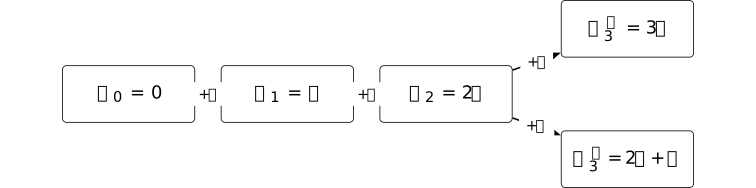
A deterministic history-only forecaster must return the same matrix \(\widehat W_3\) in both worlds. Since \(\|W_3^A-W_3^B\|_F=\|P-Q\|_F=\sqrt {2}\), the triangle inequality forces its Frobenius error to be at least \(1/\sqrt {2}\) on one continuation. Low-rank early motion therefore does not identify the next subspace or the next checkpoint.
Remark. Compression of a charted path is not capability acquisition [ftip-008B]AGENTDRAFTED
Remark. Compression of a charted path is not capability acquisition [ftip-008B]AGENTDRAFTED
NExt extracts global, local, and target differences from LoRA checkpoint matrices, keeps leading singular factors, learns a nonlinear predictor, jumps in that parameter chart, and resumes RLVR [chen2026lowrank, Sections 3.2, 4.1--4.3, and 5.1]. Its reported results are empirical; the paper states no theorem that a leading subspace remains stable or that a forecast preserves a policy.
The quantities in Definition [ftip-0086]--Definition [ftip-0089] separate four tests. Squared singular-energy share concerns one matrix, spectral gap controls whether its leading subspace is identifiable, projector drift compares those subspaces over time, and path-emulation regret returns to fixed independent evaluation. None, by itself, is evidence that new feedback was acquired or that a new capability was learned. Such a claim must use a declared post-training gain such as Definition [ftip-005F] and must charge forecast training, the parameter jump, and recovery updates.
Alignment gain and preference information [ftip-008E]AGENTDRAFTED
Alignment gain and preference information [ftip-008E]AGENTDRAFTED
Two finite models ask different questions about post-training. The first assumes an exact KL-regularized optimizer and characterizes the reward gain that its exponential tilt can produce. The second asks what ordinal comparisons reveal when post-training may reroute a fixed set of response circuits.
Neither source model is a general account of neural post-training. The first assumes exact optimization of a declared scalar reward. The second is a stylized routing model with a fixed circuit set. Extending the KL identity to an approximate optimizer requires further analysis. Extending the ordinal routing conclusion to a changing circuit set requires additional assumptions on that change.
Finite KL-regularized alignment [ftip-008F]AGENTDRAFTED
Finite KL-regularized alignment [ftip-008F]AGENTDRAFTED
This subsection studies an exact, finite optimization model. A reference law is exponentially tilted by a declared scalar reward. In this setting, reward gain admits two exact descriptions: a Jeffreys-divergence identity and a covariance under the reference law.
The statements do not model approximate optimization, neural training cost, reward validity, or independent capability evaluation.
Remark. Exact optimization on a finite response set [ftip-008G]AGENTDRAFTED
Remark. Exact optimization on a finite response set [ftip-008G]AGENTDRAFTED
Theorems 1 and 2 of the v1 preprint [paes2026theoretical] concern an exactly optimal KL-regularized policy and a fixed query. On a finite response set, their expectations and normalizers are ordinary finite sums.
These exact identities do not establish a comparison among best-of-\(N\), PPO, and GRPO, or a general guarantee for proxy rewards and reward ensembles. Those questions require assumptions beyond exact optimization of one reward.
Notation. Translating the alignment source notation [ftip-008H]AGENTDRAFTED
Notation. Translating the alignment source notation [ftip-008H]AGENTDRAFTED
The source writes \(\lambda >0\) for the KL penalty. Here we write \(\beta >0\), matching the DPO notation in Notation [ftip-003M]--Definition [ftip-003O]. This avoids collision with the generalized-advantage parameter in Definition [ftip-003E] and the protocol law in Definition [ftip-007Q].
The source's gain \(\Delta (r,r')\) is written \(G_p(r;s)\): \(r\) is the reward used to tilt the reference law \(p\), while \(s\) is the reward used to evaluate the tilted law. This avoids collision with both the simplex notation \(\Delta (X)\) of Notation [ftip-000A] and the paired DPO margin of Notation [ftip-003M]. For a finite set \(\mathcal Y\), a law \(p\in \Delta (\mathcal Y)\), and functions \(f,g:\mathcal Y\to \mathbb R\), set
\[ \operatorname {Cov}_p(f,g) =\mathbb E_{y\sim p}[f(y)g(y)] -\mathbb E_{y\sim p}[f(y)]\, \mathbb E_{y\sim p}[g(y)]. \]
Definition. Finite KL-alignment instance [ftip-008I]AGENTDRAFTED
Definition. Finite KL-alignment instance [ftip-008I]AGENTDRAFTED
A finite KL-alignment instance consists of a nonempty finite response set \(\mathcal Y\), a reference law \(p\in \Delta (\mathcal Y)\), a penalty \(\beta >0\), and finite real functions \(r,s:\mathcal Y\to \mathbb R\). The reference support is
\[ S_p=\{y\in \mathcal Y:p(y)>0\}. \]A prompt is fixed and suppressed. The function \(r\) determines the alignment update; \(s\) measures its result. They may coincide, but they need not. Finiteness makes every exponential weight and expectation below finite.
These objects specialize the fixed-query setting in [paes2026theoretical, Section 2, equations (2.1)--(2.2)]; they are not a definition of alignment in general.
Definition. Exponential weight and partition function [ftip-008J]AGENTDRAFTED
Definition. Exponential weight and partition function [ftip-008J]AGENTDRAFTED
For a finite KL-alignment instance, define the exponential weight and partition function by
\[ a_r(y)=\exp \left (\frac {r(y)}{\beta }\right ), \qquad Z_r=\mathbb E_{y\sim p}[a_r(y)]. \]Every \(a_r(y)\) is finite and strictly positive. Since \(p\) is a probability law on a nonempty finite set, \(0<Z_r<\infty \).
This weight and normalizer are the fixed-query form of [paes2026theoretical, Equation (2.2)].
Definition. Aligned law in finite-source notation [ftip-008K]AGENTDRAFTED
Definition. Aligned law in finite-source notation [ftip-008K]AGENTDRAFTED
The aligned law induced by \(r\) is \(q_r\in \Delta (\mathcal Y)\) given by
\[ q_r(y)=\frac {p(y)a_r(y)}{Z_r}. \]Normalization follows from the definition of \(Z_r\). Moreover, \(q_r(y)>0\) exactly when \(p(y)>0\). This is the finite notation for the same exponential-tilt optimizer stated in Definition [ftip-003O]; support preservation was proved in Theorem [ftip-007C].
This formula is [paes2026theoretical, Equation (2.2)]. It assumes the exact optimizer, not an iterate returned by a particular training algorithm.
Definition. Cross-reward gain under an alignment reward [ftip-008L]AGENTDRAFTED
Definition. Cross-reward gain under an alignment reward [ftip-008L]AGENTDRAFTED
The cross-reward gain from aligning with \(r\) and evaluating with \(s\) is
\[ G_p(r;s) =\mathbb E_{y\sim q_r}[s(y)] -\mathbb E_{y\sim p}[s(y)]. \]The semicolon records two roles. Its left argument changes the response law; its right argument scores both laws. Thus \(G_p(r;s)\) is not an independent evaluation unless \(s\) has separately been declared to serve that role.
This is the finite notation for \(\Delta (r,r')\) in Theorem 2, equation (3.4), of Theoretical limits of language model alignment[paes2026theoretical].
Definition. Jeffreys divergence [ftip-008M]AGENTDRAFTED
Definition. Jeffreys divergence [ftip-008M]AGENTDRAFTED
For probability laws \(p\) and \(q\) for which both terms are finite, their Jeffreys divergence is
\[ J(p,q) =D_{\mathrm {KL}}(p\Vert q) +D_{\mathrm {KL}}(q\Vert p). \]The KL divergence and its argument order are defined in Definition [ftip-006X]. Unlike either directed term, \(J(p,q)=J(q,p)\). In the finite tilt of Definition [ftip-008K], \(p\) and \(q_r\) have the same support, so both terms are finite.
Lemma. Log-density ratio of the exact tilt [ftip-008N]AGENTDRAFTED
Lemma. Log-density ratio of the exact tilt [ftip-008N]AGENTDRAFTED
For every \(y\in S_p\), the aligned law satisfies
\[ \log \frac {q_r(y)}{p(y)} =\frac {r(y)}{\beta }-\log Z_r. \]
Proof.
Proof.
On \(S_p\), both \(p(y)\) and \(q_r(y)\) are positive. Dividing the formula of Definition [ftip-008K] by \(p(y)\) and taking logarithms gives the identity.
This is equation (B.1) followed by the logarithmic step in [paes2026theoretical, Appendix B.1, equations (B.1)--(B.2)].
Theorem. Exact reward gain equals scaled Jeffreys divergence [ftip-008O]AGENTDRAFTED
Theorem. Exact reward gain equals scaled Jeffreys divergence [ftip-008O]AGENTDRAFTED
For a finite KL-alignment instance,
\[ G_p(r;r)=\beta J(p,q_r). \]
Proof.
Proof.
Rearranging Lemma [ftip-008N] gives \(r(y)=\beta \log (q_r(y)/p(y))+\beta \log Z_r\) on the common support. Taking expectation first under \(q_r\) and then under \(p\) yields
\[ \begin {aligned} \mathbb E_{q_r}[r] &=\beta D_{\mathrm {KL}}(q_r\Vert p)+\beta \log Z_r,\\ \mathbb E_p[r] &=-\beta D_{\mathrm {KL}}(p\Vert q_r)+\beta \log Z_r. \end {aligned} \]Subtracting cancels the common normalizer and gives the result.
This is the finite form of [paes2026theoretical, Theorem 1, equation (3.2), with proof in Appendix B.1].
Remark. What the Jeffreys identity does and does not identify [ftip-008P]AGENTDRAFTED
Remark. What the Jeffreys identity does and does not identify [ftip-008P]AGENTDRAFTED
The identity Theorem [ftip-008O] is an equality inside one declared model. It says that exact gain in the optimizing reward equals a symmetric divergence from the reference law. It does not say that a larger divergence improves a different utility, nor that a training algorithm reaches the exact tilt.
The identity accounts for neither rollout and update work nor the cost of obtaining \(r\). Consequently it is not, by itself, a bound on the costed post-training potential of Definition [ftip-005M].
Theorem. Cross-reward gain is a base-law covariance [ftip-008Q]AGENTDRAFTED
Theorem. Cross-reward gain is a base-law covariance [ftip-008Q]AGENTDRAFTED
For a finite KL-alignment instance,
\[ G_p(r;s) =\operatorname {Cov}_p\left (s,\frac {a_r}{Z_r}\right ). \]
Proof.
Proof.
The aligned expectation can be written under the reference law as \(\mathbb E_{q_r}[s]=\mathbb E_p[s a_r/Z_r]\). Also \(\mathbb E_p[a_r/Z_r]=1\). Substituting these two identities into Definition [ftip-008L] gives the covariance defined in Notation [ftip-008H].
This is the finite form of Theorem 2, equation (3.4), in Theoretical limits of language model alignment[paes2026theoretical]. Its proof is in Appendix B.1, equations (B.5)--(B.7).
Remark. The covariance is predictive only for a declared reward [ftip-008R]AGENTDRAFTED
Remark. The covariance is predictive only for a declared reward [ftip-008R]AGENTDRAFTED
The identity Theorem [ftip-008Q] expresses exact tilted-law gain using expectations under \(p\). This makes the population quantity accessible from the reference law in principle. A finite-sample estimator still needs its own sampling law, moment assumptions, and error analysis.
The formula also remains indexed by both \(r\) and \(s\). It cannot turn a proxy reward into an independent utility. If \(s=r\), it measures improvement in the same quantity that defined the exact optimizer; if \(s\ne r\), its sign is determined by the displayed covariance.
Example. A two-response alignment identity [ftip-008S]AGENTDRAFTED
Example. A two-response alignment identity [ftip-008S]AGENTDRAFTED
Take \(\mathcal Y=\{a,b\}\), \(p=(1/2,1/2)\), \(\beta =1\), and \(r(a)=0\), \(r(b)=\log 3\). Exponential weighting changes the reference law as follows.

The reward gain is
\[ G_p(r;r) =\left (\frac 34-\frac 12\right )\log 3 =\frac 14\log 3. \]Direct calculation gives
\[ \begin {aligned} D_{\mathrm {KL}}(q_r\Vert p) &=\frac 14\log \frac 12+\frac 34\log \frac 32,\\ D_{\mathrm {KL}}(p\Vert q_r) &=\frac 12\log 2+\frac 12\log \frac 23, \end {aligned} \]whose sum is \(\frac 14\log 3\). Thus the example checks Theorem [ftip-008O] exactly; it is not an empirical alignment result.
Corollary. Averaging the fixed-query identity over prompts [ftip-008T]AGENTDRAFTED
Corollary. Averaging the fixed-query identity over prompts [ftip-008T]AGENTDRAFTED
Let \(\mathcal X\) be finite with prompt law \(\mu \). For each \(x\in \mathcal X\), let \(p_x\), \(r_x\), and \(q_{r_x}\) be a finite KL-alignment instance with the same penalty \(\beta >0\). Then
\[ \sum _{x\in \mathcal X}\mu (x)G_{p_x}(r_x;r_x) =\beta \sum _{x\in \mathcal X}\mu (x)J(p_x,q_{r_x}). \]
Proof.
Proof.
Apply Theorem [ftip-008O] at each prompt and take the finite \(\mu \)-weighted sum.
The source theorem is stated for each fixed query. This corollary performs only finite averaging; it does not introduce a shared neural parameterization across prompts.
Lemma. Additive reward shifts leave the aligned law unchanged [ftip-008U]AGENTDRAFTED
Lemma. Additive reward shifts leave the aligned law unchanged [ftip-008U]AGENTDRAFTED
For constants \(c,d\in \mathbb R\),
\[ q_{r+c}=q_r, \qquad G_p(r+c;s+d)=G_p(r;s). \]
Proof.
Proof.
The shifted weight is \(a_{r+c}=e^{c/\beta }a_r\), while its partition function is \(Z_{r+c}=e^{c/\beta }Z_r\); the common factor cancels in the aligned law. Adding \(d\) to the evaluation reward adds \(d\) to both expectations in the gain, so it also cancels.
This finite lemma records the same prompt-dependent additive non-identifiability that appears in the DPO reparameterization of Definition [ftip-003P].
Remark. A penalty coefficient is not a hard KL budget [ftip-008V]AGENTDRAFTED
Remark. A penalty coefficient is not a hard KL budget [ftip-008V]AGENTDRAFTED
For fixed \(\beta \), the exponential tilt solves the penalized problem
\[ \max _{q\in \Delta (\mathcal Y)} \left \{\mathbb E_q[r] -\beta D_{\mathrm {KL}}(q\Vert p)\right \} \]under the conventions of Definition [ftip-008I]. This is not the same specification as choosing a number \(\kappa \) and solving
\[ \max _q\mathbb E_q[r] \quad \text {subject to}\quad D_{\mathrm {KL}}(q\Vert p)\leq \kappa . \]A Lagrange multiplier can relate the two problems when the relevant duality and activity conditions hold. The coefficient \(\beta \) alone does not declare a hard budget, and the identities Theorem [ftip-008O]--Theorem [ftip-008Q] do not supply those conditions.
Remark. Fixed-query identities and their assumptions [ftip-008W]AGENTDRAFTED
Remark. Fixed-query identities and their assumptions [ftip-008W]AGENTDRAFTED
The source setup writes rewards as \(r(\mathbf x,\mathbf y)\), while the display of Theorem 1 reverses the two arguments in places. This subsection uses the setup order and then suppresses the fixed prompt. The source also moves between a dataset-level penalized objective and fixed-query identities. The finite-averaging result Corollary [ftip-008T] makes that step explicit.
The identities specialize Theoretical limits of language model alignment[paes2026theoretical] to a finite response set. They require no extension to the full sequence space.
Finally, exact exponential tilting is a distributional optimizer. It does not account for rollout, gradient, optimizer, or systems cost, and it does not show that PPO, GRPO, DPO, or any frontier training run attains the displayed law. Applying the identities to a training run therefore requires a separate argument that its output law is the exact optimizer.
Preference-feedback distortion [ftip-008X]AGENTDRAFTED
Preference-feedback distortion [ftip-008X]AGENTDRAFTED
A finite routing model supports preference-distortion lower bounds in Sections 2--3 and Appendix A of The limits of preference data for post-training[zhao2025limits]. Cardinal queries permit a different guarantee under the hypotheses of Peeking behind the ordinal curtain: Improving distortion via cardinal queries[amanatidis2021peeking].
Both comparisons depend on the queries, circuits, routing maps, utility, feedback profile, algorithm, and comparator class. The noiseless and Bradley--Terry bounds retain those model restrictions.
Remark. The routing-model assumption behind preference limits [ftip-008Y]AGENTDRAFTED
Remark. The routing-model assumption behind preference limits [ftip-008Y]AGENTDRAFTED
The routing model and preference limits below are based on the v1 preprint The limits of preference data for post-training[zhao2025limits]. It models a pretrained system as a finite collection of response circuits plus learned maps that route queries to those circuits. Post-training changes the routing maps while retaining the circuit collection.
The noiseless lower bound is proved here under explicit pointwise response separation and a deterministic preference-only learner, whose returned router may be stochastic. Its finite partition estimate and cardinal-utility construction give a restricted reconstruction of the source rate; the proof does not establish a randomized-learner extension.
The routing model is a source assumption, not an architectural theorem about language models. In particular, its lower bounds do not prove that real post-training creates no circuits, that a neural network decomposes into the displayed objects, or that every preference-learning algorithm obeys the same bound outside this model.
Notation. Notation for the finite preference model [ftip-008Z]AGENTDRAFTED
Notation. Notation for the finite preference model [ftip-008Z]AGENTDRAFTED
The finite preference model uses the following symbols, corresponding to the notation of The limits of preference data for post-training[zhao2025limits]:
\[ \mathcal Q\mapsto Q,\qquad \mathcal R\mapsto Y,\qquad \mathcal S_0\mapsto C_0,\qquad \mathcal Z\mapsto H, \]\[ \Phi \mapsto \mathfrak E,\qquad \mathcal D\mapsto \mu _Q,\qquad M\mapsto \mathfrak m. \]Thus \(H\) denotes the source's finite internal-representation set, not a public interaction history. The family \(\mathfrak E\) contains admissible query encoders and is unrelated to the costed potential \(\Phi \) of Definition [ftip-005M].
Definition. Queries, responses, and retained circuits [ftip-0090]AGENTDRAFTED
Definition. Queries, responses, and retained circuits [ftip-0090]AGENTDRAFTED
Following the formal model in Section 2 of The limits of preference data for post-training[zhao2025limits], let \(Q\) be a finite nonempty query set and \(Y\) a response set. A response circuit is a function \(c:Q\to Y\). The finite nonempty set \(C_0\) contains the circuits retained from the pretrained model.
The word ``circuit'' is source terminology for this abstract function. No claim is made here that an element of \(C_0\) is localized in a neural network or corresponds to one human-named capability.
Definition. Query representation and circuit routing [ftip-0091]AGENTDRAFTED
Definition. Query representation and circuit routing [ftip-0091]AGENTDRAFTED
Let \(H\) be a finite nonempty representation set and \(\mathfrak E\subseteq H^Q\) a finite nonempty family of admissible encoders. A query encoder is \(e\in \mathfrak E\). A circuit router is a map
\[ h:H\longrightarrow \Delta (C_0). \]For a query \(\xi \in Q\), the composition \(h(e(\xi ))\) is a law on the retained circuits. Sampling \(c\sim h(e(\xi ))\) and returning \(c(\xi )\) gives the response law. These are the two routing components in the source model [zhao2025limits, Section 2, ``Formal model''].
Definition. Pretrained and post-trained routing models [ftip-0092]AGENTDRAFTED
Definition. Pretrained and post-trained routing models [ftip-0092]AGENTDRAFTED
A routing model is a triple \(\mathfrak m=(e,h,C_0)\) with the types fixed in Definition [ftip-0090]--Definition [ftip-0091]. The pretrained model is \(\mathfrak m_0=(e_0,h_0,C_0)\). In the source intervention, a post-trained model may replace \(e_0\) and \(h_0\), but it retains exactly \(C_0\).
Write \(\mathfrak m(\xi )\) for the random response obtained by sampling \(c\sim h(e(\xi ))\) and returning \(c(\xi )\). The source sometimes writes this as though the router selected a circuit rather than a distribution; the stochastic reading follows its declared codomain \(\Delta (C_0)\).
Definition. Utility and the uniform query law [ftip-0093]AGENTDRAFTED
Definition. Utility and the uniform query law [ftip-0093]AGENTDRAFTED
The source fixes the uniform probability law \(\mu _Q\) on \(Q\) and a utility function
\[ u:Q\times Y\longrightarrow \mathbb R. \]For a routing model \(\mathfrak m\), its expected utility is
\[ U_u(\mathfrak m) =\mathbb E_{\xi \sim \mu _Q} \mathbb E\left [u\left (\xi ,\mathfrak m(\xi )\right )\mid \xi \right ]. \]This is the outcome objective in [zhao2025limits, Section 2, ``Outcome-based optimization with preference data'']. It is an assumed cardinal utility, not something ordinal comparisons directly reveal.
Definition. Complete noiseless ordinal preference profile [ftip-0094]AGENTDRAFTED
Definition. Complete noiseless ordinal preference profile [ftip-0094]AGENTDRAFTED
Assume that distinct retained circuits never tie at a query. For each \(\xi \in Q\), utility then induces a strict comparison by
\[ c_i\succ _{\xi ,u}c_j \quad \Longleftrightarrow \quad u\left (\xi ,c_i(\xi )\right ) >u\left (\xi ,c_j(\xi )\right ). \]The complete noiseless ordinal profile is \(\succ _u=(\succ _{\xi ,u})_{\xi \in Q}\). The source gives the learner unlimited, unbiased access to every such comparison [zhao2025limits, Section 2, final paragraph]. Utilities with ties require a separately declared deterministic tie-break; the lower bounds below use the source's tie-free constructions.
Remark. Full preference data and an online oracle expose the same source information [ftip-0095]AGENTDRAFTED
Remark. Full preference data and an online oracle expose the same source information [ftip-0095]AGENTDRAFTED
Within this finite model, a table containing every comparison in \(\succ _u\) and a noiseless online oracle that answers every possible query expose the same ordinal information. The source deliberately grants this ideal access so that its obstruction is not caused by finite sampling or an offline split [zhao2025limits, Section 2].
This equivalence does not price the number of queries, labeler time, or adaptivity. It therefore cannot be transferred to a finite-feedback protocol without a separate query-complexity statement.
Definition. Preference-only post-training algorithm and attainable route class [ftip-0096]AGENTDRAFTED
Definition. Preference-only post-training algorithm and attainable route class [ftip-0096]AGENTDRAFTED
A preference-only post-training algorithm \(\mathcal A\) maps the pretrained routing model and the complete profile to
\[ \mathfrak m_{\mathcal A}(u) =\mathcal A(\mathfrak m_0,\succ _u). \]The deterministic comparator class displayed in the source theorems is
\[ \mathcal M_{\rm det}(C_0) =\left \{(e,h,C_0):e\in \mathfrak E, h:H\to C_0\right \}. \]The source's formal model initially permits stochastic routers \(h:H\to \Delta (C_0)\), but its theorem comparator uses deterministic \(h:H\to C_0\). The comparator class is therefore the displayed deterministic class.
Definition. Multiplicative post-training distortion [ftip-0097]AGENTDRAFTED
Definition. Multiplicative post-training distortion [ftip-0097]AGENTDRAFTED
Let \(\mathcal B\) be any post-training algorithm with output \(\mathfrak m_{\mathcal B}(u)\) under the feedback law induced by \(u\). When the denominator is positive, define its multiplicative post-training distortion by
\[ \operatorname {Dist}_u(\mathcal B;\mathfrak m_0) =\frac { \max _{\mathfrak m^*\in \mathcal M_{\rm det}(C_0)}U_u(\mathfrak m^*) }{ U_u(\mathfrak m_{\mathcal B}(u)) }. \]If the numerator is positive and the denominator is zero, set the ratio to \(+\infty \). The source lower bounds construct bounded nonnegative utilities for which the comparison is well defined [zhao2025limits, Equation (2) and Appendix A]. Distortion measures loss relative to the declared comparator class; it is not an absolute capability score.
Definition. Borda count [ftip-0098]AGENTDRAFTED
Definition. Borda count [ftip-0098]AGENTDRAFTED
Let \(m=|C_0|\), and suppose each \(\succ _{\xi ,u}\) is a strict total order on \(C_0\). If \(\operatorname {rank}_{\succ _{\xi ,u}}(c)\) places the most preferred circuit at rank one, its Borda score is
\[ B_{\xi }(c)=m-\operatorname {rank}_{\succ _{\xi ,u}}(c). \]The Borda-count choice is any circuit in
\[ \operatorname *{arg\,max}_{c\in C_0} \sum _{\xi \in Q}B_{\xi }(c). \]This is [zhao2025limits, Definition 3.1]. The source cites a prior equivalence between a standard RLHF model and Borda count; the definition here does not assert that every RLHF implementation is a Borda rule.
Example. A compromise circuit can maximize utility without winning Borda count [ftip-0099]AGENTDRAFTED
Example. A compromise circuit can maximize utility without winning Borda count [ftip-0099]AGENTDRAFTED
Example 3.2 of The limits of preference data for post-training[zhao2025limits] prints only \(a\geq 0\) and \(2a<b\), but those conditions do not force its stated rankings or Borda totals. Sufficient conditions are \(0<a<1/2\) and \(2a<b<1\). Take three queries, three circuits, and a singleton representation set, so every query must use one common circuit. Set
\[ \begin {array}{c|ccc} &c_A&c_B&c_C\\ \hline \xi _1&1&0&1-a\\ \xi _2&1&0&1-a\\ \xi _3&0&1&b \end {array} \]These inequalities give the rankings \(c_A\succ c_C\succ c_B\) for \(\xi _1,\xi _2\) and \(c_B\succ c_C\succ c_A\) for \(\xi _3\). Hence the Borda totals are \((4,2,3)\), so the ordinal rule selects \(c_A\). The utility totals are \((2,1,2-2a+b)\). Since \(2a<b\), circuit \(c_C\) has strictly greater total utility than \(c_A\).
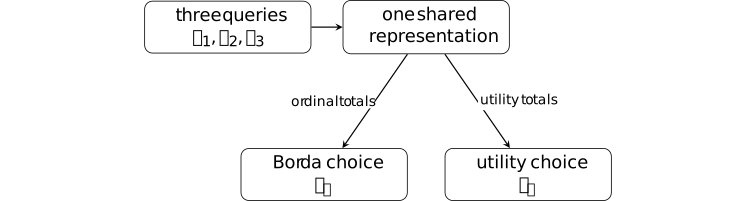
This finite example isolates information lost by ranking. The compromise circuit is never first for an individual query, yet its aggregate utility is largest. It does not show that Borda is always suboptimal or that a neural model must collapse all queries to one representation.
Theorem. Noiseless preference distortion for deterministic learners [ftip-009A]AGENTDRAFTED
Theorem. Noiseless preference distortion for deterministic learners [ftip-009A]AGENTDRAFTED
Let \(Q,H\) be nonempty finite sets, let \(\varnothing \neq \mathfrak E\subseteq H^Q\) be finite, and let \(C_0=\{c_1,\ldots ,c_m\}\) be a nonempty finite set of deterministic maps \(Q\to Y\). Write \(N=|Q|\), \(r=|H|\), \(p=|\mathfrak E|\) and \(m=|C_0|\). The query law is uniform on \(Q\). Call \(C_0\) pointwise response-separating when
\[ c_i\neq c_j\quad \Longrightarrow \quad c_i(q)\neq c_j(q) \qquad (q\in Q). \]Assume this separation. Let \(\mathcal A\) be a deterministic preference-only learner: from a pretrained model \(\mathfrak m_0\) and the complete strict ordinal profile, it returns \((e,h,C_0)\) with \(e\in \mathfrak E\) and a possibly stochastic router \(h:H\to \Delta (C_0)\). The comparator class is exactly \(\mathcal M_{\rm det}(C_0)\) of Definition [ftip-0096], including every map \(H\to C_0\) for each \(e\in \mathfrak E\).
For every such pretrained model and learner there exists \(u:Q\times Y\to [0,1]\), inducing a strict profile, such that
\[ \sum _{j=1}^m u(q,c_j(q))=1\quad (q\in Q), \]\[ R_{Q,\mathfrak E,H}=\frac {N}{\sqrt {N(r+\log p)}+r}, \]\[ \operatorname {Dist}_u(\mathcal A;\mathfrak m_0) \geq \frac 1{80}\min \{\sqrt m,R_{Q,\mathfrak E,H}\}. \]Logarithms are natural. Utility averages over the uniform query and the learner's router draw as in Definition [ftip-0093]. The comparator maximum exists because its class is finite and nonempty. It is positive for the normalized utilities above: some constant-circuit route has mean at least \(1/m\). A zero learner utility therefore gives distortion \(+\infty \), with no \(0/0\) case.
Proof.
Proof.
First, for every normalized nonnegative utility, the comparator value is at least the learner value. Keep the learner's representation map and, on each fiber, choose a circuit maximizing its total utility there. That deterministic choice dominates the stochastic mixture and belongs to the comparator class. Thus distortion is at least one.
Put
\[ \begin {aligned} D&=\sqrt {Nr}+\sqrt {\frac N2\log (4p)},& B&=\sqrt {N(r+\log p)},\\ T&=\min \{\sqrt m,R_{Q,\mathfrak E,H}\},& x&=\min \{\sqrt m,N/(2D)\}. \end {aligned} \]Since \((\log 4)/2<1\leq r\) and \(\log p\geq 0\), we have \(D\leq 2B\). Consequently \(N/(2D)\geq N/(4B)\geq R_{Q,\mathfrak E,H}/4\) and \(x\geq T/4\). Every denominator is positive.
If \(m=1\), assign utility one to the sole circuit response at every query. Distortion is one and \(T\leq 1\). If \(m\geq 2\) but \(x<2\), assign the same strict normalized values \(2(m-j)/(m(m-1))\) to the circuits in index order at every query. Distortion is at least one and \(T<8\), which proves the claimed bound. Extend both assignments by zero to all other responses.
In the remaining case set \(k=\lfloor x\rfloor \). Then
\[ 2\leq k\leq \sqrt m,\qquad kD\leq N/2, \qquad k\geq x/2\geq T/8. \]Write \([k]=\{1,\ldots ,k\}\) and fix a map \(f:Q\to [k]\) supplied by Lemma [ftip-009C]. At a query with label \(i=f(q)\), fix the strict order putting \(c_i\) first and the remaining circuits in increasing index order. Let \(\operatorname {rank}_i(j)\in \{1,\ldots ,m\}\) be the position of \(c_j\), with the first circuit at rank one, and define
\[v_i(j)=\frac {2(m-\operatorname {rank}_i(j))}{m(m-1)}.\]These values decrease strictly in the fixed order, sum to one and lie in \([0,2/m]\). The ordinal profile is now fixed independently of the learner's output. Run the deterministic learner on this profile and \(\mathfrak m_0\), obtaining \((e,h,C_0)\). Write \(h_z(j)=h(z)(c_j)\) for the probability of circuit \(c_j\) at representation \(z\). For each \(z\in H\), choose \(i_z\in [k]\) minimizing \(h_z(j)\) over \(j\in [k]\), breaking ties by index. Since \(\sum _{j=1}^k h_z(j)\leq 1\), we have \(h_z(i_z)\leq1/k\).
Let \(A=\{q:f(q)=i_{e(q)}\}\) and \(S=|A|\). The lower partition bound gives
\[ S=\sum _zX_{z,i_z}\geq \sum _z\min _{j\in [k]}X_{z,j} \geq N/k-D\geq N/(2k). \]Fix \(\epsilon =1/4\). For \(i=f(q)\), assign
\[ u(q,c_j(q))= \begin {cases} (1-\epsilon )\mathbf 1_{j=i}+\epsilon v_i(j),&q\in A,\\ (1-\epsilon )/m+\epsilon v_i(j),&q\notin A. \end {cases} \]Each row is nonnegative and sums to one. On selected queries the added peak favors the already highest-ranked circuit; on the other queries the same constant is added to every circuit. Hence every row induces exactly the fixed strict order. Pointwise response separation makes these assignments well-defined on \(Q\times Y\); assign zero to responses outside the attained circuit responses. Because the final utility has the unchanged ordinal profile, the deterministic learner returns the same \((e,h,C_0)\).
Write \(W=NU\) for total utility. A selected query gives the learner at most \((1-\epsilon )/k+2\epsilon/m\); any other query gives at most \((1-\epsilon )/m+2\epsilon/m\). Averaging over the stochastic router yields
\[ W_{\mathcal A} \leq (1-\epsilon )S/k+(1-\epsilon )(N-S)/m+2\epsilon N/m \leq S/k+2N/m. \]Choose the deterministic comparator \(e^*=e\) and \(h^*(z)=c_{i_z}\). It belongs to the declared class, attains utility at least \(1-\epsilon \geq1/2\) on each selected query and nonnegative utility elsewhere. Thus its total utility is at least \(S/2\). If learner utility is zero the bound follows. Otherwise, using \(S\geq N/(2k)\) and \(k^2\leq m\),
\[ \begin {aligned} \operatorname {Dist}_u &\geq \frac {S/2}{S/k+2N/m} =\frac {k}{2(1+2kN/(mS))}\\ &\geq \frac {k}{2(1+4k^2/m)} \geq \frac {k}{10}\geq \frac {T}{80}. \end {aligned} \]Appendix Theorem A.1 of The limits of preference data for post-training[zhao2025limits] states the corresponding rate for its routing model. Its displayed balancing parameter retains \(\log N\) factors that are absent from its final rate; the second-moment partition bound in Lemma [ftip-009C] supplies a separate argument for the stated restricted model. Its index-based perturbation on queries outside the selected group need not preserve their prescribed favorite; the query-dependent rank weights used here preserve it. When circuits collide at a query, a circuitwise prescription need not define a response utility; pointwise separation excludes that issue.
The utility is a worst-case existential choice for each fixed learner. The proof permits stochastic inference, but it does not cover internal learner randomness: a utility chosen after a realized random output need not be one utility valid before the learner's random draw. No claim about response-colliding circuits or the separate noisy-preference bound follows.
Corollary. A square-root corollary under explicit query growth [ftip-009B]AGENTDRAFTED
Corollary. A square-root corollary under explicit query growth [ftip-009B]AGENTDRAFTED
Under all hypotheses of Theorem [ftip-009A], including a deterministic preference-only learner and pointwise response separation, assume
\[R_{Q,\mathfrak E,H}\geq \sqrt {|C_0|}.\]For every pretrained model and every such learner, the utility supplied by that theorem satisfies
\[ \operatorname {Dist}_u(\mathcal A;\mathfrak m_0) \geq \frac 1{80}\sqrt {|C_0|}. \]
Proof.
Proof.
The displayed growth condition makes the minimum in Theorem [ftip-009A] equal to \(\sqrt {|C_0|}\).
Theorem 3.3 of The limits of preference data for post-training[zhao2025limits] gives a square-root rate in its large-query regime. The explicit condition above gives a finite regime for the reconstructed theorem with its stated learner and response assumptions.
Lemma. A simultaneous finite partition bound [ftip-009C]AGENTDRAFTED
Lemma. A simultaneous finite partition bound [ftip-009C]AGENTDRAFTED
Let \(Q,H\) be nonempty finite sets with \(N=|Q|\) and \(r=|H|\), and let \(\mathfrak E\subseteq H^Q\) be nonempty and finite with \(p=|\mathfrak E|\). For every integer \(k\geq 1\), there is a map \(f:Q\to [k]\) such that, simultaneously for every \(e\in \mathfrak E\),
\[ \begin {aligned} \sum _{z\in H}\max _{j\in [k]}X_{z,j}&\leq \frac Nk+D,\\ \sum _{z\in H}\min _{j\in [k]}X_{z,j}&\geq \frac Nk-D, \end {aligned} \]where \([k]=\{1,\ldots ,k\}\), logarithms are natural, and
\[ X_{z,j}=|\{q\in Q:e(q)=z,\ f(q)=j\}|, \qquad D=\sqrt {Nr}+\sqrt {\frac N2\log (4p)}. \]
Proof.
Proof.
Choose the labels \(f(q)\) independently and uniformly from \([k]\). Fix \(e,z\), write \(n_z=|e^{-1}(z)|\), and put \(a_j=X_{z,j}-n_z/k\). Each occupancy has variance \(n_z(1/k)(1-1/k)\), so
\[\mathbb E\sum _{j=1}^k a_j^2=n_z(1-1/k).\]The pointwise maximum and minimum satisfy
\[ \begin {aligned} \max _jX_{z,j}&\leq n_z/k+\|a\|_2,\\ \min _jX_{z,j}&\geq n_z/k-\|a\|_2. \end {aligned} \]Jensen's inequality gives \(\mathbb E\|a\|_2\leq \sqrt {n_z(1-1/k)}\). Summing over \(z\) and applying Cauchy--Schwarz yields
\[ \begin {aligned} \mathbb E\sum _z\max _jX_{z,j}&\leq N/k+\sqrt {Nr(1-1/k)},\\ \mathbb E\sum _z\min _jX_{z,j}&\geq N/k-\sqrt {Nr(1-1/k)}. \end {aligned} \]Changing one label changes only one representation group: one occupancy decreases by one and another increases by one. Its maximum and its minimum each change by at most one. Thus both sums have bounded differences with all \(N\) constants equal to one. McDiarmid's inequality, also used in Appendix A.1 of The limits of preference data for post-training[zhao2025limits], bounds each relevant one-sided deviation of size \(t\) by \(\exp (-2t^2/N)\).
Choose \(t=\sqrt {(N/2)\log (4p)}\). A union bound over both tails and all \(p\) representations gives total failure probability at most
\[2p\exp (-2t^2/N)=\frac 12<1.\]At least one deterministic labeling satisfies both claimed bounds, since \(\sqrt {Nr(1-1/k)}\leq \sqrt {Nr}\). Empty representation fibers have all occupancies zero and require no exception.
The bound uses a second-moment estimate in place of the occupancy estimate in source Lemma A.2. The chosen labeling depends only on \(Q,H,\mathfrak E,k\); its existence uses proof randomness and does not assume randomness in the learning algorithm.
Definition. Bradley--Terry preference from a score map [ftip-009D]AGENTDRAFTED
Definition. Bradley--Terry preference from a score map [ftip-009D]AGENTDRAFTED
Fix a query \(\xi \) and nonnegative circuit scores \(a_{\xi ,c}\geq 0\) such that \(a_{\xi ,c_i}+a_{\xi ,c_j}>0\) for every compared pair. The Bradley--Terry comparison law is
\[ \Pr (c_i\succ _{\xi }c_j) =\frac {a_{\xi ,c_i}} {a_{\xi ,c_i}+a_{\xi ,c_j}}. \]Only score ratios are identified: multiplying every score for a fixed query by the same positive constant leaves all comparison probabilities unchanged. The linear and exponential score links discussed in [zhao2025limits, Section 3.2] therefore impose different assumptions on the relation between rewards and comparisons.
Definition. Exponential-score Bradley--Terry feedback [ftip-009E]AGENTDRAFTED
Definition. Exponential-score Bradley--Terry feedback [ftip-009E]AGENTDRAFTED
The exponential-score link sets
\[ a_{\xi ,c}=\exp \left (u(\xi ,c(\xi ))\right ). \]For this link, exact comparison probabilities reveal pairwise utility differences through
\[ \log \frac {\Pr (c_i\succ _{\xi }c_j)} {\Pr (c_j\succ _{\xi }c_i)} =u(\xi ,c_i(\xi ))-u(\xi ,c_j(\xi )). \]This algebra explains why a known link and infinite noiseless frequency information can expose more than an ordinal order. It does not apply when the link is unknown or misspecified.
Definition. Linear-score Bradley--Terry feedback [ftip-009F]AGENTDRAFTED
Definition. Linear-score Bradley--Terry feedback [ftip-009F]AGENTDRAFTED
The linear-score link sets
\[ a_{\xi ,c}=u(\xi ,c(\xi )), \qquad \Pr (c_i\succ _{\xi }c_j) =\frac {u(\xi ,c_i(\xi ))} {u(\xi ,c_i(\xi ))+u(\xi ,c_j(\xi ))}. \]Write \(p^u_{\xi ,ij}\) for the displayed probability and define the complete pairwise-probability profile
\[ P_u^{\rm lin} =\left (p^u_{\xi ,ij}\right )_{\xi \in Q,\,c_i\neq c_j\in C_0}. \]This requires nonnegative utilities and a positive denominator for each queried pair. A linear-score algorithm \(\mathcal A_{\rm lin}\) takes \((\mathfrak m_0,P_u^{\rm lin})\) as input and returns \(\mathfrak m_{\mathcal A_{\rm lin}}(u)\). The following lower bound concerns this specific link; it is not a lower bound for every stochastic preference model.
Theorem. General linear-score noisy preference lower bound [ftip-009G]AGENTDRAFTED
Theorem. General linear-score noisy preference lower bound [ftip-009G]AGENTDRAFTED
Assume pointwise response separation as defined in Theorem [ftip-009A]. For every pretrained routing model and linear-score algorithm \(\mathcal A_{\rm lin}\), there exists a utility
\[ u:Q\times Y\longrightarrow [0,1]. \]Post-training from even the complete comparison-probability profile of the linear-score link then satisfies
\[ \operatorname {Dist}_u(\mathcal A_{\rm lin};\mathfrak m_0) \geq \widetilde \Omega \left ( \min \left \{|C_0|,R_{Q,\mathfrak E,H}\right \} \right ), \]where \(R_{Q,\mathfrak E,H}\) is defined in Theorem [ftip-009A]. The theorem is again existential in \(u\) and uses the source's deterministic comparator. The same circuitwise-utility issue recorded in Theorem [ftip-009A] prevents us from asserting the source's unrestricted pretrained-model quantifier here. Its noise is informative because probabilities depend on cardinal scores; the obstruction survives under the particular linear link.
This lower bound is the form of Appendix Theorem A.5 in The limits of preference data for post-training[zhao2025limits] with the additional pointwise response-separation assumption stated above.
Remark. The noisy main theorem and appendix have different asymptotic notation [ftip-009H]AGENTDRAFTED
Remark. The noisy main theorem and appendix have different asymptotic notation [ftip-009H]AGENTDRAFTED
The main-text Theorem 3.4 of The limits of preference data for post-training[zhao2025limits] displays \(\Omega (|C_0|)\) in its stated large-query regime. Appendix Theorem A.5 displays the general bound with \(\widetilde \Omega \) and the minimum in Theorem [ftip-009G]. The tilde can hide logarithmic factors, so these statements are not textually identical.
The general bound in Theorem [ftip-009G] has the appendix's rate with a possible logarithmic loss. Eliminating that loss to obtain the main-text rate requires an additional argument.
Definition. Cardinal value query [ftip-009I]AGENTDRAFTED
Definition. Cardinal value query [ftip-009I]AGENTDRAFTED
In the social-choice source, agents rank alternatives and also have nonnegative cardinal values. A value query takes an agent \(i\) and an alternative \(j\) and returns \(v_{ij}\) [amanatidis2021peeking, Definition 1].
Under the routing analogy, a query \(\xi \in Q\) plays the role of an agent and a circuit \(c\in C_0\) plays the role of an alternative. A cardinal query therefore reveals one value \(u(\xi ,c(\xi ))\). Query counts inherited from the social-choice theorem are per query/agent, not totals across \(Q\).
Theorem. Acceptable Range Voting information--distortion tradeoff [ftip-009J]AGENTDRAFTED
Theorem. Acceptable Range Voting information--distortion tradeoff [ftip-009J]AGENTDRAFTED
Let \(m\) be the number of alternatives and let \(k\in \{1,\ldots ,m\}\). Theorem 4 of Peeking behind the ordinal curtain: Improving distortion via cardinal queries[amanatidis2021peeking] states that \(k\)-Acceptable Range Voting uses
\[ O(k\log m) \]value queries per agent and has distortion
\[ O\left (m^{1/(k+1)}\right ). \]This is a social-choice mechanism theorem. It transfers directly to the singleton-representation specialization \(|H|=1\), where every query must use one common circuit. Under that restriction, queries are agents and circuits are alternatives as in Definition [ftip-009I]. The theorem does not by itself cover a routing comparator that may choose different circuits for different representations, and it is not an implementation of neural post-training.
This statement is Theorem 4 of Peeking behind the ordinal curtain: Improving distortion via cardinal queries[amanatidis2021peeking].
Corollary. Constant distortion with logarithmically many value queries per query [ftip-009K]AGENTDRAFTED
Corollary. Constant distortion with logarithmically many value queries per query [ftip-009K]AGENTDRAFTED
Taking \(k\) proportional to \(\log m\) in Theorem [ftip-009J] yields constant distortion with
\[ O(\log ^2 m) \]value queries per agent. This is Corollary 2 of Peeking behind the ordinal curtain: Improving distortion via cardinal queries[amanatidis2021peeking], inherited as Theorem 3.5 by The limits of preference data for post-training[zhao2025limits]. Under the routing analogy, the count is per query, so a full table over \(|Q|\) queries can require \(O(|Q|\log ^2m)\) values. The statement is an upper bound for the named mechanism in the common-circuit specialization of Theorem [ftip-009J]. It is not a result for the full routing comparator, nor a lower bound saying that this many values are necessary.
Remark. Information and optimization assumptions in the two finite models [ftip-009L]AGENTDRAFTED
Remark. Information and optimization assumptions in the two finite models [ftip-009L]AGENTDRAFTED
The two source families assume different information models; the diagram compares them without imposing an information order.
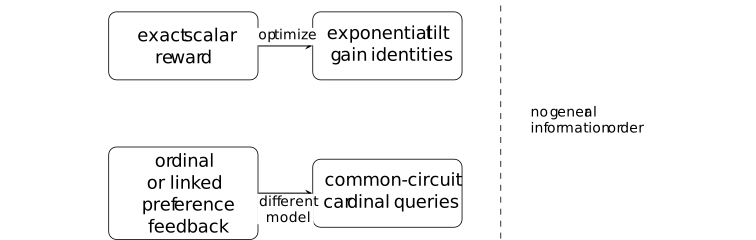
The KL identities characterize the exact optimizer for a declared scalar reward. The preference lower bounds are worst-case statements inside a fixed- circuit routing model. Bradley--Terry conclusions depend on the chosen score link. In the common-circuit specialization, cardinal queries change the information modality and admit a positive mechanism result. Outside that specialization, the preference and cardinal-query results are not directly comparable without further assumptions.
None of these statements derives the finite transcript theorem Theorem [ftip-007S], and none proves that benchmark gain is capability acquisition. Applying either result to a training system requires that system to satisfy the corresponding information, optimizer, and comparator assumptions.
Controlled coverage, feedback resolution, and prompt breadth [ftip-009M]AGENTDRAFTED
Controlled coverage, feedback resolution, and prompt breadth [ftip-009M]AGENTDRAFTED
This section studies finite measurements and controlled comparisons that separate starting-policy coverage from the information supplied by a reward. It also records how a training prompt law limits the scope of an observed post-training effect.
The empirical route is a controlled language-model post-training study. Its reported outcomes remain experiment-specific observations. Theorems in this section follow from the stated finite-probability assumptions; the empirical results alone do not imply those conclusions.
Starting-policy interventions [ftip-009N]AGENTDRAFTED
Starting-policy interventions [ftip-009N]AGENTDRAFTED
A comparison among starting policies is meaningful only after the task, training grid, feedback rule, and evaluation procedure have been declared. Observed differences are conditional on those experimental coordinates.
Remark. The source experiment as an intervention matrix [ftip-009O]AGENTDRAFTED
Remark. The source experiment as an intervention matrix [ftip-009O]AGENTDRAFTED
[clay2026demystifying, Sections 4.1--4.3 and Figure 1] organize the reported experiments along three declared axes: a starting model distribution, a training-prompt distribution, and a reward function. Each reported measurement therefore belongs to a cell of a matrix rather than to an unqualified ``RL post-training'' condition. The source holds its broad training recipe fixed while varying selected axes; it does not study variation among RL algorithms.
Each experimental comparison is conditional on its model, task, prompt law, executable reward rule, training budget, and evaluation procedure. The reward rule is especially consequential here because the main text and Appendix C do not state identical sparse-reward semantics. Section 4.2 describes target containment with a length penalty. Appendix C's prose says an exact target receives unit reward, but its displayed equation requires the response to be strictly longer than the target for any positive reward. These two descriptions do not identify a single sparse-reward implementation.
Definition. Target-response event [ftip-009P]AGENTDRAFTED
Definition. Target-response event [ftip-009P]AGENTDRAFTED
Fix an evaluation instance \(x\), a response space \(\mathcal Y_x\), and a declared target predicate \(h_x^\star :\mathcal Y_x\to \{0,1\}\). For a sampled response \(Y\), the target-response event is
\[ E_x^\star =\{h_x^\star (Y)=1\}. \]The predicate is part of the evaluation specification. It may test exact string equality after a declared normalization, containment of a target substring, equality of a parsed answer, or another explicitly typed condition. These predicates are not interchangeable. The movie-quote and AIME experiments in [clay2026demystifying, Sections 4.1--4.2] use different response objects and therefore require different target predicates.
Remark. Exact-string success and task utility are different predicates [ftip-009Q]AGENTDRAFTED
Remark. Exact-string success and task utility are different predicates [ftip-009Q]AGENTDRAFTED
Let \(y_x^\star \) be a designated string and let \(N_x\) be a declared normalizer. Exact-string success is the specialization \(h_x^\star (y)=\mathbf 1\{N_x(y)=N_x(y_x^\star )\}\) of Definition [ftip-009P]. A task utility may instead accept semantically equivalent answers, assign partial credit, invoke a verifier, or depend on evaluator randomness as in Convention [ftip-005D].
Consequently, a change in target-string match rate is not automatically a change in task utility. [clay2026demystifying, Sections 4.1--4.2] deliberately use narrow target behaviours to study controlled coverage. Transferring their measurements to broader capability requires a separately justified evaluator.
Definition. Base, SFT-positive, and SFT-negative starting-policy triple [ftip-009R]AGENTDRAFTED
Definition. Base, SFT-positive, and SFT-negative starting-policy triple [ftip-009R]AGENTDRAFTED
For one declared model family and target predicate, a starting-policy triple is
\[ \left (\pi ^{\mathrm {base}},\pi ^+,\pi ^-\right ). \]Here \(\pi ^{\mathrm {base}}\) is the unmodified starting policy, \(\pi ^+\) is obtained by a declared supervised update intended to increase target-response frequency, and \(\pi ^-\) is obtained by a declared update intended to decrease it. The superscripts name producing interventions, not mathematical order relations between the resulting policies.
[clay2026demystifying, Section 4.1] instantiates the triple with the source's Base, SFT-positive, and SFT-negative checkpoints. For the movie quote, its SFT mixture places twenty percent weight on the target quote and eighty percent on other quotes from the Cornell Movie-Dialogs corpus; the negative intervention maximizes cross-entropy loss on the target.
Remark. SFT-positive and SFT-negative are composite weight interventions [ftip-009S]AGENTDRAFTED
Remark. SFT-positive and SFT-negative are composite weight interventions [ftip-009S]AGENTDRAFTED
The policies \(\pi ^+\) and \(\pi ^-\) of Definition [ftip-009R] are produced by optimization. Their weights, output probabilities, representations, and off-target behaviours can all change together. Calling one intervention ``positive'' and the other ``negative'' describes its intended effect on the declared target response; it does not assert that only one probability mass was edited.
The comparisons in [clay2026demystifying, Sections 4.1 and 5.1] therefore test dependence on three constructed starting checkpoints. They do not identify a causal effect of initial target probability alone without an additional intervention model.
Definition. Controlled post-training experiment cell [ftip-009T]AGENTDRAFTED
Definition. Controlled post-training experiment cell [ftip-009T]AGENTDRAFTED
A controlled post-training experiment cell is a record
\[ \mathfrak c= (M,\pi ^{\mathrm {init}},\mathsf T,\mathcal D_{\mathrm {tr}}, r^{\mathrm {id}},\mathcal A,b_{\mathrm {tr}},\mathsf E), \]where \(M\) identifies the model architecture and checkpoint lineage, \(\pi ^{\mathrm {init}}\) is its starting policy, \(\mathsf T\) is the task, \(\mathcal D_{\mathrm {tr}}\) is the training-prompt law, \(r^{\mathrm {id}}\) identifies an executable reward rule and version, \(\mathcal A\) is the update procedure, \(b_{\mathrm {tr}}\) is the training budget, and \(\mathsf E\) is the evaluation interface. Random seeds and hyperparameters belong to the relevant record fields even when suppressed from the notation.
[clay2026demystifying, Figure 1 and Sections 4.1--4.3] motivates the coordinates. The source varies starting distribution, prompt distribution, and reward while using a common broad RL setup. Because its main-text and Appendix-C sparse rewards differ, the reward field is an identifier for an executable rule, not merely the word ``sparse.''
Definition. Matched cells and held-fixed coordinates [ftip-009U]AGENTDRAFTED
Definition. Matched cells and held-fixed coordinates [ftip-009U]AGENTDRAFTED
Let \(J\) index the coordinates of an experiment cell \(\mathfrak c\) from Definition [ftip-009T]. For \(S\subseteq J\), two cells \(\mathfrak c\) and \(\mathfrak c'\) are matched outside \(S\) when
\[ \mathfrak c_j=\mathfrak c'_j\qquad \text {for every }j\in J\setminus S. \]The coordinates in \(J\setminus S\) are the held-fixed coordinates; those in \(S\) are the declared intervention coordinates. Equality means equality at the resolution recorded by the experiment, including evaluation sample size when that size affects the reported statistic.
A matched comparison licenses a contrast between the recorded cells. It does not show that a named coordinate is internally atomic. In particular, matching outside the starting-policy coordinate leaves the composite-checkpoint qualification of Remark [ftip-009S] in force.
Example. Three starting laws under one declared training grid [ftip-009V]AGENTDRAFTED
Example. Three starting laws under one declared training grid [ftip-009V]AGENTDRAFTED
A source comparison may place the three starting policies of Definition [ftip-009R] into cells matched outside the starting-policy coordinate. The shared boxes below mean equality of the declared grid fields, not that the three checkpoints differ in only one scalar probability.
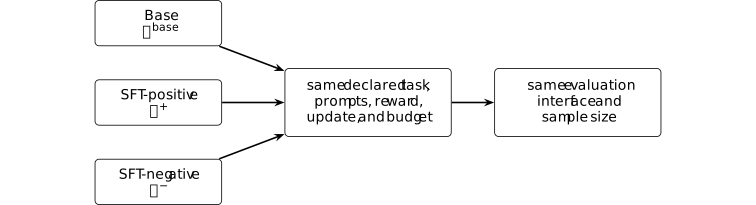
This is the comparison pattern used in [clay2026demystifying, Sections 4.1 and 5.1]. An actual cell still needs its model, task, reward implementation, and numerical record; the diagram is not a claim that all experiments in the paper instantiate one identical grid.
Remark. What the starting-policy comparison can and cannot identify [ftip-009W]AGENTDRAFTED
Remark. What the starting-policy comparison can and cannot identify [ftip-009W]AGENTDRAFTED
Within a declared model, task, training grid, and evaluation procedure, the three-cell comparison can establish that the measured post-training outcome differs across the source's constructed starting checkpoints. The movie-quote and AIME entries in [clay2026demystifying, Section 5.1, Tables 1--2] are empirical records of that form.
The comparison does not isolate initial target probability from every other SFT-induced weight change, prove that an observed zero has zero support, or establish acquisition of a broader capability. The reported model sets differ across the paper: [clay2026demystifying, Section 4.1] names OLMo 3, Qwen2-7B, Qwen3-1.7B, and Qwen2.5-7B-Instruct, while Table 1 and Appendix G also report Qwen3-8B and Qwen2-1.5B. Each measurement is specific to the model and configuration in its table row.
Finite initial-coverage measurement [ftip-009X]AGENTDRAFTED
Finite initial-coverage measurement [ftip-009X]AGENTDRAFTED
A finite evaluation records hits, not mathematical support. This subsection introduces the hit count and its sampling law, derives the exact zero-hit bound under independent sampling, and then returns to the limits of the source measurement.
Definition. Initial evaluation hit count [ftip-009Y]AGENTDRAFTED
Definition. Initial evaluation hit count [ftip-009Y]AGENTDRAFTED
Fix a starting policy, an evaluation sampling law, and the target predicate of Definition [ftip-009P]. Before post-training, draw evaluation records \((X_j,Y_j)_{j=1}^m\). Define the hit indicators and the initial evaluation hit count by
\[ I_j^\star =h_{X_j}^\star (Y_j), \qquad K_m=\sum _{j=1}^{m}I_j^\star . \]The sampling law determines whether the instances \(X_j\) are fixed, resampled, or stratified. The adjective ``initial'' locates the measurement before the post-training intervention; it does not assert that the samples are independent or that the starting policy is a foundation checkpoint.
Definition. Empirical initial success rate [ftip-009Z]AGENTDRAFTED
Definition. Empirical initial success rate [ftip-009Z]AGENTDRAFTED
For a nonempty initial evaluation sample of size \(m\), the empirical initial success rate is
\[ \widehat p_m=\frac {K_m}{m} =\widehat {\mathbb E}_{j\in \{1,\ldots ,m\}}[I_j^\star ], \]using the empirical-average convention of Convention [ftip-006Z]. This is a statistic of the declared sample. It is not, without a sampling model and an uncertainty statement, the exact successful-support probability \(p_P(x)\) of Definition [ftip-005U].
Remark. Zero observed hits are not zero probability [ftip-00A0]AGENTDRAFTED
Remark. Zero observed hits are not zero probability [ftip-00A0]AGENTDRAFTED
The equality \(K_m=0\) says that no target response occurred in one finite sample. Every success probability \(0\leq p<1\) assigns positive probability \((1-p)^m\) to this observation under independent Bernoulli sampling. Thus \(\widehat p_m=0\) does not imply \(p=0\), absence from mathematical support, or impossibility of discovery under a larger budget.
The entries printed as 0.00 percent in [clay2026demystifying, Section 5.1, Tables 1--2] are empirical rates at the stated evaluation sizes. They must not be rewritten as exact support claims.
Theorem. Zero-hit likelihood under iid evaluation [ftip-00A1]AGENTDRAFTED
Theorem. Zero-hit likelihood under iid evaluation [ftip-00A1]AGENTDRAFTED
Let \(m\in \mathbb N_{\geq 1}\). Assume the hit indicators from Definition [ftip-009Y] are independent Bernoulli variables with a common success probability \(p\). Then \(K_m\) has the binomial law and
\[ \Pr _p(K_m=0)=(1-p)^m. \]
Proof.
Proof.
The event \(K_m=0\) is \(\bigcap _{j=1}^m\{I_j^\star =0\}\). Independence and \(\Pr _p(I_j^\star =0)=1-p\) give the displayed product.
This finite statement follows from the displayed hypotheses. Applying it to a source table requires the additional iid and stationary-success assumptions stated above.
Corollary. Exact one-sided bound after zero hits [ftip-00A2]AGENTDRAFTED
Corollary. Exact one-sided bound after zero hits [ftip-00A2]AGENTDRAFTED
Assume Theorem [ftip-00A1] with \(m\in \mathbb N_{\geq 1}\) and fix \(0<\delta <1\). If \(K_m=0\), inversion of the exact zero-count likelihood gives the one-sided upper endpoint
\[ u_{m,\delta }=1-\delta ^{1/m}. \]Indeed, \(\Pr _{u_{m,\delta }}(K_m=0)=\delta \), and for every \(p>u_{m,\delta }\) one has \(\Pr _p(K_m=0)<\delta \). Thus the observed zero count excludes probabilities above \(u_{m,\delta }\) at exact level \(\delta \) under the declared iid model.
Proof.
Proof.
By Theorem [ftip-00A1], the zero-count likelihood is \((1-p)^m\), which is strictly decreasing in \(p\). Solving \((1-p)^m=\delta \) gives the endpoint and the stated strict inequality.
This is a likelihood inversion derived from the displayed finite setup, not a source theorem and not a support certificate.
Example. The 128-sample zero-hit bound [ftip-00A3]AGENTDRAFTED
Example. The 128-sample zero-hit bound [ftip-00A3]AGENTDRAFTED
Take \(m=128\) and \(\delta =0.05\) in Corollary [ftip-00A2]. After zero hits, the exact one-sided upper endpoint is
\[ u_{128,0.05} =1-0.05^{1/128} \approx 0.02313. \]Under the iid Bernoulli model, probabilities above approximately 2.313 percent make a zero count less than five percent likely. The calculation does not turn a recorded \(0/128\) into proof that the true probability is zero, and it does not apply if the 128 evaluations have a different joint sampling law.
Definition. First positive sparse-reward time [ftip-00A4]AGENTDRAFTED
Definition. First positive sparse-reward time [ftip-00A4]AGENTDRAFTED
Fix an executable sparse-reward rule and let \(r_j^{\mathrm {sp}}\) be the reward returned on rollout \(j\). The first positive sparse-reward time is the extended-valued index
\[ J_+=\inf \{j\geq 1:r_j^{\mathrm {sp}}>0\}, \qquad \inf \varnothing :=\infty . \]This definition concerns the reward implementation named by an experiment cell. The event \(r_j^{\mathrm {sp}}>0\) coincides with a target-response event only when that equality is part of the declared reward semantics. In particular, a length penalty or partial-credit rule can separate positive reward from exact target match.
Corollary. Sparse-reward discovery within a rollout budget [ftip-00A5]AGENTDRAFTED
Corollary. Sparse-reward discovery within a rollout budget [ftip-00A5]AGENTDRAFTED
Suppose the events \(\{r_j^{\mathrm {sp}}>0\}\) are independent and have a common probability \(q\). For every positive rollout budget \(B\),
\[ \Pr (J_+\leq B)=1-(1-q)^B. \]
Proof.
Proof.
Apply the independent-attempt theorem Theorem [ftip-0078] with \(E_j=\{r_j^{\mathrm {sp}}>0\}\). Its discovery event is exactly \(\{J_+\leq B\}\).
This is a specialization proved from the displayed hypotheses. It does not supply independence, stationarity, or the value of \(q\) for a training run, and it does not equate positive proxy reward with task utility.
Example. The AIME 128-sample measurement record [ftip-00A6]AGENTDRAFTED
Example. The AIME 128-sample measurement record [ftip-00A6]AGENTDRAFTED
[clay2026demystifying, Section 5.1, Table 2] reports the following empirical target-answer rates for AIME Problem 4 with Qwen2.5-7B-Instruct and evaluation size \(m=128\). The task asks for the number of integer pairs \((x,y)\in [-100,100]^2\) satisfying \(12x^2-xy-6y^2=0\); the target answer is \(117\).
\[ \begin {array}{c|ccc} &\mathrm {SFT{+}}&\mathrm {Base}&\mathrm {SFT{-}}\\ \hline \text {No Reward}&26.6&3.92&0.00\\ \text {Sparse Reward}&85.9&10.2&0.00\\ \text {Dense Reward}&86.7&92.2&0.00 \end {array} \]Every entry in the displayed array is a percentage.
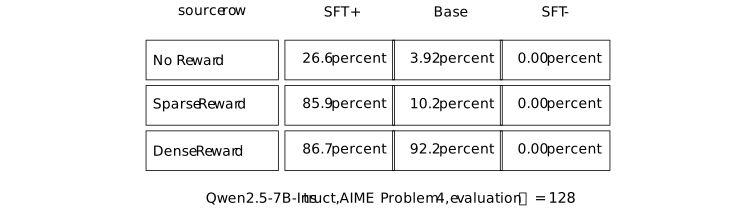
These are source-reported empirical percentages, not exact policy probabilities. ``No Reward'' is retained as the source's row label; the table alone does not define it as a post-training protocol. The three zero entries for SFT-negative are finite observations and remain subject to Remark [ftip-00A0]. Appendix Figure 5's caption prints a different set of Qwen2.5-7B-Instruct values that duplicates the neighbouring movie-quote caption and is incompatible with Table 2. The displayed percentages are those of Table 2; the caption does not provide a consistent alternative measurement.
Remark. An observed plateau is not a universal probability threshold [ftip-00A7]AGENTDRAFTED
Remark. An observed plateau is not a universal probability threshold [ftip-00A7]AGENTDRAFTED
[clay2026demystifying, Section 5.2 and Figure 2] report that the Qwen3-1.7B Base movie-quote cell, whose initial empirical match rate is about 0.5 percent, does not optimize under the source's sparse-reward run, whereas its dense-reward run rises toward fifty percent. [clay2026demystifying, Appendix Figure 8] gives final match rates 10.0 percent for sparse reward and 48.8 percent for dense reward. Thus ``failed'' here means failure of the reported sparse run to optimize as intended, not zero final matches.
A plateau is indexed by the model, target, reward implementation, optimizer, sampling process, and budget in its experiment cell. One observed transition therefore does not identify a universal initial-probability threshold for RL learning, support, or capability acquisition.
Sparse, dense, and process feedback [ftip-00A8]AGENTDRAFTED
Sparse, dense, and process feedback [ftip-00A8]AGENTDRAFTED
Sparse, dense, and process rewards expose different observations about a response. This subsection treats that difference as a change in the feedback channel, rather than as a free change in the smoothness of one fixed objective.
Definition. Sparse exact reward [ftip-00A9]AGENTDRAFTED
Definition. Sparse exact reward [ftip-00A9]AGENTDRAFTED
Let \(\mathcal Y\) be a finite response set and fix a target response \(\tau \in \mathcal Y\). The sparse exact reward is the map \(r_{\rm exact}:\mathcal Y\to \{0,1\}\) defined by
\[ r_{\rm exact}(y)=\mathbf 1\{y=\tau \}. \]This idealized reward exposes one bit: whether the whole response equals the target. It does not expose a prefix, edit location, or partial milestone. The movie-quote source uses related but textually inconsistent substring and length-penalized rewards; the distinct formulas are compared in Remark [ftip-00AA].
Remark. Main-text and Appendix-C sparse-reward discrepancy [ftip-00AA]AGENTDRAFTED
Remark. Main-text and Appendix-C sparse-reward discrepancy [ftip-00AA]AGENTDRAFTED
Section 4.2 of Demystifying Reinforcement Learning Post-Training of Language Models[clay2026demystifying] displays a substring indicator \(\mathbf 1\{\tau \subseteq y\}\) and says that a length penalty is applied. In Appendix C, \(n\) is the maximum generation length and \(s\) is the number of tokens beyond the target. The appendix first defines the excess-length penalty
\[ p(s)= \begin {cases} 0,&s=0,\\ s/n,&s>0, \end {cases} \]and then gives Equation (3):
\[ r_{\rm C}(y,\tau )= \begin {cases} \max \{0.5,1-p(s)\},&\tau \text { occurs in }y \text { and }|y|>|\tau |,\\ 0,&\text {otherwise}. \end {cases} \]As printed, Equation (3) assigns zero when \(y=\tau \), because its first branch requires strict excess length. This conflicts with the immediately preceding Appendix-C prose, which assigns base reward one when the target is generated, and it is not the exact-match reward of Definition [ftip-00A9]. The two printed descriptions therefore specify different reward rules.
Definition. Edit-distance reward [ftip-00AB]AGENTDRAFTED
Definition. Edit-distance reward [ftip-00AB]AGENTDRAFTED
Let \(y=y_1\cdots y_m\) and a nonempty target \(\tau =\tau _1\cdots \tau _n\) be finite strings. Their Levenshtein distance is determined by \(D(0,j)=j\), \(D(i,0)=i\), and, for \(i,j>0\),
\[ D(i,j)=\min \left \{ \begin {aligned} &D(i-1,j)+1,\\ &D(i,j-1)+1,\\ &D(i-1,j-1)+\mathbf 1\{y_i\neq \tau _j\} \end {aligned} \right \}. \]Set \(L(y,\tau )=\max \{|y|,|\tau |\}\). The edit-distance reward is
\[ r_{\rm edit}(y,\tau ) =\max \left \{0,1-\frac {D(|y|,|\tau |)}{L(y,\tau )}\right \}. \]The recurrence is Equation (1) in the main text and Equation (4) in Appendix C of Demystifying Reinforcement Learning Post-Training of Language Models[clay2026demystifying]; the normalized reward is its Equation (5). The nonempty-target assumption makes the displayed denominator positive. This reward does not establish that edit similarity is the correct utility for a different task.
Remark. Dense reward imports target structure [ftip-00AC]AGENTDRAFTED
Remark. Dense reward imports target structure [ftip-00AC]AGENTDRAFTED
The edit reward of Definition [ftip-00AB] is not obtained from the binary value in Definition [ftip-00A9] by a numerical smoothing operation. It also receives the target string, a character-level edit model, and the ordering of symbols. Two non-target responses that both receive sparse reward zero can therefore receive different edit rewards.
That extra resolution can improve credit assignment, but it changes the feedback channel and its assumptions. The source calls edit distance a dense proxy and reports controlled movie-quote experiments [clay2026demystifying, Sections 4.2 and 5.2]. Neither the formula nor those observations establish that edit proximity is an independent measure of general response quality.
Definition. Milestone process reward [ftip-00AD]AGENTDRAFTED
Definition. Milestone process reward [ftip-00AD]AGENTDRAFTED
For the source's fixed AIME problem, let
\[ M(y)=(m_1(y),\ldots ,m_5(y))\in \{0,1\}^5 \]record whether a completed response contains five declared milestones: a valid algebraic setup, correct root relations, correct integer bounds, a correct count for at least one branch, and correct subtraction of the overlap at the origin. With
\[ (w_1,\ldots ,w_5)=(0.05,0.05,0.10,0.15,0.25), \]the milestone process reward is
\[ r_{\rm proc}(y)=\sum _{i=1}^{5}w_i m_i(y). \]Appendix D.1 of Demystifying Reinforcement Learning Post-Training of Language Models[clay2026demystifying] gives Equation (6) and the milestone list above. In the experiment, a 32-billion-parameter instruction-tuned model classifies the completed trajectory. The displayed map is therefore richer than a deterministic final-answer verifier, even though it returns one scalar after the rollout.
Remark. Process feedback assumptions and milestone-weight discrepancy [ftip-00AE]AGENTDRAFTED
Remark. Process feedback assumptions and milestone-weight discrepancy [ftip-00AE]AGENTDRAFTED
Appendix D.2 of Demystifying Reinforcement Learning Post-Training of Language Models[clay2026demystifying] supplements \(r_{\rm proc}\) with an extracted-answer override and two penalties. Translating its notation, let \(\tau =117\), \(\tau _{\rm near}=118\), and define
\[ r_{\rm base}(y)= \begin {cases} 1.0,&\operatorname {extract}(y)=\tau ,\\ 0.6,&\operatorname {extract}(y)=\tau _{\rm near},\\ r_{\rm proc}(y),&\text {otherwise}. \end {cases} \]Let \(p_{\rm loop}(y)=-0.3\) when the judge flags a loop without the exact answer, and zero otherwise. Let \(p_{\rm format}(y)=-0.5\) when the response lacks the required boxed delimiter, and zero otherwise. Equations (7)--(8) then give
\[ r_{\rm PRM}(y) =\max \{0,r_{\rm base}(y)+p_{\rm loop}(y)+p_{\rm format}(y)\}. \]These clauses assume a reliable milestone judge, parser, near-miss choice, loop flag, and formatting rule. They are part of the feedback definition, not consequences of reinforcement learning. The main text describes ``exponentially increasing'' dense rewards, and Appendix D calls the weights ``exponential scaling.'' The printed vector \((0.05,0.05,0.10,0.15,0.25)\) is neither strictly increasing at every milestone nor a geometric progression. We preserve the exact weights and do not infer an exponential law from that wording.
Definition. Reward-induced observational equivalence [ftip-00AF]AGENTDRAFTED
Definition. Reward-induced observational equivalence [ftip-00AF]AGENTDRAFTED
Let \(\mathcal Y\) be a finite response set and \(r:\mathcal Y\to \mathcal R\) any reward map. Two responses are observationally equivalent under \(r\), written \(y\sim _r y'\), when
\[ y\sim _r y'\quad \Longleftrightarrow \quad r(y)=r(y'). \]Equality makes \(\sim _r\) an equivalence relation. Its quotient \(\mathcal Y/{\sim _r}\) is the finite set of response classes distinguished by the reward alone. This proposed equivalence relation ignores any information in the response that is not returned by \(r\); equal rewards need not imply equal latent utility.
Lemma. Refining feedback separates at least as many responses [ftip-00AG]AGENTDRAFTED
Lemma. Refining feedback separates at least as many responses [ftip-00AG]AGENTDRAFTED
Let \(\mathcal Y\) be finite and let \(r_1:\mathcal Y\to \mathcal R_1\) and \(r_2:\mathcal Y\to \mathcal R_2\). Say that \(r_2\) refines \(r_1\) when
\[ r_2(y)=r_2(y')\quad \Longrightarrow \quad r_1(y)=r_1(y') \qquad (y,y'\in \mathcal Y). \]If \(r_2\) refines \(r_1\), then
\[ \left |\mathcal Y/{\sim _{r_2}}\right | \geq \left |\mathcal Y/{\sim _{r_1}}\right |. \]
Proof.
Proof.
Send the \(r_2\)-class of \(y\) to the \(r_1\)-class of \(y\). The refinement condition makes this map well defined. It is surjective because every \(r_1\)-class contains some \(y\), whose \(r_2\)-class maps to it. A surjection between finite sets has a domain at least as large as its codomain.
This finite lemma compares observational partitions only. It does not say that the refined reward is cheaper, more accurate, or better aligned with utility.
Example. Counterexample: equal sparse reward, unequal dense reward [ftip-00AH]AGENTDRAFTED
Example. Counterexample: equal sparse reward, unequal dense reward [ftip-00AH]AGENTDRAFTED
Take the target string \(\tau =\texttt {abc}\) and two responses \(y=\texttt {abx}\) and \(y'=\texttt {xyz}\). Both fail exact matching, while their edit distances and normalized edit rewards are
\[ \begin {array}{c|c|c|c} \text {response}&r_{\rm exact}&D(\,cdot\,,\tau )&r_{\rm edit}\\ \hline \texttt {abx}&0&1&2/3\\ \texttt {xyz}&0&3&0 \end {array} \]Thus \(y\sim _{r_{\rm exact}}y'\) but \(y\not \sim _{r_{\rm edit}}y'\). The example witnesses a strict separation inside one sparse-reward class. It does not claim that every dense proxy refines every sparse verifier.
Example. Three feedback resolutions on one response set [ftip-00AI]AGENTDRAFTED
Example. Three feedback resolutions on one response set [ftip-00AI]AGENTDRAFTED
One finite response set can be observed through three different maps. The arrows below share a domain; they do not assert that the three codomains form a refinement chain.
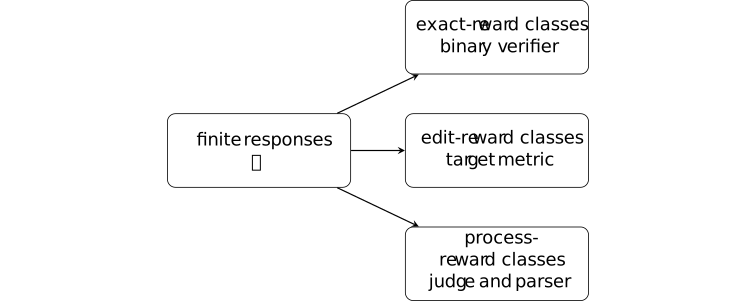
The exact reward forgets every difference among failures. Edit reward can retain character-level proximity, while the source process reward retains a declared milestone vector only after judge, override, and penalty choices. The partition lemma Lemma [ftip-00AG] applies to a pair only after its refinement hypothesis has been checked.
Remark. Reward density is not cost-free smoothing [ftip-00AJ]AGENTDRAFTED
Remark. Reward density is not cost-free smoothing [ftip-00AJ]AGENTDRAFTED
A denser reward can distinguish more responses and supply more frequent update signal. It can also require information absent from a sparse verifier. In the controlled source, edit feedback assumes the full target and computes a string metric; process feedback uses a 32-billion-parameter judge, five problem-specific milestones, answer extraction, an enumerated near miss, and loop and format penalties [clay2026demystifying, Appendices C--D].
The richer feedback channel incurs specification, computation, and validation costs. Replacing sparse feedback by dense feedback can alter both the information available to training and the objective being optimized. The resulting comparison is an intervention on feedback resolution, not evidence that one fixed reward was smoothed at zero cost.
Prompt breadth and effect locality [ftip-00AK]AGENTDRAFTED
Prompt breadth and effect locality [ftip-00AK]AGENTDRAFTED
Training on one prompt law can change behavior unevenly across evaluation slices. Localized and distributed degradation are distinguished relative to that training law and the specified evaluation slices.
Definition. Training prompt law and evaluated prompt slice [ftip-00AL]AGENTDRAFTED
Definition. Training prompt law and evaluated prompt slice [ftip-00AL]AGENTDRAFTED
Let \(\mathcal X\) be a task-instance set. Write \(\mu _{\rm tr}=\mathcal D_{\rm tr}\) for the training-prompt coordinate of an experiment cell in Definition [ftip-009T]. A training prompt law is this probability law on \(\mathcal X\), used to draw instances during a post-training protocol. Let \(\mu _{\rm ev}\) be an independently declared evaluation law on the same set.
An evaluated prompt slice is a measurable set \(C\subseteq \mathcal X\) with \(\mu _{\rm ev}(C)>0\). Its conditional evaluation law is
\[ \mu _{\rm ev}(A\mid C) =\frac {\mu _{\rm ev}(A\cap C)}{\mu _{\rm ev}(C)}. \]The training and evaluation laws need not agree. A slice records where an effect is measured; it does not assert that prompts inside the slice are equally difficult or represented equally in pretraining. We specialize the task-law convention of Definition [ftip-001Q].
Definition. Source-specific narrow and broad configurations [ftip-00AM]AGENTDRAFTED
Definition. Source-specific narrow and broad configurations [ftip-00AM]AGENTDRAFTED
A prompt configuration is the record
\[ \mathsf c=(M_0,\mu _{\rm tr},m_{\rm tr},r,\mathsf A,b), \]containing the starting artifact, training prompt law, finite prompt-pool size, reward, update algorithm, and training budget. We call two particular records \(\mathsf c_{\rm nar}\) and \(\mathsf c_{\rm brd}\) only when a cited experiment names them narrow and broad.
Section 4.3 and Appendix F of Demystifying Reinforcement Learning Post-Training of Language Models[clay2026demystifying] instantiate these labels in two model-family experiments. The Qwen comparison uses 100 DeepScaleR prompts versus 10,000 WildChat prompts. The OLMo comparison uses 100 math-only prompts versus 10,000 prompts split evenly among mathematics, instruction following, and code. These labels identify the two reported configurations; they do not define a general measure or ordering of prompt breadth.
Remark. Prompt breadth is not a total order [ftip-00AN]AGENTDRAFTED
Remark. Prompt breadth is not a total order [ftip-00AN]AGENTDRAFTED
The records in Definition [ftip-00AM] change several coordinates together. The prompt-pool size, domain mixture, and repetition frequency differ. Across the paper's Qwen and OLMo studies, the starting artifact and evaluated tasks also differ.
We therefore use ``narrow'' and ``broad'' as names for the source cells. They do not define a total order on prompt laws, and their comparison does not identify a causal effect of breadth alone. A breadth theorem would need a declared statistic and matched configurations that differ only in that statistic.
Definition. Slice-conditioned success change [ftip-00AO]AGENTDRAFTED
Definition. Slice-conditioned success change [ftip-00AO]AGENTDRAFTED
Fix an evaluated slice \(C\) from Definition [ftip-00AL], and let \(P_0\) and \(P_1\) denote the pre- and post-training protocols whose successful-support probabilities are defined in Definition [ftip-005U]. The slice-conditioned success change is
\[ \Delta _{\rm suc}(C;P_1,P_0) =\mathbb E_{X\sim \mu _{\rm ev}(\cdot \mid C)} \left [p_{P_1}(X)-p_{P_0}(X)\right ]. \]The evaluation interface, inference budget, and success predicate are held fixed across the two terms. The quantity is an average change on one declared slice. It neither locates the change inside the model nor identifies which training coordinate caused it.
Definition. Localized and distributed degradation [ftip-00AP]AGENTDRAFTED
Definition. Localized and distributed degradation [ftip-00AP]AGENTDRAFTED
Fix pairwise disjoint evaluated slices \(C_1,\ldots ,C_J\) and a declared degradation threshold \(\kappa >0\). Define the set of materially degraded slices
\[ \mathcal H_\kappa (P_1,P_0) =\left \{j:\Delta _{\rm suc}(C_j;P_1,P_0)\leq -\kappa \right \}. \]Degradation is localized relative to this slice family and threshold when \(|\mathcal H_\kappa |=1\). It is distributed when \(|\mathcal H_\kappa |\geq 2\).
These terms depend on the chosen partition, threshold, and evaluation budget. They do not turn a finite benchmark vector into a statement about all capabilities.
Example. Narrow and broad random-reward paths [ftip-00AQ]AGENTDRAFTED
Example. Narrow and broad random-reward paths [ftip-00AQ]AGENTDRAFTED
Section 5.3 and Appendix F of Demystifying Reinforcement Learning Post-Training of Language Models[clay2026demystifying] supply two OLMo paths; Figure 4 reports their outcomes. Both replace the usual verifiable reward with a random scalar drawn from \(\operatorname {Unif}[0,1]\), but their prompt configurations differ.
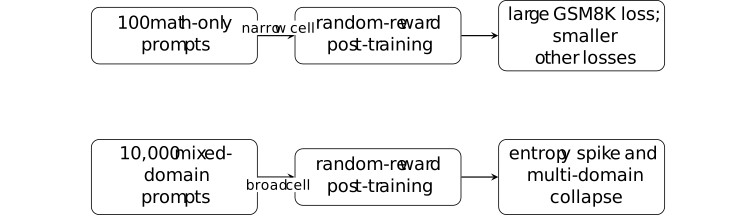
In the narrow SFT-start path, GSM8K accuracy falls from 86 to about 32 by step 400, while the reported MMLU and IFEval changes are much smaller. In the broad path, the source reports an entropy spike near step 400 together with collapse on GSM8K, MMLU, and IFEval. The diagram records that interpretation; it does not isolate prompt breadth from pool size, mixture, or repetition.
Remark. What the source observes about spurious reward [ftip-00AR]AGENTDRAFTED
Remark. What the source observes about spurious reward [ftip-00AR]AGENTDRAFTED
Section 5.3 and Figures 3--4 of Demystifying Reinforcement Learning Post-Training of Language Models[clay2026demystifying] report that the Qwen narrow configuration retains higher MATH and AMC Acc@1 than its broad configuration under random reward. The OLMo experiment reports the different evaluation patterns summarized in Example [ftip-00AQ].
These are finite empirical observations. The random scalar reward removes task alignment from one feedback channel, but it does not hold all other training coordinates fixed. The reported entropy is a named token statistic, not a direct measure of capability or acquisition.
Example. Counterexample: equal marginal reward, unequal prompt-local damage [ftip-00AS]AGENTDRAFTED
Example. Counterexample: equal marginal reward, unequal prompt-local damage [ftip-00AS]AGENTDRAFTED
Let two evaluation slices \(C_1,C_2\) have equal mass. A feedback channel returns an independent Bernoulli reward with mean \(1/2\) under either of two post-training protocols. Suppose their fixed-interface success changes are
\[ \left (\Delta _{\rm suc}(C_1),\Delta _{\rm suc}(C_2)\right ) =(-1,0) \quad \hbox {or}\quad \left (-\tfrac 12,-\tfrac 12\right ). \]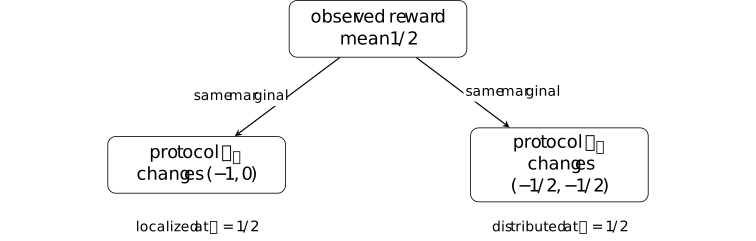
The reward law and its mean are identical, but the slice-level evaluation vectors differ. Hence marginal training reward does not determine whether damage is localized or distributed. This is a finite counterexample, not a claim about the mechanism in the source experiment.
Remark. Coverage, feedback resolution, and prompt-conditioned effects [ftip-00AT]AGENTDRAFTED
Remark. Coverage, feedback resolution, and prompt-conditioned effects [ftip-00AT]AGENTDRAFTED
The source cells motivate tests of starting-policy coverage, feedback resolution, and prompt-conditioned damage. They do not establish that dense reward creates mathematical support, that zero sampled hits imply zero probability, or that random reward has one model-independent effect.
Separating the effects of coverage, feedback resolution, and prompt breadth requires stronger controls. One comparison fixes prompt laws and varies only the feedback sigma-algebra. Another fixes feedback and evaluation while varying one starting-policy coordinate. Confidence regions for the complete vector of slice-conditioned changes would quantify effects that an aggregate score can hide.
The reported observations remain conditional on their experimental configurations. They do not establish general results about capability acquisition, elicitation, or the optimal allocation of post-training compute.
Finite consequences and counterexamples [ftip-00JE]AGENTDRAFTED
Finite consequences and counterexamples [ftip-00JE]AGENTDRAFTED
Finite sampling, reward information, and deterministic execution give conditional conclusions about post-training. Their counterexamples show why the task law, feasible set, and available information cannot be omitted.
This synthesis brings together the finite results used in the evaluation analysis. The conceptual-discovery chapter asks whether such arguments can constrain a complete learning lineage, including changes to representations, curricula and research procedures.
Probability, information, and execution [ftip-00I1]AGENTDRAFTED
Probability, information, and execution [ftip-00I1]AGENTDRAFTED
Discovery probabilities, support, proxy error, feedback resolution, and replay each constrain a different part of a comparison. Capability remains conditional behavior under a declared intervention and evaluation law, rather than a scalar latent property.
Finite probability and execution results [ftip-00I2]AGENTDRAFTED
Finite probability and execution results [ftip-00I2]AGENTDRAFTED
The conclusions depend on their declared probability laws, finite index sets, positivity conditions, and execution inputs. Changing one of these assumptions can change the result even when the observed score is unchanged.
Convention. Domains of the finite results [ftip-00I5]AGENTDRAFTED
Convention. Domains of the finite results [ftip-00I5]AGENTDRAFTED
Each result concerns its declared carriers \(X_1,\ldots ,X_n\), with fixed equality and order conventions. Finiteness, probability laws, and positivity conditions are hypotheses of the result; they cannot be inferred from a finite observation alone.
Theorem. Independent discovery probability [ftip-00I7]AGENTDRAFTED
Theorem. Independent discovery probability [ftip-00I7]AGENTDRAFTED
For \(B\in \mathbb N\) independent discovery events with the probabilities declared in Convention [ftip-0077], the identity in Theorem [ftip-0078] gives \(\Pr (D_B)=1-\prod _{i=1}^{B}(1-p_i)\).
Theorem. Discovery budget for a failure threshold [ftip-00I8]AGENTDRAFTED
Theorem. Discovery budget for a failure threshold [ftip-00I8]AGENTDRAFTED
Under \(0<p<1\), \(0<\delta <1\), and an integer budget \(B\geq 1\), the failure constraint is equivalent to the following bound.
\[B\geq \left \lceil \frac {\log \delta }{\log (1-p)}\right \rceil .\]The result is proved in Corollary [ftip-0079].
Theorem. Support under finite exponential tilting [ftip-00I9]AGENTDRAFTED
Theorem. Support under finite exponential tilting [ftip-00I9]AGENTDRAFTED
Under the finite-carrier and positive-temperature hypotheses of Theorem [ftip-007C], normalized exponential tilting preserves the base law's positive support.
Theorem. Uniform proxy error and objective regret [ftip-00IA]AGENTDRAFTED
Theorem. Uniform proxy error and objective regret [ftip-00IA]AGENTDRAFTED
For a finite common feasible set and a common regularizer, the uniform proxy error hypothesis in Definition [ftip-007G] yields the two-epsilon objective regret bound proved in Theorem [ftip-007H]; the conclusion concerns the regularized objective named there.
Theorem. Utility under a change of evaluation law [ftip-00IB]AGENTDRAFTED
Theorem. Utility under a change of evaluation law [ftip-00IB]AGENTDRAFTED
If the evaluation laws and finite response space satisfy the total-variation hypotheses of Theorem [ftip-00GM], then the expectation difference is bounded by the stated sup-norm times total variation.
Theorem. Response classes under feedback refinement [ftip-00IC]AGENTDRAFTED
Theorem. Response classes under feedback refinement [ftip-00IC]AGENTDRAFTED
For finite response set \(\mathcal Y\) and deterministic rewards, a reward channel that refines the equality partition of another channel separates at least as many response classes, as proved in Lemma [ftip-00AG].
Theorem. Equal execution inputs give equal replay traces [ftip-00IJ]AGENTDRAFTED
Theorem. Equal execution inputs give equal replay traces [ftip-00IJ]AGENTDRAFTED
If the execution map is deterministic in all coordinates fixed by Definition [ftip-00HF], then equal input, revision, environment, and seed records produce equal finite traces, as proved in Theorem [ftip-00HG].
Theorem. Observational equivalence under a common update kernel [ftip-00IK]AGENTDRAFTED
Theorem. Observational equivalence under a common update kernel [ftip-00IK]AGENTDRAFTED
For the finite transcript and world kernels declared in Definition [ftip-008C]--Definition [ftip-008D], observationally equivalent worlds induce the same output law for any common randomized post-training kernel, as proved in Theorem [ftip-007S].
Theorem. Conditions for an admissible commit decision [ftip-00IL]AGENTDRAFTED
Theorem. Conditions for an admissible commit decision [ftip-00IL]AGENTDRAFTED
Under the typed audit record of Definition [ftip-00HL], a commit is admissible exactly when all required checks pass, the digest matches, and the recorded decision is \(commit\), as proved in Theorem [ftip-00HM].
Theorem. Admission of a finite audit plan [ftip-00IM]AGENTDRAFTED
Theorem. Admission of a finite audit plan [ftip-00IM]AGENTDRAFTED
A finite audit plan with nonnegative stage costs is admissible exactly when its declared additive cost is within budget; adding a positive stage beyond slack is inadmissible, by Theorem [ftip-00HX].
Counterexamples and restricted assumptions [ftip-00ID]AGENTDRAFTED
Counterexamples and restricted assumptions [ftip-00ID]AGENTDRAFTED
Finite constructions can separate average success from coverage, proxy accuracy from evaluation quality, and observed gradients from the hypotheses needed to bound them. Each separation identifies an assumption that a stronger conclusion would require.
Remark. What a finite counterexample establishes [ftip-00IE]AGENTDRAFTED
Remark. What a finite counterexample establishes [ftip-00IE]AGENTDRAFTED
A finite assignment satisfying a claim's hypotheses and violating its conclusion disproves that universal claim. It does not estimate how often the failure occurs under another distribution or establish a general failure rate.
Remark. Changing the model or evaluation changes the claim [ftip-00IF]AGENTDRAFTED
Remark. Changing the model or evaluation changes the claim [ftip-00IF]AGENTDRAFTED
A conclusion about fixed carriers, policies, feedback, budgets, and evaluation laws need not survive a change to those objects. Finite zero hits do not imply zero support, empirical benchmark movement does not imply acquisition, and an exact-optimizer result need not hold for an approximate optimizer without an additional error bound.
Example. Equal averages and zero hits do not identify coverage [ftip-00IG]AGENTDRAFTED
Example. Equal averages and zero hits do not identify coverage [ftip-00IG]AGENTDRAFTED
The two-task examples in Example [ftip-007E] and Example [ftip-00A3] show that equal one-shot averages or zero observed hits can coexist with different coverage or nonzero latent rates. These conclusions use their declared iid model and do not estimate rates outside it.
Example. Small training-law error can reverse evaluation selection [ftip-00IH]AGENTDRAFTED
Example. Small training-law error can reverse evaluation selection [ftip-00IH]AGENTDRAFTED
In the two-point construction of Example [ftip-007J], training-law average error is small while evaluation selection reverses. The missing hypothesis is a uniform bound on the evaluated feasible set; an informal promise of similar distributions does not supply it.
Remark. Untied heads, shared gradients, and checkpoint forecasts [ftip-00II]AGENTDRAFTED
Remark. Untied heads, shared gradients, and checkpoint forecasts [ftip-00II]AGENTDRAFTED
For DGG, the untied head identity and its finite-batch Jensen bound in Theorem [ftip-007Z] and Theorem [ftip-0081] differ from an intermediate-occurrence bound. A shared intermediate weight requires the sum over all occurrences in Theorem [ftip-007Z]; the source's local hypotheses do not establish its claimed total-gradient bound in [miao2026when, Section 4.2.1, Lemma 1, Theorem 1, and Appendix A.3]. The cancellation example Example [ftip-0084] also separates the active clipping interval from the raw-surrogate extension.
NExt's empirical checkpoint forecasts in [chen2026lowrank, Sections 3.2, 4.1--4.3, and 5.1] do not establish a universal subspace-collapse, capability, or speed theorem. The spectral and evaluation quantities in Definition [ftip-0086] through Remark [ftip-008B] measure different trajectory properties.
Mathematical notation [ftip-00IN]AGENTDRAFTED
Mathematical notation [ftip-00IN]AGENTDRAFTED
Prompt and response spaces, probability laws, policies, rewards, evaluation scores, and execution traces are distinct mathematical objects.
Convention. Prompt spaces, response spaces, and laws [ftip-00IO]AGENTDRAFTED
Convention. Prompt spaces, response spaces, and laws [ftip-00IO]AGENTDRAFTED
Use \(\mathcal X\) for prompts, \(\mathcal Y\) for finite responses, \(\Omega \) for sample space, \(\mathsf P\) for a declared protocol, and \(\mu \) for a prompt law. A probability law is written \(\Pr \) only after its sample space is named.
Convention. Policies and reference policies [ftip-00IP]AGENTDRAFTED
Convention. Policies and reference policies [ftip-00IP]AGENTDRAFTED
Use \(\pi \) for a policy, \(\pi _{\rm base}\) for a reference policy, and \(\pi _\theta \) for a parameterized policy. A policy is always typed as a kernel from the declared prompt carrier to the declared response carrier.
Convention. Rewards and evaluation utilities [ftip-00IQ]AGENTDRAFTED
Convention. Rewards and evaluation utilities [ftip-00IQ]AGENTDRAFTED
Use \(r:\mathcal X\times \mathcal Y\to \mathbb R\) for a deterministic reward and \(u\) for an evaluation utility. Proxy, verifier, and process rewards retain their local subscripts; no bare symbol silently changes meaning.
Convention. Model artifacts and evaluation scores [ftip-00IR]AGENTDRAFTED
Convention. Model artifacts and evaluation scores [ftip-00IR]AGENTDRAFTED
Use \(M\) for a model artifact, \(\mathsf E\) for an evaluation protocol, and \(J_{\mathsf E}(M)\) for its declared score. A comparison must state the invariant evaluation law before subtracting two scores.
Convention. Traces, states, lineages, and costs [ftip-00IS]AGENTDRAFTED
Convention. Traces, states, lineages, and costs [ftip-00IS]AGENTDRAFTED
Use \(z_{0:n}\) for a finite trace, \(s_t\) for a harness state, \(\ell \) for a lineage, and \(c\) for an execution cost. Event logs and summaries are distinct carriers even when one is computed from the other.
Architecture-conditioned potential and computation [ftip-00JC]AGENTDRAFTED
Architecture-conditioned potential and computation [ftip-00JC]AGENTDRAFTED
This chapter refines the evaluation framework for claims that depend on architecture, optimization geometry or a systems implementation. It begins with the decoder-only Transformer, then maps mechanism families to capability bottlenecks before introducing architecture-indexed frontiers and matched-compute comparisons. It also studies how an optimizer can depend on the representation of its parameters.
The reference architecture specifies how token probabilities are computed; it does not replace the shared task and evaluation interfaces. The mechanism-family map asks which bottleneck a design changes and what evidence would demonstrate that change; it does not rank model families. Readers whose question does not depend on an architecture or optimizer can continue directly to conceptual discovery. Changes to retained context and rollout computation are treated with agent state.
Decoder-only Transformer architecture [ftip-000K]AGENTDRAFTED
Decoder-only Transformer architecture [ftip-000K]AGENTDRAFTED
The continuation law in Definition [ftip-000I] specifies what probabilities a language model exposes. A decoder-only Transformer specifies how a sequence of token identifiers is transformed into those probabilities. This section introduces one component at a time, with dimensions fixed before the component formulas are used.
Notation. Tensor dimensions, positions, heads, and layers [ftip-000L]AGENTDRAFTED
Notation. Tensor dimensions, positions, heads, and layers [ftip-000L]AGENTDRAFTED
Let \(T\) be the maximum token positions processed together, \(d\) the residual-stream width, \(d_{\mathrm {ff}}\) a feed-forward hidden width, \(H\) the number of attention heads, \(d_h\) the query-key width of one head, and \(L\) the number of decoder layers. Positions are indexed by \(t,s\in \{1,\ldots ,T\}\), heads by \(h\in \{1,\ldots ,H\}\), and layers by \(\ell \in \{1,\ldots ,L\}\).
A batch of \(B\) hidden-state sequences is a tensor in \(\mathbb R^{B\times T\times d}\). When the batch coordinate is irrelevant, write \(X\in \mathbb R^{T\times d}\) and let \(X_t\in \mathbb R^d\) denote its row at position \(t\). Matrix products act on the final coordinate.
Definition. Token embedding [vaswani2017attention, sec. 3.4, Embeddings and Softmax] [ftip-000M]AGENTDRAFTED
Definition. Token embedding [vaswani2017attention, sec. 3.4, Embeddings and Softmax] [ftip-000M]AGENTDRAFTED
Let \(\mathcal V\) be the vocabulary of Definition [ftip-000D] and \(d\) the residual width of Notation [ftip-000L]. A token embedding matrix is a learned matrix \(E\in \mathbb R^{|\mathcal V|\times d}\). The hidden vector assigned to token \(a\in \mathcal V\) is the row \(E_a\in \mathbb R^d\).
For a sequence \(x_{1:n}\), embedding lookup produces the matrix \(X^{\mathrm {tok}}\in \mathbb R^{n\times d}\) with row \(X^{\mathrm {tok}}_t=E_{x_t}\). This operation maps token identifiers to vectors; it does not yet encode their positions.
Definition. Embedding-stage positional transformation [ftip-000N]AGENTDRAFTED
Definition. Embedding-stage positional transformation [ftip-000N]AGENTDRAFTED
Using the dimensions of Notation [ftip-000L], an embedding-stage positional transformation is a specified family of position-dependent transformations \(r_t:\mathbb R^d\to \mathbb R^d\), one for each \(t\in \{1,\ldots ,T\}\). Applied after the token embedding of Definition [ftip-000M], it produces the initial hidden vector \[ X^{(0)}_t=r_t(E_{x_t}). \] The family \((r_t)_{t=1}^T\) is part of the architecture, even when it has no learned parameters.
Remark. Where positional information enters [ftip-000O]AGENTDRAFTED
Remark. Where positional information enters [ftip-000O]AGENTDRAFTED
Definition [ftip-000N] covers only mechanisms acting on the hidden vector at the embedding stage. The original Transformer adds a fixed or learned vector \(p_t\) to the token embedding, so \(r_t(z)=z+p_t\); see [vaswani2017attention, §3.5].
Relative-bias methods instead alter an attention score as a function of the displacement \(t-s\). ALiBi gives one such construction in [press2021train, §3].
Rotary position embedding applies position-indexed rotations to queries and keys rather than adding a vector to the residual stream; see RoFormer, Section 3.2, equations (14)--(16) [⧉]. These mechanisms are not interchangeable choices of one tensor: they act at different points in the computation, so a model specification must name the mechanism and placement.
Definition. Query, key, and value projections [vaswani2017attention, sec. 3.2.1] [ftip-000P]AGENTDRAFTED
Definition. Query, key, and value projections [vaswani2017attention, sec. 3.2.1] [ftip-000P]AGENTDRAFTED
Let \(X\in \mathbb R^{T\times d}\) use the notation of Notation [ftip-000L]. For attention head \(h\), choose learned matrices \[ W_h^Q,W_h^K\in \mathbb R^{d\times d_h}, \qquad W_h^V\in \mathbb R^{d\times d_v}, \] where \(d_v\) is the value width of one head. The query, key, and value matrices are \[ Q_h=XW_h^Q,\qquad K_h=XW_h^K,\qquad V_h=XW_h^V. \] Their rows associate a query, key, and value vector with each token position.
Definition. Scaled dot-product attention [vaswani2017attention, sec. 3.2.1, equation (1)] [ftip-000Q]AGENTDRAFTED
Definition. Scaled dot-product attention [vaswani2017attention, sec. 3.2.1, equation (1)] [ftip-000Q]AGENTDRAFTED
Using the head widths in Definition [ftip-000P], let \(T_q,T_k\geq 1\) be query and key-value sequence lengths. For \(Q\in \mathbb R^{T_q\times d_h}\), \(K\in \mathbb R^{T_k\times d_h}\), and \(V\in \mathbb R^{T_k\times d_v}\), scaled dot-product attention is \[ \operatorname {Att}(Q,K,V) =\operatorname {softmax}\left (\frac {QK^{\mathsf T}}{\sqrt {d_h}}\right )V. \] The softmax is applied across each row of the \(T_q\times T_k\) score matrix, so every output row is a convex combination of the value rows.
Example. A two-token attention calculation [ftip-000R]AGENTDRAFTED
Example. A two-token attention calculation [ftip-000R]AGENTDRAFTED
A scalar attention head on two positions makes the masked softmax and its resulting value average explicit.

Take head width \(d_h=1\), so the scale \(1/\sqrt {d_h}\) is one. At position two both keys are causally available. Therefore \[ \operatorname {softmax}(0,\log 3) =\frac {(1,3)}{1+3} =\left (\tfrac 14,\tfrac 34\right ), \qquad z_2=\tfrac 14\cdot 2+\tfrac 34\cdot 6=5. \]
Substitution into the scaled dot-product attention of Definition [ftip-000Q] produces the displayed value. Projection matrices, multiple heads, normalization, and residual connections remain outside this scalar calculation; it represents only one attention operation.
Definition. Causal attention mask [vaswani2017attention, sec. 3.2.3] [ftip-000S]AGENTDRAFTED
Definition. Causal attention mask [vaswani2017attention, sec. 3.2.3] [ftip-000S]AGENTDRAFTED
For a length-\(T\) sequence, the causal attention mask is the matrix \(M\in (\mathbb R\cup \{-\infty \})^{T\times T}\) with \[ M_{ts}= \begin {cases} 0,&s\leq t,\\ -\infty ,&s>t. \end {cases} \] Masked self-attention replaces the score matrix in Definition [ftip-000Q] by \(QK^{\mathsf T}/\sqrt {d_h}+M\). Consequently, the output at position \(t\) has zero attention weight on every later position \(s>t\).
Example. A length-four causal mask [ftip-000T]AGENTDRAFTED
Example. A length-four causal mask [ftip-000T]AGENTDRAFTED
For four positions, a causal mask admits the current and earlier keys and excludes every future key.

Rows index querying positions and columns index key positions. In row three, the first three entries remain available and the fourth receives \(-\infty \); after softmax the fourth token therefore contributes exactly zero.
The construction is the autoregressive mask of [vaswani2017attention, Section 3.2.3]. It enforces a dependency restriction. Effective use of the available earlier positions is a separate model property.
Definition. Multi-head self-attention [vaswani2017attention, sec. 3.2.2] [ftip-000U]AGENTDRAFTED
Definition. Multi-head self-attention [vaswani2017attention, sec. 3.2.2] [ftip-000U]AGENTDRAFTED
For each head \(h\in \{1,\ldots ,H\}\), form \(Q_h,K_h,V_h\) as in Definition [ftip-000P] from the same input \(X\), and apply the masked attention of Definition [ftip-000S]: \[ Z_h=\operatorname {softmax}\left ( \frac {Q_hK_h^{\mathsf T}}{\sqrt {d_h}}+M \right )V_h. \] With \(W^O\in \mathbb R^{H d_v\times d}\), multi-head self-attention is \[ \operatorname {MHA}(X) =\operatorname {Concat}(Z_1,\ldots ,Z_H)W^O. \] It returns one width-\(d\) vector at every input position.
Remark. Multi-head, grouped-query, and compressed-attention variants [ftip-000V]AGENTDRAFTED
Remark. Multi-head, grouped-query, and compressed-attention variants [ftip-000V]AGENTDRAFTED
The multi-head construction in Definition [ftip-000U] stores a key and value projection per query head. Grouped-query attention instead partitions query heads into groups that share key and value heads; see Ainslie et al., Section 2 [⧉]. This changes parameter and cache shapes while preserving the query-key-value semantics.
Multi-head latent attention first compresses key-value information through a lower-dimensional latent representation and reconstructs head-specific quantities; see DeepSeek-V2, Section 2.1 [⧉]. DeepSeek-V3, Section 2.1, records a later use of that architecture [⧉]. These architectural differences do not establish that their post-training effects equal those of ordinary multi-head attention.
Definition. Positionwise feed-forward sublayer [vaswani2017attention, sec. 3.3, equation (2)] [ftip-000W]AGENTDRAFTED
Definition. Positionwise feed-forward sublayer [vaswani2017attention, sec. 3.3, equation (2)] [ftip-000W]AGENTDRAFTED
With widths \(d\) and \(d_{\mathrm {ff}}\) from Notation [ftip-000L], a positionwise feed-forward sublayer is a map \(F:\mathbb R^d\to \mathbb R^d\) of the form \[ F(z)=\phi (zW_1+b_1)W_2+b_2, \] where \(W_1\in \mathbb R^{d\times d_{\mathrm {ff}}}\), \(W_2\in \mathbb R^{d_{\mathrm {ff}}\times d}\), the vectors \(b_1,b_2\) have the corresponding widths, and \(\phi \) is applied coordinatewise. The same map is applied independently at each token position.
Definition. Sparse mixture-of-experts routing [ftip-000X]AGENTDRAFTED
Definition. Sparse mixture-of-experts routing [ftip-000X]AGENTDRAFTED
Let \(J\geq 1\) and \(1\leq k\leq J\). Let \(F_1,\ldots ,F_J:\mathbb R^d\to \mathbb R^d\) be feed-forward experts and let \(g:\mathbb R^d\to \mathbb R^J\) be a router. For a hidden vector \(z\), let \(S_k(z)\) be the indices of the \(k\) largest coordinates of \(g(z)\), breaking equal scores by a fixed total order on expert indices. A sparse mixture-of-experts layer returns \[ F_{\mathrm {MoE}}(z) =\sum _{j\in S_k(z)}\alpha _j(z)F_j(z), \qquad \alpha _j(z)= \frac {\exp g_j(z)}{\sum _{i\in S_k(z)}\exp g_i(z)}. \] Only the selected experts are evaluated for that token.
Remark. Dense and routed feed-forward computation [ftip-000Y]AGENTDRAFTED
Remark. Dense and routed feed-forward computation [ftip-000Y]AGENTDRAFTED
The dense sublayer in Definition [ftip-000W] evaluates one learned map for every token. The sparsely gated construction of Shazeer et al., Section 2, selects among multiple experts and introduces an additional routing and load-balancing problem [⧉]. The top-\(k\) selection rule is described in Definition [ftip-000X].
Parameter count, active parameter count, and executed operations therefore need not agree. A post-training comparison involving routed models must state which quantity is held fixed and whether the router itself is updated.
Example. Top-k expert routing and its DeepSeek counterpart [ftip-000Z]AGENTDRAFTED
Example. Top-k expert routing and its DeepSeek counterpart [ftip-000Z]AGENTDRAFTED
A routed mixture-of-experts layer uses router scores to activate only a declared subset of routed experts, then combines their outputs with any shared expert path.

The revision-pinned configuration [⧉] declares \(256\) routed experts, \(6\) experts selected per token, and one shared expert. This instantiates the selection interface while leaving the artifact's router scores, load-balancing mechanism, and expert outputs unspecified.
Definition. Residual connection [vaswani2017attention, sec. 3.1] [ftip-0010]AGENTDRAFTED
Definition. Residual connection [vaswani2017attention, sec. 3.1] [ftip-0010]AGENTDRAFTED
Using the sequence and residual dimensions of Notation [ftip-000L], let \(F:\mathbb R^{T\times d}\to \mathbb R^{T\times d}\) be a sublayer whose input and output have the same shape. A residual connection forms \[ R_F(X)=X+F(X). \] The addition is coordinatewise. Shape equality is part of the construction; the residual path is not a concatenation of features.
Definition. Layer normalization [ba2016layer, sec. 3] [ftip-0011]AGENTDRAFTED
Definition. Layer normalization [ba2016layer, sec. 3] [ftip-0011]AGENTDRAFTED
For the residual width \(d\) of Notation [ftip-000L], a declared numerical stabilizer \(\varepsilon _{\mathrm {LN}}>0\), and \(z=(z_1,\ldots ,z_d)\in \mathbb R^d\), define \(\mu (z)=d^{-1}\sum _i z_i\) and \(\sigma ^2(z)=d^{-1}\sum _i(z_i-\mu (z))^2\). With learned vectors \(\gamma ,\beta \in \mathbb R^d\), layer normalization is \[ \operatorname {LN}(z) =\gamma \odot \frac {z-\mu (z)\mathbf 1} {\sqrt {\sigma ^2(z)+\varepsilon _{\mathrm {LN}}}}+\beta . \] It is applied independently to the hidden vector at each token position. The declared stabilizer makes the numerical operator total on \(\mathbb R^d\); the unstabilized expression is recovered where \(\sigma ^2(z)>0\) by setting \(\varepsilon _{\mathrm {LN}}=0\).
Definition. Normalization placement [ftip-006E]AGENTDRAFTED
Definition. Normalization placement [ftip-006E]AGENTDRAFTED
For a residual stream \(X\), a sublayer \(F\), and a normalization operator \(N\), post-normalization applies \(N(X+F(X))\). In pre-normalization, the sublayer receives a normalized input and the residual update is \(X+F(N(X))\).
Placement is an architecture coordinate, separate from the formula for \(N\). Every decoder block must state which residual branches use which placement.
Definition. Root mean square layer normalization [zhang2019root, Section 4, equation (4)] [ftip-006F]AGENTDRAFTED
Definition. Root mean square layer normalization [zhang2019root, Section 4, equation (4)] [ftip-006F]AGENTDRAFTED
For \(z\in \mathbb R^d\), learned scale \(\gamma \in \mathbb R^d\), and a declared numerical stabilizer \(\varepsilon _{\mathrm {RMS}}>0\), root mean square layer normalization is
\[ \operatorname {RMSNorm}(z) =\gamma \odot \frac {z}{\sqrt {d^{-1}\sum _{i=1}^{d}z_i^2+ \varepsilon _{\mathrm {RMS}}}}. \]Unlike layer normalization in Definition [ftip-0011], this operator does not subtract the coordinate mean. The declared stabilizer makes it total at the zero vector; setting the stabilizer to zero recovers the source expression on nonzero inputs.
Remark. Normalization operator and placement are separate choices [ftip-006G]AGENTDRAFTED
Remark. Normalization operator and placement are separate choices [ftip-006G]AGENTDRAFTED
Ba et al. define layer normalization in [ba2016layer, Section 3]. The original Transformer applies it after residual addition in [vaswani2017attention, Section 3.1]. Xiong et al. distinguish post-normalized and pre-normalized Transformers in [xiong2020layer, Section 3.3]. Either the normalization operator or its placement can change while the other is held fixed.
A later stability statement must therefore name both choices. A result about the normalization formula alone does not determine the residual path.
Definition. Decoder-only Transformer language model [phuong2022formal, sec. 6, Decoder-only transformers] [ftip-0012]AGENTDRAFTED
Definition. Decoder-only Transformer language model [phuong2022formal, sec. 6, Decoder-only transformers] [ftip-0012]AGENTDRAFTED
A decoder-only Transformer language model consists of:
- the token interface in Definition [ftip-000E];
- an initial representation from Definition [ftip-000M] and Definition [ftip-000N];
- a stack of \(L\) causal decoder layers built from the attention, feed-forward, residual, and normalization constructions in Definition [ftip-000S]--Definition [ftip-0011]; and
- an output map from the final hidden vector to token logits.
If the final hidden vector at position \(t\) is \(h_t\in \mathbb R^d\), an output matrix \(W_U\in \mathbb R^{|\mathcal V|\times d}\) and bias \(b_U\in \mathbb R^{|\mathcal V|}\) give logits \(z_t=W_Uh_t+b_U\). The softmax \[ \pi _\theta (a\mid x_{1:t}) =\frac {\exp (z_{t,a})} {\sum _{v\in \mathcal V}\exp (z_{t,v})} \] realizes the conditional next-token law of Definition [ftip-000H]. The parameter tuple \(\theta \) contains every learned tensor named by this architecture.
Example. Decoder-only dataflow and a DeepSeek V4-Flash provenance overlay [ftip-0013]AGENTDRAFTED
Example. Decoder-only dataflow and a DeepSeek V4-Flash provenance overlay [ftip-0013]AGENTDRAFTED
A decoder pipeline maps token identifiers through hidden states to logits; the released model instance and family report provide different evidence about that pipeline.
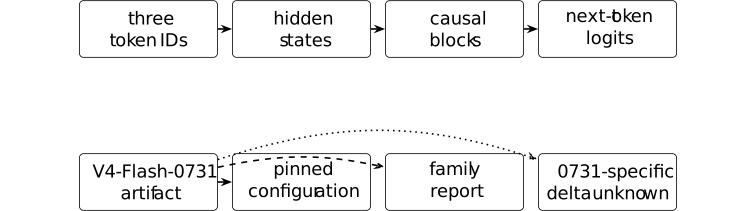
The pinned configuration [⧉] declares 43 layers, hidden width 4096, 64 attention heads, and one key--value head. Section 2 of the family report [⧉] describes the preview architecture. Neither source identifies a complete 0731-specific architecture or training delta. The diagram records the interface, not a small copy of the released model.
Mechanism families and capability bottlenecks [ftip-00OQ]AGENTDRAFTED
Mechanism families and capability bottlenecks [ftip-00OQ]AGENTDRAFTED
This map asks which mechanism family changes a declared capability bottleneck and what evidence would show that change. It is a comparison aid, not a ranking of architectures. The shared model, task, intervention, cost and evaluation interfaces remain the conditions of every claim. A source description, a measured result and a transfer claim are kept separate.
The five capability dimensions are state access, the information that can remain available across tokens, steps or external memory operations; adaptive computation, conditional allocation of depth, recurrence, search or stopping together with its charged cost; representation and abstraction, the available representation, composition or predictive state; plasticity, the changes reachable by a declared objective, optimizer, parameter tying and post-training recipe; and portability, survival of a result when the model family, task, scale or deployment regime changes. This is distinct from transfer, which evaluates a frozen artifact on new problems under a common deployment budget. They are coordinates for the capability vector, not a single intelligence scalar.
A bottleneck is the declared resource or interface condition that limits one of these dimensions in a comparison. Cost, numerical stability and monitorability remain evaluation coordinates: the ability to observe the relevant state, compute, update or failure signals under the study protocol. A matched-compute comparison fixes the cost accounting before comparing outcomes; its protocol and the architecture frontier remain authoritative elsewhere in this chapter.
The default core panel contains mechanism families that alter the sequence computation or its state interface. Existing Transformer notation and the decoder-only reference are in § [ftip-000K]; the entries below identify the question each family makes testable.
- Transformer reference. Attention exposes token-indexed content access through the declared context and serves as the baseline for the matched-compute comparison and interface comparisons.
- Selective state-space models. The Mamba construction, Sections 3.1--3.3 makes the state-space parameters input-dependent and computes the resulting time-varying recurrence with a hardware-aware scan. The testable bottleneck is how selective compression trades long-context access and throughput against retrieval and portability boundaries; a source mechanism does not settle that tradeoff.
- Linear attention. The linear-attention formulation, Sections 3.2--3.3 uses a feature-map factorization and associative prefix summaries rather than the full softmax attention matrix. The comparison asks which retrieval and memory tasks preserve their evaluation under the changed state interface; it does not identify every hybrid or recurrent model with pure linear attention.
- Internal-tick and looped models. The Continuous Thought Machine, Sections 3.1--3.5 uses a discrete internal tick dimension, private neuron-level models that process activation histories, synchronization as a latent representation, and standard cross-attention to the input features. Its loss selects minimum-loss and maximum-certainty ticks, making variable internal compute a testable mechanism. The looped computations in § [ftip-00KG] are a separate family; neither is a continuous-time claim, and every extra tick or loop must be charged in the comparison.
- Recurrent or compressed-state mechanisms. The Dragon Hatchling / BDH proposal, Section 3.2 defines a tensor-friendly BDH-GPU state-space system whose attention state admits a reduced representation, alongside local graph dynamics. Its open comparison is whether this state interface supports the target tasks and stable credit assignment at a declared budget; the proposal is not a production result.
The adjunct panel changes an objective, temporal law or function-space bias without being interchangeable with the core architecture families. I-JEPA, Section 3 is an encoder/predictor training architecture as well as an embedding-space prediction objective: its context, target and predictor use ViT backbones, the target encoder is updated by exponential moving average, and masked target blocks are predicted from a context block. That predictive objective leaves a specific representation limit: retaining or recovering the latent state does not by itself identify which directions are invariant and which vary across matched observations. SplitJEPA, Sections 3.1--3.4 (the project overview) makes the boundary explicit—predictive recovery can leave a global orthogonal mixing—and resolves it under stationary Gaussian predictive dynamics, a full-rank second moment of variant differences across invariant correspondences, and representation normalization, by identifying invariant and variant subspaces up to within-block isometries without an observation decoder. Here SplitJEPA is a structured JEPA adjunct and a conditional identifiability result, not a general guarantee for I-JEPA. Liquid time-constant networks, Sections 1--2 supply input-dependent continuous dynamics and a numerical ODE-solver interface; the Neural Operator formulation, Sections 1 and 3 supplies a function-space lens with discretization-invariant operator layers. The Zoology study, Sections 3--5 provides controlled recall analyses of sequence mixers. These sources motivate hypotheses and controls; they do not establish a common capability ordering or make an adjunct a replacement architecture. The JEPA comparability interface specifies fields that must be fixed for a JEPA-like comparison; it is not the source of I-JEPA's architecture. Combining CTM's internal dynamics with I-JEPA's encoder/predictor package is a proposed joint intervention, not an established result, and would require separate attribution of both components.
For each panel row, a study should name the changed state or compute interface, the bottleneck dimension, the task and intervention, the evidence type, and the transport boundary. Existing architecture-indexed ceilings and matched compute, published paired measurements (§ [ftip-00KU] and § [ftip-00L4]), conditional frontiers (§ [ftip-00LH]) and study design (§ [ftip-00LS]) provide those controls. Blank, incompatible and unmeasured cells remain findings rather than scores to be filled by intuition.
Architecture-indexed ceilings and matched compute [ftip-00JF]AGENTDRAFTED
Architecture-indexed ceilings and matched compute [ftip-00JF]AGENTDRAFTED
This optional section refines the architecture-neutral capability framework only when the question names an architecture, optimizer, or systems implementation. The general model/interface formulation remains available when these fields are unnecessary.
Architecture comparisons below are conditional on a declared task family, evaluation law, intervention class, and scalar cost. Toy bounds are finite results under their displayed assumptions and do not transfer to concrete model instances without verified interface, task, and cost assumptions.
Architecture, optimizer, and systems variables [ftip-00JG]AGENTDRAFTED
Architecture, optimizer, and systems variables [ftip-00JG]AGENTDRAFTED
Architecture, optimizer, and systems fields refine the model/interface description. A comparison depends only on the fields named in its assumptions and conclusion.
Definition. Optional architecture refinement [ftip-00JH]AGENTDRAFTED
Definition. Optional architecture refinement [ftip-00JH]AGENTDRAFTED
Let \(M\) denote an existing model intervention. An architecture refinement is a record \(A=(\mathcal X,\mathcal Y,\operatorname {Map}_A)\) whose map realizes the same declared input and output interface. Forgetting \(A\) returns \(M\); no architecture claim is made when the field is omitted.
Definition. Optimizer and systems records [ftip-00JI]AGENTDRAFTED
Definition. Optimizer and systems records [ftip-00JI]AGENTDRAFTED
When needed, extend the record by \(O\) for optimizer and state-update rules, and \(S\) for kernels, precision, memory, cache, and scheduling. The triplet \((A,O,S)\) is descriptive; it is not a scalar intelligence score.
Definition. Architecture-indexed evaluation functional [ftip-00JJ]AGENTDRAFTED
Definition. Architecture-indexed evaluation functional [ftip-00JJ]AGENTDRAFTED
Fix an architecture \(A\), its base artifact, a declared intervention set \(\mathfrak I_A\), and the common evaluation interface of Convention [ftip-005D]. Each \(\eta \in \mathfrak I_A\) specifies a protocol \(P_{A,\eta }=\operatorname {PostTrain}(A,\eta )\) in that measurable and absolutely integrable evaluation domain, with real performance \(J_{\rm ev}(P_{A,\eta })\). Let \(c_A(\eta )\in [0,+\infty ]\) be its scalar cost under the study's declared accounting rule: a fixed measured cost or an expected nonnegative cost, as specified. For a finite budget \(C\in \mathbb R_{\geq 0}\), define \[ V_A(C)=\sup \left \{ J_{\rm ev}(P_{A,\eta }): \eta \in \mathfrak I_A,\ c_A(\eta )\leq C \right \}\in \overline {\mathbb R}. \] Infinite-cost interventions are infeasible at every such budget.
As in Definition [ftip-005M], the empty feasible set has value \(-\infty \); an unbounded-above feasible score set has value \(+\infty \). The value is real exactly when that set is nonempty and bounded above. Increasing \(C\) enlarges the feasible set, so \(V_A\) is nondecreasing. A finite supremum need not be attained by any intervention.
Frontier differences and derivatives are ordinary real operations only where the relevant values are finite, with differentiability additionally required for a derivative. Cost ratios use the domain in Definition [ftip-00JP]. The allowed intervention set, evaluation law, and accounting rule are part of the definition, so \(V_A\) is not a universal intelligence function.
Remark. Architecture-neutral projection and gradual complexity [ftip-00JK]AGENTDRAFTED
Remark. Architecture-neutral projection and gradual complexity [ftip-00JK]AGENTDRAFTED
A statement that depends only on the model/interface map is invariant under changes to architecture \(A\), optimizer \(O\), or systems \(S\) that leave that map fixed. A conclusion about one of those fields instead requires assumptions that distinguish its possible values.
Definition. Three ceiling layers [ftip-00JL]AGENTDRAFTED
Definition. Three ceiling layers [ftip-00JL]AGENTDRAFTED
For fixed task and evaluation laws, distinguish the representational ceiling of \(A\), the optimizer-reachable ceiling of \((A,O)\), and the systems-feasible frontier of \((A,O,S,C)\). Each layer is conditional on the objects named; none implies that the next layer attains it.
Definition. Capability vector and conditional frontier [ftip-00JM]AGENTDRAFTED
Definition. Capability vector and conditional frontier [ftip-00JM]AGENTDRAFTED
For an architecture record \(A\), optimizer record \(O\), systems record \(S\), evaluation configuration \(\mathfrak e\) from Definition [ftip-00CE], and declared intervention \(\eta \) at cost cap \(C\), define the capability vector
\[ \mathbf K(A,O,S,\mathfrak e,\eta ,C) =\bigl (K_{\rm state},K_{\rm adapt},K_{\rm repr}, K_{\rm plast},K_{\rm port}\bigr ). \]Its coordinates respectively record state access, adaptive computation, representation and abstraction, plasticity, and portability under the named task, intervention, evaluation law, and cost accounting. A coordinate may be a descriptive field, an estimand, or \(\bot \) when the record is missing, incompatible, or not measured. The tuple is therefore not a common scalar and does not order architectures without a declared comparison rule.
The five coordinates attach to the existing ceiling layers conditionally: representation claims first require a map from \(A\); optimizer-reachable plasticity requires \((A,O)\); state, adaptive computation, and portability claims require the relevant \((A,O,S)\) interface, task family, and deployment regime. A systems-feasible claim also carries \(C\), the cost vector and its declared scalarization. The records in Definition [ftip-00JH], Definition [ftip-00JI], Definition [ftip-00JL], and Definition [ftip-00CE] remain authoritative.
The scalar frontier \(V_A(C)\) of Definition [ftip-00JJ] is a projection onto the declared utility \(J_{\rm ev}\) for one architecture and intervention envelope; it is not a capability coordinate. For a fixed evaluation configuration, a vector-valued study may instead retain the conditional set
\[ \mathcal F_{\mathfrak e}(C) =\operatorname {Pareto}\left \{ \bigl (\mathbf K(A,O,S,\mathfrak e,\eta ,C), J_{\rm ev}(P_{A,\eta }),\mathbf c(P_{A,\eta })\bigr ): c_A(\eta )\leq C \right \}, \]where Pareto dominance is declared for the reported coordinates. The set is conditional on the task, intervention class, evaluation law, cost vector, and missingness rule; it is not a universal intelligence frontier.
Matched-compute arms in § [ftip-00JU] compare entries only after stating which coordinates are held fixed, which are allowed to vary, and how the cost vector is charged. Cost, numerical stability, and monitorability remain evaluation coordinates alongside the vector, so a lower scalar cost or a stable implementation is not silently counted as a capability increase.
Depth reuse and latent recurrence [ftip-00KG]AGENTDRAFTED
Depth reuse and latent recurrence [ftip-00KG]AGENTDRAFTED
Repeated depth, latent feedback, and recirculation change the computation performed at inference. Relative to the fixed reference autoregressive Transformer, their costs include any extra passes, state, and prefill work.
Definition. Computation-axis record [ftip-00KH]AGENTDRAFTED
Definition. Computation-axis record [ftip-00KH]AGENTDRAFTED
For an architecture record \(A\), distinguish token steps, feed-forward depth passes, recurrent passes, and latent-state updates. Let \(d(A,r)\) be the declared number of depth passes in run \(r\); it is a computation coordinate, not a synonym for parameter count or reasoning quality.
Remark. Looped Transformers as a source result [ftip-00KI]AGENTDRAFTED
Remark. Looped Transformers as a source result [ftip-00KI]AGENTDRAFTED
Giannou et al. show that a fixed shallow Transformer placed in a loop can execute programmed iterative computations, including conditional branches and in-context algorithms, in Looped Transformers as Programmable Computers[giannou2023looped]. This is a source result under its program, state, and precision assumptions; it is not a universal claim about language-model capability.
Remark. Parameter sharing and width tradeoffs [ftip-00KJ]AGENTDRAFTED
Remark. Parameter sharing and width tradeoffs [ftip-00KJ]AGENTDRAFTED
Xue et al. report that depth sharing can reduce trainable parameters while limiting modeling capacity, and study width and mixture-of-experts remedies in Go Wider Instead of Deeper[xue2021wider]. The comparison is empirical and task-specific; it does not identify a depth-independent ceiling.
Remark. Virtual logical depth and scaling [ftip-00KK]AGENTDRAFTED
Remark. Virtual logical depth and scaling [ftip-00KK]AGENTDRAFTED
Zhu et al. vary virtual logical depth by reusing weights and report reasoning gains at nearly fixed parameter count in Beyond Parameters: Exploring Virtual Logic Depth for Scaling Laws[zhu2025virtualdepth]. Their results motivate a depth coordinate in a scaling study, while leaving knowledge capacity, optimization, and transfer dependent on the declared training and evaluation protocol.
Remark. Recirculation as an inference intervention [ftip-00KL]AGENTDRAFTED
Remark. Recirculation as an inference intervention [ftip-00KL]AGENTDRAFTED
Mozer et al. introduce inference-time recirculation that feeds latent states back through an off-the-shelf model and report task improvements in Recirculation[mozer2026recirculation]. The added serial prefill and adaptive tuning belong in the systems and inference records; the observation is not a proof of a new representational ceiling.
Remark. Latent feedback with a preserved Transformer interface [ftip-00KM]AGENTDRAFTED
Remark. Latent feedback with a preserved Transformer interface [ftip-00KM]AGENTDRAFTED
Wang et al. widen the feedback channel between decoding steps with latent feedback while retaining a Transformer and language-modeling interface in Full-bandwidth transformer[wang2026fullbandwidth]. Any reported token or accuracy savings are conditional on the scheduled multi-pass training and measured decoding cost.
Remark. Latent prediction as a training intervention [ftip-00KN]AGENTDRAFTED
Remark. Latent prediction as a training intervention [ftip-00KN]AGENTDRAFTED
Teoh et al. add next-latent prediction to next-token training and report compact predictive states without changing the Transformer interface in Next-Latent Prediction Transformers Learn Compact World Models[teoh2025nextlatent]. This belongs to the training intervention record, not to an architecture-only comparison.
Example. Equal parameters do not fix effective depth [ftip-00KO]AGENTDRAFTED
Example. Equal parameters do not fix effective depth [ftip-00KO]AGENTDRAFTED
Two runs can share parameter count while using different numbers of recurrent or latent-feedback passes. A matched study must therefore report the computation-axis record and cannot infer an architecture ceiling from parameters alone.
Definition. Depth-reuse model-instance record [ftip-00KP]AGENTDRAFTED
Definition. Depth-reuse model-instance record [ftip-00KP]AGENTDRAFTED
For a depth-reuse comparison, record shared weights, pass count, stopping rule, recurrent state, training objective, token and pass FLOPs, prefill and decode latency, memory, and evaluation seeds. A pass-count change is an intervention even when the parameter tensor is unchanged.
Example. Fixed-recipe depth comparison [ftip-00KQ]AGENTDRAFTED
Example. Fixed-recipe depth comparison [ftip-00KQ]AGENTDRAFTED
In a fixed-recipe arm, hold data, optimizer, feedback, stopping rule, and evaluation law fixed while varying only the declared depth-reuse intervention. The resulting difference is an estimand for that recipe, not a best-achievable comparison.
Remark. Scaling surfaces rather than a single law [ftip-00KR]AGENTDRAFTED
Remark. Scaling surfaces rather than a single law [ftip-00KR]AGENTDRAFTED
A depth-reuse study may fit a surface over parameters, tokens, passes, and cost. The fit is an empirical summary over its measured range; it does not establish an asymptotic law or a universal saturation point.
Remark. Architecture and training are separable records [ftip-00KS]AGENTDRAFTED
Remark. Architecture and training are separable records [ftip-00KS]AGENTDRAFTED
Weight sharing, latent objectives, and recirculation can alter optimization without changing the declared external interface. The comparison must retain architecture, training intervention, and systems coordinates separately.
Remark. Depth reuse across passes, parameters, and tasks [ftip-00KT]AGENTDRAFTED
Remark. Depth reuse across passes, parameters, and tasks [ftip-00KT]AGENTDRAFTED
The cited looped, virtual-depth, latent-feedback, and recirculation results do not show that more passes always improve capability, that parameter sharing dominates added parameters, or that inference-time gains transfer to training or to another task family. Each transfer requires a matched model-instance record.
Ceilings, frontiers, and saturation [ftip-00JN]AGENTDRAFTED
Ceilings, frontiers, and saturation [ftip-00JN]AGENTDRAFTED
Definition. Fixed-recipe and tuned frontiers [ftip-00JO]AGENTDRAFTED
Definition. Fixed-recipe and tuned frontiers [ftip-00JO]AGENTDRAFTED
The fixed-recipe frontier evaluates one common \(\eta \). The equal-tuning frontier permits architecture-specific choices from a predeclared trial set with the same tuning data and budget. The restricted envelope permits a predeclared class of interventions under \(C\). These are distinct estimands.
Definition. Iso-quality cost ratio [ftip-00JP]AGENTDRAFTED
Definition. Iso-quality cost ratio [ftip-00JP]AGENTDRAFTED
For a finite real target \(q\in \mathbb R\) and the frontier of Definition [ftip-00JJ], define the inverse cost \[ C_A(q)=\inf \{C\in \mathbb R_{\geq 0}:V_A(C)\geq q\} \in [0,+\infty ], \qquad \inf \varnothing =+\infty . \] The iso-quality ratio is defined only on the domain \[ \rho _{A/B}(q)=\frac {C_A(q)}{C_B(q)}, \qquad 0\leq C_A(q)<+\infty , \quad 0<C_B(q)<+\infty . \] The architectures must use the same target, evaluation interface, cost units, and comparison arm. The ratio compares efficiency under these choices.
An inverse cost is a threshold infimum, not an executable minimum. The infimum over budgets may be unattained; even if a budget satisfies \(V_A(C)\geq q\), its performance supremum may be unattained at \(q\). An actual target-achieving intervention requires a separate witness.
Positive individual costs do not guarantee a positive inverse cost. For interventions \(\eta _n\), \(n\geq 1\), with score \(1\) and cost \(1/n\), the target \(q=1\) has \(C_A(1)=0\), although every intervention costs more than zero. If both architectures have this family, the putative ratio is \(0/0\) and is excluded by the displayed domain.
Definition. Operational cost vector and scalarization [ftip-00JQ]AGENTDRAFTED
Definition. Operational cost vector and scalarization [ftip-00JQ]AGENTDRAFTED
Record training FLOPs, inference FLOPs, wall time, memory, energy, and hardware separately as \(\mathbf c\). A scalar cost \(C=w\cdot \mathbf c\) is a declared study choice with nonnegative units \(w\); changing \(w\) changes the frontier and must not be hidden as architecture quality.
Theorem. Finite-window representational obstruction [ftip-00JR]AGENTDRAFTED
Theorem. Finite-window representational obstruction [ftip-00JR]AGENTDRAFTED
Consider a causal system whose state after each prefix has at most \(K\) distinct values, and a task with \(K+1\) prefixes requiring pairwise distinct continuation labels. By the pigeonhole principle two prefixes share a state, so at least one continuation label is wrong. This is a finite toy obstruction only; it does not bound a concrete Transformer or KDA instance without a proved reduction to this state model.
Theorem. A conditional saturation certificate [ftip-00JS]AGENTDRAFTED
Theorem. A conditional saturation certificate [ftip-00JS]AGENTDRAFTED
Let \(V_A\) be the nondecreasing frontier of Definition [ftip-00JJ], bounded above by a finite \(U\in \mathbb R\). If an intervention reaches a real target \(q<U\) at a finite cost \(C_q\geq 0\), then at every finite \(C\geq C_q\), \(q\leq V_A(C)\leq U\). In particular \(V_A(C)\) is real and \(0\leq U-V_A(C)\leq U-q\). This elementary certificate is conditional on the bound \(U\); it does not assert that real intelligence saturates.
Example. Equal scalar cost does not identify architecture [ftip-00JT]AGENTDRAFTED
Example. Equal scalar cost does not identify architecture [ftip-00JT]AGENTDRAFTED
Two systems can have the same scalar \(C\) while differing in memory, latency, and training allocation. A cost-weight change can reverse their ordering without changing either system. Thus a one-factor comparison needs a fixed scalarization and a reported cost vector; no architecture effect follows from equal \(C\) alone.
Matched-compute comparison protocol [ftip-00JU]AGENTDRAFTED
Matched-compute comparison protocol [ftip-00JU]AGENTDRAFTED
Definition. Common-recipe comparison arm [ftip-00JV]AGENTDRAFTED
Definition. Common-recipe comparison arm [ftip-00JV]AGENTDRAFTED
A common-recipe arm fixes training data, optimizer family, schedule, post-training procedure and feedback, training and post-training budgets, inference budget, and evaluation protocol and draws. Interface-compatible parameter choices are declared in advance as part of each permitted architecture package. The comparison varies that package under the common recipe; any further deviation is recorded as a separate comparison coordinate. Its score difference measures performance under this recipe, not the best attainable result for either architecture.
Definition. Equal-tuning-budget comparison arm [ftip-00JW]AGENTDRAFTED
Definition. Equal-tuning-budget comparison arm [ftip-00JW]AGENTDRAFTED
An equal-tuning-budget arm permits architecture-specific tuning under a predeclared protocol that fixes the tuning data and its volume, trial count, selection rule, stopping rule, and tuning cost for both architectures. The cost uses the same declared accounting rule. The resulting comparison measures practical performance under this equal optimization effort; it does not determine best possible training or a representation-only limit.
Definition. Restricted-envelope comparison arm [ftip-00JX]AGENTDRAFTED
Definition. Restricted-envelope comparison arm [ftip-00JX]AGENTDRAFTED
A restricted-envelope arm declares an allowed intervention class \(\mathcal E_A\subseteq \mathfrak I_A\) for each architecture, specifying the permitted training, post-training, and inference procedures. The classes expose exclusions, search budgets, seeds, and stopping rules. Restrict the evaluation functional of Definition [ftip-00JJ] to \(\mathcal E_A\) and compare the resulting suprema under the same finite cost cap \(C\geq 0\), common evaluation law, and common declared cost accounting.
The measurable, integrable evaluation domain and extended-real conventions of Definition [ftip-00JJ] apply: an empty feasible class has value \(-\infty \), an unbounded-above feasible score set has value \(+\infty \), and a finite supremum need not be attained. The allowed class is part of the comparison, so its envelope is a restriction-dependent quantity, not an unrestricted architectural ceiling.
Definition. Model-instance comparison evidence record [ftip-00JY]AGENTDRAFTED
Definition. Model-instance comparison evidence record [ftip-00JY]AGENTDRAFTED
A model-instance record contains architecture/checkpoint identity, parameter count, data and post-training recipe, optimizer, precision, hardware, cache policy, training and inference cost vectors, task suite, and independent evaluation seed. A missing field makes an architecture attribution unknown.
Remark. Systems optimizations are measured interventions [ftip-00JZ]AGENTDRAFTED
Remark. Systems optimizations are measured interventions [ftip-00JZ]AGENTDRAFTED
FlashAttention, KV-cache layouts, quantization, batching, and kernels can change feasible cost. If they approximate, truncate, or alter precision of the mathematical computation, the record must mark that as a systems intervention rather than as a pure architecture comparison.
Theorem. Matched-protocol difference is an estimand [ftip-00K0]AGENTDRAFTED
Theorem. Matched-protocol difference is an estimand [ftip-00K0]AGENTDRAFTED
Given \(n\geq 1\) evaluation draws, let \(\widehat V_A(C)\) be the sample mean of finite real evaluation scores for architecture \(A\) at a finite cost cap \(C\geq 0\). Under a fixed evaluation law and common-recipe arm, the finite difference \(\widehat V_A(C)-\widehat V_B(C)\) is a well-defined empirical estimand.
It does not identify a causal architecture effect when data, tuning, or systems coordinates differ. The conclusion follows directly from the declared record.
Remark. Conditions for applying a toy model [ftip-00K1]AGENTDRAFTED
Remark. Conditions for applying a toy model [ftip-00K1]AGENTDRAFTED
A toy theorem applies to a concrete model only if an explicit map from its state and interface to the model preserves the theorem's assumptions, including its cost accounting. Without such a map, the conclusion concerns only the abstract model; its validity for the concrete system is unknown.
Kimi Delta Attention versus Transformer [ftip-00K2]AGENTDRAFTED
Kimi Delta Attention versus Transformer [ftip-00K2]AGENTDRAFTED
Definition. KDA model-instance record [ftip-00K3]AGENTDRAFTED
Definition. KDA model-instance record [ftip-00K3]AGENTDRAFTED
For a Kimi Delta Attention (KDA) versus full-attention baseline study, record the exact Kimi Linear checkpoint, layer mix, context length, hardware, kernel, precision, batch, and decoding workload. The paper describes KDA as a fine-grained gated delta-rule module in a hybrid architecture; those are source observations from Kimi Linear: An Expressive, Efficient Attention Architecture[kimi2025linear], not universal theorems.
If the baseline is called a Transformer, record whether it is the paper's MLA baseline or another full-attention implementation; the label alone does not identify a common architecture or cost.
Example. Matched-cost KDA and Transformer comparison [ftip-00K4]AGENTDRAFTED
Example. Matched-cost KDA and Transformer comparison [ftip-00K4]AGENTDRAFTED
A matched comparison uses the same task prompts, post-training data and feedback, optimizer family, evaluation protocol, and quality target. The corresponding measurements include parameter count, training FLOPs, inference FLOPs, wall time, memory, KV-cache bytes, and context length for each architecture. A reported speed or quality difference is conditional on these experimental conditions and measurements.
Remark. What the Kimi Linear paper establishes [ftip-00K5]AGENTDRAFTED
Remark. What the Kimi Linear paper establishes [ftip-00K5]AGENTDRAFTED
Kimi Linear reports a hybrid KDA/MLA model and fair-comparison experiments in Sections 3--5, with setup in Section 5.4 and efficiency comparisons in Sections 5.5--5.6 of Kimi Linear: An Expressive, Efficient Attention Architecture[kimi2025linear]. These include long-context efficiency.
The reported throughput and quality are empirical under its training recipe and hardware; they are lower bounds on demonstrated performance, not an architecture-independent ceiling.
Example. Parameter matching is not cost matching [ftip-00K6]AGENTDRAFTED
Example. Parameter matching is not cost matching [ftip-00K6]AGENTDRAFTED
Two models with equal parameter count can have different attention FLOPs, KV-cache memory, kernel utilization, and attainable context. Conversely, equal wall time can hide different hardware and precision. Therefore a parameter-matched result cannot by itself identify a compute frontier.
Remark. Cache, throughput, and quality in KDA comparisons [ftip-00K7]AGENTDRAFTED
Remark. Cache, throughput, and quality in KDA comparisons [ftip-00K7]AGENTDRAFTED
The KDA example does not prove that every linear-attention model beats every Transformer, that cache savings imply equal quality, or that a measured throughput gain is a capability gain. Any such statement requires a new matched study with the evidence record of Definition [ftip-00JY].
Definition. Model-instance comparison decision rule [ftip-00K8]AGENTDRAFTED
Definition. Model-instance comparison decision rule [ftip-00K8]AGENTDRAFTED
Call architecture A more cost-efficient than B at quality \(q\) only when the compared threshold costs use the same declared protocol, the confidence procedure and stopping rule are fixed, and all cost-vector coordinates needed by the claim are present. A ratio additionally requires finite costs and a strictly positive denominator as in Definition [ftip-00JP]. State whether the costs are measured target-achieving witnesses or justified inverse-frontier values \(C_A(q)\) and \(C_B(q)\); observing one successful run does not identify those infima. Otherwise the comparison is descriptive or unknown.
Interface boundaries for alternative architectures [ftip-00K9]AGENTDRAFTED
Interface boundaries for alternative architectures [ftip-00K9]AGENTDRAFTED
Definition. JEPA comparability interface [ftip-00KA]AGENTDRAFTED
Definition. JEPA comparability interface [ftip-00KA]AGENTDRAFTED
A JEPA-like architecture is comparable to an autoregressive model only after fixing the predictor, target representation, decoder or downstream interface, training objective, inference procedure, and evaluation law. A parameter-count match alone is not a typed comparison.
Remark. Representation and task interface are separate [ftip-00KB]AGENTDRAFTED
Remark. Representation and task interface are separate [ftip-00KB]AGENTDRAFTED
A latent predictor can be excellent under one decoder and unusable under another. The evaluation record must therefore include the interface that maps the representation to the declared task output.
Theorem. Interface-preserving architecture reduction [ftip-00KC]AGENTDRAFTED
Theorem. Interface-preserving architecture reduction [ftip-00KC]AGENTDRAFTED
If two architecture records induce the same conditional output law on a fixed task and evaluation interface, every evaluation functional \(J\) gives the same value. This is an immediate pushforward identity under the stated output-law and interface assumptions. It does not imply that distinct architectures are generally equivalent.
Example. Equal benchmark score can hide different ceilings [ftip-00KD]AGENTDRAFTED
Example. Equal benchmark score can hide different ceilings [ftip-00KD]AGENTDRAFTED
Two architectures may tie on a finite benchmark while differing on an unmeasured task slice or longer context. Thus a single score cannot establish equal representational ceilings; the task family and evaluation coverage must be declared.
Remark. Architecture-independent model interfaces [ftip-00KE]AGENTDRAFTED
Remark. Architecture-independent model interfaces [ftip-00KE]AGENTDRAFTED
A result stated solely in terms of a model/interface map applies to every architecture realizing that map and satisfying its hypotheses. An architecture-specific conclusion can require further assumptions, as in Remark [ftip-00JK].
Remark. Open model-instance questions [ftip-00KF]AGENTDRAFTED
Remark. Open model-instance questions [ftip-00KF]AGENTDRAFTED
The relative capability and cost of KDA, full attention, and JEPA candidates remain empirical questions. A reproducible comparison requires identified checkpoints or reproducible training, fixed evaluation seeds, and measured cost vectors. Architecture-specific ceilings remain estimands and hypotheses rather than established constants.
Published hybrid-attention comparison [ftip-00KU]AGENTDRAFTED
Published hybrid-attention comparison [ftip-00KU]AGENTDRAFTED
Kimi Linear combines recurrent KDA layers with periodic full MLA attention. Its published comparison shows task-dependent score changes and lower long-context decoding times. The selected scores in Example [ftip-00LC], the memory estimate in Example [ftip-00KY], and the discovery calculation in Example [ftip-00L3] connect these observations to a post-training question: when can a cheaper attempt compensate for a possible lower per-attempt success probability?
Example. Published Kimi Linear operating point [ftip-00KV]AGENTDRAFTED
Example. Published Kimi Linear operating point [ftip-00KV]AGENTDRAFTED
The Kimi Linear report compares experimental models pretrained on 1.4 trillion tokens, each with 48 billion total and 3 billion active parameters. Kimi Linear uses three Kimi Delta Attention layers for each full Multi-head Latent Attention layer, with no positional encoding (NoPE) in its MLA layers; the reference uses full MLA attention [kimi2025linear, Sections 4 and 5.4]. These are properties of the reported hybrid architecture.
These experimental models are distinct from the released Kimi Linear model, pretrained on 5.7 trillion tokens and supporting up to one million tokens of context. Appendix D compares that release with Moonlight, which has 16 billion total and 3 billion active parameters [kimi2025linear, Section 5.4.1 and Appendix D].
Example. Published efficiency observations [ftip-00KW]AGENTDRAFTED
Example. Published efficiency observations [ftip-00KW]AGENTDRAFTED
For batch size one at one million tokens, Figure 7 labels a \(2.9\times \) prefill speedup and a \(2.2\times \) decoding speedup for Kimi Linear against MLA. Section 6.3 gives \(2.3\times \) for the latter point, so the graphic and prose differ slightly [kimi2025linear, Figure 7 and Sections 5.6 and 6.3].
The larger-batch comparison in Figure 1(b) gives decoding time per output token of 1.84 milliseconds for Kimi Linear and 11.48 milliseconds for MLA, with a reported \(6.3\times \) speedup. Section 6.3 describes this as a theoretical speedup from reallocating saved KV-cache memory to larger batches. It illustrates a different use of the memory saving from the batch-one latency result [kimi2025linear, Figure 1(b) and Section 6.3].
Figure 1(a) reports RULER scores of 84.3 for Kimi Linear and 81.3 for MLA at 128k context, with \(3.98\times \) decoding acceleration [kimi2025linear, Figure 1(a)]. The report also gives a reduction of up to 75 percent in KV-cache use [kimi2025linear, Abstract]. Together these observations motivate studying context length and batch size as separate cost coordinates. The unequal RULER scores and different timing regimes are retained when interpreting those points.
Definition. Quality target and cost measurement [ftip-00KX]AGENTDRAFTED
Definition. Quality target and cost measurement [ftip-00KX]AGENTDRAFTED
For a reported benchmark score q, use the same task, prompt law, scoring rule, and post-training condition for both systems. The comparison records the smallest measured cost at which each system reaches q, when such a measurement exists. A throughput or cache ratio is not substituted for this iso-quality cost.
Example. A cache-memory estimate for hybrid attention [ftip-00KY]AGENTDRAFTED
Example. A cache-memory estimate for hybrid attention [ftip-00KY]AGENTDRAFTED
The cited FLA KDA implementation at commit 6b6f546f stores one active recurrent state
per sequence, with dimensions determined by the value heads and key/value
dimensions rather than accumulated context length. Its newly allocated
state uses float32
[⧉].
The optional short-convolution state has one fixed-width kernel buffer per
channel and sequence
[⧉].
This supplies a concrete implementation model for the recurrent part of
the 3:1 mixture in Example [ftip-00KV].
Consider a stylized comparison with \(4\ell \) layers, batch size \(b\), and context length \(T\), where \(\ell ,b,T\) are positive integers. Assume each MLA layer stores \(\kappa T\) bytes per sequence, with the same \(\kappa >0\) in both designs, and each KDA layer stores one terminal recurrent-plus-convolution state of \(\sigma >0\) bytes. The active attention-state memories are
\[ M_{\rm MLA}=4b\ell \kappa T,\qquad M_{\rm hybrid}=b\ell (\kappa T+3\sigma ),\qquad \frac {M_{\rm hybrid}}{M_{\rm MLA}} =\frac {1}{4}+\frac {3\sigma }{4\kappa T}. \]The hybrid uses less active state exactly when \(T>\frac {\sigma }{\kappa }\), and the ratio tends to \(1/4\) as context grows. This explains why replacing three quarters of the growing caches can approach a 75-percent saving, while fixed recurrent-state overhead can erase the advantage at short contexts. The retained MLA layers keep the hybrid's state memory linear in \(T\); the whole model is not a fixed-memory recurrent system.
Weights, training activations, workspaces, allocator padding and saved prefix states are outside this active-state calculation. At a fixed device memory budget, the estimate predicts more room for simultaneous or longer rollouts when attention state dominates. It does not predict a fourfold speedup. Training and decoding also use different execution paths: FLA selects chunk kernels for gradient-enabled computation and fused recurrence for short inference calls [⧉]. The fixed-state estimate is therefore a useful serving hypothesis, not a training-memory or training-speed formula.
Example. Common-recipe reading of the Kimi result [ftip-00KZ]AGENTDRAFTED
Example. Common-recipe reading of the Kimi result [ftip-00KZ]AGENTDRAFTED
The report holds its stated pretraining and SFT recipes common across the experimental models [kimi2025linear, Sections 5.4--5.5 and Table 4]. The selected observations in Example [ftip-00LC] compare the resulting trained designs, including the hybrid's 3:1 KDA/MLA pattern and NoPE choice. The mixed score directions suggest a task-dependent tradeoff rather than one ordering of the two architectures.
The theoretical mechanism is a change in the cost of maintaining and using the prefix: recurrent layers compress it into state, while the retained MLA layers preserve growing attention caches. The model in Example [ftip-00KY] predicts the largest memory advantage at long contexts. If this advantage reduces the cost of generating useful candidates, Example [ftip-00L3] predicts when more attempts can offset a reduction in per-attempt quality. This is a conditional explanation to test through rollout costs and verified success rates; it does not require attributing the whole result to KDA alone.
Example. Measured iso-quality cost ratio [ftip-00L0]AGENTDRAFTED
Example. Measured iso-quality cost ratio [ftip-00L0]AGENTDRAFTED
Let \(c_K(q)\) and \(c_T(q)\) be measured inference costs for Kimi Linear and the Transformer reference at the same finite real score \(q\) and context length, under one accounting rule. If \(0\leq c_K(q)<+\infty \) and \(0<c_T(q)<+\infty \), the measured ratio \(\widehat \rho _{K/T}(q)=c_K(q)/c_T(q)\) is reported together with the full cost vectors. These measured costs need not be the inverse frontier infima of Definition [ftip-00JP]. If either threshold is unmeasured or the denominator is zero, the ratio is left undefined rather than inferred from the paper's speedup plot.
Remark. Hybrid attention is not pure linear attention [ftip-00L1]AGENTDRAFTED
Remark. Hybrid attention is not pure linear attention [ftip-00L1]AGENTDRAFTED
Kimi Linear combines KDA with periodic full-attention layers. A measured advantage therefore identifies the reported hybrid intervention, not a claim that a purely linear recurrent architecture has the same quality or ceiling. The layer pattern belongs in the architecture record.
Remark. Demonstrated performance is a lower bound [ftip-00L2]AGENTDRAFTED
Remark. Demonstrated performance is a lower bound [ftip-00L2]AGENTDRAFTED
The published benchmark scores demonstrate attainable points for the reported checkpoints and protocol. They do not establish a representational ceiling, a universal scaling law, or a claim that additional cost cannot improve either architecture.
Example. When cheaper attempts compensate for lower success [ftip-00L3]AGENTDRAFTED
Example. When cheaper attempts compensate for lower success [ftip-00L3]AGENTDRAFTED
Smaller caches can support more concurrent requests or avoid preemption and recomputation. These are actual serving mechanisms in vLLM's memory and scheduling guidance [⧉]. For post-training, the useful prediction is therefore about completed candidate attempts under a budget, including verification and optimization costs, rather than decoding speed alone.
Use the following cost model on the same hardware. One baseline attempt costs \(c>0\); generation accounts for a fraction \(f\in [0,1]\). Suppose generation becomes \(s_{\rm gen}>0\) times as fast while all other cost per attempt stays fixed. The new cost and total attempt-throughput factor are
\[ c_K=c\left (1-f+\frac {f}{s_{\rm gen}}\right ),\qquad S=\frac {c}{c_K} =\frac {1}{1-f+f/s_{\rm gen}}. \]For a fixed budget \(B\geq 0\), this model permits \(N_M=\lfloor B/c\rfloor \) baseline attempts and \(N_K=\lfloor B/c_K\rfloor \) hybrid attempts. Assume \(N_M,N_K\geq 1\) and verified-success events independent within each set of attempts, with respective probabilities \(p_M,p_K\in [0,1]\). Then Theorem [ftip-0078] gives discovery probabilities \(1-(1-p_M)^{N_M}\) and \(1-(1-p_K)^{N_K}\). The hybrid matches or exceeds baseline discovery exactly when
\[ p_K\geq 1-(1-p_M)^{N_M/N_K}. \]This follows by comparing the two failure probabilities and taking the nonnegative \(N_K\)-th root.
For an illustrative estimate, suppose generation consumes 80 percent of the baseline cost and use \(s_{\rm gen}=2.2\), motivated by the batch-one decode figure in Example [ftip-00KW]. Applying that decode factor to the whole generation stage is a working approximation, not a measured rollout result. Then \(S\approx 1.774\); a budget of \(B=10c\) buys 10 baseline attempts or 17 hybrid attempts. If \(p_M=0.10\) and \(p_K=0.08\), the discovery probabilities are approximately \(0.651\) and \(0.758\). The break-even hybrid probability is about \(0.0601\). Thus this model predicts that more attempts can outweigh a moderate per-attempt quality loss. The assumed probabilities are illustrative verified-success rates, not conversions of the benchmark scores in Example [ftip-00LC].
The prediction is strongest for long-context, generation-heavy work whose saved memory becomes usable rollout capacity. As verification or optimization dominates, \(f\) shrinks and \(S\) approaches one. Correlated attempts require the joint-law analysis of Convention [ftip-0077] instead of the independent product. Measure completed attempts, verified-success rates and total cost under a fixed prompt, decoding and verifier protocol to test the tradeoff. In the RLVR round of Example [ftip-004M], additional successful candidates can improve the available feedback; whether they produce useful accepted updates is a further optimizer-and-evaluation question, as Example [ftip-0085] demonstrates.
Paired measurements for model comparison [ftip-00L4]AGENTDRAFTED
Paired measurements for model comparison [ftip-00L4]AGENTDRAFTED
A paired measurement specifies both model instances and their task, intervention, evaluation, and cost coordinates. These conditions determine the meaning of each point in the measured frontier.
Definition. Comparison pair identity [ftip-00L5]AGENTDRAFTED
Definition. Comparison pair identity [ftip-00L5]AGENTDRAFTED
A paired comparison identifies the two systems, exact checkpoint or training commit, architecture variant, parameter counts, tokenizer, and context limit. A label such as ``Transformer'' is insufficient when attention, cache, or layer patterns differ.
Definition. Common task and evaluation conditions [ftip-00L6]AGENTDRAFTED
Definition. Common task and evaluation conditions [ftip-00L6]AGENTDRAFTED
Both systems use the same task family, prompt and data law, scoring rule, sampling seeds, stopping rule, and evaluator version. Any exception is a separate comparison arm, not an unrecorded architecture effect.
Definition. Training and post-training coordinates [ftip-00L7]AGENTDRAFTED
Definition. Training and post-training coordinates [ftip-00L7]AGENTDRAFTED
Record data volume, token order policy, optimizer and schedule, supervised tuning, feedback or reinforcement procedure, update count, and selection rule. The common-recipe arm fixes these coordinates; the equal-tuning arm allows predeclared alternatives with equal search resources.
Definition. Inference and systems coordinates [ftip-00L8]AGENTDRAFTED
Definition. Inference and systems coordinates [ftip-00L8]AGENTDRAFTED
Record hardware, software and kernel versions, precision, batch, cache policy, sequence lengths, warm-up procedure, concurrency, and decoding settings. A kernel or cache change that alters numerical computation is marked as an intervention rather than hidden as an implementation detail.
Definition. Per-system cost vector [ftip-00L9]AGENTDRAFTED
Definition. Per-system cost vector [ftip-00L9]AGENTDRAFTED
For each system, the cost vector \(\mathbf c\) contains training FLOPs, inference FLOPs, wall time, memory, energy when available, and context length. The primary scalar \(C\) and its weights are declared beside the vector; omitted coordinates are marked unknown.
Definition. Repeated measurement rule [ftip-00LA]AGENTDRAFTED
Definition. Repeated measurement rule [ftip-00LA]AGENTDRAFTED
For each fixed workload and system, record warm-up runs, repetition count, random seeds, and the aggregation rule. Report mean and dispersion for time, memory, and score; a single fastest run cannot define a cost frontier.
Definition. Paired uncertainty estimates [ftip-00LB]AGENTDRAFTED
Definition. Paired uncertainty estimates [ftip-00LB]AGENTDRAFTED
When the same evaluation items are used, report paired score differences and an uncertainty procedure fixed before inspecting the result. Confidence intervals quantify sampling variation; they do not repair unmatched training, systems, or task coordinates.
Example. Published Kimi Linear comparison [ftip-00LC]AGENTDRAFTED
Example. Published Kimi Linear comparison [ftip-00LC]AGENTDRAFTED
Table 4 of the Kimi Linear report compares the experimental models pretrained on 1.4 trillion tokens in Example [ftip-00KV], after the same supervised fine-tuning (SFT) recipe. Both have 48 billion total and 3 billion active parameters. Three selected benchmark scores are [kimi2025linear, Sections 4 and 5.4 and Table 4]:
| Arm | MMLU-Pro | LiveBench | EvalPlus |
|---|---|---|---|
| Kimi Linear | 67.4 | 45.2 | 61.0 |
| Full MLA | 65.7 | 45.7 | 62.6 |
The entries use the paper's score units, with larger values better on each selected benchmark; LiveBench is reported as Pass@1. Kimi Linear is higher on MMLU-Pro and lower on LiveBench and EvalPlus in these observations. These are reported point estimates on different tasks, not a single capability score; the table supplies no uncertainty estimate.
The common recipe uses the K2 pretraining corpus, MuonClip and a shared training schedule. SFT proceeds from broad instruction data to targeted reasoning tasks; evaluation uses temperature 1.0 and an internal framework derived from LM-Harness [kimi2025linear, Section 5.4]. Thus the scores provide a concrete example of how the trained hybrid and full-MLA designs respond to the same recipe. The cost mechanism and its possible post-training consequences are developed in Example [ftip-00KZ].
Remark. Measured and assumed costs [ftip-00LD]AGENTDRAFTED
Remark. Measured and assumed costs [ftip-00LD]AGENTDRAFTED
A useful cost model can combine measurements with assumptions justified by the architecture and its implementation. In Example [ftip-00L3], the generation share \(f\) and speed factor \(s_{\rm gen}\) determine a predicted attempt-throughput factor. Their assumed values can be varied without pretending they were measured in the original experiment.
For fixed \(f\in [0,1]\), write \(S(s)=1/(1-f+f/s)\) for \(s>0\). This function is nondecreasing. An interval \(s_{\rm gen}\in [s_-,s_+]\), with \(0<s_-\leq s_+\), therefore gives the conditional range \(S\in [S(s_-),S(s_+)]\). This is sensitivity to a chosen assumption range; it is a statistical confidence interval only if a sampling argument supplies that interpretation.
Definition. Measured contrasts and conditional predictions [ftip-00LE]AGENTDRAFTED
Definition. Measured contrasts and conditional predictions [ftip-00LE]AGENTDRAFTED
A measured paired contrast evaluates the same declared quantity for two observed model instances under a specified task, protocol and cost accounting. The common-recipe scores in Example [ftip-00LC] are one example. A confirmatory comparison fixes its matching and selection rules before examining the scores.
A conditional paired prediction instead uses an explicit model to supply one or more cost or response quantities, then derives the comparison under those assumptions. The discovery probabilities in Example [ftip-00L3] are an example. Such a prediction can be motivated by existing observations and guide a later experiment; its unmeasured inputs remain assumptions, and agreement with new matched measurements tests the model.
Example. How generation share changes the predicted gain [ftip-00LF]AGENTDRAFTED
Example. How generation share changes the predicted gain [ftip-00LF]AGENTDRAFTED
Keep the illustrative generation factor \(s_{\rm gen}=2.2\) from Example [ftip-00L3] and vary the baseline generation share \(f\). Its cost model gives the following total attempt-throughput factors:
| Generation share | Predicted throughput factor |
|---|---|
| 20 percent | 1.122 |
| 50 percent | 1.375 |
| 80 percent | 1.774 |
| 100 percent | 2.200 |
These calculated values show why the same decoding improvement can matter much more for generation-heavy search than for a verifier- or optimizer-dominated workload. They suggest measuring the time spent in generation, verification and updates before selecting where to invest systems effort. A change in the bottleneck changes the useful intervention, even when the attention architecture stays fixed.
Remark. Testing the predicted architecture tradeoff [ftip-00LG]AGENTDRAFTED
Remark. Testing the predicted architecture tradeoff [ftip-00LG]AGENTDRAFTED
The memory and discovery models predict the strongest benefit when long prefixes make attention state expensive, saved capacity improves useful rollout throughput, and per-attempt success remains above the break-even threshold. Short contexts, expensive verification, or strongly correlated attempts can weaken that benefit. These are distinct mechanisms to test, rather than a universal ranking of KDA and full attention.
A comparison across implementations can retain this reasoning while re-estimating state sizes, generation share and success probabilities for the new system. Report both the prediction and the matched measurements: their agreement or disagreement identifies which mechanism or assumption needs revision.
Conditional frontier and saturation analysis [ftip-00LH]AGENTDRAFTED
Conditional frontier and saturation analysis [ftip-00LH]AGENTDRAFTED
A finite matched study measures capability at selected values of one declared cost. Its frontier and saturation target are conditional on that protocol; they do not establish a universal intelligence law.
Definition. Finite cost grid [ftip-00LI]AGENTDRAFTED
Definition. Finite cost grid [ftip-00LI]AGENTDRAFTED
Choose a finite ordered grid \(0<C_1<\cdots <C_m\) and evaluate each architecture at every declared grid point under the same task and protocol. The resulting values \(\widehat V_A(C_i)\) are observations of the restricted frontier, not its values between grid points.
Definition. Observed upper envelope [ftip-00LJ]AGENTDRAFTED
Definition. Observed upper envelope [ftip-00LJ]AGENTDRAFTED
For an observed score \(s_A(C_i)\) define the discrete upper envelope \(U_A(C_i)=\max _{j\leq i}s_A(C_j)\). It is a descriptive monotone summary of the measured points; it is not evidence that unmeasured costs attain the envelope or that extra cost cannot reduce score.
Definition. Uncertainty bands on the frontier [ftip-00LK]AGENTDRAFTED
Definition. Uncertainty bands on the frontier [ftip-00LK]AGENTDRAFTED
Attach a predeclared uncertainty interval \(I_A(C_i)\) to each score and carry those intervals through score differences and threshold crossings. A finite band describes sampling and measurement variation; it does not cover unmeasured training procedures or architectures.
Definition. Declared saturation target [ftip-00LL]AGENTDRAFTED
Definition. Declared saturation target [ftip-00LL]AGENTDRAFTED
Fix a quality target \(q\in \mathbb R\), tolerance and cost increment \(\varepsilon ,\delta \in (0,+\infty )\), and a budget \(C\in \mathbb R_{\geq 0}\). Require both \(V_A(C)\) and \(V_A(C+\delta )\) to be finite real values. A study calls an architecture \(\varepsilon \)-saturated at \(C\) only relative to its allowed intervention class when the restricted frontier has certified gain \(V_A(C+\delta )-V_A(C)\leq \varepsilon \).
Theorem. Conditional saturation certificate [ftip-00LM]AGENTDRAFTED
Theorem. Conditional saturation certificate [ftip-00LM]AGENTDRAFTED
Take finite real \(U\), \(C\geq 0\), \(\delta \geq 0\), and \(\varepsilon \geq 0\), with the nondecreasing frontier of Definition [ftip-00JJ]. If a justified upper bound gives \(V_A(C+\delta )\leq U\) and a justified lower bound gives \(V_A(C)\geq U-\varepsilon \), then \(U-\varepsilon \leq V_A(C)\leq V_A(C+\delta )\leq U\). Both endpoint values are therefore finite real, and \(0\leq V_A(C+\delta )-V_A(C)\leq \varepsilon \). This is a conditional bound for the named frontier; it proves no universal saturation of intelligence.
For the finite controller class with hard resource admission, Corollary [ftip-00MC] obtains the required bounds from a feasible controller and a uniform Bellman certificate.
Example. Finite observations need not identify a frontier [ftip-00LN]AGENTDRAFTED
Example. Finite observations need not identify a frontier [ftip-00LN]AGENTDRAFTED
Let \(S\subset \mathbb R_{\geq 0}\) be a finite set of measured costs, and choose \(C_0>0\) larger than every element of \(S\). Suppose the exact frontier value observed at each cost in \(S\) is zero. For finite budgets \(C\geq 0\), suppose the declared class of possible frontiers permits both \[ V_0(C)=0, \qquad V_1(C)= \begin {cases} 0,&0\leq C<C_0,\\ 1,&C\geq C_0. \end {cases} \] These nondecreasing frontiers with scores in \([0,1]\) agree on every observed cost and differ at \(C_0\). The observations alone do not distinguish them.
Both possibilities have finite realizations in the framework of Definition [ftip-00JJ]: allow two interventions with costs \(0\) and \(C_0\). Give the first score zero and the second score \(\theta \in \{0,1\}\). For example, on a single deterministic evaluation task with utility equal to the output bit, let the two resulting protocols return \(0\) and \(\theta \). The two possible choices of \(\theta \) give \(V_0\) and \(V_1\), respectively, under the same intervention and cost specification. Every score is finite, and the feasible score maximum is attained at each budget.
This example does not supply a strictly better agreeing frontier for every possible data set or every admissible class. If a proved global score bound is \(1\) and an intervention attains it at a finite cost \(C_*\geq 0\), monotonicity forces \(V_A(C)=1\) for every \(C\geq C_*\); no higher value is admissible. A singleton class of possible frontiers can also identify the frontier without such an alternative. A conditional certificate such as Theorem [ftip-00LM] therefore requires its stated upper-bound evidence; that evidence does not follow merely from the absence of an observed improvement.
Definition. One-factor cost interpretation [ftip-00LO]AGENTDRAFTED
Definition. One-factor cost interpretation [ftip-00LO]AGENTDRAFTED
The primary cost \(C\) is a declared scalarization of the recorded cost vector. A frontier statement is conditional on its units and weights; the same paired measurements may produce a different ordering under a different scalarization.
Example. Crossing architecture frontiers [ftip-00LP]AGENTDRAFTED
Example. Crossing architecture frontiers [ftip-00LP]AGENTDRAFTED
Two architectures may alternate in the observed ordering across costs: one can score higher at small \(C\) while the other catches up at larger \(C\). Thus a single comparison point cannot establish a global ordering or a common ceiling.
Example. Frontier report for the KDA study [ftip-00LQ]AGENTDRAFTED
Example. Frontier report for the KDA study [ftip-00LQ]AGENTDRAFTED
A Kimi Delta Attention versus Transformer study should publish the cost grid, paired scores, uncertainty intervals, scalarization weights, and the exact identities and configurations of the compared models. The report may then state which measured points are Pareto or iso-quality comparisons under that protocol.
Remark. Frontiers depend on the intervention and evaluation [ftip-00LR]AGENTDRAFTED
Remark. Frontiers depend on the intervention and evaluation [ftip-00LR]AGENTDRAFTED
The conditional frontier is indexed by architecture, intervention class, task family, evaluation law, and cost scalarization. Changing any of these coordinates creates a new estimand; no ordering transfers automatically to a new checkpoint, optimizer, hardware stack, or task family.
Study design for comparisons across model instances [ftip-00LS]AGENTDRAFTED
Study design for comparisons across model instances [ftip-00LS]AGENTDRAFTED
This subsection specifies how a conditional architecture comparison may be instantiated without changing the architecture-neutral formulation. It is a study design, not a universal ranking of architectures.
Definition. Matched model-instance record [ftip-00LT]AGENTDRAFTED
Definition. Matched model-instance record [ftip-00LT]AGENTDRAFTED
A model-instance record names the architecture, parameterization or checkpoint, training and post-training recipe, optimizer, execution stack, inference budget, task family, evaluation law, and recorded cost vector. Two records are comparable only after the fields held fixed and the fields allowed to vary are declared.
Definition. Pair identity and comparison unit [ftip-00LU]AGENTDRAFTED
Definition. Pair identity and comparison unit [ftip-00LU]AGENTDRAFTED
A comparison unit is a pair of model-instance records evaluated on the same task family and evaluation law, together with a declared cost scalarization. A Transformer reference and a Kimi Delta Attention instance may form such a pair only when the remaining coordinates are documented.
Remark. Paired responses to a common recipe [ftip-00LV]AGENTDRAFTED
Remark. Paired responses to a common recipe [ftip-00LV]AGENTDRAFTED
For a pair of matched model-instance records, the common-recipe arm measures how the permitted architecture packages respond to one recipe. A score advantage in this comparison need not persist after either package is retuned.
Remark. Different recipes under equal tuning effort [ftip-00LW]AGENTDRAFTED
Remark. Different recipes under equal tuning effort [ftip-00LW]AGENTDRAFTED
Under the equal-tuning-budget arm, the two selected model instances may use different recipes. That difference is compatible with equal predeclared tuning effort; forcing the selected recipes to match would answer a different comparison question.
Remark. How an allowed class changes its envelope [ftip-00LX]AGENTDRAFTED
Remark. How an allowed class changes its envelope [ftip-00LX]AGENTDRAFTED
In the restricted-envelope arm, enlarging an allowed intervention class at fixed evaluation law, cost accounting, and budget can raise its envelope and cannot lower it. A finite search over feasible interventions supplies a lower bound from the scores it attains. It certifies the supremum only if it covers every feasible intervention or is accompanied by a matching upper-bound argument.
Remark. Coordinate-change rule [ftip-00LY]AGENTDRAFTED
Remark. Coordinate-change rule [ftip-00LY]AGENTDRAFTED
Changing the optimizer, post-training method, hardware or kernel, precision, context policy, or evaluation law changes a comparison coordinate. A score difference after such a change belongs to the new intervention, unless the study explicitly estimates the interaction.
Definition. Architecture-family transfer matrix [ftip-00LZ]AGENTDRAFTED
Definition. Architecture-family transfer matrix [ftip-00LZ]AGENTDRAFTED
A transfer matrix records which interfaces, intervention arms, and budgets permit a comparison. Each row is a study record: its source, estimand, matched controls, evaluation coordinates, and declared scope boundary are explicit. A blank or incompatible cell is an incomparability finding, not a missing score to be imputed. The vector and evaluation coordinates are reported together under the conditional frontier of Definition [ftip-00JM].
| Comparison cell | Source | Estimand | Matched controls | Cost / stability / monitorability | Status and scope boundary |
|---|---|---|---|---|---|
| Transformer--KDA/full attention | Remark [ftip-00KF], Definition [ftip-00LU], Example [ftip-00LQ] | Difference in utility, cost, and \(K_{\rm state}\) between KDA and full attention | Same task, model scale, recipe, context, seeds, and evaluation law | Report measured cost vector, training/inference stability, and state/failure observability | Open; a finite KDA--Transformer result does not establish an architecture-wide ceiling |
| Transformer--Mamba | Mamba, Sections 3.1--3.3; § [ftip-00OQ] | Difference in retrieval utility and \(K_{\rm state}\) at the declared budget | Task, scale, recipe, context, and inference budget | Report cost vector, recurrence stability, and state/failure observability | Open; selective compression does not transfer a retrieval result across tasks |
| Transformer--linear attention | Linear attention, Sections 3.2--3.3; § [ftip-00OQ] | Difference in retrieval utility and \(K_{\rm state}\) for associative summaries | Task family, feature map, context budget, and evaluation law | Report prefix cost, numerical stability, and summary-state observability | Open; associative summaries do not imply full-attention equivalence |
| Transformer--CTM or looped model | Continuous Thought Machine, Sections 3.1--3.5; § [ftip-00KG]; § [ftip-00OQ] | Difference in utility and \(K_{\rm adapt}\) per charged tick or loop | Input, base model, stopping rule, recipe, and charged internal compute | Report tick/loop cost, training and inference stability, and stopping-signal monitorability | Open; extra passes are charged and do not imply continuous-time behavior |
| Transformer--BDH | BDH, Section 3.2; § [ftip-00OQ] | Difference in task utility and \(K_{\rm state}\) under the reduced state interface | Task, state parameterization, credit horizon, systems stack, and cost | Report memory and compute cost, optimization stability, and state observability | Open; a reduced state-space proposal is not a production transfer result |
| Core architecture--JEPA adjunct | I-JEPA, Section 3; § [ftip-00OQ] | Conditional change in \(K_{\rm repr}\) and \(K_{\rm plast}\) after the objective intervention | Same base artifact, target task, predictor budget, data, and optimizer arm | Report intervention cost, training stability, and representation/probe monitorability | Conditional; an objective intervention is not a replacement architecture |
| I-JEPA--SplitJEPA | SplitJEPA, Sections 3.1--3.4; § [ftip-00OQ] | Subspace identifiability and conditional change in \(K_{\rm repr}\) | Matched invariant correspondences, variant-rank premise, normalization, and encoder budget | Report probe cost, numerical and optimization stability, and subspace monitorability | Conditional; identifiability does not become a general I-JEPA guarantee |
| Core architecture--liquid dynamics | Liquid time-constant networks, Sections 1--2; § [ftip-00OQ] | Difference in utility and \(K_{\rm adapt}\) under the solver intervention | Input law, solver, step budget, tolerance, task, and cost vector | Report solver cost, numerical stability, and trajectory/failure monitorability | Open; continuous dynamics and solver choices remain intervention coordinates |
| Core architecture--Neural Operator | Neural Operators, Section 3; § [ftip-00OQ] | Difference in utility and \(K_{\rm repr}\) across discretizations | Function-space task, discretization family, operator layer, and evaluation law | Report training/inference cost, discretization stability, and field-observation monitorability | Open; discretization invariance under one source formulation is not task transfer |
A completed row must report its paired observations through § [ftip-00L4] and the common-recipe, equal-tuning, and restricted-envelope arms of § [ftip-00JU]. Until those records are supplied, its status remains open or incompatible.
Remark. Applying a finite model to an architecture [ftip-00M0]AGENTDRAFTED
Remark. Applying a finite model to an architecture [ftip-00M0]AGENTDRAFTED
A toy representation or recurrence result may motivate a hypothesis, but it is not transferred to a model instance until its interface, task, cost accounting, numerical regime, and evaluation protocol are instantiated and checked. If any required assumption is unverified, applicability to the model instance remains unestablished.
Definition. Negative-result and stopping report [ftip-00M1]AGENTDRAFTED
Definition. Negative-result and stopping report [ftip-00M1]AGENTDRAFTED
A completed comparison reports the tested cost grid, excluded configurations, stopping rule, uncertainty, and negative results. Stopping without a detected difference is evidence about the declared study, not proof that the architectures have equal potential.
Remark. Open comparison questions [ftip-00M2]AGENTDRAFTED
Remark. Open comparison questions [ftip-00M2]AGENTDRAFTED
The matrix in Definition [ftip-00LZ] is a protocol map, not a result table. The following probes keep the five capability coordinates separate and leave an unknown cell visible until the required records exist. Each probe names its source, estimand, controls, and evaluation coordinates so that a missing record cannot be mistaken for a zero score.
- State access. Sources: Mamba, Sections 3.1--3.3 and linear attention, Sections 3.2--3.3. Estimand: the paired difference in retrieval utility and \(K_{\rm state}\). Controls: Transformer, Mamba, and linear-attention systems on a predeclared retrieval and continuation suite at matched parameter, context, recipe, and cost budgets. Evaluation: report cost, recurrence or summary stability, and state observability. Scope boundary: a long-context score does not transfer to another task family without its task and transport record.
- Adaptive computation. Source: Continuous Thought Machine, Sections 3.1--3.5 and the looped-model contract in § [ftip-00KG]. Estimand: the paired change in utility and \(K_{\rm adapt}\) per charged internal tick or loop. Controls: common input, base model, recipe, stopping rule, and charged internal compute. Evaluation: report tick/loop cost, training and inference stability, and stopping-signal monitorability. Scope boundary: an observed adaptive gain remains conditional on that stopping law.
- Representation and abstraction. Sources: I-JEPA, Section 3 and SplitJEPA, Sections 3.1--3.4. Estimand: subspace identifiability and the conditional change in \(K_{\rm repr}\). Controls: fixed correspondences, full-rank variant differences, normalization, encoder budget, and matched downstream probes. Evaluation: report probe cost, optimization stability, and subspace monitorability. Scope boundary: the conditional subspace result is separate from downstream task transfer; failure of a premise is an incompatible cell, not a zero score.
- Plasticity. Source: the objective and optimizer interfaces in Definition [ftip-00JM] and the I-JEPA intervention description in § [ftip-00OQ]. Estimand: the paired change in \(K_{\rm plast}\) after a declared post-training intervention. Controls: common recipe and equal-tuning arms with data, optimizer, trial count, stopping, and feedback fixed or explicitly varied. Evaluation: report intervention cost, training stability, and update-signal monitorability. Scope boundary: an intervention effect is limited to the declared base artifact, task, and objective; it does not transfer across architectures without a new paired record.
- Portability. Sources: the Mamba, BDH, and Neural Operator method descriptions in § [ftip-00OQ]: Mamba, BDH, and Neural Operators. Estimand: survival of the declared utility and \(K_{\rm port}\) across one transfer edge. Controls: source model, task family, model scale, deployment regime, evaluation law, and cost vector retained as paired fields. Evaluation: report migration cost, stability after the shift, and failure monitorability. Scope boundary: evidence for one transfer edge does not order unmeasured edges; blank edges remain unmeasured.
- Adjunct interactions. Sources: liquid time-constant networks, Sections 1--2, Neural Operators, Section 3, and I-JEPA, Section 3. Estimand: the joint change in the declared capability coordinates after an explicit intervention. Controls: declared core model, objective, temporal law, function-space bias, matched controls, and separate single-intervention arms. Evaluation: report joint and marginal costs, numerical/training stability, and interaction monitorability. Scope boundary: a joint effect is limited to the declared core, task, temporal law, and function-space regime; it does not transfer across regimes without separate intervention records.
These probes do not establish a common ordering of architecture families. They specify what would count as evidence for a declared bottleneck change, while cost, numerical stability, monitorability, and transfer remain separate evaluation coordinates. Paired observations should use § [ftip-00L4], the study arms of § [ftip-00LS], and the capability vector of Definition [ftip-00JM].
Optimizer geometry and representation dependence [ftip-00AU]AGENTDRAFTED
Optimizer geometry and representation dependence [ftip-00AU]AGENTDRAFTED
A scalar objective does not by itself determine a training intervention. This section studies an exact finite-dimensional witness: one represented matrix can have many factor bases, the loss can be constant along that gauge orbit, and an update rule can nevertheless distinguish the bases.
The principal source is the version-one arXiv preprint The loss does not see the basis, but Adam does[singh2026lossbasis]. Its algebraic results assume the stated dimensions, rank conditions, state conventions, and real arithmetic. Experimental observations concern the reported configurations.
Factored objectives and gauge symmetry [ftip-00AV]AGENTDRAFTED
Factored objectives and gauge symmetry [ftip-00AV]AGENTDRAFTED
We first separate a represented matrix from a choice of factors and then separate its full product-preserving symmetry from the orthogonal subgroup that preserves the Euclidean parameter metric.
Notation. Factored objective and represented matrix [ftip-00AW]AGENTDRAFTED
Notation. Factored objective and represented matrix [ftip-00AW]AGENTDRAFTED
Fix integers \(d_1,d_2,k\geq 1\). Let \(U\in \mathbb R^{d_1\times k}\) and \(V\in \mathbb R^{d_2\times k}\) be factors, let
\[ W(U,V)=UV^{\mathsf T}\in \mathbb R^{d_1\times d_2}, \]and let \(f:\mathbb R^{d_1\times d_2}\to \mathbb R\) be differentiable. The corresponding factored objective is \(L(U,V)=f(W(U,V))\). The pair \((U,V)\) is a parameterization; \(W(U,V)\) is the represented object on which \(f\) depends. This is the rectangular form noted in Section 3 of The loss does not see the basis, but Adam does[singh2026lossbasis].
Definition. General linear gauge action [ftip-00AX]AGENTDRAFTED
Definition. General linear gauge action [ftip-00AX]AGENTDRAFTED
For \(A\in \mathrm {GL}(k)\), define the general linear gauge action by
\[ \gamma _A(U,V)=(UA,VA^{-\mathsf T}). \]The inverse transpose on the second factor is essential for a general invertible \(A\). When \(A=Q\in \mathrm O(k)\), one has \(Q^{-\mathsf T}=Q\), and the action becomes \((UQ,VQ)\).
Lemma. The gauge action preserves the product and loss [ftip-00AY]AGENTDRAFTED
Lemma. The gauge action preserves the product and loss [ftip-00AY]AGENTDRAFTED
For every \(A\in \mathrm {GL}(k)\),
\[ W(UA,VA^{-\mathsf T})=UV^{\mathsf T} \quad \hbox {and}\quad L(UA,VA^{-\mathsf T})=L(U,V). \]
Proof.
Proof.
Since \((VA^{-\mathsf T})^{\mathsf T}=A^{-1}V^{\mathsf T}\), the first identity is \(UAA^{-1}V^{\mathsf T}=UV^{\mathsf T}\). Applying \(f\) gives the second.
This is the factored-model calculation in Section 3 of The loss does not see the basis, but Adam does[singh2026lossbasis].
Definition. Orthogonal gauge orbit [ftip-00AZ]AGENTDRAFTED
Definition. Orthogonal gauge orbit [ftip-00AZ]AGENTDRAFTED
The orthogonal gauge orbit of \((U,V)\) is
\[ \mathcal O(U,V)=\{(UQ,VQ):Q\in \mathrm O(k)\}. \]Every pair in the orbit represents the same \(W\). This orbit is generally smaller than the complete fibre of the map \((U,V)\mapsto UV^{\mathsf T}\). The restriction to \(\mathrm O(k)\) is geometric: it preserves the Euclidean metric on factor space.
Lemma. The orthogonal gauge is the maximal isometric subgroup [ftip-00B0]AGENTDRAFTED
Lemma. The orthogonal gauge is the maximal isometric subgroup [ftip-00B0]AGENTDRAFTED
The action \(\gamma _A\) preserves \(\lVert U\rVert _F^2+\lVert V\rVert _F^2\) for every pair \((U,V)\) if and only if \(A\in \mathrm O(k)\).
Proof.
Proof.
If the action is an isometry, take \(V=0\) and let one row of \(U\) be an arbitrary \(u\in \mathbb R^{1\times k}\). Then \(\lVert uA\rVert _2=\lVert u\rVert _2\) for every \(u\), hence \(AA^{\mathsf T}=I\). Conversely, right multiplication by an orthogonal matrix preserves both Frobenius norms.
See Lemma 3.2 and its proof in Appendix B.1 of The loss does not see the basis, but Adam does[singh2026lossbasis].
Lemma. Gradients transform covariantly along an orthogonal orbit [ftip-00B1]AGENTDRAFTED
Lemma. Gradients transform covariantly along an orthogonal orbit [ftip-00B1]AGENTDRAFTED
For \(Q\in \mathrm O(k)\),
\[ \nabla _U L(UQ,VQ)=\nabla _U L(U,V)Q, \qquad \nabla _V L(UQ,VQ)=\nabla _V L(U,V)Q. \]
Proof.
Proof.
Put \(G=\nabla f(W)\). Then \(\nabla _U L=GV\) and \(\nabla _V L=G^{\mathsf T}U\). The represented matrix, and hence \(G\), is unchanged along the orbit. Substitution gives both identities.
See Lemma 4.1 and its proof in Appendix B.2 of The loss does not see the basis, but Adam does[singh2026lossbasis].
Definition. Optimizer state action [ftip-00B2]AGENTDRAFTED
Definition. Optimizer state action [ftip-00B2]AGENTDRAFTED
Use the optimizer-state convention of Definition [ftip-001H]. For every \(Q\in \mathrm O(k)\), an optimizer state action is a map \(\sigma _Q:\mathcal S_{\rm opt}\to \mathcal S_{\rm opt}\) compatible with the shapes of the factor states and satisfying \(\sigma _Q(s_0)=s_0\) for the declared initial state.
For example, a momentum buffer shaped like \(U\) transforms by right multiplication by \(Q\); a shared scalar second moment is fixed. An entrywise second-moment array need not admit a state action compatible with every orthogonal \(Q\).
Definition. Gauge-equivariant optimizer [ftip-00B3]AGENTDRAFTED
Definition. Gauge-equivariant optimizer [ftip-00B3]AGENTDRAFTED
Let \(\mathcal A\) be a deterministic instance of the parameter-update rule of Definition [ftip-001I], acting on \((U,V,s)\). It is gauge-equivariant when for every \(Q\in \mathrm O(k)\) there is a state action \(\sigma _Q\) such that gauge-related initial states produce
\[ (\widetilde U_t,\widetilde V_t,\widetilde s_t) =(U_tQ,V_tQ,\sigma _Q(s_t)) \qquad (t\geq 0). \]This is Definition 3.1 of The loss does not see the basis, but Adam does[singh2026lossbasis]. Any randomness, schedules, stopping rule, and mixed update blocks must also be coupled as required by Remark [ftip-001J]; the definition does not hide them.
Example. A commuting optimizer square [ftip-00B4]AGENTDRAFTED
Example. A commuting optimizer square [ftip-00B4]AGENTDRAFTED
One update of a gauge-equivariant optimizer makes the following square commute. The vertical arrows change factor basis and the horizontal arrows apply the same declared update.
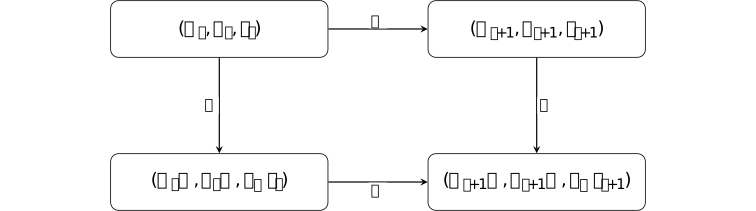
Commutation is stronger than equality of the scalar losses before the step. It states equality of the represented product trajectory after aligning the parameter bases.
Remark. Product symmetry is larger than the isometric gauge [ftip-00B5]AGENTDRAFTED
Remark. Product symmetry is larger than the isometric gauge [ftip-00B5]AGENTDRAFTED
The full \(\mathrm {GL}(k)\) action in Definition [ftip-00AX] preserves \(W\), but ordinary Euclidean gradients are covariant under the orthogonal specialization used in Lemma [ftip-00B1]. A theorem for \((UQ,VQ)\) must therefore not be silently promoted to every product-preserving reparameterization.
The source calls the orthogonal subgroup the gauge in its optimizer classification while also noting the larger function-preserving group. These are compatible statements only when their different geometric scopes remain explicit.
Equivariant and basis-sensitive update rules [ftip-00B6]AGENTDRAFTED
Equivariant and basis-sensitive update rules [ftip-00B6]AGENTDRAFTED
Gradient covariance supplies a test for update rules. Linear and full-matrix operations can commute with a latent rotation, whereas a fixed nonlinear map applied separately to coordinates selects a preferred basis.
Definition. Memoryless right-equivariant update [ftip-00B7]AGENTDRAFTED
Definition. Memoryless right-equivariant update [ftip-00B7]AGENTDRAFTED
A memoryless factor-update map is a function \(\Phi :\mathbb R^{n\times k}\to \mathbb R^{n\times k}\) applied to a current gradient \(G\) without a persistent optimizer state. It is right-equivariant when
\[ \Phi (GQ)=\Phi (G)Q \qquad (G\in \mathbb R^{n\times k},\ Q\in \mathrm O(k)). \]This local definition is the input of Theorem 4.5 in The loss does not see the basis, but Adam does[singh2026lossbasis]. It does not classify stateful optimizers such as Adam.
Proposition. Gradient descent and momentum preserve the orthogonal gauge [ftip-00B8]AGENTDRAFTED
Proposition. Gradient descent and momentum preserve the orthogonal gauge [ftip-00B8]AGENTDRAFTED
Gradient descent and Polyak or Nesterov momentum are gauge-equivariant when their factor gradients, momentum buffers, schedules, and look-ahead points are transformed consistently.
Proof.
Proof.
By Lemma [ftip-00B1], \(G_t\) becomes \(G_tQ\). Gradient descent therefore sends \(U_tQ\) to \((U_t-\eta _tG_t)Q\). A momentum buffer initialized at zero and formed by linear combinations of covariant gradients transforms as \(M_tQ\); a Nesterov look-ahead point is likewise the reference look-ahead right-multiplied by \(Q\). Induction proves the claim.
Proposition 4.2(1) and its proof are in Appendix B.3 of The loss does not see the basis, but Adam does[singh2026lossbasis].
Proposition. A shared scalar second moment preserves the orthogonal gauge [ftip-00B9]AGENTDRAFTED
Proposition. A shared scalar second moment preserves the orthogonal gauge [ftip-00B9]AGENTDRAFTED
Replace Adam's entrywise second-moment denominator by one scalar whose updates depend only on gauge-invariant quantities such as the pooled mean of the squared entries of both factor gradients. With a covariant first-moment buffer, the resulting stateful update is gauge-equivariant.
Proof.
Proof.
The first moment is a linear exponential average and transforms by right multiplication by \(Q\). The pooled squared-entry mean is the joint squared Frobenius norm divided by the entry count, hence is unchanged by \(G\mapsto GQ\). Its bias correction and positive scalar denominator are unchanged, so the complete update transforms covariantly.
Proposition 4.2(2) and its proof are in Appendix B.3 of The loss does not see the basis, but Adam does[singh2026lossbasis]. The result concerns this declared shared-scalar variant, not stock Adam.
Proposition. Full-matrix Muon and Shampoo preserve the orthogonal gauge [ftip-00BA]AGENTDRAFTED
Proposition. Full-matrix Muon and Shampoo preserve the orthogonal gauge [ftip-00BA]AGENTDRAFTED
Fix one factor, write \(n\in \{d_1,d_2\}\) for its row dimension, and let \(G_t,M_t\in \mathbb R^{n\times k}\) be its gradient and Muon momentum buffer. For \(0\leq \beta <1\), \(M_{-1}=0\), and the source's linear momentum update \(M_t=\beta M_{t-1}+G_t\), Muon's direction is \(\Delta _t=\operatorname {msign}(M_t)\). Under real arithmetic this stateful update and the source's damped Shampoo update are right-equivariant. The Muon claim includes the stated finite Newton--Schulz approximations; the Shampoo claim uses its complete left and right accumulators.
Proof.
Proof.
By Lemma [ftip-00B1], the primed gradient is \(G'_t=G_tQ\). Starting from \(M'_{-1}=M_{-1}Q=0\), induction through the linear momentum update gives \(M'_t=M_tQ\). If \(M_t=A\Sigma B^{\mathsf T}\) is a compact singular-value decomposition, then \(M_tQ=A\Sigma (Q^{\mathsf T}B)^{\mathsf T}\), so \(\operatorname {msign}(M_tQ)=\operatorname {msign}(M_t)Q\). For \(\epsilon _{\rm NS}>0\), the Newton--Schulz initialization \(X_0=M_t/(\lVert M_t\rVert _F+\epsilon _{\rm NS})\) is covariant because its Frobenius normalization is invariant; each polynomial iterate formed from \(X_j\) and \(X_jX_j^{\mathsf T}\) preserves the same covariance. For Shampoo, the left accumulator is invariant while the right accumulator transforms by \(R_t\mapsto Q^{\mathsf T} R_t Q\). Orthogonal functional calculus conjugates the right matrix function, so the transformed update is the original update right-multiplied by \(Q\).
Proposition 4.2(3)--(4) and its proof are in Appendix B.3 of The loss does not see the basis, but Adam does[singh2026lossbasis]. Variable splitting, coordinatewise clipping, mixed update rules, finite precision, and different damping conventions lie outside this statement. The Muon part is stateful; it does not replace the momentum buffer by the current gradient or invoke the memoryless classification of Definition [ftip-00B7].
Proposition. Coordinatewise equivariance forces linearity [ftip-00BB]AGENTDRAFTED
Proposition. Coordinatewise equivariance forces linearity [ftip-00BB]AGENTDRAFTED
Let \(k\geq 2\) and let a memoryless update have the fixed entrywise form \(\Phi (G)_{ij}=\phi (G_{ij})\). If \(\Phi (GQ)=\Phi (G)Q\) for every \(G\) and \(Q\in \mathrm O(k)\), then \(\phi (x)=cx\) for some \(c\in \mathbb R\).
Proof.
Proof.
It suffices to use one row and rotations in the first two coordinates. Equivariance at zero gives \(\phi (0)=0\). Rotating \((x,0)\) through an angle whose cosine is \(a\in [-1,1]\) gives \(\phi (ax)=a\phi (x)\). For nonzero \(x,y\), compare each with a third number of at least their absolute magnitudes; the ratio \(\phi (x)/x\) is constant.
Proposition 4.3 and its proof are in Appendix B.4 of The loss does not see the basis, but Adam does[singh2026lossbasis]. No continuity assumption is needed.
Corollary. Fixed nonlinear coordinatewise updates break the gauge [ftip-00BC]AGENTDRAFTED
Corollary. Fixed nonlinear coordinatewise updates break the gauge [ftip-00BC]AGENTDRAFTED
A nonlinear fixed entrywise update applied at a zero optimizer state is not gauge-equivariant when \(k\geq 2\). In particular, the source applies Proposition [ftip-00BB] to the first-step maps of Adam, RMSProp, signSGD, and Lion; it checks Adafactor separately because its factored statistics are not an entrywise map.
This is a first-step obstruction. It suffices to disprove equivariance of the full run, but it does not classify every later state or say that such an optimizer cannot reach a particular solution.
Definition. First-step Adam map and gauge defect [ftip-00BD]AGENTDRAFTED
Definition. First-step Adam map and gauge defect [ftip-00BD]AGENTDRAFTED
Fix \(\epsilon >0\). For zero-state, bias-corrected Adam define the entrywise first-step direction
\[ D_\epsilon (G)=G\mathbin {\oslash }(|G|+\epsilon ) \]and, for \(Q\in \mathrm O(k)\), define its gauge-aligned defect by
\[ E_Q(G)=D_\epsilon (GQ)Q^{\mathsf T}-D_\epsilon (G). \]Here \(|G|\), addition, and division are entrywise. Bias correction makes the first direction independent of Adam's two decay coefficients under the declared convention [singh2026lossbasis, Proposition 4.4].
Proposition. Exact represented-matrix defect after one Adam step [ftip-00BE]AGENTDRAFTED
Proposition. Exact represented-matrix defect after one Adam step [ftip-00BE]AGENTDRAFTED
Let \(G_U=\nabla _UL(U_0,V_0)\), \(G_V=\nabla _VL(U_0,V_0)\), \(D_U=D_\epsilon (G_U)\), and \(D_V=D_\epsilon (G_V)\). Let \(W_1\) be the product after one Adam step from \((U_0,V_0)\) and \(\widetilde W_1\) the product after one step from \((U_0Q,V_0Q)\). Then
\[ \begin {aligned} \widetilde W_1-W_1={}&-\eta \bigl (E_Q(G_U)V_0^{\mathsf T} +U_0E_Q(G_V)^{\mathsf T}\bigr )\\ &+\eta ^2\bigl (E_Q(G_U)D_V^{\mathsf T} +D_UE_Q(G_V)^{\mathsf T} +E_Q(G_U)E_Q(G_V)^{\mathsf T}\bigr ). \end {aligned} \]
Proof.
Proof.
Gauge-align the rotated factors back by \(Q^{\mathsf T}\). They are \(U_0-\eta (D_U+E_Q(G_U))\) and \(V_0-\eta (D_V+E_Q(G_V))\). Multiply, subtract \((U_0-\eta D_U)(V_0-\eta D_V)^{\mathsf T}\), and collect powers of \(\eta \).
Proposition 4.4 and its proof are in Appendix B.5 of The loss does not see the basis, but Adam does[singh2026lossbasis].
Example. A two-coordinate Adam defect witness [ftip-00BF]AGENTDRAFTED
Example. A two-coordinate Adam defect witness [ftip-00BF]AGENTDRAFTED
Take \(d_1=d_2=1\), \(k=2\), \(f(w)=w^2/2\), \(U_0=V_0=(1,0)\), and
\[ Q=2^{-1/2}\begin {pmatrix}1&1\\-1&1\end {pmatrix}. \]The original and rotated products after one zero-state Adam step are
\[ W_1=\left (1-\frac {\eta }{1+\epsilon }\right )^2, \qquad \widetilde W_1=\left (1-\frac {\eta }{2^{-1/2}+\epsilon }\right )^2. \]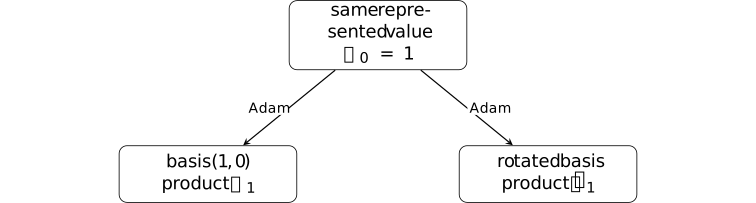
They differ when \(0<\eta <2^{-1/2}+\epsilon \). This is the explicit witness in Proposition 4.4 of The loss does not see the basis, but Adam does[singh2026lossbasis]; it is a statement about one factored quadratic, not about language-model performance.
Example. A rotated sign update fails to commute [ftip-00BG]AGENTDRAFTED
Example. A rotated sign update fails to commute [ftip-00BG]AGENTDRAFTED
For \(G=(1,1)\) and the 45-degree rotation matrix \(Q\) of Example [ftip-00BF], one has \(GQ=(0,\sqrt 2)\). With \(\operatorname {sign}(0)=0\),
\[ \operatorname {sign}(GQ)=(0,1), \qquad \operatorname {sign}(G)Q=(0,\sqrt 2). \]Thus even this two-coordinate update violates the commuting equation in Definition [ftip-00B7]. The calculation is the explicit Appendix B.4 witness of The loss does not see the basis, but Adam does[singh2026lossbasis].
Theorem. Full-rank memoryless equivariant rules are Gram-determined [ftip-00BH]AGENTDRAFTED
Theorem. Full-rank memoryless equivariant rules are Gram-determined [ftip-00BH]AGENTDRAFTED
Let \(k\leq n\), and let \(\Phi \) be defined on full-column-rank matrices \(G\in \mathbb R^{n\times k}\). Then \(\Phi (GQ)=\Phi (G)Q\) for every \(Q\in \mathrm O(k)\) if and only if there is a matrix-valued function \(H\) of \(GG^{\mathsf T}\) such that
\[ \Phi (G)=H(GG^{\mathsf T})G. \]
Proof.
Proof.
The displayed form is immediately equivariant. Let \(G^+\) denote the Moore--Penrose pseudoinverse. Conversely, set \(X(G)=\Phi (G)G^+\). Then \(X(G)G=\Phi (G)\) and \(X(GQ)=X(G)\). Two full-column-rank matrices with the same left Gram matrix have the same range and differ by a right orthogonal factor. Hence \(X(G)\) depends only on \(GG^{\mathsf T}\); take \(H=X\).
See Theorem 4.5 and its proof in Appendix B.6 of The loss does not see the basis, but Adam does[singh2026lossbasis]. It classifies the full-rank stratum only.
Corollary. The square invertible preconditioner representation [ftip-00BI]AGENTDRAFTED
Corollary. The square invertible preconditioner representation [ftip-00BI]AGENTDRAFTED
In the specialization \(k=n\) with \(G\) invertible, let \(P^{1/2}\) denote the unique positive-definite square root of \(P\). The function in Theorem [ftip-00BH] has the unique canonical representative
\[ H(P)=\Phi (P^{1/2})P^{-1/2}, \qquad P=GG^{\mathsf T}>0. \]
Proof.
Proof.
The polar decomposition writes \(G=P^{1/2}Q\). Equivariance gives \(\Phi (G)=\Phi (P^{1/2})Q=H(P)G\). Evaluating at \(G=P^{1/2}\) proves uniqueness in this square invertible case.
For rectangular \(G\), the action of \(H(P)\) away from the range needed to multiply \(G\) is not determined by \(\Phi \). The proof above establishes uniqueness in the square invertible specialization.
Remark. What the structure theorem leaves unresolved at rank deficiency [ftip-00BJ]AGENTDRAFTED
Remark. What the structure theorem leaves unresolved at rank deficiency [ftip-00BJ]AGENTDRAFTED
In the ambient matrix space, full-column-rank matrices form an open dense subset whose complement has Lebesgue measure zero. A probability-one claim requires the random gradient law to be absolutely continuous and not confined to a lower-rank set; random initialization alone does not supply that premise.
Theorem [ftip-00BH] therefore makes no classification claim on a general rank-deficient stratum. Equivariance still constrains values within each orthogonal orbit, and it forces \(\Phi (0)=0\), but it does not determine the rule there by continuity unless continuity is separately assumed. The source's generic-rank discussion therefore does not establish a classification at rank deficiency.
Common-scalar flows, clock changes, and momentum [ftip-00BK]AGENTDRAFTED
Common-scalar flows, clock changes, and momentum [ftip-00BK]AGENTDRAFTED
One narrow class of continuous-time preconditioners follows the gradient-flow path at a different speed. The clock change transfers path properties, but not rates, and it does not encompass a stateful momentum method.
Definition. Common-scalar preconditioned flow [ftip-00BL]AGENTDRAFTED
Definition. Common-scalar preconditioned flow [ftip-00BL]AGENTDRAFTED
Let \(\theta =(U,V)\) and let \(a(t)>0\) be measurable with \(1/a\) locally integrable. A common-scalar preconditioned flow is a locally absolutely continuous trajectory satisfying
\[ \dot \theta (t)=-\frac {\nabla L(\theta (t))}{a(t)} \]for almost every \(t\). The same scalar multiplies every coordinate of both factor gradients. For gauge-uniform conclusions, the source additionally requires \(a(t)\) to be determined by gauge-invariant statistics of the trajectory up to time \(t\).
Definition. Effective optimizer clock [ftip-00BM]AGENTDRAFTED
Definition. Effective optimizer clock [ftip-00BM]AGENTDRAFTED
For the flow of Definition [ftip-00BL], define the effective optimizer clock
\[ \tau (t)=\int _0^t\frac {du}{a(u)}, \qquad \tau _{\max }=\int _0^\infty \frac {du}{a(u)}, \qquad 0<\tau _{\max }\leq \infty . \]The clock is strictly increasing on its domain. If \(\tau _{\max }=\infty \), it reaches every gradient-flow time; otherwise it traverses only the prefix with effective time below \(\tau _{\max }\).
Theorem. Common-scalar flow is a time-reparameterized gradient flow [ftip-00BN]AGENTDRAFTED
Theorem. Common-scalar flow is a time-reparameterized gradient flow [ftip-00BN]AGENTDRAFTED
Let \(\theta (t)\) satisfy Definition [ftip-00BL], let \(t(\tau )\) be the inverse of the clock in Definition [ftip-00BM], and put \(\widetilde \theta (\tau )=\theta (t(\tau ))\). Then, for almost every \(\tau \),
\[ \widetilde \theta '(\tau )=-\nabla L(\widetilde \theta (\tau )). \]
Proof.
Proof.
The chain rule for absolutely continuous changes of variable gives \(dt/d\tau =a(t)\) almost everywhere. Multiplying \(\dot \theta =-\nabla L/a(t)\) by \(dt/d\tau \) yields the displayed gradient flow.
See Theorem 4.6 and its proof in Appendix B.9 of The loss does not see the basis, but Adam does[singh2026lossbasis]. Gauge invariance of \(a\) is not needed for this single-trajectory clock identity; it makes the clock common across a gauge orbit.
Corollary. Transfer of path and limit properties [ftip-00BO]AGENTDRAFTED
Corollary. Transfer of path and limit properties [ftip-00BO]AGENTDRAFTED
Every property depending only on the portion of the gradient-flow path traversed before \(\tau _{\max }\) transfers to the common-scalar flow. If \(\tau _{\max }=\infty \) and gradient flow converges, both flows have the same limit point. A sufficient condition for clock divergence is an eventual finite upper bound on \(a(t)\).
For shallow factorization, the source cites Implicit regularization in matrix factorization[gunasekar2017implicit]. For deep factorization, it cites Implicit regularization in deep matrix factorization[arora2019implicit]. For greedy low-rank dynamics, it cites Towards resolving the implicit bias of gradient descent for matrix factorization: Greedy low-rank learning[li2021greedy].
Those conclusions transfer only when both this clock theorem and every hypothesis of the original result hold. This corollary supplies no missing matrix-sensing assumption.
Remark. Rates and hitting times do not survive time reparameterization [ftip-00BP]AGENTDRAFTED
Remark. Rates and hitting times do not survive time reparameterization [ftip-00BP]AGENTDRAFTED
Two flows can traverse the same curve with arbitrarily different physical clocks. A convergence rate, finite-step budget, or hitting time stated in \(t\) therefore does not transfer through Theorem [ftip-00BN] without quantitative bounds on \(a\) and its integral. If \(\tau _{\max }<\infty \), even the tail and limit of the gradient-flow path are not reached.
Remark. Scalar-Adam is outside the common-scalar flow theorem [ftip-00BQ]AGENTDRAFTED
Remark. Scalar-Adam is outside the common-scalar flow theorem [ftip-00BQ]AGENTDRAFTED
The shared-scalar Adam variant in Proposition [ftip-00B9] retains a first-moment exponential moving average. It is stateful and is not the memoryless flow in Definition [ftip-00BL]. Remark 4.7 of The loss does not see the basis, but Adam does[singh2026lossbasis] treats its agreement with gradient flow as empirical rather than as a consequence of Theorem 4.6.
The theorem likewise does not apply to discrete Adam, PPO, RLVR update loops, clipping, weight decay, and mixed optimizers. Gauge equivariance and time reparameterization are separate properties.
Example. Equivariance neither guarantees nor precludes recovery [ftip-00BR]AGENTDRAFTED
Example. Equivariance neither guarantees nor precludes recovery [ftip-00BR]AGENTDRAFTED
The source records controls on both sides of the proposed implication. Its ScaledGD-inspired control is equivariant but equalizes the spectral schedule and does not recover the planted low-rank target at the declared budget. A long-anneal sign update is non-equivariant but eventually reaches a low-recovery-error regime.
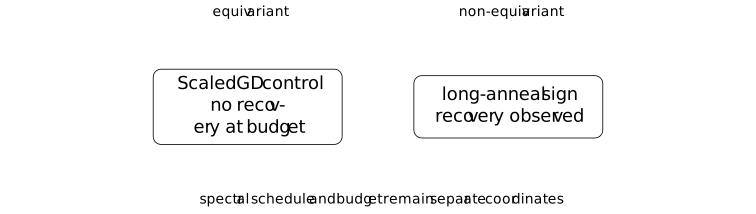
The controls are reported in Remark 4.7 and Appendix D.10 of The loss does not see the basis, but Adam does[singh2026lossbasis]. The source reports no tuned reproducibility baseline for the ScaledGD control. The diagram is not a convergence theorem.
Optimizer geometry in training interventions [ftip-00BS]AGENTDRAFTED
Optimizer geometry in training interventions [ftip-00BS]AGENTDRAFTED
Equivalent parameterizations need not follow equivalent training trajectories. Their evolution also depends on the update geometry; the scalar loss and represented starting object do not always suffice.
Definition. Objective-equivalent parameterizations [ftip-00BT]AGENTDRAFTED
Definition. Objective-equivalent parameterizations [ftip-00BT]AGENTDRAFTED
Two factor pairs \((U,V)\) and \((\widetilde U,\widetilde V)\) are objective-equivalent for \(L=f\circ W\) when
\[ W(U,V)=W(\widetilde U,\widetilde V). \]They then have the same scalar loss for every objective depending only on that represented matrix. Orthogonal gauge-related pairs are objective-equivalent by Lemma [ftip-00AY]; objective equivalence need not imply membership in the same orthogonal orbit.
Definition. Parameterization-stable training intervention [ftip-00BU]AGENTDRAFTED
Definition. Parameterization-stable training intervention [ftip-00BU]AGENTDRAFTED
Fix a factorized objective, an update algorithm, hyperparameter schedule, randomness coupling, stopping rule, and initial optimizer state. The resulting training intervention is parameterization-stable on an orthogonal orbit when every two gauge-related initial states have identical represented trajectories:
\[ \widetilde U_t\widetilde V_t^{\mathsf T}=U_tV_t^{\mathsf T} \qquad \hbox {at every compared step }t. \]This is a local stability property of a fully declared intervention. It does not say that arbitrary objective-equivalent pairs outside the orbit must agree.
Proposition. Gauge equivariance gives parameterization stability [ftip-00BV]AGENTDRAFTED
Proposition. Gauge equivariance gives parameterization stability [ftip-00BV]AGENTDRAFTED
Every gauge-equivariant optimizer is parameterization-stable on each orthogonal orbit, provided the remaining protocol coordinates are coupled as in Definition [ftip-00BU].
Proof.
Proof.
Definition [ftip-00B3] gives \((\widetilde U_t,\widetilde V_t)=(U_tQ,V_tQ)\). Hence
\[ \widetilde U_t\widetilde V_t^{\mathsf T} =U_tQQ^{\mathsf T}V_t^{\mathsf T}=U_tV_t^{\mathsf T}. \]This is a sufficient condition on a declared orbit, not a claim that equivariance is necessary for every possible equality of represented trajectories.
Proposition. A first-step defect falsifies a loss-only protocol specification [ftip-00BW]AGENTDRAFTED
Proposition. A first-step defect falsifies a loss-only protocol specification [ftip-00BW]AGENTDRAFTED
Suppose two orthogonally gauge-related initializations have equal represented object and scalar objective, but a declared update produces different represented objects after one step. Then the training intervention is not determined by the represented initialization and scalar objective alone.
Proof.
Proof.
If those two objects determined the intervention, equal inputs would give the same represented next state. The witnessed inequality contradicts that factorization.
Proposition Proposition [ftip-00BE] and Example [ftip-00BF] instantiate its premise for one factored quadratic and zero-state Adam. It proves underspecification, not a capability difference.
Example. The orthogonal gauge of an attention head [ftip-00BX]AGENTDRAFTED
Example. The orthogonal gauge of an attention head [ftip-00BX]AGENTDRAFTED
For the row-vector attention weights of Definition [ftip-000P], let \(W^Q,W^K\in \mathbb R^{d\times d_h}\) and \(Q_h=XW^Q\), \(K_h=XW^K\). Attention logits depend on these weights through
\[ Q_hK_h^{\mathsf T}=XW^Q(W^K)^{\mathsf T}X^{\mathsf T}. \]For \(A\in \mathrm O(d_h)\), the right action \((W^Q,W^K)\mapsto (W^QA,W^KA)\) preserves the middle product.

Section 6 of The loss does not see the basis, but Adam does[singh2026lossbasis] uses column-vector weights and the invariant \(W_Q^{\mathsf T}W_K\). Transposition gives the row-vector invariant \(W^Q(W^K)^{\mathsf T}\), with the action on the right as displayed.
Remark. What the attention-twin experiment observes [ftip-00BY]AGENTDRAFTED
Remark. What the attention-twin experiment observes [ftip-00BY]AGENTDRAFTED
Section 6 and Table 3 of The loss does not see the basis, but Adam does[singh2026lossbasis] compare two function-equivalent initializations of a two-layer, four-head transformer on modular addition. The reported relative logit distance after one Adam step is \(3.6\times 10^{-3}\), versus \(2.9\times 10^{-7}\) for a same-basis noise twin; the final per-head invariant distance is reported as 56 percent.
The exact first-step defect has an algebraic explanation, but later drift, scale robustness, and downstream behavior are empirical. The tested small transformers, precision, optimizer allocation, seeds, and task do not establish a frontier-wide law.
Example. One loss quotient and two optimizer trajectories [ftip-00BZ]AGENTDRAFTED
Example. One loss quotient and two optimizer trajectories [ftip-00BZ]AGENTDRAFTED
A loss-only description collapses a gauge orbit to one represented starting point. A basis-sensitive optimizer can split that quotient back into different represented trajectories.
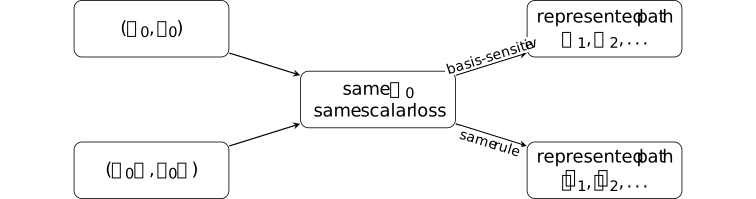
The right-hand split is possible only because the centre box omits the factor basis and optimizer geometry. An FTIP admissible protocol in Definition [ftip-005J] must retain those intervention coordinates when they affect the executable result.
Remark. Product symmetry and the scope of optimizer conclusions [ftip-00C0]AGENTDRAFTED
Remark. Product symmetry and the scope of optimizer conclusions [ftip-00C0]AGENTDRAFTED
The relevant optimizer results appear in version 1 of [⧉], submitted 5 August 2026: Sections 3--4 and 6, Appendices B.1--B.6 and B.9, with limitations in Section 11.
The full product symmetry acts on the factors by
\[ (U,V)\longmapsto (UA,VA^{-\mathsf T}). \]It does not use \((UA,VA)\). For row-vector attention weights, the corresponding action uses right multiplication, as in Example [ftip-00BX].
The general rectangular preconditioner representation need not have the square-case uniqueness. A probability-one full-rank claim additionally needs a law for the gradient; a generic full-rank observation does not specify one.
The coordinatewise theorem is a zero-state, memoryless obstruction. The clock theorem is continuous-time and excludes scalar-Adam's momentum. Experimental optimizer and attention results remain observations reported by the source. Equivariance is not identified with low-rank recovery.
Remark. Continuous-flow conclusions and discrete optimization [ftip-00C1]AGENTDRAFTED
Remark. Continuous-flow conclusions and discrete optimization [ftip-00C1]AGENTDRAFTED
The factored-model results prove that update geometry can be a genuine intervention coordinate even when objective and represented initialization are fixed. They do not prove transformer or RLVR convergence, practical optimizer superiority, a scaling law, or any change in reliable capability. Different represented trajectories are not by themselves an acquisition witness of Definition [ftip-005X].
The memoryless theorem does not describe Adam's full state, and the continuous-flow result does not supply discrete rates or finite-step bounds. The source also notes that fixed-rank LoRA changes the learned-rank mechanism; no LoRA transfer is made here.
A dynamic-compute comparison also depends on active research state, persistent harness state, retained history, evaluation configuration, and descendant and retry costs. One realized chain and an archive-best envelope are different outcomes, even at the same declared budget.
Conceptual discovery across model generations [ftip-00MH]AGENTDRAFTED
Conceptual discovery across model generations [ftip-00MH]AGENTDRAFTED
The preceding chapters specify the model and learning mechanisms, retained agent state, evaluation and costs, with architecture-dependent refinements when needed. This chapter combines them in a question about capability growth across successive learned artifacts.
A mathematical breakthrough may require a new representation, a useful invariant, or a connection to another domain. The question is whether a specified model lineage can discover and acquire that structure within its resources, including by improving its own search and training procedures. An external contribution might make the same capability affordable.
This is a proposed separation between complete processes. A plateau in one training recipe does not establish it. Nor does the size of unexplored mathematics imply that current architectures can only recombine a fixed stock of ideas. Useful structure may be generated implicitly by updates, through analogy, or by programs constructed during the campaign.
The acquisition question in Definition [ftip-0007] therefore extends across successive learned artifacts. The finite discovery estimates of § [ftip-0076] apply only when their probability premises cover that evolving process. The finite controller certificate in § [ftip-00M8] illustrates an upper-bound method for a fully specified action class.
The complete lineage and its resources [ftip-00MI]AGENTDRAFTED
The complete lineage and its resources [ftip-00MI]AGENTDRAFTED
The comparison starts from disclosed artifacts and executable operations. A lineage includes the models it trains, the controllers it writes, and the evidence it retains. Its limits cannot be inferred from the support of one initial decoder while allowing the rest of the system to change.
Definition. A resource-bounded model lineage [ftip-00MJ]AGENTDRAFTED
Definition. A resource-bounded model lineage [ftip-00MJ]AGENTDRAFTED
Fix a specification
\[ \Xi =(I_0,\mathcal C_0,\Gamma ,\mathcal E_0,V, \mathcal D,\mathcal F,\mathbf B,\mathbf b_{\mathrm {eval}}). \]Here \(I_0\) contains the initial models, corpora, libraries, prompts, optimizers, evaluators, software and cached results. The nonempty class \(\mathcal C_0\) specifies controller programs and constants available from \(I_0\); it does not grant an arbitrary program chosen after a discovery. An initial generator of additional controllers is allowed, with its generation and selection work charged as explained in Convention [ftip-00N6]. The semantics \(\Gamma \) specifies executable operations and costs; \(\mathcal E_0\) specifies baseline observations and tool-response laws. The checker \(V\), task law and reveal schedule \(\mathcal D\), allowed final artifacts \(\mathcal F\), campaign cap \(\mathbf B\) and deployment cap \(\mathbf b_{\mathrm {eval}}\) are fixed before evaluation. Include the no-update procedure as a baseline.
A campaign is a causal execution starting from this endowment. Its state contains available checkpoints, contexts, generated code, retained traces, libraries, optimizer state and resource usage. A controller may use only its charged accessible state: discarded history must be reconstructed at cost. Environment state may remain hidden. All random seeds follow their declared laws; a fortunate completed trajectory is not an available program.
Whenever admitted by \(\Gamma \), operations include model inference, proof and program search, tool calls, parallel workers, memory management, candidate comparison, reward and credit assignment, synthetic tasks, parameter training, architecture changes, and controller replacement. Generated controllers execute under the same semantics and caps. Selection, evaluation and the controller's own computation are charged. These operations may recur in any order; learning need not first produce a complete successful trace or an explicitly verbalized idea.
The lineage is closed relative to \((I_0,\mathcal E_0)\) when its only campaign inputs are scheduled tasks, its randomness and admitted environment responses. This allows computation to reveal useful structure. A simulator using independent randomness is different from a tool observing new hidden world state; the latter access belongs in \(\mathcal E_0\).
Controller selection is independent of unrevealed instance seeds, conditional on declared public family information. This alone does not exclude family-wide answer tables: all such constants and preprocessing belong in \(I_0\). An asymptotic claim specifies uniform generation across instance sizes or explicitly accounts for nonuniform advice and preparation.
Definition. Hard resource accounting across generations [ftip-00MK]AGENTDRAFTED
Definition. Hard resource accounting across generations [ftip-00MK]AGENTDRAFTED
For a realized campaign \(\zeta \), let \(\mathbf R(\zeta )\) record inference work, training work, tool and checker work, total accelerator time, peak live memory and storage, peak allocated hardware, wall time and money under the declared operational model. Admission requires
\[\mathbf R(\zeta )\preceq \mathbf B\quad \text {almost surely}.\]Stop before an unaffordable operation; a missing result scores zero. Charge every failed path, discarded trace, evaluator call, consultation, checkpoint comparison and update. Bound the number of transitions by charged elementary work or an explicit finite horizon: infinitely many free operations are not admitted.
For additive work coordinates, a portfolio costs shared development plus the sum of task-specific work. Shared training is charged once even when it benefits many tasks. Peak resources and elapsed time come from the actual joint schedule, including communication and sequential dependencies. Parallel work is summed across workers. An expected-cost bound does not replace this hard cap.
A scalar budget \(B\) is used only after choosing one resource or a declared conversion with the remaining constraints fixed. Human time, accelerator work and elapsed time have no implicit exchange rate. Model pretraining and contributor expertise may be disclosed sunk endowments in a marginal comparison. A lifetime-cost claim must also account for producing both; unknown historical costs remain unknown.
Discovery and acquired capability [ftip-00ML]AGENTDRAFTED
Discovery and acquired capability [ftip-00ML]AGENTDRAFTED
A contribution can help solve a current problem without becoming a reusable ability. Discovery and acquisition are therefore separate outcomes, both evaluated against a fixed mathematical truth contract.
Definition. Signed discovery and fresh-task acquisition [ftip-00MM]AGENTDRAFTED
Definition. Signed discovery and fresh-task acquisition [ftip-00MM]AGENTDRAFTED
Fix the statement translation, allowed axioms, formal library and certificate checker \(V\). An answer is a sign \(\sigma \in \{+,-\}\) and a certificate \(p\). Put \(s_V(x,(\sigma ,p))=1\) when \(V\) accepts \(p\) as a proof of \(x\) for sign \(+\), or of \(\neg x\) for sign \(-\); otherwise put \(s_V=0\). The failure output \(\bot \) scores zero. A proof of excluded middle without either signed certificate does not solve the task. A task family may assume one signed certificate exists; independence from the allowed axioms is otherwise a separate source of failure.
For a current portfolio \(x_1,\ldots ,x_n\) with fixed nonnegative weights \(w_i\) summing to one, a campaign \(P\) has discovery score
\[Q_{\mathrm {disc}}(P)=\mathbb E\sum _{i=1}^n w_i s_V(x_i,P_i).\]For one fixed conjecture use a singleton portfolio; its truth need not be randomized. The expectation includes the declared task and execution randomness, with no assumption of independent attempts.
After development, freeze an artifact \(A\in \mathcal F\cup \{\bot \}\) before revealing fresh problems \(x'_1,\ldots ,x'_m\), where \(m\geq 1\). Their identities and solutions are unavailable during development; they are conditionally independent of development draws given the declared task-family variable. With a fixed deployment procedure \(\mathrm {Deploy}\), define
\[ Q_{\mathrm {acq}}(P)=\mathbb E\frac 1m\sum _{j=1}^m s_V(x'_j,\mathrm {Deploy}(A,x'_j;\mathbf b_{\mathrm {eval}})). \]Remove contributor access and feedback into training or checkpoint selection. Any permitted adaptation within one test problem is charged and discarded before the next. Evaluation work counts in the campaign; the per-problem cap is common to both arms. Deployment of \(\bot \) fails.
For model acquisition, \(\mathcal F\) contains learned parameters or adapters with a common fixed harness. For system acquisition it may instead include a bounded acquired library or controller. State which is measured. The pair \((Q_{\mathrm {disc}},Q_{\mathrm {acq}})\) does not allow success on one coordinate to conceal failure on the other. Imported mathematical results and new proof notation require sound translation under \(V\), including the cost of expanding and checking certificates.
Affordable complementary contributions [ftip-00MT]AGENTDRAFTED
Affordable complementary contributions [ftip-00MT]AGENTDRAFTED
The recipient is the learning system that receives and processes a contribution. Its interaction protocol specifies the permitted tools, retained state and update procedures. The contributor is the source of that contribution.
A contributor can make a representation, analogy, criticism, discriminating question or research direction affordably available to a recipient. The relevant properties are the interaction it can produce and what the recipient can make of it. Architecture, culture, expertise and developmental history can explain these properties without becoming mandatory coordinates of the abstract definition.
Availability, structural quality and realized benefit require different arguments. A familiar connection can be novel to a learner's affordable repertoire, while a surprising sentence may be useless. The existence of infinitely many possible patterns supplies neither a probability of useful help nor an unaided computational lower bound.
Definition. A causal contribution process [ftip-00MU]AGENTDRAFTED
Definition. A causal contribution process [ftip-00MU]AGENTDRAFTED
Fix the recipient specification, task family, reveal schedule, interaction permissions and resource accounting. Abstract a contributor \(v\) by a causal interaction law, written as budget-indexed kernels
\[K_v^b(\mathrm dh\mid H).\]Here \(H\) is the history available to the contributor, \(b\) is its remaining contribution budget, and \(h\) includes the next message or failure/stop output with its joint resource record. The kernels arise from one consistent causal process under stopping: different budgets cannot be assigned unrelated ideal answers. No access to unrevealed test instances or their answers is permitted.
Two internal realizations are equivalent for this abstraction when they induce the same joint laws of transcripts, costs and stopping for every admitted recipient protocol and budget. Mathematically equivalent message contents need not be equivalent interactions: the recipient may find one encoding much easier to interpret or verify. A useful contribution may develop through several exchanges. Producing, interpreting, rejecting, correcting and learning from suggestions all consume resources.
Conditional theorems may assume properties of this interface without simulating a brain or reconstructing a civilization. An unconditional existence result additionally requires a realizable member of the assumed class, for example an executable source with disclosed initial state and costs. A controlled human protocol instead supplies empirical estimates. An arbitrary answer kernel or assumed success probability proves neither.
The target statements, truth contract, checker and reveal schedule stay fixed. Contributors may have different broad backgrounds or search biases; these endowment differences are disclosed. Relevant prior results must be justified under the target checker. A hidden target parameter or precomputed answer table is a different mechanism from conceptual insight. Equalizing all background material is an optional stronger comparison. Giving the recipient textual access to the relevant material can test whether acquiring and using the connection remains costly. Historical preparation follows the symmetric accounting convention in Definition [ftip-00MK].
Definition. Structural quality and good contributor classes [ftip-00MV]AGENTDRAFTED
Definition. Structural quality and good contributor classes [ftip-00MV]AGENTDRAFTED
Fix a development law and recipient interaction protocol \(\Pi \) before final evaluation. For development input \(D\) and resulting contribution transcript \(H_v\), choose an independently specified structural predicate \(S(D,H_v)\). Define
\[q_v=\Pr _{\Pi ,v}\bigl (S(D,H_v)\bigr ).\]A possible property is a sound reduction to a declared tractable class with bounded translation and certificate-expansion costs. A reusable invariant with a proved consequence or a curriculum satisfying a separate learning condition are other possibilities. A fallible analogy may require charged recipient completion before the property holds. The predicate is not simply that the final score improved; soundness, scope and checking costs require their own arguments. Quality is relative to this task, protocol and budget, not a universal ranking of minds.
For \(0<q_0\leq 1\), the restricted class
\[\mathcal G(q_0)=\{v\in \mathfrak V:q_v\geq q_0\}\]is legitimate. An existence theorem about a member of this class need not help every contributor outside it. Nonemptiness remains a separate obligation; choosing sources on final test outcomes does not establish pre-evaluation availability. Recruitment and screening costs are necessary when claiming an affordable procedure to find a good contributor, but mere existence does not require a population recruitment theorem.
To discuss a median, additionally declare a population law \(\mu \) on admissible contributors with measurable quality \(v\mapsto q_v\). Let \(q_{50}\) satisfy \(\mu (q_v\leq q_{50})\geq \frac 12\) and \(\mu (q_v\geq q_{50})\geq \frac 12\). Then define
\[\mathcal G_\mu (q_0)=\{v:q_v\geq \max (q_0,q_{50})\}.\]If \(q_0\leq q_{50}\), this class has at least half the population mass. If \(q_0>q_{50}\), even nonemptiness needs evidence. The median can be zero, so belonging to the upper half alone does not guarantee useful assistance. There is no default uniform law over all possible contributors, and an unattained quality supremum need not have a best contributor.
Proposition. From structural quality to acquired capability [ftip-00MW]AGENTDRAFTED
Proposition. From structural quality to acquired capability [ftip-00MW]AGENTDRAFTED
Fix one contributor and one recipient protocol with almost-sure total resource caps, including failed consultations. Let \(Z\in [0,1]\) be the realized fresh-task score of its frozen artifact with contributor access removed. Suppose, for the same joint process and remaining resources,
\[\Pr (S)\geq q_0>0,\qquad \mathbb E[Z\mid S]\geq \beta \geq 0.\]Then \(Q_{\mathrm {acq}}=\mathbb E Z\geq q_0\beta \).
Proof.
Proof.
Nonnegativity and conditional expectation give
\[\mathbb E Z\geq \mathbb E[Z\mathbf 1_S] =\Pr (S)\mathbb E[Z\mid S]\geq q_0\beta .\]No independence assumption is used. A uniform recipient guarantee for qualified transcripts and compatible development histories can establish the transfer premise, including interpretation, verification and acquisition costs. A guarantee for a different, easier message distribution cannot.
Together with a universal closed bound \(Q_{\mathrm {acq}}(P)\leq \tau ^-\) and an admissible member of \(\mathcal G(q_0)\), the strict inequality \(q_0\beta \geq \tau ^+>\tau ^-\) yields the assisted crossing in Conjecture [ftip-00MN]. The substantive obligations are affordable source quality, recipient transfer and the bound over every admitted unaided alternative. The elementary expectation inequality alone establishes none of these.
Proposition. Simulation can erase an apparent contribution advantage [ftip-00MX]AGENTDRAFTED
Proposition. Simulation can erase an apparent contribution advantage [ftip-00MX]AGENTDRAFTED
Fix a scalar accounting model with the other constraints declared. Suppose an admitted assisted campaign \((R,v)\) at total budget \(B\) has an admitted closed simulator at budget \(g(B)\). Require that the simulator can reproduce the contributor's endowment, observations and causal interaction, together with the recipient's allowed final artifact and evaluation law. All simulation work and initialization count. Then, for \(j\in \{\mathrm {disc},\mathrm {acq}\}\),
\[\sup _{P\in \mathcal L(g(B))}Q_j(P)\geq Q_j(R,v).\]
Proof.
Proof.
Couple the initial states and each successive conditional interaction using the stipulated simulator. Induction gives the same joint law of observable transcripts, final artifact and evaluated outcomes. The closed simulator therefore has the same score, and its admission places that score below the displayed supremum.
If the simulation is uniform across instance sizes with \(g(B)\leq cB\) for a fixed constant \(c\), an actual assisted procedure reaching \(\tau \) at work \(U(n)\) implies \(B_{\mathrm {closed}}(n,\tau )\leq cU(n)\). This excludes a lower bound \(L(n)\) with \(U(n)/L(n)\to 0\). Unavailable background state, observations, hardware or large simulation overhead can invalidate the premise; different origin alone does not. The argument does not assume that a language model already has an affordable simulation of a human contributor.
Admission includes discovery of any required reconstruction program from the declared initial state. A simulator written with advance knowledge of the useful representation does not satisfy this premise merely because its later execution is cheap. If the program is generated during the campaign, its generation law, failed attempts and selection costs belong in the simulation. This conditional proposition supplies no lower bound on that discovery cost; Convention [ftip-00N6] distinguishes program existence from its availability to the lineage.
Example. A human–agent exchange about conceptual discovery [ftip-00MY]AGENTDRAFTED
Example. A human–agent exchange about conceptual discovery [ftip-00MY]AGENTDRAFTED
In this exchange, the human is the contributor and the agent is the recipient: the system receiving and processing the contribution. The agent's proposals arose within an already human-directed conversation; they were not outputs of a separate unaided experiment.
- The agent proposed a resource-bounded formulation and a finite missing-evidence construction. The human rejected missing facts as the intended mechanism and described conceptual leaps across model generations: new perspectives, paradigms and connections between domains. The agent revised the target to conceptual discovery and separated prohibitive finite work from permanent unreachability using the enumeration countercheck.
- The agent specified an executable source with bounded observations. The human challenged an oracle-like abstraction, pointed to diverse cultural backgrounds and developed representations, and asked for an abstract account of what the source contributes. The agent formulated the causal contribution interface, with background differences disclosed rather than a mandatory model of a brain or lifetime.
- The human emphasized that existence of good contributors need not imply usefulness of all contributors, and suggested an upper-median restriction. The agent separated independent structural quality, class nonemptiness and recipient transfer, while showing why a median requires a population and need not have positive quality.
- The human suggested studying recursive self-improvement papers for the gap between the problems they diagnose and the portions their methods repair. The agent examined contemporary work and checked a revised primary source that narrowed stronger self-imitation claims. The resulting thesis distinguishes affordable quality, recipient acquisition and a universal unaided bound, with proof, refutation and precise obstacles all possible.
In Definition [ftip-00MU], \(H\) corresponds to the exchange so far and \(h\) to the human's next criticism, analogy or research direction. The agent's retained conversation and revised artifacts form its evolving state; reasoning, literature search and checking are its processing actions. The human did not supply a completed theorem: the assistance changed the problem representation and choice of inquiry. The observed outcome was a revised conjecture, before any fixed-target acquisition experiment. No structural-quality probability, cost advantage, held-out acquisition score or universal unaided bound was measured, so it does not establish the separation conjecture.
Conjecture. The conceptual-discovery conjecture [ftip-00MN]AGENTDRAFTED
Conjecture. The conceptual-discovery conjecture [ftip-00MN]AGENTDRAFTED
Fix the lineage specification and a separately specified admissible class \(\mathfrak V\) of contributors as in Definition [ftip-00MU]. A contributor interacts causally from its disclosed background within charged resources, without hidden target answers or unrevealed test inputs. Background knowledge may differ between arms; target statements, axioms, checker and test law remain fixed. The conjectured mechanism is making conceptual structure affordable to discover, recognize or acquire under those endowments.
Let \(\mathcal L(B)\) contain every closed campaign admitted by Definition [ftip-00MJ] under the chosen scalar cap and other fixed constraints. Let \(\mathcal A_v(B)\) contain admitted contributor–recipient campaigns, including contribution production, failed help, communication, interpretation, validation, training and evaluation in the cap. For some specified research family and initial lineage, conjecture thresholds \(0\leq \tau ^-<\tau ^+\leq 1\) and a realistic cap \(B\) such that
\[ \begin {gathered} \forall P\in \mathcal L(B),\qquad Q_{\mathrm {acq}}(P)\leq \tau ^-,\\ \exists v\in \mathfrak V,\ \exists R\in \mathcal A_v(B),\qquad Q_{\mathrm {acq}}(R)\geq \tau ^+. \end {gathered} \]This is not asserted for every task, model or budget. It allows unaided improvements below the threshold. A discovery version uses \(Q_{\mathrm {disc}}\); a joint claim requires the same assisted campaign to cross both thresholds. An abstract contributor class requires a realizable member for an unconditional existence result.
For a difficulty-indexed family and fixed \(0<\tau \leq 1\), define the closed work threshold by
\[ B_{\mathrm {closed}}(n,\tau )= \inf \{B:\sup _{P\in \mathcal L_n(B)}Q_{\mathrm {acq}}(P)\geq \tau \}, \qquad \inf \varnothing =+\infty . \]Define \(B_{\mathrm {assisted}}\) with the supremum over admissible contributors and recipients. A stronger asymptotic conjecture asks for positive functions \(L,U\) satisfying
\[ B_{\mathrm {closed}}(n,\tau )\geq L(n),\qquad B_{\mathrm {assisted}}(n,\tau )\leq U(n),\qquad \frac {U(n)}{L(n)}\longrightarrow 0. \]An operational crossing additionally requires an actual assisted procedure achieving \(\tau \) at work at most \(U(n)\) and a realistic cap \(U(n)\leq B_{\mathrm {real}}(n)<L(n)\). Suprema and infima alone need not be attained. Both inequalities remain conjectural for the intended mechanism. The proof-directed formulation in § [ftip-00N5] asks how developmental experience could yield the assisted construction and the closed lower bound.
Discovery without advance knowledge of the useful pattern [ftip-00N5]AGENTDRAFTED
Discovery without advance knowledge of the useful pattern [ftip-00N5]AGENTDRAFTED
Knowing how to construct a representation after someone identifies it is different from finding it during research. The relevant cost includes reaching a useful idea, recognizing enough of its value to act on it, and acquiring a capability that survives fresh evaluation. Each step may occur implicitly through learning; an explicit name for the idea is unnecessary.
Convention. Which discovery procedures are initially available? [ftip-00N6]AGENTDRAFTED
Convention. Which discovery procedures are initially available? [ftip-00N6]AGENTDRAFTED
The initial controller class in Definition [ftip-00MJ] is part of the endowment. It is not enlarged after an assisted discovery by inserting a program tailored to that discovery. A concrete specification can supply a finite collection of initial controllers, or an executable procedure that generates further controllers. In the latter case, generation, execution, comparison and selection occur within the campaign and consume its budget. The generator's fixed code and constants are themselves initial resources.
For example, let a campaign generate a program \(A_Z\) using a random variable \(Z\), and let its later interaction depend on the observed results. Its score averages over that declared generation and subsequent execution. Showing that one realization \(A_z\) constructs a useful representation cheaply does not show that the campaign finds that realization cheaply. Replacing the campaign by this selected program changes the initial endowment unless a legal route to its availability has been supplied.
This distinction does not forbid an ingenious algorithm. A procedure already admitted from the public task-family description is a legitimate closed alternative even if nobody has tested it. A lower bound must cover it. Conversely, a proof quantifying over all programs with arbitrary family-specific constants grants more advice than a fixed model lineage possesses. Uniformity across input sizes does not alone remove that advice: a single finite program can already contain the decisive family-wide idea. The theorem must state which controller access it grants.
An existential mathematical upper bound may describe a particular admitted program without proving that a person will discover its proof. The operational claim that a fixed lineage can acquire that program is stronger. It requires an available initial program or a charged causal construction from its accessible state. Keeping these claims distinct prevents both free advance knowledge and the exclusion of legitimate internal discoveries.
Definition. Every equally useful acquired solution [ftip-00N7]AGENTDRAFTED
Definition. Every equally useful acquired solution [ftip-00N7]AGENTDRAFTED
Fix a difficulty \(n\) and task-family parameter, the truth contract, fresh evaluation law and deployment cap of Definition [ftip-00MM]. For an allowed frozen artifact \(f\), including the failure artifact \(\bot \), let \(q_n(f)\) be its expected fresh-task score under that evaluation. The expectation includes fresh tasks and deployment randomness; set \(q_n(\bot )=0\). Evaluation begins with exactly the retained state permitted by the specification. Define
\[\mathcal U_{n,\tau }=\{f\in \mathcal F_n\cup \{\bot \}:q_n(f)\geq \tau \}.\]If the comparison randomizes a shared family parameter, apply this definition conditionally on that parameter and then average the resulting scores. This class is defined for mathematical analysis; membership need not be decidable or cheaply recognizable during research. It includes any artifact with the required performance: explicit lemmas, learned libraries, new architectures, implicit weights, and methods that avoid the contributor's representation entirely, whenever those artifacts are allowed.
For a random final artifact \(F_P\), the acquisition score is \(Q_{\mathrm {acq}}(P)=\mathbb E[q_n(F_P)]\). The desired lower bound must control this expectation for every admitted closed campaign. It cannot merely show that one named representation is unlikely to appear. Nor is a bound on reaching \(\mathcal U_{n,\tau }\) automatically a bound below \(\tau \): many outcomes just below the threshold can still have high mean score. A proposed proof must connect its event or structural quantity to the complete score distribution, as the explicit hypotheses of Proposition [ftip-00MP] illustrate.
The contributor need not transmit an entire solution. A question, analogy or example may change which experiments the recipient attempts. The resulting interpretation, validation and learning remain charged. Acquisition is established only by the frozen recipient's performance on fresh instances; an insightful exchange by itself establishes neither that performance nor a lower bound on unaided discovery.
Remark. From absent experience to a discovery lower bound [ftip-00N8]AGENTDRAFTED
Remark. From absent experience to a discovery lower bound [ftip-00N8]AGENTDRAFTED
The proof direction is to begin with a concrete developmental asymmetry: some task-relevant experience available to a contributor is absent from the lineage's initial data and observed traces. From a specified family and computational model, derive that acquiring any equally useful capability exceeds the closed budget. The absence of that experience is a premise. The absence of every affordable substitute is the desired conclusion, and must not be included as another premise.
Three arguments are needed. A bounded developmental process must produce reusable structure with a stated probability before fresh target instances are revealed. A charged interaction and learning procedure must turn that structure into recipient capability. A lower-bound argument must cover all closed histories admitted by the initial endowment and execution semantics, including adaptive tools, simulations, generated programs, training, changed architectures and alternative representations. The first two arguments describe a constructive assisted procedure; the third establishes why the closed lineage cannot match it at the chosen resources.
A necessary-event estimate becomes useful only after the family and operations justify both its necessity and its probability bound. Assuming that every successful route requires a rare conceptual event simply moves the central difficulty into an assumption. Likewise, absence from a corpus does not imply computational inaccessibility: affordable experiments or derivations may supply a substitute. A proof must explain what the particular environment makes accessible and why the admitted closed operations cannot obtain an equally useful substitute within budget.
Both inequalities in Conjecture [ftip-00MN] remain open for the intended conceptual-discovery mechanism. The conditional transfer estimate in Proposition [ftip-00MW] and simulation proposition in Proposition [ftip-00MX] do not prove them. The research objective is a positive separation proof, beginning with a sufficiently concrete account of development, access and cost. Any restriction used to make the mathematics tractable must be visible in the claim; a result for a narrow action class does not establish a ceiling for all model lineages.
Developmental experience and affordable discovery [ftip-00N9]AGENTDRAFTED
Developmental experience and affordable discovery [ftip-00N9]AGENTDRAFTED
A contributor arrives with a history of learning. That history may have made a useful invariant, decomposition or research direction easy to recognize long before the present problem arose. The proposed mechanism is that development changes which conceptual structures become accessible at reasonable cost. Different experience alone does not prove this effect.
The first comparison can isolate environment while holding the learning architecture fixed. This is a mathematical control, not a claim that human brains and current models have identical capabilities. A useful result under that control would not require architectural superiority.
Definition. A contributor produced by bounded development [ftip-00NA]AGENTDRAFTED
Definition. A contributor produced by bounded development [ftip-00NA]AGENTDRAFTED
Specify a developmental process by an architecture, initial state, learning and action rules, an environment response law, and hard resource caps. The process generates an interaction history and a retained state \(Z\); from that state it induces a contributor \(v_Z\) of Definition [ftip-00MU]. States include learned parameters, habits, libraries and memories. Their existence must follow from the declared development, rather than from choosing an arbitrary helpful state after seeing the evaluation.
An initial library or teacher may already embody earlier learning. Treat that preparation as a disclosed inherited endowment, or include a bounded process producing it. The controlled comparison must not credit the current environment with structure already present before development begins.
Development may include other learners, teachers, language, tools and related tasks. Their response laws and relevant preparation are part of the specification. The source's developmental randomness, failed learning and failed contributions remain in the joint score distribution. An existence claim can supply one explicit developmental process with a proved quality guarantee. Selecting a lucky realized graduate is different: an affordable selection procedure must account for screening and failures, as in Definition [ftip-00MV].
A task-family parameter may be shared between development and fresh evaluation, allowing experience to be relevant. The development law and source-selection rule are fixed before final instance seeds are sampled. Conditional on the declared family parameter, those seeds are independent of development. The contributor receives neither the unrevealed instances nor their answers. Broadly useful structure acquired on earlier tasks is allowed; a secret determining the final answers is a different mechanism from the conceptual discovery sought here.
To isolate the environmental contribution, one controlled comparison starts copies with the same architecture, initial state, learning rules and development caps, then varies only their environmental access. This can establish an environmental effect for those processes. The lower-bound claim is stronger: it must still cover every closed campaign admitted by Definition [ftip-00MJ], rather than only the one control learner used in that comparison. Architecture, initial artifacts and permitted learning changes must remain explicit when moving from this control to a human–model study.
Remark. Experience coverage and computational accessibility [ftip-00NB]AGENTDRAFTED
Remark. Experience coverage and computational accessibility [ftip-00NB]AGENTDRAFTED
The starting asymmetry concerns available experience: the lineage's initial corpora, memories and recorded traces do not contain some relevant part of the contributor's development. Literal absence is only a weak condition. Another description, a simulation, a derivation or a different experience may make an equally useful capability affordable. The claim in Remark [ftip-00N8] is to derive a bound covering these substitutes.
Three kinds of access should be distinguished. A stored trace gives particular observations and actions. Interactive access lets a learner choose actions based on its current state and receive the corresponding responses. Access to an executable environment model permits simulations, subject to the cost and fidelity of that model. None is automatically identical to either other kind: a finite trace need not determine responses to untried actions, while an accurate model can sometimes replace direct experience. Declare what the baseline actually has.
If environmental responses reveal a hidden bit that fixes the target answer, an information bound may be possible, but it proves a different mechanism. For conceptual discovery, retain a common mathematical truth contract and ask how development reveals reusable ways to search, represent or reason. The baseline may already contain enough information to compute the answer in principle. The proposed gap concerns the resources required to find and acquire an effective method.
A compact description of the acquired structure need not imply a cheap route to it. Description length, execution cost after identification, and discovery cost are different quantities. Conversely, declaring the structure absent from all affordable computations would assume the desired conclusion. Its inaccessibility must follow from the concrete task family, the supplied endowment and the admitted operations. Tools and simulations are charged operations within that argument, not an additional process outside the comparison.
Remark. Human and model growth as interacting learning processes [ftip-00NC]AGENTDRAFTED
Remark. Human and model growth as interacting learning processes [ftip-00NC]AGENTDRAFTED
A realistic comparison needs more than the contrast between a person who grows and a model that reads text. Human experience is selective and changes with the learner's actions and abilities. Models also inherit large bodies of human-produced data and can learn from video, interaction, feedback, generated tasks and earlier model generations. The relevant asymmetry is the particular developmental access and retained structure available in the specified comparison.
Smith and colleagues' 2018 review, The developing infant creates a curriculum for statistical learning, describes head-camera and eye-tracking evidence that infants' visual inputs change with posture, mobility and object manipulation. It proposes that these changing inputs can support a developmental curriculum. The authors leave the causal benefit of particular ordering and its relation to learning mechanisms as research questions. This motivates modelling learner-dependent experience; it does not establish an adult mathematical advantage or a lower bound for artificial learners.
Artificial learning already combines different forms of experience. In V-JEPA 2, Assran and colleagues pretrain visual representations on large-scale video, then train an action-conditioned predictor with robot interaction trajectories. The result supports planning for evaluated manipulation tasks. The relevant lesson is that recorded observations, action information and learned simulation can play different roles within one model's development. These results do not by themselves concern mathematical concept discovery.
The SIMA 2 report of November 2025 describes learning in new game environments using self-generated experience, with Gemini supplying tasks and estimated rewards, after initial learning from demonstrations. This is an example of a model lineage gaining skills through further interaction. Its teacher, environment access and retained experience belong in the baseline when available. The reported remaining difficulties with long tasks and memory are properties of that system, not universal limits of model growth.
These observations suggest comparing concrete interventions: preserve or shuffle a developmental sequence; provide selected traces or interactive access; add a bounded teacher; allow the lineage to design its own curriculum. Fix total resources and evaluate fresh-task acquisition after removing help. Such comparisons can identify which experience matters and guide a mathematical family. Even a large measured gap applies only to the tested procedures; proving the closed inequality still requires the broader argument in Remark [ftip-00N8].
Definition. Marginal assistance and the cost of development [ftip-00ND]AGENTDRAFTED
Definition. Marginal assistance and the cost of development [ftip-00ND]AGENTDRAFTED
A marginal comparison begins with a specified pretrained lineage and an already-developed contributor. It charges the closed campaign's new search and learning, and the assisted campaign's contribution production, failed help, communication, interpretation, checking and learning. Both face the same final evaluation and resource accounting. Their prior histories are disclosed endowments. A gap here means that assistance makes new acquisition affordable from those starting states; it does not mean that producing the contributor was cheaper than producing the model.
For an additive scalar work measure, let \(D_M\) be the model lineage's prior development, \(D_C\) the contributor's prior development not already included in \(D_M\), and \(W_0(m)\), \(W_1(m)\) the closed and assisted marginal work for a specified portfolio of \(m\) tasks. With any shared preparation charged once, the corresponding lifetime totals are
\[ \begin {aligned} T_0(m)&=D_M+W_0(m),\\ T_1(m)&=D_M+D_C+W_1(m). \end {aligned} \]Thus \(W_1(m)<W_0(m)\) need not imply \(T_1(m)<T_0(m)\). Shared expertise may be amortized across a declared portfolio; one cannot divide its cost by an arbitrary number of hypothetical future beneficiaries. Human-created training data, cultural resources, teachers and infrastructure follow the same inclusion convention on both sides. Unmeasured historical costs remain unmeasured.
The full resource comparison is a vector as in Definition [ftip-00MK]. Human time and accelerator work need an explicit conversion before a scalar inequality compares them. Wall time, peak hardware and memory follow the actual schedule, including causal dependencies. A model may copy states and run many experiments in parallel; an environment may impose an interaction rate. Whether simulation or accumulated experience can remove that delay is part of the setting, not an assumed advantage for either side.
A first proof target is marginal assistance, with bounded prior development specified separately. A lifetime comparison is a stronger additional question. Even with identical architectures, environmental access and prior duration can differ; equalizing architecture alone does not equalize all costs. State whether a claimed prohibitive expense is work, money, memory or elapsed time, and give the corresponding operational cap.
Remark. Settings for a developmental separation proof [ftip-00NE]AGENTDRAFTED
Remark. Settings for a developmental separation proof [ftip-00NE]AGENTDRAFTED
A promising mathematical setting couples related developmental tasks to a fresh target family through reusable structure. The contributor must acquire that structure by a bounded process. The recipient must then learn to use it under the common checker. The central choice is a family whose structure can both explain the developmental benefit and support a lower bound over the admitted closed alternatives. The following possibilities are research directions, not established separations.
One direction is a family of transformation puzzles with public local move rules. Development offers related tasks on which a learner can experiment, notice conserved quantities or discover a compositional decomposition. Fresh tasks ask for a checked move sequence or a certificate of impossibility. The acquired method must apply to new instances, and its certificates must fit the shared checker and deployment cap. This makes the intended assistance concrete without giving the contributor unrevealed answers. The missing argument is why the closed lineage cannot affordably discover any comparably useful invariant, decomposition or direct search method from the same public rules and its admitted tools.
A second direction studies the order and interaction of developmental experience. A learner's partial understanding can determine which question or intervention makes the next relation visible. Compare that process with the available passive traces and with any interactive or simulated substitutes admitted to the closed lineage. A proof must derive the cost of obtaining enough useful experience or processing the available data; simply withholding the interaction and declaring its outputs necessary would not explain conceptual discovery. Giving the lineage the same interaction channel is a stronger comparison when the intended mechanism is the cost of choosing how to use it.
A third direction studies a contributor drawing on cumulative cultural search. Several bounded learners develop, test and teach reusable concepts across earlier tasks. A current contributor's short suggestion may transmit structure produced by that longer process. This naturally motivates a marginal advantage and an amortization calculation. A lifetime advantage additionally requires accounting for that earlier population's work and for analogous shared data, teachers and parallel search available to model lineages. Culture must be generated by the declared process; a collection of perfect hints would assume its success.
For each direction, the proof needs a quantity that can be bounded through every admitted operation and connected to fresh-task performance. Information arguments apply when there is residual uncertainty; query arguments apply to explicitly limited response interfaces; computational arguments must address the available program class and its costs. If a separation is conditional on an independent computational hardness assumption, state that assumption and exhibit the reduction. Merely renaming the desired discovery difficulty as a hardness assumption adds no explanation. Restricted models can yield useful first results, provided their restrictions are not silently transferred to contemporary agents.
The most immediate constructive target is a development process that learns a reusable invariant on one task distribution and transfers it to fresh certified tasks. Alongside that construction, seek a family-specific lower bound covering every equally useful acquired method as in Definition [ftip-00N7]. Keep the model's own discovery, simulations and learning inside this argument. Neither the construction alone nor a failed search for substitutes proves the prohibitive closed cost.
§ [ftip-00NF] develops the first direction as a representation learner whose developmental experience also teaches it to construct a useful curriculum for another recipient. The concrete objects are the grounded representation, the learned teaching policy and their fresh-task effects.
Representation discovery through developmental curricula [ftip-00NF]AGENTDRAFTED
Representation discovery through developmental curricula [ftip-00NF]AGENTDRAFTED
A useful contribution can change how a learner represents a problem and how it learns to reason in that representation. The contributor may recognize a conserved quantity, a compositional structure or a distinction missing from the learner's present vocabulary. Its curriculum then makes that structure usable by another system. This combines two acquisition problems: discovering a grounded representation and discovering experiences that teach it.
The proposed construction uses related tasks with public transformation rules. A bounded developmental learner acquires representations and teaching procedures on earlier tasks; an initially separate recipient learns from its contribution and faces fresh certified tasks. The intended gain is less total acquisition work at a fixed success threshold. The construction below specifies the mechanisms to establish that gain. A successful learning process and a lower bound over every affordable closed alternative remain mathematical obligations, not consequences of specifying the setting.
A complementary acquisition problem is deciding which representations will matter before future demands are apparent. § [ftip-00NK] studies that prospective choice through a changing public task process.
Example. Public transformations and learned representations [ftip-00NG]AGENTDRAFTED
Example. Public transformations and learned representations [ftip-00NG]AGENTDRAFTED
Consider finite expressions built from a public grammar. A family parameter \(\theta \) specifies local rewrite rules and a distribution of problem sizes and compositions. The description of \(\theta \), the grammar and the rules are available to both campaigns. A target instance asks whether one expression can be transformed into another. An accepted answer contains either a legal rewrite sequence or a proof of impossibility in a fixed sound proof system. The generator produces instances with certificates of bounded size, retains those certificates for evaluation, and reveals only the instance to the learner. The checker, allowed proof rules and certificate-size cap are identical for assisted and closed campaigns.
Public rules make the intended difficulty computational. Earlier experience may teach consequences of the rules that are expensive to find from their description. It supplies no secret governing future answers. The family parameter, development law, evaluation distribution and resource caps are fixed before final seeds are sampled. Developmental and final seeds are independent conditional on \(\theta \). Intermediate learning tasks may be simpler than final tasks, but their relation to the final distribution must be specified by the generator rather than chosen after observing a favorable test result.
One possible learned representation consists of a map \(\phi \) from concrete expressions to abstract states, abstract operations, and procedures connecting abstract reasoning to checked concrete certificates. For example, a learner may discover that several rewrites preserve a quantity, or that large expressions decompose into components with a small interface. A soundness proof for the invariant or decomposition is part of the acquired method when it is used to certify an answer. Recognizing a pattern in a few examples is insufficient. Grounding here means computing the abstract description from the supplied expression and justifying the concrete consequences used by the solver.
The map may discard distinctions. If two expressions have the same abstract description but require different choices, a successful learner can refine the representation, retain a concrete side condition, or use another level of description. The cost of discovering the counterexample and implementing the revision counts. The task family should admit several sufficient methods: another invariant, a different decomposition, a compiled solver or direct search may succeed without reconstructing \(\phi \). Success is measured by checked answers, so equally useful implicit representations in model parameters also qualify.
This is a parameterized family design, not a claimed hard rewrite system. An explicit instance of the construction must give the grammar, rules, certified generator and learning procedures, then prove their performance. Families reducible to a cheap canonical form or direct search may demonstrate learning and transfer while offering no discovery-cost separation. That possibility is a substantive test of the proposed mechanism.
Definition. Learning to discover and teach a representation [ftip-00NH]AGENTDRAFTED
Definition. Learning to discover and teach a representation [ftip-00NH]AGENTDRAFTED
The contributor begins with the disclosed state and bounded development of Definition [ftip-00NA]. On related rewrite tasks it can propose predicates, execute public rules, test conjectures, build examples and revise its representation. Neither a completed invariant nor a successful curriculum is placed in its initial state unless that preparation is explicitly counted as an inherited endowment. A constructive success argument must describe how the development process produces useful structure with a stated probability, including failed attempts.
Teaching is a further learned action. Let \(Z_t\) be the contributor's retained state, \(h_t\) the observed interaction history and \(q_t\) an intermediate task or demonstration. A teaching policy chooses \(q_t\) from \(Z_t\) and \(h_t\); the recipient's response and checked learning progress supply feedback for later choices. The policy may first teach a distinction on small expressions, then ask for a general invariant, and finally require composition on larger expressions. These stages describe a possible mechanism. Their usefulness must be established for the specified learner, rather than assumed from the apparent pedagogical order.
During development, the contributor can practice with bounded copies of a declared recipient population. It learns which examples correct particular failures and when a new abstraction is worth introducing. The student updates used to evaluate a teaching proposal are real work: cloning, training, progress evaluation, rejected curricula and teacher updates all count. A progress set drawn from the development distribution can provide a verified reward. Final evaluation instances remain unavailable for curriculum selection. Any guarantee must connect development progress to fresh-task success, since a curriculum may overfit either the practiced recipient or its progress measure.
At assistance time, a fresh recipient starts from the declared model endowment. The contributor supplies an explanation, programs, examples or an adaptive sequence of tasks, within communication and interaction caps. The recipient must interpret the contribution, check the relevant claims and learn to use the representation. Evaluation occurs after the contributor is removed. A retained contributed program is allowed when it fits the common deployment interface and cap; merely consulting an uncharged external solver during evaluation is a different experiment.
Useful teaching need not require the teacher to solve the final tasks itself. Conversely, a source that can solve them may still fail to teach the recipient. Measuring the contributor's discovery, its teaching skill and the recipient's later capability separately makes these possibilities visible. A short explanation or a short successful curriculum measures transmission after discovery; its length does not establish that finding it was cheap or expensive.
Remark. Contemporary representation and curriculum learners [ftip-00NI]AGENTDRAFTED
Remark. Contemporary representation and curriculum learners [ftip-00NI]AGENTDRAFTED
Current agents already implement substantial parts of this construction. TheoryCoder-2 synthesizes PDDL abstractions alongside a learned Python dynamics model and hierarchical planning. Its discussion nevertheless identifies supplied object-oriented states and brittle predicate grounding as limitations. In its tested environments, an initial observation sufficed for adequate abstractions; learning to revise a representation through unfamiliar interventions remains a further problem. This motivates learning the concrete-to-abstract map, without implying that generated predicates are beyond model capabilities.
ProPlay learns a procedural graph with transition reliability to guide later action. Its failure analysis shows why reusable structure alone is insufficient: a coarse procedure can lose necessary quantitative detail, and a generally reliable transition can be unhelpful for the present task. Its plan is produced once per episode. The representation learner above must therefore be compared with agents allowed to revise plans and abstraction levels, not just with the particular implementation evaluated in that paper.
SOAR, especially its method, ablations and limitations, provides an automated teaching mechanism: teacher tasks receive reward through a student's improvement on a separate hard training set, without the teacher seeing those hard questions. Its substantial bilevel training cost and dependence on a ground-truth progress signal belong in the comparison. Failure on an initial finite sample does not prove that direct discovery is impossible.
Vocabulary Dropout for Curriculum Diversity shows that modifying proposal generation can sustain curriculum diversity, while its asymmetric proposer/solver experiment and verification analysis show that diversity and stronger teachers need not yield better learning. ANCORA combines supervised initialization, proposer/solver training and a filtered curriculum graph for verifier-based learning. Its limitations include diversity collapse within valid outputs and longer-run plateaus. Its Proposition 4.1 assumes continued positive probability of admitting new specifications; that premise does not establish the cost of discovering useful new concepts.
These results motivate a combined comparison with representation synthesis, curriculum generation, active experiments, persistent memory, search and model updates. Their reported benchmarks do not instantiate the rewrite construction or establish its separation. A contributor defined only as a supplier of abstractions, diverse exercises or a curriculum graph would duplicate mechanisms already available to the closed campaign. The remaining question concerns how much work any adequate combination needs to acquire useful structure from the specified starting state.
Convention. Fresh transfer and the discovery-cost argument [ftip-00NJ]AGENTDRAFTED
Convention. Fresh transfer and the discovery-cost argument [ftip-00NJ]AGENTDRAFTED
Fix a final success threshold and a resource vector before comparing methods. The assisted upper-bound problem is constructive: specify bounded development, a prospective source-selection procedure, contribution production and recipient learning, and establish their joint probability of reaching the threshold. Charge failed development and teaching runs where selection uses them. The marginal comparison discloses earlier contributor development separately; a lifetime claim includes that work under Definition [ftip-00ND]. Communication length, token count, accelerator work and elapsed time are distinct quantities unless an explicit conversion relates them.
Several controlled comparisons can locate the benefit. Giving the recipient a completed grounded representation measures acquisition after discovery. Replaying a successful curriculum measures learning after its selection. Replacing adaptive teaching with fixed examples tests the value of recipient feedback; varying the final expression size and composition tests reuse. A closed campaign that builds its own curricula, revises representations and updates its models tests affordable reconstruction. The supplied-representation and replay experiments are positive controls, not estimates of unaided discovery cost.
The mechanism predicts that a useful developmental curriculum reduces recipient work on unseen compositions, and that failures caused by lost abstract distinctions decrease after grounded refinement. If gains vanish when the source is removed, depend on near-duplicate evaluation instances, or disappear under a cheap alternative solver, the proposed explanation must change. Measuring these outcomes can reject a candidate construction. An observed advantage over the implemented comparison agents still leaves the all-campaign claim open.
For that claim, start with an arbitrary successful closed campaign in Definition [ftip-00MJ]. Its code search, implicit representations, retrieval, synthetic tasks, self-play, active interventions, training updates, heterogeneous models and resource-allocation choices are all admissible when allowed by the declared endowment and caps. The lower-bound argument must connect its checked fresh-task success to work that every such route incurs. It cannot require the campaign to discover the contributor's particular invariant or follow its curriculum. Direct solving is an alternative to conceptual reconstruction.
A family-specific reduction could show that any successful closed campaign solves an independently hard computational problem, while the bounded developmental process and assistance yield an affordable upper bound under the disclosed prior endowments. A restricted representation language or response interface may admit a first, narrower theorem. Neither case permits assuming that every useful curriculum or representation is negligibly likely under arbitrary adaptive search: that would assume the desired discovery barrier. The absence of the contributor's experience in Remark [ftip-00N8] supplies the starting condition; the prohibitive cost of every equivalent capability is still to be derived.
Prospective abstraction in evolving task families [ftip-00NK]AGENTDRAFTED
Prospective abstraction in evolving task families [ftip-00NK]AGENTDRAFTED
Some concepts become valuable because they prepare a learner for tasks that have not yet arrived. A contributor may learn how research demands evolve and invest in structure whose utility is poorly reflected by compression of past solutions. The acquired capability is a way to forecast, choose and revise abstractions under limited resources.
This differs from constructing a teaching curriculum in § [ftip-00NF]. There the source chooses experiences that help a recipient learn useful structure. Here the source learns about the process producing future demands, and uses that understanding to decide which structure is worth acquiring. Teaching can transmit the resulting capability, but does not define its prospective value. Informative experiments, cumulative culture and research judgment can support either process.
Definition. A public process for changing task demands [ftip-00NL]AGENTDRAFTED
Definition. A public process for changing task demands [ftip-00NL]AGENTDRAFTED
Extend the public rewrite setting of Example [ftip-00NG] by a sequence of demand states \(X_t\), with a declared initial distribution. A fixed transition law \(K_\theta \) governs how the demand state changes. Conditional on \(X_t\), a fixed generator \(G_\theta \) samples a certified task. The parameter \(\theta \), both laws and the rewrite rules are available to both campaigns. A demand state may favor particular compositions, expression sizes or interfaces, so an abstraction useful in one period need not remain useful in the next. The future random seeds are unrevealed, and the laws are fixed independently of either learner's decisions. The laws are given as computable programs; their execution and any derived approximation are charged.
For example, demand may move between tasks dominated by local cancellation, tasks requiring repeated composition, and tasks coupling several components through a shared boundary. This describes possible structure in the generator, not established difficulty of those tasks. The change law could make a local regularity predictive of later coupling, so acquiring a compositional representation has value before that coupling becomes common. An actual construction must specify the expressions, rules and transition probabilities, and show that its proposed investment really reduces later work.
A state \(X_t\) can be observed directly or inferred from the common history of revealed tasks and responses. Fix which case applies. If the state is latent, both campaigns receive the same observations; the source has no private reading of the current state or future seed. In the computational version, their problem is to process the available history and public laws cheaply enough. Uncertainty remaining even for an unlimited observer is common to both. Giving only the contributor an informative sensor or an undisclosed generator defines a separate information-access comparison.
Development uses earlier independently seeded episodes from the declared process family. It may teach a learner to recognize which histories predict useful future structure, but cannot supply the final episode's hidden state. Selection of the source and its retained state precedes final seeds. During evaluation, tasks arrive in order; any feedback and adaptation available after an answer follow the same specified schedule on both sides. The final correctness predicate, proof rules and certificate cap stay fixed throughout the changing demand distribution.
Definition. Joint acquisition of a forecast and a library [ftip-00NM]AGENTDRAFTED
Definition. Joint acquisition of a forecast and a library [ftip-00NM]AGENTDRAFTED
A developmental learner retains a predictive state \(b_t\) and a library \(L_t\) of representations, subroutines or reusable reasoning procedures. From the observed history it updates its forecast of future tasks and decides whether to extend, refine or discard library elements. The forecast need not be an explicit Bayesian posterior, and the library may be encoded in parameters. The defining feature is that the learner uses anticipated downstream utility in deciding what to acquire.
The two learning problems interact. A new representation can make a previously obscure regularity in the task process easier to recognize; a revised forecast can change which representation is worth learning. Consequently, a predictor operating over a fixed, human-supplied list of perfect abstractions removes part of the proposed acquisition problem. A bounded construction should describe how candidate structure is generated, how its consequences are grounded, and how experience updates both prediction and selection. Initial program libraries, pretrained predictors and demonstration histories remain disclosed endowments.
One possible developmental procedure generates candidate decompositions from earlier solved tasks, predicts their usefulness over a finite future horizon, and spends a capped amount of work testing the most promising candidates on independently sampled continuations. Failed predictions supply feedback. This is an explicit algorithmic pattern, not a free forecast oracle: generating continuations, constructing a simulator, evaluating candidates and revising the predictor all cost work. With public computable laws, the closed campaign may implement this procedure too. The intended advantage must come from the cost of acquiring a sufficiently useful procedure from the specified endowments.
A developed contributor can teach the recipient its selection method, transmit a grounded library with its conditions of use, or help initialize a predictor. The recipient must acquire and apply the contribution within the assistance cap. Later library selection and task solving are performed without further uncharged source access. A one-time selection for a revealed history is a weaker form of help than learning a reusable prospective policy; transfer to fresh episodes distinguishes them. Neither form requires matching the source's internal concepts.
Remark. Prospective selection and contemporary agent alternatives [ftip-00NN]AGENTDRAFTED
Remark. Prospective selection and contemporary agent alternatives [ftip-00NN]AGENTDRAFTED
Prospective Compression in Human Abstraction Learning studies reusable-helper choices while a latent curriculum changes. Its two controlled Pattern Builder experiments involve 60 participants in total and six computational comparison models. The results support sensitivity to future reusable structure beyond the tested retrospective and LLM-based accounts. They motivate studying prospective acquisition rather than only compression of earlier solutions.
The paper's limitations are decisive for the comparison here. It does not implement a full learner that infers the latent task-generating process, and individual tasks can be solved without reproducing human helper choices. Its restricted helper-optimization hardness result does not bound arbitrary learning agents. The proposed construction therefore evaluates checked future performance and total work, rather than similarity to human-selected helpers, and admits agents that jointly learn a process model and a library.
Such agents may forecast by Bayesian inference, learned world models, sequence prediction or simulation; select structure by search, expected utility or learned value estimates; and retain experience in memory or model updates. ProPlay supplies one contemporary procedural-memory mechanism, while BREW constructs reusable recipes from trajectories and optimizes their correctness and retrieval usefulness. These particular systems do not establish prospective learning for the public rewrite process, but their mechanisms are available components of an alternative campaign.
Theoretical active-inference guarantees also require attention to what is already supplied. Curiosity is Knowledge proves results under stated identifiability and regularity conditions; its discussion identifies idealizations including a discrete hypothesis setting and exact mutual-information computation. Providing an adequate hypothesis class or an exact acquisition calculation can remove work that the developmental construction is meant to explain. Conversely, these restrictions do not establish that a more general agent cannot find an affordable approximation or a different sufficient method.
Remark. Experiments, cultural preparation and research judgment [ftip-00NO]AGENTDRAFTED
Remark. Experiments, cultural preparation and research judgment [ftip-00NO]AGENTDRAFTED
Informative experiments can improve either representation discovery or forecasts of future demand. A contributor may learn which intervention distinguishes plausible decompositions or exposes a misleading progress measure. In the public-rule setting, both campaigns can execute the same permitted experiments; the question is the cost of choosing and interpreting them. Criticality-guided learning learns to target failure-prone conditions from execution outcomes, showing why rarity under random sampling is too weak an argument. Its predefined state representations remain a relevant limitation of that implementation. A physical experiment with unequal access may support a different, explicitly informational or interaction-rate result.
Cultural preparation can supply earlier exploration, tested concepts and teaching practices. Model it as a bounded population that generates, selects and transmits methods, or disclose its products as inherited endowments. Failed discoveries, selection and transmission count; so do analogous shared data, model populations and libraries on the closed side. The study of AI-discovered strategies in human culture separates difficulty of discovery, ease of transmission and recognizable advantage. Its AI-to-human direction supports an origin-neutral contribution. Neither that experiment nor its population simulations establish a general discovery lower bound. Prior cultural work can explain a marginal benefit, while lifetime and amortized claims require the accounting in Definition [ftip-00ND].
Research judgment can help choose a fruitful subproblem, recognize when an abstraction loses an essential distinction, or improve an intermediate progress measure. Such choices affect how computation is spent; they do not change the final mathematical task or checker. The study of divergence and negation in scientific ideas reports differences between expert ratings and several automated evaluations, while also showing benefits from learning a reward model on human ratings. This motivates acquired judgment without treating it as a human monopoly. Expert ratings of ideas do not directly certify mathematical discovery. For this construction, any learned progress measure must justify its value through fresh checked outcomes, with its own training and validation charged.
These three contributions have distinct roles: experiments produce useful evidence, culture explains how prior useful structure was generated and transmitted, and judgment guides selection and evaluation. They can support both major constructions, but their benefits do not automatically add. A curriculum learned from cultural demonstrations and selected by an experimental progress measure may share preparation across all three. Ablations should vary one mechanism at a time, and total accounting should charge shared work once.
Definition. Future utility, investment cost and proof scope [ftip-00NP]AGENTDRAFTED
Definition. Future utility, investment cost and proof scope [ftip-00NP]AGENTDRAFTED
Fix a horizon \(H\), a success threshold and a common adaptation schedule. In an additive work measure, let \(A_t\) charge forecasting, experiments and library construction before task \(t\), and let \(S_t\) charge solving, checking and permitted learning from that task. Let \(I\) charge assistance production, communication and recipient acquisition. The assisted marginal work is
\[W_1=I+\sum _{t=1}^{H}(A_t+S_t).\]The closed total charges its corresponding acquisition and task work under the same convention. Forecasts may optimize expected future work, but a hard budget claim must also bound realized resource use and include runs that exhaust the cap in the success probability. Memory, peak hardware and elapsed time retain their separate operational constraints. Earlier development and any portfolio amortization follow Definition [ftip-00ND].
A useful prospective policy should reduce later acquisition and solving work enough to repay its earlier investment at the fixed success threshold. Compare it with retrospective compression, a learned generative-model policy, direct solving without a reusable library, and a campaign that constructs its own predictor and representations. Equalize current observations and disclose earlier preparation. An oracle given the future sequence can diagnose the maximum possible value of anticipation, but its performance does not establish that either real learner can obtain it.
The mechanism predicts a larger benefit when demand changes have learnable structure and the right abstractions require substantial advance investment. It predicts a smaller benefit when demand is uninformative, useful libraries are cheap to build on arrival, or direct solving already fits the cap. A predictor can be accurate yet unhelpful if its forecast does not change an affordable decision. Measure fresh-task success, realized work and the effect of forecast-guided investment together. These are testable predictions for the specified process, not reported experiments.
The constructive proof problem is to produce a bounded developmental learner and establish its later performance without hindsight selection or privileged final-episode information. The closed lower-bound problem must cover every equally useful selection or solving method in Definition [ftip-00N7], including implicit forecasts, alternate abstractions, heterogeneous learners and internally generated curricula. A lower bound only against retrospective compression would explain that restricted comparison, not the conjecture about contemporary closed campaigns.
For a computational separation with public laws, a reduction must connect fresh checked success to an independently hard inference or computation problem under the declared endowment and resource cap. It must also explain why direct solving and alternative investment policies cannot avoid that work. Withholding the future law from one side, choosing future tasks after seeing its library, or assuming every useful forecast is rare would establish a different claim or assume the desired conclusion. The prospective construction supplies a distinct acquisition problem; the all-campaign cost inequality remains open.
Mathematical research beyond initial ability [ftip-00NQ]AGENTDRAFTED
Mathematical research beyond initial ability [ftip-00NQ]AGENTDRAFTED
A mathematical agent can develop a method for a problem whose solution is already known to its evaluators. What matters for acquisition is the agent's starting ability, the research it performs, and the new problems it can solve afterward. Novel mathematics strengthens the discovery outcome, but withholding a known solution can make the development of a method observable under a precise standard of correctness.
This setting makes the developmental construction of § [ftip-00NF] concrete through mathematical research. A candidate concept is tested against objects and counterexamples, useful lemmas are retained, and a recipient acquires an artifact before fresh problems are revealed. The prospective question in § [ftip-00NK] concerns which such concepts are worth developing for future demands. Both questions admit successful autonomous discovery.
Definition. Initial difficulty, discovery and retained capability [ftip-00NR]AGENTDRAFTED
Definition. Initial difficulty, discovery and retained capability [ftip-00NR]AGENTDRAFTED
Fix an initial agent, its available mathematical material and tools, a correctness standard, and a budget for an initial attempt. A problem is initially unresolved by this agent when the declared attempt procedure returns no accepted solution. A family-level measurement reports the initial success rate and its sampling uncertainty. Failure under this procedure neither proves that the solution is absent from pretrained weights nor establishes failure under every affordable procedure.
This operational condition permits three settings. In controlled rediscovery, evaluators know a useful mathematical concept and withhold its explicit construction. In withheld research problems, evaluators possess proofs that the agent cannot retrieve through its permitted interfaces. In open mathematical research, a result may also be new to the community. The initial agent can have relevant background knowledge in all three. Novelty, correctness and improvement over initial ability are different measurements.
The First Proof second batch provides a concrete withheld-research protocol: human-proved research lemmas were evaluated before their proofs were published, with organizer-run agents, a time limit and expert assessment. Its released statements and logs are now public, so a new experiment must use fresh withheld material or state which reconstruction of earlier access is being tested. An agent's accepted alternative proof can be a substantive discovery even if the theorem has an existing human proof.
The research campaign has three observable products. A discovery is an accepted mathematical result or method obtained during development. An acquired artifact is the state retained for subsequent work: parameters, a checked library, an executable representation, a search procedure, or an explicitly specified combination. Transfer is the performance of that frozen artifact on new problems under a common deployment budget. A successful answer to the current problem alone does not establish transfer. Continuing to consult the contributor during evaluation changes the system being measured and must be a separate condition.
DreamProver (sections 3--5) illustrates how research produces a reusable library. Failed training goals are decomposed into helper results; a later phase clusters, generalizes, verifies and prunes candidate lemmas. Libraries are then evaluated on separate theorems. The learned lemmas may be well-known mathematics, and the retained artifact is available in context rather than necessarily encoded by a parameter update. This is evidence for a particular acquisition mechanism, with discovery and library-construction costs still relevant to a complete comparison.
ProofEvolve (section 5.6) separates two useful reuse experiments. Synthetic compositional families compare a growing library against resetting it. A separate held-out theorem study supplies relevant self-generated, verified proofs as examples and compares them with no examples and random retrieval. That second experiment disables proof-graph search, decomposition and repair, so its measured gain isolates contextual reuse rather than the entire evolving prover. This suggests testing the contribution of an acquired library independently of changes to the surrounding search algorithm.
The multi-agent concept-discovery study provides a complementary mechanism. A conjecturing process guides symbolic regression, a skeptical process challenges regularities by reweighting examples, and provability feedback helps select candidates. Experiments reconstruct expressions related to Euler characteristic and Betti numbers. The provided incidence matrices, dimensions, ranks and nullities already encode mathematical insight. Discovering an expression from those features and inventing the underlying representation are distinct acquisition tasks. A concrete experiment must state which one it measures.
SOAR makes useful teaching an executable development process: a teacher proposes intermediate exercises and is rewarded by measured student progress on difficult training questions. Its initial filtering by repeated failed attempts is an operational criterion, not an impossibility claim. Teacher development and recipient training are separately charged, including unsuccessful curricula. A contributor can therefore be a learned mathematical teacher rather than an unexplained source of ideal hints.
The autonomous comparator must also admit learning during search. TTT-Discover (section 3) updates a model while seeking an excellent solution to the current problem; later generalization is outside that stated objective. ThetaEvolve (section 4.3.1) includes an experiment freezing a checkpoint trained on one mathematical search task and applying it to unseen tasks. These mechanisms distinguish current search progress from retained parameter acquisition. Checkpoint selection and learning costs accompany the latter comparison.
The proposed FTIP experiment combines concept testing, verified lemma accumulation and recipient transfer. This combination is a research proposal, not a result reported jointly by the cited papers. Both campaigns retain the fixed mathematical rules and checker of § [ftip-00ML]; an external contribution may provide a representation, connection or curriculum developed from permitted related experience. Its producer does not receive the withheld evaluation answers. The recipient may reject it, improve it or find an alternative. All of that work belongs to the process being compared.
The finite comparison can show that one developed artifact is useful or affordable relative to tested alternatives. It cannot establish the all-lineage lower bound in Conjecture [ftip-00MN]. If an admitted classical solver, a self-generated library or a learned autonomous procedure reaches the same capability more cheaply, that finding is evidence against the proposed advantage for this setting. The correctness criterion does not privilege reconstruction of the evaluator's preferred concept.
Example. A finite setting for invariant rediscovery [ftip-00NS]AGENTDRAFTED
Example. A finite setting for invariant rediscovery [ftip-00NS]AGENTDRAFTED
A first concrete family can use linear chain complexes over the two-element field \(\mathbb F_2\). This adapts the incidence-matrix concept-discovery setting of Aggarwal et al. into an exact finite experiment. The chosen field, transformations and certificate tasks below are part of this proposal, not a reproduction of that paper.
An object consists of vector spaces of dimensions \(n_0,n_1,n_2\) and matrices \(D_1:\mathbb F_2^{n_1}\to \mathbb F_2^{n_0}\) and \(D_2:\mathbb F_2^{n_2}\to \mathbb F_2^{n_1}\) satisfying \(D_1D_2=0\). All entries, dimensions and allowed operations are public. Arithmetic is exact. Zero-dimensional spaces and zero maps are included. The experiment can provide only matrices and arithmetic, or additionally ranks and nullities; these are different initial endowments and receive separate results. Neither regime establishes discovery of the entire mathematical representation from unstructured observations.
The middle cycles and boundaries are \(Z_1=\ker D_1\) and \(B_1=\operatorname {im}D_2\). The chain identity gives \(B_1\subseteq Z_1\), so the quotient \(H_1=Z_1/B_1\) is defined. Rank-nullity yields
\[ \beta _1=\dim H_1 =n_1-\operatorname {rank}D_1-\operatorname {rank}D_2. \notag\]Indeed, \(\dim Z_1=n_1-\operatorname {rank}D_1\) and \(\dim B_1=\operatorname {rank}D_2\); taking the quotient subtracts these dimensions. At the ends, \(\beta _0=n_0-\operatorname {rank}D_1\) and \(\beta _2=n_2-\operatorname {rank}D_2\). These elementary identities explain the evaluator's target and remain withheld as explicit answers where rediscovery is being measured. They are not new mathematical results.
Allowed changes include invertible changes of basis \(P_i\) in each space. They replace the matrices by
\[ \begin {aligned} D'_1&=P_0D_1P_1^{-1},\\ D'_2&=P_1D_2P_2^{-1}. \end {aligned} \notag\]The product remains zero and the ranks remain unchanged. Another allowed change adjoins or removes a direct summand consisting of an identity map between two adjacent one-dimensional spaces, with zero maps elsewhere. That summand has zero homology in every degree. Direct sums add dimensions of homology, so these moves preserve all three \(\beta _i\). A candidate invariant can be challenged with new valid objects, basis changes and such elementary additions.
A target asks whether two presented objects are related by a sequence of these allowed moves. A positive certificate lists legal moves and their exact matrices, including inverses for basis changes and the displayed summand for a removal. A negative certificate supplies unequal homology dimensions with checked rank witnesses. A rank witness can give invertible row and column transformations, their inverses and a diagonal normal form with an identity block and zeros elsewhere; the checker verifies these matrix identities and counts the block size. Agreement of a proposed invariant on a few examples is insufficient, and equality of the dimensions alone is not accepted as a positive certificate. The agent must construct the required transformation or another certificate justified by the fixed mathematical checker.
A concrete sampler first draws uniformly from the finite set of nonnegative integer tuples \((h_0,h_1,h_2,r_1,r_2)\) satisfying the declared dimension cap, where
\[ \begin {aligned} n_0&=h_0+r_1,\\ n_1&=h_1+r_1+r_2,\\ n_2&=h_2+r_2. \end {aligned} \notag\]It builds a direct sum of zero-differential spaces of dimensions \(h_i\) in degree \(i\), \(r_1\) identity pairs in degrees one and zero, and \(r_2\) identity pairs in degrees two and one. Independently sampled invertible binary basis matrices scramble this presentation; uniform sampling by rejection from all binary square matrices is one exact choice. The resulting \(\beta _i=h_i\) are evaluator facts, not additional observations supplied to either agent. The distribution and sampling algorithm themselves are public, so reconstructing this decomposition is an admitted strategy.
Positive instances apply a sampled legal move sequence to an object, retaining that sequence privately. At each step the sampler chooses uniformly among the declared finite encodings of dimension-bounded legal moves; the identity move permits padding to the specified length. Negative instances draw two canonical tuples with different homology vectors and randomize their presentations independently. Their dimensions are matched where the chosen profile permits, and results are also stratified by dimension differences to detect easy size cues. Retained rank witnesses certify the labels. The mixture, move count, dimension profile and certificate limits are fixed before final seeds are sampled.
A single middle invariant is not complete even for this family. Objects concentrated in degree zero can have identical \(\beta _1=0\) and different \(\beta _0\), and hence cannot be related by the allowed moves. This provides a concrete counterexample to premature abstraction. A learner may retain the whole homology vector, refine its proposal or use direct algebraic reasoning; successful certification, rather than one preferred formula, determines the outcome.
This initial family has an efficient classical alternative. Gaussian elimination computes bases for cycles and boundaries and decomposes a finite complex over a field into homology summands and adjacent identity summands. It therefore supplies both the invariants and constructive transformations when appropriate. Its arithmetic and certificate costs must be measured as an admitted baseline. The setting can reveal how an agent develops and transfers a method, but cannot support a claim that all autonomous methods face a prohibitive search barrier merely because one language model initially fails it.
Convention. Developing a method and teaching a recipient [ftip-00NT]AGENTDRAFTED
Convention. Developing a method and teaching a recipient [ftip-00NT]AGENTDRAFTED
The finite family in Example [ftip-00NS] permits a complete account of what a contributor learns and what a recipient acquires. Development takes place on earlier instances with independently sampled seeds. The final instance distribution, allowed observations and resource caps are specified before development; target instances and their certificates remain unrevealed. Broad mathematical preparation is disclosed separately from work performed during this experiment.
An autonomous research process alternates candidate generation, experiments and proof attempts. It can propose expressions involving the available matrix features, search for transformations, generate helper lemmas or invent code. A skeptical process selects valid chains that challenge a proposal. Exact counterexamples return a failed instance; a finite test pass only advances a conjecture to a proof attempt. A general lemma enters the verified library only after justification in the fixed proof system. Special-case facts carry their assumptions and are not silently promoted to universal laws.
The library-development loop follows the mechanism of DreamProver: use failed goals to identify helper results, group related discoveries, propose generalizations, verify them and discard redundant material. Suitable discoveries here include behavior under direct sums, invariance under changes of basis, and the need to account for all relevant degrees. Generalization may fail; its attempts, counterexamples and proof costs are part of development. No rule confines the process to discovering the evaluator's homology formula if another certified method is useful.
One executable contributor begins with related finite linear-algebra episodes: solving systems, studying kernels and images, and comparing quotients of nested subspaces. A bounded learner selects useful exercises and retains procedures and justified claims. It subsequently encounters the chain-complex development family and can propose a connection, a proof-producing solver, or exercises that teach the connection to the recipient. Its prior lessons, their solutions and its development work are recorded. It does not receive final target answers, an ideal hint for each instance, or an uncharged completed representation.
A second contribution type is a learned teaching curriculum. Following the progress-based idea in SOAR, a teacher chooses intermediate tasks and is evaluated by improvement of a provisional student on a separate development set. Teacher selection never uses final evaluation outcomes. Useful exercises need not solve the ultimate task directly. Producing and testing them, training provisional students and selecting a curriculum all consume resources. The recipient may receive incorrect suggestions, provided their verification and rejection are included rather than scored as free work.
Separate recipient conditions identify what was acquired. A library condition retains checked statements, proofs and an executable retriever. A procedural condition retains a certified transformation algorithm. A parameter condition updates a declared trainable model using the permitted development material. A combined condition retains an explicitly listed combination. These are different systems, not interchangeable evidence that the same capability has entered model weights. Imported proof macros must expand or be justified under the unchanged checker.
After acquisition, freeze the retained artifact, remove access to the contributor and reveal fresh instances. Measure accepted certificates under a common deployment budget. Test new random presentations within the development size range first, then a separately specified larger-size or composition regime. Success on one does not imply success on the other. A further assessment asks for general laws about direct sums and allowed transformations, with formal proof or independently assessed mathematical arguments as declared in advance. Benchmark prompts and theorem families are held out by mathematical content, not merely renamed variables.
The contributor may itself be an agent, a human or another bounded learning process. What matters is its endowment, development, transmitted artifact and the recipient's resulting capability. Supplying a previously published human proof is a legitimate retrieval condition, but its effect does not by itself demonstrate that a newly developed contributor discovered or taught the method. This distinction permits successful autonomous research to revise the proposed complementarity claim.
Convention. A prospective comparison of research campaigns [ftip-00NU]AGENTDRAFTED
Convention. A prospective comparison of research campaigns [ftip-00NU]AGENTDRAFTED
The purpose of the first experiment is to determine whether a developed mathematical contribution improves affordable retained capability in Example [ftip-00NS]. The family, algorithm interfaces, model versions, seed schedule, success threshold and resource profiles are fixed before the contribution conditions are compared. A task initially easy for the agent cannot demonstrate overcoming its initial difficulty; a task solved cheaply by an admitted classical method cannot demonstrate a general discovery barrier. Both are informative outcomes.
Information revealed by the generator, certificate interface, exposed checker code or accessible literature belongs to the initial endowment. If it supplies the homology formula, evaluate construction and reuse of a certifying method rather than rediscovery of that formula.
A proposed pilot uses four disjoint sources of instances: admission probes, development episodes, development validation and final evaluation. Admission tests the initial agent without adaptation on 32 probes at a fixed per-probe budget. An operational admission threshold is at most eight accepted certificates. This threshold is a declared experimental choice, not a theorem about the model. Report every admission result. If the chosen family fails this condition, retain the result as an easy-family finding; any revised family starts a new prospectively specified experiment. Do not search for a family on which the assisted condition has already won.
One concrete size profile gives development objects at most eight dimensions in each degree, with up to eight generating moves; final in-distribution instances use the same profile and new seeds. A separate extrapolation set permits dimensions and move counts up to sixteen. For dimension cap \(d\), allow at most \(8d+16\) transformation steps and \(64(d+1)^3\) binary matrix entries in a certificate; check dimensions, indices and invertibility explicitly. All conditions share these limits, and generation rejects instances whose retained certificates exceed them. The pilot evaluates 128 final instances per regime, balanced between positive and negative generation, across ten independent development seeds. These are proposed settings, to be costed before execution; they are not reported measurements.
Development validation may select a checkpoint, library or curriculum; its repeated use and all discarded candidates are charged. Final instances are revealed only after the retained artifact is frozen. A failed final result cannot be used to revise that artifact within the same evaluation. If another research generation uses those results, it receives a new final set and a separate generation label. Exact repeated instances are excluded. Fresh presentations with the same homology are intentional transfer tests, not independent discoveries. For general-lemma assessments, screen equivalent statements and trivial variable renamings across training and final sets.
The comparison includes the following complete procedures.
- An exact classical solver constructs certificates by elimination and decomposition, including all certificate production and checking.
- A fixed initial agent uses direct attempts and verification feedback, establishing the reference capability under the common deployment cap.
- An autonomous researcher develops lemmas, curricula, representations and executable solvers from permitted initial material. Its search can use experiments, counterexamples, retrieval, persistent archives and, where the selected model permits it, parameter updates.
- The same recipient acquires a contribution from the specified developmental producer, with producer preparation, validation and teaching included in the campaign resources.
- Retrieval of existing mathematical methods is measured separately, with the same declared library or literature access and charged search and integration.
Within these conditions, compare relevant and irrelevant material at similar context size, an acquired library with its removal, and a learned curriculum with a predetermined curriculum. A parameter-acquisition claim also compares against giving the same material in context without training. These controls answer different questions and need not all share one headline score. The stronger autonomous method may reconstruct the contributor's development process, and that reconstruction is admitted whenever its initial material and operations are available.
AlphaEvolve motivates allowing invented algorithms and code; TTT-Discover motivates updates during search; ThetaEvolve motivates frozen transfer. Nexus and OEIS Open motivate comparing richer research machinery against a strong simple loop. These choices prevent the unaided condition from being defined as one deliberately weak sampling recipe. They still form a finite tested collection, not every admitted lineage in the theoretical conjecture.
The initial finite problem permits a later research extension. New withheld lemmas can assess proof development in the manner of First Proof; longer campaigns can use archives and communication as in Station. Problem selection can also be assessed prospectively, following the question posed by FAR. Such an extension receives its own mathematical standard and evaluation schedule. Success on the finite linear-algebra family does not establish success on research mathematics.
Definition. Costs, measurements and outcomes that would change the claim [ftip-00NV]AGENTDRAFTED
Definition. Costs, measurements and outcomes that would change the claim [ftip-00NV]AGENTDRAFTED
A campaign's resource record includes model inference, training, mathematical experiments, classical computation, retrieval, contribution production, communication, certificate generation and verification. It also includes failed attempts, discarded checkpoints and validation used to select a method. Model calls alone do not equalize systems using different models, context lengths or training procedures. Record accelerator time, CPU work, human time, money, memory and wall time separately before applying any declared scalar conversion.
Let \(D_A\) denote development work for an autonomous process and \(D_C\) the contributor's charged development. Let \(T\) include transmission, recipient adaptation and validation. For a common deployment budget, write \(E_A(N)\) and \(E_C(N)\) for work on \(N\) fresh instances, including certification. A specified accounting convention then compares
\[ \begin {aligned} W_A(N)&=D_A+E_A(N),\\ W_C(N)&=D_C+T+E_C(N). \end {aligned} \notag\]The expression includes any autonomous reconstruction of contributor preparation in \(D_A\). Report inherited preparation and resources treated as sunk separately for both sides. A marginal-session saving does not establish a lifetime saving. If resources remain a vector, compare each component or state a Pareto relation; do not add human hours to accelerator operations without a conversion rule.
At equal task distributions and accepted-success requirements, reuse can amortize a contribution. Under the additional approximation of constant per-instance costs \(e_A\) and \(e_C\), with \(e_A>e_C\), the contributed method has lower total work precisely when
\[ N(e_A-e_C)>D_C+T-D_A. \notag\]This is an accounting consequence, not a prediction that the inequality holds. If the contributed method has lower success, comparisons must account for the additional work required to reach the same criterion. If its per-instance work is no better, amortization alone cannot erase a larger initial cost. Report failures at a cap as censored attempts; do not turn them into an infinite measured cost or a solved-instance ratio.
The primary acquisition measurement is the fraction of new instances with accepted certificates under the fixed deployment cap. Record it separately for the original distribution and extrapolation regime, along with certificate lengths, work and failures. Repeat complete development campaigns, rather than only decoding from one favorable learned library. Use common evaluation instances for paired comparisons and report variation across development seeds. Cost-to-threshold conclusions require uncertainty for both success and work and must name the procedures and budgets tested.
Additional measurements explain a result without replacing it: which verified lemmas are used in accepted proofs; whether a transformation method handles new presentations; whether the recipient still succeeds without contributor access; and whether a new recipient benefits from the same artifact. A proof differing textually from examples is not by itself evidence of conceptual novelty. Conversely, reuse of a short verified lemma can be a useful acquisition even when that lemma is familiar to mathematicians.
The literature motivates several testable predictions.
- Relevant verified lemmas should improve recipient performance more than similarly sized irrelevant examples, as suggested by the reuse studies in DreamProver and ProofEvolve. A missing difference would weaken the claimed library mechanism for this family.
- Challenging conjectures with counterexamples should expose the failure of incomplete invariants, including the middle-degree example in Example [ftip-00NS]. If a simple algebraic solver already gives equivalent performance at lower cost, this mechanism supplies no cost advantage.
- A useful curriculum should improve frozen-recipient performance beyond direct exposure to its material at the same accounted resources. If it merely helps while the teacher remains present, the result concerns assisted deployment rather than retained capability.
- Amortized savings, when present, should depend on reuse count and the deployment regime. Failure on larger compositions would restrict transfer even if the original-size evaluation improves.
A positive pilot would establish a bounded acquisition result for the specified procedures. An autonomous reconstruction at comparable cost would weaken a proposed developmental advantage; a cheap classical solver would defeat an all-method barrier for this family. Neither result decides whether a different mathematical research family admits the separation in Conjecture [ftip-00MN]. Moving to that stronger claim requires a new family and an argument covering all equally useful methods, including implicit representations and future model generations.
Conditional obstructions to conceptual discovery [ftip-00MO]AGENTDRAFTED
Conditional obstructions to conceptual discovery [ftip-00MO]AGENTDRAFTED
One possible lower-bound mechanism is a necessary structural event: every successful route must construct or acquire some adequate representation. The event must cover alternative proofs and structures learned implicitly in parameters. The elementary probability bound below becomes informative only when its necessity and uniform probability premises can be established from the admitted system.
Proposition. A necessary-event bound for an evolving lineage [ftip-00MP]AGENTDRAFTED
Proposition. A necessary-event bound for an evolving lineage [ftip-00MP]AGENTDRAFTED
Fix \(B\in \mathbb N\) charged elementary transitions and a \([0,1]\)-valued realized acquisition score \(Z\), including its evaluation randomness. Let \(G_t\) mean a specified necessary structural event has occurred by transition \(t\). Assume \(G_0\) is false, \(G_t\subseteq G_{t+1}\), and \(Z\leq \mathbf 1_{G_B}\) almost surely. For deterministic \(\epsilon _t\in [0,1]\), suppose that every admitted campaign and every permitted positive-probability history before \(G\) satisfy
\[ \Pr (G_t\mid \text {that history at }t-1)\leq \epsilon _t, \qquad t=1,\ldots ,B. \]For general history spaces use the corresponding conditional-kernel bound almost everywhere for each admitted campaign. Include histories after training and controller replacement. Stopped runs are padded by absorbing transitions. Then every admitted \(P\) satisfies
\[ Q_{\mathrm {acq}}(P)=\mathbb E Z \leq 1-\prod _{t=1}^B(1-\epsilon _t) \leq \min \{1,\sum _{t=1}^B\epsilon _t\}. \]
Proof.
Proof.
Conditional on not having reached \(G\) by \(t-1\), survival at the next transition has probability at least \(1-\epsilon _t\). Conditional expectation gives
\[ \Pr (G_t^c)\geq (1-\epsilon _t)\Pr (G_{t-1}^c). \]Induction from \(\Pr (G_0^c)=1\) gives the product bound. The union bound on first-entry events gives the sum bound, while probabilities are at most one. Taking expectations of \(Z\leq \mathbf 1_{G_B}\) proves the score bound. For \(B=0\), the empty product is one and the bound is zero.
If the premise holds with \(\epsilon _t=\epsilon (n)>0\) at every work budget, then \(B_{\mathrm {closed}}(n,\tau )\geq \frac {\tau }{\epsilon (n)}\) for integer work budgets. A bound measured for one fixed checkpoint does not supply this premise. If other routes can achieve positive score without \(G\), the domination assumption fails. Calling \(G\) simply “success” does not explain a discovery mechanism without an independent probability bound. Recognition and learning obstructions may require other arguments.
Finite work, permanent barriers, and enumeration [ftip-00MQ]AGENTDRAFTED
Finite work, permanent barriers, and enumeration [ftip-00MQ]AGENTDRAFTED
Work exceeding a realistic cap, divergence with instance size, and permanent unreachability of a fixed target differ. A permanent barrier needs closure under all admitted learning, program and architecture changes. Excluding the target from a set does not derive that closure. An assisted crossing must leave the invariant set while preserving the checker. Fair enumeration gives a countercheck.
Proposition. A permanent barrier requires transition closure [ftip-00MR]AGENTDRAFTED
Proposition. A permanent barrier requires transition closure [ftip-00MR]AGENTDRAFTED
Let \(\mathcal R\) be a measurable set of complete states. Suppose the initial state lies in \(\mathcal R\) almost surely, and every admitted transition from a permitted history ending in \(\mathcal R\) remains in \(\mathcal R\) with probability one. Suppose no successful terminal state lies in \(\mathcal R\). Then for every admitted campaign,
\[\Pr (T_{\mathrm {success}}<\infty )=0.\]
Proof.
Proof.
Induction and conditional expectation imply that the state lies in \(\mathcal R\) at each finite time with probability one. The countable union of the null events of leaving \(\mathcal R\) has probability zero. Success at finite time would require such a departure.
Proposition. Finite certificates defeat an unrestricted never-reachable claim [ftip-00MS]AGENTDRAFTED
Proposition. Finite certificates defeat an unrestricted never-reachable claim [ftip-00MS]AGENTDRAFTED
Fix a target with a finite accepted signed certificate under a decidable checker. If the baseline admits enumeration of all finite signed candidate strings over a finite alphabet in increasing length, checking each in finite time, then some admitted procedure discovers a certificate in finite total work.
Proof.
Proof.
A finite alphabet has finitely many strings no longer than the accepted certificate. Each preceding check terminates, so the sum of their finite execution costs and the successful check is finite.
This assumes enumeration and checking have the required memory and other resources as work grows; it does not override fixed hardware caps. It gives no useful realistic work bound and no fresh-task acquisition guarantee. Short compressed proofs may still be expensive to expand.
Independent restarted attempts of uniformly bounded cost with fixed success probability \(p>0\) have expected attempt count \(1/p\). Full token support alone does not establish restart access, termination or such a fixed probability for an adaptive lineage. Other processes can succeed almost surely with infinite expected time. Neither one slow process nor one failed search bounds all admitted alternatives.
Where contemporary self-improvement meets conceptual discovery [ftip-00MZ]AGENTDRAFTED
Where contemporary self-improvement meets conceptual discovery [ftip-00MZ]AGENTDRAFTED
Recent work supplies mechanisms for finding and using new structure, as well as examples of improvements generated inside a model's own workflow. A paper's motivating problem often extends beyond the part its method repairs. That difference identifies something to investigate; it does not establish an obstruction to every possible repair. The following studies connect these mechanisms to the conceptual-discovery conjecture, using the indicated primary versions.
Remark. Background structure and realized complementarity [ftip-00N0]AGENTDRAFTED
Remark. Background structure and realized complementarity [ftip-00N0]AGENTDRAFTED
Hemmer and colleagues distinguish available complementarity from benefit actually realized by a human–AI team. They also distinguish differences in information from differences in capability, and choosing an individual's answer from producing an answer neither individual supplied alone. This motivates the separation between Definition [ftip-00MV] and Proposition [ftip-00MW]: a source can expose useful structure while the joint procedure fails to exploit it. Their decision-making experiments do not establish learning into successor models.
In Semantic knowledge guides innovation and drives cultural evolution, Yaman, Tian and Lindström combine an agent-based model with a 1,243-participant experiment. Meaningful item depictions let participants use semantic knowledge; abstract symbols obscure it while preserving combination rules. Semantic knowledge and social learning support cumulative innovation. The model gives a concrete mechanism: learned representations direct exploration, and socially transmitted examples improve those representations across generations. The evidence comes from a closed-world recipe task. The authors also warn that strong priors may hide counterintuitive combinations. Cultural background is therefore a possible source of directed search, with relevance and flexibility still to be established.
Unlocking LLM Creativity in Science through Analogical Reasoning makes cross-domain object and relation mappings explicit, then searches for candidate solutions. It reports diversity and judged-novelty gains and four biomedical implementation case studies. Its cross-domain baseline also uses two model calls; its unconstrained baseline uses one. These counts help interpret the comparison without establishing matched total cost. Feasibility and later acquisition remain separate questions. Because the model itself constructs analogies, this method also belongs among the closed lineage's possible substitutes for an external contributor.
A testable hypothesis is that assistance helps when it supplies a relevant relation the recipient can verify more cheaply than it can discover. Compare a supplied relation with internally generated analogies at matched total cost. Give both arms the relevant background texts in a further comparison, charging retrieval and interpretation. If the advantage persists, access to texts alone has not explained it; if it disappears, this instance supports a background-access explanation. Neither outcome by itself bounds all admitted internal search procedures.
Remark. Choosing what is worth learning next [ftip-00N1]AGENTDRAFTED
Remark. Choosing what is worth learning next [ftip-00N1]AGENTDRAFTED
A contributor may offer a promising question or a direction of inquiry without knowing its final answer. The difficulty is prospective: the learner must choose where to spend effort before observing how much that effort will teach it. Surprise can prioritize noise, while measured learning progress arrives after the investment.
Herrmann and Schmidhuber model interestingness through complexity–runtime profiles and future compression progress under specified Length, Algorithmic and Speed priors. Their analysis and finite enumeration experiments study when present structure predicts further compressibility. Section 4.4 limits the formal correspondence through Busy Beaver time scales; a long plateau does not exclude a later breakthrough. The analysis supplies neither an affordable selector for frontier models nor a lower bound over their possible research strategies.
For the contribution model, a direction's quality needs an independent property: for example, a reduction exposing a learnable subproblem with bounded translation cost. Calling a direction “interesting” cannot supply that property for free. An informative experiment would compare equal-cost choices by the recipient, a contributor and a shuffled-direction control, then measure verified progress and fresh-task performance after a fixed learning budget. A plausible prediction is that a useful structural selector outperforms mere surprise when high-surprise distractors are present. A successful internal selector weakens the proposed external advantage for that specification.
Remark. Improving workflows and learning from comparisons [ftip-00N2]AGENTDRAFTED
Remark. Improving workflows and learning from comparisons [ftip-00N2]AGENTDRAFTED
Recursive Harness Self-Improvement addresses the cost of maintaining effective agent workflows and the need for useful execution traces in model–workflow co-evolution. It revises prompt-level workflows from pairwise evaluation history while holding the foundation model fixed. Experiments on 30 synthetic machine-learning research tasks show gains over the tested configurations. The proposed information-theoretic explanation is a hypothesis. Its conclusion leaves internalizing the resulting traces into future foundation models for future work. The improved workflow is evidence of better system behavior; successor-model acquisition needs a further result.
Mendel Gödel Machine diagnoses a different missed opportunity: editing from a single failed trajectory underuses comparisons across tasks and lineages. Its operators extract evidence from both kinds of comparison to edit agent scaffold code. The diagnostic theory assumes informative comparisons and an editor able to use them. Its simulations vary the comparative fixing advantage, including a null setting with no advantage, and its coding-agent experiments test bounded benchmark subsets. This is a concrete internal remedy, not evidence that every archive automatically yields useful structure.
These methods suggest an acquisition experiment with declared artifact types. First measure the improved workflow with its persistent instructions and memory. Then train a successor on the resulting traces and evaluate that frozen successor under the same declared deployment wrapper, with contributor access removed. An unchanged-weights comparison and a successor trained from baseline traces distinguish workflow effects from learning effects. All trace generation, evaluation, selection and training consume the lineage budget. A gain that survives the second comparison supports acquisition under that contract; a workflow-only gain still counts when workflows are among the allowed final artifacts in Definition [ftip-00MM].
A second prediction concerns archive quality: comparisons should help most when failures share an identifiable cause and the archive contains a relevant contrast. Vary those conditions while matching archive-building and editing costs. Successful internally generated comparisons must enter the closed baseline before attributing an affordable advantage to an external source.
Remark. Retained experience and the limits of self-imitation [ftip-00N3]AGENTDRAFTED
Remark. Retained experience and the limits of self-imitation [ftip-00N3]AGENTDRAFTED
Beyond Final Scores studies seven models on 36 long-horizon AI research and development tasks. Its process diagnostics separate framing, execution and feedback; its experience comparisons include continuations with retained versus erased experience and lessons transferred to held-out tasks. Reuse can help or mislead. Under its particular novelty review, three of 252 best-seed solutions qualify as novel approaches. This finite observation identifies a problem in the tested setting, without proving a ceiling over alternative learning lineages.
The mechanism worth testing is whether a learner can extract a reusable principle while discarding task-specific tactics. Compare raw experience, verified abstractions, deliberately mismatched lessons and no retained experience, with extraction and verification charged. Predict that matched abstractions help across the declared structural family and that harmful reuse increases when applicability conditions are violated. Improved internal experience revision is a possible remedy and belongs in the baseline.
Version differences matter for the stronger claim that a closed loop must deteriorate. The September revision of the RSI survey by Chen, Wang and Qu describes an unvanishing external-signal requirement. Zenil's August revision explicitly narrows that formulation: a per-generation correction fraction may vanish while cumulative correction remains sufficient. It distinguishes exact self-imitation, replacement, retention and correction, and does not assert universal collapse.
Zenil also distinguishes total information from the consequences an affordable procedure can make accessible. This is compatible with the role of computation in Definition [ftip-00MJ]: a new representation can expose a consequence without adding a hidden fact. Neither the information distinction nor the narrow resampling calculations show that an autonomous lineage lacks every useful representation change. A conceptual-discovery lower bound must constrain those alternatives explicitly.
Remark. Three obligations for a separation proof [ftip-00N4]AGENTDRAFTED
Remark. Three obligations for a separation proof [ftip-00N4]AGENTDRAFTED
The conditional transfer result separates three substantive obligations. First establish an affordably available contribution with independently meaningful structural quality. Then establish recipient interpretation, verification and acquisition within the remaining resources. Finally bound every admitted closed alternative, including internal analogy search, comparative archives, revised experience, task selection and changes across model generations. Existing studies motivate the first two and offer useful counterchecks to the third. They do not jointly prove the conjecture.
The central objective is to prove the separation. The developmental formulation in Remark [ftip-00N8] begins with absent experience and asks what family-specific argument makes every equally useful closed route expensive. An affordable qualified contributor and a recipient learning guarantee provide the constructive side; a necessary-event premise is insufficient unless its necessity and bound are derived for the admitted process.
Evidence can revise the setting while this proof is sought. A proved admitted procedure whose expected score exceeds the proposed ceiling invalidates that ceiling. One unusually successful run does not establish such an expectation, and failure of a tested menu does not establish a universal lower bound. Internal improvements belong in the closed process; a contribution the recipient cannot acquire leaves the constructive claim unproved. Fix the target, checker, endowments, resource limits and evaluation law before the decisive comparison.
The economic extension studies how civilization and economic reproduction constrain the resources available to these learning lineages. It separates feasible schedules from task-specific discovery difficulty.
Civilization, economic reproduction and capability [ftip-00NX]
📄PDFAGENTDRAFTED
- September 13, 2026
Civilization, economic reproduction and capability [ftip-00NX]
📄PDFAGENTDRAFTED
- September 13, 2026
Learning systems depend on productive capacity and on institutions that create, transmit and validate knowledge. Their training and deployment can change those conditions. This chapter extends the model-lineage framework by specifying economic trajectories alongside learning procedures. It studies the resources attainable before a deadline and the cost of acquiring contributions from a maintained knowledge-producing population.
An economic restriction and a computational difficulty are different premises. A resource envelope constrains what can be executed; a learning lower bound constrains what a task requires. A capability separation needs both, together with a realizable assisted procedure. The results below are conditional mathematical statements about specified models.
Economic conditions on a learning campaign [ftip-00NY]AGENTDRAFTED
Economic conditions on a learning campaign [ftip-00NY]AGENTDRAFTED
The architecture refinement makes a model implementation explicit when it affects a comparison. Economic conditions play an analogous role: they determine which resource schedules can be supplied, while the original checker, task law and acquisition criterion remain fixed.
Definition. Economic state and admissible joint execution [ftip-00NZ]AGENTDRAFTED
Definition. Economic state and admissible joint execution [ftip-00NZ]AGENTDRAFTED
Fix a horizon \(T>0\) and a lineage specification \(\Xi \). An economic specification \(\Omega \) consists of an initial state \(x_0\), causal transition laws, a class of policies, physical and financial constraints, and a measurable viability region \(\mathcal V\). A state may contain productive capital \(K\), maintained expertise \(H\), accessible knowledge \(D\), energy and hardware capacity \(E\), and institutional capacity \(J\). These coordinates name declared state variables; no production function or substitutability assumption follows from their names.
A joint execution \(z=(P,\pi ,x,r)\) comprises a permitted lineage procedure \(P\), a causal economic policy \(\pi \), its state trajectory \(x\), and an actual resource schedule \(r\). Transitions may depend on admitted learning outcomes and deployment decisions. Feasibility requires that \(r\) supplies every operation of \(P\) and every charged economic activity at the time and place used, under the hard resource conventions. All work on search, synthetic generation, evaluation and controller changes is included. Missing output scores zero. The procedure \(P\) includes the stopping and evaluation decisions induced by its resource schedule. Economic policies preserve the observation laws and information access permitted by \(\Xi \); they supply no undeclared channel for target answers.
Let \(\mathcal Z_{\rm phys}\) contain physically feasible joint executions. Financeable executions additionally satisfy specified balance sheets and funding constraints; viable executions also remain in \(\mathcal V\) almost surely. Thus
\[\mathcal Z_{\rm viable}\subseteq \mathcal Z_{\rm fin} \subseteq \mathcal Z_{\rm phys}.\]An equilibrium class is an additional restriction, not a synonym for all financeable choices. Welfare floors in \(\mathcal V\) impose normative or institutional constraints unless physical necessity independently justifies them. Autonomy may maintain schools, public knowledge and power infrastructure; its access to new target-specific contributions remains controlled by \(\Xi \).
Both arms disclose their endowments and use the same external accounting boundary. Currency outlays and physical resource coordinates remain separate. Buying electricity spends money and uses energy; these are two constraints on one transaction, not two independent monetary costs.
Definition. Economically conditioned potential [ftip-00O0]AGENTDRAFTED
Definition. Economically conditioned potential [ftip-00O0]AGENTDRAFTED
For any admitted class \(\mathcal Z\) of joint executions and acquisition score \(Q_{\rm acq}(P)\in [0,1]\), define
\[\Phi (\Xi ,\Omega ,T;\mathcal Z)= \sup _{z\in \mathcal Z}Q_{\rm acq}(P_z).\]Take the supremum of an empty class to be zero in the ordered interval \([0,1]\). For a nonnegative counted compute rate \(u_z\), define the hard resource envelope
\[\overline B(T;\mathcal Z)= \sup _{z\in \mathcal Z}\operatorname *{ess\,sup} \int _0^T u_z(t)\,dt,\]with zero for an empty class. The essential supremum is over the execution's declared randomness. A claim about expected expenditure alone does not bound this quantity. The compute unit is fixed by the operational semantics and must agree with any subsequent learning lower bound.
Class inclusion gives \(\Phi (\mathcal Z_1)\leq \Phi (\mathcal Z_2)\) and \(\overline B(\mathcal Z_1)\leq \overline B(\mathcal Z_2)\) whenever \(\mathcal Z_1\subseteq \mathcal Z_2\), with other arguments fixed. Indeed every value in the first supremum also occurs in the second. A supremum need not be attained: \(\Phi \geq \tau \) does not by itself provide a procedure with score at least \(\tau \).
Finite-horizon resources and discovery difficulty [ftip-00O1]AGENTDRAFTED
Finite-horizon resources and discovery difficulty [ftip-00O1]AGENTDRAFTED
Financing, hardware throughput and power supply constrain different coordinates of a learning schedule. Their uniform bounds can be combined without asserting that any bound is attainable. Infrastructure investment and algorithmic improvements belong among the policies being bounded.
Proposition. A uniform finite-horizon compute envelope [ftip-00O2]AGENTDRAFTED
Proposition. A uniform finite-horizon compute envelope [ftip-00O2]AGENTDRAFTED
Suppose for every \(z\in \mathcal Z\), almost surely, its nonnegative compute service rate \(u_z(t)\) has monetary price \(p_z(t)\geq p_*>0\), and
\[\int _0^T p_z(t)u_z(t)\,dt\leq F_T,\qquad u_z(t)\leq q(t),\qquad u_z(t)\leq e(t)P(t).\]The deterministic functions are measurable and nonnegative; \(0\leq F_T<\infty \), \(q\) and \(eP\) are integrable. Here \(q\) bounds usable hardware throughput, \(P\) available power, and \(e\) compute per unit energy. These bounds hold over all admitted investments, prices, implementations and efficiency changes. Then
\[\overline B(T;\mathcal Z)\leq \min \left \{F_T/p_*,\int _0^T q(t)\,dt, \int _0^T e(t)P(t)\,dt\right \}.\]
Proof.
Proof.
For each execution integrate the two rate inequalities. The expenditure inequality gives \(p_*\int _0^T u_z(t)\,dt\leq F_T\) almost surely. Taking the essential supremum for each execution and then the supremum over executions preserves all three bounds.
This is a necessary envelope. It does not establish that its minimum can be spent on an arbitrary schedule or that its inputs describe a particular economy. An excluded financing source or a permitted efficiency improvement that violates the displayed premises invalidates that application of the bound.
Proposition. Economic exclusion from an independent work lower bound [ftip-00O3]AGENTDRAFTED
Proposition. Economic exclusion from an independent work lower bound [ftip-00O3]AGENTDRAFTED
Fix \(0<\tau \leq 1\) and the autonomous procedure class admitted by \(\Xi \). Suppose every such procedure attaining \(Q_{\rm acq}\geq \tau \) requires a hard compute cap at least \(L>0\): no implementation with a smaller almost-sure cap attains that score. If a uniform economic envelope \(b\) satisfies \(\overline B(T;\mathcal Z_{\rm aut})\leq b<L\), then no admitted autonomous execution reaches score \(\tau \) by \(T\).
Proof.
Proof.
An admitted successful execution would implement an autonomous procedure with hard cap at most \(b<L\), contradicting the work lower bound.
An economically feasible separation additionally requires an actual assisted execution achieving the same score and satisfying the shared external constraints. The scalar relation \(U\leq b\) alone does not provide one: resource timing, memory, communication, contributor formation and evaluation must fit a supplied schedule.
The lower-bound premise must cover permitted representations, search, training and controller development. It is stronger than failure of a particular recipe. For the intended conceptual-discovery tasks, establishing such a lower bound remains part of the conjecture. The proposition makes a finite work lower bound operationally decisive when a separately justified economic envelope lies below it.
Knowledge reproduction and viable expenditure [ftip-00O4]AGENTDRAFTED
Knowledge reproduction and viable expenditure [ftip-00O4]AGENTDRAFTED
A learning campaign can divert resources from the productive knowledge stock that supports later learning. The following model gives a bound over all permitted allocations, including allocations that deliberately maintain that stock. It describes effective capacity to produce useful knowledge; copying a nonrival dataset does not consume its bytes. The distinction between use and access incentives is developed in Jones and Tonetti's economics of data.
Definition. A maintained productive knowledge stock [ftip-00O5]AGENTDRAFTED
Definition. A maintained productive knowledge stock [ftip-00O5]AGENTDRAFTED
Fix \(A,\eta ,\delta >0\) with \(g=\eta A-\delta >0\), and initial stock \(h_0\geq h_{\min }>0\). Productive output is \(Ah(t)\) per unit time, measured in a fixed consumption numeraire. Learning expenditure \(v(t)\) and maintenance \(m(t)\) exhaust output. Assume
\[v(t)+m(t)=Ah(t),\qquad \dot h(t)=\eta m(t)-\delta h(t)=gh(t)-\eta v(t).\]An allocation on \([0,T]\) is admissible when \(h\) is absolutely continuous, \(v\) is measurable, \(h(0)=h_0\), and almost everywhere \(0\leq v(t)\leq Ah(t)\), while \(h(t)\geq h_{\min }\) at every time. Randomized allocations must satisfy these conditions almost surely. The conversion \(\eta \) and depreciation \(\delta \) are model assumptions; no causal estimate of human deskilling is asserted.
The variable \(v\) measures expenditure, not compute. To connect it to \(u\) in the compute envelope, specify the service price and require \(p(t)u(t)\leq v(t)\). The model excludes other productive assets and outside output. Applications that admit them must enlarge its state and recompute the bound.
Proposition. A renewal bound valid for every admissible allocation [ftip-00O6]AGENTDRAFTED
Proposition. A renewal bound valid for every admissible allocation [ftip-00O6]AGENTDRAFTED
Every allocation in Definition [ftip-00O5] satisfies
\[\int _0^T v(t)\,dt\leq \min \left \{\frac {Ah_0(e^{gT}-1)}{g}, \frac {h_0e^{gT}-h_{\min }}{\eta }\right \}.\]
Proof.
Proof.
The stock equation gives \((e^{-gt}h(t))'=-\eta e^{-gt}v(t)\leq 0\) almost everywhere. Hence \(h(t)\leq h_0e^{gt}\). Integrating \(v\leq Ah\) gives the first bound. Integrating the discounted stock equation gives
\[\eta \int _0^T e^{-gt}v(t)\,dt =h_0-e^{-gT}h(T)\leq h_0-e^{-gT}h_{\min }.\]Since \(v\geq 0\) and \(e^{-gt}\geq e^{-gT}\), multiplication by \(e^{gT}\) gives the second bound. The argument is pathwise, so it also covers randomized causal allocations satisfying the hypotheses.
The bound is necessary and need not be attained. With a positive service-price lower bound \(p_*\), division by \(p_*\) supplies a compute envelope and can be used in Proposition [ftip-00O3]. The relevant autonomous lower bound is still independent of this stock calculation. The bound increases with \(T\); it makes no finite lifetime claim.
Financing as a constrained balance sheet [ftip-00O7]AGENTDRAFTED
Financing as a constrained balance sheet [ftip-00O7]AGENTDRAFTED
Expenditure must be financed even when hardware and power are physically available. Conversely, a fall in household income need not imply a fall in funds available for training. The following accounting model states exactly which funds enter the resource envelope.
Definition. A finite-horizon learning account [ftip-00O8]AGENTDRAFTED
Definition. A finite-horizon learning account [ftip-00O8]AGENTDRAFTED
Let \(b(t)\) be an absolutely continuous liquid balance with \(b(0)=b_0\geq 0\). Let \(f(t)\geq 0\) be admitted inflows, \(o(t)\geq 0\) other outlays, \(u(t)\geq 0\) the counted compute rate, and \(p(t)>0\) its price. Assume these flows are measurable and integrable, and the balance equation holds almost everywhere. The account satisfies
\[\dot b(t)=f(t)-p(t)u(t)-o(t),\qquad b(T)\geq 0.\]All quantities are measured over the same institutional boundary and time interval. Inflows include operating receipts, equity, grants and debt proceeds whenever admitted; debt service and terminal obligations enter outlays or a stronger terminal-balance condition. Receipts recycled within this account are not counted again as external funding. A restriction to retained earnings is a special financing model, not a property of AI.
For a resource envelope, require a uniform bound \(\int _0^T f(t)\,dt\leq F\) over the admitted policies, with \(0\leq F<\infty \). Expected inflows alone do not impose this almost-sure bound. Unlimited refinancing violates this premise unless some separate constraint bounds its cumulative proceeds.
Proposition. A compute bound from financed expenditure [ftip-00O9]AGENTDRAFTED
Proposition. A compute bound from financed expenditure [ftip-00O9]AGENTDRAFTED
If Definition [ftip-00O8] holds and \(p(t)\geq p_*>0\), then
\[\int _0^T u(t)\,dt\leq \frac {b_0+F}{p_*}.\]
Proof.
Proof.
Integration of the balance sheet gives
\[\int _0^T p(t)u(t)\,dt =b_0-b(T)+\int _0^T f(t)\,dt-\int _0^T o(t)\,dt \leq b_0+F.\]Apply the price lower bound. If the premises hold uniformly almost surely, the same bound holds for the hard envelope over all executions.
This establishes the financing term in Proposition [ftip-00O2] from an explicit account. It does not derive \(F\) from aggregate output or welfare. A concrete model must establish the inflow bound while admitting its actual investment, borrowing and redistribution mechanisms.
Competitive automation and retained training finance [ftip-00OA]AGENTDRAFTED
Competitive automation and retained training finance [ftip-00OA]AGENTDRAFTED
The AI Layoff Trap, Proposition 1, gives a static model in which firms internalize their own cost savings but only part of a demand loss. The calculation below reproduces its interior game and derives a conditional financing consequence. Cooperation here means maximizing joint firm profits; it is not a general social optimum. Appendix A of the paper leaves saving, investment and interest-rate closure outside the baseline model.
Definition. An interior automation game [ftip-00OB]AGENTDRAFTED
Definition. An interior automation game [ftip-00OB]AGENTDRAFTED
Fix an integer \(N>1\), \(L,k>0\), and \(0<\ell <s<k+\ell / N\). Firm \(i\) chooses \(\alpha _i\in [0,1]\), average automation is \(\bar \alpha =N^{-1}\sum _i\alpha _i\), and its profit is
\[\pi _i=\Pi _0+L\left (s\alpha _i-\ell \bar \alpha -\frac {k}{2}\alpha _i^2\right ).\]The saving \(s\) and demand leakage \(\ell \) are fixed parameters. In the seed model \(s=w-c\) and \(\ell =\lambda (1-\eta )w\), with wage \(w\), automation cost \(c\), spending propensity \(\lambda \) and replacement-income fraction \(\eta \). These are static parameters; they do not specify training expenditure or a law of economic development.
Strict concavity gives the unique Nash choice and the unique joint-profit maximizing choice, both interior:
\[\alpha ^{\rm NE}=\frac {s-\ell / N}{k},\qquad \alpha ^{\rm CO}=\frac {s-\ell }{k}.\]
Proof.
Proof.
Differentiate individual profit in \(\alpha _i\) to obtain \(L(s-\ell / N-k\alpha _i)\). Differentiate total profit in each choice to obtain \(L(s-\ell -k\alpha _i)\). The stated inequalities put both stationary choices strictly between zero and one; negative second derivatives establish the maxima.
Proposition. Retained-finance loss under the competitive allocation [ftip-00OC]AGENTDRAFTED
Proposition. Retained-finance loss under the competitive allocation [ftip-00OC]AGENTDRAFTED
In Definition [ftip-00OB], write total profit at a common choice \(a\) as \(\Pi (a)=N\Pi _0+NL((s-\ell )a-ka^2/2)\). Then
\[\Delta \Pi =\Pi (\alpha ^{\rm CO})-\Pi (\alpha ^{\rm NE}) =\frac {NLk}{2}(\alpha ^{\rm NE}-\alpha ^{\rm CO})^2>0.\]
Proof.
Proof.
Complete the square around \(a=(s-\ell )/k\). The difference of the choices is \(\ell (1-1/N)/k>0\).
Suppose both total profits are nonnegative, a fixed fraction \(\rho \in [0,1]\) funds the next training round, outside finance is unavailable, and its compute price is a fixed \(p>0\). The difference between the monetary training allocations is \(\rho \Delta \Pi \), and the difference between their financially purchasable compute quantities is \(\rho \Delta \Pi / p\). This follows directly from the stipulated rule \(C(a)=\rho \Pi (a)/p\); other physical constraints can prevent those quantities from being realized.
The result compares two allocations. It does not bound all autonomous policies, which may coordinate, borrow or maintain demand when permitted. For \(\rho =0\) the financing difference vanishes. Changing institutions or adding productive investment changes the model rather than contradicting the displayed algebra.
Distributed expertise and reliable acquisition [ftip-00OD]AGENTDRAFTED
Distributed expertise and reliable acquisition [ftip-00OD]AGENTDRAFTED
A maintained population can preserve distinct lines of experience and produce useful representations, criticism and proofs. The mathematical question is whether a recipient can find, validate and acquire useful structure at a lower total cost. Diversity alone supplies no probability bound. The following protocol strengthens the single-consultation result with explicit conditions for repeated acquisition.
Definition. Costed consultation with observable certification [ftip-00OE]AGENTDRAFTED
Definition. Costed consultation with observable certification [ftip-00OE]AGENTDRAFTED
Fix the shared task, checker, evaluation law and endowments from the lineage specification. Preparation of the contributor population and recipient costs at most \(S\geq 0\) in one declared additive resource unit. For a fixed integer \(k\geq 1\), a causal protocol makes at most \(k\) attempts, each with hard cost at most \(c\geq 0\). Each attempt includes selection of a contributor, communication, recipient learning, validation, and any reset. Retention, final selection and evaluation are also charged within these caps. All remaining resource coordinates require a feasible schedule.
An attempt either returns an observable certificate with a frozen recipient artifact or reports failure. The protocol returns the first certified artifact, continuing after each failure until certification or \(k\) failures; in the latter case it returns a declared fallback. Contributor access is removed for fresh evaluation. Let \(Z\in [0,1]\) be the resulting score. Assume \(0<q\leq 1\) and \(0<\beta \leq 1\) such that:
- At every prior failure history reached with positive probability, the conditional probability of certification on the next attempt is at least \(q\). For general history spaces this condition holds almost surely.
- For every possible selected certificate history, the conditional expected fresh-evaluation score of that retained artifact is at least \(\beta \), again almost surely.
The second premise is a soundness requirement for acquired capability, including any effect of selection. A proof checked on an observed task or a finite validation score need not imply it. Establishing such soundness, affordable contributor access and the first probability bound remains a substantive obligation for an application. Independent attempts are not required.
Proposition. A reliable acquisition bound [ftip-00OF]AGENTDRAFTED
Proposition. A reliable acquisition bound [ftip-00OF]AGENTDRAFTED
The protocol in Definition [ftip-00OE] has hard additive cost at most \(U=S+kc\) and attains
\[Q_{\rm acq}=\mathbb E Z\geq \beta \bigl (1-(1-q)^k\bigr ).\]
Proof.
Proof.
Let \(F_j\) denote failure of the first \(j\) attempts, with \(F_0\) certain. Conditional certification gives \(\Pr (F_j)\leq (1-q)\Pr (F_{j-1})\), hence \(\Pr (F_k)\leq (1-q)^k\). Conditional soundness at the first selected certificate and nonnegativity on failure imply \(\mathbb E Z\geq \beta \Pr (F_k^c)\). Summing the preparation and attempt caps proves the cost claim, including early stopping.
If \(0<q<1\) and \(0<\tau <\beta \), the choice
\[k=\left \lceil \frac {\log (1-\frac {\tau }{\beta })}{\log (1-q)}\right \rceil \]ensures \(Q_{\rm acq}\geq \tau \). If \(q=1\), one attempt suffices for \(\tau \leq \beta \). For example, \(q=1/4\), \(\beta =0.9\) and \(k=8\) give \(Q_{\rm acq}\geq 0.9(1-(3/4)^8)>0.8\); this is an illustration of the assumptions, not an empirical estimate.
Together with an actual economically viable schedule for this protocol and an independent autonomous hard-work lower bound \(L>U\), this supplies the assisted construction needed in Proposition [ftip-00O3], whenever the autonomous economic envelope is below \(L\). Here \(U\), \(L\) and that envelope must use the same counted resource unit, with any conversion explicitly justified. A low scalar cost does not establish the schedule or the lower bound.
Civilizational preparation and shared costs [ftip-00OG]AGENTDRAFTED
Civilizational preparation and shared costs [ftip-00OG]AGENTDRAFTED
A contributor population can serve many campaigns. Economies from sharing its preparation are meaningful only for an actual portfolio and under the same accounting treatment given to shared model pretraining. The following comparison makes the amortization and its quantifiers explicit.
Definition. A portfolio with charged preparation [ftip-00OH]AGENTDRAFTED
Definition. A portfolio with charged preparation [ftip-00OH]AGENTDRAFTED
For difficulty \(n\), fix \(R\geq 1\) specified tasks, their common evaluation convention and a portfolio success condition: each task's recipient attains expected fresh-task score at least \(\tau \). An admitted assisted construction pays preparation \(S(n)\) once and at most \(c(n)\) per task, including failed consultations and acquisition. Its actual joint schedule therefore has additive work at most
\[U_R(n)=S(n)+R c(n),\qquad \frac {U_R(n)}{R}=\frac {S(n)}{R}+c(n).\]This charges the whole preparation cost to the portfolio. A single campaign does not gain extra cash from anticipated future users. Count maintenance over the service interval and capacity needed for all tasks in \(S\) or \(c\); peak resources and time come from the actual schedule, not this sum.
Let \(L_R(n)>0\) be a lower bound on the total hard additive work of every admitted autonomous portfolio meeting the same success condition, including permitted shared training and development. One cannot obtain \(L_R\) by adding isolated-task lower bounds without proving that sharing does not invalidate the result. Marginal comparisons may disclose sunk preparation on both sides; lifecycle comparisons must charge both.
Proposition. A conditional asymptotic portfolio advantage [ftip-00OI]AGENTDRAFTED
Proposition. A conditional asymptotic portfolio advantage [ftip-00OI]AGENTDRAFTED
Under Definition [ftip-00OH], suppose actual assisted schedules exist and, for integers \(n\geq 1\), constants \(C_s,C_c,c_0>0\), exponents \(a,b,d\geq 0\) and \(r>0\),
\[S(n)\leq C_s n^a,\qquad c(n)\leq C_c n^b,\qquad R(n)=\lceil n^r\rceil ,\qquad L_{R(n)}(n)\geq R(n)c_0 n^d.\]If \(\max \{a-r,b\}<d\), then
\[\frac {U_{R(n)}(n)}{L_{R(n)}(n)}\longrightarrow 0.\]
Proof.
Proof.
Since \(R(n)\geq n^r\),
\[0\leq \frac {U_{R(n)}(n)}{L_{R(n)}(n)} \leq \frac {C_s}{c_0}n^{a-r-d} +\frac {C_c}{c_0}n^{b-d}\longrightarrow 0.\]For instance, \(a=2,b=0,r=2,d=1\) obeys the exponent condition. The displayed lower bound on autonomous portfolios is still a hypothesis; the calculation does not establish it for conceptual discovery. The result identifies a possible macroeconomic route: sustained expertise serves many tasks while each recipient acquires a comparatively inexpensive contribution. If autonomous preparation is equally reusable, the proposed \(L_R\) may fail.
Alternative mathematical models and failure conditions [ftip-00OJ]AGENTDRAFTED
Alternative mathematical models and failure conditions [ftip-00OJ]AGENTDRAFTED
Economic dependence does not fix the sign or magnitude of feedback. The models below isolate assumptions under which continued learning is sustainable, expertise is replenished or a machine can reconstruct the assisted process. Each is a mathematical alternative with stated premises, not a fitted description of the economy. The equations are elementary illustrations; links identify related research rather than attributing these particular equations to those papers.
Example. A maintained stock can finance training forever [ftip-00OK]AGENTDRAFTED
Example. A maintained stock can finance training forever [ftip-00OK]AGENTDRAFTED
In Definition [ftip-00O5], choose constant expenditure \(v(t)=gh_0/\eta \) and maintenance \(m(t)=\delta h_0/\eta \). Since \(g=\eta A-\delta >0\), these are nonnegative and sum to \(Ah_0\). The stock equation gives \(h(t)=h_0\geq h_{\min }\) for all \(t\geq 0\), so the allocation is admissible on every finite interval and
\[\int _0^T v(t)\,dt=\frac {gh_0}{\eta }T\longrightarrow \infty .\]At a fixed compute price \(p>0\), a service with constant physical capacity at least \(gh_0/(\eta p)\) can supply that positive compute rate indefinitely. Thus maintenance dependence and a finite bound for each deadline are compatible with infinite lifetime compute. No conclusion about unbounded capability follows without a learning model.
Example. Productive investment expands the envelope [ftip-00OL]AGENTDRAFTED
Example. Productive investment expands the envelope [ftip-00OL]AGENTDRAFTED
Consider a single productive capital stock \(K_0>0\), output \(AK\), depreciation \(\delta _K>0\) and allocation fractions \(s,\theta >0\) with \(s+\theta \leq 1\). Invest \(sAK\), spend \(\theta AK\) on training, and allocate the remainder to other uses. If \(A>0\) and \(\gamma =sA-\delta _K>0\), then
\[\dot K=\gamma K,\qquad K(t)=K_0e^{\gamma t},\qquad \int _0^T\theta AK(t)\,dt =\frac {\theta AK_0}{\gamma }(e^{\gamma T}-1).\]These identities follow by solving the linear stock equation and integrating output. With service price \(p>0\) and sufficient installed service capacity, division by \(p\) gives affordable compute. For \(T>0\), this expenditure exceeds the frozen-capital estimate \(\theta AK_0T\), since \(e^{\gamma T}-1>\gamma T\). That estimate cannot bound this policy. The model assumes investment converts into usable capital without delay; construction lags and essential complements require additional states.
Aghion, Jones and Jones study AI and economic growth with production and idea-generation mechanisms. Caballero analyzes a richer financing and capital-installation mechanism with alternative long-run outcomes. Neither citation makes the exponential path here an empirical forecast.
Example. Knowledge renewal depends on useful yield [ftip-00OM]AGENTDRAFTED
Example. Knowledge renewal depends on useful yield [ftip-00OM]AGENTDRAFTED
Let \(D(t)\) denote effective task-relevant coverage, rather than raw token count. Suppose useful new human input arrives at rate \(h\geq 0\), synthetic generation at rate \(v\geq 0\) has effective yield \(a\geq 0\), and coverage depreciates at rate \(\delta _D>0\). Under the stipulated law
\[\dot D=h+av-\delta _DD,\qquad D(t)=D_*+(D_0-D_*)e^{-\delta _Dt},\qquad D_*=(h+av)/\delta _D.\]Direct differentiation verifies the solution. For a required coverage \(D_{\min }>0\), if \(D_0\geq D_{\min }\) and \(h+av\geq \delta _DD_{\min }\), then \(D(t)\geq D_{\min }\) at every time. If \(h+av<\delta _DD_{\min }\) and \(D_0\) is finite, the path eventually falls below the threshold. The necessary synthetic contribution is exactly \(av\geq \max \{0,\delta _DD_{\min }-h\}\). Positive synthetic yield is necessary when human inflow leaves a deficit; an affordable schedule must also produce and check the generated material.
The scalar law omits distributional coverage and estimation error. The contrast between recursive replacement in Shumailov et al., accumulation in Gerstgrasser et al., and consistency conditions in Barzilai and Shamir is a reason to specify \(a\) and the learning process, not to assume that every generated token has fixed positive knowledge value.
Example. Essential and substitutable expertise give different restrictions [ftip-00ON]AGENTDRAFTED
Example. Essential and substitutable expertise give different restrictions [ftip-00ON]AGENTDRAFTED
Let \(H,M\geq 0\) denote usable human and machine expertise. Under perfect substitution, effective expertise is \(E=H+\chi M\) with \(\chi >0\). The productive requirement \(E\geq E_{\min }>0\) is satisfied with \(H=0\) whenever \(M\geq E_{\min }/\chi \). Under essential complementarity, take \(E=\min \{H,\chi M\}\) instead. Then \(E\geq E_{\min }\) implies \(H\geq E_{\min }\). Both claims follow directly from the definitions.
A human-stock floor can therefore represent either an explicit social constraint or an indispensable productive input. The latter interpretation requires a complementarity premise. An economic model does not prove biological exclusivity merely by naming one coordinate human expertise. The organization and substitution of knowledge also depend on communication and access, as modeled by Ide and Talamàs.
Example. Assistance can maintain or erode expertise [ftip-00OO]AGENTDRAFTED
Example. Assistance can maintain or erode expertise [ftip-00OO]AGENTDRAFTED
Fix maintenance \(m\geq 0\), assistance intensity \(a\geq 0\), and parameters \(\eta ,\delta _0>0\), \(\xi ,\delta _1\geq 0\). Consider
\[\dot H=\eta m+\xi a-(\delta _0+\delta _1a)H,\qquad H_* =\frac {\eta m+\xi a}{\delta _0+\delta _1a}.\]Here \(\xi a\) models learning produced by assistance and \(\delta _1aH\) models lost practice. The solution is \(H(t)=H_*+(H_0-H_*)e^{-(\delta _0+\delta _1a)t}\). If \(H_0\geq H_{\min }\), the stock stays above that floor for every \(t\geq 0\) exactly when \(H_*\geq H_{\min }\); if the stationary stock is smaller, it eventually crosses below. For a finite deadline \(T\), monotonicity instead makes viability equivalent to \(H(T)\geq H_{\min }\), which may hold even when the stationary stock is smaller. Moreover,
\[\frac {dH_*}{da}= \frac {\xi \delta _0-\delta _1\eta m}{(\delta _0+\delta _1a)^2}.\]Differentiation shows that the sign depends on the stated parameters. Neither automatic deskilling nor automatic skill improvement follows from assistance alone. Bastani et al. study learning outcomes under different assistance designs; their particular experiment does not identify universal coefficients for this stock law. Assistance and maintenance costs must also fit the resource account.
Proposition. Affordable autonomous reconstruction removes the gap [ftip-00OP]AGENTDRAFTED
Proposition. Affordable autonomous reconstruction removes the gap [ftip-00OP]AGENTDRAFTED
Fix one admitted assisted campaign with final score \(Z\in [0,1]\). Suppose an autonomous campaign is admitted under the same external resource caps and evaluation convention, with simulation, development and recipient learning fully charged. If its joint law of transcript, retained artifact and fresh evaluation agrees with that of the assisted campaign, then its expected acquisition score is identical.
Proof.
Proof.
The acquisition score is the expectation of the same bounded measurable score function under equal laws.
More generally, if these laws have total variation distance at most \(\varepsilon \), where \(\operatorname {TV}(P,Q)=\sup _A|P(A)-Q(A)|\), then \(|\mathbb E_PZ-\mathbb E_QZ|\leq \varepsilon \). Indeed, \(\mathbb E_PZ=\int _0^1P(Z>t)\,dt\), and the probability difference in each integrand is at most \(\varepsilon \). Thus the autonomous score is at least \(Q_{\rm acq}^{\rm assisted}-\varepsilon \).
Approximate agreement of output laws does not establish an almost-sure resource cap: admission of the autonomous implementation is a separate premise. Nor does computability establish affordable reconstruction of the contributor's development and observations. This is the economic version of the reconstruction boundary; a claimed separation must exclude such an affordable implementation by an actual lower bound.
Notes on formalizing counterexamples to Connes' rigidity conjecture [connes-0001]
📄PDFAGENTDRAFTED
- August 12, 2026
- Utensil Song
Notes on formalizing counterexamples to Connes' rigidity conjecture [connes-0001]
📄PDFAGENTDRAFTED
- August 12, 2026
- Utensil Song
These notes treat the OpenAI, Zhou, and Anthropic counterexamples to Connes' rigidity conjecture as three distinct formalization targets. All three proofs are in scope; the current detailed development follows Zhou's construction.
Introduction [connes-0010]AGENTDRAFTED
- with contributions from Utensil Song
Introduction [connes-0010]AGENTDRAFTED
- with contributions from Utensil Song
Connes' rigidity conjecture [connes-000O]AGENTDRAFTED
Connes' rigidity conjecture [connes-000O]AGENTDRAFTED
For a countable discrete group \(\Gamma \), the group von Neumann algebra \(L(\Gamma )\) is generated by the left regular representation of \(\Gamma \). When \(\Gamma \) has infinite conjugacy classes (ICC), meaning that every nonidentity conjugacy class is infinite, \(L(\Gamma )\) is a \(\mathrm {II}_1\) factor. The reconstruction question asks how much of \(\Gamma \) remains visible in that analytic completion.
Kazhdan's property (T) says that a unitary representation with almost invariant unit vectors has a nonzero invariant vector [ershov2010noncommutative, Section 3.1]. ICC makes the group von Neumann algebra a factor, while property (T) imposes representation-theoretic rigidity. These are the two hypotheses in the conjecture and in all three counterexample constructions below [zhou2026icc, Section 1, pp. 1–2].
Connes first proved that, for an ICC property-(T) group, \(\operatorname {Out}(L(\Gamma ))\) and the fundamental group \(\mathcal F(L(\Gamma ))\) are countable [zhou2026icc, Section 1, p. 1].
He subsequently proposed that such groups should be \(W^*\)-superrigid: for every countable group \(\Lambda \), an isomorphism \(L(\Lambda )\cong L(\Gamma )\) should force \(\Lambda \cong \Gamma \). Zhou's introduction states this original 1982 conjecture and distinguishes it from the later, narrower rigidity question for higher-rank lattices [zhou2026icc, Section 1, pp. 1–2].
The counterexamples considered here disprove the broad conjecture. They do not settle that higher-rank-lattice question.
Counterexample background [connes-000P]AGENTDRAFTED
Counterexample background [connes-000P]AGENTDRAFTED
The OpenAI and Zhou counterexamples were obtained independently and at nearly the same time. Zhou records that his preliminary manuscript predated the public OpenAI announcement, while acknowledging that the two projects were concurrent [zhou2026icc, Section 1, pp. 2–3].
OpenAI gives a countable family of pairwise nonisomorphic ICC property-(T) groups with isomorphic group factors [openai2026tenadvances, Chapter 4]. Zhou gives an explicit pair through a different action-changing construction [zhou2026icc, Theorem A and Section 3].
The later Anthropic proof gives another explicit pair by comparing a split extension with a nonsplit one [anthropic2026icc, Sections 3–5].
These are not three presentations of one proof. The algebraic datum hidden by the factor sits at a different level in each construction, and each factor argument removes it by a different measurable mechanism. The mathematical and formalization motivations for comparing them are stated next. The detailed OpenAI and Anthropic architectures appear in § [connes-000M] and § [connes-000N]; Sections 2–7 below follow Zhou's proof in its original order.
Motivation [connes-000Z]AGENTDRAFTED
Motivation [connes-000Z]AGENTDRAFTED
The motivation for this formalization experiment is threefold.
Mathematical motivation
Mathematical motivation
The three counterexamples form a controlled test of nonfaithfulness. OpenAI varies the abelian kernel [openai2026tenadvances, Chapter 4]; Zhou fixes the kernel while varying the action and module structure [zhou2026icc, Sections 1 and 3]; and Anthropic fixes both while varying the extension class [anthropic2026icc, Sections 3–5]. In each construction, a genuine group distinction survives algebraically but disappears after measurable crossed-product transport. The comparison asks which distinctions survive representation, twisting, duality, and analytic completion. Property (T) here serves as a control condition: failure of reconstruction persists for groups with strong representation-theoretic rigidity.
Formalization motivation
Formalization motivation
Formalization asks where the information is lost. Named interfaces for the characteristic-two retraction, Fourier shear, measurable transport, continuous closure, spectral detection, and characteristic-module obstruction turn the claim that a factor forgets structure into an auditable dependency map. This separates direct translation from designed bridges and makes the project a consumer of Mathlib and TauCeti. Missing or bespoke interfaces mark candidates for reusable contributions to those libraries.
Agent-assisted work and human examination
Agent-assisted work and human examination
The project also tests whether an agent-authored formalization can be brought to a standard suitable for human examination and digestion. Literature grounding, the exact external premise boundary, provenance, technical proof replay, mathematical audit, and companion notes answer different questions. Technical verification checks the formal statement and its replay; source and mathematical review ask whether the theorem, definitions, hypotheses, and supporting facts match the intended mathematics. A reader can then trace a claim from the literature to its Lean declaration, downstream use, audit status, and executable check.
Formalization design [connes-000K]AGENTDRAFTED
- August 12, 2026
- Utensil Song
Formalization design [connes-000K]AGENTDRAFTED
- August 12, 2026
- Utensil Song
The Lean development turns the preceding motivations into one construction stage and four certificate lanes: factor equivalence, property (T), ICC, and group nonisomorphism. The final theorem assembles those four endpoints.
The diagram is a map of both the proof and the notes. Solid arrows are internal Lean developments. The dashed arrow is the sole substantive mathematical input left external: the Ershov–Jaikin-Zapirain–Kassabov property-(T) theorem for \(\mathrm {EL}_3(\mathbb F_2[t])\). Each lane uses a separate port at the construction and theorem nodes.
The mathematical weight is uneven:
- Construction. The characteristic-two calculation in Lemma [connes-000C], with its Lean realization in § [connes-000U], is concrete algebra and supplies every later carrier.
- Factor equivalence. Theorem [connes-0007], § [connes-000D], and § [connes-000E] carry heavy operator algebra: compact duals, Haar measure, Fourier transforms, von Neumann closures, and trace transport.
- Property (T). Definition [connes-0003], § [connes-000V], Theorem [connes-0004], § [connes-000Y], Lemma [connes-0005], and § [connes-000W] carry heavy harmonic and representation theory. Spectral measures and finite detectors are internal; EJZK enters at one boundary.
- ICC. Theorem [connes-0006] is the lightest lane conceptually, but its implementation in § [connes-000X] still needs exact orbit and finite-quotient displacement calculations.
- Nonisomorphism. Theorem [connes-0008] is the deepest internal algebraic chain. Characteristic kernels, quotient twists, semisimplicity, and a finite cocycle obstruction must survive an arbitrary isomorphism.
Most definitions and algebraic laws translate directly. Six interfaces require special design:
- the square-span certificate implemented in § [connes-000U];
- the Fourier-shear proof of factor equivalence: its unitary implementation in Theorem [connes-0007], its automatic projection-order transport in § [connes-001C], the four conjugation identities in § [connes-001D], and the measure and closure arguments in § [connes-000D] and § [connes-000E];
- the quantitative detector and qualitative property-(T) boundary in Definition [connes-0003], § [connes-000V], Theorem [connes-0004], and § [connes-000Y];
- the three-case ICC criterion in Theorem [connes-0006] and § [connes-000X];
- the quotient twist in § [connes-000H]; and
- the proposition-valued assembly in § [connes-0002].
The formalization lessons are discussed in § [connes-000A], § [connes-000F], § [connes-001C], § [connes-001D], and § [connes-000J].
The code has two layers. Reusable group theory, linear algebra, topology, measure theory, and operator algebra live in a foundation layer. Zhou-specific carriers and certificates live in construction and paper layers. This separation lets the paper-facing modules state small consumer interfaces while coordinate or finite calculations remain behind named certificates.
The public formalization plan and statement map give the complete module and declaration crosswalk.
Each lane exports the smallest object needed by its next consumer: a spatial witness, a qualitative property-(T) certificate, orbit and displacement data, or a twist-stable module obstruction.
Four corrections were mathematically decisive:
- replace identity-action scaffolds by Zhou's actions;
- make the ICC abstraction handle the finite \(\operatorname {Sp}_4(\mathbb F_2)\) factor;
- follow the quotient automorphism induced by a hypothetical group isomorphism; and
- tie the factor target to the Fourier shear and completed von Neumann closures.
The final interface remains proposition-valued. Its assembly and trust boundary are detailed in § [connes-0002] and Theorem [connes-0009]; the remaining EJZK work is scoped in § [connes-000B], § [connes-000G], and § [connes-000I]; the representation-universe boundary is recorded in § [connes-000L].
Section 1 separates the mathematical introduction, counterexample background, three motivations, and design. Sections 2–7 correspond respectively to Zhou's Sections 2–7; their headings record that correspondence without reusing Zhou's section number as the note title. Section 8 collects proof-engineering adaptations. The challenge and its verification role are described in § [connes-001M]; § [connes-0018] and § [connes-0019] compare the other two proof architectures; § [connes-001A] scopes the remaining EJZK formalization; and § [connes-001B] records the human–agent contribution and review workflow.
The formalization adapts selected public Lean proof blocks and organization
patterns from a
pinned openai/ten-proofs snapshot,
but does not import that repository. The project records declaration-level
adaptations in its public
port map;
the concrete Zhou carriers, corrected theorem boundaries, and final assembly
are local to this development.
Characteristic-two tensor kernel (Zhou §2) [connes-0011]AGENTDRAFTED
Characteristic-two tensor kernel (Zhou §2) [connes-0011]AGENTDRAFTED
Tensor retraction in characteristic two [connes-001E]AGENTDRAFTED
Tensor retraction in characteristic two [connes-001E]AGENTDRAFTED
Lemma. Characteristic-two tensor retraction [connes-000C]
L∃∀NAGENTDRAFTED
Lemma. Characteristic-two tensor retraction [connes-000C]
L∃∀NAGENTDRAFTED
Let \(k=\mathbb F_2\), \(A=k[t]^3\), and let \[C=(A\otimes _k A)^{\mathrm {Flip}}.\] The diagonal function \(\Delta (a)=a\otimes a\) lands in \(C\). Although \(\Delta \) is not a linear map, Zhou's characteristic-two calculation produces a surjective linear retraction \(\delta :C\to A\) satisfying \(\delta (\Delta (a))=a\) [zhou2026icc, Section 2, Lemma 2.1]. The retraction is equivariant for the diagonal \(\mathrm {SL}_3(k[t])\)-action.
Formalizing the characteristic-two retraction [connes-000U]
L∃∀NAGENTDRAFTED
Formalizing the characteristic-two retraction [connes-000U]
L∃∀NAGENTDRAFTED
The Lean carriers and diagonal for Lemma [connes-000C] are
The implementation fixes the standard polynomial and coordinate bases. It takes the coefficientwise Hadamard product on \(k[t]\), applies it in the three coordinates of \(A\), lifts the resulting bilinear map through the tensor product, and restricts it to \(C\). The Boolean identity \(x^2=x\) gives \(\delta (a\otimes a)=a\).
The basis-dependent formula implements a basis-free role: a linear left
inverse to the diagonal squares, equivariant for the diagonal
\(\mathrm {SL}_3(k[t])\)-action. Equivariance is not proved by expanding an
arbitrary fixed tensor. The submodule
The basis calculation in
SquareSpanData interface therefore hides the coordinates from later
sections. Consumers need only the spanning result, so a future basis-free
construction could replace the formula without changing the action or theorem
interfaces.
Factor equivalence by Fourier shear (Zhou §3) [connes-0012]AGENTDRAFTED
Factor equivalence by Fourier shear (Zhou §3) [connes-0012]AGENTDRAFTED
Spatial factor equivalence [connes-001F]AGENTDRAFTED
Spatial factor equivalence [connes-001F]AGENTDRAFTED
Theorem. Spatial implementation of the factor equivalence [connes-0007]
Theorem. Spatial implementation of the factor equivalence [connes-0007]
The group von Neumann algebra \(L(G)\) is represented on \(\ell ^2(G)\) as the von Neumann closure of the left regular operators. Its canonical trace is the vacuum coefficient at \(\delta _e\). Consequently a unitary \(U:\ell ^2(G)\simeq \ell ^2(H)\) gives the required tracial equivalence once two facts are proved: conjugation by \(U\) carries one closed operator algebra onto the other, and \(U\delta _e=\delta _e\).
These are precisely the fields of
The theorem
For Zhou's groups, the concrete unitary composes the two Fourier models with
the fiber shear. The measure-transport and von Neumann closure obligations are
separated in § [connes-000D] and § [connes-000E]. Together they construct
Nonadditive shear and measure transport [connes-000D]
L∃∀NAGENTDRAFTED
Nonadditive shear and measure transport [connes-000D]
L∃∀NAGENTDRAFTED
Proposition 3.2 proves that the fiber shear preserves Haar measure and strictly conjugates the two actions. Its quadratic correction is generally not additive, so Zhou's Remark 3.3 does not claim a compact-group automorphism. Proposition 3.4 uses only the resulting equivariant measure-space isomorphism after Fourier transform [zhou2026icc, Proposition 3.2, Remark 3.3, and Proposition 3.4].
The independent crossed-product discussion in [openai2026tenadvances, Chapter 4, Section 2.3, equation (2.1)] states the same abstract mechanism: group-law compatibility of the underlying compact spaces is not required.
The Lean boundary mirrors this distinction. The concrete
At the foundation layer,
A measurable equivariant isomorphism is mathematically sufficient for the abstract transport. The concrete homeomorphism is formally convenient because pullback preserves continuous coefficients. The proof uses that extra structure for the density bridge and forgets it at the measurable boundary, without falsely requiring an additive equivalence. The separate closure step is recorded in § [connes-000E].
Continuous coefficients and von Neumann closure [connes-000E]
L∃∀NAGENTDRAFTED
Continuous coefficients and von Neumann closure [connes-000E]
L∃∀NAGENTDRAFTED
Coordinate characters have norm-dense linear span in the continuous
functions by Stone–Weierstrass. Since continuous coefficients act continuously
as crossed-product multipliers, the generic continuous-coefficient closure theorem
Pullback along the homeomorphism then gives
The paper-facing proof applies the transport and closure bridges once to each action, then composes the Fourier models with the shear. This removes parallel action-one/action-two closure plumbing while preserving Zhou's Proposition 3.4 endpoint and section order. Mapping a convenient generating family remains an intermediate step; the consumer-facing contract is equivalence of membership in the completed von Neumann algebras.
Property (T) by spectral transfer (Zhou §4) [connes-0013]AGENTDRAFTED
Property (T) by spectral transfer (Zhou §4) [connes-0013]AGENTDRAFTED
Qualitative property (T) [connes-001G]AGENTDRAFTED
Qualitative property (T) [connes-001G]AGENTDRAFTED
Definition. Qualitative property (T) interface [connes-0003]
L∃∀NAGENTDRAFTED
Definition. Qualitative property (T) interface [connes-0003]
L∃∀NAGENTDRAFTED
Let \(G\) be a countable discrete group. A unitary representation \(\pi \) has almost-invariant unit vectors if every finite \(K\subset G\) and every \(\varepsilon >0\) admit a unit vector \(\xi \) satisfying \[\lVert \pi (g)\xi -\xi \rVert <\varepsilon \qquad (g\in K).\] The project defines property (T) by requiring every such representation to contain a nonzero invariant vector. Relative property (T) for a subgroup \(N\leq G\) requires every such representation to contain a nonzero vector fixed by \(N\).
Property-(T) transfer interface [connes-000V]
L∃∀NAGENTDRAFTED
Property-(T) transfer interface [connes-000V]
L∃∀NAGENTDRAFTED
The exact Lean boundary for Definition [connes-0003] uses
the almost-invariance and property-(T) predicates
The transfer argument uses the fixed subspace \(H^N\) of a normal subgroup
\(N\) and its orthogonal complement. Relative property (T) produces a nonzero
vector in \(H^N\); property (T) of the quotient then acts on \(H^N\). The
relative-and-quotient transfer theorem
A future EJZK development should use Kazhdan pairs, ratios, or spectral
gaps internally, then export
Spectral criterion for split abelian extensions [connes-001H]AGENTDRAFTED
Spectral criterion for split abelian extensions [connes-001H]AGENTDRAFTED
Theorem. Spectral bridge for split abelian extensions [connes-0004]
L∃∀NAGENTDRAFTED
Theorem. Spectral bridge for split abelian extensions [connes-0004]
L∃∀NAGENTDRAFTED
A split extension \(A\rtimes H\) with \(A\) abelian turns the restriction of a unitary representation to \(A\) into harmonic analysis on the Pontryagin dual \(\widehat A\). For a vector \(\xi \), a projection-valued spectral measure \(P\) yields the positive scalar measure \[\mu _\xi (B)=\langle P(B)\xi ,\xi \rangle .\] Its total mass is \(\lVert \xi \rVert ^2\); kernel displacement becomes the energy \(\int _{\widehat A}|\chi (a)-1|^2\,d\mu _\xi (\chi )\); and quotient-fixed vectors give invariant measures. A positive atom at the trivial character yields a nonzero invariant vector through its spectral projection.
Formalizing the spectral bridge [connes-000Y]
L∃∀NAGENTDRAFTED
Formalizing the spectral bridge [connes-000Y]
L∃∀NAGENTDRAFTED
The project records the group-theoretic data consumed by
Theorem [connes-0004] in
The scalar measure and displacement interfaces are formalized in
The direct consumer boundary is the following positive-atom estimate. If an invariant probability measure \(\mu \) satisfies \[c(1-\mu (\{1\}))\leq \sum _{a\in J}\int |\chi (a)-1|^2\,d\mu (\chi )\] for some \(c>0\), then sufficiently small displacement on the finite detector \(J\) forces \(\mu (\{1\})>0\).
Over \(\mathbb F_2\), characters take values through the two-element circle
subgroup. The local equivalence
Elementary generation of SL₃ [connes-001I]AGENTDRAFTED
Elementary generation of SL₃ [connes-001I]AGENTDRAFTED
Lemma. Elementary matrices and special linear transport [connes-0005]
L∃∀NAGENTDRAFTED
Lemma. Elementary matrices and special linear transport [connes-0005]
L∃∀NAGENTDRAFTED
Let \(R=\mathbb F_2[t]\). The subgroup \(\mathrm E_3(R)\) is generated by transvections \(I+rE_{ij}\) for \(i\ne j\). Zhou's Proposition 4.1 first uses Euclidean row reduction to identify it with \(\mathrm {SL}_3(R)\), then invokes the property-(T) theorem of [ershov2017rootgraded, Theorem 1.1 and Section 1.2]. The equality step is not part of the remaining external boundary.
Consequently the multiplicative equivalence
Formalizing elementary generation and transport [connes-000W]
L∃∀NAGENTDRAFTED
Formalizing elementary generation and transport [connes-000W]
L∃∀NAGENTDRAFTED
The formalization proves the equality used in Lemma [connes-0005] by
determinant-preserving row operations and Euclidean descent on polynomial
entries, culminating in
It then constructs
Rewriting subgroup equality into carrier equality would expose dependent coercions throughout Section 4. Keeping transport at one explicit equivalence also lets later finite-index and quotient arguments remain independent of the chosen presentation.
ICC by orbit displacement (Zhou §5) [connes-0014]AGENTDRAFTED
ICC by orbit displacement (Zhou §5) [connes-0014]AGENTDRAFTED
ICC criterion [connes-001J]AGENTDRAFTED
ICC criterion [connes-001J]AGENTDRAFTED
Theorem. Orbit and displacement criterion for ICC [connes-0006]
L∃∀NAGENTDRAFTED
Theorem. Orbit and displacement criterion for ICC [connes-0006]
L∃∀NAGENTDRAFTED
For a countable group, the ICC condition asks that every nonidentity conjugacy class be infinite. In a semidirect product \(N\rtimes (S\times Q)\), the proof can be separated from the concrete formulas by supplying two kinds of certificates:
- every nonidentity \(a\in N\) has an infinite \(S\)-orbit; and
- every nonidentity \(q\in Q\) admits \(a\in N\) whose displacement \(a(q\cdot a)^{-1}\) is nonidentity and has an infinite \(S\)-orbit.
The structure
- A nontrivial \(S\)-coordinate inherits an infinite conjugacy class from \(S\).
- A pure kernel element uses the first certificate.
- A surviving \(Q\)-coordinate reduces to the second certificate.
This organization follows the cases used in [zhou2026icc, Section 5] without building the concrete tensors into the reusable ICC theorem.
Formalizing the ICC criterion [connes-000X]
L∃∀NAGENTDRAFTED
Formalizing the ICC criterion [connes-000X]
L∃∀NAGENTDRAFTED
The paper-specific work behind Theorem [connes-0006] is confined to orbit
calculations in
ICCOrbits.lean.
Those calculations construct the action data and yield
The displacement certificate is the finite-quotient input. Conjugating an element with nontrivial \(Q\)-coordinate by a kernel element changes its kernel coordinate by \(a(q\cdot a)^{-1}\). Asking directly for an infinite family of conjugates would duplicate this algebra for each action. The certificate instead exposes the one displacement whose infinite \(S\)-orbit suffices.
Nonisomorphism by characteristic modules (Zhou §6) [connes-0015]AGENTDRAFTED
Nonisomorphism by characteristic modules (Zhou §6) [connes-0015]AGENTDRAFTED
Characteristic-module obstruction [connes-001K]AGENTDRAFTED
Characteristic-module obstruction [connes-001K]AGENTDRAFTED
Theorem. Characteristic modules detect nonisomorphism [connes-0008]
Theorem. Characteristic modules detect nonisomorphism [connes-0008]
The Section 6 invariant is semisimplicity of a module obtained from the characteristic abelian kernel. This is suitable for formal transport: a group isomorphism identifies the characteristic kernels, descends to an automorphism \(\sigma \) of the finite quotient, and induces a linear equivalence between the first quotient module and the second module with its action restricted along \(\sigma \). Semisimplicity is invariant under that linear equivalence.
The characteristic-kernel and quotient-twist boundaries used here are separated in § [connes-000H].
On the first side, explicit decomposition into simple summands culminates
in
On the second side, a nonsplit submodule obstruction is proved for every
quotient twist \(\sigma \). The bridge
The public contradiction is
Characteristic kernels and quotient-twisted transport [connes-000H]AGENTDRAFTED
Characteristic kernels and quotient-twisted transport [connes-000H]AGENTDRAFTED
The characteristic-kernel step maps an abelian normal subgroup to both factors of \(\mathrm {SL}_3(\mathbb F_2[t])\times \operatorname {Sp}_4(\mathbb F_2)\). It therefore needs two vanishing results:
- The polynomial-matrix argument
- The stronger finite result
The product
argument applying both inputs is
Design adaptation: twisting does not repair nonsplitting. Restriction along a group automorphism is an equivalence of module categories, with inverse given by restriction along the inverse automorphism. The formal proof nevertheless exports the exact twisted obstruction needed by the consumer, so no unproved categorical transport principle remains hidden at the final contradiction.
Theorem assembly and trust boundary (Zhou §7) [connes-0016]AGENTDRAFTED
Theorem assembly and trust boundary (Zhou §7) [connes-0016]AGENTDRAFTED
Exact external boundary [connes-0002]
L∃∀NAGENTDRAFTED
Exact external boundary [connes-0002]
L∃∀NAGENTDRAFTED
The public theorem is
EJZKInput.
All spectral, factor, ICC, and nonisomorphism certificates downstream of that parameter are constructed in the project. This is completeness for the load-bearing content of Zhou's Theorem A under the project's definitions, not a claim that every expository sentence of [zhou2026icc] has been encoded.
The dependency boundary is deliberately narrow:

The solution import graph contains no axiom, opaque declaration, sorry, or
admit. Lean's axiom report for Connes.theoremA contains only:
propext;Classical.choice; andQuot.sound.
These are the usual Lean foundations used by the imported library. The one
sorry in an independent Comparator challenge is outside the theorem's
import graph.
Theorem A [connes-001L]AGENTDRAFTED
Theorem A [connes-001L]AGENTDRAFTED
Theorem. Assembly of Theorem A [connes-0009]
Theorem. Assembly of Theorem A [connes-0009]
The final assembly has four independent certificate branches. The spectral
branch proves property (T) for both concrete groups from the EJZK input and
the internally constructed finite detectors. The other branches provide ICC,
the trace-preserving group-factor equivalence, and nonisomorphism. The theorem
The source-facing declaration
Kernel and source trust boundary. The precise external premise, axiom report, and meaning of completeness are recorded once in § [connes-0002].
Formalization adaptations [connes-0017]AGENTDRAFTED
Formalization adaptations [connes-0017]AGENTDRAFTED
Dependency placement and consumer boundaries [connes-000A]
L∃∀NAGENTDRAFTED
Dependency placement and consumer boundaries [connes-000A]
L∃∀NAGENTDRAFTED
Place instances at their mathematical source. The compact-dual topology, second-countability, and measurable-space instances belong beside the Pontryagin dual construction in Section 3, not at their first measure-theoretic use in Section 4. Likewise, the additive group instance for a representation module belongs at the module boundary in Section 6. Early placement makes Zhou's section order an acyclic dependency discipline instead of a directory convention.
Concrete examples are:
- the dual topology instances
- the Borel instances
- the representation-module carrier instance
Isolate certificates from structural theorems. The finite symplectic enumeration, concrete orbit witnesses, and detector estimates live in dedicated files. Their consumers see named propositions or small structures. This prevents an exhaustive certificate, coordinate calculation, or normalization choice from contaminating a generic transfer theorem.
Index shared structure by the action.
Zhou's two groups have the same abelian kernel and acting group, but different
actions [zhou2026icc, Sections 2–5]. Lean therefore defines their common
semidirect-product carrier through
Keep the bicommutant boundary visible.
The group von Neumann algebra in Zhou's factor comparison is the bicommutant
of the left regular operators [zhou2026icc, Section 3 and Proposition 3.4].
The definition StarSubalgebra.centralizer as a von Neumann algebra and applies
VonNeumannAlgebra.commutant for the outer commutant. This removes a
duplicated proof of the outer commutant's double-commutant condition; it does
not replace the bicommutant by a topological closure or change the mathematical
boundary.
State the direct consumer boundary. The external theorem is requested as property (T) of the elementary group, not as a stronger numerical constant. The factor bridge asks for a spatial unitary that maps completed algebras and the vacuum. The ICC bridge asks for orbit and displacement data. Each boundary contains exactly what its next theorem consumes, which makes hypothesis strength and reuse auditable.
Structure forgetting and equivalence reuse [connes-000F]
L∃∀NAGENTDRAFTED
Structure forgetting and equivalence reuse [connes-000F]
L∃∀NAGENTDRAFTED
The formalization uses the topology of the fiber shear at an intermediate step. It defines the shear as an equivariant measure-preserving homeomorphism because pullback must preserve continuous coefficients. Once this density argument is complete, the crossed-product theorem uses only the underlying equivariant measurable equivalence.
Zhou's shear need not be additive, so the Lean proof does not treat it as a compact-group automorphism. Continuity is retained for the density argument and then forgotten. This matches the two roles separated in [zhou2026icc, Proposition 3.2 and Remark 3.3].
A second lesson came from the reverse inclusion between the generated operator algebras. Mathlib's continuous pullback is already a star-algebra equivalence, so its surjectivity proves that inclusion without a separate involutivity calculation. Similarly, the inverse law for conjugation by a linear isometry equivalence replaces a pointwise operator calculation. In both cases, an equality that first looked computational follows from the inverse laws of an equivalence.
Normality of the factor isomorphism [connes-001C]
L∃∀NAGENTDRAFTED
Normality of the factor isomorphism [connes-001C]
L∃∀NAGENTDRAFTED
Zhou's Proposition 3.4 identifies the two group factors by combining Fourier transform with the fiber shear [zhou2026icc, Proposition 3.4]. The Lean development records two properties of the resulting star-algebra equivalence explicitly. Preservation of projection suprema in both directions follows automatically from the star-algebra equivalence between these concrete operator subalgebras, while preservation of the canonical trace is proved from the spatial unitary.
The definition
IsLUB.
For star subalgebras of bounded operators, the usual order on projections
is characterized by \(p\leq q\iff pq=p\). A star-algebra equivalence preserves
multiplication, so
This refactor leaves the definitions of projection supremum and normal star-algebra equivalence independent of bounded operators. The operator order appears only in the theorem that applies those definitions to the group factors in Theorem [connes-0007].
Four conjugation identities [connes-001D]AGENTDRAFTED
Four conjugation identities [connes-001D]AGENTDRAFTED
To identify the generated von Neumann algebras, Lean checks what each chosen unitary does to the regular-representation generators. There is one calculation for the abelian kernel and one for the acting group in each of Zhou's two group constructions, giving four identities in all.
For the first group, see the kernel
These calculations spell out a step summarized by the Fourier and crossed-product identifications in [zhou2026icc, Proposition 3.4]. They carry the generators through the Fubini equivalence for a semidirect product and then through the Fourier unitary.
Most explicit heartbeat settings disappeared during the later proof cleanup. These four declarations still require a larger elaboration limit because Lean must simplify nested equivalences and pointwise operator formulas. The limit controls elaboration time; it adds no mathematical assumption.
Proposition-valued final assembly [connes-000J]
Proposition-valued final assembly [connes-000J]
Keep final assembly proposition-valued.
Section 7 combines previously proved endpoints. It does not accept a broad
record containing the desired conclusion as a field. This “certificate
isolation” makes #print axioms meaningful and lets semantic review trace
each conjunct to the file where its mathematics occurs.
The nonisomorphism conjunct is stated directly as the absence of a multiplicative equivalence, \(\neg \operatorname {Nonempty}(\Gamma _1\simeq \Gamma _2)\), rather than through a project-local synonym. This is Lean's standard expression for the absence of a group isomorphism, so the result proved in Section 6 can be used directly.
The same assembly pattern applies when a linear paper proof crosses topology, analysis, finite computation, and algebraic transport: export small propositions from those layers, then combine them only at the theorem boundary.
Comparator challenge and auditability [connes-001M]AGENTDRAFTED
Comparator challenge and auditability [connes-001M]AGENTDRAFTED
The Comparator challenge is an independent statement file, not a second formalization of Zhou's proof. Its purpose is to make the theorem small enough that a reader familiar with the mathematics and Lean can inspect the definitions, compare them with Zhou's Sections 3–7, and check that the solution proves the same statement [zhou2026icc, Sections 3–7]. It therefore uses the following design criterion: define no more vocabulary than is needed to state Theorem A. General notions should come from Mathlib when its definitions have the required meaning; a genuinely general local construction is a candidate for upstreaming rather than permanent duplication. The self-contained challenge at the synchronized commit is the file to inspect. The declaration links below point to the mirrored solution-side declarations, which have the same public contracts and are rendered by doc-gen4.
The declarations in that file divide into four groups.
- Mathematical-domain foundation.
- Theorem-specific data.
The abbreviations \(\mathbb F_2\), \(\mathbb F_2[t]\), and
\(\mathrm {SL}_3(\mathbb F_2[t])\), together with their inferred countability
instances, fix the coefficient ring and ambient matrix group.
The
- Paper-shape adaptation and transport.
- Verification boundary.
The challenge imports Mathlib, not the solution, and leaves only the body of
Recent simplifications illustrate the design. The reindexing proof now
shares
Mathlib now supplies the conjugacy-class operation, the centralizer star
subalgebra, and the commutant of a von Neumann algebra. The challenge reuses
those APIs. In particular, StarSubalgebra.centralizer and then apply
VonNeumannAlgebra.commutant; no separate proof of the outer
commutant's double-commutant condition is needed.
The concrete elementary subgroup and explicit EJZK premise are theorem-specific and should remain near the challenge. The trace-preserving factor witness is local statement vocabulary chosen to match Theorem A; it should remain local unless Mathlib adopts the same contract. By contrast, an arbitrary-index \(\ell ^2\) reindexing linear isometry and a bundled left regular unitary representation are genuinely general and plausible Mathlib contributions: the present library has the ingredients but no direct API with these contracts. If those are upstreamed, the reindexing lemma and the two action-law proofs can disappear from the challenge. Without that library API, further proof compression would mainly conceal the chosen left-action convention rather than remove mathematics.
OpenAI proof architecture [connes-0018]AGENTDRAFTED
OpenAI proof architecture [connes-0018]AGENTDRAFTED
Changing the kernel while preserving the measured action [connes-000M]
L∃∀NAGENTDRAFTED
Changing the kernel while preserving the measured action [connes-000M]
L∃∀NAGENTDRAFTED
Chapter 4 of [openai2026tenadvances] constructs a countable family \(\Gamma _n=E_n\rtimes K\). The acting property-(T) group \(K\) is fixed, while the discrete abelian kernels \(E_n\) are dual to different compact group laws on one underlying probability space. Binary carry changes the compact group structure but not its Borel probability space or the relevant \(K\)-action.
Pontryagin duality therefore presents every group factor by the same measured crossed product \(L^\infty (X\times Y)\rtimes K\) [openai2026tenadvances, Chapter 4, Sections 2.3, 4, and 6.1–6.2].
The proof separates the information forgotten by the group-factor functor from the information retained by the abstract group. The common measured action gives isomorphic factors.
For the first pair, order-four torsion already distinguishes the groups. For the full family, the parameter \(n\) is recovered from an intrinsic finite-orbit subgroup of \(E_n[2]/2E_n\); finite-index embeddings simultaneously prove mutual commensurability [openai2026tenadvances, Chapter 4, Sections 5.1, 6.2, and 6.4–6.5].
The same chapter proves property (T) by a relative-property-(T) spectral estimate and a Boolean-polynomial support bound, rather than taking it only from a classical lattice theorem [openai2026tenadvances, Chapter 4, Sections 5.2–5.5].
This is not Zhou's deformation. Zhou keeps both the discrete kernel and the quotient fixed and changes the action; the quadratic shear then conjugates the two dual actions [zhou2026icc, Section 1, pp. 2–3]. Here the action on the underlying measured space is already common, while the compact group law, hence its discrete dual, changes.
The present Lean development formalizes Zhou's action-changing route. Its Fourier and crossed-product interfaces are conceptually reusable, but the shifted carry groups, the infinite family, and its finite-orbit invariant are not claims of the current formalization. This change of kernel is also what lets the OpenAI construction produce an infinite fiber, whereas Zhou's theorem selects one explicit pair.
The balance of proof weight is correspondingly different. Once the compact models are identified as the same measured \(K\)-space, the factor comparison is short. More of the work lies in constructing the shifted family, proving the initial relative-property-(T) estimate, and extracting an intrinsic invariant that distinguishes every parameter. Zhou instead puts substantial weight into the explicit action conjugacy and into transporting a module obstruction through an arbitrary group isomorphism.
Anthropic proof architecture [connes-0019]AGENTDRAFTED
Anthropic proof architecture [connes-0019]AGENTDRAFTED
Changing the extension class and measurably gauging it away [connes-000N]
L∃∀NAGENTDRAFTED
Changing the extension class and measurably gauging it away [connes-000N]
L∃∀NAGENTDRAFTED
The construction in [anthropic2026icc] fixes both the kernel \(A=\mathbb Z^4\) and quotient \(Q=\operatorname {Sp}_4(\mathbb Z)\). It compares the split semidirect product \(\Gamma _0=A\rtimes Q\) with an extension \(\Gamma _\tau \) defined by a nonzero two-torsion class \([\tau ]\in H^2(Q,A)\).
The algebraic difference lies neither in the kernel nor in the action, but in the extension cocycle. The class is obtained as a Bockstein of the theta-characteristic cocycle [anthropic2026icc, Sections 3.1–3.3].
After Fourier transform, the two group factors become an untwisted and a twisted crossed product over \(\mathbb T^4\). A Borel choice of representatives for \(\mathbb R^4/\mathbb Z^4\) produces an integral carry cocycle. The paper combines that carry with a quadratic refinement of the symplectic form to construct phases \(\Psi _g\); their coboundary is exactly the dual twist \(u_\tau \).
The resulting gauge is a trace-preserving isomorphism of the crossed products [anthropic2026icc, Sections 2.3 and 5.1–5.3, especially Theorems 5.1 and 5.2].
Nonisomorphism survives because \([\tau ]\ne 0\): one extension splits and the other does not [anthropic2026icc, Section 4]. The paper proves ICC directly and obtains property (T) from the classical \(\operatorname {Sp}_4(\mathbb Z)\) and relative-property-(T) input, followed by finite-index permanence [anthropic2026icc, Lemmas 3.7–3.8].
The constructions vary three different algebraic data:
- OpenAI changes the kernel through a different compact dual law;
- Zhou changes the action through a nonsplit module extension; and
- Anthropic changes the group-extension class in \(H^2\).
Their measurable repairs also differ: an already common measured action, an explicit conjugacy of actions, and a one-cochain that untwists a crossed-product two-cocycle. Remark 7.1 of [anthropic2026icc] describes the last point as a torsion class becoming measurably trivial on the connected dual while its branch defects are repaired by the quadratic carry terms.
Formalizing this proof would not be a small refactor of the Zhou development. The current factor-transport layer treats untwisted crossed products and strict action conjugacy. The Anthropic route would need:
- explicit group-extension cohomology;
- cocycle-twisted crossed products;
- Borel fundamental-domain representatives; and
- a verified measurable gauge.
Its property-(T) lane appears shorter than the current EJZK boundary, but its factor lane introduces new infrastructure. These claims are not included in the present Lean theorem.
EJZK formalization outlook [connes-001A]AGENTDRAFTED
EJZK formalization outlook [connes-001A]AGENTDRAFTED
EJZK route and effort estimate [connes-000B]
EJZK route and effort estimate [connes-000B]
The exact property-(T) input is classical and mathematically well established. The literature survey in [ershov2017rootgraded, Section 1.2, pp. 3–4] recalls that Kazhdan's 1967 theorem, together with subsequent work of Vaserstein, gives property (T) for \(G_\Phi (\mathbb F[t])=E_\Phi (\mathbb F[t])\) when \(\mathbb F\) is finite and \(\Phi \) is a reduced irreducible classical root system of rank at least two.
Taking \(\Phi =A_2\) and \(\mathbb F=\mathbb F_2\) yields the required \(E_{A_2}(\mathbb F_2[t])=\mathrm {EL}_3(\mathbb F_2[t])\) instance. The open boundary is therefore one of formalization completeness, not mathematical uncertainty.
The only remaining substantive premise is property (T) for \(\mathrm {EL}_3(\mathbb F_2[t])\). The route estimated below specializes the 2010 elementary-group theorem to \(R=\mathbb F_2[t]\) and \(n=3\). Its graph and six-root estimates are cited in the implementation layers below. The later root-graded treatment supplies broader supporting language.
Our central estimate remains 24–28 thousand new Lean lines; a wider plausible range is 18–35 thousand. That range is about \(0.8\)–\(1.5\) times the roughly 23,000 lines already in the project. We expect the proof search and engineering to require two to four times the effort of the present formalization.
This estimates one explicit, quantitative route that fits the present Lean interfaces; it is neither a measure of confidence in the theorem nor a lower bound for formalizing the classical route. The literature supports the route and its decomposition, not these LOC or effort figures.
The six implementation layers, with overlapping uncertainty ranges, are:
- quantitative Kazhdan subsets, constants, and relative ratios, with a bridge to the current qualitative predicate; our internal allocation is 2–3.5 thousand lines;
- the six additive root-subgroup embeddings and the direct \(A_2\) commutator relations; our internal allocation is 2–4 thousand. A Steinberg-group detour is optional, not required for this direct matrix-group specialization;
- fixed-space angles, codistance, and the class-two nilpotent estimate; our internal allocation is 5–9 thousand;
- the unweighted standard-Laplacian boundary case on six vertices. This is Section 5.4 of [ershov2010noncommutative]. Our internal allocation is 1.5–3 thousand; the weighted criterion in Section 5.5 is a separate generalization;
- the packaged relative-ratio estimate for the union of all six root subgroups in [ershov2010noncommutative, Proposition 6.1, p. 34]; our internal allocation is 3–5.5 thousand. Six repeated Lean instantiations would be an implementation choice, not six mathematical inputs; and
- assembly plus the exact qualitative export theorem for the elementary-group property-(T) boundary; our internal allocation is 1.5–3 thousand.
The allocations overlap. Their subtotal also excludes integration adapters, proof-search retries, and pin-specific repair risk, so it is not an arithmetic derivation of the 18–35 thousand-line envelope.
The existing analytic shell is not part of the missing estimate.
The remaining work is the quantitative root-subgroup, fixed-space, graph, and detector mathematics listed above; it should reuse that shell rather than construct another PVM layer.
Available Mathlib and TauCeti infrastructure [connes-000G]
L∃∀NAGENTDRAFTED
Available Mathlib and TauCeti infrastructure [connes-000G]
L∃∀NAGENTDRAFTED
The pinned Connes project uses Mathlib revision
c2d7843e
with Lean 4.34.0-rc2. Mathlib supplies the graph Laplacian and its positivity
theorem, exposed by the declaration links above, but not the
Ershov–Jaikin-Zapirain graph-of-groups criterion, Kazhdan ratios, root
gradings, codistance, or the graph argument.
Kassabov's estimates for a free associative integer ring require quotient transport before application to \(\mathbb F_2[t]\) [kassabov2005universal, Theorem 2.2 and Lemmas 2.3–2.7]. For an arbitrary finitely generated ring and module, the cleaner calibration is [ershov2017rootgraded, Appendix Theorem A.1]. The direct route is the earlier quantitative development [ershov2010noncommutative, Sections 2–6 and Appendix A].
TauCeti at revision
ac3bfb3
uses Mathlib ac1b4db
and Lean 4.34.0-rc1. Its
diagonal-dominance proof
consumes the same Mathlib Laplacian facts.
Its source and roadmap contain no direct property (T), Kazhdan, codistance, root-graded-group, or magic-graph lane. Recent algebraic-group root-space additions do not supply the root-graded-group criterion used by EJK. TauCeti is therefore not a drop-in dependency for this boundary; aligning project pins would not reduce the missing mathematics.
Alternative EJZK routes and literature anchors [connes-000I]
L∃∀NAGENTDRAFTED
Alternative EJZK routes and literature anchors [connes-000I]
L∃∀NAGENTDRAFTED
Bounded elementary generation is not presently shorter. Nica's [nica2019bounded, Theorem 2, p. 2] gives \[\nu _3=\frac {3\cdot 3^2-3}{2}+29=41,\] and its proof invokes the Kornblum–Artin theorem for irreducibles in polynomial arithmetic progressions, stated as [nica2019bounded, Theorem 3, p. 2]. That input is absent from the pinned Mathlib revision.
Our internal estimate for a self-contained Nica–Kassabov route is 20–45 thousand lines and three to six times the current engineering effort, with roughly 70 percent internal uncertainty.
Assuming Kornblum–Artin gives our internal estimate of 8–15 thousand lines, but merely moves the external boundary. Our internal estimate for a reusable formalization of the generic EJK theorem is 45–90 thousand lines; that generality is unnecessary for Zhou's application.
The route decomposition has four literature anchors:
- Zhou's exact invocation [zhou2026icc, Proposition 4.1, pp. 8–10];
- the elementary-group theorem, unweighted boundary graph, and packaged six-root estimate [ershov2010noncommutative, Theorem 1.1, p. 1; Section 5.4, pp. 25–29; Proposition 6.1, pp. 34–35];
- the broader root-graded theorem and arbitrary-ring relative estimate [ershov2017rootgraded, Theorem 1.1, p. 3; Appendix Theorem A.1, p. 110]; and
- Kassabov's free-associative-ring estimates and Nica's exact-ring alternative.
None states our LOC or effort ranges.
Representation-space universe boundary [connes-000L]
L∃∀NAGENTDRAFTED
Representation-space universe boundary [connes-000L]
L∃∀NAGENTDRAFTED
The cited literature formulates property (T) by quantifying over unitary representations. The basic definitions and elementary-group theorem appear in [ershov2010noncommutative, Section 3.1 and Theorem 1.1]; the root-graded generalization is [ershov2017rootgraded, Theorem 1.1]. Lean must also make the size of each carrier explicit.
The current
Type u and quantifies over Hilbert carriers in the same
Type u. This conventional interface is sufficient for the theorem
schema formalized here.
It matches the spectral consumer:
spectral_criterion_unconditional is uniform in each
K : Type u and each UnitaryRepresentation G K, rather than
selecting one concrete \(\ell ^2\) or regular representation.
The interface does not assert universe independence. A classical theorem
quantifying over carriers in every universe implies this predicate by
restriction to Type u; thus EJZK safely supplies the premise used here.
The converse is nontrivial and is not part of the present interface.
For a countable group, that converse has a two-stage route:
- Choose witnesses for every finite subset and a cofinal sequence of positive accuracies. The closed span of their group orbits is invariant, complete, separable, and still has almost-invariant unit vectors. An invariant vector there remains invariant in the original representation.
- Choose a countable Hilbert basis, reindex it by a small countable type, and conjugate the action onto the resulting \(\ell ^2\) carrier in the group's universe. The same-universe predicate then gives the polymorphic statement.
The pinned
Mathlib
already contains separability of spans
(TopologicalSpace.IsSeparable.span), separability of closures
(TopologicalSpace.IsSeparable.closure), completeness of closed spans
(Submodule.topologicalClosure.completeSpace),
and Hilbert-basis existence (exists_hilbertBasis).
At the pinned
TauCeti
revision, the continuous-representation library provides invariant restriction
(TauCeti.ContRepresentation.subrepresentation), unitarity
under restriction
(TauCeti.ContRepresentation.IsUnitary.subrepresentation), and
transport along an isometry
(TauCeti.ContRepresentation.IsUnitary.congr).
Its compact-group lane also standardizes finite-dimensional carriers
(TauCeti.IrrepModel) by an orthonormal basis, following the explicit
finite-dimensional universe convention
in its roadmap.
Neither pinned codebase assembles the countable invariant span, gives its Hilbert basis a small countable index, or transports the full property-(T) predicate across that model. Together these form the lowering seam.
They are more focused than generalizing the entire
Disclosure of AI use [connes-001B]AGENTDRAFTED
Disclosure of AI use [connes-001B]AGENTDRAFTED
Human direction and agent implementation [connes-000R]AGENTDRAFTED
Human direction and agent implementation [connes-000R]AGENTDRAFTED
This is a human-directed, substantially agent-implemented formalization and exposition project. The division of work was concrete.
Human mathematical and proof direction
- selected Zhou's theorem and required completion of every Zhou-internal argument, with property (T) for \(\mathrm {EL}_3(\mathbb F_2[t])\) as the single explicit external premise;
- fixed Zhou's Sections 2–7 as the proof order and required the overview to show one construction feeding factor equivalence, property (T), ICC, and nonisomorphism; and
- required comparison of the OpenAI, Zhou, and Anthropic proofs by the algebraic information each factor forgets, followed by the EJZK formalization outlook.
Human review and exposition contract
- required literature grounding, declaration-level provenance, public privacy boundaries, and Tau Ceti rubric review;
- required Linux Comparator verification with statement and axiom checks, confinement, Lean-kernel replay, and nanoda replay, while keeping technical acceptance distinct from mathematical audit;
- specified notes about the formalization rather than a restatement of the source papers, including proof architecture, mathematical weight, special designs, the threefold motivation, proof-family comparison, and unresolved boundaries; and
- reviewed rendered output and required corrections to headings, prose, diagrams, cross-references, navigation, privacy, and publication wording.
Human direction in recent refactoring
- requested repeated searches against the pinned Mathlib API, simplification of the challenge, and proof golf while preserving the exact theorem contract;
- treated heartbeat overrides as performance and refactor signals, required measured thresholds, and requested review of overlapping APIs and preparation of the Palomar metadata; and
- required the companion notes to track the Lean changes and identified
Agent implementation and review
- reconciled the literature and public Lean sources, adapted attributed proof blocks, implemented the Lean development, and refactored its public interfaces;
- implemented the resulting Mathlib reuse, action-indexed definitions, challenge and proof golf, measured heartbeat cleanup, and bicommutant simplification;
- ran full builds, Linux Comparator and nanoda checks, Lean-kernel replay, and clean-room reviews; reconciled the changes with the literature and public source; and repaired the resulting findings; and
- prepared the Palomar metadata and public documentation, then synchronized the mathematical notes, diagrams, comparisons, and formalization estimates under the human-specified structure and constraints.
The working cycle was: human proof and review contract \(\longrightarrow \) agent implementation \(\longrightarrow \) role-separated agent review and repair \(\longrightarrow \) human inspection and correction \(\longrightarrow \) approved landing.
Agent role separation is not independent human review; the project's audit ledger records the remaining review boundary. Public proof transfers are identified in the port map.
Notes on formalized Clifford algebra programme [fcap-0001]
📄PDFAGENTDRAFTED
- August 2, 2026
- Utensil Song
Notes on formalized Clifford algebra programme [fcap-0001]
📄PDFAGENTDRAFTED
- August 2, 2026
- Utensil Song
These are the accompanying mathematical notes for the experimental research project FCAP. FCAP is read “F-cap,” and studies whether Lean can serve both as a formal language for the abstract and concrete mathematics of Clifford algebras and as an implementation language for efficient symbolic and numerical computation. It is also a coined acronym for “Formalized Clifford Algebra Programme.”
FCAP's formalization is still at an early spike-test stage. The main storyline follows its own coordinate representations and orthogonal-product transport. The appendix is a mathematical companion to Tau Ceti's Clifford and Spin work: it connects the filtered exterior model, reflection and Pin/Spin constructions, bivector lifts, real signatures, and spinor modules. Those results supply context and possible tools for FCAP's longer program; the appendix does not claim they are FCAP formalizations.
Coordinate representations [fcap-0002]AGENTDRAFTED
Coordinate representations [fcap-0002]AGENTDRAFTED
A basis of the generating module gives coordinates on the exterior algebra, and the exterior equivalence transports those coordinates to the Clifford algebra. The empty and singleton coordinates fix the scalar and generator conventions. Orthogonality then controls how certain ordered products pass between the two algebras.
Definition. Transported exterior-basis coordinates [wieser2024formalizing, 9.3.5] [fcap-0003]AGENTDRAFTED
Definition. Transported exterior-basis coordinates [wieser2024formalizing, 9.3.5] [fcap-0003]AGENTDRAFTED
Let \(R\) be a commutative ring in which \(2\) is invertible, let \(M\) be an \(R\)-module, and choose a basis \(b\) indexed by a linearly ordered type. Write \(E_b(s)\) for the exterior-basis vector indexed by a finite subset \(s\). For a quadratic form \(Q\), the Mathlib linear equivalence CliffordAlgebra.equivExterior from \(\mathcal {C}\kern -2pt\ell (Q)\) to \(\bigwedge _R M\) gives a coordinate basis
\[B_{Q,b}(s) = \operatorname {equivExterior}(Q)^{-1}(E_b(s)).\]
This basis is transported through a linear equivalence. It does not say that the equivalence preserves multiplication or that Clifford multiplication becomes exterior multiplication. The basis-free construction is developed in [wieser2022formalizing].
The exterior equivalence is treated in [wieser2024formalizing, 9.3.5].
Two calculations anchor the choice. The empty subset maps to the scalar unit, \[B_{Q,b}(\varnothing ) = 1,\] and a singleton maps to the corresponding Clifford generator, \[B_{Q,b}(\{i\}) = \iota _Q(b(i)).\] These are module-level identities: they determine the first two coordinate types but do not determine multiplication of arbitrary coordinates.
For subsets with several elements, a coordinate formula additionally needs an ordering convention and its attendant signs. No such convention is implicit in the transported basis.
Lemma. Orthogonal pair transport [wieser2024formalizing, 8.4] [fcap-0004]AGENTDRAFTED
Lemma. Orthogonal pair transport [wieser2024formalizing, 8.4] [fcap-0004]AGENTDRAFTED
Let \(R\) be a commutative ring in which \(2\) is invertible, let \(M\) be an \(R\)-module, and let \(Q\) be a quadratic form on \(M\). Write \(T_Q\) for the linear equivalence from \(\mathcal {C}\kern -2pt\ell (Q)\) to the exterior algebra supplied by CliffordAlgebra.equivExterior. It is a module equivalence, not an algebra equivalence.
For vectors \(m,n \in M\), the change-of-form calculation for \(T_Q(\iota _Q(m)\iota _Q(n))\) has one extra scalar contribution, evaluated by the bilinear form associated to \(-Q\). If \(m\) and \(n\) are \(Q\)-orthogonal, that contribution vanishes. The resulting two-generator calculation is \[T_Q\bigl (\iota _Q(m)\iota _Q(n)\bigr )=\iota _0(m)\iota _0(n).\] This is the first point at which an orthogonality hypothesis changes the transport calculation. It does not turn \(T_Q\) into a multiplicative map.
The change-of-form construction is the relevant mathematical background in [wieser2024formalizing, 8.4], and the Lean construction of \(\operatorname {equivExterior}\) is described in [wieser2024formalizing, 9.3.5]. The concrete geometric-product discussion in [wieser2024formalizing, 2.1.2] motivates the role of orthogonality, but does not provide this note's formal interface.
Thus orthogonality removes precisely the scalar correction in the two-generator change-of-form identity. No basis or reordering convention is needed.
Lemma. Vanishing list contraction [wieser2024formalizing, 8.4, (8.54)] [fcap-0005]AGENTDRAFTED
Lemma. Vanishing list contraction [wieser2024formalizing, 8.4, (8.54)] [fcap-0005]AGENTDRAFTED
Let \(R\) be a commutative ring, \(M\) an \(R\)-module, \(Q\) a quadratic form on \(M\), and \(d : M \to R\) a linear functional. For a list \(l\) of generators, define an ordered product by \[P_Q([])=1, \qquad P_Q(m::l)=\iota _Q(m)P_Q(l),\] and write \(C_{Q,d}\) for left contraction by \(d\). The condition \(\forall m\in l,\ d(m)=0\) forces \(C_{Q,d}(P_Q(l))=0\).
There is one induction calculation. The empty product contracts to zero. At a head \(m\), the generator recurrence \[C_{Q,d}(P_Q(m::l))=d(m)P_Q(l)-\iota _Q(m)C_{Q,d}(P_Q(l))\] is the local rule in [wieser2024formalizing, 8.4, (8.54)]. The hypothesis deletes the first summand, and the induction hypothesis deletes the second. This turns the recurrence into a finite-list vanishing criterion rather than a calculation for one fixed product.
Only the ordered recurrence and pointwise vanishing of \(d\) matter; no basis or reordering convention is used.
Theorem. Pairwise orthogonal list transport [wieser2024formalizing, 8.4, (8.55)] [fcap-0006]AGENTDRAFTED
Theorem. Pairwise orthogonal list transport [wieser2024formalizing, 8.4, (8.55)] [fcap-0006]AGENTDRAFTED
Let \(R\) be a commutative ring in which \(2\) is invertible, let \(M\) be an \(R\)-module, and let \(Q\) be a quadratic form on \(M\). For a list \(l\) of vectors, write
\[P_Q([])=1, \qquad P_Q(m::l)=\iota _Q(m)P_Q(l),\]
and write \(T_Q\) for the linear equivalence CliffordAlgebra.equivExterior from \(\mathcal {C}\kern -2pt\ell (Q)\) to \(\bigwedge _R M\). In the corresponding zero-form product notation, suppose every earlier vector in \(l\) is \(Q\)-orthogonal to every later vector. Then
\[T_Q(P_Q(l))=P_0(l).\]
The order of the list is unchanged. The equality concerns this product under the stated orthogonality condition; it does not say that \(T_Q\) preserves arbitrary products.
The calculation proceeds from the head of the list. The one-generator change-of-form recurrence separates \(T_Q(P_Q(m::l))\) into the zero-form generator \(\iota _0(m)\) times the transported tail and a left-contraction correction. Pairwise orthogonality makes the associated dual vector vanish on every member of the tail. The criterion in Lemma [fcap-0005] therefore kills the correction, and the induction hypothesis transports the tail.
The contraction recurrence in [wieser2024formalizing, 8.4, (8.54)], the change-of-form recurrence in [wieser2024formalizing, 8.4, (8.55)], and the exterior equivalence in [wieser2024formalizing, 9.3.5] supply the local identities. Their induction over a pairwise-orthogonal list gives the displayed theorem; the source locations do not state that finite-list consequence separately.
The order of the list is fixed throughout. Reordering would require an additional permutation-sign calculation and is not a consequence of this theorem.
Theorem. Strict-inversion multiplication of orthogonal blades [fcap-002O]AGENTDRAFTED
Theorem. Strict-inversion multiplication of orthogonal blades [fcap-002O]AGENTDRAFTED
Let \(R\) be a commutative ring, \(M\) an \(R\)-module, \(Q\) a quadratic form on \(M\), and \(I\) a linearly ordered type. Suppose \(b_i\in M\) is a family satisfying \(B_Q(b_i,b_j)=0\) whenever \(i\ne j\). For a finite subset \(s\subset I\), let \(E_s\) be the product of the generators \(\iota _Q(b_i)\) in strictly increasing order, with \(E_\varnothing =1\). Put \[q_i=Q(b_i),\qquad N(s,t)=\#\{(i,j)\in s\times t:i>j\}.\] \[k(s,t)=(-1)^{N(s,t)}\prod _{i\in s\cap t}q_i.\] If \(\operatorname {sc}:R\to \mathcal {C}\kern -2pt\ell (Q)\) is the central scalar map, then \[E_sE_t=\operatorname {sc}(k(s,t))E_{s\mathbin {\triangle }t}.\] This identity needs no basis, field, nondegeneracy, inverse of \(2\), or invertibility of the \(q_i\). In particular, zero and zero-divisor metric factors remain in the formula.
Indeed, stably sort the concatenation of the increasing words for \(s\)
and \(t\). Each strict cross inversion \(i>j\) exchanges two distinct
orthogonal generators and contributes one minus sign. Equal indices are not
inversions. After sorting, the two copies of every \(i\in s\cap t\) are
adjacent and collapse by \(\iota _Q(b_i)^2=\operatorname {sc}(q_i)\). The
unpaired increasing indices are exactly \(s\mathbin {\triangle }t\). No step
divides or cancels a scalar
CliffordAlgebra.prod_map_ι_mul_ι_of_forall_isOrtho
CliffordAlgebra.prod_map_ι_sq_scalar.
Now additionally suppose that \(b\) is an \(R\)-basis and that \(2\) is invertible in \(R\). The increasing list attached to \(s\) is pairwise orthogonal, so Theorem [fcap-0006] identifies its Clifford product with the corresponding exterior monomial under \(T_Q\). Consequently \[E_s=B_{Q,b}(s),\] where \(B_{Q,b}\) is the particular transported exterior basis of Definition [fcap-0003]. This uses a supplied orthogonal basis; it does not assert that every quadratic form over every ring admits one.
Chevalley's ordered-monomial argument starts from \(x^2=Q(x)\) and \(xy+yx=B_Q(x,y)\) [chevalley1954algebraic, II.1.1--2, pp. 39--40]. [grinberg2016clifford, Theorem 2 and Definition 4, p. 3] gives the ascending finite-subset basis for finite free modules over a commutative ring, while [wieser2024formalizing, 2.1.2, (2.4) and Table 2.1, p. 7] checks adjacent swaps and repeated squares in Euclidean three-space. Wieser's dot product is \(B_Q/2\), and his cyclic slot \(e_ze_x\) is the negative of our increasing slot \(e_xe_z\). The strict inversion count and arbitrary diagonal factors above synthesize these calculations without importing that cyclic convention.
Proposition. Finite blade coordinates refine Clifford multiplication [fcap-002P]AGENTDRAFTED
Proposition. Finite blade coordinates refine Clifford multiplication [fcap-002P]AGENTDRAFTED
Retain the orthogonal \(R\)-basis \(b:I\to M\) and the inverse of \(2\) from the preceding theorem. Let \(\mathcal C\) be the \(R\)-module of finitely supported coefficient families \(c=(c_s)\) indexed by finite subsets of \(I\), and let \(\delta _s\) be its standard coordinate vectors. Define a bilinear product by the structure constants \[\delta _s\ast \delta _t =k(s,t)\delta _{s\mathbin {\triangle }t}.\] Equivalently, for every finite subset \(u\), \[(c\ast d)_u =\sum _{\substack {s\in \operatorname {supp}(c),\ t\in \operatorname {supp}(d)\\ s\mathbin {\triangle }t=u}} c_s d_t k(s,t).\] The sum and the resulting support are finite, even when \(I\) is infinite.
Let \[\eta (c)=\sum _s c_sE_s,\qquad \operatorname {enc}=\eta ^{-1}.\] The transported-basis identification in the preceding theorem makes \(\eta \) a linear equivalence, and its multiplication refinement is \[\eta (c\ast d)=\eta (c)\eta (d),\qquad \operatorname {enc}(xy) =\operatorname {enc}(x)\ast \operatorname {enc}(y).\] To prove the first equality, expand the two finite sums, apply the blade product to each pair, and regroup by symmetric difference. The second follows by applying \(\eta ^{-1}\). Thus the displayed structure constants, rather than an implicit transport definition, determine the coordinate product.
For example, work over \(\mathbb Q\) with ordered indices \(0<1<2\) and diagonal values \((q_0,q_1,q_2)=(0,2,-3)\). The formula gives \[\begin {aligned} E_{\{0,2\}}E_{\{1,2\}}&=3E_{\{0,1\}},& E_{\{1,2\}}E_{\{0,2\}}&=-3E_{\{0,1\}},\\ E_{\{0,1\}}E_{\{0,2\}}&=0,& E_{\{1,2\}}^2&=6. \end {aligned}\] The first product has one strict cross inversion, the second has two, and the third retains the repeated radical factor \(q_0=0\). Also \[(\delta _{\{0,2\}}+2\delta _{\{0,1\}})\ast \delta _{\{1,2\}} =3\delta _{\{0,1\}}+4\delta _{\{0,2\}}.\] This matches \((E_{\{0,2\}}+2E_{\{0,1\}})E_{\{1,2\}}\). Nonzero basis blades remain basis vectors although their products can vanish.
Orthogonality is essential to the symmetric-difference rule. Over \(\mathbb Q\), take \(Q(xe_0+ye_1)=x^2+xy+y^2\). Then \(B_Q(e_0,e_1)=1\) and \[T_Q(\iota _Q(e_0)\iota _Q(e_1)) =e_0\wedge e_1+\frac 12.\] The correction is the half-polar value. The general construction in Definition [fcap-0003] already gives \(T_Q\) as a linear equivalence; this example shows directly that it is not an algebra equivalence. The contraction and change-of-form recurrences in [wieser2024formalizing, 8.4, (8.54)--(8.55), p. 106] give the same sign and normalization.
The ascending-basis theorem and change-of-form maps in [grinberg2016clifford, Theorem 2, p. 3, and Theorems 34--35, pp. 55--56] corroborate the ordered basis and orthogonal transport. The latter is the specialization with symmetric half-polar form \(B_Q/2\); an arbitrary nonsymmetric form with the same diagonal need not define this transport. Wieser's exterior equivalence likewise assumes an inverse of \(2\) [wieser2024formalizing, 9.3.5, p. 120].
The displayed finite formula is a mathematical coordinate refinement. The currently public FCAP basis transport is noncomputable and does not expose an executable coordinate type, multiplication kernel, or encode/decode product theorem. Those declarations, together with any fixed finite-slot or floating-point contract, remain a separate implementation step.
Convention. Two coordinate orders for the degenerate projective plane [fcap-002Q]AGENTDRAFTED
Convention. Two coordinate orders for the degenerate projective plane [fcap-002Q]AGENTDRAFTED
Work over \(\mathbb R\) with an orthogonal frame \(e_0,e_1,e_2\) and \[Q(ae_0+be_1+ce_2)=b^2+c^2.\] Thus \(e_0^2=0\), \(e_1^2=e_2^2=1\), and distinct generators anticommute. Suppress the canonical generator map in products and write \(e_{ij}=e_ie_j\) and \(I=e_{012}\). This is the full degenerate Clifford algebra: no radical quotient is taken, \(I^2=0\), and \(I\) will never be inverted. The Euclidean row of Sokolov's metric table fixes this convention [sokolov2013foundations, Section 2.4, p. 20].
We will compare two mathematical basis orders. Sokolov's displayed order is \[S=(1,e_0,e_1,e_2,e_{12},e_{20},e_{01},e_{012}),\] whereas the ascending-mask order used by the preceding coordinate cards is \[C=(1,e_0,e_1,e_{01},e_2,e_{02},e_{12},e_{012}).\] The only change of blade orientation is \(e_{20}=-e_{02}\). These are declared mathematical orders; neither is an assertion about any software library's physical storage or iteration order. Sokolov's basis table appears with his duality calculation in [sokolov2013foundations, Section 2.6, p. 25].
Use nonzero homogeneous representatives \[L(d,a,b)=de_0+ae_1+be_2,\qquad P(w,x,y)=we_{12}+xe_{20}+ye_{01}\] for a projective line and point. A finite point has \(w\ne 0\) and may be normalized to \(w=1\); \(e_0\) is the ideal line, and every nonzero \(P(0,x,y)\) is an ideal point. These encodings and their ideal elements are the source conventions in [sokolov2013foundations, Section 2.9, pp. 32--33].
Proposition. The signed projective adapter preserves products and incidence [fcap-002R]AGENTDRAFTED
Proposition. The signed projective adapter preserves products and incidence [fcap-002R]AGENTDRAFTED
For the two orders in the preceding Convention, define \[\begin {aligned} \operatorname {toCore} &(s,c_0,c_1,c_2,c_{12},c_{20},c_{01},c_{012})\\ &=(s,c_0,c_1,c_{01},c_2,-c_{20},c_{12},c_{012}),\\ \operatorname {toNamed} &(r,r_0,r_1,r_{01},r_2,r_{02},r_{12},r_{012})\\ &=(r,r_0,r_1,r_2,r_{12},-r_{02},r_{01},r_{012}). \end {aligned}\] They are inverse linear maps on every eight-tuple. The minus sign is exactly \(e_{20}=-e_{02}\); substituting either displayed tuple into the other proves both round trips coordinate by coordinate.
This signed permutation also preserves the Clifford product, rather than merely being declared to do so. Encode the ascending blades by masks \(0,\ldots ,7\), with bit \(i\) representing \(e_i\), and put \[\sigma =(0,1,2,4,6,5,3,7),\qquad \epsilon =(1,1,1,1,1,-1,1,1).\] Then the \(i\)-th named blade is \(S_i=\epsilon _iC_{\sigma _i}\). For masks identified with subsets of \(\{0,1,2\}\), set \[g(m,n)=(-1)^{\#\{(i,j)\in m\times n:i>j\}} \prod _{i\in m\cap n}q_i, \qquad (q_0,q_1,q_2)=(0,1,1).\] The strict-inversion formula of Theorem [fcap-002O] gives \(C_mC_n=g(m,n)C_{m\mathbin {\triangle }n}\). If \(\sigma _k=\sigma _i\mathbin {\triangle }\sigma _j\), it follows that \[S_iS_j=\epsilon _i\epsilon _j\epsilon _k g(\sigma _i,\sigma _j)S_k.\] This checks every one of the \(64\) basis pairs, including the zero products caused by a repeated \(e_0\); bilinearity proves multiplication compatibility for arbitrary tuples. Addition, scalar multiplication, and the unit are preserved immediately.
The permutation \(\sigma \) preserves grade. Reversal multiplies a grade-\(k\) blade by \((-1)^{k(k-1)/2}\), so it commutes with the adapter. For exterior multiplication, the same crossing sign applies to disjoint masks and both sides vanish when masks overlap. Hence the adapter also preserves reversal and exterior multiplication. It therefore preserves inverses wherever they exist and, in particular, \[\operatorname {toCore}(MX\widetilde M) =\operatorname {toCore}(M)\operatorname {toCore}(X) \widetilde {\operatorname {toCore}(M)}.\] Under the ordered basis of Proposition [fcap-002P], these equations give the corresponding abstract-coordinate commuting square. They do not supply a named executable coordinate type or software-storage theorem.
For the projective representatives of the preceding Convention, direct exterior multiplication gives \[L(d,a,b)\wedge P(w,x,y)=(dw+ax+by)I.\] Since \(I\) is a nonzero basis blade, the point lies on the line precisely when \(dw+ax+by=0\); no inverse pseudoscalar is used. This agrees with Sokolov's incidence equation [sokolov2013foundations, (37), p. 25]. The four coordinate rows are \[\begin {aligned} [L(d,a,b)]_S&=(0,d,a,b,0,0,0,0),\\ [L(d,a,b)]_C&=(0,d,a,0,b,0,0,0),\\ [P(w,x,y)]_S&=(0,0,0,0,w,x,y,0),\\ [P(w,x,y)]_C&=(0,0,0,y,0,-x,w,0). \end {aligned}\] Thus the abstract incidence calculation and both coordinate presentations agree through the full adapter.
The ideal-direction sign is fixed by the same convention. Namely, \[e_0\wedge (ue_1+ve_2) =ue_{01}+ve_{02}=ue_{01}-ve_{20}=P(0,-v,u).\] The input pair \((u,v)\) is a line normal, while the resulting homogeneous point has direction \((-v,u)\). Direction \((u,v)\) itself is represented by \(P(0,u,v)\). This distinction keeps the algebraic encoding separate from a drawn arrow-orientation convention.
The result synthesizes Sokolov's projective encoding with the explicit blade kernel of Theorem [fcap-002O] and the finite coordinate refinement of Proposition [fcap-002P]. FCAP's current exterior-basis transport is noncomputable and does not yet expose these named conversion functions, an executable multiplication kernel, or compatibility theorems. Those implementation and external storage-order claims remain separate work.
Proposition. Translations and rotations form an exact plane-motor family [fcap-002S]AGENTDRAFTED
- September 27, 2026
Proposition. Translations and rotations form an exact plane-motor family [fcap-002S]AGENTDRAFTED
- September 27, 2026
Retain the real degenerate frame and projective encodings of
Convention [fcap-002Q]. Put \(E=e_{01}\). Since \(E^2=0\) and
\(\widetilde E=-E\), the one-axis motor
\[M_d=1-dE\]
satisfies
\[M_d^{-1}=\widetilde M_d=1+dE,\qquad
M_sM_t=M_{s+t}.\]
It belongs to the actual vector-generated Spin carrier because
\[M_d=e_1(e_1+de_0),\qquad
Q(e_1)=Q(e_1+de_0)=1\]
CliffordAlgebra.ι_mul_ι_mem_spinGroup_of_norm_mul_norm_eq_one.
Direct sandwich multiplication gives
\[\begin {aligned}
M_dP(w,x,y)M_d^{-1}&=P(w,x+2dw,y),\\
M_dL(d_0,a,b)M_d^{-1}&=L(d_0-2da,a,b).
\end {aligned}\]
Thus the radical shear of Example [fcap-002N] is, in the fixed projective
encoding, translation by \((2d,0)\). The packaged nondegenerate transvection
theorem is not used.
For a general translation vector \(t=(t_x,t_y)\), define \[T(t)=1-\frac {t_x}{2}e_{01}+\frac {t_y}{2}e_{20}.\] Each increment squares to zero, and their products in either order vanish, so \[T(t)T(v)=T(t+v),\qquad T(t)^{-1}=T(-t).\] More precisely, \[T(t)= \left [e_1\left (e_1+\frac {t_x}{2}e_0\right )\right ] \left [e_2\left (e_2+\frac {t_y}{2}e_0\right )\right ].\] Every displayed vector has quadratic value \(1\); hence \(T(t)\) lies in the same actual Spin carrier. This is a direct factorization in the full degenerate Clifford algebra, not membership in a radical quotient.
Let \(c^2+s^2=1\) and put \[U=c-se_{12}=e_1(ce_1-se_2),\qquad U^{-1}=\widetilde U=c+se_{12}.\] Again both vector factors have quadratic value \(1\). Its active spatial matrix is \[R_U= \begin {pmatrix} c^2-s^2&-2cs\\ 2cs&c^2-s^2 \end {pmatrix}.\] For the ordered factorization \(M(t,U)=T(t)U\), which applies the rotation before the translation, write \(p=(x,y)\) and \(n=(a,b)\). Then \[\begin {aligned} (w,p)&\longmapsto (w,R_Up+wt),\\ (d,n)&\longmapsto (d-t\mathbin {\cdot }R_Un,R_Un). \end {aligned}\] The second row is the line action. It preserves incidence because \[(d-t\mathbin {\cdot }R_Un)w +(R_Un)\mathbin {\cdot }(R_Up+wt)=dw+n\mathbin {\cdot }p.\] In particular, translations fix every ideal point \((0,p)\). The selected family is closed, with exact order and inverse \[\begin {aligned} M(t,U)M(v,V)&=M(t+R_Uv,UV),\\ M(t,U)^{-1}&=M(-R_U^{-1}t,U^{-1}). \end {aligned}\] These formulas prove the claims for this family; they do not assert that every motor is a single exponential.
Sokolov's negative-half-angle rotor and nilpotent translator fix the sign and half-factor in this convention [sokolov2013foundations, (51)--(52), p. 39]. Independently, [dereli2010degenerate, Lemma 2.2, p. 567] proves \(\exp (aF)=1+aF\) for a radical vector \(F\); taking \(F=e_0\) and \(a=(t_xe_1+t_ye_2)/2\) gives exactly the increment of \(T(t)\). That paper later defines a quotient carrier [dereli2010degenerate, Definition 2.4, p. 570]; no such quotient is imported here. The vector-pair factorizations above establish membership in the carrier actually used in these notes.
Example. A rational motor checks every projective coordinate layer [fcap-002T]AGENTDRAFTED
- September 27, 2026
Example. A rational motor checks every projective coordinate layer [fcap-002T]AGENTDRAFTED
- September 27, 2026
Take \[c=\frac 35,\qquad s=\frac 45,\qquad t=(4,0).\] Then \[U=\frac {3-4e_{12}}5,\qquad R_U=\frac 1{25}\begin {pmatrix}-7&-24\\24&-7\end {pmatrix},\] and the ordered motor is \[M=T(4,0)U =\frac 35-\frac 45e_{12}-\frac 85e_{20}-\frac 65e_{01}.\] Its full named tuple and the ascending core tuple supplied by Proposition [fcap-002R] are \[\begin {aligned} \operatorname {named}(M) &=\left (\frac 35,0,0,0,-\frac 45,-\frac 85,-\frac 65,0\right ),\\ \operatorname {core}(M) &=\left (\frac 35,0,0,-\frac 65,0,\frac 85,-\frac 45,0\right ). \end {aligned}\] Thus the calculation enters the algebra through all eight-coordinate conversion data, including the \(e_{20}=-e_{02}\) sign.
The point and line \[P_0=P(1,3,-1),\qquad L_0=L(3,-1,0)\] are incident. The motor action gives \[\begin {aligned} MP_0M^{-1}&=P\left (1,\frac {103}{25},\frac {79}{25}\right ),\\ ML_0M^{-1}&=L\left (\frac {47}{25},\frac 7{25},-\frac {24}{25}\right ). \end {aligned}\] The output incidence check is \[\frac {47}{25} +\frac 7{25}\frac {103}{25} -\frac {24}{25}\frac {79}{25}=0.\] The output point has tuples \[\begin {aligned} \operatorname {named}(MP_0M^{-1}) &=\left (0,0,0,0,1,\frac {103}{25},\frac {79}{25},0\right ),\\ \operatorname {core}(MP_0M^{-1}) &=\left (0,0,0,\frac {79}{25},0,-\frac {103}{25},1,0\right ). \end {aligned}\] This checks the geometric action and the signed coordinate adapter on the same exact example.
Reversal gives the algebra inverse, and sandwiching the two outputs by \(\widetilde M\) and \(M\) returns both original representatives. In the same ordered factorization, \[M^{-1}=M\left (\left (\frac {28}{25},\frac {96}{25}\right ),U^{-1}\right ).\] Composition order is visible: reversing the factors gives \[UT(4,0):P(1,3,-1)\longmapsto P(1,-1,7),\] which differs from the output above. These are exact rational identities, not floating-point or private-software evidence. FCAP does not yet expose the named executable product and conversion theorems needed to certify this calculation as a public implementation refinement.
Spin-representation roadmap [fcap-0019]AGENTDRAFTED
Spin-representation roadmap [fcap-0019]AGENTDRAFTED
This appendix follows the mathematical dependencies organized by the spin-representation roadmap and the orthogonal Spin-groups roadmap of Tau Ceti. The first organizes the filtered Clifford algebra, bivectors, spinor modules, and real classification. The second organizes reflections, the Pin and Spin covers, Clifford norms, and the orthogonal action. These roadmaps guide the scope and dependencies below; formalization links refer to specific landed declarations.
The filtered Clifford algebra first exposes its exterior shadow. Reflections then lead to the global Pin and Spin extensions, while bivectors provide the algebraic infinitesimal orthogonal action. A polar-dual basis turns that action into a coordinate lift, and the Killing pairing gives the adjoint case. The Lie functor records the separate differential bridge from smooth group homomorphisms. A polarization joins the algebraic group and Lie constructions in the exterior spinor model. The real-signature recurrence and classification form a parallel algebraic branch and do not depend on the spinor-module or double-cover join.
The exterior shadow of a Clifford algebra [fcap-000F]AGENTDRAFTED
The exterior shadow of a Clifford algebra [fcap-000F]AGENTDRAFTED
The Clifford relation lowers word length by two. Filtering by word length therefore separates a word from its contraction terms: the highest-degree part is alternating, and the associated graded algebra is the exterior algebra. Reversal then distinguishes word order from parity, while orthogonality gives a scalar square for a volume word.
§ [ca-0001]
Definition. Word-length filtration [chevalley1954algebraic, II.1.2 and II.1.6, pp. 40--42] [fcap-000G]
L∃∀NAGENTDRAFTED
Definition. Word-length filtration [chevalley1954algebraic, II.1.2 and II.1.6, pp. 40--42] [fcap-000G]
L∃∀NAGENTDRAFTED
Chevalley constructs the classical filtration after choosing a finite basis of a vector space over a field. TauCeti's coordinate-free version below is defined for a quadratic form on a module over a commutative ring. The leading-symbol equivalences in Lemma [fcap-000H] and Theorem [fcap-000I] additionally assume that \(2\) is invertible.
Let \(R\) be a commutative ring, let \(M\) be an \(R\)-module, and let \(Q:M\to R\) be a quadratic form. In the Clifford algebra \(\mathcal {C}\kern -2pt\ell (Q)\), define \(F_n\mathcal {C}\kern -2pt\ell (Q)\) to be the \(R\)-submodule spanned by all products of at most \(n\) generators: \[F_n\mathcal {C}\kern -2pt\ell (Q)=\operatorname {span}_R\left \{\iota (v_1)\cdots \iota (v_r):0\le r\le n\right \}.\] The empty product gives \(F_0\mathcal {C}\kern -2pt\ell (Q)=R1\). Concatenating words makes the filtration multiplicative; in fact, \[F_i\mathcal {C}\kern -2pt\ell (Q)\,F_j\mathcal {C}\kern -2pt\ell (Q)=F_{i+j}\mathcal {C}\kern -2pt\ell (Q).\] Thus multiplication descends to the successive quotients and makes \[\operatorname {gr}_F\mathcal {C}\kern -2pt\ell (Q)=\bigoplus _{n\ge 0}F_n\mathcal {C}\kern -2pt\ell (Q)/F_{n-1}\mathcal {C}\kern -2pt\ell (Q)\] a graded algebra, with \(F_{-1}\mathcal {C}\kern -2pt\ell (Q)=0\).
Lemma. The leading symbol is exterior [chevalley1954algebraic, II.1.6, pp. 41--42] [fcap-000H]
Lemma. The leading symbol is exterior [chevalley1954algebraic, II.1.6, pp. 41--42] [fcap-000H]
Retain the coordinate-free commutative-ring and module setting of Definition [fcap-000G], and assume that \(2\) is invertible in \(R\). This is TauCeti's extension of Chevalley's finite-basis, vector-space leading-symbol argument. For vectors \(v_1,\ldots ,v_n\in M\), the Clifford relation replaces an interchange by its alternating term plus a scalar contraction. Each contraction removes two generators. Consequently \[\iota (v_1)\cdots \iota (v_n) \equiv v_1\wedge \cdots \wedge v_n\pmod {F_{n-2}},\] where the right-hand side is read through the zero-form exterior model. In particular, the class of the Clifford word in \(F_n/F_{n-1}\) depends alternately on the vectors and is the leading exterior symbol.
Proof.
Proof.
Move a generator through the word using \[\iota (u)\iota (v)+\iota (v)\iota (u)=B_Q(u,v)1.\] The swapped word contributes the alternating sign, whereas the polar term has two fewer generators. Iterating separates the fully alternating word from terms in \(F_{n-2}\). Equivalently, changing from \(Q\) to the zero quadratic form changes a word only below its leading filtration degree.
Theorem. The graded pieces are exterior powers [chevalley1954algebraic, II.1.6, pp. 41--42] [fcap-000I]
Theorem. The graded pieces are exterior powers [chevalley1954algebraic, II.1.6, pp. 41--42] [fcap-000I]
Let \(R\), \(M\), and \(Q\) be as in Lemma [fcap-000H]. Chevalley's finite-dimensional field argument motivates the identification. TauCeti proves the following coordinate-free commutative-ring and module equivalence. For every \(n\ge 0\), the leading-symbol map gives \[F_n\mathcal {C}\kern -2pt\ell (Q)/F_{n-1}\mathcal {C}\kern -2pt\ell (Q)\simeq \bigwedge ^n_R M.\] At \(n=0\) this is the scalar equivalence \(F_0/0\simeq R=\bigwedge ^0_RM\). For \(n>0\), the inverse sends a decomposable exterior product to the class of the corresponding Clifford word.
The point of the quotient is that every contraction term has already fallen into a lower filtration step. Alternation is therefore exact in the graded piece even though it is not exact in the Clifford algebra itself.
Theorem. PBW equivalence with the exterior algebra [meinrenken2013clifford, Proposition 2.6, pp. 33--34] [fcap-000J]
L∃∀NAGENTDRAFTED
Theorem. PBW equivalence with the exterior algebra [meinrenken2013clifford, Proposition 2.6, pp. 33--34] [fcap-000J]
L∃∀NAGENTDRAFTED
Meinrenken's Proposition 2.6 assumes a finite-dimensional vector space over a characteristic-zero field. TauCeti proves the corresponding extension for an additive commutative group \(M\) with a module structure over a commutative ring \(R\), a quadratic form \(Q\) on \(M\), and invertible \(2\in R\). Under these hypotheses, the equivalences of Theorem [fcap-000I] respect multiplication of homogeneous classes and assemble into a graded-algebra equivalence \[\operatorname {gr}_F\mathcal {C}\kern -2pt\ell (Q)\simeq _{\mathrm {grAlg}}\bigwedge _R M.\] The class of a product of an \(i\)-word and a \(j\)-word is carried to the exterior product of their leading symbols in degree \(i+j\).
This is a PBW theorem for the Clifford filtration. It does not make \(\mathcal {C}\kern -2pt\ell (Q)\) and \(\bigwedge _RM\) isomorphic as algebras. The quadratic form survives in the lower-degree contraction terms of Clifford multiplication; only the associated graded multiplication forgets it.
Example. The degree-two symbol [chevalley1954algebraic, II.1.6, pp. 41--42] [fcap-000K]
L∃∀NAGENTDRAFTED
Example. The degree-two symbol [chevalley1954algebraic, II.1.6, pp. 41--42] [fcap-000K]
L∃∀NAGENTDRAFTED
Let \(R\), \(M\), and \(Q\) be as in Definition [fcap-000G], and assume \(2\) is invertible in \(R\), as in Lemma [fcap-000H]. For \(u,v\in M\), the degree-two leading-term map sends their exterior product to the class of the corresponding Clifford word. Writing that word as \[\iota (u)\iota (v) =\frac 12\bigl (\iota (u)\iota (v)-\iota (v)\iota (u)\bigr ) +\frac 12B_Q(u,v)1.\] The second summand belongs to \(F_0\), so it vanishes in \(F_2/F_1\). Thus \(u\wedge v\) maps to the class of \(\iota (u)\iota (v)\); equivalently, under the graded-piece equivalence, that class maps to \(u\wedge v\). This is the two-generator instance of Chevalley's leading-symbol calculation cited in the title. The surviving half-commutator is the Clifford bivector studied next; the scalar polar term is invisible to the leading symbol.
Remark. Basis proof and quotient proof [fcap-000L]AGENTDRAFTED
Remark. Basis proof and quotient proof [fcap-000L]AGENTDRAFTED
Chevalley's proof chooses a basis, proves that ordered Clifford monomials form a basis, and identifies the underlying vector space with the exterior algebra [chevalley1954algebraic, II.1.2 and II.1.6, pp. 40--42]. Panyushev uses the resulting stable filtration and exterior associated graded as standard representation-theoretic background [panyushev2001exterior, Section 2, p. 7].
The quotient construction above is TauCeti's coordinate-free commutative-ring and module extension of that finite-dimensional field proof. It builds each graded piece from the word-length submodule and its predecessor, handles degree zero separately, and then takes their direct sum. This is a change of packaging and generality, not a stronger claim about unfiltered Clifford multiplication.
Theorem. Scalar extension preserves the Clifford and exterior constructions [fcap-003V]
Theorem. Scalar extension preserves the Clifford and exterior constructions [fcap-003V]
Changing the field need not require new generators or a new quadratic basis. Let \(L/K\) be a field extension with \(\operatorname {char}K\ne 2\), and let \((V,Q)\) be a finite-dimensional quadratic space, possibly degenerate. Its scalar extension is \(V_L=L\otimes _K V\) with quadratic form \(Q_L\) characterized by \(Q_L(a\otimes v)=a^2Q(v)\) and the extended polar form. There are canonical \(L\)-algebra isomorphisms \[\begin {aligned} \beta _Q:L\otimes _K\mathcal {C}\kern -2pt\ell _K(Q)&\longrightarrow \mathcal {C}\kern -2pt\ell _L(Q_L),\\ a\otimes \iota _Q(v)&\longmapsto a\,\iota _{Q_L}(1\otimes v),\\ \beta _\wedge :L\otimes _K\bigwedge _K V&\longrightarrow \bigwedge _L V_L,\\ a\otimes (v_1\wedge \cdots \wedge v_r)&\longmapsto a(1\otimes v_1)\wedge \cdots \wedge (1\otimes v_r). \end {aligned}\] The first preserves the word-length filtration and parity; the second preserves exterior degree. No nondegeneracy hypothesis or chosen basis is needed to define either map.
The Clifford statement is [chevalley1954algebraic, II.1.5, p. 41]. The proof below uses the universal property; applying it to the zero form gives the exterior algebra statement.
Proof.
Proof.
The assignment \(v\mapsto \iota _{Q_L}(1\otimes v)\) has square \(Q(v)1\). The universal property extends it to a \(K\)-algebra map; extending scalars gives \(\beta _Q\). For the inverse, take the \(L\)-linear map \[j:V_L\longrightarrow L\otimes _K\mathcal {C}\kern -2pt\ell _K(Q),\qquad j(a\otimes v)=a\otimes \iota _Q(v).\] The Clifford anticommutator is \(\iota _Q(v)\iota _Q(w)+ \iota _Q(w)\iota _Q(v)=B_Q(v,w)1\). Thus, for \(x=\sum _i a_i\otimes v_i\), \[j(x)^2=\left (\sum _i a_i^2Q(v_i)+ \sum _{i<j}a_ia_jB_Q(v_i,v_j)\right )1=Q_L(x)1.\] The same universal property therefore extends \(j\) to an \(L\)-algebra map in the opposite direction. Both composites fix scalars and vector generators, so they are identities. For \(Q=0\), this argument gives \(\beta _\wedge \). The two maps and their inverses preserve word length and parity because they send generators to generators.
Write \(C=\mathcal {C}\kern -2pt\ell _K(Q)\) and \(C_L=\mathcal {C}\kern -2pt\ell _L(Q_L)\), and denote the leading-symbol equivalences of Theorem [fcap-000I] by \(\sigma _K,\sigma _L\). Scalar extension and taking the exterior symbol commute:
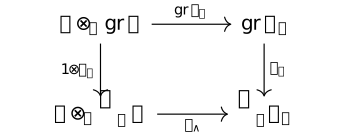
For example, \(\beta _Q(1\otimes \iota _Q(v)^2)=Q(v)1\), whereas \((1\otimes v)\wedge (1\otimes v)=0\). The square compares associated graded multiplication. It does not turn the linear Clifford-to-exterior coordinates of Definition [fcap-0003] into an algebra map. Chevalley makes this product distinction immediately after II.1.5.
The marked declarations give the two algebra equivalences in the reverse direction. Mathlib allows arbitrary commutative base and extension rings with \(2\) invertible; TauCeti's exterior equivalence needs neither invertible two nor flatness. The symbol square above is the consequence proved here, using the existing leading-symbol equivalence. The separate Spin-lifting consequences remain in Theorem [fcap-003N] and Proposition [fcap-003O].
Theorem [ca-000C]Definition [ca-000E]
Example. Real structures in chosen complex coordinates [fcap-003W]AGENTDRAFTED
Example. Real structures in chosen complex coordinates [fcap-003W]AGENTDRAFTED
Why does the complex Clifford algebra forget a real signature, while its real vectors still remember it? Let \(V\) be a finite-dimensional real space with nondegenerate quadratic form \(Q\). Its complexification is the scalar extension \(V_{\mathbb C}=\mathbb C\otimes _{\mathbb R}V\). Complex conjugation on the first factor fixes \(V\) and induces the conjugate-linear algebra involution \[\sigma (z\otimes a)=\overline z\otimes a\] on \(\mathbb C\otimes _{\mathbb R}\mathcal {C}\kern -2pt\ell _{\mathbb R}(Q)\). It preserves product order and conjugates scalar coefficients; the grade reversion instead reverses product order and is complex-linear after scalar extension. A real structure on a complex vector space or algebra means a map with \(\sigma (\lambda v+\mu w)=\overline \lambda \sigma (v)+ \overline \mu \sigma (w)\) and \(\sigma ^2=1\), an algebra automorphism in the algebra case. The fixed algebra here is \(1\otimes \mathcal {C}\kern -2pt\ell _{\mathbb R}(Q)\): write an element uniquely as \(1\otimes a+i\otimes b\) with \(a,b\) real to check this.
For the underlying real module of \(\mathcal {C}\kern -2pt\ell _{\mathbb R}(Q)\), this
coefficient map is TauCeti.tmulConj.
Its involution law is TauCeti.tmulConj_involutive, and
its fixed vectors are described by
TauCeti.tmulConj_eq_self_iff.
These supporting declarations concern the conjugate-linear involution and
fixed vectors; multiplicativity and the coordinate comparisons below are
the algebra calculations given here.
This is the conjugation construction in [meinrenken2013clifford, Section 2.2.6, p. 34]. Meinrenken's symmetric form is \(B=B_Q/2\), so his generator relation is \(uv+vu=2B(u,v)=B_Q(u,v)\). The following coordinate calculation applies that construction to the scalar-extension isomorphism of Theorem [fcap-003V].
Choose an orthogonal real basis \(e_1,\ldots ,e_n\) with \(Q(e_j)=1\) for \(j\le p\) and \(Q(e_j)=-1\) for \(j>p\), where \(n=p+q\). These are the signature signs of Convention [fcap-0011]. On \(\mathbb C^n\), put \(Q_0(z)=\sum _j z_j^2\), with coordinate vectors \(u_j\). The chosen complex isometry \[T(e_j)=\begin {cases}u_j&j\le p,\\i u_j&j>p\end {cases}\] induces \(\mathcal {C}\kern -2pt\ell (T):\mathcal {C}\kern -2pt\ell _{\mathbb C}(Q_{\mathbb C}) \simeq \mathcal {C}\kern -2pt\ell _{\mathbb C}(Q_0)\). Transporting \(\sigma \) through this map and Theorem [fcap-003V] gives \(\sigma _T\) on the standard complex algebra. On its generators, \[\sigma _T(\iota (u_j))=\begin {cases} \iota (u_j)&j\le p,\\-\iota (u_j)&j>p. \end {cases}\] Indeed, \(T^{-1}(u_j)=-i e_j\) for a negative direction, and conjugation sends this to \(i e_j\), whose image under \(T\) is \(-u_j\). The fixed real generators are consequently \(\iota (u_j)\) and \(i\iota (u_j)\) in the positive and negative directions, respectively.
Already in dimension one, the same complex algebra \(A=\mathbb C[u]/(u^2-1)\) has two different real structures: \[\begin {aligned} \sigma _+(z+wu)&=\overline z+\overline w u, & A^{\sigma _+}&=\mathbb R[ u]\simeq \mathbb R\oplus \mathbb R,\\ \sigma _-(z+wu)&=\overline z-\overline w u, & A^{\sigma _-}&=\mathbb R[iu]\simeq \mathbb C. \end {aligned}\] The first real-algebra isomorphism evaluates at \(u=1,-1\); the second uses \((iu)^2=-1\). Thus forgetting the real structure loses the distinction between \(\mathcal {C}\kern -2pt\ell (1,0)\) and \(\mathcal {C}\kern -2pt\ell (0,1)\). If a different complex isometry is \(T'=UT\), then \(\sigma _{T'}=\mathcal {C}\kern -2pt\ell (U)\sigma _T\mathcal {C}\kern -2pt\ell (U)^{-1}\). The real structure moves with the coordinates; it is not generally entrywise conjugation in every model.
The real-algebra identifications in this example are formalized as
TauCeti.realCliffordOneZeroEquivProd and
TauCeti.realCliffordZeroOneEquivComplex.
These declarations identify the two real Clifford algebras; the comparison
of their conjugations inside \(A\) is the calculation above.
Choosing the polarization data for a spinor carrier is a further choice. For \(Q(x,y)=x^2+y^2\), the complex isotropic lines \[W=\mathbb C(e_1+i e_2),\qquad W'=\mathbb C(e_1-i e_2)\] are complementary, and conjugation exchanges them. Their polar pairing is nonzero, so they give the split model after normalizing a dual basis. The carrier \(S=\bigwedge W\) uses \(W\) for creation and \(W'\) for contraction, as in Definition [fcap-001I]. Conjugation therefore maps this exterior space to \(\bigwedge W'\), rather than supplying a conjugation on \(S\) compatible with the same chosen operators. Comparing these carriers needs an additional intertwining map. This explains why the canonical real structure on the Clifford algebra alone does not choose a real structure on a particular spinor module. The creation/contraction construction is [chevalley1954algebraic, II.2.1--II.2.2, pp. 42--44].
Definition [ca-000J]
Lemma. Parity and reversal separate on bivectors [fcap-0021]
L∃∀NAGENTDRAFTED
Lemma. Parity and reversal separate on bivectors [fcap-0021]
L∃∀NAGENTDRAFTED
Let \(R\) be a commutative ring with invertible \(2\), let \(M\) be an \(R\)-module, and let \(Q\) be a quadratic form on \(M\). Write \(\alpha \) for the grading involution and \(\operatorname {rev}\) for reversal. For the half-commutator bivector of Convention [fcap-000N], \[\begin {aligned} \alpha (\beta _Q(u,v))&=\beta _Q(u,v),\\ \operatorname {rev}(\beta _Q(u,v))&=-\beta _Q(u,v). \end {aligned}\] The same reversal sign holds for every bivector in the image of \(\bigwedge _R^2 M\); reversal acts as minus the identity there.
Chevalley defines the main antiautomorphism by reversing products while fixing generators [chevalley1954algebraic, Section 2.1, p. 38]. His parity decomposition identifies even exterior degree with the even Clifford part [chevalley1954algebraic, II.1.6, p. 42]. Those are finite-dimensional field-space conventions; the displayed bivector statement is Tau Ceti's commutative-ring extension.
Proof.
Proof.
Parity changes the sign of each generator, so it fixes a product of
two. Reversal exchanges the order of those generators. Applied to the
half-commutator, the exchange negates it. Linearity then gives the same
sign on the exterior-square image
CliffordAlgebra.reverse_bivectorExterior.
The bivector is even
CliffordAlgebra.bivector_mem_evenOdd_zero;
on any even element reversal also agrees with Clifford conjugation
\(x\mapsto x^*\), since parity is the identity there
CliffordAlgebra.reverse_eq_star_of_mem_even.
The same reversal and parity conventions determine the scalar norm signs and the distinction between even-unitary and Spin units in Remark [fcap-0028].
Remark. Reverse norm signs and the Spin carrier [fcap-0028]AGENTDRAFTED
Remark. Reverse norm signs and the Spin carrier [fcap-0028]AGENTDRAFTED
Let \(R\) be a commutative ring, let \(M\) be an \(R\)-module, and let
\(Q\) be a quadratic form on \(M\). Write \(\widehat v=\iota _Q(v)\) for a
Clifford generator. Before imposing any invertibility condition, consider the
two algebra-valued norm expressions
\(N_{\mathrm {rev}}(x)=\operatorname {rev}(x)x\) and \(N_*(x)=x^*x\), where
\(x^*=\operatorname {rev}(\alpha (x))\). Identifying a scalar with its image in
the Clifford algebra gives
\[\begin {aligned}
N_{\mathrm {rev}}(\widehat v)&=Q(v),
&N_*(\widehat v)&=-Q(v),\\
N_{\mathrm {rev}}(\widehat u\widehat v)
&=\widehat v\widehat u\widehat u\widehat v
=Q(u)Q(v),
&N_*(\widehat u\widehat v)&=Q(u)Q(v).
\end {aligned}\]
Thus the two signs differ on one generator and agree on a product of two.
More generally, reversal gives the product of the quadratic values on every
vector word
CliffordAlgebra.reverse_prod_map_ι_mul_prod_map_ι, and the
two norm expressions agree on every even Clifford element
CliffordAlgebra.star_mul_self_eq_reverse_mul_self_of_mem_even.
For a Clifford unit \(x\), membership in the even-unitary carrier is
equivalent to evenness together with \(N_{\mathrm {rev}}(x)=1\)
CliffordAlgebra.evenUnitaryGroup.mem_iff_reverse_mul_self_eq_one.
Those two conditions do not establish Lipschitz membership, which must be
retained in the Spin criterion. Precisely,
\[\operatorname {im}\bigl (\operatorname {Spin}(Q)\longrightarrow
\operatorname {Cl}(Q)^\times \bigr )
=\operatorname {Lipschitz}(Q)\cap \operatorname {EvenUnitary}(Q)\]
CliffordAlgebra.range_spinGroup_toUnits.
Consequently, if \(Q(u)Q(v)=1\), then \(\widehat u\widehat v\) is an even
product of Lipschitz vector units with reverse norm one, hence a Spin element
CliffordAlgebra.ι_mul_ι_mem_spinGroup_of_norm_mul_norm_eq_one.
This is an unquotiented scalar calculation. The passage to square classes,
including the odd reflection sign and its cancellation on even products, is
recorded separately in Theorem [fcap-0023].
Chevalley obtains the same norm from what he calls the main antiautomorphism and records \(\lambda (v)=Q(v)\) and the paired values \(Q(u)Q(v)\) [chevalley1954algebraic, II.3.5--6, pp. 52--53]. His symbol \(\alpha \) in that passage denotes reversal, whereas \(\alpha \) in Lemma [fcap-0021] denotes the grading involution. Meinrenken calls reversal transposition, writes \(N(x)=x^\top x\), and defines Spin as its norm-one subgroup inside the special Clifford group [meinrenken2013clifford, Sections 2.2.6 and 3.1.1--2, pp. 34, 49--51]. His convention has \(Q(v)=B(v,v)\), so his \(B\) is the half-polar form \(b_Q\) of Convention [fcap-0027]. Both sources work in narrower finite-dimensional field settings; Meinrenken here assumes characteristic zero and a nondegenerate form. The formal identities linked above hold under the commutative-ring and module hypotheses stated here.
Theorem. The square of an orthogonal Clifford volume word [fcap-0022]
L∃∀NAGENTDRAFTED
Theorem. The square of an orthogonal Clifford volume word [fcap-0022]
L∃∀NAGENTDRAFTED
Let \(R\) be a commutative ring, \(M\) an \(R\)-module, and \(Q\) a quadratic form on \(M\). For a pairwise \(Q\)-orthogonal list \(\ell =(v_1,\ldots ,v_n)\), set \[\omega _\ell =\iota _Q(v_1)\cdots \iota _Q(v_n).\] Its square is the scalar \[\omega _\ell ^2 =(-1)^{\binom n2}\left (\prod _{i=1}^{n}Q(v_i)\right )1.\] The empty list gives \(\omega _\ell =1\). No basis, nondegeneracy, finite-dimensionality, or invertibility of \(2\) is required.
Chevalley computes the corresponding square for an orthogonal basis of a nondegenerate even-dimensional quadratic space over a field of characteristic different from \(2\) [chevalley1954algebraic, Proof of II.2.3, p. 45]. His generator relation \(v_i^2=Q(v_i)1\) matches the convention above. Tau Ceti's list identity extends that calculation to arbitrary lengths and the stated commutative-ring setting.
Proof.
Proof.
Pairwise orthogonality gives \(\iota _Q(v_i)\iota _Q(v_j)=-\iota _Q(v_j)\iota _Q(v_i)\) for \(i\ne j\). Move each factor of the second copy of \(\omega _\ell \) next to its matching factor in the first copy. This takes \((n-1)+(n-2)+\cdots +1=\binom n2\) swaps. Each adjacent pair then contracts to \(\iota _Q(v_i)^2=Q(v_i)1\), giving the formula.
Reflections and square-normalized Clifford lifts [fcap-0007]AGENTDRAFTED
Reflections and square-normalized Clifford lifts [fcap-0007]AGENTDRAFTED
A nonisotropic vector acts on the generating space by a reflection through twisted Clifford conjugation. Normalizing such vectors gives elements of Pin, while determinant parity detects the even products that belong to Spin. The cards pass from local lifts to reflection generation, Pin surjectivity, and finally Spin surjectivity onto the special orthogonal group.
§ [ca-0001]
Convention. Quadratic-form sign [lawson2016spin, I.1, (1.3)--(1.4), p. 8] [fcap-0008]AGENTDRAFTED
Convention. Quadratic-form sign [lawson2016spin, I.1, (1.3)--(1.4), p. 8] [fcap-0008]AGENTDRAFTED
Lawson and Michelsohn write
\[v^2=-q(v)1, \qquad vw+wv=-2q(v,w),\]
where \(2q(v,w)=q(v+w)-q(v)-q(w)\). Mathlib and TauCeti instead use a quadratic form \(Q\) with
\[\iota (v)^2=Q(v)1.\]
The conventions agree after setting \(Q=-q\). The orthogonal group and its reflections are unchanged by this global sign reversal. A vector with \(q(v)=1\) therefore has \(Q(v)=-1\) in the convention used below. Mathlib's generator-square rule CliffordAlgebra.ι_sq_scalar uses this \(Q\)-convention.
Definition. Reflection in a nonisotropic vector [lawson2016spin, I.2, (2.12), p. 14] [fcap-0009]
L∃∀NAGENTDRAFTED
Definition. Reflection in a nonisotropic vector [lawson2016spin, I.2, (2.12), p. 14] [fcap-0009]
L∃∀NAGENTDRAFTED
Let \(F\) be a field of characteristic different from \(2\), let \(Q\) be a quadratic form on an \(F\)-vector space \(V\), and write \[B_Q(x,y)=Q(x+y)-Q(x)-Q(y)\] for its polar form. If \(Q(v)\ne 0\), the reflection with normal vector \(v\) is \[\rho _v(w)=w-\frac {B_Q(v,w)}{Q(v)}v.\] It fixes \(v^\perp \) pointwise, sends \(v\) to \(-v\), and preserves \(Q\). Multiplying \(v\) by a nonzero scalar does not change \(\rho _v\).
Lemma. Twisted Clifford conjugation is a reflection [lawson2016spin, I.2, Proposition 2.2 and (2.8), p. 13; (2.11)--(2.12), p. 14] [fcap-000A]AGENTDRAFTED
Lemma. Twisted Clifford conjugation is a reflection [lawson2016spin, I.2, Proposition 2.2 and (2.8), p. 13; (2.11)--(2.12), p. 14] [fcap-000A]AGENTDRAFTED
Let \(\alpha \) denote the grading involution of \(\mathcal {C}\kern -2pt\ell (Q)\). For \(Q(v)\ne 0\), the Clifford generator \(\iota (v)\) is invertible with \[\iota (v)^{-1}=Q(v)^{-1}\iota (v).\] Its twisted adjoint action on a generator is the reflection in Definition [fcap-0009]: \[\alpha (\iota (v))\,\iota (w)\,\iota (v)^{-1}=\iota (\rho _v(w)).\]
Proof.
Proof.
The generator-square rule CliffordAlgebra.ι_sq_scalar and the anticommutator rule CliffordAlgebra.ι_mul_ι_add_swap give
\[\iota (v)\iota (w)+\iota (w)\iota (v)=B_Q(v,w).\]
Since \(\alpha (\iota (v))=-\iota (v)\) and \(\iota (v)^2=Q(v)\), substitution yields
\[-\iota (v)\iota (w)\frac {\iota (v)}{Q(v)}
=\iota (w)-\frac {B_Q(v,w)}{Q(v)}\iota (v)
=\iota (\rho _v(w)).\]
The ordinary adjoint differs by the leading minus sign; the twisted adjoint is the action that gives the reflection itself.
Lemma. Square-normalized Pin lift [lawson2016spin, I.2, Definition 2.3 and (2.26), pp. 14, 18] [fcap-000B]
L∃∀NAGENTDRAFTED
Lemma. Square-normalized Pin lift [lawson2016spin, I.2, Definition 2.3 and (2.26), pp. 14, 18] [fcap-000B]
L∃∀NAGENTDRAFTED
Lawson--Michelsohn make this product-and-scaling argument for a finite-dimensional quadratic vector space over a field. The statement below is TauCeti's extension to a quadratic module over a commutative ring. It assumes that \(2\) and \(Q(v)\) are invertible.
Let \(R\) be a commutative ring, let \(Q\) be a quadratic form on an \(R\)-module \(M\), and suppose \(2\) and \(Q(v)\) are invertible. If there is a scalar \(c\) such that \[c^2=-Q(v)^{-1},\] then \(Q(cv)=-1\). The normalized Clifford generator \(\iota (cv)\) belongs to the Pin group and its twisted adjoint action is \(\rho _v\), because \(\rho _{cv}=\rho _v\). Consequently \[\rho _v\in \operatorname {range}(\operatorname {pinToOrthogonal}).\] Equivalently, the required hypothesis is that \(-Q(v)^{-1}\) is a square. The conclusion is existential: it asserts that a Pin lift exists, not that a canonical square root has been chosen.
Theorem. Paired reflections have a product-square Spin lift [lawson2016spin, I.2, (2.24)--(2.26), p. 18] [fcap-000C]
L∃∀NAGENTDRAFTED
Theorem. Paired reflections have a product-square Spin lift [lawson2016spin, I.2, (2.24)--(2.26), p. 18] [fcap-000C]
L∃∀NAGENTDRAFTED
The cited product formulas are stated for a finite-dimensional quadratic vector space over a field. TauCeti packages the same scaling and Clifford-product calculation over the commutative-ring and module hypotheses inherited from Lemma [fcap-000B].
Let \(R\), \(M\), and \(Q\) be as in Lemma [fcap-000B]. Suppose \(Q(v)\), \(Q(w)\), and \(2\) are invertible. If there is a scalar \(c\) such that \[c^2=Q(v)^{-1}Q(w)^{-1},\] then \[Q(cv)Q(w)=1.\] Set \(x=\iota (cv)\iota (w)\). The element \(x\) is a product of invertible Clifford generators, and \[x^{*}x =\iota (w)\iota (cv)^2\iota (w) =Q(cv)Q(w)=1.\] Thus \(x\) is a unitary element of the Lipschitz group. It has even degree, so it belongs to the Spin group. Its twisted adjoint action is the ordered product of reflections, and therefore \[\rho _v\rho _w\in \operatorname {range}(\operatorname {spinToOrthogonal}).\]
Proof.
Proof.
The displayed square identity gives \(Q(cv)Q(w)=c^2Q(v)Q(w)=1\). Each generator is a Clifford unit and lies in the Lipschitz group, while the star calculation above establishes the unitary condition. The twisted adjoint is multiplicative on Clifford units, and scalar rescaling does not change a reflection. Hence the action of \(x\) is \(\rho _{cv}\rho _w=\rho _v\rho _w\); its even degree supplies the remaining Spin condition.
Equations (2.24)--(2.26) give the product descriptions and scaling invariance used here. The product-square condition is sharper than asking for separate normalizations of \(v\) and \(w\): one scalar normalizes the product even when neither vector has been normalized separately.
Example. A Euclidean unit normal [lawson2016spin, I.2, (2.12), p. 14; (2.24)--(2.26), p. 18] [fcap-000D]AGENTDRAFTED
Example. A Euclidean unit normal [lawson2016spin, I.2, (2.12), p. 14; (2.24)--(2.26), p. 18] [fcap-000D]AGENTDRAFTED
Let \(V=\mathbb {R}^n\) with Euclidean inner product and use the sign convention \[Q(x)=-\langle x,x\rangle .\] For a unit vector \(v\), one has \(Q(v)=-1\); thus \(c=1\) satisfies the square condition in Lemma [fcap-000B]. The Clifford generator \(\iota (v)\) is already Pin-normalized, and its action is the familiar hyperplane reflection \[\rho _v(w)=w-2\langle v,w\rangle v.\] For orthonormal \(v,w\), the even product \(\iota (v)\iota (w)\) lies in Spin and lifts the composition \(\rho _v\rho _w\). This is the Euclidean specialization of the general Pin and paired-Spin lifting statements in Lemma [fcap-000B] and Theorem [fcap-000C].
Remark. From individual lifts to generation [lawson2016spin, I.2, Proposition 2.2, Definition 2.3, and (2.24)--(2.26), pp. 13--18] [fcap-000E]AGENTDRAFTED
Remark. From individual lifts to generation [lawson2016spin, I.2, Proposition 2.2, Definition 2.3, and (2.24)--(2.26), pp. 13--18] [fcap-000E]AGENTDRAFTED
Lawson and Michelsohn supply the twisted-adjoint reflection formula, the definitions of Pin and Spin, the description by products of normalized vectors, and the square-root obstruction to normalization. The square-witness statements in Lemma [fcap-000B] and Theorem [fcap-000C] isolate the precise algebraic hypotheses under which one or two reflections lift.
An individual lift does not by itself show that all orthogonal transformations lift. That global conclusion requires finite dimension, nondegeneracy, and the Cartan--Dieudonne factorization developed next.
From reflection generation to Pin and Spin [fcap-000U]AGENTDRAFTED
From reflection generation to Pin and Spin [fcap-000U]AGENTDRAFTED
One reflection can enlarge the fixed subspace of an orthogonal transformation. Iterating this correction proves reflection generation and makes the unnormalized Lipschitz action onto the orthogonal group. Passing to the norm-one Pin and Spin carriers requires scalar normalization: determinant parity controls evenness, while the spinor norm measures the remaining obstruction over a general field.
Extending the field preserves the spinor norm through the map on square classes. A quadratic extension can make a nontrivial obstruction vanish; the resulting pair of Spin lifts records this change through its Galois action.
Isotropic transvections give a complementary explicit family in the Spin image: their nilpotent Clifford lifts add through the quotient \(u^{\perp }/Ku\). A null-frame calculation exhibits the quadratic action term, while a separate factorization retains a radical PGA shear inside the vector-generated carrier.
Lemma. Fixed-subspace correction by reflections [cartan1981theory, Section 10, pp. 10--12] [fcap-000V]AGENTDRAFTED
Lemma. Fixed-subspace correction by reflections [cartan1981theory, Section 10, pp. 10--12] [fcap-000V]AGENTDRAFTED
Cartan proves reflection factorization by an induction that enlarges the fixed subspace. TauCeti formalizes the correction as a list of at most two anisotropic reflections whose product with \(g\) fixes \(W+Kx\) pointwise TauCeti.QuadraticMap.exists_reflectionOrthogonal_list_prod_mul_eqOn_sup_span_singleton. The statement below repackages that list-valued result: when \(H\) contains every reflection, closure under products places the correcting element in \(H\).
Let \(K\) be a field of characteristic different from \(2\), let \(Q\) be a quadratic form on a \(K\)-vector space \(V\), and let \(H\le O(V,Q)\) contain every reflection in a nonisotropic vector. Suppose \(g\in O(V,Q)\) fixes a subspace \(W\) pointwise and \(x\in W^{\perp }\) has \(Q(x)\ne 0\). Then there is an element \(r\in H\) such that \[rg\vert _{W+Kx}=\operatorname {id}.\] The correction leaves the previously fixed space untouched and fixes one additional nonisotropic direction. It is either one reflection or a product of two reflections.
Proof.
Proof.
Compare \(x\) with \(g(x)\). When \(g(x)-x\) is nonisotropic, reflection in that difference carries \(g(x)\) to \(x\); because the difference is orthogonal to \(W\), the reflection fixes \(W\). In the exceptional case \(g(x)+x\) is nonisotropic: reflection in this sum carries \(g(x)\) to \(-x\), and reflection in \(x\) supplies the second factor. Both factors fix \(W\), so their product gives the required correction.
Lemma. Pin-range refinement of the correction [cartan1981theory, Section 10, pp. 10--12]; [lawson2016spin, I.2, (2.26) and Theorem 2.9, pp. 18--19] [fcap-0018]
L∃∀NAGENTDRAFTED
Lemma. Pin-range refinement of the correction [cartan1981theory, Section 10, pp. 10--12]; [lawson2016spin, I.2, (2.26) and Theorem 2.9, pp. 18--19] [fcap-0018]
L∃∀NAGENTDRAFTED
Under the hypotheses of Lemma [fcap-000V], suppose moreover that \(K\) is separably closed and take \(H\) to be the range of the Pin action. Over a separably closed field, TauCeti's fixed-sign square condition from Theorem [fcap-000X] holds, so every reflection factor used by the correction has a square-normalized Pin lift by Lemma [fcap-000B]. The correcting element \(r\) can therefore be chosen in \[\operatorname {range}(\operatorname {pinToOrthogonal}),\] and still satisfies \(rg\vert _{W+Kx}=\operatorname {id}\). The statement concerns the correcting element in the Pin-action range; in the exceptional case it is the image of a product of two Pin lifts, not the image of a single reflecting vector.
Theorem. Cartan--Dieudonne generation [lawson2016spin, I.2, Theorem 2.7, p. 17] [fcap-000W]
L∃∀NAGENTDRAFTED
Theorem. Cartan--Dieudonne generation [lawson2016spin, I.2, Theorem 2.7, p. 17] [fcap-000W]
L∃∀NAGENTDRAFTED
Let \(K\) be a field of characteristic different from \(2\), let \(V\) be finite-dimensional, and let \(Q\) be nondegenerate. Every orthogonal transformation is a product of reflections in nonisotropic vectors. Equivalently, if a subgroup \(H\le O(V,Q)\) contains every such reflection, then \[H=O(V,Q).\] This formulation asserts generation only; it records neither a sharp bound on the number of reflection factors nor a parity formula for such a factorization.
Proof.
Proof.
Begin with the zero fixed subspace, whose restricted polar form is nondegenerate. If the current nondegenerate fixed subspace is not all of \(V\), its orthogonal complement is nonzero and nondegenerate, hence contains a nonisotropic vector. The correction step of Lemma [fcap-000V] enlarges the fixed subspace by that orthogonal line and preserves nondegeneracy. Finite-dimensional induction eventually makes the corrected product the identity, expressing the original transformation as a product of reflections. Cartan gives this fixed-vector induction, including the isotropic-difference case, in [cartan1981theory, Section 10, pp. 10--12].
Theorem. Surjectivity of the Pin action [lawson2016spin, I.2, Theorem 2.9, pp. 18--19] [fcap-000X]
L∃∀NAGENTDRAFTED
Theorem. Surjectivity of the Pin action [lawson2016spin, I.2, Theorem 2.9, pp. 18--19] [fcap-000X]
L∃∀NAGENTDRAFTED
Let \(K\), \(V\), and \(Q\) be as in Theorem [fcap-000W]. Suppose every scalar \(-Q(v)^{-1}\) attached to a nonisotropic vector is a square in \(K\). Then the twisted-adjoint homomorphism is surjective: \[\operatorname {pinToOrthogonal}:\operatorname {Pin}(V,Q)\twoheadrightarrow O(V,Q).\] Indeed, Lemma [fcap-000B] puts every reflection in its range, and Theorem [fcap-000W] says that those reflections generate the target. In particular the conclusion holds over a separably closed field.
Lawson and Michelsohn ask whether a nonzero vector can be rescaled to quadratic length either \(+1\) or \(-1\); see (2.26) and the discussion preceding Theorem 2.9. Under the convention \(Q=-q\), TauCeti's hypothesis asks for the particular scalar \(-Q(v)^{-1}\) to be a square, so every reflecting vector is normalized to one fixed sign. This is a sufficient and generally stronger condition, not an equivalent reformulation of Lawson--Michelsohn's condition.
Example. A planar rotation as two reflections [lawson2016spin, I.2, (2.24)--(2.26), p. 18] [fcap-000Y]AGENTDRAFTED
Example. A planar rotation as two reflections [lawson2016spin, I.2, (2.24)--(2.26), p. 18] [fcap-000Y]AGENTDRAFTED
In an oriented Euclidean plane, let \(u\) and \(v\) be unit normals whose directed angle is \(\frac {\theta }{2}\). Reflection in \(u^{\perp }\) followed by reflection in \(v^{\perp }\) is rotation through \(\theta \). With the convention \(Q=-\langle -,-\rangle \), both vectors have \(Q=-1\), and \[s=\iota (v)\iota (u)\in \operatorname {Spin}(V,Q)\] lifts that rotation. In an oriented orthonormal basis \(e_1,e_2\), the familiar rotor form is \[\pm s=\cos \left (\frac {\theta }{2}\right )+\sin \left (\frac {\theta }{2}\right )\,\iota (e_1)\iota (e_2),\] after choosing the central sign and the order convention for the two reflections. This is the two-dimensional specialization of the paired lift in Theorem [fcap-000C]; the half-angle appears because the Spin element acts by conjugation on vectors.
Lemma. Determinant parity detects the even lift [lawson2016spin, I.2, Theorems 2.7 and 2.9, pp. 17--19] [fcap-001A]
L∃∀NAGENTDRAFTED
Lemma. Determinant parity detects the even lift [lawson2016spin, I.2, Theorems 2.7 and 2.9, pp. 17--19] [fcap-001A]
L∃∀NAGENTDRAFTED
Let \(R\) be a commutative ring in which \(2\) is invertible, let \(M\) be a finite free \(R\)-module, and let \(Q\) be a quadratic form on \(M\). A reflection in a vector of invertible quadratic value has determinant \(-1\). Therefore a product of \(r\) such reflections has determinant \[(-1)^r.\] In particular, every product of an even number of reflections belongs to \(SO(M,Q)\).
Lawson--Michelsohn state this parity argument for quadratic vector spaces over a field. The finite-free commutative-ring statement above is the formalized extension: its determinant calculation uses freeness and finiteness, while invertibility of \(2\) identifies the fixed part of the grading involution with the even subalgebra.
The Clifford lift remembers this parity. If \(p\in \operatorname {Pin}(M,Q)\) and its orthogonal action has determinant \(1\), then \(p\) lies in the even Clifford subalgebra. Hence \(p\) is a Spin element. Thus any Pin lift of a special orthogonal transformation is automatically even.
Proof.
Proof.
Multiplicativity of the determinant gives the first assertion from \(\det (\rho _v)=-1\). For the second, the grading involution of a Lipschitz element is its determinant sign times that element. If the determinant is \(1\), the involution fixes the Pin element. Because \(2\) is invertible, the fixed submodule of the grading involution is precisely the even Clifford subalgebra.
Theorem. Surjectivity of the Spin action [lawson2016spin, I.2, Theorem 2.9, pp. 18--19] [fcap-001B]
Theorem. Surjectivity of the Spin action [lawson2016spin, I.2, Theorem 2.9, pp. 18--19] [fcap-001B]
Let \(K\) be a field of characteristic different from \(2\), let \(V\) be finite-dimensional, and let \(Q\) be nondegenerate. Suppose that for every nonisotropic \(v\in V\), the scalar \(-Q(v)^{-1}\) is a square in \(K\). Then the twisted-adjoint action restricts to a surjection
\[\operatorname {Spin}(V,Q)\twoheadrightarrow SO(V,Q).\]
The underlying homomorphism is CliffordAlgebra.spinToSpecialOrthogonal, and its action on vectors is the usual Spin action by CliffordAlgebra.coe_spinToSpecialOrthogonal_apply.
Indeed, the square-normalization hypothesis and Cartan--Dieudonne generation give the Pin surjection of Theorem [fcap-000X]. It lifts an element of \(SO(V,Q)\) to Pin; the lift has determinant \(1\), so Lemma [fcap-001A] shows that it is even and therefore lies in Spin. The restriction square

CliffordAlgebra.spinToSpecialOrthogonal_surjective_of_pinToOrthogonal_surjective.The square condition is TauCeti's fixed-sign sufficient hypothesis, stronger in general than Lawson--Michelsohn's option to normalize each vector to either sign; see Theorem [fcap-000X]. For a positive-definite real geometric form \(q\), the Clifford convention is \(Q=-q\); hence \(-Q(v)^{-1}>0\) for every nonzero \(v\), so the reflecting vectors can be normalized over \(\mathbb {R}\). This observation does not assert the square condition for arbitrary real signatures.
Proposition. The reverse norm descends through the Lipschitz action [fcap-002D]AGENTDRAFTED
Proposition. The reverse norm descends through the Lipschitz action [fcap-002D]AGENTDRAFTED
Let \(K\) be a field of characteristic different from two, let \(V\) be a positive-dimensional finite-dimensional \(K\)-space, and let \(Q\) be nondegenerate. Write \(\Gamma (Q)\) for the vector-generated Lipschitz group, and \(\tau _Q:\Gamma (Q)\to O(V,Q)\) for its twisted action. For \(x\in \Gamma (Q)\), let \(N_{\mathrm {rev}}(x)\in K^{\times }\) be the unique scalar unit satisfying \(\operatorname {rev}(x)x=N_{\mathrm {rev}}(x)\,1\). Set \(\mathcal {S}_K=K^{\times }/(K^{\times })^2\). The top row is exact, and the square commutes:

CliffordAlgebra.scalarUnits_injective
CliffordAlgebra.ker_lipschitzToOrthogonal
CliffordAlgebra.lipschitzToOrthogonal_surjective. The right
vertical map is the orthogonal spinor norm, while
\(\nu _Q=\nu _Q^O|_{SO(V,Q)}\) is its restriction used in Theorem [fcap-0023].
The square expresses descent through the action, not surjectivity of
\(\nu _Q^O\)
CliffordAlgebra.orthogonalSpinorNorm_lipschitzToOrthogonal.If \(Q(v)\) is nonzero, then
\[N_{\mathrm {rev}}(\widehat v)=Q(v),\qquad
\nu _Q^O(r_v)=[Q(v)]\]
CliffordAlgebra.cliffordNorm_unitι
CliffordAlgebra.orthogonalSpinorNorm_reflectionOrthogonal.
Consequently, for an even product
\(x=\widehat v_1\cdots \widehat v_{2k}\) of nonisotropic vector lifts,
\[\tau _Q(x)=r_{v_1}\cdots r_{v_{2k}}\in SO(V,Q),\qquad
\nu _Q(r_{v_1}\cdots r_{v_{2k}})
=\left [\prod _{i=1}^{2k}Q(v_i)\right ].\]
Multiplying a lift by \(c\in K^\times \) changes its reverse norm by \(c^2\),
so the square class is independent of the chosen lift.
[chevalley1954algebraic, II.3.5--6, pp. 52--53] gives these vector and
paired-product values. The scalar exact sequence, reflection factorization,
and the same square-scaling law appear in
[meinrenken2013clifford, Theorem 3.1, pp. 50--51].
Chevalley's quotient statement assumes positive dimension; Meinrenken works
with a finite-dimensional characteristic-zero nondegenerate bilinear space.
If \(e:(V,Q)\simeq (V',Q')\) is an isometry equivalence, then conjugation
transport preserves both norms: for \(g\in O(V,Q)\) and \(h\in SO(V,Q)\),
\[\nu _{Q'}^O(ege^{-1})=\nu _Q^O(g),\qquad
\nu _{Q'}(ehe^{-1})=\nu _Q(h).\]
It therefore carries \(\ker \nu _Q\) onto \(\ker \nu _{Q'}\)
QuadraticMap.IsometryEquiv.orthogonalSpinorNorm_orthogonalGroupCongr
QuadraticMap.IsometryEquiv.spinorNorm_specialOrthogonalGroupCongr
kernel-transport source.
The induced kernel equivalence also commutes with Spin transport
Spin-transport source.
These are isometry-equivalence statements; they do not assert scalar-extension
or orthogonal-product naturality. This is the norm-square companion to the
vector-action square in Proposition [fcap-0029].
Theorem. The Spin image is the spinor-norm kernel [fcap-0023]
L∃∀NAGENTDRAFTED
Theorem. The Spin image is the spinor-norm kernel [fcap-0023]
L∃∀NAGENTDRAFTED
Let \(K\) be a field in which \(2\) is invertible, \(V\) a
finite-dimensional \(K\)-space, and \(Q\) a nondegenerate quadratic form.
The Clifford norm of a Lipschitz lift, taken modulo squares, descends to
\(\nu _Q^O:O(V,Q)\to K^{\times }/(K^\times )^2\)
CliffordAlgebra.orthogonalSpinorNorm_lipschitzToOrthogonal.
Its restriction to \(SO(V,Q)\) is the spinor norm
\(\nu _Q:SO(V,Q)\to K^\times / (K^\times )^2\)
CliffordAlgebra.spinorNorm. Then
\[\operatorname {im}\bigl (\operatorname {Spin}(V,Q)\to SO(V,Q)\bigr )
=\ker \nu _Q.\]
Thus a special orthogonal transformation has a Spin lift exactly
when its spinor-norm class is trivial.
[chevalley1954algebraic, II.3.5--6, pp. 52--53] defines the
reversal norm and describes the reduced orthogonal image by square
classes of products \(Q(u)Q(v)\). His ordinary Clifford action and
reversal norm compare with TauCeti's twisted action on even lifts: grading
fixes such lifts, so the two actions agree, and reverse and star norms
coincide Remark [fcap-0028]. For a single nonisotropic reflection, the descended
orthogonal spinor norm is
\[\nu _Q^O(r_v)=[Q(v)]\]
CliffordAlgebra.orthogonalSpinorNorm_reflectionOrthogonal.
This agrees with Chevalley's reverse norm. TauCeti's star norm on the odd
vector lift has class \([-Q(v)]\); it is a different norm. The extra minus
sign cancels on an even product, where the reverse and star norms agree.
Proof.
Proof.
Every Spin element has reverse norm one, so its image has trivial
spinor norm
CliffordAlgebra.spinorNorm_spinToSpecialOrthogonal.
Conversely, suppose first that \(V\) has positive dimension. Take
\(g\in SO(V,Q)\) with \(\nu _Q(g)=1\), and choose a Lipschitz lift \(x\) of
\(g\). Since \(\det (g)=1\), determinant parity first shows that
\(x\) is even
CliffordAlgebra.mem_even_of_det_lipschitzToOrthogonal_eq_one
Lemma [fcap-001A]. Trivial spinor class says that
\(N_{\mathrm {rev}}(x)\) is a square. Scalar normalization therefore produces
an even lift with reverse norm one
source theorem;
by the even-element comparison in Remark [fcap-0028], it lies in Spin and has
the same orthogonal action. In dimension zero \(SO(V,Q)\) is trivial, so the
image and the spinor-norm kernel are both its identity subgroup.
Theorem. Spinor norms commute with extension of scalars [fcap-003N]AGENTDRAFTED
Theorem. Spinor norms commute with extension of scalars [fcap-003N]AGENTDRAFTED
Let \(L/K\) be an extension of fields of characteristic different from two. Let \(V\) be a positive-dimensional finite-dimensional \(K\)-space, and let \(Q\) be nondegenerate. Set \(V_L=L\otimes _K V\), with extended form \(Q_L\), and write \[j:K^{\times }/(K^\times )^2\longrightarrow L^{\times }/(L^\times )^2, \qquad j([a]_K)=[a]_L.\] For \(g\in O(V,Q)\), scalar extension gives \(g_L(a\otimes v)=a\otimes g(v)\). Then \[\nu _{Q_L}^O(g_L)=j\bigl (\nu _Q^O(g)\bigr ).\] In particular, for \(g\in SO(V,Q)\), \[\nu _{Q_L}(g_L)=j\bigl (\nu _Q(g)\bigr ),\] and \(g_L\) has a Spin lift exactly when \(j(\nu _Q(g))=1\).
Proof.
Proof.
A Gram matrix for the unhalved polar form \(B_Q\) has nonzero determinant. Its determinant remains nonzero under the field embedding, so \(Q_L\) is nondegenerate. For \(Q(v)\ne 0\), the reflection formula is \[r_v(x)=x-\frac {B_Q(x,v)}{Q(v)}v.\] Since \(Q_L(1\otimes v)=Q(v)\) and the polar form extends by \(L\)-bilinearity, this formula on pure tensors gives \((r_v)_L=r_{1\otimes v}\). Cartan--Dieudonne writes any orthogonal \(g\) as \(r_{v_1}\cdots r_{v_k}\). The reflection values from Proposition [fcap-002D] therefore give \[\begin {aligned} \nu _{Q_L}^O(g_L) &=\left [\prod _{i=1}^k Q_L(1\otimes v_i)\right ]_L\\ &=j\left (\left [\prod _{i=1}^k Q(v_i)\right ]_K\right ) =j\bigl (\nu _Q^O(g)\bigr ). \end {aligned}\] Determinants also extend, so restricting to \(SO\) proves the second identity. Apply the image/kernel theorem Theorem [fcap-0023] over \(L\) to obtain the lifting criterion.
The Clifford map \(c:\mathcal {C}\kern -2pt\ell (Q)\to \mathcal {C}\kern -2pt\ell (Q_L)\) sends \(\iota _Q(v)\) to \(\iota _{Q_L}(1\otimes v)\). It preserves parity, reversal and products, and carries each nonisotropic vector unit to a nonisotropic vector unit. Thus it restricts to a map of the actual Spin carriers, and their vector actions satisfy \[q_L(c(s))=(q_K(s))_L\qquad (s\in \operatorname {Spin}(Q)),\] where \(q_K\) and \(q_L\) denote the Spin projections. Indeed, apply \(c\) to the conjugation identity on every vector generator. A lift defined over \(K\) therefore remains a lift over \(L\); the next proposition explains how additional lifts can appear when \(j\) kills a nontrivial square class.
[chevalley1954algebraic, Section 2.7, pp. 60--61] describes the Clifford extension, compatibility with the main antiautomorphism, and the group/vector-action inclusions in even dimension. His main antiautomorphism is reversal. The reflection proof above gives the stated naturality in every positive dimension, using the reverse-norm convention of Proposition [fcap-002D].
TauCeti proves the orthogonal and special-orthogonal identities in
CliffordAlgebra.orthogonalSpinorNorm_orthogonalGroupBaseChange
and
CliffordAlgebra.spinorNorm_specialOrthogonalGroupBaseChange
under the field, finite-dimensionality, nondegeneracy and invertibility-of-two
hypotheses. The commuting Spin-action square is
CliffordAlgebra.spinToSpecialOrthogonal_baseChange;
its more general input is a finite free module over a commutative ring
with two invertible.
Proposition. Spin lifts over a quadratic extension [fcap-003O]AGENTDRAFTED
Proposition. Spin lifts over a quadratic extension [fcap-003O]AGENTDRAFTED
Keep the quadratic-space hypotheses of Theorem [fcap-003N]. Let \(d\in K^\times \) be nonsquare, put \(L=K(\sqrt d)\), and let \(\sigma \) be its nontrivial \(K\)-automorphism. The square-class map has kernel \[\ker j=\{1,[d]_K\}.\] Consequently, for \(g\in SO(V,Q)\), \[g_L\text { has a Spin lift} \quad \Longleftrightarrow \quad \nu _Q(g)\in \{1,[d]_K\}.\] The trivial class already gives a lift over \(K\). If \(\nu _Q(g)=[d]_K\), the two lifts over \(L\) are exchanged by \(\sigma \); neither is the scalar extension of a \(K\)-defined Spin element.
Proof.
Proof.
Suppose \(a\in K^\times \) becomes a square in \(L\). Write \[a=(u+v\sqrt d)^2=u^2+dv^2+2uv\sqrt d, \qquad u,v\in K.\] The basis \(1,\sqrt d\) and characteristic different from two give \(uv=0\). If \(v=0\), then \(a=u^2\); if \(u=0\), then \(a=dv^2\). The nonzero remaining coefficient shows that \([a]_K\) is respectively \(1\) or \([d]_K\). Both classes become squares in \(L\), and they are distinct because \(d\) is nonsquare. This proves the kernel formula; Theorem [fcap-003N] gives the criterion for \(g_L\).
Now assume \(\nu _Q(g)=[d]_K\). By Proposition [fcap-002D], take a Lipschitz lift \(x\) of \(g\); determinant parity makes it even. Its reverse norm is \(db^2\) for some \(b\in K^\times \). Replacing \(x\) by \(x/b\) preserves its action and makes \(N_{\mathrm {rev}}(x)=d\). In the extended Clifford algebra set \[s=\frac {c(x)}{\sqrt d}.\] Scalar units are Lipschitz and even by Proposition [fcap-002D]. Thus \(s\) is even and Lipschitz, and \[N_{\mathrm {rev}}(s)=\frac {d}{(\sqrt d)^2}=1.\] The carrier criterion Remark [fcap-0028] places \(s\) in the actual \(\operatorname {Spin}(Q_L)\), and scalar normalization leaves its vector action equal to \(g_L\). Any other Spin lift differs from \(s\) by a scalar unit, by the Lipschitz action kernel over \(L\). Norm one forces that scalar's square to be one, so all lifts are precisely \(s\) and \(-s\).
The coefficient automorphism \(\sigma \) acts semilinearly on \(\mathcal {C}\kern -2pt\ell (Q_L)\): it fixes each extended generator and sends \(\sqrt d\) to \(-\sqrt d\). In particular it fixes \(c(x)\) and gives \[\sigma (s)=-s,\qquad \sigma (-s)=s.\] These elements are distinct because \(s\) is a unit and the characteristic is not two. Every Clifford element obtained by extending coefficients from \(K\) is fixed by \(\sigma \). Neither lift can therefore come from \(\operatorname {Spin}(Q)\), in agreement with its nontrivial spinor-norm obstruction.
For an explicit rational example, take \(K=\mathbb Q\) and \[Q(ae+bf)=a^2+2b^2,\qquad g=-\operatorname {Id}=r_e r_f.\] Here \(e^2=1\), \(f^2=2\), and \(ef=-fe\). Thus \(x=ef\) satisfies \[\operatorname {rev}(x)x=feef=2,\qquad x^2=efef=-2,\] and \(\nu _Q(g)=[2]_{\mathbb Q}\) is nontrivial. Over \(L=\mathbb Q(\sqrt 2)\), however, \[s=\frac {ef}{\sqrt 2},\qquad N_{\mathrm {rev}}(s)=1,\qquad s^2=-1.\] Its vector action is still \(-\operatorname {Id}\). The two Spin lifts \(s,-s\) are interchanged by conjugating \(\sqrt 2\); the rational orthogonal transformation acquires lifts without either lift becoming rational.
Proposition. Eichler transvections have additive Spin lifts [fcap-002M]AGENTDRAFTED
Proposition. Eichler transvections have additive Spin lifts [fcap-002M]AGENTDRAFTED
Let \(K\) be a field in which \(2\) is invertible, let \(V\) be a
\(K\)-space, and let \(Q\) be nondegenerate. Write \(B_Q\) for the unhalved
polar form and \(\widehat v=\iota _Q(v)\) for a Clifford generator. Suppose
\[Q(u)=0,\qquad B_Q(u,w)=0.\]
The Eichler transvection and its Clifford lift are
\[\begin {aligned}
E_{u,w}(x)
&=x+B_Q(x,u)w-B_Q(x,w)u-Q(w)B_Q(x,u)u,\\
L_{u,w}&=1+\widehat w\widehat u.
\end {aligned}\]
Then \(L_{u,w}\in \operatorname {Spin}(Q)\), its Spin action is \(E_{u,w}\), and
\[L_{u,w}^{-1}=\operatorname {rev}(L_{u,w})=1-\widehat w\widehat u.\]
The formal transformation formula already makes sense over a commutative
ring and module, without nondegeneracy or invertible \(2\)
QuadraticMap.transvection_apply
QuadraticMap.transvection_mem_specialOrthogonalGroup.
The actual Spin lift uses the field, invertible-two, and nondegeneracy
hypotheses stated above
CliffordAlgebra.coe_spinTransvection
CliffordAlgebra.coe_spinToSpecialOrthogonal_spinTransvection.
Indeed, put \(N=\widehat w\widehat u\). The Clifford relations give \[\begin {gathered} N^2=0,\qquad \operatorname {rev}(N)=-N,\\ N\widehat x-\widehat xN =B_Q(x,u)\widehat w-B_Q(x,w)\widehat u,\\ N\widehat xN=Q(w)B_Q(x,u)\widehat u. \end {gathered}\] Thus expansion of \((1+N)\widehat x(1-N)\) gives exactly the displayed formula, including its negative quadratic term, and proves reverse norm one. Actual membership in the vector-generated carrier is a separate point. If \(Q(w)\ne 0\), the explicit factorization is \[1+\widehat w\widehat u =\widehat {\frac {w}{Q(w)}}\, \widehat {\bigl (w+Q(w)u\bigr )},\] and the two quadratic values multiply to \(1\). If \(Q(w)=0\) and \(w\notin Ku\), nondegeneracy supplies \(x\perp u\) with \(b=B_Q(w,x)\ne 0\). For \[a=x+\frac {b-Q(x)}{b}w\] one has \(Q(a)=b\), \(Q(w+a)=2b\), and \(L_{u,w}=L_{u,w+a}L_{u,-a}\), reducing to the nonisotropic case. If \(w\in Ku\), the lift is \(1\). This is the algebraic carrier argument behind the linked formal construction; it needs no finite-dimensionality.
For \(w,w'\in u^\perp \), the cross term
\((\widehat w\widehat u)(\widehat {w'}\widehat u)\) vanishes. Hence
\[L_{u,w+w'}=L_{u,w}L_{u,w'},\qquad
L_{u,-w}=L_{u,w}^{-1},\qquad
L_{u,w+cu}=L_{u,w}.\]
The same equations hold after projection to the Eichler transformations.
Thus the lifts form a homomorphism
\[u^{\perp }/Ku\longrightarrow \operatorname {Spin}(Q)\]
which commutes with the projection to \(SO(Q)\); when \(u\ne 0\), it is
injective
CliffordAlgebra.spinTransvection_add
CliffordAlgebra.spinTransvection_add_smul
CliffordAlgebra.spinToSpecialOrthogonal_comp_spinTransvectionHom
CliffordAlgebra.spinTransvectionHom_injective.
The domain is \(u^{\perp }/Ku\), not all of \(V/Ku\); for \(u=0\) the family is
trivial. If \(V\) is additionally finite-dimensional, these transformations
have trivial spinor norm, as predicted by Theorem [fcap-0023]
CliffordAlgebra.spinorNorm_transvection.
Chevalley treats the common totally singular case \(Q(u)=Q(w)=B_Q(u,w)=0\): his finite exponential is \(1+\widehat w\widehat u\) and his conjugation formula is the displayed action with its quadratic term zero [chevalley1954algebraic, III.1.7, pp. 73--74]. This passage does not state the arbitrary-\(Q(w)\) formula. Meinrenken's quantization of the bivector \(w\wedge u\) is \(\widehat w\widehat u\); his commutator theorem and exponential Spin comparison recover the full formula over finite-dimensional nondegenerate real or complex spaces [meinrenken2013clifford, Section 2.2.10, Theorem 2.1 and Proposition 2.12, pp. 39--40] [meinrenken2013clifford, Proposition 3.2, pp. 53--54]. Here his symmetric form is the half-polar form \(B_M=b_Q=B_Q/2\). Since \(N^2=0\), both the Clifford and vector exponentials truncate, and the written polynomial calculation fixes the normalization and extends the formula to the stated general field. No claim that every Spin element is one exponential is made.
Example. A null-frame Spin transvection and a radical shear [fcap-002N]AGENTDRAFTED
Example. A null-frame Spin transvection and a radical shear [fcap-002N]AGENTDRAFTED
Let \(K\) be a field in which \(2\) is invertible and take the
three-dimensional quadratic space
\[Q(au+bv+cz)=ab+c^2.\]
Thus \(u,v\) are null, \(B_Q(u,v)=1\), \(Q(z)=1\), and \(z\) is orthogonal to
their hyperbolic plane. For \(w=tz\), the preceding lift and action become
\[\begin {gathered}
L_t=1+t\widehat z\widehat u
=\widehat z\,\widehat {(z+tu)},\\
E_t(u)=u,\qquad E_t(z)=z-2tu,\qquad
E_t(v)=v+tz-t^2u.
\end {gathered}\]
Both factors in the displayed product have quadratic value \(1\). Hence the
pair criterion puts \(L_t\) directly in the actual Spin group, including at
\(t=0\)
CliffordAlgebra.ι_mul_ι_mem_spinGroup_of_norm_mul_norm_eq_one.
In coordinates \((a,c,b)\) the transformation is
\[E_t=
\begin {pmatrix}
1&-2t&-t^2\\
0&1&t\\
0&0&1
\end {pmatrix}.\]
Substitution gives \(Q(E_t x)=Q(x)\), while multiplication gives
\(E_sE_t=E_{s+t}\) and \(L_sL_t=L_{s+t}\). At \(t=1/2\),
\[z\longmapsto z-u,\qquad
v\longmapsto v+\frac 12z-\frac 14u,\]
and composing this map with itself gives
\(z\mapsto z-2u\) and \(v\mapsto v+z-u\). For \(t\ne 0\), the vector action has
\((E_t-1)^2v=-2t^2u\) and \((E_t-1)^3=0\), although the Clifford increment
satisfies \((L_t-1)^2=0\). Over \(\mathbb R\), this is the null frame inside
the split model of Example [fcap-002I]; over every stated field it is a concrete
element of the spinor-norm kernel in Theorem [fcap-0023].
There is also a precise radical comparison. On the degenerate real form \[Q_{\mathrm {PGA}}(ar+xe+yf)=x^2+y^2\] the line \(\mathbb Rr\) is radical. With \(u=r\) and \(w=te\), the same ring-level transvection formula gives \[\begin {gathered} L_t=1+t\widehat e\widehat r =\widehat e\,\widehat {(e+tr)},\\ E_t(r)=r,\qquad E_t(e)=e-2tr,\qquad E_t(f)=f. \end {gathered}\] The nondegenerate packaged Spin-transvection theorem does not apply here. Nevertheless this particular lift still belongs to the vector-generated Spin carrier, because both displayed factors have quadratic value \(1\); the pair criterion itself needs no nondegeneracy. The quadratic action term vanishes because \(B_Q(r,-)=0\), and now \((E_t-1)^2=0\). This retains the original degenerate Clifford algebra rather than replacing it by the radical quotient of Remark [fcap-002C]. It does not identify the shear with a particular PGA point translation, motor parameter, dual encoding, or orientation convention.
Example. A mixed-sign isometry has no norm-one Spin lift [fcap-002E]AGENTDRAFTED
Example. A mixed-sign isometry has no norm-one Spin lift [fcap-002E]AGENTDRAFTED
On \(\mathbb R^2\), let \(Q(a,b)=a^2-b^2\), \(e_+=(1,0)\), and \(e_-=(0,1)\). The corresponding reflections are \[r_{e_+}=\operatorname {diag}(-1,1),\qquad r_{e_-}=\operatorname {diag}(1,-1),\] so \(g=r_{e_+}r_{e_-}=-I\) lies in \(SO(Q)\). Its spinor norm is \[\nu _Q(g)=[Q(e_+)Q(e_-)]=[-1]\ne [1].\] With the two norm conventions of Remark [fcap-0028], the even Clifford lift \(x=\widehat e_+\widehat e_-\) has \[N_{\mathrm {rev}}(x)=N_*(x)=-1.\] For every \(c\in \mathbb R^\times \), the scalar multiple \(cx\) has norm \(-c^2\), which cannot equal \(1\). More generally, any two Lipschitz lifts of \(g\) differ by a scalar by Proposition [fcap-002D], so no lift can be normalized into the norm-one Spin carrier. Equivalently, the image theorem in Theorem [fcap-0023] excludes a Spin lift because \(\nu _Q(g)\) is nontrivial.
This is the mixed-sign counterpart to the successful square normalizations in Lemma [fcap-000B] and Theorem [fcap-000C]. Meinrenken notes that over \(\mathbb R\) one sometimes uses the weaker carrier condition \(N(x)=\pm 1\); under that different convention this \(x\) passes the norm test [meinrenken2013clifford, Remark 3.2, p. 52]. TauCeti's Spin group uses the norm-one carrier, so the two conventions must not be identified.
Remark. Real spinor-norm images and the low-rank boundary [fcap-002F]AGENTDRAFTED
Remark. Real spinor-norm images and the low-rank boundary [fcap-002F]AGENTDRAFTED
Let \(Q\) be a positive-dimensional finite-dimensional nondegenerate real
quadratic form. Distinguish the orthogonal norm \(\nu _Q^O\) on \(O(Q)\) from
its restriction \(\nu _Q\) to \(SO(Q)\). Since
\(\mathbb R^{\times }/(\mathbb R^\times )^2=\{[1],[-1]\}\), their images and the
Spin image are:
\[\begin {array}{c|c|c|c}
\text {case}&\operatorname {im}\nu _Q^O&
\operatorname {im}\nu _Q&\text {Spin image}\\ \hline
\text {positive definite}&\{[1]\}&\{[1]\}&SO(Q)\\
\text {negative definite}&\{[1],[-1]\}&\{[1]\}&SO(Q)\\
\text {indefinite}&\{[1],[-1]\}&\{[1],[-1]\}&\ker \nu _Q
\end {array}\]
For a positive form, every reflected value is a square, so the orthogonal
norm is trivial
CliffordAlgebra.orthogonalSpinorNorm_eq_one_of_posDef. For
a negative form, the orthogonal norm is the determinant square class and is
therefore trivial on \(SO(Q)\)
CliffordAlgebra.orthogonalSpinorNorm_eq_orthogonalDetSquareClass_of_negDef
CliffordAlgebra.spinorNorm_eq_one_of_negDef. In the
indefinite case, one positive and one negative reflection give a
determinant-one element of norm \([-1]\), so \(\nu _Q\) is onto
CliffordAlgebra.spinorNorm_surjective_of_indefinite. Thus
the final kernel has index two. The Spin-image column follows from
Theorem [fcap-0023]; the table does not identify this kernel with a topological
component.
Rank zero is separate: \(SO(Q)\) is trivial, and the image/kernel theorem
uses its subsingleton branch rather than the positive-dimensional scalar row.
In rank one, \(SO(Q)\) and its spinor norm are trivial. For any nonzero \(v\),
the image of \(\nu _Q^O\) is generated by \([Q(v)]\), and it is trivial exactly
when \(Q(v)\) is a square
CliffordAlgebra.spinorNorm_eq_one_of_finrank_le_one
CliffordAlgebra.orthogonalSpinorNorm_range_eq_zpowers_of_finrank_eq_one
CliffordAlgebra.orthogonalSpinorNorm_eq_one_iff_isSquare_apply_of_finrank_eq_one.
An indefinite real form has rank at least two. Degenerate or semidefinite PGA
forms lie outside every row of this nondegenerate table.
Theorem. Spin acts transitively on a positive quadratic sphere [fcap-0024]
L∃∀NAGENTDRAFTED
Theorem. Spin acts transitively on a positive quadratic sphere [fcap-0024]
L∃∀NAGENTDRAFTED
Let \(V\) be a finite-dimensional real vector space with \(\dim V\geq 2\), and let \(Q\) be positive definite. If \(Q(x)=Q(y)=c>0\), then some \(s\in \operatorname {Spin}(Q)\) satisfies \[\operatorname {spinVectorAction}_Q(s,x)=y.\] In particular, Spin acts transitively on the unit level \(Q(v)=1\). This is a statement about the algebraic vector action; no topology or compactness is needed.
Cartan's anisotropic-normal reflection has determinant \(-1\) [cartan1981theory, Section 9, pp. 9--10]. His even-reflection correction appears in [cartan1981theory, Section 10, p. 10]. The following two-case calculation gives the sphere orbit explicitly.
Proof.
Proof.
Write \(B_Q\) for the polar form. For \(a\ne 0\), reflection in the
hyperplane perpendicular to \(a\) is
\[r_a(v)=v-\frac {B_Q(a,v)}{Q(a)}a.\]
If \(x+y\ne 0\), then positive definiteness makes \(x+y\) anisotropic,
and
\[Q(x+y)=2c+B_Q(x,y)=B_Q(x+y,x).\]
Hence \(r_{x+y}(x)=-y\) and \(r_y r_{x+y}(x)=y\). If \(y=-x\), choose a
nonzero \(z\) with \(B_Q(z,x)=0\), possible because \(\dim V\geq 2\). Then
\(r_z(x)=x\) and \(r_x r_z(x)=y\). Both maps are products of two
reflections, so they lie in \(SO(Q)\). The positive-definite surjectivity
CliffordAlgebra.spinToSpecialOrthogonal_surjective_of_posDef
lifts the chosen map to Spin, whose vector action is the same map.
The formal surjectivity theorem uses positive \(Q\) directly: every
nonzero value \(Q(v)\) has a real square root, making the spinor norm
trivial on \(SO(Q)\)
CliffordAlgebra.orthogonalSpinorNorm_eq_one_of_posDef.
This is a separate route from the fixed-sign
sufficient hypothesis in Theorem [fcap-001B].
Lemma. The real Spin kernel is the scalar pair [gallier2014clifford, Section 1.8, Proposition 1.21, pp. 39--40] [fcap-001C]
L∃∀NAGENTDRAFTED
Lemma. The real Spin kernel is the scalar pair [gallier2014clifford, Section 1.8, Proposition 1.21, pp. 39--40] [fcap-001C]
L∃∀NAGENTDRAFTED
For a real quadratic space of signature \((p,q)\) with \(p+q>0\), the kernel of the Spin action is the scalar pair: \[(\mathbb Z/2\mathbb Z)_{\mathrm {mult}} \simeq \ker \bigl (\operatorname {Spin}(p,q)\longrightarrow SO(p,q)\bigr ).\] The nontrivial residue class maps to the scalar Clifford element \(-1\). Thus the two kernel elements are precisely \(1\) and \(-1\). This is the kernel used in Gallier's real double-cover theorem.
TauCeti proves the analogous algebraic statement over a field \(K\): \(V\) is nontrivial and finite-dimensional, \(Q\) is nondegenerate, and \(2\) is invertible in \(K\). Under exactly those hypotheses it constructs the displayed canonical multiplicative equivalence. This is a generalization of the cited real result, not an attribution of arbitrary-field kernel classification to Gallier.
Theorem. The algebraic Spin extension [meinrenken2013clifford, Definition 3.2, pp. 51--52] [fcap-001D]
L∃∀NAGENTDRAFTED
Theorem. The algebraic Spin extension [meinrenken2013clifford, Definition 3.2, pp. 51--52] [fcap-001D]
L∃∀NAGENTDRAFTED
Let \(K\) be a characteristic-zero field, let \(V\) be nonzero and
finite-dimensional, and let its bilinear form be nondegenerate. Meinrenken defines Spin as the
even part of the norm-one Clifford group. Its kernel is the scalar pair. If
the Spin action is surjective, these data form the group extension
\[1\longrightarrow (\mathbb Z/2\mathbb Z)_{\mathrm {mult}}
\longrightarrow \operatorname {Spin}(Q)\longrightarrow SO(Q)\longrightarrow 1.\]
The left map sends the nontrivial class to \(-1\); the right map is the Spin
action. TauCeti packages this generic construction from an explicit
surjectivity proof. The group-extension constructor used in that package is
GroupExtension.ofMulEquivKer.
Meinrenken warns that the map to \(SO(V)\) need not be surjective over a general field; it is surjective when every element of \(K\) has a square root, because lifts can then be rescaled to have norm one. TauCeti separates this issue explicitly. Its generic construction assumes a field, a nontrivial finite-dimensional module, invertible \(2\), a nondegenerate quadratic form, and a supplied surjectivity proof. Over a separably closed field, Theorem [fcap-001B] supplies that proof and yields the specialized extension.
Lemma. The real Pin kernel is the scalar pair [gallier2014clifford, Section 1.8, Proposition 1.21, pp. 39--40] [fcap-001E]
L∃∀NAGENTDRAFTED
Lemma. The real Pin kernel is the scalar pair [gallier2014clifford, Section 1.8, Proposition 1.21, pp. 39--40] [fcap-001E]
L∃∀NAGENTDRAFTED
For a real quadratic space of signature \((p,q)\) with \(p+q>0\), the Pin action has the same two-element kernel: \[(\mathbb Z/2\mathbb Z)_{\mathrm {mult}} \simeq \ker \bigl (\operatorname {Pin}(p,q)\longrightarrow O(p,q)\bigr ).\] Its nontrivial generator is the image in Pin of the scalar Spin element \(-1\). The identification is obtained by comparing the Pin kernel with the Spin kernel, not by adding a second pair of central elements. Gallier's real double-cover proof uses exactly the quotient by \(\{\pm 1\}\).
TauCeti transports the Spin-kernel equivalence to Pin over a field \(K\) when the module is nontrivial and finite-dimensional, \(Q\) is nondegenerate, and \(2\) is invertible. These are the formal theorem's exact assumptions; the cited scholarly claim is the real case.
Theorem. The algebraic Pin extension [meinrenken2013clifford, Definition 3.2, pp. 51--52] [fcap-001F]
L∃∀NAGENTDRAFTED
Theorem. The algebraic Pin extension [meinrenken2013clifford, Definition 3.2, pp. 51--52] [fcap-001F]
L∃∀NAGENTDRAFTED
In Meinrenken's characteristic-zero, nonzero, finite-dimensional, nondegenerate setting, Pin is the kernel of the norm on the Clifford group. Its scalar kernel and any proof that the Pin action is surjective determine the group extension \[1\longrightarrow (\mathbb Z/2\mathbb Z)_{\mathrm {mult}} \longrightarrow \operatorname {Pin}(Q)\longrightarrow O(Q)\longrightarrow 1.\] The inclusion sends the nontrivial class to the scalar \(-1\), and the projection is the Pin action. Meinrenken notes that surjectivity can fail over a general field and that square roots for all field elements suffice to normalize lifts. TauCeti's generic theorem instead assumes a field, a nontrivial finite-dimensional module, invertible \(2\), a nondegenerate quadratic form, and an explicit surjectivity proof. Its separably closed specialization obtains that proof from the formal Cartan--Dieudonne route.
Proposition. Isometries transport the Spin vector action [fcap-0029]
L∃∀NAGENTDRAFTED
Proposition. Isometries transport the Spin vector action [fcap-0029]
L∃∀NAGENTDRAFTED
Let \(R\) be a commutative ring, let \(M_1,M_2\) be \(R\)-modules with
quadratic forms \(Q_1,Q_2\), and let \(f:M_1\to M_2\) be an \(R\)-linear map
satisfying
\[Q_2(f(m))=Q_1(m).\]
The Clifford universal property gives an algebra homomorphism
\(\operatorname {Cl}(f):\mathcal {C}\kern -2pt\ell (Q_1)\to \mathcal {C}\kern -2pt\ell (Q_2)\) characterized on generators by
\[\operatorname {Cl}(f)(\iota _{Q_1}(m))=\iota _{Q_2}(f(m))\]
CliffordAlgebra.map_apply_ι.
It preserves the Spin carrier and therefore restricts to a group homomorphism
\(\operatorname {Spin}(f):\operatorname {Spin}(Q_1)\to \operatorname {Spin}(Q_2)\)
QuadraticMap.Isometry.spinGroupMap. Concretely, the
Clifford map preserves Lipschitz membership
QuadraticMap.Isometry.map_mem_lipschitzGroup, evenness
CliffordAlgebra.map_mem_even, and Clifford conjugation
CliffordAlgebra.map_star; these are the carrier conditions
separated in Remark [fcap-0028]. Neither construction requires \(f\) to have an
inverse.
Now suppose that \(2\) is invertible in \(R\). If \(a_i\) denotes the Spin
vector action on \(M_i\), then
\[a_2\bigl (\operatorname {Spin}(f)(s),f(m)\bigr )
=f\bigl (a_1(s,m)\bigr ).\]
This identity says that the square with horizontal maps \(a_1,a_2\) and
vertical maps \(\operatorname {Spin}(f)\times f,f\) commutes. It is the vector-action
naturality equation, with no finite-dimensionality or nondegeneracy
hypothesis. If \(f\) is instead an isometry equivalence, it induces a Spin
equivalence
QuadraticMap.IsometryEquiv.spinGroupEquiv, and the same
square packages as naturality of the Spin-to-special-orthogonal homomorphism
source theorem.
A changed Gram matrix shows why the target form is part of the data. Over \(\mathbb Q\), set \(Q_1(x,y)=x^2+y^2\) and \(T(x,y)=(2x,y)\). Keeping the same form on the target does not give an isometry: at \(e_1\), \[Q_1(Te_1)=4\ne 1=Q_1(e_1).\] Correspondingly, the source generator \(\iota _{Q_1}(e_1)\) squares to \(1\), while its proposed image \(\iota _{Q_1}(2e_1)\) squares to \(4\); that assignment cannot define the claimed Clifford map.
For the transported target form \(Q_2(x,y)=x^2/4+y^2\), one has \(Q_2(Tv)=Q_1(v)\). In column coordinates, \[G_1=I,\qquad G_2=(T^{-1})^\top G_1T^{-1} =\begin {pmatrix}1/4&0\\0&1\end {pmatrix},\qquad T^\top G_2T=G_1.\] Now \(\iota _{Q_2}(2e_1)^2=Q_2(2e_1)=1\), so the generator relation is preserved. Thus an arbitrary basis scaling is not a fixed-form isometry; it becomes an isometry only after the domain and target forms are related in the correct direction. This differs from the module equivalence \(T_Q:\mathcal {C}\kern -2pt\ell (Q)\simeq \bigwedge M\) in Lemma [fcap-0004], which is not an algebra map.
Meinrenken derives \(\operatorname {Cl}(f)\) from the same universal property for a bilinear-form-preserving linear map [meinrenken2013clifford, Section 2.2.2, Proposition 2.2, p. 29]. Chevalley's tensor-quotient construction gives the corresponding extension from generator images whose squares are \(Q(x)\) [chevalley1954algebraic, II.1.1, pp. 38--39]. In Meinrenken's convention \(Q(v)=B(v,v)\), so his \(B\) is the half-polar form \(b_Q\) of Convention [fcap-0027]. These sources work over finite-dimensional vector spaces over fields; Meinrenken assumes characteristic different from two. The formal action square above has the commutative-ring hypotheses stated here. This card makes no claim about scalar extension, orthogonal sums, or composition of extension maps.
Remark. Algebraic extension versus topological cover [fcap-000Z]AGENTDRAFTED
Remark. Algebraic extension versus topological cover [fcap-000Z]AGENTDRAFTED
The extensions in Theorem [fcap-001D] and Theorem [fcap-001F] are exact sequences of abstract groups. They record a surjective homomorphism and its two-element kernel, but no topology. For the positive real form, the actual finite-dimensional carrier topology, compact double cover, and connectedness are established in Proposition [fcap-0039]; the stabilizer argument and the universal-cover boundary are established in Proposition [fcap-003A]. Those results do not extend the compact connectedness conclusion to arbitrary real signature.
Proposition. The compact real Spin projection is a two-sheeted cover [fcap-0039]AGENTDRAFTED
Proposition. The compact real Spin projection is a two-sheeted cover [fcap-0039]AGENTDRAFTED
For \(n\geq 0\), let \[Q_n^+(x)=\sum _{i=1}^n x_i^2\] on \(\mathbb R^n\), and give its actual vector-generated group \(\operatorname {Spin}(Q_n^+)\) the subspace topology from the finite-dimensional real Clifford algebra. This group is compact for every \(n\); it is path-connected for \(n\geq 2\). For \(n\geq 1\), the vector action is a two-sheeted covering \[\operatorname {Spin}(Q_n^+)\longrightarrow SO(n)\] with kernel \(\{1,-1\}\).
Here is the compactness mechanism. Cartan--Dieudonne writes every special orthogonal transformation as a bounded even word of reflections. Positive definiteness normalizes every reflecting vector to the unit sphere. An additional unit-vector pair corrects the possible scalar \(-1\), and pairs \((e,e)\) pad the lift to a fixed length. Clifford multiplication therefore gives a continuous surjection \[\bigl (S^{n-1}\times S^{n-1}\bigr )^{n+1} \longrightarrow \operatorname {Spin}(Q_n^+)\qquad (n\geq 1).\] For \(n=0\), the actual vector-generated carrier is the singleton group, hence compact. For \(n\geq 1\), the displayed source is compact, proving compactness. For \(n\geq 2\) it is also path-connected, proving path-connectedness of the target. The plane curve in Example [fcap-0038] independently joins \(1\) to \(-1\).
The vector action is a continuous surjection onto the Hausdorff group \(SO(n)\). Compactness makes it a quotient map. Its two-element kernel is discrete and acts freely, so the quotient-covering theorem makes the action a two-sheeted covering. The finite kernel alone would not prove either the quotient-map or covering assertion.
[gallier2014clifford, Section 1.8, pp. 38--40] gives the compact double cover for \(n\geq 1\) and path-connectedness for \(n\geq 2\), using generators with negative square in \(\operatorname {Cl}_{0,n}\). [lawson2016spin, I.2 and I.4, pp. 14, 19, 25] use the same compact sign through \(v^2=-q(v)\).
To compare their carrier with the positive-square model above, let \(e_i^2=1\) and \(f_i^2=-1\). The complex map \(e_i\mapsto i f_i\) restricts on real even PBW words to \[F(e_{i_1}\cdots e_{i_{2k}}) =(-1)^k f_{i_1}\cdots f_{i_{2k}}.\] The same formula is its inverse. It is a real linear homeomorphism, preserves multiplication and reversal, and carries an even product of real vectors to the corresponding even product up to a scalar \(-1\). That scalar belongs to both actual carriers, since \(e(-e)=-1\) and \(ff=-1\). Thus \(F\) and its inverse identify the actual Spin carriers. Complexifying the vector action and cancelling the common factor \(i\) shows that they also intertwine the actions on \(\mathbb R^n\). Gallier defines Spin through a normalizer condition; the carrier-completion argument in Proposition [fcap-0037], applied after this sign transfer, identifies that normalizer-defined group with the selected vector-generated carrier. This translates the source convention without identifying the two full real Clifford algebras.
TauCeti proves compactness for every \(n\), path-connectedness in
dimensions \(n+2\), and the quotient-covering and covering statements for
nonzero dimension:
CliffordAlgebra.instCompactSpaceRealCliffordSpinGroupZero,
CliffordAlgebra.pathConnectedSpace_realCliffordSpinGroupZero_add_two,
CliffordAlgebra.isQuotientCoveringMap_realCliffordSpinDoubleCoverZero_rightHom,
and
CliffordAlgebra.isCoveringMap_realCliffordSpinDoubleCoverZero_rightHom.
These exact results concern the positive form and the finite-dimensional
carrier topology; they do not assert simple connectedness.
Proposition. The compact Spin cover is universal from dimension three [fcap-003A]AGENTDRAFTED
Proposition. The compact Spin cover is universal from dimension three [fcap-003A]AGENTDRAFTED
For \(n\geq 3\), the covering in Proposition [fcap-0039] is the universal covering of \(SO(n)\). The proof uses the action on the unit sphere from Theorem [fcap-0024], together with the topology just supplied.
Fix a unit vector \(e\). Its stabilizer in \(\operatorname {Spin}(Q_n^+)\) is the preimage of \(SO(e^\perp )\). The Clifford map for the orthogonal inclusion \(e^\perp \hookrightarrow \mathbb R^n\) embeds \(\operatorname {Spin}(Q_{n-1}^+)\) into that preimage, maps onto \(SO(e^\perp )\), and has the same kernel \(\{1,-1\}\). Hence the embedded subgroup is exactly the stabilizer. It is closed. Using the concrete Lie group structure of Proposition [fcap-0037], the closed-subgroup bundle theorem gives \[\operatorname {Spin}(n-1)\longrightarrow \operatorname {Spin}(n)\longrightarrow S^{n-1}.\] This supplies the stabilizer step rather than inferring a fibration from transitivity alone.
One can see the local section directly in the positive-square
convention. For a unit vector \(x\ne -e\), put
\[u(x)=\frac {e+x}{\sqrt {Q_n^+(e+x)}},\qquad
s(x)=\iota (u(x))\iota (e).\]
Positive definiteness makes the denominator nonzero, and both vectors
have square one. Thus \(s(x)\) is even with reverse norm one. If
\(h=\iota (e+x)\), the Clifford relation gives
\[h\iota (e)h=\bigl (2+B_Q(e,x)\bigr )\iota (x)
=Q_n^+(e+x)\iota (x),\]
so \(s(x)\iota (e)s(x)^{-1}=\iota (x)\). The formula is continuous on
\(S^{n-1}\setminus \{-e\}\). In TauCeti \(e\) is the last coordinate
vector: TauCeti.realCliffordSpinLastLocalSection_apply
records the formula,
TauCeti.continuousOn_realCliffordSpinLastLocalSection
its continuity on that punctured sphere, and
TauCeti.realCliffordSpinLastLocalSection_action
its orbit identity. The definition assigns the identity at \(-e\); this
totalization is not a continuous section on the whole sphere.
With \(k=n-1\geq 1\),
CliffordAlgebra.realCliffordSpinContinuousMulEquivLastStabilizer
identifies \(\operatorname {Spin}(k)\) with the entire last-vector stabilizer in
\(\operatorname {Spin}(k+1)\), continuously and multiplicatively.
CliffordAlgebra.exists_realCliffordSpinOrbitTrivialization
then provides a bundle chart around every sphere point \(y\), with base
\(S^k\setminus \{-y\}\) and fiber \(\operatorname {Spin}(k)\); the resulting fiber-bundle
statement is
CliffordAlgebra.isFiberBundle_realCliffordSpinOrbitMap.
These are charts for the actual orbit map, with the same rank shift as
the displayed bundle.
For \(n=3\), Example [fcap-002H] gives the coordinate isomorphism with unit quaternions. Its displayed linear map and inverse restrict continuously to the unit three-sphere, so \(\operatorname {Spin}(3)\) is simply connected. For \(n\geq 4\), the homotopy exact sequence of the bundle and simple connectedness of \(S^{n-1}\) give a surjection \[\pi _1\operatorname {Spin}(n-1)\longrightarrow \pi _1\operatorname {Spin}(n).\] Induction therefore gives \(\pi _1\operatorname {Spin}(n)=0\) for every \(n\geq 3\). Together with path-connectedness and the two-sheeted covering, this makes \(\operatorname {Spin}(n)\to SO(n)\) the universal cover.
The formal base case uses
TauCeti.realSpinThreeContinuousMulEquivQuaternionUnitary,
the continuous multiplicative quaternion equivalence corresponding to
Example [fcap-002H]. The full conclusion
CliffordAlgebra.simplyConnectedSpace_realCliffordSpinGroupZero
establishes simple connectedness for every \(n\geq 3\). Its induction
uses the two antipodal bundle charts: their bases are contractible
punctured spheres, their fibers are simply connected by induction, and
their overlap is path-connected. Van Kampen then gives simple
connectedness of the total space. This implements the same geometric
induction through charts rather than the homotopy exact sequence used
above. The quaternion case starts the induction; \(\operatorname {Spin}(2)\) is not a
simply connected base case. Combining this conclusion with
Proposition [fcap-0039] yields the universal-cover assertion.
[gallier2014clifford, Section 1.8, pp. 40--42] gives this sphere--stabilizer induction. [meinrenken2013clifford, Section 1.6, Lemma 1.4, p. 13] independently checks the base topology using the parallel sphere fibration for \(SO(n)\). The explicit carrier/stabilizer comparison above is the convention bridge to the selected positive-square model.
The lower ranks remain separate: \[\begin {array}{c|c|c} n&\operatorname {Spin}(n)&\text {cover behavior}\\ \hline 0&\{1\}&\text {separate trivial carrier}\\ 1&\{1,-1\}&\text {two sheets over }SO(1),\ \text {not universal}\\ 2&S^1&\text {twofold circle cover of }SO(2),\ \pi _1\ne 0. \end {array}\] The rank-two identification follows from \(a+b e_1e_2\) with \(a=\cos \phi \) and \(b=\sin \phi \). In the orientation of Example [fcap-0038], its vector action has angle \(-2\phi \); hence the map is a twofold circle cover. The formal simple-connectedness theorem therefore has exactly the lower bound needed here; the universal-cover claim combines it with the separately established covering.
Bivectors and the orthogonal Lie algebra [fcap-000M]AGENTDRAFTED
Bivectors and the orthogonal Lie algebra [fcap-000M]AGENTDRAFTED
The second exterior power singled out by the PBW filtration has a second life inside the Clifford algebra. Its half-commutators are closed under the commutator bracket, and their action on generators is exactly the infinitesimal orthogonal action. A polar-dual basis then reconstructs a general skew lift; the Killing form specializes that calculation to the adjoint action.
§ [ca-0001]
Convention. Bivector normalizations [meinrenken2013clifford, Section 2.2.5, Proposition 2.5, p. 33] [fcap-000N]
L∃∀NAGENTDRAFTED
Convention. Bivector normalizations [meinrenken2013clifford, Section 2.2.5, Proposition 2.5, p. 33] [fcap-000N]
L∃∀NAGENTDRAFTED
Meinrenken works throughout this chapter with finite-dimensional vector spaces over a characteristic-zero field. The cards below retain his normalization and formulas but follow TauCeti's extensions. Each card states the commutative-ring, module, invertible-\(2\), finite-dimensional, or nondegeneracy assumptions it needs.
Meinrenken starts with a symmetric bilinear form \(B\) and the relation \[uv+vu=2B(u,v)1.\] For the associated quadratic form \(Q(v)=B(v,v)\), the polar form used here is \(B_Q=2B\).
Meinrenken's quantization formula and the half-commutator agree: \[q(u\wedge v)=uv-B(u,v)1 =\frac 12(uv-vu)=:\beta (u,v).\] The induced action on a vector is \[[\beta (u,v),x] =B_Q(v,x)u-B_Q(u,x)v =2\bigl (B(v,x)u-B(u,x)v\bigr ).\] This is Meinrenken's formula \(-2\iota _{B(x,-)}(u\wedge v)\) and Kostant's formula \(-2\iota _x(u\wedge v)\) in the corresponding contraction convention [kostant1997clifford, Section 2.4, (12) and Theorem 8, pp. 283, 286]. The factor of two belongs to the passage from \(B\) to the unhalved polar form \(B_Q\); it is not an additional rescaling of \(\beta \).
Definition. Clifford bivector [meinrenken2013clifford, Section 2.2.5, Proposition 2.5, p. 33] [fcap-000O]
L∃∀NAGENTDRAFTED
Definition. Clifford bivector [meinrenken2013clifford, Section 2.2.5, Proposition 2.5, p. 33] [fcap-000O]
L∃∀NAGENTDRAFTED
For the formalized extension described in Convention [fcap-000N], let \(R\) be a commutative ring in which \(2\) is invertible, let \(M\) be an \(R\)-module, and let \(Q\) be a quadratic form on \(M\). The Clifford bivector of \(u,v\in M\) is \[\beta _Q(u,v)=\frac 12\bigl (\iota (u)\iota (v)-\iota (v)\iota (u)\bigr ).\] It is alternating in \(u\) and \(v\), so it induces a linear map \[\beta _Q:\bigwedge _R^2M\longrightarrow \mathcal {C}\kern -2pt\ell (Q).\] The exterior model is a left inverse on its image: \[\operatorname {equivExterior}_Q\bigl (\beta _Q(z)\bigr )=z \qquad (z\in \bigwedge _R^2M).\] Hence \(\beta _Q\) is injective.
Lemma. A bivector acts by an infinitesimal rotation [meinrenken2013clifford, Section 2.2.10, Theorem 2.1, pp. 39--40] [fcap-000P]
L∃∀NAGENTDRAFTED
Lemma. A bivector acts by an infinitesimal rotation [meinrenken2013clifford, Section 2.2.10, Theorem 2.1, pp. 39--40] [fcap-000P]
L∃∀NAGENTDRAFTED
For \(u,v,x\in M\), the commutator of the bivector with a Clifford generator is \[[\beta _Q(u,v),\iota (x)] =\iota \left (B_Q(v,x)u-B_Q(u,x)v\right ).\] The endomorphism \[A_{u\wedge v}(x)=B_Q(v,x)u-B_Q(u,x)v\] is skew-adjoint for \(B_Q\), since \[B_Q(A_{u\wedge v}x,y)+B_Q(x,A_{u\wedge v}y)=0.\] Thus commutation by a degree-two Clifford element preserves the generating module and realizes the elementary infinitesimal orthogonal transformation attached to \(u\wedge v\).
Proof.
Proof.
Expand the half-commutator and move \(\iota (x)\) past \(\iota (u)\) and \(\iota (v)\) using the Clifford relation. The cubic terms cancel; the two polar terms combine to the displayed generator. Symmetry of \(B_Q\) then makes the skew-adjointness equation cancel in pairs.
Theorem. Exterior bivectors are the quadratic Clifford Lie algebra [meinrenken2013clifford, Section 2.2.10, Theorem 2.1, pp. 39--40] [fcap-000Q]
L∃∀NAGENTDRAFTED
Theorem. Exterior bivectors are the quadratic Clifford Lie algebra [meinrenken2013clifford, Section 2.2.10, Theorem 2.1, pp. 39--40] [fcap-000Q]
L∃∀NAGENTDRAFTED
Over the commutative ring and module of Definition [fcap-000O], let \(\mathfrak {cl}^{(2)}(Q)\) be the submodule of \(\mathcal {C}\kern -2pt\ell (Q)\) spanned by the elements \(\beta _Q(u,v)\). This is TauCeti's module-general extension of Meinrenken's characteristic-zero vector-space construction. The commutator formula of Lemma [fcap-000P], together with the Jacobi identity, shows that this submodule is closed under commutators. Transporting its bracket across \(\beta _Q\) gives a Lie algebra structure on \(\bigwedge _R^2M\) and a Lie equivalence \[\bigwedge _R^2M\simeq _{\mathrm {Lie}}\mathfrak {cl}^{(2)}(Q).\] On a decomposable bivector the equivalence is exactly \[u\wedge v\longmapsto \frac 12(uv-vu).\] No choice of basis enters this identification.
Theorem. Quadratic elements realize the orthogonal Lie algebra [meinrenken2013clifford, Section 2.2.10, Proposition 2.12, p. 40] [fcap-000R]
L∃∀NAGENTDRAFTED
Theorem. Quadratic elements realize the orthogonal Lie algebra [meinrenken2013clifford, Section 2.2.10, Proposition 2.12, p. 40] [fcap-000R]
L∃∀NAGENTDRAFTED
Meinrenken states this realization over a characteristic-zero field. TauCeti proves the extension below over any field of characteristic different from \(2\). Let \(K\) be such a field, let \(V\) be finite-dimensional, and let \(Q\) be nondegenerate. Write \(\mathfrak {so}(V,B_Q)\) for the Lie algebra of endomorphisms skew-adjoint for the polar form. Then commutation on generators gives a Lie equivalence \[\mathfrak {so}(V,B_Q)\simeq _{\mathrm {Lie}}\mathfrak {cl}^{(2)}(Q).\] If \(A\in \mathfrak {so}(V,B_Q)\) corresponds to \(z_A\in \mathfrak {cl}^{(2)}(Q)\), then \[[z_A,\iota (x)]=\iota (Ax)\qquad (x\in V).\] Combining this equivalence with Theorem [fcap-000Q] gives the basis-free chain \[\bigwedge _K^2V\simeq _{\mathrm {Lie}}\mathfrak {so}(V,B_Q) \simeq _{\mathrm {Lie}}\mathfrak {cl}^{(2)}(Q).\] Kostant identifies the same degree-two subspace with \(\operatorname {Lie}(\operatorname {Spin}(V))\) and the first equivalence with the differential of the double cover [kostant1997clifford, Section 2.4, Theorem 8, pp. 286--287].
Example. An elementary skew matrix [meinrenken2013clifford, Section 2.2.10, Proposition 2.12, p. 40] [fcap-000S]
L∃∀NAGENTDRAFTED
Example. An elementary skew matrix [meinrenken2013clifford, Section 2.2.10, Proposition 2.12, p. 40] [fcap-000S]
L∃∀NAGENTDRAFTED
This coordinate example specializes TauCeti's extension of the characteristic-zero construction summarized in Convention [fcap-000N]. Take \(V=R^n\) with the standard sum-of-squares quadratic form, and let \(e_i,e_j\) be distinct coordinate vectors. Under the standard-coordinate realization, \[e_i\wedge e_j\longmapsto 2(E_{ij}-E_{ji}).\] Thus its action on \(x=(x_k)\) is \[x\longmapsto 2x_j e_i-2x_i e_j.\] The factor \(2\) is the polar-form normalization from Convention [fcap-000N]: for the sum-of-squares form, \(B_Q(x,y)=2\sum _kx_ky_k\). The displayed matrix is the standard-coordinate specialization of the basis-free isomorphism in Meinrenken's proposition. Dividing the skew matrix by two would correspond to using the associated bilinear form \(B_Q/2\) instead.
Theorem. Reconstructing a skew Clifford lift in polar-dual coordinates [fcap-001Z]
L∃∀NAGENTDRAFTED
Theorem. Reconstructing a skew Clifford lift in polar-dual coordinates [fcap-001Z]
L∃∀NAGENTDRAFTED
Let \(K\) be a field in which \(2\) is invertible, \(V\) a finite-dimensional \(K\)-space, and \(Q\) a nondegenerate quadratic form. Write \(B_Q\) for its unhalved polar form. For a basis \((b_i)\) let \((d_i)\) be its \(B_Q\)-dual basis, and let \(f\in \mathfrak {so}(V,B_Q)\). The quadratic Clifford element \(z_f=\operatorname {soEquivQuadratic}(f)\) has the coordinate expression \[z_f=\frac 12\sum _i\beta _Q\bigl (f(b_i),d_i\bigr ),\] where \(\beta _Q(u,v)=\tfrac 12(\iota (u)\iota (v)-\iota (v)\iota (u))\) is the bivector normalization of Convention [fcap-000N].
[goodman2009symmetry, Definition 6.1.1(C1), p. 302] uses the complex Clifford relation \[\{\gamma (u),\gamma (v)\}=\beta (u,v)1.\] Thus their \(\beta \) is \(B_Q\), with \(Q(v)=\beta (v,v)/2\).
[goodman2009symmetry, Section 6.2.1, Lemmas 6.2.1--2 and (6.13), pp. 312--313] gives the complex, nondegenerate basis-free construction through \(R_{a,b}(x)=\beta (b,x)a-\beta (a,x)b\) and its half-commutator lift. The displayed polar-dual sum is the coordinate reconstruction; Tau Ceti proves it over the stated wider class of fields.
Proof.
Proof.
For \(x\in V\), dual-basis reconstruction and skew-adjointness give the two contractions \[\begin {aligned} \sum _i B_Q(d_i,x)f(b_i)&=f(x),\\ \sum _i B_Q(f(b_i),x)d_i&=-f(x). \end {aligned}\] By Lemma [fcap-000P], the commutator of the sum of bivectors with \(\iota (x)\) is the image of their difference, hence \(2\iota (f(x))\). Multiplication by \(1/2\) gives the action of \(z_f\) on every generator. The nondegenerate quadratic realization in Theorem [fcap-000R] then identifies the two quadratic elements.
Theorem. The Killing-adjoint lift has coefficient one quarter [fcap-0020]
L∃∀NAGENTDRAFTED
Theorem. The Killing-adjoint lift has coefficient one quarter [fcap-0020]
L∃∀NAGENTDRAFTED
Let \(K\) be a field in which \(2\) is invertible, and let \(L\) be a
finite-dimensional \(K\)-Lie algebra whose Killing form \(\kappa \) is
nondegenerate (the formal hypothesis is \(\operatorname {IsKilling}_K(L)\)).
Set \(Q_\kappa (y)=\kappa (y,y)\). If \((b_i)\) is a basis and
\((b_i^\vee )\) its Killing-dual basis, then for \(x\in L\) the quadratic
Clifford lift of the adjoint action is
\[\operatorname {adjointCliffordHom}(x)
=\frac 14\sum _i\beta _{Q_\kappa }
\bigl ([x,b_i],b_i^\vee \bigr ).\]
Here \(\beta _{Q_\kappa }\) is the half-commutator bivector of
Convention [fcap-000N]; the summand is the value of
CliffordAlgebra.adjointBivector_apply.
Kostant identifies the complex orthogonal Lie algebra with \(\bigwedge ^2L\) and constructs the adjoint map from a complex semisimple \(L\) using its Killing pairing [kostant1997clifford, Sections 1.1--1.2, pp. 275--276]. This supports the complex adjoint construction. The coordinate expression and its \(1/4\) normalization are the calculation here; Tau Ceti's theorem uses the stated \(\operatorname {IsKilling}\) hypothesis over a wider field class.
Proof.
Proof.
The invariance of \(\kappa \) makes \(\operatorname {ad}_x\) skew-adjoint.
Applying Theorem [fcap-001Z] to \(f=\operatorname {ad}_x\) first gives a factor
\(1/2\) with the dual basis for \(B_{Q_\kappa }\). Since
\(B_{Q_\kappa }=2\kappa \), that polar-dual basis is
\(d_i=\tfrac 12 b_i^\vee \). Bilinearity of the bivector gives the second
factor \(1/2\), and \((1/2)(1/2)=1/4\). The equality
\(B_{Q_\kappa }=2\kappa \) is the convention encoded by
TauCeti.LieAlgebra.polarBilin_killingQuadraticForm.
Remark. Infinitesimal and global Clifford symmetry [fcap-000T]AGENTDRAFTED
Remark. Infinitesimal and global Clifford symmetry [fcap-000T]AGENTDRAFTED
The quadratic Clifford Lie algebra is the infinitesimal part of the same conjugation action that produces reflections. Kostant proves that \(\bigwedge ^2V=\operatorname {Lie}(\operatorname {Spin}(V))\), that its map to \(\mathfrak {so}(V)\) is the differential of \(\operatorname {Spin}(V)\to SO(V)\), and that its commutator action extends as the corresponding derivation of the exterior algebra [kostant1997clifford, Section 2.4, Theorem 8, pp. 286--287]. Chevalley obtains the same two-vector Lie algebra inside the Clifford group [chevalley1954algebraic, II.2.9, pp. 67--68].
The cards above identify the algebraic Lie layer and reconstruct its lifts in coordinates. They do not construct Lie-group structures or identify a differential of a Lie-group covering map. The module-action card that follows uses the quadratic lift; the global orthogonal group is reached elsewhere by finite products of reflections.
Theorem. An orthogonal Lie action lifts to every Clifford module [kostant1997clifford, Section 3.1, pp. 294--295] [fcap-001O]
L∃∀NAGENTDRAFTED
Theorem. An orthogonal Lie action lifts to every Clifford module [kostant1997clifford, Section 3.1, pp. 294--295] [fcap-001O]
L∃∀NAGENTDRAFTED
Let \(K\) be a field in which \(2\) is invertible, let \(V\) be finite-dimensional, and let \(Q\) be nondegenerate. Suppose a \(K\)-Lie algebra \(L\) acts orthogonally on \(V\) through \[\theta :L\longrightarrow \mathfrak {so}(V,B_Q),\] and let \(\rho :\mathcal {C}\kern -2pt\ell (Q)\to \operatorname {End}_K(S)\) be any Clifford module. The equivalence of Theorem [fcap-000R] lifts \(\theta \) to quadratic Clifford elements; composing with \(\rho \) gives a Lie representation \[\rho _{\mathcal {C}\kern -2pt\ell }:L\longrightarrow \operatorname {End}_K(S),\qquad \rho _{\mathcal {C}\kern -2pt\ell }(y)=\rho \bigl (\operatorname {soEquivQuadratic}(\theta (y))\bigr ).\] Kostant constructs this lift for a complex reductive group representation and then lets its quadratic elements act on the spin module. The formalized statement isolates the algebraic mechanism over the stated field and for an arbitrary Clifford module; it does not assert that \(\theta \) is a differential of a group representation.
Proposition. Left Clifford multiplication is not the commutator action [fcap-003E]AGENTDRAFTED
Proposition. Left Clifford multiplication is not the commutator action [fcap-003E]AGENTDRAFTED
Let \(\mathfrak g\) be a finite-dimensional complex semisimple Lie algebra with Killing form \(\kappa \), and put \(Q_\kappa (x)=\kappa (x,x)\). If \((b_i)\) is a basis and \((b_i^\vee )\) its Killing-dual basis, the normalized quadratic lift of the adjoint action is \[\delta (x)=\frac 14\sum _i \beta _{Q_\kappa }([x,b_i],b_i^\vee )\in \mathcal {C}\kern -2pt\ell (Q_\kappa )^0.\] The coefficient is the one derived in Theorem [fcap-0020]: the polar form is \(B_{Q_\kappa }=2\kappa \), so the polar-dual basis contributes one factor \(1/2\), and the general lift contributes the other. This is a grade-two element, not the canonical generator \(\iota _{Q_\kappa }(x)\).
There are two natural actions on the same Clifford vector space: \[L_x(c)=\delta (x)c,\qquad D_x(c)=\delta (x)c-c\delta (x).\] If \(R_a(c)=ca\), then \[D_x=L_x-R_{\delta (x)},\qquad [L_x,R_a]=0.\] Under equivariant Clifford antisymmetrization, \(D\) is the derivation extension of the adjoint action to \(\bigwedge \mathfrak g\). The action \(L\) is instead left multiplication on the Clifford algebra. On matrix coordinates \(\operatorname {End}(S)\simeq S\otimes S^*\), it acts on the \(S\) factor and leaves \(S^*\) as a multiplicity space.
TauCeti defines the selected left action and proves these comparisons
in
CliffordAlgebra.kostantLieModule
CliffordAlgebra.kostant_lie_def
CliffordAlgebra.kostant_lie_sub_mul
CliffordAlgebra.kostantRightMul.
The generic module lift in Theorem [fcap-001O] supplies the same algebraic
mechanism, but it does not identify the left action with the exterior
derivation action.
[kostant1997clifford, Sections 3.1 and 5.2, pp. 294 and 311] defines the left action through this quarter-normalized lift and separately identifies the commutator with the exterior extension. [panyushev2001exterior, Section 2, internal preprint pp. 7--8] studies the exterior/spin action under the same complex semisimple hypotheses. The following example shows why their roles cannot be exchanged.
Example. For \(\mathfrak {sl}_2\), the two Clifford actions have different constituents [fcap-003F]AGENTDRAFTED
Example. For \(\mathfrak {sl}_2\), the two Clifford actions have different constituents [fcap-003F]AGENTDRAFTED
Take the basis \(e,f,h\) of \(\mathfrak {sl}_2(\mathbb C)\) with \[[h,e]=2e,\qquad [h,f]=-2f,\qquad [e,f]=h.\] The Killing form satisfies \(\kappa (e,f)=4\) and \(\kappa (h,h)=8\). Hence the Clifford relations are \[e^2=f^2=0,\qquad ef+fe=8,\qquad h^2=8,\qquad he=-eh,\quad hf=-fh.\] Substitution in the lift of Proposition [fcap-003E] gives \[E=\delta (e)=\frac {he}{8},\qquad F=\delta (f)=\frac {fh}{8},\qquad H=\delta (h)=\frac {ef-fe}{8}=\frac {ef}{4}-1.\] Direct Clifford multiplication yields \[E^2=F^2=0,\qquad H^2=1,\qquad EF=\frac {1+H}{2},\qquad FE=\frac {1-H}{2}.\] Thus \(E,F,EF,FE\) are the four matrix units of the lifted \(\mathfrak {sl}_2\) action.
For left multiplication, the \(H=+1\) and \(H=-1\) subspaces are interchanged by \(F\) and \(E\); the two maps are inverse on the corresponding projected spaces because \(EF\) and \(FE\) are their identity projectors. They have equal dimension, and \(\dim \mathcal {C}\kern -2pt\ell (Q_\kappa )=8\), so each has dimension four. Choosing a basis of the positive space and its \(F\)-images displays \[(\mathcal {C}\kern -2pt\ell (Q_\kappa ),L)\simeq 4V_1,\] four copies of the standard two-dimensional module.
For the commutator action \(D\), antisymmetrization identifies the same vector space with \(\bigwedge \mathfrak {sl}_2\). The exterior powers are \[\bigwedge ^0\mathfrak g\simeq V_0,\qquad \bigwedge ^1\mathfrak g\simeq V_2,\qquad \bigwedge ^2\mathfrak g\simeq V_2,\qquad \bigwedge ^3\mathfrak g\simeq V_0,\] where the middle identification uses the bracket and the last uses the invariant volume. Therefore \[(\mathcal {C}\kern -2pt\ell (Q_\kappa ),D)\simeq 2V_0\oplus 2V_2.\] The dimensions agree but the characters do not. [kostant1997clifford, Theorem 39, pp. 312--313] gives the first answer through Kostant's primary-type theorem. [panyushev2001exterior, Example 2.5(1), internal preprint p. 8] independently gives the exterior decomposition. The displayed matrix-unit calculation directly verifies which action produces which answer.
Theorem. The left Killing-Clifford module is primary of type \(V_\rho \) [fcap-003G]AGENTDRAFTED
Theorem. The left Killing-Clifford module is primary of type \(V_\rho \) [fcap-003G]AGENTDRAFTED
Let \(\mathfrak g\) be a finite-dimensional complex semisimple Lie algebra of rank \(\ell \). Choose positive roots \(\Phi ^+\), put \(r=\lvert \Phi ^+\rvert \), and write \(\rho =\frac 12\sum _{\alpha >0}\alpha \). Then \[\dim \mathfrak g=\ell +2r.\] Give \(\mathcal {C}\kern -2pt\ell (Q_\kappa )\) the left action \(L\) of Proposition [fcap-003E]. As a \(\mathfrak g\)-module it is \[\mathcal {C}\kern -2pt\ell (Q_\kappa )\simeq 2^{\ell +r}V_\rho .\] Here the exponent is the multiplicity; \(\dim V_\rho =2^r\), so the total dimension is \(2^{\ell +2r}\), as required. For the zero Lie algebra this reads as the one-dimensional trivial module.
First compute the spinor constituent. The weights of the adjoint orthogonal module are zero with multiplicity \(\ell \) and the roots in opposite pairs. The exterior spinor character is therefore \[\operatorname {ch}S= 2^{\lfloor \ell/2\rfloor } \prod _{\alpha >0} \left (e^{\alpha/2}+e^{-\alpha/2}\right ).\] The Weyl character formula for highest weight \(\rho \), together with the Weyl denominator identity applied to \(2\rho \) and divided by the ordinary denominator, gives \[\operatorname {ch}V_\rho =e^\rho \prod _{\alpha >0}(1+e^{-\alpha }) =\prod _{\alpha >0} \left (e^{\alpha/2}+e^{-\alpha/2}\right ).\] Complete reducibility and independence of irreducible characters now give \[S\simeq 2^{\lfloor \ell/2\rfloor }V_\rho .\] [panyushev2001exterior, Example 2.5(1), internal preprint p. 8] records this adjoint specialization under the complex semisimple hypotheses. The character calculation above supplies the comparison in the fixed normalization rather than substituting that conclusion without proof.
It remains to pass from a spinor carrier to the full Clifford algebra. If \(n=\ell +2r\) is even, the matrix range of Theorem [fcap-002V] gives \[\mathcal {C}\kern -2pt\ell (Q_\kappa )\simeq \operatorname {End}(S)\simeq S\otimes S^*.\] Left multiplication acts on the first factor, so \(S^*\) is a trivial multiplicity space of dimension \(2^{n/2}\). If \(n\) is odd, the odd structure of Proposition [fcap-002W] gives two matrix blocks \(\operatorname {End}(S_1)\oplus \operatorname {End}(S_2)\). The two full Clifford actions differ, but their restrictions to the even algebra are equivalent; since \(\delta (\mathfrak g)\) is even, both blocks contain the same \(\mathfrak g\)-module. Their combined multiplicity-space dimension is \(2\cdot 2^{(n-1)/2}=2^{\lceil n/2\rceil }\).
In both parity cases the multiplicity of \(V_\rho \) is \[2^{\lceil n/2\rceil } 2^{\lfloor \ell/2\rfloor } =2^{\ell +r}.\] This proves the displayed decomposition. [kostant1997clifford, Theorem 39, pp. 312--313] independently proves the exact left-regular primary-type statement by a highest-weight right ideal. TauCeti formalizes the selected left action and its commuting right multiplications, but the character, matrix-block, and multiplicity synthesis here is not a packaged formal theorem.
The conclusion is a module decomposition only. It does not assert the stronger algebra factorization \(\operatorname {End}(V_\rho )\otimes \mathcal {C}\kern -2pt\ell (P)\), identify the full commutant, or invoke the Hopf--Koszul--Samelson primitive algebra. The normal-ordered \(\mathfrak {gl}_N\) calculation in the separate CAR section uses a trace shift and is not a substitute for this Killing-adjoint theorem.
Theorem. The invariant algebra is the internal commutant [fcap-003P]AGENTDRAFTED
Theorem. The invariant algebra is the internal commutant [fcap-003P]AGENTDRAFTED
Let \(\mathfrak g\) be complex semisimple of rank \(\ell \), with \(r\) positive roots and \(\rho \) their half-sum. Put \(A=\mathcal {C}\kern -2pt\ell (Q_\kappa )\), where \(Q_\kappa (x)=\kappa (x,x)\), and use the lift \(\delta \) of Proposition [fcap-003E]. Define the unital algebra \(E=\delta (U(\mathfrak g))\subseteq A^0\) and the commutator invariants \[J=\{a\in A:[\delta (x),a]=0\text { for every }x\in \mathfrak g\}.\] Then \(J=\operatorname {Cent}_A(E)\), \(E\simeq \operatorname {End}(V_\rho )\), and multiplication is an isomorphism of ordinary complex algebras \[E\otimes J\longrightarrow A,\qquad e\otimes j\longmapsto ej.\] In particular, \(\dim J=2^\ell \). These assertions include the zero Lie algebra, where \(A=E=J=\mathbb C\).
An element commutes with the generators \(\delta (\mathfrak g)\) exactly when it commutes with their unital associative algebra, proving the centralizer assertion. Set \(d=2^{\lfloor \ell /2\rfloor }\). The spinor calculation in Theorem [fcap-003G] gives \(S\simeq V_\rho \otimes \mathbb C^d\). The associative algebra generated by an irreducible complex representation is its full endomorphism algebra (Burnside's theorem). Thus the image of \(U(\mathfrak g)\) on \(S\) is \(\operatorname {End}(V_\rho )\otimes 1\). This is the primary-representation calculation in [kostant1997clifford, equations (74)--(76), p. 295].
If \(\ell \) is even, then \(\dim \mathfrak g=\ell +2r\) is even, and Theorem [fcap-002V] identifies \(A\) with \(\operatorname {End}(S)\). Matrix units in \(\operatorname {End}(V_\rho )\) show that its commutant on \(V_\rho \otimes \mathbb C^d\) is \(1\otimes \operatorname {End}(\mathbb C^d)\): commuting with diagonal units forces a block-diagonal operator, and commuting with off-diagonal units makes all its diagonal blocks equal. Consequently \[J\simeq \operatorname {End}(\mathbb C^d),\qquad E\otimes J\simeq \operatorname {End}(V_\rho \otimes \mathbb C^d)=A.\] This also gives \(\dim J=d^2=2^\ell \).
If \(\ell \) is odd, Proposition [fcap-002W] identifies \(A\) with \(\operatorname {End}(S_+)\oplus \operatorname {End}(S_-)\). The two spinor restrictions to \(A^0\) are equivalent and faithful. After identifying them, \(E\subseteq A^0\) is the diagonal copy of \(\operatorname {End}(V_\rho )\otimes 1\). The same matrix-unit argument in each block gives \[J\simeq \operatorname {End}(\mathbb C^d) \oplus \operatorname {End}(\mathbb C^d).\] Multiplication \(E\otimes J\to A\) is the preceding matrix isomorphism in each of the two summands, and \(\dim J=2d^2=2^\ell \). This proves both parity cases without assuming that the full odd-dimensional Clifford algebra is simple. [kostant1997clifford, Propositions 17--20, pp. 294--297] gives this centralizer factorization for any primary spin representation.
Under the commutator action, \(\mathfrak g\) acts trivially on \(J\) and by conjugation on \(E\). Equivariant antisymmetrization from Proposition [fcap-003E] therefore yields the exterior-module consequence \[\bigwedge \mathfrak g\simeq 2^\ell (V_\rho \otimes V_\rho ^*).\] This multiplicity concerns the commutator action; the left-action multiplicity in Theorem [fcap-003G] is \(2^{\ell +r}\). The algebra factorization and its proof here are not a packaged formal theorem.
Remark. Three different commutants for the left Clifford action [fcap-003Q]AGENTDRAFTED
Remark. Three different commutants for the left Clifford action [fcap-003Q]AGENTDRAFTED
Keep the hypotheses and notation of Theorem [fcap-003P], and let \(L_x(c)=\delta (x)c\). The internal centralizer \(J\subseteq A\), the right-multiplication operators on \(A\), and the full algebra of \(\mathfrak g\)-module endomorphisms of \((A,L)\) have distinct roles.
Left multiplication by \(j\in J\) commutes with every \(L_x\). Right multiplication by any \(a\in A\) also commutes with every \(L_x\), purely by associativity. Thus there are injective algebra maps \[J\longrightarrow \operatorname {End}_{\mathfrak g}(A,L), \qquad j\longmapsto (c\longmapsto jc),\] \[A^{\mathrm {op}}\longrightarrow \operatorname {End}_{\mathfrak g}(A,L), \qquad a\longmapsto (c\longmapsto ca).\] Evaluation at \(1\) proves injectivity. The opposite algebra in the second map records the reversed order of right compositions.
By Theorem [fcap-003G], \((A,L)\simeq V_\rho \otimes \mathbb C^m\) with \(m=2^{\ell +r}\). Schur's lemma and the same block calculation as in Theorem [fcap-003P] give \[\operatorname {End}_{\mathfrak g}(A,L) \simeq M_m(\mathbb C).\] The dimensions of the three algebras are therefore \[\dim J=2^\ell ,\qquad \dim A^{\mathrm {op}}=2^{\ell +2r},\qquad \dim \operatorname {End}_{\mathfrak g}(A,L)=2^{2\ell +2r}.\] For \(\mathfrak g=\mathfrak {sl}_2\), these are \(2\), \(8\), and \(16\), respectively: \(J\simeq \mathbb C\oplus \mathbb C\), while \(\operatorname {End}_{\mathfrak g}(A,L)\simeq M_4(\mathbb C)\). The four-copy left-module calculation is explicit in Example [fcap-003F]. For every nonzero complex semisimple \(\mathfrak g\), the dimensions show that right multiplications form a proper subalgebra of the full module commutant. They do not by themselves identify that commutant.
Theorem. Primitive invariants and their quadratic form [fcap-003R]AGENTDRAFTED
Definition [ca-000J]
Theorem. Primitive invariants and their quadratic form [fcap-003R]AGENTDRAFTED
Let \(\mathfrak g\) be finite-dimensional complex semisimple of rank \(\ell \). Write \(I=(\bigwedge \mathfrak g)^{\mathfrak g}\) for the adjoint invariants and \(I^+\) for their positive-degree part. Extend the Killing form \(\kappa \) to the determinant pairing \(\langle -,-\rangle \) on each exterior degree, with different degrees orthogonal. Let \(\pi :\bigwedge \mathfrak g\to I\) be the invariant projection along \(\mathfrak g\mathbin {\cdot }\bigwedge \mathfrak g\), the span of all adjoint derivatives. The coproduct on \(I\) is \[\Delta =(\pi \otimes \pi )\Delta _0|_I,\] where \(\Delta _0(x)=x\otimes 1+1\otimes x\) for \(x\in \mathfrak g\). It is this projected coproduct that defines primitive invariants: \[P=\{p\in I:\Delta p=p\otimes 1+1\otimes p\} =I^+\cap ((I^+)^2)^\perp .\] The ordinary exterior coproduct need not take \(I\) into \(I\otimes I\). The Lie-homology construction makes \(I\), with the displayed \(\Delta \), a graded super Hopf algebra; multiplication on \(I\otimes I\) uses the Koszul rule \((a\otimes b)(c\otimes d)=(-1)^{\lvert b\rvert \lvert c\rvert }ac\otimes bd\) for homogeneous elements. The coproduct is dual to the wedge product. This is the input from [meinrenken2013clifford, Theorem 10.1 and Proposition 10.11, pp. 240--241].
The Hopf--Koszul--Samelson theorem says that inclusion extends to \[\bigwedge P\xrightarrow {\sim }I.\] Here every primitive has odd exterior degree. Indeed, a nonzero homogeneous even primitive \(p\) would have a least nilpotent power \(p^k=0\); the component \(k p\otimes p^{k-1}\) of \(\Delta (p^k)\) could not vanish in characteristic zero. The orthogonal decomposition \(I^+=P\oplus (I^+)^2\) then proves generation: substituting it repeatedly expresses every element as a polynomial in \(P\), since the augmentation ideal is nilpotent. For independence, contraction by a primitive acts as an odd derivation on \(I\), and contraction of two primitives is a scalar. The first assertion is dual to \(\Delta \) preserving multiplication; the second follows from \(P\perp (I^+)^2\). Successive contractions by a dual primitive basis extract the coefficients of an exterior-monomial relation, starting with the largest number of factors. All coefficients vanish. This proves the stated isomorphism; compare [meinrenken2013clifford, Theorem 10.2 and Proposition 10.13, pp. 242--243]. By Theorem [fcap-003P], \(\dim I=2^\ell \), so \(\dim P=\ell \).
For \(x\in \mathfrak g\), let \(\iota _x\) be contraction using \(\kappa \), and set \(\iota _{x_1\wedge \cdots \wedge x_k}=\iota _{x_1}\cdots \iota _{x_k}\). Exterior reversion is \(\operatorname {rev}(u)=(-1)^{k(k-1)/2}u\) on degree \(k\). The form relevant to Clifford multiplication is \[B_\wedge (u,v)=(\iota _u v)_0 =\langle \operatorname {rev}(u),v\rangle ,\qquad Q_P(p)=B_\wedge (p,p).\] In particular, on primitive degree \(2m+1\), \(B_\wedge (p,q)=(-1)^m\langle p,q\rangle \). The Clifford polar relation for \(Q_P\) is therefore \(pq+qp=2B_\wedge (p,q)\), with the same generator-square convention as \(Q_\kappa (x)=\kappa (x,x)\).
This restriction of \(B_\wedge \) to \(P\) is nondegenerate. Choose a compact real form. Its Killing form is negative definite; on exterior degree \(k\), the determinant pairing is \((-1)^k\) times a positive definite real form. The subspace \(P\) is graded and preserved by compact conjugation, so the determinant pairing and its degreewise sign multiple \(B_\wedge \) are nondegenerate there. This also explains the normalization change from [meinrenken2013clifford, Section 11.3, p. 260], which starts with a positive compact form. Replacing that form by its negative preserves the graded orthogonal subspaces while changing the indicated degree signs.
Theorem. Kostant's primitive Clifford factorization [fcap-003S]AGENTDRAFTED
Theorem. Kostant's primitive Clifford factorization [fcap-003S]AGENTDRAFTED
With \(P,Q_P\) as in Theorem [fcap-003R], put \(A=\mathcal {C}\kern -2pt\ell (Q_\kappa )\) and \(J=A^{\mathfrak g}\) for the commutator invariants of Theorem [fcap-003P]. Let \(q:\bigwedge \mathfrak g\to A\) be antisymmetrization. Then \(p\mapsto q(p)\) extends to an isomorphism of complex superalgebras \[\mathcal {C}\kern -2pt\ell (Q_P)\xrightarrow {\sim }J.\] Consequently multiplication gives \[\operatorname {End}(V_\rho )\otimes \mathcal {C}\kern -2pt\ell (Q_P) \xrightarrow {\sim }\mathcal {C}\kern -2pt\ell (Q_\kappa ).\] The endomorphism factor is purely even. Thus the displayed tensor product has the ordinary multiplication as well as the superalgebra interpretation. The proof below establishes the Clifford relation and generation separately.
We use the Lie-homology Hodge decomposition \[\bigwedge \mathfrak g =I\oplus \operatorname {im}d\oplus \operatorname {im}\partial =I\oplus (\mathfrak g\mathbin {\cdot }\bigwedge \mathfrak g),\] orthogonal for \(B_\wedge \). Here \(\partial \) is the Lie-homology boundary and \(d\) is the cohomology differential transported by \(\kappa \). The needed contraction identities are \[\iota _{\operatorname {im}d}I\subseteq \operatorname {im}\partial , \qquad \iota _{\operatorname {im}\partial }I\subseteq \operatorname {im}d,\] \[\ker \partial \wedge \operatorname {im}\partial \subseteq \mathfrak g\mathbin {\cdot }\bigwedge \mathfrak g.\] Proposition 10.8 and Lemmas 10.4--10.5 of [meinrenken2013clifford, pp. 238--239] give these identities. Changing the compact form's sign multiplies contractions and the transported differential by degreewise nonzero scalars, so the displayed ranges and identities also hold for \(\kappa \).
Choose a homogeneous basis \(\tau _a\) of the exterior algebra adapted to the three Hodge summands, and its \(B_\wedge \)-dual basis \(\tau ^a\). For odd \(p\in P\) and \(q'\in P\), the Clifford product formula is \[q^{-1}(q(p)q(q'))= \sum _a\iota _{\tau _a}p\wedge \iota _{\tau ^a}q'.\] This is the contraction expansion in [meinrenken2013clifford, equation (11.10), p. 260]; using the \(B_\wedge \)-dual basis incorporates the reversion signs. Terms indexed by \(\operatorname {im}d\) lie in \(\mathfrak g\mathbin {\cdot }\bigwedge \mathfrak g\) by the two contraction identities and the boundary-product identity. Terms indexed by \(\operatorname {im}\partial \) lie in \(\operatorname {im}d\), because \(d\) is a derivation and the wedge product of two exact elements is exact. Their combined sum is zero: the full product and the terms indexed by \(I\) are invariant, whereas the remaining terms lie in the complementary Hodge summand.
Take a homogeneous basis \(p_1,\ldots ,p_\ell \) of \(P\) and its \(B_\wedge \)-dual basis \(p^1,\ldots ,p^\ell \). The HKS monomials give a basis of \(I\). Repeated primitive contractions of a primitive vanish after the first contraction, which is already scalar. Moreover, \(\mathbb C\oplus P\oplus (I^+)^2\) is orthogonal, so the dual vectors belonging to the single primitives are \(p^i\). Only the constant monomial and the single primitives survive in the preceding sum. Hence \[q^{-1}(q(p)q(q')) =p\wedge q'+\sum _i B_\wedge (p_i,p)B_\wedge (p^i,q') =p\wedge q'+B_\wedge (p,q').\] Both primitives are odd, so swapping them cancels their wedge products and yields \[q(p)q(q')+q(q')q(p)=2B_\wedge (p,q').\] This is Kostant's primitive Clifford relation in the fixed sign convention; see [meinrenken2013clifford, Theorem 11.6 and equation (11.13), pp. 260--261] and [kostant1997clifford, Theorem 35, pp. 306--308].
The universal property now gives a homomorphism \(\mathcal {C}\kern -2pt\ell (Q_P)\to J\). To prove generation, order the HKS monomials by their total exterior degree. The product \(q(p_{i_1})\cdots q(p_{i_s})\) has leading exterior term \(p_{i_1}\wedge \cdots \wedge p_{i_s}\) under \(q^{-1}\); its other terms have lower degree, by the Clifford filtration. They are invariant, hence linear combinations of lower-degree HKS monomials. Induction therefore puts every \(q(p_{i_1}\wedge \cdots \wedge p_{i_s})\) in the generated algebra. This proves surjectivity. Both algebras have dimension \(2^\ell \), so the map is an isomorphism. It preserves parity, since all elements of \(P\) have odd degree.
Finally, substitute this identification of \(J\) in the multiplication isomorphism of Theorem [fcap-003P]. This yields the claimed factorization, also displayed in [meinrenken2013clifford, equation (11.14), p. 262]. For \(\mathfrak {sl}_2\), \(P\) has dimension one in exterior degree three. As an ordinary algebra, its nondegenerate complex Clifford algebra is \(\mathbb C\oplus \mathbb C\); the underlying ordinary algebra factorization becomes \(M_2(\mathbb C)\oplus M_2(\mathbb C)\), in agreement with Remark [fcap-003Q]. The primitive relation, HKS argument, and factorization here are mathematical proofs without a packaged formal theorem.
Proposition. Normal ordering adds a matrix-trace central character [fcap-0035]AGENTDRAFTED
Proposition. Normal ordering adds a matrix-trace central character [fcap-0035]AGENTDRAFTED
Let \(K\) be a field in which \(2\) is invertible. On \(V=M_N(K)\) take \[Q_{\mathrm {tr}}(Y)=\operatorname {Tr}(Y^2),\qquad B_{Q_{\mathrm {tr}}}(X,Y)=2\operatorname {Tr}(XY),\] and write \(d_{ij}=\iota _{Q_{\mathrm {tr}}}(E_{ij})\). The Clifford relation is \[d_{ij}d_{kl}+d_{kl}d_{ij} =2\delta _{jk}\delta _{li}.\] Let \(q(X)\) be the quadratic Clifford lift of the adjoint action \(Y\mapsto [X,Y]\). The normal-ordered lift used for the CAR module is \[D(X)=q(X)+\frac N2\operatorname {Tr}(X)1.\] On a matrix unit it has the concrete form \[D(E_{ij})=\frac 12\sum _{k=0}^{N-1}d_{ik}d_{kj}.\] Indeed, \(d_{ik}d_{kj}=\beta _{Q_{\mathrm {tr}}}(E_{ik},E_{kj}) +\delta _{ij}1\); summing the contraction term over \(k\) gives \((N/2)\delta _{ij}1\). This derives both the coefficient and its positive sign.
There are three different actions here. The ordinary exterior extension of the adjoint action is the derivation \[\delta _X(Y_1\wedge \cdots \wedge Y_r) =\sum _sY_1\wedge \cdots \wedge [X,Y_s]\wedge \cdots \wedge Y_r.\] The quadratic Clifford action is the inner derivation \([q(X),-]=[D(X),-]\). The CAR representation on the full Clifford algebra is instead left multiplication, \[\rho _{\mathrm {CAR}}(X)c=D(X)c, \qquad \rho _{\mathrm {CAR}}(X)c-cD(X)=[D(X),c].\] On the central matrix the three formulas read: \[\operatorname {ad}_I=0,\qquad q(I)=0, \qquad D(I)=\frac {N^2}{2}1.\] The left-regular carrier has dimension \(2^{N^2}\). For \(N\geq 1\) it is not an irreducible exterior spinor carrier; \(N=0\) is the one-dimensional trivial exception.
The exact identities are formalized at the pinned TauCeti revision. The normal-ordered lift, its matrix-unit and generator formulas, and the left-action comparison have the field and inverse-two hypotheses stated above. They do not identify this module with an irreducible spinor representation.
[pressley1986loop, Section 12.1, pp. 230--233] let the determinant-square-root cover of \(U(W)\) act on \(\bigwedge ^kW\) by \(u^{-1}\bigwedge ^k(A)\), with \(u^2=\det A\). Differentiating first along a unitary curve gives \(d\bigwedge (X)-\frac 12\operatorname {Tr}_W(X)\) for \(X\in \mathfrak u(W)\); complexifying then gives the corresponding \(\mathfrak {gl}(W)\) formula. No arbitrary complex matrix is being presented as the derivative of a unitary curve.
[panyushev2001exterior, Section 2, Example 2.5(3), preprint pp. 8--9] works over an algebraically closed field of characteristic zero and gives the ordinary spinor correction as \(\mathbb k_{-\nu }\otimes \bigwedge W\), where \(\nu \) is half the sum of the weights with multiplicity. Evaluating \(\nu \) is half the exterior trace. These two sources agree on the ordinary minus-half-trace normalization. They do not produce the positive \((N/2)\operatorname {Tr}\) term above: the trace of \(\operatorname {ad}_X\) on \(M_N\) is zero, while that term is the contraction created by normal ordering on the full left-regular Clifford module.
Proposition. The positive CAR product has half-staircase weight [fcap-0036]AGENTDRAFTED
Proposition. The positive CAR product has half-staircase weight [fcap-0036]AGENTDRAFTED
Let \(K\) be a field in which \(2\) is invertible. Begin with \(N=2\) and put \(v_+=d_{01}\). The relations are \[d_{01}^2=d_{10}^2=0,\qquad d_{00}^2=d_{11}^2=1, \qquad d_{01}d_{10}+d_{10}d_{01}=2.\] The only raising operator is \[D(E_{01})=\frac 12(d_{00}d_{01}+d_{01}d_{11}),\] and each summand kills \(v_+\). For the diagonal operators, the same CAR relations give \[D(E_{00})v_+=\frac 32v_+,\qquad D(E_{11})v_+=\frac 12v_+.\] Thus \(v_+\) has weight \((3/2,1/2)\), and \(D(I)v_+=2v_+\). Subtracting the central correction \((N/2)\operatorname {Tr}\) leaves \((1/2,-1/2)\). In characteristic zero this is the usual \(\mathfrak {sl}_2\) value \(\rho \).
For general \(N\), order the indices as \(0<1<\cdots <N-1\) and form the lexicographically ordered product \[v_+=\prod _{0\leq i<j<N}^{\mathrm {lex}}d_{ij}.\] Every positive matrix unit is \(Q_{\mathrm {tr}}\)-null, and distinct positive matrix units are polar-orthogonal. Their Clifford generators therefore anticommute. PBW linear independence shows that the ordered product is nonzero over a field.
Let \(i<j\). In \[D(E_{ij})v_+=\frac 12\sum _kd_{ik}d_{kj}v_+,\] a term with \(k<j\) vanishes because the positive generator \(d_{kj}\) already occurs in \(v_+\). If \(k\geq j\), then \(i<k\); first anticommute \(d_{ik}\) past \(d_{kj}\), using \(i\ne j\), and the repeated positive factor \(d_{ik}\) makes the term zero. Hence every raising operator annihilates \(v_+\).
For a diagonal generator, \[D(E_{ii})v_+=\frac 12\sum _kd_{ik}d_{ki}v_+.\] The contributions for \(k<i\), \(k=i\), and \(k>i\) are respectively \(0\), \(v_+\), and \(2v_+\). Therefore \[D(E_{ii})v_+ =\frac 12\bigl (1+2|\{k:k>i\}|\bigr )v_+.\] For \(i\in \operatorname {Fin}(N)\), the weight and its quadratic-lift part are \[\lambda _i=N-i-\frac 12,\qquad \lambda _i-\frac N2=\frac {N-1}{2}-i,\qquad \sum _i\lambda _i=\frac {N^2}{2}.\] The last equality agrees with the direct central calculation \(D(I)=N^2/2\).
TauCeti defines this ordered product and proves its nonvanishing, raising equations, and diagonal weight. See the exact pinned product and PBW nonvanishing and half-staircase theorems. Nonvanishing needs a field; the highest-vector statement adds invertible \(2\). Identifying the subtracted weight with the rational staircase requires characteristic zero.
[panyushev2001exterior, Section 2, Example 2.5(1), preprint p. 8] identifies, over an algebraically closed field of characteristic zero, the reduced adjoint spin module with highest weight \(\rho \). The subtracted weight above is exactly that semisimple staircase. The added \((N/2)\operatorname {Tr}\) character records the reductive center of this normal-ordered left action. This comparison does not attribute the selected product or the full left-regular CAR module to Panyushev, and it makes no irreducibility or whole-module decomposition claim.
Differentiating and integrating Spin representations [fcap-001Q]AGENTDRAFTED
Differentiating and integrating Spin representations [fcap-001Q]AGENTDRAFTED
The quadratic Clifford construction in the preceding section is algebraic. A different bridge starts from a smooth homomorphism of Lie groups and differentiates it at the identity. The concrete Spin calculation identifies this differential with the normalized quadratic lift. For compact \(\operatorname {Spin}(n)\), \(n\geq 3\), simple connectedness then gives the reverse construction: integration of a Lie-algebra representation. Its action on the covering kernel decides whether it also represents \(SO(n)\).
Definition. The differential of a smooth homomorphism
[liu2016lie, Section 2.1, p. 9] [fcap-001R]AGENTDRAFTED
Definition. The differential of a smooth homomorphism
[liu2016lie, Section 2.1, p. 9] [fcap-001R]AGENTDRAFTED
Let \(G\) and \(H\) be finite-dimensional real Lie groups, with identities \(e_G\) and \(e_H\), and let \(\phi :G\to H\) be a smooth group homomorphism. Their Lie algebras are the tangent spaces \[\mathfrak g=T_{e_G}G, \qquad \mathfrak h=T_{e_H}H.\] The differential of \(\phi \) at the identity is the linear map \[\operatorname {Lie}(\phi )=d\phi _{e_G}: \mathfrak g\longrightarrow \mathfrak h.\] No connectedness or simply-connectedness hypothesis is needed to define this map. Those hypotheses enter the converse problem of integrating a Lie-algebra homomorphism, not the differentiation of a given smooth homomorphism.
For \(X\in \mathfrak g\), let \(\widetilde X\) be its left-invariant vector field, \[\widetilde X_g=d(L_g)_{e_G}X.\] The homomorphism identity \(\phi \circ L_g=L_{\phi (g)}\circ \phi \) gives \[d\phi _g(\widetilde X_g) =\widetilde {\operatorname {Lie}(\phi )(X)}_{\phi (g)}.\] Thus differentiation at the identity and transport by left translation are two descriptions of the same infinitesimal map.
Lemma. The differential preserves the Lie bracket
[liu2016lie, Section 2.1, p. 9] [fcap-001S]AGENTDRAFTED
Lemma. The differential preserves the Lie bracket
[liu2016lie, Section 2.1, p. 9] [fcap-001S]AGENTDRAFTED
In the setting of Definition [fcap-001R], the differential is a Lie-algebra homomorphism: \[\operatorname {Lie}(\phi )([X,Y]) =[\operatorname {Lie}(\phi )(X), \operatorname {Lie}(\phi )(Y)].\] Indeed, the left-invariant fields \(\widetilde X\) and \(\widetilde Y\) are \(\phi \)-related to the left-invariant fields determined by their images. Brackets of related vector fields are again related. Evaluating that relation at \(e_G\) gives the displayed identity.
This argument is local at the identity. In particular, bracket preservation does not require \(G\) to be connected or simply connected.
Theorem. The Lie functor [liu2016lie, Section 2.2, p. 10] [fcap-001T]AGENTDRAFTED
Theorem. The Lie functor [liu2016lie, Section 2.2, p. 10] [fcap-001T]AGENTDRAFTED
Differentiation at the identity is functorial. For smooth homomorphisms \(G\xrightarrow {\phi }H\xrightarrow {\psi }K\), the chain rule gives \[\operatorname {Lie}(\operatorname {id}_G) =\operatorname {id}_{\mathfrak g}, \qquad \operatorname {Lie}(\psi \circ \phi ) =\operatorname {Lie}(\psi )\circ \operatorname {Lie}(\phi ).\] Together with Lemma [fcap-001S], this defines a functor from Lie groups and smooth homomorphisms to Lie algebras and Lie-algebra homomorphisms.
The stronger correspondence between simply connected Lie groups and Lie algebras concerns existence and uniqueness in the reverse direction. It is not a hypothesis of these functor laws.
Theorem. Naturality of the exponential
[liu2016lie, Section 2.4, pp. 12--13] [fcap-001U]AGENTDRAFTED
Theorem. Naturality of the exponential
[liu2016lie, Section 2.4, pp. 12--13] [fcap-001U]AGENTDRAFTED
Let \(\phi :G\to H\) be a smooth Lie-group homomorphism. For every \(X\in \mathfrak g\), \[\phi (\exp _G X) =\exp _H\bigl (\operatorname {Lie}(\phi )(X)\bigr ).\] Equivalently, the square

Proof.
Proof.
The curve \(t\mapsto \phi (\exp _G(tX))\) is a one-parameter subgroup of \(H\). Its tangent vector at \(t=0\) is \(\operatorname {Lie}(\phi )(X)\). The curve \(t\mapsto \exp _H(t\operatorname {Lie}(\phi )(X))\) has the same property and the same tangent vector. Uniqueness of the one-parameter subgroup with a given tangent vector identifies the curves; setting \(t=1\) proves the formula.
Example. Differentiating a matrix representation
[liu2016lie, Sections 2.1 and 2.4, pp. 9, 12] [fcap-001V]AGENTDRAFTED
Example. Differentiating a matrix representation
[liu2016lie, Sections 2.1 and 2.4, pp. 9, 12] [fcap-001V]AGENTDRAFTED
Let \(V\) be a finite-dimensional real vector space and let \[\rho :G\longrightarrow \operatorname {GL}(V)\] be a smooth representation. Its differential is a Lie-algebra representation \[d\rho _{e_G}:\mathfrak g\longrightarrow \mathfrak {gl}(V).\] Naturality of the exponential becomes \[\rho (\exp _G X)=\exp \bigl (d\rho _{e_G}(X)\bigr ),\] where the exponential on the right is the ordinary matrix exponential. For example, for the determinant homomorphism \(\det :\operatorname {GL}_n(\mathbb R)\to \mathbb R^\times \), \[d(\det )_I(A)=\operatorname {tr}(A).\]
Remark. Why explicit smoothness changes the roadmap
[liu2016lie, Sections 2.1--2.4 and 2.8, pp. 9--13, 19--20];
[isaev2018theory, Section 3.1.2, pp. 106--107] [fcap-001W]AGENTDRAFTED
Remark. Why explicit smoothness changes the roadmap
[liu2016lie, Sections 2.1--2.4 and 2.8, pp. 9--13, 19--20];
[isaev2018theory, Section 3.1.2, pp. 106--107] [fcap-001W]AGENTDRAFTED
The constructions in Definition [fcap-001R]--Example [fcap-001V] start with a smooth homomorphism. Their tangent map, bracket law, functor laws, and exponential naturality therefore do not require a theorem that upgrades a continuous homomorphism to a smooth one. The generic theorem does not invoke the closed-subgroup theorem; that theorem belongs to the later specialization to concrete matrix subgroups. This is the dependency split recorded in TauCetiRoadmap PR 224.
The exponential input is separate from the tangent and bracket input. Likewise, the Baker--Campbell--Hausdorff calculation can first be made in a matrix or general-linear group; using it inside a particular closed matrix subgroup additionally requires the subgroup's Lie structure. Liu describes the local exponential and BCH coordinates, while Isaev--Rubakov give the matrix Campbell--Hausdorff calculation.
Tau Ceti's generic interface now defines the Lie map of a bundled smooth
monoid morphism between finite-dimensional real Lie groups
lieMap. It proves the identity and composition laws
lieMap_id, lieMap_comp, and exponential
naturality map_lieExp. These declarations act on
left-invariant derivations and require the corresponding smooth Lie-group
structures.
The generic interface does not by itself identify the differential of \(\operatorname {Spin}(Q)\to SO(Q)\) inside the vector-generated Clifford carrier. The closed-subgroup realization, tangent calculation, and quadratic-lift comparison are supplied in Proposition [fcap-0037]. Thus the generic Lie functor and the Clifford calculation retain distinct hypotheses and meet only after the actual group structure has been established.
Proposition. The differential of the actual Spin action is the quadratic lift [fcap-0037]AGENTDRAFTED
Proposition. The differential of the actual Spin action is the quadratic lift [fcap-0037]AGENTDRAFTED
Let \(V\) be a positive-dimensional finite-dimensional real vector space, and let \(Q\) be nondegenerate. Give \(\mathcal {C}\kern -2pt\ell (Q)\) its ordinary finite-dimensional topology. Inside \(\mathcal {C}\kern -2pt\ell (Q)^\times \), evenness, reverse norm one, and normalization of the embedded vector subspace are closed conditions and define a subgroup. This subgroup is the actual vector-generated \(\operatorname {Spin}(Q)\). Indeed, for any element \(x\) satisfying them, its twisted action lies in \(O(Q)\). Cartan--Dieudonne supplies a vector product \(u\) with the same twisted action. For \(z=u^{-1}x\), \[\alpha (z)\iota (v)=\iota (v)z\qquad (v\in V).\] Graded centrality makes \(z\) a nonzero scalar; no parity of \(u\) has been assumed in this step. If \(Q(w)\ne 0\), every nonzero scalar \(c\) is the two-vector product \[\iota (w)\,\iota \left (\frac {c}{Q(w)}w\right )=c1.\] Thus \(x\) is vector-generated, and its stated evenness and norm place it in Spin. The reverse inclusion is immediate from the carrier definition. The closed-subgroup theorem now gives this concrete Spin group its finite-dimensional real Lie-group structure.
For \(A\in \mathfrak {so}(V,B_Q)\), let \(b(A)\) be the normalized quadratic Clifford lift of Theorem [fcap-000R]. For every \(t\in \mathbb R\), \[g_A(t)=\exp \bigl (t b(A)\bigr )\in \operatorname {Spin}(Q), \qquad g_A(t)\,\iota (v)\,g_A(t)^{-1} =\iota \bigl (\exp (tA)v\bigr ).\] Indeed, reversal sends \(b(A)\) to \(-b(A)\), so the exponential is even and has reverse norm one. The commutator identity \([b(A),\iota (v)]=\iota (Av)\) gives the displayed conjugation formula by the exponential series. Hence \(g_A(t)\) satisfies the three closed conditions above and belongs to the actual Spin group.
The tangent Lie algebra at \(1\) is exactly the image of \(b\). One inclusion is supplied by the curves \(g_A\). Conversely, let \(X\) be tangent at \(1\). Differentiating evenness, reverse norm one, and vector normalization gives \[X\text { even},\qquad \operatorname {rev}(X)=-X, \qquad [X,\iota (V)]\subseteq \iota (V).\] Write \([X,\iota (v)]=\iota (Av)\). Differentiating preservation of \(Q\) makes \(A\) skew-adjoint. Then \(X-b(A)\) is even and commutes with every vector, so it is scalar; reverse antisymmetry forces that real scalar to vanish. Therefore \[T_1\operatorname {Spin}(Q)=b\bigl (\mathfrak {so}(V,B_Q)\bigr ), \qquad d_1(\operatorname {spinVectorAction})\bigl (b(A)\bigr )=A.\] This is the genuine differential statement whose algebraic commutator precursor appears in Theorem [fcap-000R] and whose polar-dual coordinate formula is Theorem [fcap-001Z].
If \(\pi :\mathcal {C}\kern -2pt\ell (Q)\to \operatorname {End}_{\mathbb R}(S)\) is a finite-dimensional real Clifford module, continuity of the power series gives \[\pi (g_A(t))=\exp \bigl (t\pi (b(A))\bigr ), \qquad d\pi _1\bigl (b(A)\bigr )=\pi (b(A)).\] A complex Clifford module may be regarded here as a real module; this does not assert a separately constructed complex Lie-group structure.
[meinrenken2013clifford, Proposition 2.12, p. 40; Proposition 3.2, pp. 53--54] proves the normalized bivector realization and the Spin exponential/action identity. [lawson2016spin, I.2, Remark 2.1 and (2.6)--(2.7), pp. 13--14] independently give the ambient Clifford exponential and its conjugation derivative. The carrier completion and tangent converse above identify the exact vector-generated group used here; Lawson's ambient exponential formula alone does not supply that membership.
For the convention match, Meinrenken's bilinear form \(B_M\) satisfies
\(B_Q=2B_M\). If \((e_M^i)\) is \(B_M\)-dual to \((e_i)\), then the
\(B_Q\)-dual vectors are \(e_M^i/2\), and
\[b(A)=\frac 12\sum _i\beta _Q\left (Ae_i,\frac 12e_M^i\right )
=\frac 14\sum _i\beta _Q(Ae_i,e_M^i)
=\frac 14\sum _i(Ae_i)e_M^i.\]
The last equality uses \(\operatorname {tr}(A)=0\); it does not rescale the
half-commutator \(\beta _Q\). TauCeti proves the algebraic lift and
generator action at the pinned revision through
CliffordAlgebra.quadraticLift_lie_ι and the coordinate
formula CliffordAlgebra.soEquivQuadratic_eq_sum_bivector.
The same normalization governs the actual compact differential below.
For the standard positive form \(Q_n^+\), TauCeti equips the closed
range of Spin in Clifford units with a Lie-group structure. The
continuous multiplicative equivalence
TauCeti.CliffordAlgebra.realCliffordSpinContinuousMulEquivUnitsRange
identifies this range with the original vector-generated carrier.
Write \(\eta :\Lambda ^2\mathbb R^n\to \mathfrak {cl}^2(Q_n^+)\) for the
exterior-bivector realization and \(\kappa :\Lambda ^2\mathbb R^n\to
\mathfrak {so}(n)\) for the standard bivector Lie equivalence. In these
coordinates the differential of the actual projection \(q:\operatorname {Spin}(n)\to
SO(n)\) satisfies
\[(d_1q)_{\mathrm {coord}}\bigl (\eta (z)\bigr )=\kappa (z),
\qquad
b(A)=\eta \bigl (\kappa ^{-1}(A)\bigr ).\]
The first equality is
TauCeti.CliffordAlgebra.realCliffordSpinToSpecialOrthogonalCoordinateLieHom_eq_bivectorEquivSo.
Its proof differentiates conjugation by the Clifford exponential and
identifies the resulting action with the commutator above. Thus neither
an extra sign nor a factor of two is inserted in passing from the
algebraic lift to the group differential.
There is also an all-signature exponential criterion. For the
standard real form \(Q_{p,q}\),
CliffordAlgebra.forall_expUnit_smul_mem_realCliffordSpinGroup_iff_mem_quadraticLieSubalgebra
states, for an ambient Clifford element \(x\),
\[\bigl (\forall t\in \mathbb R,\ \exp (tx)\in \operatorname {Spin}(Q_{p,q})\bigr )
\quad \Longleftrightarrow \quad
x\in \mathfrak {cl}^2(Q_{p,q}).\]
Here the exponential is first formed as a Clifford unit and membership
is in the actual Spin carrier. This quantifies over every real \(t\); it
does not identify quadratic elements from a single exponential value.
The differential declaration uses the compact form \(Q_n^+\); the
criterion ranges over all standard real signatures. The argument above
continues to supply the assertion for an arbitrary nondegenerate \(Q\).
Example. A planar Spin curve records the half-angle [fcap-0038]AGENTDRAFTED
Example. A planar Spin curve records the half-angle [fcap-0038]AGENTDRAFTED
Let \(Q(e_1)=Q(e_2)=1\) with \(B_Q(e_1,e_2)=0\), and let \(J(e_1)=-e_2\), \(J(e_2)=e_1\). The normalization in Proposition [fcap-0037] gives \[b(J)=\frac 12e_1e_2, \qquad g(\theta )=\exp \left (\frac \theta 2e_1e_2\right ) =\cos \frac \theta 2+\sin \frac \theta 2e_1e_2.\] Since \((e_1e_2)^2=-1\), direct multiplication gives \[g(\theta )e_1g(\theta )^{-1} =\cos \theta \,e_1-\sin \theta \,e_2.\] Thus differentiating at zero gives \(J\) with the displayed sign, while \[g(2\pi )=-1,\qquad g(4\pi )=1.\] The Spin parameter therefore has twice the period of its vector action. This is the rank-two curve used in the compact-cover calculation below.
[meinrenken2013clifford, Example 3.3, p. 54] computes the same Clifford exponential and planar action. His convention has \(B_M(e_i,e_i)=1\), hence the same generator squares; the preceding polar-form translation fixes the coefficient \(1/2\).
Theorem. Lie-algebra representations integrate uniquely on compact Spin [fcap-003L]AGENTDRAFTED
Theorem. Lie-algebra representations integrate uniquely on compact Spin [fcap-003L]AGENTDRAFTED
Let \(n\geq 3\), let \(F=\mathbb R\) or \(\mathbb C\), and let \(S\) be a finite-dimensional \(F\)-vector space. Put \(G=\operatorname {Spin}(Q_n^+)\) for the compact positive-square group of Proposition [fcap-0039], and write \(b:\mathfrak {so}(n)\to T_1G\) for the quadratic lift of Proposition [fcap-0037]. Every real-linear Lie-algebra homomorphism \[r:\mathfrak {so}(n)\longrightarrow \mathfrak {gl}_F(S)\] has a unique smooth group representation \(R:G\to GL_F(S)\) satisfying \[dR_1(b(A))=r(A),\qquad R\bigl (\exp (t b(A))\bigr )=\exp (t r(A)).\] Here \(A\in \mathfrak {so}(n)\) and \(t\in \mathbb R\). When \(F=\mathbb C\), the target \(\mathfrak {gl}_{\mathbb C}(S)\) is regarded as a real Lie algebra: the group being represented is compact real Spin, and its operators on \(S\) are complex-linear.
[fulton2004representation, Section 8.3, Proposition 8.41 and Second Principle, pp. 118--119] proves integration by the graph-subgroup construction. The concrete Lie structure in Proposition [fcap-0037] and simple connectedness in Proposition [fcap-003A] supply its hypotheses for the selected Spin carrier.
Proof.
Proof.
Compose \(r\) with \(b^{-1}\) to obtain a Lie homomorphism \(\widetilde r:T_1G\to \mathfrak {gl}_F(S)\). Its graph \[\mathfrak j=\{(X,\widetilde r(X)):X\in T_1G\}\] is a real Lie subalgebra of \(T_1G\oplus \mathfrak {gl}_F(S)\). The Lie-subgroup theorem integrates it to a connected immersed subgroup \(J\subseteq G\times GL_F(S)\). Projection onto the first factor gives a homomorphism \(p:J\to G\) whose differential is an isomorphism.
Thus \(p\) is a local diffeomorphism. Its image is an open subgroup of connected \(G\), hence all of \(G\). Moreover, \(p\) is a covering: choose an identity neighborhood \(U\subseteq J\) on which \(p\) is a diffeomorphism onto \(V\subseteq G\). The inverse image of \(V\) is the disjoint union of the translates \(kU\), \(k\in \ker p\); every translate maps diffeomorphically to \(V\). Since \(J\) is connected and \(G\) is simply connected, this covering is an isomorphism. Projection onto the second factor after \(p^{-1}\) is the required \(R\).
A smooth homomorphism carries a one-parameter subgroup to the one-parameter subgroup with the differentiated generator. This gives the exponential identity above. If two homomorphisms have the stated differential, they therefore agree on the image of an exponential neighborhood of zero. An identity neighborhood generates every connected Lie group, so they agree on all of \(G\).
TauCeti's lieMap_injective proves this uniqueness
principle for smooth homomorphisms out of a preconnected finite-dimensional
real Lie group. It does not supply the existence construction above. The
restriction \(n\geq 3\) enters through simple connectedness; the circle
\(\operatorname {Spin}(2)\) does not have the same unrestricted integration property.
Proposition. The central sign determines descent to the special orthogonal group [fcap-003M]AGENTDRAFTED
Proposition. The central sign determines descent to the special orthogonal group [fcap-003M]AGENTDRAFTED
Keep the hypotheses and notation of Theorem [fcap-003L], and let \(q:G\to SO(n)\) be the vector action. The integrated representation \(R\) factors through a smooth representation \(\overline R\) of \(SO(n)\) precisely when \[R(-1)=\operatorname {Id}_S.\] Equivalently, let \(J\in \mathfrak {so}(n)\) send \(e_1\mapsto -e_2\), \(e_2\mapsto e_1\), and vanish on the remaining coordinate vectors. Then the descent condition is \[\exp \bigl (2\pi r(J)\bigr )=\operatorname {Id}_S.\]
Proof.
Proof.
The covering Proposition [fcap-0039] has kernel \(\{1,-1\}\). A factorization forces \(R(-1)=\overline R(1)=\operatorname {Id}_S\). Conversely, under that condition set \(\overline R(q(g))=R(g)\). Any two lifts differ by \(1\) or \(-1\), so the value is independent of the lift. Surjectivity of \(q\) proves both the homomorphism law and uniqueness of \(\overline R\). The differential of \(q\) is an isomorphism by Proposition [fcap-0037]; its local smooth inverse sections express \(\overline R\) locally as \(R\) composed with a smooth section. Hence the descended representation is smooth. Finally, Example [fcap-0038] gives \[\exp \bigl (2\pi b(J)\bigr )=-1,\] so exponential naturality identifies \(R(-1)\) with the displayed matrix exponential.
This criterion compares the integrated action with Clifford modules. Suppose \[f:\mathcal {C}\kern -2pt\ell ^0(Q_n^+)\longrightarrow \operatorname {End}_F(S)\] is a unital real-algebra homomorphism from the even Clifford algebra. Its restriction \(R_f(g)=f(g)\) takes Spin to invertible operators, with inverse \(f(g^{-1})\). Finite-dimensional linearity makes this restriction smooth. Since \(b(A)\) is even, the exponential power series stays inside \(\mathcal {C}\kern -2pt\ell ^0(Q_n^+)\) and gives \[R_f\bigl (\exp (t b(A))\bigr ) =\exp \bigl (t f(b(A))\bigr ).\] Since \(f\) preserves commutators, \(r(A)=f(b(A))\) is a Lie-algebra action. Consequently \(d(R_f)_1(b(A))=f(b(A))\). The uniqueness in Theorem [fcap-003L] identifies \(R_f\) with the integrated action for \(r(A)=f(b(A))\); it is an equality on the chosen module, not merely an unspecified representation equivalence.
Unitality gives \(R_f(-1)=-\operatorname {Id}_S\). Thus a nonzero such module does not descend to \(SO(n)\). This includes the complex spin and half-spin modules: they are restrictions of modules for the complexified even Clifford algebra, as described in [meinrenken2013clifford, Section 3.7.5, pp. 80--81]. No extension of a half-spin module to the full Clifford algebra is needed. The central scalar \(-1\) is fixed by the even-algebra sign comparison in Proposition [fcap-0039], so this obstruction is unchanged by the two Clifford sign conventions.
The same calculation shows why tensor constructions can descend. On \(S\otimes _F S\) the central element acts by \((-\operatorname {Id})\otimes (-\operatorname {Id})=\operatorname {Id}\); on \(\operatorname {End}_F(S)\) its conjugation action is also the identity. Both actions therefore factor through \(SO(n)\). Differentiating their defining group actions gives, respectively, \[\begin {aligned} A\cdot (s\otimes t)&=r(A)s\otimes t+s\otimes r(A)t,\\ A\cdot T&=r(A)T-Tr(A). \end {aligned}\] The tensor formula agrees with [fulton2004representation, Section 8.1, equation (8.12), p. 110]. Descent concerns the central action of the whole group, even though these differentiated formulas use only its Lie algebra.
For an action of the full real Clifford algebra, TauCeti's
AlgHom.lieMap_realCliffordSpinSmoothHom_eq
identifies its differentiated smooth restriction with the quadratic
Clifford action. The declaration uses the closed Spin range in Clifford
units and its Lie-algebra coordinates; the natural carrier equivalence
transports the action back to \(G\). Its input is a full-Clifford algebra
homomorphism into a finite-dimensional normed real algebra. It does not
state the even-module extension or the descent criterion proved here.
The actual orthogonal differential fixes its coordinates as well.
Let \(X\in T_1\operatorname {Spin}(n)\) and put \(A=d_1q(X)\), expressed as a
skew-symmetric matrix. With the normalized \(b\) from
Proposition [fcap-0037], the refined identity is
\[d(R_f)_1(X)=f\bigl (b(A)\bigr )
=f\bigl (\eta (\kappa ^{-1}(A))\bigr ).\]
AlgHom.unitsLieAlgebraLieEquiv_lieMap_realCliffordSpinSmoothHom_eq_bivectorExterior
proves this after the canonical identification of the target units Lie
algebra with its ambient algebra. Its \(A\) comes from the differential
of the actual Spin projection, so the formula has the normalization
already checked in Proposition [fcap-0037]. The input remains a homomorphism
from the full \(\mathcal {C}\kern -2pt\ell (Q_n^+)\) into a finite-dimensional normed real
algebra. It supplies the differential comparison for that restriction;
the integration, even-only and half-spin cases, and central-sign descent
argument retain their separate proofs above and in Theorem [fcap-003L].
Polarization and the exterior spinor model [fcap-001G]AGENTDRAFTED
Polarization and the exterior spinor model [fcap-001G]AGENTDRAFTED
A polarization turns Clifford generators into creation, contraction, and parity operators on an exterior algebra. The resulting Clifford action has two group restrictions and receives every orthogonal Lie action through the quadratic Clifford realization.
Write \(S=\bigwedge _K W\) for the exterior carrier and \(\rho :\mathcal {C}\kern -2pt\ell (Q)\to \operatorname {End}(S)\) for its Clifford action. Let \(\mathfrak g\) be an external Lie algebra with an orthogonal action \(\theta :\mathfrak g\to \mathfrak {so}(V,Q)\). The diagram records the induced Lie action at the top and the Pin and Spin restrictions of \(\rho \) below.
§ [ca-0001]
Definition. Polarization data and its carrier [chevalley1954algebraic, II.2.1--II.2.2, pp. 42--44] [fcap-001H]
L∃∀NAGENTDRAFTED
Definition. Polarization data and its carrier [chevalley1954algebraic, II.2.1--II.2.2, pp. 42--44] [fcap-001H]
L∃∀NAGENTDRAFTED
Let \(K\) be a commutative ring, let \(V\) be a \(K\)-module, and let \(Q\) be a quadratic form. Polarization data consists of isotropic submodules \(W,W'\subseteq V\), an orthogonal remainder \(L\), and a linear equivalence \[(W\oplus W')\oplus L\simeq V.\] The polar form identifies \(W'\) with \(W^*\); the pairing is separating in both variables. A coordinate \(\ell :L\to K\) is injective and satisfies \(\ell (z)^2=Q(z)\). Thus \(L\) is an orthogonal remainder equipped with an injective coordinate. Over a field it is at most one-dimensional; it vanishes in the classical even split model. The carrier of the exterior spinor model is \[S=\bigwedge _K W.\]
Chevalley treats complementary totally singular subspaces in the split, even-dimensional field case. Meinrenken uses the equivalent Lagrangian model \(V=F^*\oplus F\) [meinrenken2013clifford, Section 3.2.2, Proposition 3.5, pp. 56--57]. The packaged remainder and commutative-ring hypotheses are TauCeti's stated generalization.
Convention. Clifford generators and polarized operators [fcap-0027]AGENTDRAFTED
Convention. Clifford generators and polarized operators [fcap-0027]AGENTDRAFTED
Let \(Q\) be a quadratic form on a module \(V\) over a commutative ring \(K\). Write \[B_Q(u,v)=Q(u+v)-Q(u)-Q(v)\] for its unhalved polar form, and reserve \(\iota _Q:V\to \mathcal {C}\kern -2pt\ell (Q)\) for the canonical Clifford generator map. Then \[\iota _Q(u)\iota _Q(v)+\iota _Q(v)\iota _Q(u) =B_Q(u,v)1.\] If \(2\) is invertible, write \(b_Q=\tfrac 12B_Q\); the same relation is then \(\{\iota _Q(u),\iota _Q(v)\}=2b_Q(u,v)1\). No use of \(b_Q\) is made when division by two is unavailable.
For polarization data \(V\simeq (W\oplus W')\oplus L\) and
\(S=\bigwedge _K W\), the definitions are in Definition [fcap-001I]. Write
\(\varepsilon _x:S\to S\) for creation,
\(a_y=\iota _{\varphi _y}:S\to S\) for contraction,
\(\alpha :S\to S\) for parity, \(\lambda _z:S\to S\) for the orthogonal-line
action, and \(c(v):S\to S\) for the assembled Clifford operator.
In particular,
\[a_y\varepsilon _x+\varepsilon _xa_y
=B_Q(x,y)\operatorname {id}_S.\]
This is the normalization of
TauCeti.SpinPolarizationData.contract_wedge; the assembled
square \(c(v)^2=Q(v)\operatorname {id}_S\) is
TauCeti.SpinPolarizationData.cliffordOperator_sq. The
contracted notation \(\iota _y\) in Lemma [fcap-001J] and Example [fcap-001P] is a
legacy alias for \(a_y=\iota _{\varphi _y}\); it does not denote the generator
map \(\iota _Q\).
The source conventions translate as follows. Fulton--Harris use a symmetric bilinear form \(Q_{\mathrm {FH}}\) and write the anticommutator as \(2Q_{\mathrm {FH}}\); their contraction functional is also \(2Q_{\mathrm {FH}}(-,w')\) [fulton2004representation, Section 20.1, (20.1), Lemma 20.9 and (20.11), pp. 301, 304--305]. Meinrenken likewise starts from \(B\) with Clifford relation \(2B\) and, after choosing \(V=F^*\oplus F\), acts on \(\bigwedge F^*\) by creation from \(F^*\) and contraction from \(F\) [meinrenken2013clifford, Section 3.2.1--3.2.2, Proposition 3.5, pp. 55--57]. Thus \(Q_{\mathrm {FH}}=B=b_Q\) whenever \(b_Q\) exists. Goodman--Wallach instead name the anticommutator form \(\beta \); under their identification \(W_{\mathrm {GW}}^*=W\) and \(W_{\mathrm {GW}}=W'\), one has \(\beta =B_Q\) [goodman2009symmetry, Definition 6.1.1 and Theorem 6.1.3, proof, pp. 302, 304--305]. The formulas agree after these substitutions; the different letters do not signal different Clifford actions.
Definition. The three polarized Clifford operators [fcap-001I]
L∃∀NAGENTDRAFTED
Definition. The three polarized Clifford operators [fcap-001I]
L∃∀NAGENTDRAFTED
Let \(P\) be polarization data as in Definition [fcap-001H], over a commutative ring \(K\), and set \(S=\bigwedge _K W\). For \(x\in W\), creation is exterior multiplication \[\varepsilon _x(s)=x\wedge s.\] For \(y\in W'\), let \(\varphi _y(x)=B_Q(x,y)\). Annihilation is contraction against this functional, \[a_y(s)=\iota _{\varphi _y}(s).\] If \(z\in L\), its operator is \[\lambda _z=\ell (z)\,\alpha ,\] where \(\alpha (s)=(-1)^r s\) for homogeneous \(s\in \bigwedge ^r W\). The Clifford operator attached to the decomposed vector \(v=x+y+z\) is therefore \[c(v)=\varepsilon _x+a_y+\lambda _z.\]
These symbols separate three maps that sources often denote similarly. The canonical generator map is \(\iota _Q:V\to \mathcal {C}\kern -2pt\ell (Q)\); the representation then satisfies \[\rho (\iota _Q(x))=\varepsilon _x,\qquad \rho (\iota _Q(y))=a_y,\qquad \rho (\iota _Q(z))=\lambda _z.\] Thus contraction is an operator on \(S\), not another use of the symbol for the Clifford generator. The normalization and source dictionary are fixed in Convention [fcap-0027].
Chevalley obtains creation and contraction from left multiplication on a minimal ideal: one totally singular summand acts by exterior multiplication, and the complementary summand by antiderivations [chevalley1954algebraic, II.2.1--II.2.2, pp. 42--44]. Meinrenken's Lagrangian-complement construction gives the same pair as \(\varepsilon (\mu )+\iota (v)\) [meinrenken2013clifford, Section 3.2.2, Proposition 3.5, p. 57]. Fulton--Harris independently writes the two actions as exterior multiplication and derivation, with the derivation paired by their anticommutator form [fulton2004representation, Section 20.1, Lemma 20.9 and (20.11), pp. 304--305]. Fulton--Harris and Goodman--Wallach extend the model in odd dimension by sending a normalized orthogonal generator to parity [fulton2004representation, Lemma 20.16, p. 306], and [goodman2009symmetry, Theorem 6.1.3, proof, p. 305]. TauCeti packages this last step as the supplied coordinate \(\ell :L\to K\), so that every \(z\in L\) acts by \(\ell (z)\alpha \). Chevalley's cited result is the field case of maximal index; Meinrenken assumes a field of characteristic different from two, a split form, and a chosen Lagrangian complement; Fulton--Harris and Goodman--Wallach work with finite-dimensional nondegenerate complex spaces and chosen maximal isotropics. Once \(P\) is supplied, the four displayed TauCeti operators require no additional field, finite-dimensionality, nondegeneracy, or division-by-two hypothesis.
Lemma. The polarized Clifford relation [meinrenken2013clifford, Section 3.2.1, pp. 54--55] [fcap-001J]
L∃∀NAGENTDRAFTED
Lemma. The polarized Clifford relation [meinrenken2013clifford, Section 3.2.1, pp. 54--55] [fcap-001J]
L∃∀NAGENTDRAFTED
Creation and contraction satisfy \[\iota _y\varepsilon _x+\varepsilon _x\iota _y =B_Q(x,y)\operatorname {id}_S.\] Creation and contraction each square to zero. Parity anticommutes with both, while \(\lambda _z^2=Q(z)\operatorname {id}_S\). Consequently the operator \(c(v)\) assembled from the three polarization coordinates obeys \[c(v)^2=Q(v)\operatorname {id}_S.\] This is the quadratic form of the usual polarized anticommutation relation \(c(v)c(w)+c(w)c(v)=B_Q(v,w)\). Meinrenken states the latter as the defining condition for a Clifford module.
Theorem. The exterior Clifford action [meinrenken2013clifford, Section 3.2.2, Proposition 3.5, p. 57] [fcap-001K]
L∃∀NAGENTDRAFTED
Theorem. The exterior Clifford action [meinrenken2013clifford, Section 3.2.2, Proposition 3.5, p. 57] [fcap-001K]
L∃∀NAGENTDRAFTED
The square relation of Lemma [fcap-001J] extends uniquely to an algebra
homomorphism
\[\rho :\mathcal {C}\kern -2pt\ell (Q)\longrightarrow \operatorname {End}_K(S).\]
On the three summands it is determined by
\[\rho (\iota (x))s=x\wedge s,\qquad
\rho (\iota (y))s=\iota _y(s),\qquad
\rho (\iota (z))s=\ell (z)\alpha (s).\]
The corresponding formalized equations are
TauCeti.spinAction_ι_wedge,
TauCeti.spinAction_ι_contract, and
TauCeti.spinAction_ι_lineOperator.
Chevalley's split even-dimensional model has no remainder term; the third
formula is TauCeti's odd-line extension of that construction.
Theorem. Creation and contraction generate all endomorphisms [meinrenken2013clifford, Section 3.2.4, Theorem 3.3, pp. 59--60] [fcap-001L]
L∃∀NAGENTDRAFTED
Theorem. Creation and contraction generate all endomorphisms [meinrenken2013clifford, Section 3.2.4, Theorem 3.3, pp. 59--60] [fcap-001L]
L∃∀NAGENTDRAFTED
Assume that \(W\) is finite and free over the commutative ring \(K\). The subalgebra of \(\operatorname {End}_K(\bigwedge W)\) generated by all creation operators and all contractions is the whole endomorphism algebra. Since the polar pairing identifies \(W'\) with \(W^*\), these generators lie in the image of the exterior Clifford action. Hence \[\rho :\mathcal {C}\kern -2pt\ell (Q)\twoheadrightarrow \operatorname {End}_K(\bigwedge W)\] is surjective.
Meinrenken proves generation first in rank one by four matrix units and then by tensor decomposition. Over a split field he combines surjectivity with a dimension calculation to obtain an isomorphism and irreducibility. TauCeti formalizes the generation and surjectivity statements over a finite free module. This card does not claim that \(S\) is irreducible, or that \(\rho \) is injective.
Definition. The Spin and Pin representations [meinrenken2013clifford, Section 3.2.1, pp. 55--56] [fcap-001M]
Definition. The Spin and Pin representations [meinrenken2013clifford, Section 3.2.1, pp. 55--56] [fcap-001M]
The groups \(\operatorname {Spin}(Q)\) and \(\operatorname {Pin}(Q)\) consist of units in the Clifford algebra. Restricting the action \(\rho \) of Theorem [fcap-001K] along these two inclusions gives representations on the same exterior carrier: \[\operatorname {spinRep}:\operatorname {Spin}(Q)\longrightarrow \operatorname {Aut}_K(S), \qquad \operatorname {pinRep}:\operatorname {Pin}(Q)\longrightarrow \operatorname {Aut}_K(S).\] Meinrenken calls the restriction of a Clifford module to the Clifford group the spin representation. The definitions here require only the commutative ring, module, quadratic form, and polarization data already used for \(\rho \); no nondegeneracy or finite-dimensionality is added.
Lemma. The restricted actions are the Clifford action [meinrenken2013clifford, Section 3.2.1, pp. 55--56] [fcap-001N]
L∃∀NAGENTDRAFTED
Lemma. The restricted actions are the Clifford action [meinrenken2013clifford, Section 3.2.1, pp. 55--56] [fcap-001N]
L∃∀NAGENTDRAFTED
For every \(g\in \operatorname {Spin}(Q)\) and \(h\in \operatorname {Pin}(Q)\), the two representations act through their underlying Clifford units: \[\operatorname {spinRep}(g)=\rho (g),\qquad \operatorname {pinRep}(h)=\rho (h).\] Thus the group actions introduce no new formula on \(S\); they are the same Clifford action with a smaller domain. In particular, any equation proved for the action of the underlying Clifford element applies to its Spin or Pin restriction.
Example. Rank one: matrix units and occupation [fcap-001P]AGENTDRAFTED
Example. Rank one: matrix units and occupation [fcap-001P]AGENTDRAFTED
Let \(K\) be a commutative ring in which \(2\) is invertible, and consider polarization data for which \(W=Ke\) is free of rank one. Let \(e'\in W'\) be the dual vector, so \(B_Q(e,e')=1\). Following Convention [fcap-0027], put \(c=\varepsilon _e\) and \(a=a_{e'}=\iota _{e'}\); the last expression uses the legacy contraction notation. In the ordered basis \((1,e)\) of \(S=\bigwedge W\), \[c=\begin {pmatrix}0&0\\1&0\end {pmatrix}, \qquad a=\begin {pmatrix}0&1\\0&0\end {pmatrix}.\] Thus \(c^2=a^2=0\), \(ca+ac=I_2\), and \[ac=\begin {pmatrix}1&0\\0&0\end {pmatrix}=E_{00}, \quad a=E_{01},\quad c=E_{10},\quad ca=\begin {pmatrix}0&0\\0&1\end {pmatrix}=E_{11}.\] These are all four matrix units of \(\operatorname {End}_K(S)\).
The product \[N:=ca\] is the one-mode number operator: \(N(1)=0\) and \(N(e)=e\). Centering its two eigenvalues gives \[H:=N-\tfrac 12 I_2 =\begin {pmatrix}-\tfrac 12&0\\0&\tfrac 12\end {pmatrix}.\] In several modes, \(N_i=c_i a_i\) tests whether the \(i\)-th exterior coordinate is occupied, and \(H_i=N_i-\frac 12\) is the diagonal operator used in Theorem [fcap-0025].
Over his characteristic-not-two field, Meinrenken supplies the general creation--contraction exterior model [meinrenken2013clifford, Proposition 3.5, p. 57] and the normal-ordered isomorphism onto the full endomorphism space [meinrenken2013clifford, Remark 3.5 and (3.6), p. 60]. The four matrices above are the direct rank-one specialization made here. The centered occupation operator independently appears in the Fulton--Harris calculation [fulton2004representation, Proposition 20.15, proof, pp. 305--306].
The occupation identity for every exterior basis vector is
TauCeti.SpinPolarizationData.wedge_contract_dualVector_basis,
and the general finite-free statement that the Clifford action reaches every
endomorphism is
TauCeti.spinAction_surjective. The displayed \(2\times 2\)
matrices and their labels \(E_{rs}\) are a basis calculation, not separately
named formal declarations.
Theorem. Matrix units give the even-dimensional structure theorem [fcap-002V]AGENTDRAFTED
Theorem. Matrix units give the even-dimensional structure theorem [fcap-002V]AGENTDRAFTED
Let \(K\) be a field of characteristic different from \(2\), and let \(V\) be a finite-dimensional split quadratic space with a chosen polarization \(V=W\oplus W'\) into complementary isotropic subspaces. Put \(\dim _KW=\ell \), choose polar-dual bases \(e_i\in W\) and \(e_i'\in W'\) with \(B_Q(e_i,e_j')=\delta _{ij}\), and set \(S=\bigwedge W\). In the notation of Convention [fcap-0027], write \[c_i=\varepsilon _{e_i},\qquad a_i=a_{e_i'},\qquad N_i=c_i a_i,\qquad P_0=\prod _i(1-N_i)=\prod _i a_i c_i.\] The commuting idempotents \(N_i\) record occupation, so \(P_0\) is the projection onto the vacuum line \(K1\). For increasing subsets \(I=\{i_1<\cdots <i_p\}\) and \(J=\{j_1<\cdots <j_q\}\), put \[c_I=c_{i_1}\cdots c_{i_p},\qquad a_J=a_{j_q}\cdots a_{j_1},\qquad F_{I,J}=c_IP_0a_J.\] The reversed contraction order is essential. If \(e_K\) denotes the increasing exterior basis vector, then \[F_{I,J}(e_K)=\delta _{J,K}e_I,\qquad F_{I,J}F_{K,L}=\delta _{J,K}F_{I,L}.\] Indeed, \(a_J(e_J)=1\). A missing index makes the contraction zero, while a properly larger \(K\) leaves positive exterior degree and is killed by \(P_0\). Finally \(c_I(1)=e_I\). Thus the \(F_{I,J}\) are all matrix units in the image of the Clifford action. This is the multimode extension of the rank-one calculation in Example [fcap-001P].
The matrix units prove surjectivity, and the dimension equality
\[\dim _K\mathcal {C}\kern -2pt\ell (Q)=2^{2\ell }=(2^\ell )^2
=\dim _K\operatorname {End}_K(S)\]
then proves injectivity. Hence
\[\mathcal {C}\kern -2pt\ell (Q)\simeq \operatorname {End}_K(S).\]
This full equivalence is formalized by
TauCeti.spinAction_bijective and
TauCeti.SpinPolarizationData.cliffordEquivEnd. The
displayed multi-index matrix units are the basis calculation supplied here,
not a separately named declaration.
Every factor in \(P_0\) is even, so the Clifford parity of \(F_{I,J}\) is
\(|I|+|J|\) modulo \(2\). The even matrix units are therefore exactly those
with \(|I|\equiv |J|\pmod {2}\); they span the two diagonal blocks and give
\[\mathcal {C}\kern -2pt\ell (Q)^0\simeq
\operatorname {End}_K(S^+)\oplus \operatorname {End}_K(S^-),\qquad
S^+=\bigwedge ^{\mathrm {even}}W,\quad
S^-=\bigwedge ^{\mathrm {odd}}W.\]
The exact formal block equivalence is
TauCeti.SpinPolarizationData.evenCliffordEquivProdEnd.
If \(\ell \geq 1\), each block has size \(2^{\ell -1}\) and each parity summand
is simple for its full endomorphism block
TauCeti.SpinPolarizationData.evenCliffordEquivProdMatrix.
For \(\ell =0\), the full action still identifies \(K\) with
\(\operatorname {End}_K(K)\), but \(S^-=0\) and is not called a simple
summand.
At the group level, the block calculation alone does not prove
irreducibility after restriction to \(\operatorname {Spin}(Q)\). When \(K\) is additionally
separably closed and \(\ell \geq 1\), the formal Spin-spanning argument gives
the two irreducible half-spin representations
TauCeti.isIrreducible_spinPlusSubrep
TauCeti.isIrreducible_spinMinusSubrep.
This is stronger input than the occupation weights of Theorem [fcap-0025].
[fulton2004representation, Lemma 20.9 and (20.13), pp. 304--305] derive the full complex action and its two exterior-parity blocks; their bilinear form is the half-polar form \(b_Q\), so their contraction coefficient \(2Q_{\mathrm {FH}}\) is our \(B_Q\).
[meinrenken2013clifford, Section 3.2.4, Theorem 3.3 and (3.5)--(3.6), pp. 59--60] give the split action as a superalgebra isomorphism and prove it by the rank-one tensor calculation; their creation space \(F^*\) is our \(W\) and their bilinear form is \(b_Q\).
[goodman2009symmetry, Theorem 6.1.3, proof, pp. 304--305] independently obtain the complex creation--contraction carrier; their creation space \(W_{\mathrm {GW}}^*\) is our \(W\), and their form \(\beta \) is our unhalved \(B_Q\). The formula \(F_{I,J}=c_IP_0a_J\) synthesizes these arguments in the fixed FCAP order rather than quoting one source verbatim.
Proposition. An odd spinor action selects one Clifford summand [fcap-002W]AGENTDRAFTED
Proposition. An odd spinor action selects one Clifford summand [fcap-002W]AGENTDRAFTED
Work over \(\mathbb C\) with \(V=W\oplus W'\oplus \mathbb C z\), where \(W,W'\) are polar-dual isotropic spaces of dimension \(\ell \), \(z\) is orthogonal to them, and \(Q(z)=1\). On \(S=\bigwedge W\), the two Clifford actions agree on \(W\oplus W'\) and differ on the last generator: \[\rho _+(\iota _Q(z))=\alpha ,\qquad \rho _-(\iota _Q(z))=-\alpha ,\] where \(\alpha \) is exterior parity. For polar-dual bases, normalize the hyperbolic chirality element by \[\Gamma =\prod _{i=1}^{\ell } \bigl (1-2\iota _Q(e_i)\iota _Q(e_i')\bigr ).\] The even-dimensional action sends \(\Gamma \) to \(\prod _i(1-2N_i)=\alpha \). Moreover \(\Gamma ^2=1\), and \(\Gamma \) anticommutes with every hyperbolic vector. Consequently \[\chi =\Gamma \iota _Q(z),\qquad \chi ^2=1\] is central in \(\mathcal {C}\kern -2pt\ell (Q)\). The complementary central idempotents \[p_+=\frac {1+\chi }{2},\qquad p_-=\frac {1-\chi }{2}\] satisfy \[\rho _+(p_+)=1,\quad \rho _+(p_-)=0,\qquad \rho _-(p_+)=0,\quad \rho _-(p_-)=1.\] Thus each odd action has a visible nonzero kernel.
The central idempotents also identify the whole algebra, rather than only
showing a dimension mismatch. Given
\(A\in \operatorname {End}_{\mathbb C}(S)\), the preceding theorem supplies a
hyperbolic Clifford element \(a\) with common image \(A\). Therefore the joint
map obeys
\[(\rho _+,\rho _-)(p_+a)=(A,0),\qquad
(\rho _+,\rho _-)(p_-a)=(0,A).\]
It is surjective. Since
\[\dim _{\mathbb C}\mathcal {C}\kern -2pt\ell (Q)=2^{2\ell +1}
=2\dim _{\mathbb C}\operatorname {End}_{\mathbb C}(S),\]
it is an isomorphism
\[\mathcal {C}\kern -2pt\ell (Q)\simeq
\operatorname {End}_{\mathbb C}(S)\oplus
\operatorname {End}_{\mathbb C}(S).\]
The corresponding abstract two-block existence theorem is
CliffordAlgebra.nonempty_algEquiv_matrix_prod_of_finrank_eq_two_mul_add_one.
The explicit joint-map proof determines how the two actions select its
summands.
The restrictions \(\rho _+|_{\mathcal {C}\kern -2pt\ell (Q)^0}\) and
\(\rho _-|_{\mathcal {C}\kern -2pt\ell (Q)^0}\) are parity-conjugate. When \(\ell \geq 1\) they are
unequal, as the Spin element below shows; for \(\ell =0\) both are the same
scalar action. For every even Clifford word, the number of hyperbolic factors
has the same parity as the number of \(z\)-factors. Conjugation by \(\alpha \)
contributes exactly that sign, so
\[\rho _-(x)=\alpha \rho _+(x)\alpha ^{-1}
\qquad (x\in \mathcal {C}\kern -2pt\ell (Q)^0).\]
If \(\rho _+(x)=0\), conjugacy makes both coordinates of the joint isomorphism
zero, hence \(x=0\). The even source and target have the same dimension, so
either restriction is an isomorphism
\[\mathcal {C}\kern -2pt\ell (Q)^0\simeq \operatorname {End}_{\mathbb C}(S).\]
This faithful range is formalized by
TauCeti.evenSpinAction_surjective and
TauCeti.SpinPolarizationData.evenCliffordEquivEnd.
When \(\ell \geq 1\), exterior parity is not a decomposition into invariant
odd-dimensional Spin modules. Fix \(i\), put \(u=e_i+e_i'\), and note
\(Q(u)=Q(z)=1\). The even product
\[g=\iota _Q(z)\iota _Q(u)\in \operatorname {Spin}(Q)\]
belongs to the actual Spin carrier by the norm-one pair criterion
CliffordAlgebra.ι_mul_ι_mem_spinGroup_of_norm_mul_norm_eq_one.
Its plus action is \(\alpha (c_i+a_i)\) and satisfies
\[1\longmapsto -e_i,\qquad e_i\longmapsto 1.\]
Its minus action is the negative of this operator. Thus the two even
restrictions are unequal, and this actual Spin element exchanges even and
odd exterior degree. For \(\ell =0\), the carrier \(S\) is one-dimensional and
\(S^-=0\); no two-summand parity claim is made.
[fulton2004representation, Lemma 20.16 and (20.18), p. 306] give the odd complex product algebra and the faithful even restriction. Their second full-Clifford module is written on \(\bigwedge W'\), rather than as a second sign on the same carrier.
[goodman2009symmetry, Theorem 6.1.3, proof, pp. 304--305] construct the exterior carrier. [goodman2009symmetry, Lemma 6.1.4(3), p. 306] put the two normalized odd-vector signs on this common carrier. This supplies the common-carrier translation used above.
[meinrenken2013clifford, Section 3.2.4, (3.5), p. 60] supplies the normalized chirality product on the hyperbolic block. His Theorem 3.3 is an even split theorem, not an odd product theorem. The two-idempotent conclusion here is restricted to the split complex setting; an odd Clifford center over a general real field need not split.
Theorem. Exterior pairings determine compact spinor reality [fcap-0041]AGENTDRAFTED
Theorem. Exterior pairings determine compact spinor reality [fcap-0041]AGENTDRAFTED
Let \(W=\mathbb C^m\), \(m\geq 1\), with ordered basis \(e_1,\ldots ,e_m\), and use the exterior action on \(S=\bigwedge W\) from Theorem [fcap-002V]. Write \([u]_{\mathrm {top}}\) for the coefficient of \(e_1\wedge \cdots \wedge e_m\), and let \(r\) reverse exterior products: \(r|_{\wedge ^kW}=(-1)^{k(k-1)/2}\). Then \[B(s,t)=[r(s)\wedge t]_{\mathrm {top}},\qquad B(t,s)=\epsilon _e B(s,t),\qquad \epsilon _e=(-1)^{m(m-1)/2}\] defines a nondegenerate complex bilinear Spin-invariant form in dimension \(2m\). It pairs complementary degrees. Hence for even \(m\) it restricts nondegenerately to each half-spin module; for odd \(m\) it pairs the two halves perfectly and vanishes on either half alone. In dimension \(2m+1\), use the odd action Proposition [fcap-002W] and the adjusted form \[B_o(s,t)=B(\alpha ^m s,t),\qquad B_o(t,s)=\epsilon _o B_o(s,t),\qquad \epsilon _o=(-1)^{m(m+1)/2},\] where \(\alpha |_{\wedge ^kW}=(-1)^k\). This form is again nondegenerate and Spin-invariant.
In the exterior basis the matrix of \(B\) has one entry \(\pm 1\)
in each row and column, pairing an index set with its complement; this
proves nondegeneracy. The underlying perfect wedge pairing has the formal
counterpart
exteriorPower.instIsPerfPairWedgePairing,
for complementary exterior powers of a finite free module over a
commutative ring with a chosen top-degree trivialization. Reversal supplies
the additional signs here. For degrees \(k\) and \(m-k\), commuting the
two wedge factors and comparing their reversal signs gives
\(\epsilon _e\). Also
\(B(\alpha s,t)=(-1)^mB(s,\alpha t)\), proving the stated odd flip sign.
Every creation and contraction operator is self-adjoint for \(B\): \[B(c_i s,t)=B(s,c_i t),\qquad B(a_i s,t)=B(s,a_i t).\] For creation, \(r(e_i\wedge s)=r(s)\wedge e_i\). For contraction on degree \(k\), \(r(a_i s)=(-1)^{k-1}a_i r(s)\). Apply the contraction derivation rule to \(r(s)\wedge t=0\) in degree \(m+1\); its two terms give the second identity. All other degree combinations vanish on both sides. Thus \(B(\rho (x)s,t)=B(s,\rho (\operatorname {rev}x)t)\). The reverse-norm-one condition in Remark [fcap-0028] proves invariance under the actual Spin group. For \(B_o\), every hyperbolic vector has adjoint sign \((-1)^m\), because it anticommutes with \(\alpha \); the extra generator \(\alpha \) has the same sign. These signs cancel on even words, giving the same reversion identity and Spin invariance.
These bilinear forms also determine conjugate-linear structures for the compact real form \(\operatorname {Spin}(n,0)\), where \(n=2m\) or \(2m+1\). Give \(S\) the positive Hermitian form \(H(s,t)=\overline {s}^{\,T}t\) in the exterior basis, conjugate-linear in its first argument. The operators \(c_i+a_i\), \(i(c_i-a_i)\), and, in odd dimension, \(\alpha \), are self-adjoint, square to \(1\), and anticommute pairwise. They realize the positive real Clifford generators. Consequently reversion is Hermitian adjunction on this real algebra, and \(H\) is Spin-invariant.
Let \(M\) be the real signed permutation matrix of \(B\) or \(B_o\), and let \(\epsilon \) be its flip sign. Then \[J(s)=M^T\overline {s},\qquad H(Js,t)=s^TMt,\qquad J^2=\epsilon \,1.\] Indeed, \(M^T=\epsilon M\) and \(MM^T=1\). Invariance of both forms and nondegeneracy of \(H\) imply that \(J\) commutes with compact Spin. Writing \(\mathcal B\) for the chosen bilinear form, the comparison is the following commuting triangle of complex linear maps:
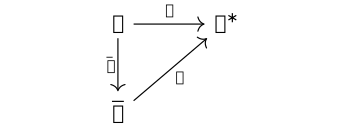
For \(\epsilon =1\), \(J\) is a real structure as in
Example [fcap-003W], and its fixed vectors form a real Spin module whose
complexification is \(S\)
Representation.IsRealStructure.isRealForm. Explicitly,
\[s=\frac {s+Js}{2}+i\frac {s-Js}{2i},\]
with both displayed components fixed by \(J\). For \(\epsilon =-1\),
\(J\) is a quaternionic structure: a conjugate-linear equivariant
map squaring to \(-1\)
Representation.IsQuaternionicStructure.
It has no nonzero fixed vector; together with multiplication by \(i\)
it gives the quaternion relations on the underlying real space.
To apply this to irreducible compact spinors, the restriction to Spin needs justification. Every even monomial in an orthonormal positive real Clifford basis has reverse norm one and lies in Spin. Such monomials span the real even algebra, hence their complex span is the complex even algebra. Therefore the block descriptions in Theorem [fcap-002V] and Proposition [fcap-002W] give irreducible compact half-spin modules in even dimension and an irreducible compact spin module in odd dimension. The even-dimensional halves are inequivalent because their two matrix blocks have different central supports.
In even dimension \(n=2m\), \(J\) preserves each half when \(m\) is
even and exchanges them when \(m\) is odd. In the latter case no
equivariant conjugate-linear bijection of one half to itself can exist:
composing it with \(J\) would give a
complex linear equivalence between the inequivalent halves. Thus the
compact types follow directly from the two flip signs:
\[\begin {array}{c|c}
n\bmod 8&\text {type of an irreducible complex spinor}\\\hline
0,1,7&\text {real}\\
3,4,5&\text {quaternionic}\\
2,6&\text {two conjugate, inequivalent half-spin modules}
\end {array}\]
In the even rows the statement applies to each half-spin module.
The general passage from an invariant nondegenerate complex bilinear
form, symmetric or alternating, and a supplied positive definite
invariant Hermitian form to a real or quaternionic structure is
formalized, for finite-dimensional
irreducible complex representations, by
Representation.exists_isRealStructure_of_isInvariantForm_of_isInvariantSesqForm
and
Representation.exists_isQuaternionicStructure_of_isInvariantForm_of_isInvariantSesqForm.
The explicit \(M\), odd adjustment, and compact residue calculation
are the exterior-basis proof above.
The reversal pairing and its covariance are [meinrenken2013clifford, Section 3.4, Definition 3.6, Example 3.5, and Proposition 3.14, pp. 66--67]. The compact reality classification agrees with [lawson2016spin, Chapter I, items 5.12--5.16, pp. 35--37]. Their negative-square Clifford convention is translated in Proposition [fcap-0042]. The positive Hermitian argument here is specific to the compact real form; it does not assign the same types to other signatures.
Definition [ca-000J]Definition [ca-0012]
Proposition. Real matrix blocks control Spin module complexification [fcap-0042]AGENTDRAFTED
Proposition. Real matrix blocks control Spin module complexification [fcap-0042]AGENTDRAFTED
Let \(A=M_d(D)\), where \(d\geq 1\) and \(D\in \{\mathbb R,\mathbb C,\mathbb H\}\), regarded as a real algebra. Its unique irreducible real left module is \(U=D^d\), with commutant \(D^{\mathrm {op}}\) acting by right multiplication. Its complexification has the following form: \[\begin {array}{c|c|c|c} D&A\otimes _{\mathbb R}\mathbb C&U\otimes _{\mathbb R}\mathbb C &\dim _{\mathbb C}S\\\hline \mathbb R&M_d(\mathbb C)&S&d\\ \mathbb C&M_d(\mathbb C)\oplus M_d(\mathbb C)&S\oplus \overline S&d\\ \mathbb H&M_{2d}(\mathbb C)&S\oplus S&2d \end {array}\] In the complex row, the two summands have different central supports; in the quaternionic row, they are isomorphic. For a product of real matrix algebras, first select one simple block. These statements apply to irreducible real Spin modules obtained from even Clifford algebras because the actual Spin group spans the even algebra.
For the matrix-module assertion, the idempotents \(E_{ii}\) split
any module into its coordinate corners, and \(E_{ij}\) identify the
corners with one another. A simple module therefore has a simple
\(D\)-module in its first corner, which is one-dimensional over the
division algebra \(D\); this gives \(D^d\). For an endomorphism commuting
with the full algebra, the matrix units make all coordinate maps the
same. Commutation with the \(D\)-valued diagonal entries makes this
common map \(f\) left \(D\)-linear, so \(f(x)=xf(1)\). It is therefore
right multiplication by a single element on every coordinate.
With \(R_a(u)=ua\), composition is
\(R_aR_b=R_{ba}\), explaining the opposite algebra. Conjugation
identifies \(D^{\mathrm {op}}\) with \(D\) when only its real algebra
type is recorded. This is the real matrix-module classification of
[lawson2016spin, Chapter I, Theorem 5.6, pp. 31--32].
The matrix-corner reconstruction has the general formal counterpart
ModuleCat.matrixEquivalence, an equivalence between
modules over a ring and modules over its matrix ring with a finite
nonempty index type. The three real types and their commutants are
the specializations calculated here.
The real row complexifies by entrywise scalar extension;
conjugation is the resulting real structure. For the other
rows, give \(U\) the complex structure \(u\mapsto ui\). The
complexification of an underlying real complex space decomposes as
\(S\oplus \overline S\), the two eigenspaces of this operator after
scalar extension. For \(D=\mathbb C\), the central element \(i1\)
acts as \(i\) on one summand and \(-i\) on the other. They are therefore
inequivalent. For \(D=\mathbb H\), right multiplication
\(J(u)=uj\) commutes with the left algebra action and obeys
\(J(uz)=J(u)\overline z\) and \(J^2=-1\). Thus it identifies
\(\overline S\) with \(S\). The quaternion matrix embedding
Quaternion.toComplexMatrix_apply
sends \(1,i,j,k\) to a complex basis of \(M_2(\mathbb C)\).
Scalar extension consequently gives
\(\mathbb H\otimes _{\mathbb R}\mathbb C\simeq M_2(\mathbb C)\)
and then the displayed matrix algebra for general \(d\). Its action
on \(S\) is the defining simple module of complex dimension \(2d\).
Here is the promised group-to-algebra bridge in every
nondegenerate real signature. Choose orthogonal Clifford generators
\(e_i\) with \(e_i^2=\varepsilon _i\in \{1,-1\}\).
The real span \(L\) of Spin is a unital subalgebra, since products
of linear combinations expand into linear combinations of group
products. For \(i\ne j\) with \(\varepsilon _i\varepsilon _j=1\),
\(e_ie_j\) itself lies in Spin by Remark [fcap-0028]. For opposite signs put
\[v=\frac {5\varepsilon _i}{3}e_i+\frac 43e_j,\qquad
Q(v)=\varepsilon _i,\qquad
g=e_iv=\frac 53+\frac 43e_ie_j\in \operatorname {Spin}(Q).\]
The last inclusion again uses \(Q(e_i)Q(v)=1\), hence the actual
norm-one Lipschitz carrier. Therefore
\(e_ie_j=\frac 34(g-\frac 53\,1)\in L\).
All bivectors lie in \(L\); their products and \(1\) span the even
Clifford algebra by its orthogonal monomial basis. Thus
\[\operatorname {span}_{\mathbb R}\operatorname {Spin}(p,q)=\mathcal {C}\kern -2pt\ell ^+(p,q).\]
It follows that real invariant subspaces and commuting endomorphisms
for Spin are exactly those for the even algebra. TauCeti's
CliffordAlgebra.span_spinGroup_eq_even_of_isSquare
proves the spanning conclusion under a square-normalization hypothesis
for every pair of nonisotropic vectors. That hypothesis holds for a
definite real form, but fails for opposite-sign pairs. The displayed
rational combination supplies the indefinite case separately.
For the compact positive form with \(n\geq 1\), the generators \(e_ie_n\), \(1\leq i<n\), square to \(-1\), anticommute, and generate the even algebra. Equality of dimensions gives \[\mathcal {C}\kern -2pt\ell ^+(n,0)\simeq \mathcal {C}\kern -2pt\ell (0,n-1).\] Combining the real classification Remark [fcap-0016] with the three rows above recovers the compact module types of Theorem [fcap-0041]. Lawson--Michelsohn write \(\mathcal {C}\kern -2pt\ell _n\) for our \(\mathcal {C}\kern -2pt\ell (0,n)\); their even-algebra identification and module table use this convention [lawson2016spin, Chapter I, (5.4)--(5.5) and Theorem 5.8, Table III, pp. 32--33]. Their compact Spin-spanning argument appears in Proposition 5.12, p. 36; the opposite-sign calculation above extends the linear-span argument to indefinite forms.
Signature still changes the real module type: \[\begin {aligned} \mathcal {C}\kern -2pt\ell ^+(2,2)&\simeq M_2(\mathbb R)\oplus M_2(\mathbb R),\\ \mathcal {C}\kern -2pt\ell ^+(4,0)&\simeq \mathbb H\oplus \mathbb H. \end {aligned}\] The split case gives real two-dimensional half-spin modules. The compact case gives quaternionic complex two-dimensional halves, each with real dimension four. The Lorentz even algebra \(M_2(\mathbb C)\) in Example [fcap-002L] has a real four-dimensional simple module; its complexification is the pair of inequivalent complex two-dimensional Weyl modules. Thus the compact Hermitian comparison cannot simply be reused for noncompact signatures. In all cases the scalar \(-1\in \operatorname {Spin}\) acts as \(-\operatorname {id}\), retaining the descent obstruction of Proposition [fcap-003M].
Theorem. Occupation signs split the half-spin carrier [fcap-0025]
Theorem. Occupation signs split the half-spin carrier [fcap-0025]
Let \(V=W\oplus W'\) be a complex nondegenerate quadratic space of dimension \(2\ell \), with \(\ell \geq 1\). The summands are maximal isotropic and dual under the polar form \(B_Q\). Choose dual bases \(w_i\in W\) and \(w_i'\in W'\) with \(B_Q(w_i,w_j')=\delta _{ij}\). On \(S=\bigwedge W\), write \(u_I\) for the wedge basis vector indexed by \(I\). The even and odd exterior degrees are \(S^+\) and \(S^-\).
The diagonal Clifford bivector of Convention [fcap-000N]
\[\widehat H_i=\beta _Q(w_i,w_i')
=\tfrac 12[\iota _Q(w_i),\iota _Q(w_i')]\]
has factors acting by \(c_i=\varepsilon _{w_i}\) and \(a_i=a_{w_i'}\) in the
notation of Convention [fcap-0027]. Write \(H_i\) for the resulting endomorphism of
\(S\). The relation \(c_i a_i+a_i c_i=1\) gives
\[N_i:=c_i a_i,\qquad
H_i=N_i-\tfrac 12\operatorname {id}_S.\]
Since \(N_i\) projects onto the vectors containing \(i\),
\[H_i u_I=\begin {cases}
\frac 12 u_I,&i\in I,\\
-\frac 12 u_I,&i\notin I.
\end {cases}\]
The simultaneous weight space for each sign pattern is the line
\(\mathbb C u_I\)
TauCeti.spinWeightSpace_spinWeight. The lines
with even \(|I|\) sum to \(S^+\), and those with odd \(|I|\) sum to
\(S^-\). Each half has dimension \(2^{\ell -1}\), while \(S\) has
dimension \(2^\ell \).
For \(\ell =2\), the occupation test gives the complete table \[\begin {array}{c|c|c|c} I&u_I&(H_1,H_2)&\text {summand}\\ \hline \varnothing &1&(-\tfrac 12,-\tfrac 12)&S^+\\ \{1\}&w_1&(\tfrac 12,-\tfrac 12)&S^-\\ \{2\}&w_2&(-\tfrac 12,\tfrac 12)&S^-\\ \{1,2\}&w_1\wedge w_2&(\tfrac 12,\tfrac 12)&S^+ \end {array}\] Every entry is obtained by applying the two rank-one operators of Example [fcap-001P]; the four displayed lines exhaust \(S\) in this case.
Fulton--Harris use \(B_Q=2Q_{\mathrm {FH}}\), so their standard hyperbolic basis becomes polar-dual here after setting \(w_i=e_i\) and \(w_i'=\frac 12e_{\ell +i}\). Their represented operator is then \(L_{e_i}D_{e_i^*}-\frac 12 I=N_i-\frac 12 I\), assigning the same positive sign to an occupied coordinate [fulton2004representation, Proposition 20.15, proof, pp. 305--306]. Thus their occupation signs and even/odd exterior-degree labels agree with the displayed TauCeti axes.
Goodman--Wallach realize the complex spinor carrier as the exterior algebra of the dual isotropic space [goodman2009symmetry, Theorem 6.1.3, proof, pp. 304--305]. Identify their creation space \(W_{\mathrm {GW}}^*\) with \(W\) here, and their annihilation space \(W_{\mathrm {GW}}\) with \(W'\), taking \(w_i=e_{-i}\) and \(w_i'=e_i\).
The reversed order in [goodman2009symmetry, Lemma 6.2.2 and (6.14), p. 313] gives \[\widehat H_i^{\mathrm {Tau}}=\beta _Q(e_{-i},e_i) =-\widehat H_i^{\mathrm {GW}}.\] Accordingly, their occupied eigenvalue \(-\frac 12\) and unoccupied eigenvalue \(+\frac 12\) negate every pair in the table [goodman2009symmetry, Proposition 6.2.3, proof, pp. 314--315]. The exterior vectors and parity labels remain fixed: \(S^+\) means even \(|I|\), and \(S^-\) means odd \(|I|\). This records the occupation operators, weight lines, and parity decomposition, without a root-system, highest-weight, or irreducibility assertion.
Proposition. The simple type-D operators generate the positive nilradical [fcap-002X]AGENTDRAFTED
Proposition. The simple type-D operators generate the positive nilradical [fcap-002X]AGENTDRAFTED
Let \(V=W\oplus W'\) be a complex nondegenerate quadratic space with a chosen split polarization of rank \(\ell \geq 4\). Choose polar-dual bases \(e_i\in W\) and \(e_i'\in W'\) with \(B_Q(e_i,e_j')=\delta _{ij}\), and put \(S=\bigwedge W\). Write \(c_i\) for left creation by \(e_i\), \(a_i\) for contraction by \(e_i'\), \(N_i=c_i a_i\), and \[H_i=N_i-\tfrac 12.\] Thus \(\epsilon _i(H_j)=\delta _{ij}\) fixes the Cartan coordinates, and the occupation signs are those of Theorem [fcap-0025]. We choose \[\Phi ^+=\{\epsilon _i-\epsilon _j,\ \epsilon _i+\epsilon _j:i<j\}\] and the Borel \(\mathfrak b=\mathfrak h\oplus \bigoplus _{\alpha \in \Phi ^+}\mathfrak g_\alpha \). Equivalently, \(\mathfrak b\) stabilizes the flag \(\langle e_1\rangle \subset \langle e_1,e_2\rangle \subset \cdots \subset W\); in the ordered Witt basis \(e_1,\ldots ,e_\ell ,e_\ell ',\ldots ,e_1'\) it is the upper-triangular Borel.
For the simple roots
\(\alpha _i=\epsilon _i-\epsilon _{i+1}\) along the chain and
\(\alpha _\ell =\epsilon _{\ell -1}+\epsilon _\ell \) at the fork, take
\[\begin {aligned}
E_i&=c_i a_{i+1},&F_i&=c_{i+1}a_i
&& (1\leq i<\ell ),\\
E_\ell &=c_{\ell -1}c_\ell ,&
F_\ell &=a_\ell a_{\ell -1}.&&
\end {aligned}\]
The reversed contraction order in \(F_\ell \) fixes the bracket sign. On an
increasing exterior word \(u_I\), a chain operator replaces an occupied
\(i+1\) by an absent \(i\), or performs the reverse replacement, with
coefficient \(1\); otherwise it gives zero. The fork operators create or
remove the final pair, again with coefficient \(1\), when the corresponding
occupancy condition holds. The CAR then gives
\[[E_i,F_i]=h_i,\qquad
h_i=N_i-N_{i+1}\ (i<\ell ),\qquad
h_\ell =N_{\ell -1}+N_\ell -1.\]
Under the bivector map these are the products
\(e_i e_{i+1}'\), \(e_{i+1}e_i'\), \(e_{\ell -1}e_\ell \), and
\(e_\ell 'e_{\ell -1}'\). Distinct orthogonal factors contribute no hidden
scalar term. TauCeti identifies these exact Clifford representatives with
the numbered type-D matrix roots and coroots
TauCeti.SpinPolarizationData.typeDQuadraticEquiv_rootGenerator
TauCeti.SpinPolarizationData.typeDQuadraticEquiv_cartanGenerator.
It remains to pass from the simple roots to the chosen Borel. Put
\[X_{ij}=c_i a_j,\qquad Y_{ij}=c_i c_j\qquad (i<j).\]
Their Cartan weights are \(\epsilon _i-\epsilon _j\) and
\(\epsilon _i+\epsilon _j\). The identities
\[\begin {aligned}
[X_{ij},X_{jk}]&=X_{ik},\\
[X_{i,\ell -1},Y_{\ell -1,\ell }]&=Y_{i,\ell },\\
[X_{j,\ell },Y_{i,\ell }]&=Y_{ij}
\end {aligned}\]
for the indicated distinct ordered indices generate every positive
\(X_{ij}\) and \(Y_{ij}\) from the simple operators. These are all positive
root spaces of \(\mathfrak {so}(V,Q)\), so their span is the full nilradical
\(\mathfrak n^+\). In particular, a vector killed by every \(E_i\) is killed
by \(\mathfrak n^+\): brackets and linear combinations preserve its
annihilator. This final root-space argument supplies the Borel bridge; the
formal file presently proves over \(\mathbb Q\) annihilation by the Lie span
of the simple positive generators, without identifying that span with a
compatible Borel
TauCeti.SpinPolarizationData.typeDSpinSerreRepresentation_positiveSimpleRootLieSpan_le_lieAnnihilator.
Theorem. The two top exterior words are the type-D fork highest vectors [fcap-002Y]AGENTDRAFTED
Theorem. The two top exterior words are the type-D fork highest vectors [fcap-002Y]AGENTDRAFTED
Continue with the Cartan and Borel of Proposition [fcap-002X]. For the increasing exterior basis \(u_I\), set \[\Omega =u_{\{1,\ldots ,\ell \}},\qquad \widehat \Omega =u_{\{1,\ldots ,\ell -1\}}.\] Every positive chain operator kills \(\Omega \) by duplicate creation. It kills \(\widehat \Omega \) either by the same mechanism or, on the final chain edge, because the contracted last coordinate is absent. The positive fork operator kills \(\Omega \) by duplicate creation and \(\widehat \Omega \) because coordinate \(\ell -1\) is already present. The preceding root-space generation therefore makes both vectors highest for \(\mathfrak b\).
Since \(H_i\) has eigenvalue \(+\frac 12\) on an occupied coordinate and \(-\frac 12\) on an unoccupied one, their weights are \[\operatorname {wt}(\Omega ) =\omega _\ell =\tfrac 12(\epsilon _1+\cdots +\epsilon _\ell ),\] \[\operatorname {wt}(\widehat \Omega ) =\omega _{\ell -1} =\tfrac 12(\epsilon _1+\cdots +\epsilon _{\ell -1}-\epsilon _\ell ).\] The first word lies in \(S^+=\bigwedge ^{\mathrm {even}}W\) exactly when \(\ell \) is even, while the second has the opposite parity. Hence, with \(S^\pm \) defined by exterior parity as in Theorem [fcap-0025], \[\begin {array}{c|cc} &S^+&S^-\\ \hline \ell \text { even}&L(\omega _\ell )&L(\omega _{\ell -1})\\ \ell \text { odd}&L(\omega _{\ell -1})&L(\omega _\ell ) \end {array}\] The parity label is therefore not an independent name for the all-plus weight.
For completeness, each displayed module is irreducible for the type-D Lie action. The commuting \(H_i\) have distinct joint eigenvalues on the one-dimensional lines \(\mathbb C u_I\), so polynomial projections in the \(H_i\) extract a nonzero basis word from any nonzero invariant subspace. The chain operators move occupied coordinates, while the fork pair creates or removes two of them. Their occupancy graph connects all subsets of a fixed parity. The invariant subspace consequently contains every basis word of that parity. This proves irreducibility without identifying it with the separate group-level theorem.
The generator calculation is already defined over \(\mathbb Q\). In the
standard model set \(S_{\mathbb Q}=\bigwedge _{\mathbb Q}\mathbb Q^\ell \). The basis
map
\[\begin {aligned}
\mathbb C\otimes _{\mathbb Q}S_{\mathbb Q}
&\longrightarrow \bigwedge _{\mathbb C}\mathbb C^\ell ,\\
z\otimes u_I&\longmapsto z u_I.
\end {aligned}\]
is an equivalence. Every \(E_i\) and \(F_i\) above has matrix entries
\(0,1,-1\); the coroot matrices are integral and the \(H_i\) matrices are
half-integral. Thus these actions, their annihilation identities, and their
weights commute with extension from \(\mathbb Q\) to \(\mathbb C\). A chosen
complex polar-dual basis then transports the standard calculation to
\(W\oplus W'\). TauCeti proves the two simple-generator annihilation
statements and exact fork weights over \(\mathbb Q\)
TauCeti.SpinPolarizationData.typeDSpinRep_serreE_exteriorBasis_univ_eq_zero
TauCeti.SpinPolarizationData.typeDSpinRep_serreE_exteriorBasis_univ_erase_last_eq_zero
TauCeti.SpinPolarizationData.isCartanWeightVector_typeDSpinRep_exteriorBasis_univ
TauCeti.SpinPolarizationData.isCartanWeightVector_typeDSpinRep_exteriorBasis_univ_erase_last.
The displayed scalar-extension and Borel steps explain how this rational
calculation gives the complex highest-weight identities; they do not assert
a packaged Lean base-change theorem.
There are also direct highest-vector counterparts over any
characteristic-zero field. They use a supplied polarization with no residual
line, a basis of \(W\) of rank \(n\geq 4\), and the concrete type-D
Cartan and Borel:
TauCeti.SpinPolarizationData.isHighestWeightVector_typeDSpinLieRep_exteriorBasis_univ
TauCeti.SpinPolarizationData.isHighestWeightVector_typeDSpinLieRep_exteriorBasis_univ_erase_last.
With \(n=\ell \), their zero-based Cartan dual-basis indices \(n-1\) and
\(n-2\) are our \(\omega _\ell \) and \(\omega _{\ell -1}\), respectively.
The restricted declarations also retain the parity assignment in the
table. In even rank, \(\Omega \in S^+\) and
\(\widehat \Omega \in S^-\)
TauCeti.SpinPolarizationData.isHighestWeightVector_typeDSpinPlusLieRep_exteriorBasis_univ_of_even
TauCeti.SpinPolarizationData.isHighestWeightVector_typeDSpinMinusLieRep_exteriorBasis_univ_erase_last_of_even;
in odd rank, \(\Omega \in S^-\) and \(\widehat \Omega \in S^+\)
TauCeti.SpinPolarizationData.isHighestWeightVector_typeDSpinMinusLieRep_exteriorBasis_univ_of_odd
TauCeti.SpinPolarizationData.isHighestWeightVector_typeDSpinPlusLieRep_exteriorBasis_univ_erase_last_of_odd.
These assert highest vectors in the indicated modules; the occupancy
argument above supplies their irreducibility.
[fulton2004representation, Proposition 20.15 and proof, pp. 305--306] independently identify the two irreducible half-spin modules and give the same parity-dependent fork assignment after the polar-dual rescaling already recorded in Theorem [fcap-0025]. Their occupied Cartan sign is positive, as it is here.
[goodman2009symmetry, Proposition 6.2.3, pp. 314--315] independently gives the two irreducible modules and their signed half-sum weights. Its creation space is identified with our \(W\), but its occupied Cartan sign is negative. Under \(H_i^{\mathrm {Tau}}=-H_i^{\mathrm {GW}}\) the weights and positive systems both reverse. The exterior-parity labels remain fixed; the assignment of the two fork highest weights to them must be translated with the Cartan sign and Borel.
Theorem. The top exterior word is the type-B spin highest vector [fcap-002Z]AGENTDRAFTED
Theorem. The top exterior word is the type-B spin highest vector [fcap-002Z]AGENTDRAFTED
Let \(V=W\oplus W'\oplus \mathbb C z\) be a nondegenerate quadratic space of dimension \(2\ell +1\), with \(\ell \geq 1\). Assume \(W,W'\) are complementary polar-dual isotropic spaces, \(z\) is orthogonal to both, and \(Q(z)=1\). Choose bases \(e_i,e_i'\) with \(B_Q(e_i,e_j')=\delta _{ij}\) and the plus odd action on \(S=\bigwedge W\), \[\rho (\iota _Q(z))=\alpha ,\] where \(\alpha \) is exterior parity. This sign is part of the choice: \(Q(z)=1\) alone says only that the line coordinate squares to \(1\). Write \(c_i,a_i,N_i,H_i,\epsilon _i\) as in Theorem [fcap-0025].
Choose the positive roots
\[\Phi ^+=\{\epsilon _i-\epsilon _j,\ \epsilon _i+\epsilon _j:i<j\}
\cup \{\epsilon _i:1\leq i\leq \ell \}.\]
The chain simple roots use \(E_i=c_i a_{i+1}\) and
\(F_i=c_{i+1}a_i\). At the terminal short root
\(\alpha _\ell =\epsilon _\ell \), take
\[E_\ell =c_\ell \alpha ,\qquad
F_\ell =\alpha a_\ell ,\qquad
[E_\ell ,F_\ell ]=2N_\ell -1.\]
The matrix short root has a coefficient \(2\) because
\(B_Q(z,z)=2\); the Clifford bivector is nevertheless exactly
\(e_\ell z\), with no extra factor \(\frac 12\)
TauCeti.SpinPolarizationData.typeBQuadraticEquiv_typeBShortRootGenerator.
On an increasing word, the terminal creation or removal sign cancels the
parity sign, so the short operators insert or remove coordinate \(\ell \)
with coefficient \(1\)
TauCeti.SpinPolarizationData.typeBSpinRep_shortRootGenerator_apply
TauCeti.SpinPolarizationData.typeBSpinRep_shortNegativeRootGenerator_apply.
This convention gives the same flag Borel as in Proposition [fcap-002X]. For \(i<j\), put \(X_{ij}=c_i a_j\), \(Y_{ij}=c_i c_j\), and \(K_i=c_i\alpha \). The chain commutators generate every \(X_{ij}\), while \[[X_{ij},K_j]=K_i,\qquad [K_i,K_j]=-2Y_{ij}.\] Because \(2\) is invertible over \(\mathbb C\), the simple chain operators and \(K_\ell \) generate the root spaces of every positive short and long root. They therefore generate the full positive nilradical.
The top word \[\Omega _B=e_1\wedge \cdots \wedge e_\ell \] is killed by each positive chain root and by \(E_\ell \), since the relevant creation coordinate is already occupied. The chain coroots have eigenvalue \(0\), and the terminal coroot \(2N_\ell -1\) has eigenvalue \(1\). Hence \[\operatorname {wt}(\Omega _B) =\omega _\ell =\tfrac 12(\epsilon _1+\cdots +\epsilon _\ell ).\] The chain moves together with the terminal toggle connect all exterior basis words. As in Theorem [fcap-002Y], the distinct joint \(H_i\)-weights first project any nonzero invariant subspace onto a basis line; the root moves then reach every line. Thus \(S\) is the irreducible type-\(B_\ell \) module \(L(\omega _\ell )\). The short root changes exterior degree, so neither \(S^+\) nor \(S^-\) is a type-B submodule.
[fulton2004representation, Proposition 20.20, p. 307] independently identifies the odd-dimensional spin representation as the irreducible module of highest weight \(\frac 12(\epsilon _1+\cdots +\epsilon _\ell )\). The preceding short-root and nilradical calculations give that conclusion in the fixed FCAP operator convention.
[goodman2009symmetry, Proposition 6.2.4, p. 315]
independently gives the same irreducible type-B module and its half-sign
weights. As in Theorem [fcap-0025], its occupied Cartan sign is opposite ours;
negating its Cartan axes and positive system gives the displayed highest
weight. TauCeti formalizes the short and difference-root actions and the
integral simple-coroot eigenvalues
TauCeti.SpinPolarizationData.typeBSpinRep_differenceRootGenerator_apply
TauCeti.SpinPolarizationData.spinAction_typeBQuadraticEquiv_typeBSimpleCorootGenerator_basis.
The top word's weight and annihilation data are available over any
field with \(2\) invertible, for a supplied polarization, basis of \(W\),
and residual vector \(z\) with \(Q(z)=1\). The Cartan acts on
\(\Omega _B\) through the terminal fundamental weight
TauCeti.SpinPolarizationData.typeBSpinLieRep_apply_cartan_exteriorBasis_univ,
and the Lie subalgebra generated by all positive simple-root generators
annihilates it
TauCeti.SpinPolarizationData.typeBSpinLieRep_lieSpan_range_simpleRootGenerator_le_lieAnnihilator_exteriorBasis_univ.
The declarations index the rank by \(n+1=\ell \); their terminal
\(\operatorname {Fin.last}(n)\) labels our \(\omega _\ell \).
The general highest-vector criterion is available separately:
a nonzero Cartan weight vector is highest exactly when every raising
generator kills it
LieAlgebra.Basis.isHighestWeightVector_iff_forall_e.
It assumes a characteristic-zero field, a finite-dimensional Lie algebra
with nondegenerate Killing form, and a Lie basis. For type B, the Killing
condition follows when every endomorphism in the full standard action is
triangularizable, in particular over \(\mathbb C\)
TauCeti.isKilling_typeB.
Triangularizability of the diagonal Cartan alone is not this hypothesis.
The selected spin-module declarations give the weight and annihilation
data, rather than a separately packaged highest-vector conclusion.
The Borel-generation and irreducibility arguments above complete the
displayed module identification.
Proposition. Exterior weights give the finite spin characters [fcap-0030]AGENTDRAFTED
Proposition. Exterior weights give the finite spin characters [fcap-0030]AGENTDRAFTED
Work over the complex split models and positive systems fixed in the preceding type-B and type-D cards. In type \(B_\ell \) assume \(\ell \geq 1\); in type \(D_\ell \) assume \(\ell \geq 4\). For \(I\subseteq \{1,\ldots ,\ell \}\), put \[\lambda _I=\tfrac 12\left ( \sum _{i\in I}\epsilon _i-\sum _{i\notin I}\epsilon _i\right ).\] By Theorem [fcap-0025], the line \(\mathbb C u_I\) has weight \(\lambda _I\); distinct subsets give distinct weights. Consequently \[\operatorname {ch}S_{B_\ell } =\sum _I e^{\lambda _I} =\prod _{i=1}^{\ell } \left (e^{\epsilon _i/2}+e^{-\epsilon _i/2}\right ),\] and the type-D parity carriers have \[\operatorname {ch}S_D^+ =\sum _{\lvert I\rvert \ {\rm even}}e^{\lambda _I},\qquad \operatorname {ch}S_D^- =\sum _{\lvert I\rvert \ {\rm odd}}e^{\lambda _I}.\] If \(a_i=e^{\epsilon _i/2}\) and \(b_i=e^{-\epsilon _i/2}\), sorting the product by occupied parity gives \[\operatorname {ch}S_D^\pm =\tfrac 12\left [ \prod _i(a_i+b_i)\ \mathbin {\pm }\ \prod _i(b_i-a_i)\right ].\] The order \(b_i-a_i\) makes an occupied coordinate contribute the minus sign. These are finite sums obtained from the exterior basis, without invoking a general character formula.
The complete half-sum weights above become honest characters on the
Spin torus. Put
\(A_i=e_i e_i'\), so its action is \(N_i\). For
\(t\in \mathbb C^\times \), define
\[g_i(t)=tA_i+t^{-1}(1-A_i)
=(t e_i+t^{-1}e_i')(e_i+e_i').\]
Both vector factors have quadratic value \(1\); the pair criterion
therefore puts \(g_i(t)\) in the actual Spin carrier
CliffordAlgebra.ι_mul_ι_mem_spinGroup_of_norm_mul_norm_eq_one.
The elements for different coordinates commute, and
\[g_i(t)u_I=
\begin {cases}t\,u_I,&i\in I,\\t^{-1}u_I,&i\notin I.\end {cases}\]
Their vector action scales \(e_i\) by \(t^2\), \(e_i'\) by \(t^{-2}\), and
fixes the other coordinates. Thus
\(g(t_1,\ldots ,t_\ell )=\prod _i g_i(t_i)\) covers the standard orthogonal
torus by coordinatewise squaring.
The kernel of this parameterization is \[\{(t_i):t_i\in \{1,-1\},\ \prod _i t_i=1\}.\] Indeed, equality of its spinor action with the identity forces \(t_i^2=1\) by comparing weights that differ in coordinate \(i\), and the vacuum weight then forces \(\prod _i t_i=1\). Conversely such a tuple gives the actual Clifford scalar \(\prod _i t_i=1\). Thus both implications hold directly for the group parameterization. The image contains the scalar \(-1\); together with the usual \(\{1,-1\}\) kernel of \(\operatorname {Spin}\to SO\) [fulton2004representation, Proposition 20.28, pp. 308--309], this is the full inverse-image torus.
A Laurent monomial on the parameter torus descends through the displayed sign kernel exactly when all its integer exponents have the same parity. Relative to the orthogonal coordinates \(x_i=t_i^2\), the Spin weight lattice is therefore \[P=\mathbb Z^\ell \cup \left (\mathbb Z+\tfrac 12\right )^\ell .\] The complete signed sums \(\lambda _I\) lie in \(P\), while an individual symbol \(e^{\epsilon _i/2}\) need not itself be a character. The orthogonal torus has character lattice \(\mathbb Z^\ell \); every spinor half-sum takes the scalar \(-1\) to \(-1\) and hence does not descend to it. In type D the adjoint torus has the still smaller root lattice.
[goodman2009symmetry, Corollary 6.3.9, p. 322; Sections 7.1 and 7.2.3, pp. 330 and 346] independently identify complex Spin as algebraically simply connected, explain the single-valued square-root torus factors, and identify the torus-character lattice with the weight lattice. Those group results support the character interpretation. The pinned TauCeti results used above are Lie and Clifford statements; no formal integration or differentiation comparison is asserted.
For \(B_2\), the four distinct weights are summarized by \[\operatorname {ch}S_{B_2} =(x^{1/2}+x^{-1/2})(y^{1/2}+y^{-1/2}),\] with highest weight \((\epsilon _1+\epsilon _2)/2=\omega _2\). For \(D_4\), the even- and odd-cardinality sums contain eight weights each: \(\omega _4=(\epsilon _1+\epsilon _2+\epsilon _3+\epsilon _4)/2\) lies in \(S^+\), while \(\omega _3=(\epsilon _1+\epsilon _2+\epsilon _3-\epsilon _4)/2\) lies in \(S^-\). This is a finite character check, not a triality claim.
Proposition. Complex Spin in dimension three is \(SL_2\) on the spin module [fcap-0031]AGENTDRAFTED
Proposition. Complex Spin in dimension three is \(SL_2\) on the spin module [fcap-0031]AGENTDRAFTED
Let \(V\) be a three-dimensional complex quadratic space with a supplied nondegenerate polarization \[V=\mathbb C w\oplus \mathbb C z\oplus \mathbb C w',\qquad B_Q(w,w')=1,\quad Q(z)=1,\] and choose the line coordinate so that \(\rho (z)=\alpha \), exterior parity. On \(S=\bigwedge (\mathbb Cw)\), use the ordered basis \((1,w)\). The even Clifford action then gives a homomorphism \[\operatorname {Spin}(Q)\longrightarrow SL(S)\simeq SL_2(\mathbb C).\] Reversal is matrix adjugation in this basis, so reverse norm one forces determinant one. This is the determinant calculation behind the dimension-three case; the target is the complex group, rather than the compact real unit-quaternion group of Example [fcap-002H].
There is a concrete inverse. For \(c\in \mathbb C\), the two products \[(z+cw)z,\qquad z(z+cw')\] are products of two norm-one vectors and hence are actual Spin elements. Creation, contraction, and parity from Proposition [fcap-002W] give their matrices \[I+cE_{21},\qquad I+cE_{12}\] in the ordered basis \((1,w)\). These elementary transvections generate \(SL_2(\mathbb C)\). Writing a target matrix as a word in them and replacing each factor by its displayed lift gives a preimage; faithfulness of the even Clifford action makes the result independent of the chosen word. Thus restriction and this lift are inverse group maps, and the same basis intertwines the spin action with the standard two-dimensional module.
TauCeti proves this exact group-and-module statement over any field
with \(2\ne 0\), given polarization data and dimension three
TauCeti.exists_spinGroup_mulEquiv_specialLinearGroup_and_spinRep_equiv_stdSLRep_of_finrank_eq_three.
Its chosen finite basis may reindex the two exterior coordinates; the
formulas above use the stated basis \((1,w)\) and the corresponding basis
change. The theorem needs no additional separable-closure hypothesis once
the polarization is supplied.
Fulton--Harris identify \(\operatorname {Spin}_3(\mathbb C)\) with \(SL_2(\mathbb C)\) and distinguish it from the compact real form \(SU(2)\) [fulton2004representation, Section 10.3, pp. 143--144; Exercise 20.39, p. 311]. Goodman--Wallach independently list the same complex exceptional isomorphism [goodman2009symmetry, Section 6.3.3, Exercise 1, p. 322]. Their statements name the target; the two Clifford products above supply the coordinate lifts used here. Meinrenken's \(\operatorname {Spin}(3)=SU(2)\) is instead the compact real comparison [meinrenken2013clifford, Section 3.7.6, p. 83].
Proposition. Complex Spin in dimension four is two copies of \(SL_2\) [fcap-0032]AGENTDRAFTED
Proposition. Complex Spin in dimension four is two copies of \(SL_2\) [fcap-0032]AGENTDRAFTED
Let \(V=W\oplus W'\) be a split nondegenerate complex quadratic
space with \(\dim W=2\), and choose polar-dual bases
\(e_1,e_2\) and \(e'_1,e'_2\). Put
\(S^+=\bigwedge ^{\mathrm {even}}W\) and
\(S^-=\bigwedge ^{\mathrm {odd}}W\), with ordered bases
\((1,e_1\wedge e_2)\) and \((e_1,e_2)\). The paired
half-spin action from Theorem [fcap-002V] gives an algebra equivalence
\[\Phi :\mathcal {C}\kern -2pt\ell (Q)^0\longrightarrow
\operatorname {End}(S^+)\times \operatorname {End}(S^-)
\simeq M_2(\mathbb C)\times M_2(\mathbb C)\]
TauCeti.SpinPolarizationData.evenCliffordEquivProdEnd.
The two factors here are the actions on the fixed exterior-parity
summands, not merely two abstract matrix blocks.
For exterior spinors define \[\langle s,t\rangle = [e_1\wedge e_2]\bigl (\operatorname {rev}_{\wedge }(s)\wedge t\bigr ),\] where the bracket takes the coefficient of \(e_1\wedge e_2\). On each displayed half-spin basis its matrix is \[J=\begin {pmatrix}0&1\\-1&0\end {pmatrix},\] and the two parity summands are orthogonal. Each creation operator and each polar-dual contraction operator is self-adjoint for this pairing, so Clifford reversal becomes the symplectic adjoint on each factor. Consequently, if \(\Phi (x)=(A,D)\), then \[\Phi (\operatorname {rev}(x)) =\bigl (J^{-1}A^{\mathsf T}J,J^{-1}D^{\mathsf T}J\bigr ) =\bigl (\operatorname {adj}(A),\operatorname {adj}(D)\bigr ).\] Therefore \(\operatorname {rev}(x)x=1\) is equivalent to \(\det A=\det D=1\).
We use one carrier-completion observation. In any positive-dimensional
nondegenerate complex quadratic space, suppose an even Clifford unit \(u\)
satisfies \(\operatorname {rev}(u)u=1\) and is already known to normalize
the vector subspace. Its conjugation action is an isometry, so choose a
vector-generated Lipschitz unit with the same orthogonal action
CliffordAlgebra.lipschitzToOrthogonal_surjective.
The quotient of that lift and \(u\) satisfies \(\alpha (z)v=vz\); graded
centrality makes it a nonzero scalar
CliffordAlgebra.exists_eq_algebraMap_of_involute_mul_ι_eq_ι_mul.
Such a scalar unit is Lipschitz
CliffordAlgebra.unitsMap_algebraMap_mem_lipschitzGroup.
Hence \(u\) is Lipschitz, even, and reverse-norm one, and the exact carrier
criterion of Remark [fcap-0028] puts it in Spin.
The forward restriction is thus a group homomorphism \[\operatorname {Spin}(Q)\longrightarrow SL(S^+)\times SL(S^-).\] Conversely, take \((A,D)\in SL_2(\mathbb C)\times SL_2(\mathbb C)\) and let \(x=\Phi ^{-1}(A,D)\). The adjugate calculation makes \(x\) an even Clifford unit with \(\operatorname {rev}(x)x=1\). It remains to prove that this algebraic preimage lies in the actual vector-generated Spin group.
For \(v\in V\), set \(y=xvx^{-1}\). It is odd and reversal-fixed: \[\operatorname {rev}(y) =\operatorname {rev}(x^{-1})v\operatorname {rev}(x)=y.\] In an orthogonal-basis Clifford expansion in dimension four, the odd part has only grades one and three. Reversal has signs \(+1\) and \(-1\) on those grades, so \(y\in V\). Moreover \(y^2=Q(v)1\); conjugation hence induces an isometry of \((V,Q)\). The carrier-completion observation now places \(x\) in the actual Spin group.
The restriction and \((A,D)\mapsto \Phi ^{-1}(A,D)\) are now inverse group maps. Hence \[\operatorname {Spin}_4(\mathbb C)\simeq SL_2(\mathbb C)\times SL_2(\mathbb C),\] and the two half-spin representations are the two standard two-dimensional modules. [fulton2004representation, Exercise 20.39, p. 311] state this group-and-module identification. [goodman2009symmetry, Section 6.3.3, Exercise 1, p. 322] independently give the same complex group. The displayed pairing, adjugate calculation, and carrier argument provide the inverse.
[meinrenken2013clifford, Section 3.7.6, p. 83]
identifies the compact real form as \(\operatorname {Spin}(4)=SU(2)\times SU(2)\). Its
quaternion-pair model is Example [fcap-002K], while the Lorentzian real form
\(SL_2(\mathbb C)\) is Example [fcap-002L]; neither replaces the split complex
proof above. TauCeti formalizes the paired half-spin algebra and matrix maps
TauCeti.SpinPolarizationData.evenCliffordEquivProdMatrix.
The actual group and both modules also have a direct formal counterpart
TauCeti.exists_spinGroup_mulEquiv_specialLinearGroup_prod_and_halfSpin_equiv_stdSLRep_of_finrank_eq_four.
For a supplied polarization over a field of characteristic different from
two and ambient dimension four, it constructs a group equivalence
\(\operatorname {Spin}(Q)\simeq SL_2(K)\times SL_2(K)\) together with equivalences from
the existing plus and minus half-spin subrepresentations to the standard
representations pulled back from the first and second factors.
The dimension hypothesis forces the residual line to vanish. The theorem
chooses bases of both half-spin spaces, so its matrix coordinates agree
with the ordered bases used here after basis transport. The displayed
pairing and carrier proof give the comparison in our explicit coordinates.
Proposition. Complex Spin in dimension five is the symplectic group on spinors [fcap-0033]AGENTDRAFTED
Proposition. Complex Spin in dimension five is the symplectic group on spinors [fcap-0033]AGENTDRAFTED
Let \(V=W\oplus \mathbb Cz\oplus W'\) be a five-dimensional complex
quadratic space with a supplied nondegenerate polarization, where
\(\dim W=2\), \(Q(z)=1\), and \(\rho (z)=\alpha \). On
\(S=\bigwedge W\), use the ordered basis
\[(1,e_1\wedge e_2,e_1,e_2).\]
Define
\[\langle s,t\rangle =
[e_1\wedge e_2]\bigl (\operatorname {rev}_{\wedge }(s)\wedge t\bigr ).\]
Its matrix is \(\Omega =\operatorname {diag}(J,J)\), where
\(J=\left (\begin {smallmatrix}0&1\\-1&0\end {smallmatrix}\right )\).
The pairing preserves exterior parity, so parity itself is self-adjoint.
Each creation operator and each polar-dual contraction operator is
self-adjoint as well. Consequently the faithful
even Clifford equivalence from Proposition [fcap-002W] takes reversal to
\[A\longmapsto A^{\dagger }
=\Omega ^{-1}A^{\mathsf T}\Omega \]
TauCeti.SpinPolarizationData.evenCliffordEquivEnd.
Reverse norm one is therefore exactly the symplectic equation
\(A^{\mathsf T}\Omega A=\Omega \).
This norm calculation alone does not yet prove membership in the vector-generated Spin group. The five vector operators \[c_1,\ c_2,\ a_1,\ a_2,\ \alpha \] are linearly independent, traceless, and \(\Omega \)-self-adjoint. The self-adjoint subspace of \(M_4(\mathbb C)\) has dimension six, and its trace-zero part has dimension five because \(\operatorname {tr}(I)=4\). Hence the Clifford image of the vector space is exactly \[\rho (V)= \{T:T^{\dagger }=T,\ \operatorname {tr}(T)=0\}.\] Conjugation by every \(A\in Sp_{\Omega }(4,\mathbb C)\) preserves this subspace: symplectic conjugation preserves the adjoint condition, and trace is conjugation-invariant.
The odd Clifford action is injective on the vector subspace. More generally, if an odd Clifford value \(y\) acts by zero, then \(zy\) is even and acts by zero. Faithfulness of the even action and invertibility of \(z\) give \(y=0\). Thus preservation of the displayed matrix subspace lifts to preservation of \(V\) inside the Clifford algebra.
For \(A\in Sp_{\Omega }(4,\mathbb C)\), let \(x\) be its unique preimage under the even Clifford equivalence. The adjoint equation gives \(\operatorname {rev}(x)x=1\), while the preceding calculation proves \(xVx^{-1}=V\). The carrier-completion argument of Proposition [fcap-0032] now places \(x\) in actual Spin. Conversely, every Spin element has symplectic matrix because its reverse norm is one. These assignments are inverse group maps, and the chosen exterior basis is the module intertwiner: \[\operatorname {Spin}_5(\mathbb C)\simeq Sp_{\Omega }(4,\mathbb C), \qquad S\simeq \mathbb C^4.\]
Fulton--Harris state the same group and standard spin-module identification [fulton2004representation, Exercise 20.39, p. 311]. Goodman--Wallach independently write the target as \(Sp(2,\mathbb C)\), the rank-two symplectic group on a four-dimensional complex space [goodman2009symmetry, Section 6.3.3, Exercise 1, p. 322]. The trace-zero normalization calculation supplies the actual group inverse rather than inferring the image from a dimension count. By contrast, Meinrenken's \(\operatorname {Spin}(5)=Sp(2)\) is the compact quaternionic real form [meinrenken2013clifford, Section 3.7.6, pp. 83--84].
TauCeti proves that in odd dimension the even Clifford action is an
equivalence onto the full endomorphism algebra and is faithful
TauCeti.SpinPolarizationData.evenCliffordEquivEnd
TauCeti.evenSpinAction_injective.
It does not package the invariant alternating form or the group image as
\(Sp_4\); those calculations are the explicit argument above.
Proposition. Complex Spin in dimension six is \(SL_4\) on a half-spin module [fcap-0034]AGENTDRAFTED
Proposition. Complex Spin in dimension six is \(SL_4\) on a half-spin module [fcap-0034]AGENTDRAFTED
Let \(V=W\oplus W'\) be a split nondegenerate complex quadratic space with \(\dim W=3\). For polar-dual bases \(e_i,e'_i\), use \[S^+:(1,e_{12},e_{13},e_{23}),\qquad S^-:(e_{123},-e_3,e_2,-e_1).\] For \(\langle s,t\rangle =[e_{123}]\bigl ( \operatorname {rev}_{\wedge }(s)\wedge t\bigr )\), the second displayed basis is dual to the first, and the full pairing matrix on \(S^+\oplus S^-\) is \[\Omega =\begin {pmatrix}0&I_4\\-I_4&0\end {pmatrix}.\] Clifford generators are self-adjoint for this pairing. Under the paired even-algebra equivalence \(\Phi \) of Theorem [fcap-002V], reversal therefore sends \[(A,D)\longmapsto (D^{\mathsf T},A^{\mathsf T}).\] Thus the even reverse-norm-one group is \[\{(A,A^{-\mathsf T}):A\in GL_4(\mathbb C)\}.\] At this stage it is \(GL_4\), not yet the actual Spin group.
The vector-normalization condition cuts out the determinant-one subgroup. If \(v=\sum _i x_i e_i+y_i e'_i\), its odd Clifford action has block form \[\rho (v)=\begin {pmatrix}0&B_v\\B_v^\sharp &0\end {pmatrix},\] where \[B_v=\begin {pmatrix} 0&-y_3&y_2&-y_1\\ y_3&0&x_1&x_2\\ -y_2&-x_1&0&x_3\\ y_1&-x_2&-x_3&0 \end {pmatrix}.\] These matrices run through all skew \(4\times 4\) matrices. For a skew matrix \(B\), define \(B^\sharp \) by \[\begin {aligned} (B^\sharp )_{01}&=B_{23},& (B^\sharp )_{02}&=-B_{13},& (B^\sharp )_{03}&=B_{12},\\ (B^\sharp )_{12}&=B_{03},& (B^\sharp )_{13}&=-B_{02},& (B^\sharp )_{23}&=B_{01}, \end {aligned}\] with skew extension. Then \((B^\sharp )^\sharp =B\), \(BB^\sharp =-\operatorname {Pf}(B)I\), and \(\operatorname {Pf}(B_v)=-\sum _i x_i y_i\). The last two identities give \(\rho (v)^2=Q(v)I\), matching the Clifford convention.
The complementary-minor identity is \[(ABA^{\mathsf T})^\sharp =\det (A)A^{-\mathsf T}B^\sharp A^{-1}.\] One derivation identifies a skew matrix with an alternating two-form: the operation \(B\mapsto B^\sharp \) is the complementary two-form determined by the ordered volume basis, while \(\bigwedge ^4 A\) multiplies that volume by \(\det A\). Evaluating on basis pairs gives the six coordinate rules above and the displayed identity.
Conjugation by \(\operatorname {diag}(A,A^{-\mathsf T})\) sends the two off-diagonal blocks to \[ABA^{\mathsf T},\qquad A^{-\mathsf T}B^\sharp A^{-1}.\] By the complementary-minor identity, it preserves the vector graph \(\{(B,B^\sharp ):B^{\mathsf T}=-B\}\) exactly when \(\det A=1\). Sufficiency is immediate. For necessity, choose any nonzero \(B^\sharp \); equality of the two lower blocks forces \(\det A=1\). Faithfulness of the full Clifford action in this even dimension lifts this matrix statement to normalization of the actual vector subspace.
Every Spin element therefore acts on \(S^+\) through \(SL_4(\mathbb C)\). Conversely, for \(A\in SL_4(\mathbb C)\), let \(x\) be the unique even Clifford preimage of \((A,A^{-\mathsf T})\). It has reverse norm one and, by the graph calculation, normalizes \(V\). The carrier-completion argument of Proposition [fcap-0032] places \(x\) in actual Spin. The mutually inverse maps are \[g\longmapsto \rho _+(g),\qquad A\longmapsto \Phi ^{-1}(A,A^{-\mathsf T}).\] Hence \[\operatorname {Spin}_6(\mathbb C)\simeq SL_4(\mathbb C).\] In the displayed bases \(S^+\) is the standard four-dimensional module and \(S^-\) is its dual.
[fulton2004representation, Exercise 20.39, p. 311] give the group and standard \(S^+\) module. [goodman2009symmetry, Section 6.3.3, Exercise 1, p. 322] independently give the same complex group. Here the cross-pairing proves \(S^-\) is dual, and the vector-graph calculation proves the actual image.
[meinrenken2013clifford, Section 3.7.6, p. 84] gives the compact real form \(\operatorname {Spin}(6)=SU(4)\).
TauCeti formalizes the paired half-spin algebra and matrix equivalences
TauCeti.SpinPolarizationData.evenCliffordEquivProdEnd
TauCeti.SpinPolarizationData.evenCliffordEquivProdMatrix.
The vector graph, determinant-one group image and inverse are proved above,
not by these declarations.
Proposition. The outer nodes of \(D_4\) permute the three eight-dimensional classes [fcap-003B]AGENTDRAFTED
Proposition. The outer nodes of \(D_4\) permute the three eight-dimensional classes [fcap-003B]AGENTDRAFTED
Work over \(\mathbb C\) with the type-\(D_4\) Cartan and Borel of Proposition [fcap-002X]. In its orthonormal coordinates put \[\begin {aligned} \alpha _1&=\epsilon _1-\epsilon _2,& \alpha _2&=\epsilon _2-\epsilon _3,\\ \alpha _3&=\epsilon _3-\epsilon _4,& \alpha _4&=\epsilon _3+\epsilon _4. \end {aligned}\] The central node is \(2\); the outer nodes are \(1,3,4\). Their fundamental weights are \[\omega _1=\epsilon _1,\qquad \omega _3=\tfrac 12(\epsilon _1+\epsilon _2+\epsilon _3-\epsilon _4),\qquad \omega _4=\tfrac 12(\epsilon _1+\epsilon _2+\epsilon _3+\epsilon _4).\] The established exterior convention identifies the vector class with \(L(\omega _1)\), the all-plus half-spin class with \(S^+=L(\omega _4)\), and the other half-spin class with \(S^-=L(\omega _3)\); see Theorem [fcap-002Y] and Proposition [fcap-0030]. Each has dimension eight.
Let \(\sigma \) be any permutation of \(\{1,3,4\}\). The linear map specified on the simple-root basis by \[T_\sigma (\alpha _i)=\alpha _{\sigma (i)}\quad (i=1,3,4),\qquad T_\sigma (\alpha _2)=\alpha _2\] preserves the \(D_4\) Cartan matrix. Hence it is orthogonal, preserves the root and coroot systems, and preserves the weight and coweight lattices. It is therefore an automorphism of the simply connected based root datum. Duality with the simple coroots gives \[T_\sigma (\omega _i)=\omega _{\sigma (i)}\qquad (i=1,3,4).\] In particular an outer three-cycle has cube one and nontrivially cycles the three labeled highest-weight classes \[L(\omega _1),\qquad S^-=L(\omega _3),\qquad S^+=L(\omega _4).\] This is a permutation of based root data and of irreducible highest-weight labels. A literal pullback of concrete group modules would additionally require an actual group automorphism and a fixed direction; that stronger statement is not inferred from this diagram calculation.
[fulton2004representation, Section 20.3, pp. 312--314] give the same \(D_4\) diagram and identify the vector and two half-spin highest weights. [adams1996exceptional, Chapter 5, Theorem 5.6, pp. 33--35] independently identifies these as the three basic eight-dimensional classes permuted by outer automorphisms. The first source is the complex highest-weight comparison used here; Adams' theorem concerns the compact actual group and is not being claimed as proved by the root-datum calculation alone.
The pinned declaration
TauCeti.D4Tripled.trialityAutomorphism
has cube one on a tripled type-\(D_4\) toral-closure carrier and permutes
its numbered root and represented-torus coordinates. The inspected file
does not identify that carrier with standard \(\operatorname {Spin}_8\), prove its torus
maximal, or identify its three factors with the vector and half-spin
modules. It is precise formal context for the diagram symmetry, not a
whole-card formalization of the proposition above.
Theorem. The actual compact \(\operatorname {Spin}(8)\) has outer Lie-automorphism group \(S_3\) [fcap-003C]AGENTDRAFTED
Theorem. The actual compact \(\operatorname {Spin}(8)\) has outer Lie-automorphism group \(S_3\) [fcap-003C]AGENTDRAFTED
Let \(Q_8^+\) be the positive quadratic form on \(\mathbb R^8\), and let \[G=\operatorname {Spin}(Q_8^+)\longrightarrow SO(8)\] be the actual vector-generated, reverse-norm-one carrier and its vector action \(\pi \). The concrete Lie-group and covering results of Proposition [fcap-0037] and Proposition [fcap-003A] make \(G\) compact, connected, and simply connected, with \(\pi \) its two-sheeted universal cover. The even-word sign-change map of Proposition [fcap-0039] identifies this positive-square carrier with the compact negative-square convention used in the classical source, compatibly with the vector action.
Let \(\nu _+\) and \(\nu _-\) be the two real eight-dimensional half-spin representations. Their complexifications have highest weights \(\omega _4\) and \(\omega _3\), so the comparison of Proposition [fcap-003B] and the exterior construction of Theorem [fcap-002Y] identify them, up to chosen intertwiners, with the two concrete complex half-spin modules. Average a positive definite inner product over compact \(G\). In an orthonormal basis either representation gives \[\nu :G\longrightarrow O(8).\] Connectedness puts its image in \(SO(8)\). Since \(G\) is simply connected, the universal cover \(\pi \) has a unique based lift \[\Theta :G\longrightarrow G,\qquad \pi \circ \Theta =\nu .\] The two maps \(\Theta (xy)\) and \(\Theta (x)\Theta (y)\) are based lifts on the connected space \(G\times G\), so uniqueness makes \(\Theta \) a group homomorphism.
Its derivative is nonzero because the half-spin representation has nonzero weights. The kernel of the derivative is an ideal of the simple Lie algebra \(\mathfrak {so}_8\), hence it is zero. Equal dimensions make \(\Theta \) a local Lie-group isomorphism. Its image is open, and compactness makes it closed; connectedness of \(G\) makes the image all of \(G\). Thus \(\Theta \) is a covering of a simply connected target by a connected source and is a Lie-group automorphism. Let Lie-group automorphisms act on representation classes by inverse pullback, \[\varphi \mathbin {\cdot }[M]=[M\circ \varphi ^{-1}].\] With this left-action convention, \(\Theta ^{-1}\) sends the vector class to the chosen half-spin class because \(\pi \circ \Theta =\nu \).
Every Lie-group automorphism permutes the three classes. After inner conjugation it preserves a chosen maximal torus and positive Weyl chamber; its differential therefore induces a based \(D_4\) root-datum automorphism. The diagram calculation of Proposition [fcap-003B] shows that it permutes precisely the outer-node weights \(\omega _1,\omega _3,\omega _4\). Inner automorphisms act trivially on isomorphism classes, so inverse pullback defines a homomorphism \[\operatorname {Out}_{\mathrm {Lie}}(G)\longrightarrow S_3.\] There is a second kind of actual Lie-group automorphism. Conjugation by any unit vector in the Clifford algebra preserves even vector products and reverse norm and has conjugation by its inverse as inverse. On the vector module it gives orthogonal conjugation of \(\pi \); on the odd Clifford action it interchanges \(S^+\) and \(S^-\). Its permutation fixes the vector class and swaps the two half-spin classes. Together with the lifted half-spin automorphism, these permutations generate \(S_3\).
This permutation action has inner kernel. Suppose an automorphism \(\varphi \) fixes all three representation classes. Equivalence of \(\pi \circ \varphi \) with \(\pi \) gives an intertwiner; after polar normalization it is a matrix \(A\in O(8)\). If \(\det A=1\), lift \(A\) to \(g\in G\). After composing \(\varphi \) with the inverse inner automorphism \(\operatorname {Int}(g)\), its projection agrees with \(\pi \). The pointwise discrepancy from the identity lies continuously in \(\ker \pi =\{1,-1\}\), hence is identically \(1\) on connected \(G\). The remaining automorphism is the identity. If \(\det A=-1\), first compose with unit-vector conjugation. The result is inner by the preceding case, but unit-vector conjugation swaps the two half-spin classes, contradicting the hypothesis. Therefore \[\operatorname {Out}_{\mathrm {Lie}}(G)\simeq S_3.\] A suitable composition of the two constructed outer classes maps to a three-cycle and therefore has order three in the outer group. This does not show that the chosen half-spin lift \(\Theta \) has order three, and no representative has been normalized here to cube to the identity. No splitting \(S_3\to \operatorname {Aut}_{\mathrm {Lie}}(G)\) is asserted.
[adams1996exceptional, Chapter 5, Theorem 5.6, pp. 34--35] proves the compact group theorem and the permutation of its three eight-dimensional representations. [fulton2004representation, Section 20.3, pp. 312--314] independently describe the corresponding complex vector/half-spin triality and root diagram. The carrier translation, universal-cover lift, surjectivity, and kernel argument above place that comparison on the actual FCAP Spin group.
The pinned declaration
TauCeti.D4Tripled.trialityAutomorphism
has literal cube one on a tripled toral-closure carrier. Its source file
does not identify that carrier with the actual group \(G\). Accordingly it
is not used to claim cube one for \(\Theta \) or as a formal badge for this
theorem.
Proposition. Clifford multiplication gives the triality trilinear [fcap-003D]AGENTDRAFTED
Proposition. Clifford multiplication gives the triality trilinear [fcap-003D]AGENTDRAFTED
Complexify the compact model and use the split rank-four exterior carrier \(S=\bigwedge W\) with a chosen top form \(\operatorname {vol}=e_1\wedge e_2\wedge e_3\wedge e_4\). Define \[B(s,t)=[\operatorname {rev}_{\wedge }(s)\wedge t]_{\operatorname {vol}}.\] In degree four this form is symmetric; its restrictions \(B_+\) and \(B_-\) to \(S^+\) and \(S^-\) are nondegenerate. Each creation operator and each polar-dual contraction operator is individually self-adjoint for \(B\). Thus the adjoint of Clifford multiplication by \(x\) is multiplication by \(\operatorname {rev}(x)\), and actual Spin elements preserve \(B\).
For \(v\in V\), \(s_+\in S^+\), and \(s_-\in S^-\), put \[F(v,s_+,s_-)=B_-(\rho (v)s_+,s_-).\] Clifford covariance of \(\rho (v)\) and invariance of \(B\) give \[F(\pi (g)v,\rho _+(g)s_+,\rho _-(g)s_-)=F(v,s_+,s_-) \qquad (g\in \operatorname {Spin}_8).\] The form is nonzero: with the displayed orientation, \[F(e_1,1,e_2\wedge e_3\wedge e_4)=1.\] This is an explicit invariant tensor \(V\otimes S^+\otimes S^-\to \mathbb C\); changing the chosen top form rescales it.
It is unique up to scalar. The full odd Clifford range is \[\operatorname {Hom}(S^+,S^-)\oplus \operatorname {Hom}(S^-,S^+).\] Under equivariant antisymmetrization its degrees are \(1,3,5,7\). Multiplication by the normalized Clifford volume element of the eight-dimensional space \(V\) exchanges degrees \(k\) and \(8-k\); projecting to either chirality block therefore gives \[\operatorname {Hom}(S^+,S^-)\simeq V\oplus \bigwedge ^3V.\] The two summands are nonisomorphic irreducible \(\operatorname {Spin}_8\)-modules, so \(V\) occurs exactly once. The nondegenerate forms identify invariant trilinears with \(\operatorname {Hom}_{\operatorname {Spin}_8}(V,S^+\otimes S^-)\), which is therefore one-dimensional.
[adams1996exceptional, Chapter 5, Proposition 5.7, pp. 35--36] states the invariant trilinear and proves the required multiplicity-one decomposition.
[fulton2004representation, Section 20.3, pp. 313--314] independently construct the Clifford-multiplication trilinear in the complex modules. The displayed top-form formula fixes its normalization in the FCAP creation--contraction convention. It does not assert a normed composition algebra or an order-three isometry of the tensor.
Theorem. A pinned three-cycle integrates to compact triality [fcap-003T]AGENTDRAFTED
Theorem. A pinned three-cycle integrates to compact triality [fcap-003T]AGENTDRAFTED
Let \(G=\operatorname {Spin}(Q_8^+)\) be the compact positive-square Clifford group, and let \(V\) denote its complexified vector representation. There is a smooth outer automorphism \(\tau :G\to G\) of exact order three for which \[V\circ \tau \simeq S^+,\qquad V\circ \tau ^2\simeq S^-.\] Here \(S^+=L(\omega _4)\) and \(S^-=L(\omega _3)\) use the exterior convention of Proposition [fcap-003B]. These are literal pullbacks of representations of the compact real group.
Proof.
Proof.
Choose a real orthonormal basis \(a_i,b_i\), \(1\leq i\leq 4\), and set \(u_i=(a_i+\mathrm i b_i)/2\), \(u_i'=\overline {u_i}\). Since \(B_Q=2\langle \ ,\ \rangle \), these are polar-dual isotropic bases. In the complexified Clifford algebra, \[u_i u_j'+u_j'u_i=\delta _{ij},\qquad u_i u_j+u_j u_i=u_i'u_j'+u_j'u_i'=0.\] Use precisely the quadratic generators of Proposition [fcap-002X]: \[\begin {aligned} H_i&=u_i u_i'-\tfrac 12,\\ E_i&=u_i u_{i+1}',&F_i&=u_{i+1}u_i',&h_i&=H_i-H_{i+1} && (i<4),\\ E_4&=u_3u_4,&F_4&=u_4'u_3',&h_4&=H_3+H_4. \end {aligned}\] They belong to the complexified quadratic Lie algebra \(\mathfrak g_{\mathbb C}\) of Proposition [fcap-0037]. The simple roots are \(\epsilon _i-\epsilon _{i+1}\) for \(i<4\) and \(\epsilon _3+\epsilon _4\) for node \(4\); node \(2\) is central.
Let \(A\) be the corresponding \(D_4\) Cartan matrix: its diagonal entries are \(2\), adjacent-node entries \(-1\), and all others \(0\). The displayed Clifford relations give \[\begin {aligned} [h_i,h_j]&=0,&[E_i,F_j]&=\delta _{ij}h_i,\\ [h_i,E_j]&=A_{ij}E_j,&[h_i,F_j]&=-A_{ij}F_j, \end {aligned}\] \[\begin {aligned} (\operatorname {ad}E_i)^{1-A_{ij}}E_j&=0,\\ (\operatorname {ad}F_i)^{1-A_{ij}}F_j&=0\qquad (i\ne j). \end {aligned}\] The positive-root generation in Proposition [fcap-002X], its lowering counterpart and the brackets \([E_i,F_i]\) generate all of \(\mathfrak g_{\mathbb C}\). The Serre presentation and pinned extension theorem in [fulton2004representation, Section 21.3, pp. 337--338] therefore apply to this Lie algebra.
The permutation \(\sigma =(1\ 3\ 4)\), fixing \(2\), preserves \(A\). Reindexing each generator family preserves the presentation, so it defines a unique complex Lie automorphism \(\theta \) with \[\theta (E_i)=E_{\sigma (i)},\qquad \theta (F_i)=F_{\sigma (i)},\qquad \theta (h_i)=h_{\sigma (i)}.\] Inverse reindexing supplies its inverse. Its cube fixes all generators, hence \(\theta ^3=1\).
The compact real form must also be preserved. Let \(\kappa \) be conjugation of the complexified real Clifford algebra. The same Clifford relations, with the reversed factor order in \(F_4\), give \[\begin {aligned} \kappa (H_i)&=u_i'u_i-\tfrac 12=-H_i,\\ \kappa (E_i)&=u_i'u_{i+1}=-F_i&& (i<4),\\ \kappa (E_4)&=u_3'u_4'=-F_4. \end {aligned}\] Also \(\kappa (F_i)=-E_i\) and \(\kappa (h_i)=-h_i\). Thus the antilinear maps \(\kappa \theta \) and \(\theta \kappa \) agree on the generators and everywhere. By Proposition [fcap-0037], the \(\kappa \)-fixed quadratic Lie algebra is exactly \(T_1G\). Consequently \(\theta \) restricts to a real Lie automorphism of the actual compact group's tangent algebra.
The group \(G\) is connected and simply connected by Proposition [fcap-003A]. The general group-to-group integration theorem, the Second Principle in [fulton2004representation, pp. 118--119], therefore integrates this restriction to a smooth homomorphism \(\tau :G\to G\). Its graph-subgroup proof is the construction in Theorem [fcap-003L] with target \(G\): first projection is a surjective covering and hence an isomorphism. Integrating \(\theta ^{-1}\) too gives the inverse of \(\tau \), because a homomorphism from connected \(G\) is determined by its differential. Indeed, equal differentials give equality on an exponential neighborhood, which generates \(G\). The same uniqueness proves \(\tau ^3=1\).
For a highest weight \(\omega _j\), literal pullback along \(\theta \) gives \[(\omega _j\circ \theta )(h_i)=\delta _{j,\sigma (i)} =\omega _{\sigma ^{-1}(j)}(h_i).\] Since \(\theta \) also permutes the positive generators, the new highest weight is \(\omega _{\sigma ^{-1}(j)}\). Starting with \(V=L(\omega _1)\), the pullbacks therefore have labels \(\omega _1,\omega _4,\omega _3\): they are \(V,S^+,S^-\) in that order. These are distinct irreducible classes. Inner automorphisms preserve each representation class, so \(\tau \) is outer and nontrivial; together with \(\tau ^3=1\), this proves exact order three.
The outer-class calculation in Theorem [fcap-003C] is thereby realized by a chosen cube-one automorphism. TauCeti's Serre diagram automorphism formalizes generator reindexing and its order relation on the presented Lie algebra. Its compact real-form identification and integration to this Clifford group are additional steps proved above. The tripled-carrier automorphism discussed in Proposition [fcap-003B] remains a different construction.
Theorem. Triality cycles three real modules and preserves the trilinear [fcap-003U]AGENTDRAFTED
Theorem. Triality cycles three real modules and preserves the trilinear [fcap-003U]AGENTDRAFTED
For the automorphism \(\tau \) of Theorem [fcap-003T], one can choose real forms of \(S^+,S^-\), invariant positive inner products on them, and real isometries \[J_0:V_{\mathbb R}\longrightarrow S^+_{\mathbb R},\qquad J_1:S^+_{\mathbb R}\longrightarrow S^-_{\mathbb R},\qquad J_2:S^-_{\mathbb R}\longrightarrow V_{\mathbb R}\] whose cyclic direct-sum map \(J\) has \(J^3=1\). Their complex-linear extensions preserve exactly the trilinear \(F\) of Proposition [fcap-003D]: \[F(J_2s_-,J_0v,J_1s_+)=F(v,s_+,s_-).\] The chosen forward cycle intertwines the diagonal group action with \(\tau ^{-1}\). The real forms and inner products are specified in the construction below.
Proof.
Proof.
Let \(E=\mathbb R^8\) with its Euclidean inner product, and let \(\pi :G\to SO(E)\) be the vector action. On three copies of this same real space define the twisted modules \[V_i=(E,\pi \circ \tau ^i),\qquad i\in \mathbb Z/3\mathbb Z.\] Their complexifications have classes \(V,S^+,S^-\), respectively, by Theorem [fcap-003T]. Thus Proposition [fcap-003D] gives a one-dimensional complex space of invariant trilinears on their complexifications.
The invariance equations on \(E^{\otimes 3}\) have real coefficients. The real and imaginary parts of every invariant complex trilinear are therefore invariant real trilinears. It follows that \[L=(V_0^*\otimes _{\mathbb R}V_1^*\otimes _{\mathbb R}V_2^*)^G, \qquad \dim _{\mathbb R}L=1,\] because complexification identifies \(L\otimes _{\mathbb R}\mathbb C\) with the invariant complex space. Choose \(0\ne t\in L\).
Write \[D(g)=\operatorname {diag}\bigl (\pi (g),\pi (\tau g), \pi (\tau ^2g)\bigr ).\] Define \(Ct(x_0,x_1,x_2)=t(x_1,x_2,x_0)\) using the common underlying space \(E\). Permuting \(D(g)(x_0,x_1,x_2)\) this way gives \(D(\tau g)(x_1,x_2,x_0)\), so \(C\) preserves \(L\). Moreover \(C^3=1\). On a real one-dimensional space this means \(C=c\) for a real scalar with \(c^3=1\); hence \(c=1\). In particular, \[t(x_0,x_1,x_2)=t(x_1,x_2,x_0)=t(x_2,x_0,x_1).\] The real field is essential here: over \(\mathbb C\), a cube-one scalar need not be one.
Choose complex \(G\)-module isomorphisms \[\phi _0=1:V_{0,\mathbb C}\to V,\qquad \phi _1:V_{1,\mathbb C}\to S^+,\qquad \phi _2:V_{2,\mathbb C}\to S^-.\] They exist by the proved representation comparisons. The pullback of \(F\) along these maps is \(\lambda t_{\mathbb C}\) for some \(\lambda \ne 0\). Multiplying \(\phi _1\) by a unit complex scalar makes \(\lambda \) real. Now define \(S^+_{\mathbb R}=\phi _1(E)\) and \(S^-_{\mathbb R}=\phi _2(E)\), with inner products transported from \(E\). They are \(G\)-invariant real forms with positive inner products, and the restriction of \(F\) to these three real forms is real-valued.
Set \[J_0=\phi _1\phi _0^{-1},\qquad J_1=\phi _2\phi _1^{-1},\qquad J_2=\phi _0\phi _2^{-1}.\] In these formulas the underlying copies of \(E\) are identified; the maps relate differently twisted actions. Each is a real isometry for the stated metrics, and each cyclic composite of all three is the identity. With \(\Phi =\phi _0\oplus \phi _1\oplus \phi _2\), let \(J=\Phi J_E\Phi ^{-1}\), where \(J_E(x_0,x_1,x_2)=(x_2,x_0,x_1)\). Thus \(J^3=1\).
The diagonal action on \(V\oplus S^+\oplus S^-\) is \(\mathcal D(g)=\Phi D(g)\Phi ^{-1}\). In the common coordinates, \[J_E D(g)=D(\tau ^{-1}g)J_E,\] so \(J\mathcal D(g)=\mathcal D(\tau ^{-1}g)J\). Finally the cyclic identity for \(t\) gives \[\begin {aligned} F(J_2s_-,J_0v,J_1s_+) &=\lambda t_{\mathbb C}(x_2,x_0,x_1)\\ &=\lambda t_{\mathbb C}(x_0,x_1,x_2) =F(v,s_+,s_-), \end {aligned}\] where \(v=\phi _0x_0\), \(s_+=\phi _1x_1\), and \(s_-=\phi _2x_2\). No rescaling of \(F\) was made, so its top-form normalization in Proposition [fcap-003D] is retained.
Proposition 5.7 in [adams1996exceptional, pp. 35--36] supplies the invariant-line and real-valued trilinear statements.
Exercises 20.50--20.51 in [fulton2004representation, pp. 314--315] describe the related cyclic tensor symmetry. The construction above obtains that symmetry from the chosen compact automorphism and the real invariant line. Its isometry claim uses the transported inner products just defined; it does not identify them with preselected exterior bilinear forms or assert a normed composition algebra.
Remark. Horizons beyond the exterior model
[meinrenken2013clifford, Section 3.2.4, Theorem 3.3, pp. 59--60];
[kostant1997clifford, Section 2.4, Theorem 8, pp. 286--287];
[lawson2016spin, I.2, pp. 13--19] [fcap-0017]AGENTDRAFTED
Remark. Horizons beyond the exterior model
[meinrenken2013clifford, Section 3.2.4, Theorem 3.3, pp. 59--60];
[kostant1997clifford, Section 2.4, Theorem 8, pp. 286--287];
[lawson2016spin, I.2, pp. 13--19] [fcap-0017]AGENTDRAFTED
The exterior model now has two distinct faithful-range results. In even split dimension, Theorem [fcap-002V] constructs all matrix units, identifies the two even endomorphism blocks, and records irreducibility after restriction to Spin under its separably closed, positive-rank hypotheses. In odd complex dimension, Proposition [fcap-002W] shows that either full Clifford action selects one simple summand, while its restriction to the even algebra is faithful and its actual Spin action exchanges exterior parity in positive rank. Thus exterior parity is not a decomposition into odd-dimensional Spin submodules.
The occupation lines of Theorem [fcap-0025] have also been joined to root and highest-weight theory. The type-D calculation in Proposition [fcap-002X] and Theorem [fcap-002Y] fixes a Borel, proves positive-nilradical generation, and identifies the two fork modules. The type-B calculation in Theorem [fcap-002Z] adds the short root and its irreducible spin module, while Proposition [fcap-0030] derives the finite type-B and type-D characters on the actual Spin torus. The selected TauCeti declarations formalize the Clifford root actions, annihilation identities, and weight vectors. The complex Borel, scalar-extension, irreducibility, torus-descent, and character conclusions are the mathematical arguments in these notes, not one packaged formal theorem.
The low-dimensional complex group comparisons are explicit in Proposition [fcap-0031], Proposition [fcap-0032], Proposition [fcap-0033], and Proposition [fcap-0034]: they identify the actual Spin carriers in dimensions three through six and the stated standard or half-spin modules. These group inverses and module intertwiners are separate from the real algebra classification in Remark [fcap-0016] and its signature-\((1,3)\) instance in Example [fcap-0026]. The concrete real differential comparison in Proposition [fcap-0037] realizes Spin as a closed Lie subgroup, identifies its tangent algebra with the quadratic Clifford lift, and differentiates the vector and finite-dimensional Clifford-module actions; Example [fcap-0038] fixes the planar half-angle normalization. The selected TauCeti declarations formalize the algebraic lift and generator action, while the Lie-group, exponential, and tangent conclusions are the source-grounded arguments in those cards. The based-root calculation in Proposition [fcap-003B] fixes the permutation of the three eight-dimensional highest-weight classes. The actual compact-group lifts and kernel calculation in Theorem [fcap-003C] prove \(\operatorname {Out}_{\mathrm {Lie}}(\operatorname {Spin}_8)\simeq S_3\), while Proposition [fcap-003D] constructs the invariant vector--half-spin trilinear and proves its multiplicity-one uniqueness. The pinned tripled-carrier automorphism is formal context on its stated carrier; it is not used as a packaged theorem about the actual Spin group.
Hyperbolic recurrence, real signatures and quaternary centers [fcap-0010]AGENTDRAFTED
Hyperbolic recurrence, real signatures and quaternary centers [fcap-0010]AGENTDRAFTED
A positive and a negative generator form a hyperbolic plane. Adjoining that plane tensors the Clifford algebra with two-by-two real matrices. Iteration removes the common part of a real signature, while a sign switch gives a complementary one-sided recurrence. With the quaternion and eight-step recurrences, these steps yield the residue-indexed real algebra classification. In dimension three, an even algebra model becomes a group model only after reverse norm one is shown to imply membership in the vector-generated Spin carrier. For the compact and split real signatures this yields the unit Hamilton quaternions and \(SL_2(\mathbb R)\), respectively. The same carrier question in dimension four is settled by a reversal-fixed odd-degree argument. It upgrades the compact even algebra to a pair of unit-quaternion groups and the Lorentz even algebra to \(SL_2(\mathbb C)\), while their centers retain the split and nonsplit signature distinction. Over any field of characteristic different from two, the four-dimensional discriminant center similarly determines a product of two quaternion norm-one groups or one such group over a quadratic field. The compact vector actions become quaternion conjugation in dimension three and left and inverse-right multiplication in dimension four, with explicit coordinates relating these two descriptions. For the split real signatures, symmetric matrices give the action in dimension three, and a pair of real matrix groups acts by left and inverse-right multiplication in dimension four. The compact quaternion action also has a concrete special unitary matrix realization. The Lorentz action becomes congruence on Hermitian matrices, with an explicit sign and coordinate dictionary between the two Lorentz signatures. In dimension five, a central volume term survives reversal; the scalar-square equation eliminates it. In dimension six, a scalar plus a volume element instead supplies an even unit of reverse norm one that does not preserve vectors. These calculations explain the precise limit of the carrier shortcut. The real Pin and Spin groups otherwise follow a separate branch through the double-cover theory.
§ [ca-0001]
Convention. Real signature and Clifford signs [chevalley1954algebraic, II.2.9, pp. 65--66] [fcap-0011]
L∃∀NAGENTDRAFTED
Convention. Real signature and Clifford signs [chevalley1954algebraic, II.2.9, pp. 65--66] [fcap-0011]
L∃∀NAGENTDRAFTED
For \(p,q\ge 0\), put \[Q_{p,q}(x)=\sum _{i<p}x_i^2-\sum _{p\le i<p+q}x_i^2\] on \(\mathbb {R}^{p+q}\), and write \(\mathcal {C}\kern -2pt\ell _{p,q}\) for \(\mathcal {C}\kern -2pt\ell (Q_{p,q})\). Thus the first \(p\) Clifford generators square to \(+1\), and the last \(q\) square to \(-1\). This agrees with Chevalley's convention for the quadratic form and with his positive/negative inertia indices.
Lawson--Michelsohn impose \(v^2=-q_{r,s}(v)1\) [lawson2016spin, I.3, Proposition 3.1, p. 21]. This swaps the indices while leaving the mixed \((1,1)\) recurrence unchanged: \[\mathcal {C}\kern -2pt\ell _{p,q}=\mathcal {C}\kern -2pt\ell ^{\mathrm {Lawson}}_{q,p}.\]
Theorem. Witt extension and the regular-subspace interface [fcap-002A]AGENTDRAFTED
Theorem. Witt extension and the regular-subspace interface [fcap-002A]AGENTDRAFTED
Let \(K\) be a field of characteristic different from two, and let \((V,Q)\) and \((V',Q')\) be isometric finite-dimensional nondegenerate quadratic spaces. If \(U\subseteq V\) is any subspace and \(f:U\to V'\) is an injective linear map satisfying \[Q'(f(u))=Q(u),\] then \(f\) extends to an isometry \(\widetilde f:(V,Q)\simeq (V',Q')\). For two subspaces of one quadratic space, the assumption that the ambient spaces are isometric is automatic.
[bourbaki2007algebra, Section 4, no. 3, Theorem 1, pp. 71--72] states the theorem with an arbitrary source subspace. In [serre1973course, Chapter IV, Section 1.5, Theorem 3, pp. 31--32], the proof explains why degeneracy of that subspace is harmless when the ambient form is nondegenerate: a radical vector can be paired with a new vector, enlarging the subspace toward a regular one. The regular case then splits orthogonally and closes by induction.
TauCeti proves a complementary form. For a finite-dimensional quadratic
space over a field with \(2\) invertible, an isometry equivalence between
subspaces \(W,W'\) extends when \(Q|_W\) is nondegenerate; the ambient form
itself may be degenerate
QuadraticMap.IsometryEquiv.exists_extension. It also chooses
an extension and records its value on \(W\)
QuadraticMap.IsometryEquiv.extension
QuadraticMap.IsometryEquiv.extension_apply. These formal
declarations do not prove the arbitrary-subspace statement above.
The distinction is visible inside \(Q_{1,3}\). The block \[A_0=\begin {pmatrix}5/4&3/4\\3/4&5/4\end {pmatrix}\] on the first positive and first negative coordinates, together with the identity on the other two coordinates, defines an ambient isometry \(A\). It satisfies \(A(e_0+e_1)=2(e_0+e_1)\), so its restriction to the null line is an isometry of a degenerate subspace. The classical theorem covers such a line; the regular-subspace formal declaration does not apply because the source restriction is degenerate.
Proposition. A Lorentz frame can be prescribed [fcap-002B]AGENTDRAFTED
Proposition. A Lorentz frame can be prescribed [fcap-002B]AGENTDRAFTED
Let \(V\) be four-dimensional over \(\mathbb R\), and let \(Q\) be a nondegenerate quadratic form with positive and negative indices \((1,3)\). Suppose \[Q(t)=1,\qquad Q(s)=-1,\qquad B_Q(t,s)=0.\] There is an isometry \(e:(\mathbb R^4,Q_{1,3})\simeq (V,Q)\) with \(e(e_0)=t\) and \(e(e_1)=s\). Moreover, \(H=\operatorname {span}(t,s)\) has an orthogonal complement of dimension two on which \(Q\) is negative definite. The sign convention for \(Q_{1,3}\) is the one fixed in Convention [fcap-0011].
Proof.
Proof.
For all \(a,b\in \mathbb R\), polarization gives
\[Q(at+bs)=a^2-b^2.\]
The polar Gram matrix of \(t,s\) is \(\operatorname {diag}(2,-2)\), so they are
independent and \(H\) is regular of inertia \((1,1)\). By
[bourbaki2007algebra, Section 7, no. 2, Theorem 1 and Definition 2, pp. 117--118],
the real law of inertia gives an initial isometry
\(j:(\mathbb R^4,Q_{1,3})\simeq (V,Q)\).
The isometry from \(j(\operatorname {span}(e_0,e_1))\) to \(H\) sending
\(j(e_0)\) to \(t\) and \(j(e_1)\) to \(s\) has regular source, so Witt extension
supplies an ambient isometry \(g\) of \((V,Q)\)
QuadraticMap.IsometryEquiv.exists_extension. Then
\(e=g\circ j\) has the prescribed values.
The orthogonal decomposition has summands \(H\) and \(H^\perp \).
Additivity of the positive and negative indices
QuadraticForm.sigPos_prod
QuadraticForm.sigNeg_prod gives
\[(1,3)=(1,1)+(0,2).\]
Hence \(H^\perp \) is the required negative plane.
The isometry transport in Proposition [fcap-0029] carries the standard first two Clifford generators to this prescribed pair and commutes with the Spin vector action. The hyperbolic split and quaternionic matrix calculation are already in Example [fcap-0026], which yields the abstract model \(\mathcal {C}\kern -2pt\ell (V,Q)\simeq M_2(\mathbb H)\). This does not identify a particular gamma-matrix homomorphism, its kernel, or its image.
Remark. The radical blocks an unqualified extension theorem [fcap-002C]AGENTDRAFTED
Remark. The radical blocks an unqualified extension theorem [fcap-002C]AGENTDRAFTED
For \(Q(a,b,c)=a^2-b^2\) on \(\mathbb R^3\), with \(e_1,e_2,e_3\) the standard coordinate basis, the radical is \(\mathbb R e_3\). The zero-form lines \(\mathbb R e_3\) and \(\mathbb R(e_1+e_2)\) are isometric by \(e_3\mapsto e_1+e_2\), but this map has no ambient isometric extension. Every ambient isometry preserves the radical, whereas \[B_Q(e_1+e_2,e_1)=2,\] so \(e_1+e_2\) is not radical. This example lies outside both guards above: the ambient form is degenerate, and the source line is not regular.
For the projective-geometric-algebra form
\(Q_{\mathrm {PGA}}(a,b,c)=a^2+b^2\), the positive, negative, and radical
dimensions are \((2,0,1)\), with radical \(\mathbb R e_3\). Its radical
quotient is a two-dimensional positive-definite space. Quotienting preserves
the positive and negative indices
QuadraticForm.sigPos_lift_radical
QuadraticForm.sigNeg_lift_radical, but it changes the
quadratic space. It therefore cannot silently replace the original degenerate
Clifford algebra or its motor carrier. Failure of the classical ambient
nondegeneracy hypothesis does not show that extension fails for PGA;
TauCeti's regular-subspace theorem may still apply there.
Definition. The hyperbolic plane [lawson2016spin, I.4, Theorem 4.1 and (4.3), pp. 25--26] [fcap-0012]
L∃∀NAGENTDRAFTED
Definition. The hyperbolic plane [lawson2016spin, I.4, Theorem 4.1 and (4.3), pp. 25--26] [fcap-0012]
L∃∀NAGENTDRAFTED
The real hyperbolic plane is \[H=(\mathbb {R}^2,Q_{1,1}),\qquad Q_{1,1}(s,t)=s^2-t^2.\] Its coordinate generators \(e_+\) and \(e_-\) satisfy \[e_+^2=1,\qquad e_-^2=-1,\qquad e_+e_-=-e_-e_+.\] For every signature, separating the last positive and negative coordinates gives an isometry \[(\mathbb {R}^{p+q+2},Q_{p+1,q+1}) \simeq (\mathbb {R}^{p+q},Q_{p,q})\perp H.\] The coordinate order is fixed: the retained \(p\) positive and \(q\) negative axes form the first factor, and the last positive and last negative axes form \(H\).
Theorem. The hyperbolic matrix recurrence [lawson2016spin, I.4, Theorem 4.1, (4.3), pp. 25--26] [fcap-0013]
L∃∀NAGENTDRAFTED
Theorem. The hyperbolic matrix recurrence [lawson2016spin, I.4, Theorem 4.1, (4.3), pp. 25--26] [fcap-0013]
L∃∀NAGENTDRAFTED
For finite-dimensional quadratic spaces, Lawson--Michelsohn state the signature recurrence \[\mathcal {C}\kern -2pt\ell _{p+1,q+1}\simeq _{\mathbb {R}\text {-alg}} \mathcal {C}\kern -2pt\ell _{p,q}\otimes _{\mathbb {R}}M_2(\mathbb {R}).\] TauCeti extends the recurrence to any real quadratic module \((M,Q)\) and supplies an explicit formula on generators: \[\mathcal {C}\kern -2pt\ell (Q\perp Q_{1,1})\simeq \mathcal {C}\kern -2pt\ell (Q)\otimes _{\mathbb {R}}M_2(\mathbb {R}).\] With \[\sigma _x=\begin {pmatrix}0&1\\1&0\end {pmatrix},\] the equivalence sends a generator \((m,(s,t))\) to \[\iota _Q(m)\otimes \sigma _x +1\otimes \begin {pmatrix}s&t\\-t&-s\end {pmatrix}.\] The first summand squares to \(Q(m)\), the second to \(s^2-t^2\), and the two anticommute. The universal property therefore gives the forward algebra map. In the other direction, the original Clifford algebra and the matrix algebra act through commuting algebra maps on the hyperbolic Clifford algebra; their tensor lift is inverse to the forward map. The two composites are checked on Clifford generators and pure tensors, which is why TauCeti's extension needs no finite-dimensional hypothesis. Chevalley's split-matrix theorem and orthogonal-sum calculation supply the classical structural mechanism [chevalley1954algebraic, II.2.1 and II.2.5, pp. 42--46].
Writing the displayed generator formula as \(f\), its universal extension is summarized by the commuting diagram

Lemma. Finite hyperbolic reduction [chevalley1954algebraic, II.2.9, pp. 65--66] [fcap-0014]
L∃∀NAGENTDRAFTED
Lemma. Finite hyperbolic reduction [chevalley1954algebraic, II.2.9, pp. 65--66] [fcap-0014]
L∃∀NAGENTDRAFTED
Chevalley splits a finite-dimensional real quadratic space into hyperbolic planes and a definite remainder. TauCeti combines that classical reduction with iteration of Theorem [fcap-0013] and Kronecker equivalences to synthesize the explicit tensor and matrix packaging below. Iterating \(n\) times gives \[\mathcal {C}\kern -2pt\ell _{p+n,q+n}\simeq \mathcal {C}\kern -2pt\ell _{p,q}\otimes _{\mathbb {R}}M_{2^n}(\mathbb {R}).\] Taking \(n=\min (p,q)\) removes the common positive and negative part: \[\mathcal {C}\kern -2pt\ell _{p,q}\simeq \mathcal {C}\kern -2pt\ell _{p-n,q-n}\otimes _{\mathbb {R}}M_{2^n}(\mathbb {R}), \qquad n=\min (p,q).\] Thus if \(p\le q\), the residual algebra is \(\mathcal {C}\kern -2pt\ell _{0,q-p}\); if \(q\le p\), it is \(\mathcal {C}\kern -2pt\ell _{p-q,0}\). The matrix factors combine through the Kronecker equivalence \[M_{2^a}(\mathbb {R})\otimes M_{2^b}(\mathbb {R}) \simeq M_{2^{a+b}}(\mathbb {R}).\] Chevalley supplies the quadratic-space decomposition. The displayed \(M_{2^n}\) packaging and its named equivalences are TauCeti's formalized synthesis.
Theorem. The signature-switch recurrence
[lawson2016spin, I.4, Theorem 4.1 and (4.1), pp. 25--26] [fcap-001X]
L∃∀NAGENTDRAFTED
Theorem. The signature-switch recurrence
[lawson2016spin, I.4, Theorem 4.1 and (4.1), pp. 25--26] [fcap-001X]
L∃∀NAGENTDRAFTED
With the TauCeti signature convention of Convention [fcap-0011], there is an algebra equivalence \[\mathcal {C}\kern -2pt\ell _{p+2,q}\simeq _{\mathbb R\text {-alg}} \mathcal {C}\kern -2pt\ell _{q,p}\otimes _{\mathbb R}M_2(\mathbb R).\] The construction first separates the last positive coordinate from \(Q_{p+2,q}\). Adjoining that positive line permits a Clifford sign switch; negating \(Q_{p+1,q}\) exchanges its positive and negative coordinate blocks. The resulting form is \(Q_{q+1,p+1}\), to which the hyperbolic recurrence of Theorem [fcap-0013] applies.
The accompanying generator theorem
SignatureSwitchRecurrenceEquiv_ι
records this composition through the positive-coordinate splitter, the
sign-switch isometry, and the generator formula for the hyperbolic
equivalence. It fixes the equivalence on the canonical Clifford generators
rather than asserting only that some algebra isomorphism exists.
After converting between the two signature conventions, inverting Lawson--Michelsohn's equation (4.1), using \(\mathcal {C}\kern -2pt\ell ^{\mathrm {Lawson}}_{0,2}\cong M_2(\mathbb R)\), and swapping the indices yields the displayed algebra isomorphism. Their equation (4.3) is instead the mixed \((1,1)\) recurrence used in Theorem [fcap-0013]. Chevalley's split-matrix and orthogonal-sum constructions give the same structural ingredients [chevalley1954algebraic, II.2.1 and II.2.5, pp. 42--46]. The exact splitter composition and generator formula are additional data recorded by TauCeti.
Remark. Why algebraic periodicity is a separate branch
[chevalley1954algebraic, II.2.1, II.2.5, and II.2.9, pp. 42--46, 65--66];
[lawson2016spin, I.4, Theorems 4.1 and 4.3, pp. 25--29] [fcap-001Y]AGENTDRAFTED
Remark. Why algebraic periodicity is a separate branch
[chevalley1954algebraic, II.2.1, II.2.5, and II.2.9, pp. 42--46, 65--66];
[lawson2016spin, I.4, Theorems 4.1 and 4.3, pp. 25--29] [fcap-001Y]AGENTDRAFTED
The recurrences in Theorem [fcap-0013], Lemma [fcap-0014], and Theorem [fcap-001X] use Clifford universal properties, orthogonal sums, tensor products, coordinate isometries, and the real base entries. They do not use the Spin representation, the structure theorem obtained from a spinor module, or the Pin and Spin double covers. This is the algebraic branch of Layer 7.
The real groups \(\operatorname {Pin}(p,q)\) and \(\operatorname {Spin}(p,q)\) form a different branch. Their actions, kernels, and algebraic extensions specialize the group theory developed in § [fcap-0007], and therefore genuinely consume the Layer-2 Pin/Spin work. The distinction between these branches is the dependency correction recorded in TauCetiRoadmap PR 225. It changes the order in which the mathematics can be built; it does not turn the roadmap proposal itself into a formal theorem.
Example. Four real Clifford base entries [lawson2016spin, I.4, Theorem 4.3 and Tables I--II, pp. 27--29] [fcap-0015]
Example. Four real Clifford base entries [lawson2016spin, I.4, Theorem 4.3 and Tables I--II, pp. 27--29] [fcap-0015]
With \(\mathcal {C}\kern -2pt\ell _{0,0}\simeq \mathbb {R}\) as the scalar anchor, the signature convention of Convention [fcap-0011] gives four nontrivial base entries:
\[\begin {aligned}
\mathcal {C}\kern -2pt\ell _{0,0}&\simeq \mathbb {R}, &
\mathcal {C}\kern -2pt\ell _{1,0}&\simeq \mathbb {R}\times \mathbb {R}, &
\mathcal {C}\kern -2pt\ell _{0,1}&\simeq \mathbb {C},\\
\mathcal {C}\kern -2pt\ell _{0,2}&\simeq \mathbb {H}, &
\mathcal {C}\kern -2pt\ell _{1,1}&\simeq M_2(\mathbb {R}).
\end {aligned}\]
For \(\mathcal {C}\kern -2pt\ell _{0,2}\), the two negative generators map to the quaternion units
\(i\) and \(j\); their product maps to \(k\). Thus they square to \(-1\) and
anticommute, as required by the Clifford relations. The exact generator map is
recorded by TauCeti.realCliffordZeroTwoEquivQuaternion_ι.
For \(\mathcal {C}\kern -2pt\ell _{1,1}\), the positive and negative generators may be represented by \[e_+\longmapsto \begin {pmatrix}1&0\\0&-1\end {pmatrix}, \qquad e_-\longmapsto \begin {pmatrix}0&1\\-1&0\end {pmatrix}.\] Their squares are \(+I\) and \(-I\), and they anticommute. The last equivalence is also the case \(p=q=0\) of Theorem [fcap-0013]. The index swap in Convention [fcap-0011] explains why Lawson's one-generator table lists \(\mathbb {C}\) and \(\mathbb {R}\times \mathbb {R}\) in the opposite order.
Lemma. Reverse norm one is the Spin carrier in real dimension three [fcap-002G]AGENTDRAFTED
Lemma. Reverse norm one is the Spin carrier in real dimension three [fcap-002G]AGENTDRAFTED
Let \(V\) be a three-dimensional real vector space and let \(Q\) be
nondegenerate. Suppress the canonical generator map in Clifford products.
For \(x\in \mathcal {C}\kern -2pt\ell ^{+}(Q)\), the following are equivalent:
\[x\text { is the Clifford value of an element of }\operatorname {Spin}(Q),
\qquad \operatorname {rev}(x)x=1.\]
The forward implication is the even-unitary condition
CliffordAlgebra.evenUnitaryGroup.mem_iff_reverse_mul_self_eq_one
CliffordAlgebra.range_spinGroup_toUnits.
For the converse, the scalar--bivector decomposition in dimension three
writes \(x=a+Z\). Every nonzero bivector is decomposable. If \(Z\ne 0\), let
\(P\) be its supporting two-plane. The plane contains \(u\) with \(Q(u)\ne 0\):
otherwise polarization would give \(P\subseteq P^\perp \), impossible because
\(\dim P=2\) and nondegeneracy gives \(\dim P^\perp =1\). Since
\(\bigwedge ^2P\) is one-dimensional, choose \(w\in P\) so that
\(Z=\beta _Q(u,w)\). If \(Z=0\), choose any nonisotropic \(u\) and take \(w=0\).
Using the unhalved polar form from Convention [fcap-0027],
\[\beta _Q(u,w)=uw-\frac 12B_Q(u,w),\qquad
v:=ux=\left (a-\frac 12B_Q(u,w)\right )u+Q(u)w.\]
Thus \(v\) is a vector. Reversal and the norm-one equation give
\[Q(v)1=\operatorname {rev}(v)v
=\operatorname {rev}(x)uux
=Q(u)\operatorname {rev}(x)x=Q(u)1.\]
The real scalar map is injective, so \(Q(v)=Q(u)\ne 0\). Consequently
\[x=\left (\frac {u}{Q(u)}\right )v,
\qquad Q\left (\frac {u}{Q(u)}\right )Q(v)=1.\]
This is a product of two actual nonisotropic vectors, and TauCeti's pair
criterion places it in Spin
CliffordAlgebra.ι_mul_ι_mem_spinGroup_of_norm_mul_norm_eq_one.
The proof includes the scalar case \(Z=0\); it uses neither a normalizer
characterization nor a connectedness argument. The general distinction
between reverse norm one and Lipschitz membership remains the one recorded in
Remark [fcap-0028].
Example. The compact three-dimensional Spin group is the unit quaternions [fcap-002H]AGENTDRAFTED
Example. The compact three-dimensional Spin group is the unit quaternions [fcap-002H]AGENTDRAFTED
Let \(Q_{3,0}(x_0,x_1,x_2)=x_0^2+x_1^2+x_2^2\) and write \(e_0,e_1,e_2\)
for its coordinate basis. TauCeti's chosen algebra equivalence
\(\theta :\mathcal {C}\kern -2pt\ell ^{+}(Q_{3,0})\simeq \mathbb H\) has the exact axes
\[e_0e_1\longmapsto -k,\qquad
e_0e_2\longmapsto i,\qquad
e_1e_2\longmapsto j\]
TauCeti.realCliffordThreeZeroEvenEquivQuaternion
TauCeti.realCliffordThreeZeroEvenEquivQuaternion_ι_single_zero_one
TauCeti.realCliffordThreeZeroEvenEquivQuaternion_ι_single_two_zero
TauCeti.realCliffordThreeZeroEvenEquivQuaternion_ι_single_one_two.
Hence
\[\theta (s+A e_0e_1+B e_0e_2+C e_1e_2)
=s+B i+C j-A k.\]
Under \(\theta \), reversal is quaternion conjugation and reverse norm is
\[s^2+A^2+B^2+C^2\]
TauCeti.realCliffordThreeZeroEvenEquivQuaternion_reverseEven
TauCeti.realCliffordThreeZeroEvenEquivQuaternion_map_reverseEven_mul_self_eq_normSq.
Let \(\mathbb H^1=\{q\in \mathbb H:\bar q q=1\}\). Restricting \(\theta \)
to Spin gives a homomorphism
\[\operatorname {Spin}(Q_{3,0})\longrightarrow \mathbb H^1.\]
For \(q=r+x i+y j+z k\in \mathbb H^1\), the inverse Clifford value is
\[r-z e_0e_1+x e_0e_2+y e_1e_2.\]
Its reverse norm is one, so the dimension-three carrier lemma places it in
the actual Spin group. The algebra inverse proves both compositions and
multiplicativity. Therefore
\[\operatorname {Spin}(Q_{3,0})\simeq \mathbb H^1.\]
TauCeti separately packages the algebra map as an equivalence between the
even-unitary carrier and unit quaternions
TauCeti.realCliffordThreeZeroEvenUnitaryEquivQuaternionUnitary;
the preceding carrier lemma is what identifies that carrier with Spin in
this real dimension-three case.
In [gallier2014clifford, Section 1.4, pp. 28--29], the analogous compact calculation writes the even element, obtains its sum-of-four-squares norm, and identifies the unit quaternions. Its generators square to \(-1\). Likewise, [lawson2016spin, I.3, Theorem 3.7, pp. 23--24; I.4, (4.0), p. 25] uses \(v^2=-q(v)\) to reduce an even algebra and identify the quaternion base entry. Translating by \(Q=-q\) and the even sign-change equivalence gives the same compact algebra and norm. The displayed axis signs are the exact TauCeti choice above, rather than a relabeling imported from either source.
Example. The compact three-dimensional Spin action is quaternion conjugation [fcap-003J]AGENTDRAFTED
- October 8, 2026
Example. The compact three-dimensional Spin action is quaternion conjugation [fcap-003J]AGENTDRAFTED
- October 8, 2026
For \(Q_{3,0}=x_0^2+x_1^2+x_2^2\), use the algebra map
\(\theta :\mathcal {C}\kern -2pt\ell ^+(Q_{3,0})\simeq \mathbb H\) of Example [fcap-002H].
The vector isometry to pure quaternions is
\[\eta _3(v_0e_0+v_1e_1+v_2e_2)=-v_1i+v_0j-v_2k.\]
For \(s\in \operatorname {Spin}(Q_{3,0})\) and \(q=\theta (s)\in \mathbb H^1\), the
ordinary Clifford conjugation action satisfies
\[\eta _3(svs^{-1})=q\eta _3(v)\bar q.\]
These are the coordinates and action in TauCeti
TauCeti.coe_realCliffordThreeZeroPureQuaternionEquiv_apply
TauCeti.realSpinThreeEquivQuaternionUnitary_action.
The volume element \(\omega =e_0e_1e_2\) is central and has \(\omega ^2=-1\). Multiplying a vector by it gives \[v\omega =v_0e_1e_2+v_1e_2e_0+v_2e_0e_1,\qquad \eta _3(v)=\theta (v\omega ).\] The three coefficients are only permuted and signed, so \(\eta _3\) is an isometry onto the pure quaternions. Since \(\omega \) is central, \[(svs^{-1})\omega =s(v\omega )s^{-1}.\] Apply \(\theta \); reversal on the even algebra becomes quaternion conjugation, and \(q^{-1}=\bar q\). This proves the displayed action formula.
The axes also determine the sign of the rotation. For real \(t\), put \(s=\cos t+\sin t\,e_0e_1\). Its reverse norm is one, hence it belongs to Spin by Example [fcap-002H], and \(q=\cos t-\sin t\,k\). Direct multiplication gives \[\begin {aligned} se_0s^{-1}&=\cos (2t)e_0-\sin (2t)e_1,\\ se_1s^{-1}&=\sin (2t)e_0+\cos (2t)e_1,\\ se_2s^{-1}&=e_2. \end {aligned}\] In quaternion coordinates the first identity is \(qj\bar q=\cos (2t)j+\sin (2t)i\), since \(\eta _3(e_1)=-i\). Thus the rotor parameter is a half-angle with the orientation fixed by the stated Clifford and quaternion axes.
Gallier [gallier2014clifford, Section 1.4, p. 29] proves the same volume-element transport to quaternion conjugation with compact generators of square \(-1\). His volume has square \(+1\), and his map is \(v\mapsto -\omega v\); for the positive squares here it is \(v\mapsto v\omega \), followed by the axes of Example [fcap-002H]. Porteous [porteous1995clifford, Chapter 8, Propositions 8.19--8.21, pp. 62--63] describes the resulting unit-quaternion rotations of pure quaternions. The signed half-angle calculation above specifies this action in the coordinates used here.
Example. The split three-dimensional Spin group is \(SL_2(\mathbb R)\) [fcap-002I]AGENTDRAFTED
Example. The split three-dimensional Spin group is \(SL_2(\mathbb R)\) [fcap-002I]AGENTDRAFTED
For \(Q_{2,1}(x_0,x_1,x_2)=x_0^2+x_1^2-x_2^2\), set
\(A=e_0e_1\), \(B=e_0e_2\), and \(C=e_1e_2\). Then
\[A^2=-1,\qquad B^2=C^2=1,\qquad AB=-C.\]
The assignments
\[A\longmapsto \begin {pmatrix}0&1\\-1&0\end {pmatrix},\qquad
B\longmapsto \begin {pmatrix}0&1\\1&0\end {pmatrix},\qquad
C\longmapsto \begin {pmatrix}-1&0\\0&1\end {pmatrix}\]
satisfy these relations, and the images of \(1,A,B,C\) form a basis of
\(M_2(\mathbb R)\). They therefore define an algebra equivalence \(\Phi \) with
\[\Phi (s+aA+bB+cC)=
\begin {pmatrix}s-c&a+b\\-a+b&s+c\end {pmatrix}.\]
Reversal negates \(A,B,C\), so it becomes matrix adjugation, and
\[N_{\mathrm {rev}}(s+aA+bB+cC)
=s^2+a^2-b^2-c^2=\det \Phi (s+aA+bB+cC)\]
CliffordAlgebra.map_reverseEven_eq_adjugate_of_finrank_eq_three
CliffordAlgebra.reverseEven_mul_eq_one_iff_det_eq_one_of_finrank_eq_three.
Restriction gives \(\operatorname {Spin}(Q_{2,1})\to SL_2(\mathbb R)\). Conversely, if \(M=(m_{ij})\in SL_2(\mathbb R)\), put \[\begin {aligned} s&=\frac {m_{00}+m_{11}}2,& a&=\frac {m_{01}-m_{10}}2,\\ b&=\frac {m_{01}+m_{10}}2,& c&=\frac {m_{11}-m_{00}}2. \end {aligned}\] Then \(\Phi (s+aA+bB+cC)=M\), and its reverse norm is \(\det M=1\). The carrier lemma puts this inverse value in the actual Spin group; the algebra maps give two-sided multiplicative inverses. Thus \[\operatorname {Spin}(Q_{2,1})\simeq SL_2(\mathbb R).\]
The source translation matters. Lawson--Michelsohn's convention turns this even algebra into \(\operatorname {Cl}_{0,2}\simeq M_2(\mathbb R)\) via [lawson2016spin, I.3, Theorem 3.7, pp. 23--24; I.4, (4.0), p. 25]. With the reversed index convention, [gallier2014clifford, Example 1.3, p. 33] independently records \(\operatorname {Cl}_{2,0}\simeq M_2(\mathbb R)\), the same real matrix base algebra. Their indefinite Pin/Spin carrier conventions allow factors of quadratic value \(\pm 1\) [lawson2016spin, I.2, (2.24)--(2.25), p. 18] [gallier2014clifford, Section 1.5, Definition 1.6, p. 31]. We use their algebra identifications but impose the displayed reverse-norm-one equation. For example, \(e_0e_2\) has reverse norm \(-1\) and maps to a determinant \(-1\) matrix, so it is excluded here.
This split form has polarization
\(W=\mathbb R(e_0+e_2)\),
\(W'=\mathbb R((e_0-e_2)/4)\), and line \(\mathbb R e_1\): the unhalved polar
pairing of the displayed generators is \(1\), and the line coordinate squares
to \(Q_{2,1}\). TauCeti's polarized dimension-three theorem therefore gives
an independent abstract group equivalence with \(SL_2(\mathbb R)\)
TauCeti.exists_spinGroup_mulEquiv_specialLinearGroup_and_spinRep_equiv_stdSLRep_of_finrank_eq_three.
The concrete map \(\Phi \) above is not asserted to be definitionally that map,
and the theorem's representation refinement belongs to the later module
packet. Likewise, the vector-action image is the spinor-norm kernel from
Theorem [fcap-0023], not all of \(SO(2,1)\). No component or covering-space claim
is made.
Example. The split three-dimensional Spin action is symmetric matrix congruence [fcap-003X]AGENTDRAFTED
Example. The split three-dimensional Spin action is symmetric matrix congruence [fcap-003X]AGENTDRAFTED
For \(Q_{2,1}(v)=v_0^2+v_1^2-v_2^2\), keep the algebra map
\(\Phi :\mathcal {C}\kern -2pt\ell ^+(Q_{2,1})\simeq M_2(\mathbb R)\) of Example [fcap-002I].
Multiplication by the last generator gives symmetric matrix coordinates
\[X(v)=\Phi (ve_2)=
\begin {pmatrix}-v_2-v_1&v_0\\v_0&-v_2+v_1\end {pmatrix},
\qquad \det X(v)=-Q_{2,1}(v).\]
The inverse sends \(\begin {pmatrix}a&b\\b&d\end {pmatrix}\) to
\((b,(d-a)/2,-(a+d)/2)\). Thus \(X\) is a real linear equivalence onto
the symmetric matrices, with the stated negative determinant form
TauCeti.coe_realCliffordTwoOneVectorEquivSymmetric_apply
TauCeti.realCliffordTwoOneVectorEquivSymmetric_det.
For \(s\in \operatorname {Spin}(Q_{2,1})\) and \(M=\Phi (s)\in SL_2(\mathbb R)\),
the vector action becomes
\[X(svs^{-1})=M X(v)M^{\mathsf T}.\]
To prove the formula, write \(A=e_0e_1\), \(B=e_0e_2\), and
\(C=e_1e_2\). Since \(e_2^2=-1\), conjugation by \(e_2\) is
\(\gamma (x)=-e_2xe_2\). It fixes \(A\) and negates \(B,C\).
On their three matrices in Example [fcap-002I], and on the identity, this gives
\[\Phi (\gamma (x))=\operatorname {adj}(\Phi (x))^{\mathsf T}.\]
Both sides are linear in \(x\), so the basis check proves the equality
on the whole even algebra. Moreover,
\[(svs^{-1})e_2=s(ve_2)\gamma (s^{-1}).\]
The determinant-one equation gives
\(\operatorname {adj}(M^{-1})=M\); applying \(\Phi \) proves the action.
TauCeti's bilinear-generator formula sends \(A,B,C\) to exactly these
three matrices, so its group map and action use this same \(\Phi \)
TauCeti.realCliffordTwoOneEvenEquivMatrix_ι
TauCeti.realSpinTwoOneEquivSpecialLinear_action.
For example, let \(M=\operatorname {diag}(a,a^{-1})\) with \(a>0\), and choose its Spin preimage using Example [fcap-002I]. Put \(c=(a^2+a^{-2})/2\) and \(h=(a^2-a^{-2})/2\). The congruence action is \[v_0'=v_0,\qquad v_1'=cv_1+hv_2,\qquad v_2'=hv_1+cv_2.\] Here \(c^2-h^2=1\). The two null coordinates \(v_1+v_2\) and \(v_1-v_2\) are multiplied by \(a^2\) and \(a^{-2}\), respectively. This exhibits the action on both null directions in the chosen coordinates.
For comparison, the compact quaternion action of Example [fcap-003J]
has a complex matrix realization. Distinguish quaternion units
\(\mathbf i,\mathbf j,\mathbf k\) from the complex scalar \(i\). The map
\[\iota (a+b\mathbf i+c\mathbf j+d\mathbf k)=
\begin {pmatrix}a+ib&c+id\\-c+id&a-ib\end {pmatrix}\]
preserves multiplication and sends quaternion conjugation to conjugate
transpose. Its determinant is \(a^2+b^2+c^2+d^2\), so it identifies the
unit quaternions with \(SU(2)\). Indeed a special unitary matrix has the
form \(\begin {pmatrix}z&w\\-\bar w&\bar z\end {pmatrix}\) with
\(|z|^2+|w|^2=1\), which recovers the four real coordinates. These are
Gallier's axes [gallier2014clifford, Section 1.1, pp. 8--9], and
the exact embedding and group equivalence in TauCeti
Quaternion.toComplexMatrix
Quaternion.unitaryEquivSpecialUnitaryGroup.
Keep \(\eta _3(v)=-v_1\mathbf i+v_0\mathbf j-v_2\mathbf k\)
from Example [fcap-003J], and put \(K(v)=i\iota (\eta _3(v))\).
It is a traceless Hermitian matrix. Applying \(i\iota \) to the already
proved quaternion action gives
\[K(svs^{-1})=U K(v)U^*,\qquad U=\iota (\theta (s))\in SU(2),\]
where \(U^*\) is conjugate transpose. The composite Spin-to-\(SU(2)\)
isomorphism is available in TauCeti
TauCeti.realSpinThreeEquivSpecialUnitary.
Its action theorem uses the unscaled matrix \(\iota (\eta _3(v))\)
TauCeti.realSpinThreeEquivSpecialUnitary_action;
multiplication by the central scalar \(i\) gives the displayed \(K\) formula.
Thus neither quaternion nor vector axes change. The split formula uses
real symmetric matrices and \(SL_2(\mathbb R)\) instead. The
fixed-vector transport underlying these formulas is illustrated by
[porteous1995clifford, Chapter 16, Proposition 16.9, pp. 143--144].
For the indefinite vector-action image, retain the spinor-norm kernel
of Theorem [fcap-0023]; no component or covering-space assertion is needed.
Lemma. Reverse norm one is the Spin carrier in real dimension four [fcap-002J]AGENTDRAFTED
Lemma. Reverse norm one is the Spin carrier in real dimension four [fcap-002J]AGENTDRAFTED
Let \(V\) be a four-dimensional real vector space and let \(Q\) be
nondegenerate. Suppress the canonical generator map in Clifford products.
For \(x\in \mathcal {C}\kern -2pt\ell ^{+}(Q)\), the following are equivalent:
\[x\text { is the Clifford value of an element of }\operatorname {Spin}(Q),
\qquad \operatorname {rev}(x)x=1.\]
The forward implication follows from the exact Spin-carrier description
CliffordAlgebra.range_spinGroup_toUnits.
Conversely, suppose \(\operatorname {rev}(x)x=1\). Since the Clifford algebra is finite-dimensional, the displayed left inverse is also a right inverse, so \(x\) is a unit and \(x^{-1}=\operatorname {rev}(x)\). For \(v\in V\), put \(w=xvx^{-1}\). The element \(w\) is odd, and \[\operatorname {rev}(w) =\operatorname {rev}(x^{-1})v\operatorname {rev}(x) =xvx^{-1}=w.\] In an orthogonal-basis Clifford expansion in dimension four, the odd part has only degrees one and three. Reversal is \(+1\) on degree one and \(-1\) on degree three, so \(w\in V\). Gallier uses this observation in the compact calculation [gallier2014clifford, p. 30]; the same basis-and-reversal argument applies to every nondegenerate real form in dimension four. Also \(w^2=Q(v)1\). Conjugation is injective, and its restriction to the finite-dimensional space \(V\) is therefore an automorphism. Thus it defines \(g\in O(V,Q)\).
Choose \(y\) in the vector-generated Lipschitz group whose twisted action
is \(g\)
CliffordAlgebra.lipschitzToOrthogonal_surjective, and set
\(z=y^{-1}x\). Since \(x\) is even, equality of the two actions rearranges for
the grading involution \(\alpha \) to
\[\alpha (z)v=vz\qquad (v\in V).\]
The graded-centrality theorem therefore gives \(z=c1\) for some real \(c\)
CliffordAlgebra.exists_eq_algebraMap_of_involute_mul_ι_eq_ι_mul.
The unit \(z\) has \(c\ne 0\). Nondegeneracy and positive dimension supply a
nonisotropic vector, so every nonzero scalar unit belongs to the generated
Lipschitz group
CliffordAlgebra.unitsMap_algebraMap_mem_lipschitzGroup.
Thus \(x=yz\) is Lipschitz. It is even and has reverse norm one, hence lies in
Spin by Remark [fcap-0028]. This dimension-sensitive argument is not asserted in
dimension five or six.
Example. The compact four-dimensional Spin group is a pair of unit quaternions [fcap-002K]AGENTDRAFTED
Example. The compact four-dimensional Spin group is a pair of unit quaternions [fcap-002K]AGENTDRAFTED
For \(Q_{4,0}=x_0^2+x_1^2+x_2^2+x_3^2\), let
\(I=e_0e_1e_2e_3\). Then \(I^2=1\), \(\operatorname {rev}(I)=I\), and \(I\)
commutes with the even algebra
CliffordAlgebra.prod_map_ι_sq_scalar
CliffordAlgebra.prod_map_ι_mul_ι_of_even_length.
Let \(H_0\) be the quaternion subalgebra with basis
\(1,e_0e_1,e_0e_2,e_1e_2\), and choose
\(\theta _0:H_0\simeq \mathbb H\) with the quaternion axes of
Example [fcap-002H]:
\[e_0e_1\longmapsto -k,\qquad
e_0e_2\longmapsto i,\qquad
e_1e_2\longmapsto j.\]
The eight even basis monomials show uniquely that every even value is
\(u+Iv\) with \(u,v\in H_0\). Centrality and \(I^2=1\) make
\[\Phi (u+Iv)
=\bigl (\theta _0(u)+\theta _0(v),\theta _0(u)-\theta _0(v)\bigr )\]
an algebra map. Its inverse is
\[(q_+,q_-)
\longmapsto
\theta _0^{-1}\left (\frac {q_++q_-}{2}\right )
+I\theta _0^{-1}\left (\frac {q_+-q_-}{2}\right ).\]
These formulas prove both multiplicativity and bijectivity.
Reversal becomes quaternion conjugation in each factor. If \(\mathbb H^1=\{q\in \mathbb H:\bar q q=1\}\) and \(\Phi (x)=(q_+,q_-)\), then \[\Phi (\operatorname {rev}(x)x) =(\bar q_+q_+,\bar q_-q_-),\qquad \operatorname {Spin}(Q_{4,0})\simeq \mathbb H^1\times \mathbb H^1.\] The forward restriction lands in the displayed product. Conversely, the written algebra inverse sends a pair of unit quaternions to an even unit of reverse norm one, and the dimension-four carrier lemma places it in the actual Spin group. No connectedness or covering-space argument is used.
Gallier computes the same \(u+Iv\mapsto (u+v,u-v)\) decomposition, norm equations, and compact group product using negative-square compact generators [gallier2014clifford, pp. 29--30]. Lawson--Michelsohn independently give the compact even-algebra reduction [lawson2016spin, I.3, Theorem 3.7, pp. 23--24] and the \(\mathbb H\oplus \mathbb H\) entry [lawson2016spin, I.4, Table I, p. 28]. Their relation \(v^2=-q(v)\) and the index translation of Convention [fcap-0011] account for the sign change. The axis labels above are those fixed in Example [fcap-002H], not labels imported from either source. Finally, \((1\pm I)/2\) are the two nonzero complementary central idempotents, so the even center is the split algebra \(\mathbb R\oplus \mathbb R\).
Example. The compact four-dimensional Spin action is left and right quaternion multiplication [fcap-003K]AGENTDRAFTED
Example. The compact four-dimensional Spin action is left and right quaternion multiplication [fcap-003K]AGENTDRAFTED
For \(Q_{4,0}=x_0^2+x_1^2+x_2^2+x_3^2\), keep the algebra map \(\Phi :\mathcal {C}\kern -2pt\ell ^+(Q_{4,0})\simeq \mathbb H\times \mathbb H\) of Example [fcap-002K]. Write \(\Phi (s)=(q_+,q_-)\) for \(s\in \operatorname {Spin}(Q_{4,0})\). In the quaternion coordinates \[W(v_0e_0+v_1e_1+v_2e_2+v_3e_3)=-v_3-v_1i+v_0j-v_2k,\] the vector action is \[W(svs^{-1})=q_+W(v)\bar q_-.\] The signed permutation \(W\) identifies the Euclidean vector norm with the quaternion norm. Both factors are unit quaternions, so the right multiplier is the inverse of \(q_-\).
To prove the formula, let \(I=e_0e_1e_2e_3\) and use the quaternion subalgebra \(H_0\) from Example [fcap-002K]. The vector \(e_3\) commutes with \(H_0\) and anticommutes with \(I\). Hence \(C(x)=e_3xe_3\) interchanges the two components of \(\Phi (x)\). The identities \[e_0e_3=-I e_1e_2,\qquad e_1e_3=I e_0e_2,\qquad e_2e_3=-I e_0e_1\] give \(\Phi _1(ve_3)=-W(v)\). Now \[(svs^{-1})e_3=s(ve_3)C(s^{-1}).\] Applying \(\Phi _1\) and negating proves the action formula. For the diagonal pair \((q,q)\), the vector \(e_3\) is fixed because \(W(e_3)=-1\); on its orthogonal complement \(W\) restricts to \(\eta _3\) of Example [fcap-003J]. Thus the three-dimensional conjugation action is the diagonal case.
TauCeti chooses a different algebra equivalence, denoted here by
\(\widehat \Phi \). Its bilinear-generator formula gives
\[\begin {aligned}
e_0e_1&\longmapsto (-k,-k),& e_0e_2&\longmapsto (j,-j),\\
e_0e_3&\longmapsto (i,i),& e_1e_2&\longmapsto (-i,i),\\
e_1e_3&\longmapsto (j,j),& e_2e_3&\longmapsto (k,-k)
\end {aligned}\]
TauCeti.realCliffordFourZeroEvenEquivQuaternionProd_ι.
In particular, \(\widehat \Phi (I)=(1,-1)\). Define quaternion automorphisms
\[\begin {aligned}
A(a+bi+cj+dk)&=a-ci+bj+dk,\\
B(a+bi+cj+dk)&=a+ci-bj+dk.
\end {aligned}\]
They are conjugation by \((1+k)/\sqrt {2}\) and \((1-k)/\sqrt {2}\),
respectively, and satisfy \(B(q)=kA(q)k^{-1}\). The rows for
\(e_0e_1,e_0e_2,e_1e_2\) identify the restrictions to \(H_0\) as
\(A\circ \theta _0\) and \(B\circ \theta _0\). Together with the image of
\(I\), the decomposition \(x=u+Iu'\) therefore proves
\[\widehat \Phi (x)=\bigl (A(\Phi _1(x)),B(\Phi _2(x))\bigr ).\]
TauCeti's vector coordinates are
\[\eta _4(v)=-v_2+v_1i-v_0j+v_3k=A(W(v))k^{-1}\]
TauCeti.realCliffordFourZeroQuaternionEquiv_apply.
Since \(A,B\) commute with quaternion conjugation and
\(A(\bar q)k^{-1}=k^{-1}\overline {B(q)}\), the formula for \(W\) gives
\[\eta _4(svs^{-1})=A(q_+)\eta _4(v)\overline {B(q_-)}.\]
This is precisely the action in the \(\widehat \Phi \) coordinates
TauCeti.realSpinFourEquivQuaternionUnitaryProd_action.
The displayed changes of coordinates derive its relation to the natural
pair \(\Phi \) used in Example [fcap-002K].
Gallier [gallier2014clifford, Section 1.4, pp. 29--30] gives the compact even-algebra decomposition into two quaternion factors with negative-square generators; Example [fcap-002K] uses the positive-square convention. Porteous [porteous1995clifford, Chapter 8, Propositions 8.26--8.27, p. 65] describes the four-dimensional rotations \(z\mapsto qz\bar r\) for unit quaternions \(q,r\). The calculation with \(ve_3\) identifies these left and inverse-right factors for \(\Phi \); the explicit \(A,B,W,\eta _4\) formulas then give the coordinate translation to \(\widehat \Phi \).
Example. The split four-dimensional Spin action is left and inverse-right multiplication [fcap-003Y]AGENTDRAFTED
Example. The split four-dimensional Spin action is left and inverse-right multiplication [fcap-003Y]AGENTDRAFTED
For \(Q_{2,2}(v)=v_0^2+v_1^2-v_2^2-v_3^2\), the even Clifford algebra is a pair of real matrix algebras. We construct its coordinates to specify which Spin factor acts on each side of a vector. Set \(A=e_0e_1\), \(B=e_0e_2\), \(C=e_1e_2\), and \(I=e_0e_1e_2e_3\). The subalgebra \(H_0=\langle 1,A,B,C\rangle _{\mathbb R}\) has \(A^2=-1\), \(B^2=C^2=1\), and \(AB=-C\). Define \[J=\begin {pmatrix}0&1\\-1&0\end {pmatrix},\quad S=\begin {pmatrix}0&1\\1&0\end {pmatrix},\quad D=\begin {pmatrix}-1&0\\0&1\end {pmatrix}.\] The assignments \(\rho (A)=-J\), \(\rho (B)=D\), \(\rho (C)=S\) satisfy these relations and give a basis of \(M_2(\mathbb R)\) together with the identity. They define an algebra equivalence \(\rho \). The volume element \(I\) is central in the even algebra and \(I^2=1\). The eight even basis monomials give \(\mathcal {C}\kern -2pt\ell ^+(Q_{2,2})=H_0\oplus I H_0\). Hence the map \[\Phi (u+Iw)=\bigl (\rho (u)-\rho (w),\ S(\rho (u)+\rho (w))S\bigr )\] is an algebra equivalence to \(M_2(\mathbb R)\times M_2(\mathbb R)\). For a pair \((P,R)\), its inverse is recovered from \[\rho (u)=\tfrac 12(P+SRS),\qquad \rho (w)=\tfrac 12(SRS-P).\]
The reversion fixes \(I\) and negates \(A,B,C\). On \(H_0\), this is matrix adjugation, since \(\rho (A), \rho (B),\rho (C)\) are traceless. Conjugation by \(S\) commutes with adjugation, so \[\Phi (\operatorname {rev}(x))= \bigl (\operatorname {adj}(\Phi _1(x)), \operatorname {adj}(\Phi _2(x))\bigr ).\] Consequently \(\operatorname {rev}(x)x=1\) if and only if both component determinants are one. The carrier lemma Lemma [fcap-002J] therefore restricts \(\Phi \), with the displayed inverse, to the actual group \[\operatorname {Spin}(Q_{2,2})\simeq SL_2(\mathbb R)\times SL_2(\mathbb R).\] Porteous's norm-one subgroup is denoted \(\operatorname {Spin}^+\); his split-four entry is a pair of \(Sp_2(\mathbb R)\) factors [porteous1995clifford, Chapter 17, Theorem 17.9 and Table 14, p. 159]. In degree two, \(M^{\mathsf T}JM=(\det M)J\), so these are precisely \(SL_2(\mathbb R)\). The norm-one restriction is essential to that comparison.
Our pair map has the following six bivector images:
\[\begin {aligned}
e_0e_1&\longmapsto (-J,J),& e_0e_2&\longmapsto (D,-D),\\
e_0e_3&\longmapsto (-S,S),& e_1e_2&\longmapsto (S,S),\\
e_1e_3&\longmapsto (D,D),& e_2e_3&\longmapsto (-J,-J).
\end {aligned}\]
In particular \(\Phi (I)=(-1,1)\). These are the specializations of
TauCeti's bilinear-generator formula
TauCeti.realCliffordTwoTwoEvenEquivMatrixProd_ι.
Since the bivectors generate the even algebra, this identifies \(\Phi \)
with its concrete even-algebra map and hence identifies the restricted
group equivalence
TauCeti.realSpinTwoTwoEquivSpecialLinearProd.
Now encode vectors by
\[X(v)=\Phi _1(ve_3)S=
\begin {pmatrix}-v_0-v_2&-v_1-v_3\\v_1-v_3&-v_0+v_2\end {pmatrix}.\]
The inverse sends \(\begin {pmatrix}a&b\\c&d\end {pmatrix}\) to
\((-(a+d)/2,(c-b)/2,(d-a)/2,-(b+c)/2)\). A determinant expansion gives
\(\det X(v)=Q_{2,2}(v)\). Thus \(X\) identifies the whole vector space
with the determinant quadratic space of real two-by-two matrices
TauCeti.realCliffordTwoTwoVectorEquivMatrix_apply
TauCeti.realCliffordTwoTwoVectorEquivMatrix_det.
Writing \(\Phi (s)=(P,R)\) for a Spin element, the action is
\[X(svs^{-1})=P X(v)R^{-1}.\]
For the proof, \(e_3^2=-1\), and conjugation
\(\gamma (x)=-e_3xe_3\) fixes \(H_0\) and negates \(I\). Therefore
\[\Phi (\gamma (x))=
\bigl (S\Phi _2(x)S,\ S\Phi _1(x)S\bigr ).\]
The identities
\[e_0e_3=IC,\qquad e_1e_3=-IB,\qquad e_2e_3=-IA\]
give the displayed formula for \(X\). Apply \(\Phi _1\) to
\((svs^{-1})e_3=s(ve_3)\gamma (s^{-1})\), then multiply on the right
by \(S\). Since \(S^2=1\), the result is \(P X(v)R^{-1}\).
This proves TauCeti's exact coordinate action
TauCeti.realSpinTwoTwoEquivSpecialLinearProd_action.
The diagram records the two ways to calculate the same action:
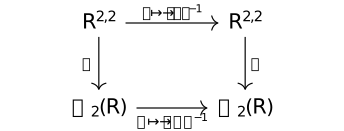
As in the compact action of Example [fcap-003K], multiplication by a fixed vector makes an odd vector accessible to the even algebra, and conjugation by that vector interchanges its two factors. Here the factors are real matrices, with the explicit \(S\)-conjugations above. This is the even-algebra action transport of [porteous1995clifford, Chapter 16, Proposition 16.9, pp. 143--144] in the stated axes. The construction gives the group and its vector action; its orthogonal image retains the spinor-norm qualification of Theorem [fcap-0023].
Definition [ca-000J]Definition [ca-001J]Definition [spin-0012]Definition [spin-000O]
Example. The Lorentzian four-dimensional Spin group is \(SL_2(\mathbb C)\) [fcap-002L]AGENTDRAFTED
Example. The Lorentzian four-dimensional Spin group is \(SL_2(\mathbb C)\) [fcap-002L]AGENTDRAFTED
For \(Q_{1,3}=x_0^2-x_1^2-x_2^2-x_3^2\), put \(A_j=e_0e_j\) for \(1\le j\le 3\) and \(I=e_0e_1e_2e_3\). Then the \(A_j\) square to \(1\) and anticommute, while \[I^2=-1,\qquad A_1A_2A_3=-I.\] For the Pauli matrices \[\sigma _1=\begin {pmatrix}0&1\\1&0\end {pmatrix},\quad \sigma _2=\begin {pmatrix}0&-i\\i&0\end {pmatrix},\quad \sigma _3=\begin {pmatrix}1&0\\0&-1\end {pmatrix},\] the assignments \(\Psi (A_j)=\sigma _j\) define a real-algebra map from the even Clifford algebra to \(M_2(\mathbb C)\). Since \(\sigma _1\sigma _2\sigma _3=i1\), necessarily \(\Psi (I)=-i1\). The images of \(1,A_1,A_2,A_3,I,IA_1,IA_2,IA_3\) form a real basis, so \(\Psi \) is an algebra equivalence.
Write a matrix uniquely as \[M=z_0 1+z_1\sigma _1+z_2\sigma _2+z_3\sigma _3, \qquad z_j=a_j+i b_j,\] where \[\begin {aligned} z_0&=(m_{11}+m_{22})/2,&z_3&=(m_{11}-m_{22})/2,\\ z_1&=(m_{12}+m_{21})/2,&z_2&=(m_{21}-m_{12})/(2i). \end {aligned}\] Then an explicit inverse is \[\Psi ^{-1}(M) =a_0+\sum _{j=1}^3a_jA_j -I\left (b_0+\sum _{j=1}^3b_jA_j\right ).\] Reversal fixes \(I\) and negates every \(A_j\); under \(\Psi \) it is the complex-linear matrix adjugate. Hence \[\Psi (\operatorname {rev}(x))=\operatorname {adj}(\Psi (x)),\qquad \Psi (\operatorname {rev}(x)x)=\det (\Psi (x))1.\] For an arbitrary even \(x\), this norm is algebra-valued: the determinant may be complex, corresponding to the even center. It is not yet the real scalar-valued Lipschitz norm, and adjugation is not conjugate transpose.
Restriction therefore gives a homomorphism \(\operatorname {Spin}(Q_{1,3})\to SL_2(\mathbb C)\). Conversely, a determinant-one matrix has adjugate as a two-sided inverse. Its displayed Clifford preimage is an even unit with \(\operatorname {rev}(x)x=1\), so the dimension-four carrier lemma places it in Spin. The written inverse proves both compositions and multiplicativity: \[\operatorname {Spin}(Q_{1,3})\simeq SL_2(\mathbb C).\]
The source indices require translation. [lawson2016spin, I.3, Theorem 3.7, pp. 23--24] use \(v^2=-q(v)\) and give the even-algebra reduction \[\operatorname {Cl}^{0}_{3,1}\simeq \operatorname {Cl}_{2,1}.\] Their base entries and recurrence then give \[\operatorname {Cl}_{2,1}\simeq M_2(\mathbb C)\] [lawson2016spin, I.4, (4.0) and Theorem 4.1, p. 25].
Gallier uses the opposite indexing. The positive-square \(A_j\) exhibit \(\operatorname {Cl}_{3,0}\). [gallier2014clifford, Example 1.3, p. 33] records the matrix base entries, while [gallier2014clifford, Lemma 1.15, p. 34] supplies the recurrence. Together they give \[\operatorname {Cl}_{3,0} \simeq \operatorname {Cl}_{0,1}\otimes \operatorname {Cl}_{2,0} \simeq M_2(\mathbb C).\]
[porteous1995clifford, Chapter 17, Proposition 17.5, pp. 151--152] identifies his norm-one subgroup \(\operatorname {Spin}^{+}(1,3)\) with \(SL_2(\mathbb C)\). He computes reversal as adjugation. His broader mixed-sign carrier permits norm \(\pm 1\), and his displayed axes are not the Pauli axes fixed above.
Here the even center is \(\mathbb R[I]\simeq \mathbb C\), with no nonzero complementary central idempotents. This contrasts with the split compact center \(\mathbb R\oplus \mathbb R\), although both even algebras have real dimension eight. The full algebra \(\mathcal {C}\kern -2pt\ell _{1,3}\simeq M_2(\mathbb H)\) in Example [fcap-0026] is a different algebra. The vector-action image remains the spinor-norm kernel from Theorem [fcap-0023]; no topological component or concrete gamma-map claim is made.
Lemma. Opposite Lorentz signatures share an even-algebra action dictionary [fcap-003Z]AGENTDRAFTED
Lemma. Opposite Lorentz signatures share an even-algebra action dictionary [fcap-003Z]AGENTDRAFTED
Keep the Pauli convention of Example [fcap-002L]: \(Q_{1,3}(v)=t^2-x_1^2-x_2^2-x_3^2\), \(A_j=e_0e_j\), and \(\Psi (A_j)=\sigma _j\). For \(Q_{3,1}(y)=y_0^2+y_1^2+y_2^2-y_3^2\), write \(f_0,\ldots ,f_3\) for the coordinate generators. The real linear bijection \[T(t,x_1,x_2,x_3)=(-x_2,x_1,-x_3,t)\] satisfies \(Q_{3,1}(Tv)=-Q_{1,3}(v)\). There is a real algebra equivalence \[E:\mathcal {C}\kern -2pt\ell ^+(Q_{1,3})\longrightarrow \mathcal {C}\kern -2pt\ell ^+(Q_{3,1}), \qquad E(vw)=-T(v)T(w).\] It preserves reversion and restricts to an equivalence of the actual Spin groups. Their vector actions satisfy \[T(svs^{-1})=E(s)T(v)E(s)^{-1}.\]
For the construction, complexify and send \(v\mapsto iT(v)\). Its square is \(Q_{1,3}(v)\), so the Clifford universal property gives an algebra map. On an even word of length \(2k\) its value is \((-1)^kT(v_1)\cdots T(v_{2k})\), which is real. This defines \(E\) by scalar extension as in Theorem [fcap-003V]. The reverse construction sends \(w\mapsto iT^{-1}(w)\); the two composites negate generators and therefore fix every even word. Reversing an even word commutes with \(E\). The dimension-four carrier lemma Lemma [fcap-002J] now identifies the reverse-norm-one even units on both sides, so \(E\) and its inverse restrict to the stated actual groups. Applying the complex map to \(svs^{-1}\) and cancelling \(i\) proves the action identity. This is the sign-transfer mechanism used for compact forms in Proposition [fcap-0039], with the additional coordinate change \(T\).
The algebraic construction is also the composite of sign scaling
and the isometry \(T:(-Q_{1,3})\to Q_{3,1}\). TauCeti's general
scaling formula at the unit \(-1\)
TauCeti.CliffordAlgebra.evenEquivEvenSMul_ι,
its reversion compatibility
TauCeti.CliffordAlgebra.evenEquivEvenSMul_reverseEven,
and the isometry formula
CliffordAlgebra.evenEquivOfIsometry_ι
provide these three component statements. The displayed \(T\) and its
Spin-action dictionary are the explicit specialization proved here.
Let \(\Phi :\mathcal {C}\kern -2pt\ell ^+(Q_{3,1})\to M_2(\mathbb C)\) be TauCeti's
concrete matrix equivalence. Its bilinear-generator formula
TauCeti.realCliffordThreeOneEvenEquivComplexMatrix_ι
gives
\[\begin {aligned}
\Phi (f_0f_3)&=-\sigma _2,&\Phi (f_1f_3)&=\sigma _1,&
\Phi (f_2f_3)&=-\sigma _3,\\
\Phi (f_0f_1)&=i\sigma _3,&\Phi (f_0f_2)&=i\sigma _1,&
\Phi (f_1f_2)&=i\sigma _2.
\end {aligned}\]
Since \(T(e_0)=f_3\), \(T(e_1)=f_1\), \(T(e_2)=-f_0\), and
\(T(e_3)=-f_2\), these formulas give \(\Phi (E(A_j))=\sigma _j\).
The \(A_j\) generate the even algebra, hence \(\Phi \circ E=\Psi \).
Also \(E(e_0e_1e_2e_3)=f_0f_1f_2f_3\), whose matrix is \(-i1\).
Thus the Pauli group equivalence agrees, through \(E\), with
TauCeti.realSpinThreeOneEquivSpecialLinear.
This dictionary concerns the even algebras and their Spin actions;
the full real Clifford algebras retain their different signature types.
Example. The Lorentz Spin action is Hermitian matrix congruence [fcap-0040]AGENTDRAFTED
Example. The Lorentz Spin action is Hermitian matrix congruence [fcap-0040]AGENTDRAFTED
In the Pauli model Example [fcap-002L], an odd vector becomes an even element after multiplication by \(e_0\). Encode \(v=te_0+x_1e_1+x_2e_2+x_3e_3\) by \[X(v)=\Psi (ve_0)=t1-\sum _{j=1}^3x_j\sigma _j =\begin {pmatrix}t-x_3&-x_1+i x_2\\-x_1-i x_2&t+x_3\end {pmatrix}.\] A matrix is Hermitian when \(Z^*=Z\), where \(*\) denotes conjugate transpose. Every Hermitian two-by-two matrix has the form \(Z=\begin {pmatrix}a&z\\\overline z&d\end {pmatrix}\) with \(a,d\in \mathbb R\). The inverse coordinates are \[X^{-1}(Z)=\left (\frac {a+d}{2},-\operatorname {Re}z, \operatorname {Im}z,\frac {d-a}{2}\right ).\] Thus \(X\) is a real linear equivalence, and direct expansion gives \[\det X(v)=t^2-x_1^2-x_2^2-x_3^2=Q_{1,3}(v).\]
For \(s\in \operatorname {Spin}(Q_{1,3})\), put \(M=\Psi (s)\in SL_2(\mathbb C)\). Then the vector action is \[X(svs^{-1})=M X(v)M^*.\] To prove it, conjugation by \(e_0\) defines an automorphism \(\gamma (x)=e_0xe_0\) of the even algebra. It negates each \(A_j=e_0e_j\) and the volume element \(I=e_0e_1e_2e_3\). On the matrix side, \(M\mapsto \operatorname {adj}(M)^*\) has the same effect on \(\sigma _j\) and \(-i1\). It is a real algebra automorphism: both adjugation and conjugate transpose reverse products, and in size two adjugation is linear. Checking the even generators therefore gives \[\Psi (\gamma (x))=\operatorname {adj}(\Psi (x))^*.\] Now multiply the Clifford action by \(e_0\): \[(svs^{-1})e_0=s(ve_0)\gamma (s^{-1}).\] Since \(\det M=1\), we have \(\operatorname {adj}(M^{-1})=M\). Applying \(\Psi \) proves the congruence formula. It preserves Hermitian matrices, and its determinant is unchanged because \(\det M=\det M^*=1\).
The square makes the coordinate meaning of the action explicit:
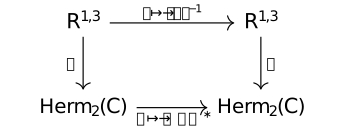
For comparison with the formal opposite-signature model, use
\(T\) and \(E\) from Lemma [fcap-003Z]. TauCeti's vector equivalence has
coordinates
\[H(y)=\begin {pmatrix}y_3+y_2&-y_1-i y_0\\
-y_1+i y_0&y_3-y_2\end {pmatrix},\qquad
\det H(y)=-Q_{3,1}(y)\]
TauCeti.coe_realCliffordThreeOneVectorEquivHermitian_apply
TauCeti.realCliffordThreeOneVectorEquivHermitian_det.
Substitution gives \(H(Tv)=X(v)\). In the even algebra this is the
same identity as \(E(ve_0)=-T(v)f_3\), since
\(H(y)=\Phi (-yf_3)\). The group coercion formula
TauCeti.coe_realSpinThreeOneEquivSpecialLinear_apply
identifies the matrix of \(E(s)\) with \(\Phi (E(s))=\Psi (s)=M\).
Consequently the action dictionary in Lemma [fcap-003Z] translates
TauCeti's exact Hermitian congruence theorem
TauCeti.realSpinThreeOneEquivSpecialLinear_action
into the displayed Pauli action. This checks both the signature sign
and the matrix axes, not just the abstract group type.
Multiplication by a fixed nonisotropic vector is the even-algebra action mechanism of [porteous1995clifford, Chapter 16, Proposition 16.9, pp. 143--144]. His Lorentz group calculation uses adjugation and the norm-one carrier [porteous1995clifford, Chapter 17, Proposition 17.5, pp. 151--152]. The coordinates and conjugate-transpose action above are derived in our chosen axes. The orthogonal image retains the spinor-norm condition of Theorem [fcap-0023]; a topological component identification is separate.
Definition [ca-000J]Definition [spin-000O]
Proposition. The discriminant center of a four-dimensional Spin group [fcap-0043]AGENTDRAFTED
Proposition. The discriminant center of a four-dimensional Spin group [fcap-0043]AGENTDRAFTED
Let \(K\) be a field of characteristic different from two, and let \(q=\langle a,b,c,d\rangle \) with \(a,b,c,d\in K^\times \). Thus \(q(x)=ax_1^2+bx_2^2+cx_3^2+dx_4^2\). The center of its even Clifford algebra determines whether the quaternion description of its Spin group has two factors over \(K\) or one factor over a quadratic field. Put \[\begin {aligned} \delta &=abcd,\\ E&=K[t]/(t^2-\delta ),\\ D&=(-ab,-ac\mid K), \end {aligned}\] using the quaternion algebra notation. The class of \(\delta \) in \(K^\times /(K^\times )^2\) is the signed discriminant in dimension four; changing the diagonalizing basis changes the determinant by a square. Lam's center theorem identifies the corresponding quadratic algebra; the explicit quaternion and group identifications below follow by calculation [lam2005quadratic, V.2, thms. 2.2--2.5, pp. 109--111].
Extend quaternion conjugation \(\overline i=-i\), \(\overline j=-j\) \(E\)-linearly to \(D_E=D\otimes _K E\). Write \(SL_1(D_E)=\{x\in D_E:x\overline x=1\}\) for its norm-one group. Indeed, for \(x=x_0+x_1i+x_2j+x_3ij\), with \(x_r\in E\), \[x\overline x=\overline x x =x_0^2+abx_1^2+acx_2^2+a^2bcx_3^2\in E.\] This extends the reduced norm to the displayed quaternion algebra, and \(x^{-1}=\overline x\) when the norm is one. There are algebra and group isomorphisms \[\begin {aligned} \mathcal {C}\kern -2pt\ell ^+(q)&\simeq D_E,\\ Z(\mathcal {C}\kern -2pt\ell ^+(q))&\simeq E,\\ \operatorname {Spin}(q)&\simeq SL_1(D_E), \end {aligned}\] where the algebra isomorphism takes grade reversion to quaternion conjugation. If \(\delta \) is a square in \(K^\times \), this gives \[\operatorname {Spin}(q)\simeq SL_1(D)\times SL_1(D).\] If \(\delta \) is nonsquare, it gives \[\operatorname {Spin}(q)\simeq SL_1(D\otimes _K K(\sqrt \delta )).\] All groups here consist of points over the indicated fields.
For a concrete comparison, take \(q_d=\langle 1,-1,1,-d\rangle \). Then \(\delta =d\) and \(D=(1,-1\mid K)\). The matrices \[i\longmapsto \begin {pmatrix}1&0\\0&-1\end {pmatrix},\qquad j\longmapsto \begin {pmatrix}0&1\\-1&0\end {pmatrix}\] have squares \(1,-1\), anticommute, and, together with their product and the identity, form a basis of \(M_2(K)\). They therefore identify \(D\) with \(M_2(K)\). Conjugation becomes matrix adjugation and the norm becomes the determinant, giving \(\operatorname {Spin}(q_d)\simeq SL_2(E)\). In particular, over \(K=\mathbb Q\), the members \(q_1\) and \(q_2\) satisfy \[\begin {aligned} \operatorname {Spin}(q_1)(\mathbb Q) &\simeq SL_2(\mathbb Q)\times SL_2(\mathbb Q),\\ \operatorname {Spin}(q_2)(\mathbb Q) &\simeq SL_2(\mathbb Q(\sqrt 2)). \end {aligned}\] These identities apply the proposition to the two centers \(\mathbb Q\times \mathbb Q\) and \(\mathbb Q(\sqrt 2)\).
Proof.
Proof.
Choose orthogonal Clifford generators with \(e_1^2=a,e_2^2=b,e_3^2=c,e_4^2=d\). Distinct generators anticommute. Set \(I=e_1e_2\), \(J=e_1e_3\), and \(w=e_1e_2e_3e_4\). Then \[\begin {aligned} I^2&=-ab,&J^2&=-ac,\\ IJ&=-JI,&w^2&=abcd. \end {aligned}\] The element \(w\) commutes with every even word. Thus \(i\mapsto I\), \(j\mapsto J\), \(t\mapsto w\) define an algebra homomorphism \(D\otimes _K E\longrightarrow \mathcal {C}\kern -2pt\ell ^+(q)\). The eight elements \[1,I,J,IJ,w,Iw,Jw,IJw\] map to nonzero scalar multiples of the eight distinct even Clifford basis monomials. Explicitly, \[\begin {aligned} IJ&=-ae_2e_3,&Iw&=-abe_3e_4,\\ Jw&=ace_2e_4,&IJw&=abce_1e_4. \end {aligned}\] They form a basis, proving bijectivity. Writing an element of \(D_E\) in the basis \(1,i,j,ij\), commutation with \(i\) forces its \(j,ij\) coefficients to vanish, and commutation with \(j\) forces its \(i\) coefficient to vanish. Here \(2,ab,ac\) are units, even when \(E\) is a product. The center is therefore exactly \(E\). Reversion negates \(I,J,IJ\) and fixes \(w\), so it is \(\overline {(\,\cdot \,)}\) on \(D_E\).
It remains to identify the actual vector-generated Spin group with all even elements of reverse norm one. The real four-dimensional argument of Lemma [fcap-002J] works over the stated field as follows. Suppose \(x\in \mathcal {C}\kern -2pt\ell ^+(q)\) and \(\operatorname {rev}(x)x=1\). Finite-dimensionality makes this left inverse a two-sided inverse. For every vector \(v\), \(xvx^{-1}\) is odd and fixed by reversion. In the orthogonal Clifford basis, reversal is \(+1\) on degree one and \(-1\) on degree three. Since two is invertible, \(xvx^{-1}\) is a vector. Its square is \(q(v)\), and conjugation is injective, hence induces an orthogonal automorphism \(g\) of the four-dimensional vector space.
By the Clifford group exact sequence, lift \(g\) to a vector-generated Clifford unit \(y\). For the grading involution \(\alpha \), equality of the twisted actions of \(y\) and the even element \(x\) implies that \(z=y^{-1}x\) satisfies \(\alpha (z)v=vz\) for every vector \(v\). The graded-centrality theorem used in Lemma [fcap-002J] gives \(z=c1\) with \(c\in K^\times \). Every such scalar belongs to the generated Clifford group: for \(q(v)\ne 0\), the two nonisotropic vectors \((c/q(v))v\) and \(v\) have Clifford product \(c1\). Thus \(x=yz\) is in that group. It is even with reverse norm one, so the carrier criterion Remark [fcap-0028] places it in Spin. Conversely, every Spin element is even with reverse norm one by that same criterion. Under the algebra isomorphism this is exactly \(SL_1(D_E)\).
If \(\delta =r^2\) with \(r\in K^\times \), evaluation at \(r,-r\) identifies \(E\) with \(K\times K\). The corresponding central idempotents are \((1+w/r)/2\) and \((1-w/r)/2\). Hence \(D_E\simeq D\times D\), with componentwise conjugation and norm, giving the displayed product of norm-one groups. If \(\delta \) is nonsquare, \(t^2-\delta \) is irreducible, so \(E=K(\sqrt \delta )\) and the second description follows.
The split-center group equivalence has a formal counterpart in
CliffordAlgebra.spinGroupEquivSplitCenterCorners, given a
center isomorphism with \(K\times K\). The field-center existence theorem
CliffordAlgebra.exists_spinGroupEquivQuaternionUnitaryOverCenter_of_finrank_eq_four
gives a quaternion norm-one model over the actual even center. Both assume
nondegeneracy and dimension four over a field with two invertible. The
explicit parameters \(-ab,-ac\) and the matrices for \(q_d\) are supplied
by the calculation above.
Lemma. The volume term does not obstruct Spin in dimension five [fcap-003H]AGENTDRAFTED
Lemma. The volume term does not obstruct Spin in dimension five [fcap-003H]AGENTDRAFTED
Let \(K\) be a field of characteristic different from two, and let
\((V,Q)\) be a nondegenerate quadratic space of dimension five over \(K\).
For \(x\in \mathcal {C}\kern -2pt\ell ^{+}(Q)\),
\[x\text { is the Clifford value of a Spin element}
\quad \Longleftrightarrow \quad \operatorname {rev}(x)x=1.\]
The norm condition implies Lipschitz membership in this dimension
CliffordAlgebra.evenUnitaryGroup_le_lipschitzGroup_of_finrank_eq_five.
The point is to remove the possible degree-five term left by the
dimension-four argument of Lemma [fcap-002J].
Choose an orthogonal basis \(e_1,\ldots ,e_5\), suppress the generator map, and put \(\omega =e_1\cdots e_5\). Nondegeneracy gives \[\omega ^2=\delta 1,\qquad \delta =\prod _{i=1}^5 Q(e_i)\ne 0.\] The element \(\omega \) is central and invertible. Suppose \(\operatorname {rev}(x)x=1\). Finite dimensionality makes the left inverse a two-sided inverse. For any \(v\in V\), the element \(y=xvx^{-1}\) is odd and satisfies \(\operatorname {rev}(y)=y\). In the orthogonal monomial basis, reversal has signs \(+1,-1,+1\) on degrees one, three and five. Hence \[y=w+c\omega \qquad (w\in V,\ c\in K).\]
Conjugation preserves the scalar square of a vector. Since \(\omega \) is central, \[Q(v)1=y^2=Q(w)1+2c\omega w+c^2\delta 1.\] Each \(\omega e_i\) is a nonzero scalar multiple of the product of the other four basis vectors. Thus \(\omega w\) has pure degree four in this basis, whereas the other terms in the equation are scalar. Independence of the Clifford basis gives \(2c\omega w=0\). As two and \(\omega \) are invertible, either \(c=0\) or \(w=0\). In the latter case \(y=c\omega \) is central, so conjugating back gives \(v=x^{-1}yx=y=c\omega \). The degree-one and degree-five subspaces have zero intersection; therefore \(v=0\) and \(c=0\). In both cases \(y\in V\).
Thus \(x\) normalizes the vector space. The Clifford-group
characterization makes it Lipschitz; together with evenness and reverse
norm one, this is the Spin criterion of Remark [fcap-0028]. The reverse
implication is that same criterion. In fact the carrier equality holds in
every dimension from one through five
CliffordAlgebra.range_spinGroup_toUnits_eq_evenUnitaryGroup.
The lower bound matters: in dimension zero the vector-generated Lipschitz
group is trivial, whereas the even-unitary group contains both \(1\) and
\(-1\). This carrier equality alone supplies no symplectic matrix model;
the spinor pairing and matrix inverse for complex dimension five remain
the separate argument of Proposition [fcap-0033].
Porteous gives the real dimension-five proof by separating the vector, trivector and volume terms [porteous1995clifford, Chapter 16, Proposition 16.15, p. 147]. His relation is \(v^2=-q(v)\), so here \(Q=-q\); his conjugation is \(\operatorname {rev}\circ \alpha \), equal to reversal on even elements. His indefinite Spin carrier permits norm \(\pm 1\); we select norm \(+1\). The basis calculation above extends the norm-one argument from real spaces to the stated fields: orthogonality, nonzero basis squares and invertibility of two replace any need for real unit-length normalization. Gallier records the compact boundary at five and the failure at six [gallier2014clifford, Section 1.4, closing Remark, p. 31]; the next example computes that failure.
Example. A norm-one even unit can leave the vector space in dimension six [fcap-003I]AGENTDRAFTED
Example. A norm-one even unit can leave the vector space in dimension six [fcap-003I]AGENTDRAFTED
Let \(K\) be a field of characteristic different from two, and let \((V,Q)\) be a finite-dimensional nondegenerate quadratic space containing six orthogonal vectors \(e_1,\ldots ,e_6\) with \(Q(e_i)\ne 0\). Put \[\omega =e_1\cdots e_6,\qquad \delta =\prod _{i=1}^6 Q(e_i).\] Now \(\omega \) is even, \(\operatorname {rev}(\omega )=-\omega \), and \(\omega ^2=-\delta 1\). It anticommutes with each of the six displayed vectors. If \(a,b\in K\) satisfy \(a^2+\delta b^2=1\), then \[x=a+b\omega ,\qquad x^{-1}=\operatorname {rev}(x)=a-b\omega \] is an even unit of reverse norm one. Its action on a displayed basis vector is \[xe_i x^{-1}=(a^2-\delta b^2)e_i+2ab\omega e_i.\]
For \(ab\ne 0\), the last term is a nonzero degree-five monomial,
up to a scalar. Extend the six vectors to an orthogonal basis; independence
of the Clifford monomials shows that the displayed conjugate is not a
vector. Since \(x\) is even, ordinary and twisted conjugation agree.
Thus \(x\) is not Lipschitz and cannot belong to Spin, despite satisfying
the norm equation
CliffordAlgebra.notMem_lipschitzGroup_of_mem_evenUnitaryGroup_of_coe_eq.
Only the selected six vectors are used: in higher dimension \(\omega \)
commutes with an additional orthogonal vector, which does not affect this
counterexample.
For a concrete compact example, take \(K=\mathbb R\) and \(Q(v)=v_1^2+\cdots +v_6^2\). With \(a=b=1/\sqrt 2\), one obtains \[x=\frac {1+\omega }{\sqrt 2},\qquad \operatorname {rev}(x)x=1,\qquad xe_1x^{-1}=\omega e_1=-e_2e_3e_4e_5e_6.\] Porteous [porteous1995clifford, Chapter 16, p. 146] exhibits the unnormalized element \(1+\omega \) of norm two.
Gallier [gallier2014clifford, Section 1.4, closing Remark, p. 31] uses the normalized element above.
Their compact generators square to \(-1\). With that choice the same six-vector product still squares to \(-1\), but \(\omega e_1=+e_2e_3e_4e_5e_6\). Both signs give the same obstruction. The calculation here uses the positive-square convention of Example [fcap-002H].
Over any infinite \(K\) as above, the conic always supplies
\(a,b\ne 0\). Indeed, choose \(t\ne 0\) with \(1+\delta t^2\ne 0\) and
\(1-\delta t^2\ne 0\), and set
\[a=\frac {1-\delta t^2}{1+\delta t^2},\qquad
b=\frac {2t}{1+\delta t^2}.\]
Only finitely many values of \(t\) are excluded, and substitution gives
\(a^2+\delta b^2=1\). Consequently the Spin image is a proper subgroup
of the even-unitary group for every nondegenerate form of dimension at
least six over an infinite field of characteristic different from two
CliffordAlgebra.range_spinGroup_toUnits_ne_evenUnitaryGroup_of_six_le_finrank.
This field extension follows from the displayed calculation; the cited
book passages concern real spaces. Over a finite field the conditional
six-vector construction remains valid, but this infinitude argument makes
no assertion that a suitable conic point exists.
Remark. From real recurrences to the residue table [fcap-0016]AGENTDRAFTED
Remark. From real recurrences to the residue table [fcap-0016]AGENTDRAFTED
The mixed \((1,1)\) recurrence removes matched axes but leaves a one-sided algebra \(\mathcal {C}\kern -2pt\ell _{r,0}\) or \(\mathcal {C}\kern -2pt\ell _{0,r}\), which it cannot classify. Together with the signature switch in Theorem [fcap-001X] and initial entries in Example [fcap-0015], the two recurrences below complete the calculation.
The two one-sided recurrences are
\[\begin {aligned}
\mathcal {C}\kern -2pt\ell _{p,q+2}&\simeq \mathcal {C}\kern -2pt\ell _{q,p}\otimes _{\mathbb R}\mathbb H,\\
\mathcal {C}\kern -2pt\ell _{p+8,q}&\simeq \mathcal {C}\kern -2pt\ell _{p,q}\otimes _{\mathbb R}M_{16}(\mathbb R).
\end {aligned}\]
The first line is the actual equivalence
TauCeti.realCliffordQuaternionRecurrenceEquiv. For the
second, the formal theorem supplies existence
TauCeti.nonempty_realCliffordEightPeriodicityEquiv.
They yield the residue-indexed mod-eight classification
TauCeti.realClifford_classification. The classical table is
[lawson2016spin, I.4, Theorem 4.3 and Tables I--II, pp. 27--29].
Example. The real Clifford algebra of signature (1,3) [fcap-0026]
L∃∀NAGENTDRAFTED
Example. The real Clifford algebra of signature (1,3) [fcap-0026]
L∃∀NAGENTDRAFTED
Use the convention of Convention [fcap-0011]: \(p\) counts positive squares, \(q\) counts negative squares, and a Clifford generator obeys \(v^2=Q(v)1\). Then the real algebra for one positive and three negative axes is \[\mathcal {C}\kern -2pt\ell _{1,3}\simeq M_2(\mathbb H).\] The Tau Ceti classification theorem states existence of an abstract real algebra equivalence. Here \(q-p=2\) is its residue modulo \(8\), and its matrix size is \(2^{(p+q-2)/2}=2\).
[chevalley1954algebraic, II.2.9, pp. 65--66] uses the same positive/negative index convention. Split off one hyperbolic plane of signature \((1,1)\); the orthogonal remainder is a negative plane of signature \((0,2)\). Chevalley's dimension-two definite calculation on p. 66 identifies its Clifford algebra with \(\mathbb H\). The hyperbolic-plane theorem [chevalley1954algebraic, II.2.1, pp. 42--43] gives \(\mathcal {C}\kern -2pt\ell _{1,1}\simeq M_2(\mathbb R)\).
[chevalley1954algebraic, II.2.5, pp. 45--46] gives an orthogonal-sum tensor-product formula for an even-dimensional nondegenerate first summand; the second quadratic form is twisted. Here normalized hyperbolic generators \(e^2=1\) and \(f^2=-1\) have volume \(J=ef\) with \(J^2=1\). For a vector \(v\) in the orthogonal remainder, \(Jv\) commutes with \(e,f\) and still squares to \(Q(v)\). Since \(v=J(Jv)\), these commuting factors generate the full algebra. Thus the special hyperbolic split leaves that remainder unchanged: \[\begin {aligned} \mathcal {C}\kern -2pt\ell _{1,3}&\simeq \mathcal {C}\kern -2pt\ell _{1,1}\otimes _{\mathbb R}\mathcal {C}\kern -2pt\ell _{0,2}\\ &\simeq M_2(\mathbb R)\otimes _{\mathbb R}\mathbb H \simeq M_2(\mathbb H). \end {aligned}\] Both sides have real dimension \(16=2^4=4\dim _{\mathbb R}\mathbb H\). By comparison, \(M_4(\mathbb C)\) has real dimension \(32\). This abstract classification alone does not identify any particular gamma-matrix map, its kernel, or its image; the concrete Dirac map is treated in Proposition [fcap-002U].
Proposition. The real algebra generated by the Dirac gamma matrices [fcap-002U]AGENTDRAFTED
Proposition. The real algebra generated by the Dirac gamma matrices [fcap-002U]AGENTDRAFTED
On \(\mathbb R^4\), let
\[q_\gamma (v)=v_0^2-v_1^2-v_2^2-v_3^2.\]
Under the coordinate identification
\(\operatorname {Fin}(4)=\operatorname {Fin}(1+3)\), the identity map is an
isometry from \(q_\gamma \) to the signature form \(Q_{1,3}\) of
Example [fcap-0026]. This is equality of the displayed forms, rather than only
equality of their signatures. Thus the Clifford transport of
Proposition [fcap-0029] and the classification in Example [fcap-0026] give
\[\mathcal {C}\kern -2pt\ell (q_\gamma )\simeq \mathcal {C}\kern -2pt\ell _{1,3}\simeq M_2(\mathbb H)\]
as real algebras. The selected formal ingredients are the coordinate formula
TauCeti.realCliffordForm_apply and the residue-two
classification
TauCeti.realClifford_classification_of_residue_eq_two;
the latter supplies existence of an abstract equivalence, not a theorem
about a particular gamma-matrix map.
Let \(\xi :\operatorname {Fin}(1)\sqcup \operatorname {Fin}(3) \simeq \operatorname {Fin}(4)\) be the standard index equivalence, and write \[\Gamma _i=\operatorname {endEquivMatrix} \bigl (\operatorname {gamma}(\xi ^{-1}i)\bigr ).\] These are the concrete matrices \(\gamma ^0,\gamma ^1,\gamma ^2,\gamma ^3\); their squares are \(+1,-1,-1,-1\), and distinct matrices anticommute. Put \[D_\gamma =\operatorname {Alg}_{\mathbb R} \langle \Gamma _0,\Gamma _1,\Gamma _2,\Gamma _3\rangle \subset M_4(\mathbb C).\] Physlib constructs the real unital algebra homomorphism \[\rho :\mathcal {C}\kern -2pt\ell (q_\gamma )\longrightarrow D_\gamma ,\qquad \rho \bigl (\iota _{q_\gamma }(v)\bigr )=\sum _{i=0}^3v_i\Gamma _i\] from the Clifford universal property and proves that it is surjective onto \(D_\gamma \); see the generator-map source and the surjectivity source. The codomain here is the generated real subalgebra, not all of \(M_4(\mathbb C)\).
It remains to prove that this actual map has zero kernel. First, \(M_2(\mathbb H)\) is simple. Let \(J\) be a nonzero two-sided ideal, choose a matrix \(A\in J\) with nonzero entry \(a=A_{ij}\), and let \(E_{kl}(b)\) denote the matrix whose only nonzero entry is \(b\) in position \((k,l)\). Since every nonzero quaternion is invertible, for all \(k,l\) one has \[E_{ki}(a^{-1})\,A\,E_{jl}(1)=E_{kl}(1)\in J.\] The order of the factors matters over \(\mathbb H\). Taking both diagonal matrix units and adding them gives \(1\in J\), so \(J=M_2(\mathbb H)\). Transport through the preceding equivalence makes \(\mathcal {C}\kern -2pt\ell (q_\gamma )\) simple. Hence \(\ker \rho \) is zero or the entire source. The second option is impossible because \(\rho \) is unital and the identity matrix in \(D_\gamma \subset M_4(\mathbb C)\) is nonzero. Therefore \(\rho \) is injective; together with the formal surjectivity, this proves that this same map is a real algebra equivalence \[\mathcal {C}\kern -2pt\ell (q_\gamma )\simeq _{\rho }D_\gamma .\]
Consequently \[\dim _{\mathbb R}D_\gamma =\dim _{\mathbb R}M_2(\mathbb H)=4\cdot 4=16.\] For the ambient algebra, \[\dim _{\mathbb R}M_4(\mathbb C)=16\cdot 2=32.\] Thus \(D_\gamma \) is a proper real subalgebra of the ambient complex matrix algebra. This conclusion uses the proved equivalence and does not assume the image dimension in order to deduce injectivity.
Lawson--Michelsohn invoke simplicity of \(M_n(K)\) for \(K=\mathbb R,\mathbb C,\mathbb H\) in their real representation theorem [lawson2016spin, I.5, Theorem 5.6, pp. 31--32]. The matrix-unit calculation above supplies that step for the quaternionic algebra and then applies it to Physlib's concrete homomorphism. Their convention is \(v^2=-q(v)1\), so our \(\mathcal {C}\kern -2pt\ell _{1,3}\) is their \(\mathcal {C}\kern -2pt\ell _{3,1}\). Their algebra in that convention is the quaternionic matrix algebra used in the simplicity argument. The abstract classification is formalized in Tau Ceti, and Physlib formalizes the concrete map and its surjectivity. The simplicity and kernel argument completing the equivalence here is informal; no whole-card formal badge is asserted.
Notes on foundational group algebras (for) physics [fgap-0001]
📄PDFAGENTDRAFTED
- July 28, 2026
- Utensil Song
Notes on foundational group algebras (for) physics [fgap-0001]
📄PDFAGENTDRAFTED
- July 28, 2026
- Utensil Song
These are the accompanying mathematical notes for the experimental research project FGAP. FGAP is read “F-gap,” for the foundational gap between established mathematical tools and open questions about physical structures, especially beyond the Standard Model. It is also a coined acronym for “Foundational Group Algebras (for) Physics.”
The project studies mathematical structures that may help us understand physical structures more deeply. It does not construct or claim a physical theory. The current storyline has been strongly shaped by agent exploration of one spike-test slice of that research domain. It follows the project's approach: turn a structural hypothesis into a small, source-grounded vertical slice, then use explicit calculations and formalization to expose its assumptions.
This slice begins with Hamilton's Quaternions and the quaternionic realization of the binary tetrahedral group, because they give a small and explicit route into finite real Group Algebras. For the human-curated storyline of the notes, see § [spin-0010].
For the mathematics, we follow the Hurwitz-unit treatment in [voight2021quaternion, ch. 11]. We keep the mathematics and the physical suggestions separate.
Remark. why begin with 2T? [fgap-0018]AGENTDRAFTED
Remark. why begin with 2T? [fgap-0018]AGENTDRAFTED
The binary tetrahedral group \(2T\) is small enough for explicit calculations, yet it connects finite symmetry, representations, real Group Algebras, and the quaternionic structures familiar from spin mathematics. Its concrete realization by Hurwitz units, and their identification with \(2T\), are described in [voight2021quaternion, sec. 11.2, pp. 166--168], while the relation between representations and Group-Algebra modules is developed in [sengupta2010representations, secs. 3.1--3.3, pp. 39--42]. Wilson uses order-3 automorphisms of \(Q_8\) to discuss possible physical interpretations in [wilson2021finite, sec. 4.3, pp. 12--13, v5]. He later adjoins an abstract generator \(f\) of order 3 to \(Q_8\) to form \(2T\) in [wilson2021finite, sec. 6.1, p. 18, v5].
Any physical identification remains a hypothesis. A proposed correspondence must specify an action and representation, an algebra map, any preserved structure or form, a unit-group choice where applicable, and the intended physical meaning. Resemblance alone is not a model.
Quaternion and Hurwitz foundations [fgap-0019]AGENTDRAFTED
Quaternion and Hurwitz foundations [fgap-0019]AGENTDRAFTED
We first introduce Hamilton's Quaternions, the Hurwitz order, and a distinguished unit. Its order and conjugation action provide the concrete calculations used by the group constructions in the next two sections.
Definition. Hamilton's Quaternions [fgap-0006]AGENTDRAFTED
- July 28, 2026
Definition. Hamilton's Quaternions [fgap-0006]AGENTDRAFTED
- July 28, 2026
The algebra of real quaternions is the 4-dimensional real vector space \[ \mathbb {H} =\mathbb {R}1\oplus \mathbb {R}i\oplus \mathbb {R}j\oplus \mathbb {R}k. \] Thus every quaternion can be written uniquely as \[ q=a+bi+cj+dk,\qquad a,b,c,d\in \mathbb {R}. \] Addition and real scalar multiplication are coordinatewise. Multiplication is extended bilinearly from \(1\) as the multiplicative identity and the table \[ \begin {gathered} i^2=j^2=k^2=ijk=-1,\\ ij=k,\quad jk=i,\quad ki=j,\\ ji=-k,\quad kj=-i,\quad ik=-j. \end {gathered} \] This makes \(\mathbb {H}\) an associative, noncommutative real algebra. In Voight's notation, \(\mathbb {H}=(-1,-1\mid \mathbb {R})\); see [voight2021quaternion, def. 2.2.1 and ex. 2.2.3].
More generally, when \(F\) is a field of characteristic different from \(2\) and \(a,b\in F^\times \), the symbol \[ (a,b\mid F) \] denotes the quaternion algebra over \(F\) generated by elements \(i,j\) with \[ i^2=a,\qquad j^2=b,\qquad ji=-ij. \] The two slots record the scalars assigned to the squares of the two generators. With \(k=ij\), the elements \(1,i,j,k\) form an \(F\)-basis. Thus the two entries \(-1,-1\) in \((-1,-1\mid \mathbb {R})\) say precisely that \(i^2=-1\) and \(j^2=-1\); the anticommutation relation then gives \(k^2=-1\).
For \(q=a+bi+cj+dk\), its quaternion conjugate and reduced norm are \[ \overline {q}=a-bi-cj-dk,\qquad \operatorname {nrd}(q)=q\overline {q} =a^2+b^2+c^2+d^2. \] We also have \(\overline {q}q=\operatorname {nrd}(q)\). If \(q\ne 0\), then \(\operatorname {nrd}(q)>0\) and \[ q^{-1}=\frac {\overline {q}}{\operatorname {nrd}(q)}. \] So every nonzero quaternion is invertible. This is the standard involution and reduced norm specialized to Hamilton's Quaternions; see [voight2021quaternion, secs. 3.1--3.3].
The corresponding Mathlib type is Quaternion.
Definition. the Hurwitz order and its units [fgap-0016]AGENTDRAFTED
- July 29, 2026
Definition. the Hurwitz order and its units [fgap-0016]AGENTDRAFTED
- July 29, 2026
Inside the rational quaternion algebra \(B=(-1,-1\mid \mathbb {Q})\), let \(k=ij\) and \[ \omega =\frac {-1+i+j+k}{2}. \] The Lipschitz order and Hurwitz order are the \(\mathbb {Z}\)-lattices \[ \begin {aligned} L&=\mathbb {Z}+\mathbb {Z}i+\mathbb {Z}j+\mathbb {Z}k,\\ \mathcal {O} &=\mathbb {Z}+\mathbb {Z}i+\mathbb {Z}j+\mathbb {Z}\omega . \end {aligned} \] Both are subrings containing \(1\). The order \(\mathcal {O}\) contains \(L\) with index \(2\); it is the unique order properly containing \(L\), and it is maximal. See [voight2021quaternion, sec. 11.1, esp. lem. 11.1.2].
A Hurwitz unit is a unit of \(\mathcal {O}\). Equivalently, it is an element \(q\in \mathcal {O}\) whose reduced norm is \(1\). Voight calculates that \(\mathcal {O}^{\times }\) has \(24\) elements in [voight2021quaternion, sec. 11.2, pp. 166--168]. The particular unit \(\omega \) will give the cyclic factor used below.
Remark. why the Hurwitz order is introduced [fgap-0017]AGENTDRAFTED
- July 29, 2026
Remark. why the Hurwitz order is introduced [fgap-0017]AGENTDRAFTED
- July 29, 2026
Hurwitz developed integral quaternions in 1919. Starting from the Lipschitz order \(L\), the question is not merely which quaternions have integral coordinates, but which order has the better arithmetic structure. The Lipschitz order is not maximal. Voight compares this with enlarging \(\mathbb {Z}[\sqrt {-3}]\) to the Eisenstein integers. Since \(a=i+j+k\) satisfies \(a^2=-3\), the analogous element \[ \omega =\frac {-1+a}{2} \] satisfies \(\omega ^2+\omega +1=0\). Adjoining it enlarges \(L\) to the maximal Hurwitz order \(\mathcal {O}\). See [voight2021quaternion, sec. 11.1, pp. 165--166].
This enlargement supplies more than a convenient lattice. Its \(24\) units form the binary tetrahedral group, and conjugation by \(\omega \) cyclically permutes the quaternion units \(i,j,k\). The same order also supports a norm-Euclidean algorithm. These features make the Hurwitz order a small meeting point of quaternion arithmetic, finite-group structure, and explicit calculation; see [voight2021quaternion, secs. 11.2--11.3, pp. 166--169].
Lemma. a Hurwitz unit of order \(3\) [fgap-0003]AGENTDRAFTED
Lemma. a Hurwitz unit of order \(3\) [fgap-0003]AGENTDRAFTED
Let \[ a=i+j+k,\qquad \omega =\frac {-1+i+j+k}{2}=\frac {-1+a}{2}. \] Then \(\omega \) is a Hurwitz unit of order \(3\). This choice appears in [voight2021quaternion, p. 165].
The mixed terms in \(a^2\) cancel in pairs: \[ \begin {aligned} a^2 &=i^2+j^2+k^2+(ij+ji)+(jk+kj)+(ki+ik)\\ &=-3. \end {aligned} \] It follows that \[ \begin {aligned} \omega ^2 &=\frac {(-1+a)^2}{4}\\ &=\frac {1-2a+a^2}{4}\\ &=\frac {-1-a}{2}. \end {aligned} \] Hence \(\omega ^2+\omega +1=0\), and multiplication by \(\omega -1\) gives \[ \omega ^3=1. \] Thus \(\omega \) is invertible, has inverse \(\omega ^{-1}=\omega ^2=(-1-i-j-k)/2\), and has order \(3\) because \(\omega \ne 1\).
Convention. left conjugation [fgap-0002]AGENTDRAFTED
Convention. left conjugation [fgap-0002]AGENTDRAFTED
For a nonzero quaternion \(q\), we use left conjugation to mean \[ q\mathbin {\triangleright }x=qxq^{-1}. \] See the remark on the conjugation calculation for why the direction is recorded explicitly.
Quaternions can also be obtained from suitable Clifford Algebras; see Notes on Clifford Algebras. Here we use the multiplication in Hamilton's Quaternions directly.
Example. conjugation by a Hurwitz unit [fgap-0004]AGENTDRAFTED
Example. conjugation by a Hurwitz unit [fgap-0004]AGENTDRAFTED
Consider left conjugation by the Hurwitz unit \(\omega =(-1+i+j+k)/2\). We have \[ \omega i\omega ^{-1}=k,\qquad \omega j\omega ^{-1}=i,\qquad \omega k\omega ^{-1}=j. \] Thus the cycle is \(i\mapsto k\mapsto j\mapsto i\). Voight says that conjugation cyclically rotates these units in [voight2021quaternion, sec. 11.2.4, p. 168]; the calculation here fixes the direction. Wilson discusses an abstract order-3 automorphism cycling the quaternion generators in [wilson2021finite, sec. 4.3, pp. 12--13, v5]. That discussion does not select the exact quaternion or fix the oriented cycle calculated here.
It is enough to calculate \[ \omega i=k\omega ,\qquad \omega j=i\omega ,\qquad \omega k=j\omega . \] For example, \[ \omega i =\frac {-1-i+j-k}{2} =k\omega . \] Right multiplication by \(\omega ^{-1}\) proves the three conjugation equations.
Remark. what the conjugation calculation gives [fgap-0005]AGENTDRAFTED
- July 28, 2026
Remark. what the conjugation calculation gives [fgap-0005]AGENTDRAFTED
- July 28, 2026
Saying that conjugation cyclically permutes \(i,j,k\) does not by itself tell us which cycle is meant. Left conjugation by \(\omega \) gives the cycle in the conjugation example. Conjugation by \(\omega ^{-1}\) gives the inverse cycle. This is why we record the three equations instead of only saying "cyclically permutes."
The calculation supplies the first concrete group action used for the binary tetrahedral group. The next notes restrict this action to the quaternion subgroup and then use it in the semidirect-product construction. The three equations alone do not identify the complete set of \(24\) Hurwitz units with that group.
In Lean, the three equations give the computational interface to
Mathlib's Quaternion type.
The abstract action is then recovered from this concrete calculation.
Quaternion and order-three subgroups [fgap-0007]AGENTDRAFTED
- July 28, 2026
Quaternion and order-three subgroups [fgap-0007]AGENTDRAFTED
- July 28, 2026
We now separate two small groups inside the nonzero quaternions. The first is the quaternion group generated by \(i\) and \(j\). The second is generated by the Hurwitz unit \(\omega \). Conjugation by \(\omega \) then tells us how the second group acts on the first.
This is the concrete input for a later construction of the binary tetrahedral group. We stop before that construction here: the present notes only define the two factors and calculate their action.
Definition. group action [fgap-0008]AGENTDRAFTED
Definition. group action [fgap-0008]AGENTDRAFTED
A left action of a group \(G\) on a set \(X\) is a map \[ G\times X\longrightarrow X,\qquad (g,x)\longmapsto g\mathbin {\cdot }x \] such that \[ 1\mathbin {\cdot }x=x,\qquad g_1\mathbin {\cdot }(g_2\mathbin {\cdot }x) =(g_1g_2)\mathbin {\cdot }x. \] Equivalently, an action is a group homomorphism \[ \alpha :G\longrightarrow \operatorname {Sym}(X), \] where \(\operatorname {Sym}(X)\) is the group of permutations of \(X\). We use left actions throughout these notes. See [woit2024quantum, sec. 1.3.2, pp. 7--9].
If \(X=H\) is a group and each permutation preserves multiplication, the action is a homomorphism \[ \alpha :G\longrightarrow \operatorname {Aut}(H). \] Its kernel is \(\ker \alpha \). The action is faithful when \(\alpha \) is injective.
Suppose \(G\) acts on both \(X\) and \(Y\). A map \(f:X\to Y\) is equivariant if \[ f(g\mathbin {\cdot }x)=g\mathbin {\cdot }f(x) \] for every \(g\in G\) and \(x\in X\). Equivariance is how an action passes between two different models of the same object.
Definition. the quaternion group inside Hamilton's Quaternions [fgap-0009]AGENTDRAFTED
- July 28, 2026
Definition. the quaternion group inside Hamilton's Quaternions [fgap-0009]AGENTDRAFTED
- July 28, 2026
Inside the group \(\mathbb {H}^{\times }\) of nonzero quaternions, let \[ Q=\{\pm 1,\pm i,\pm j,\pm k\}. \] The multiplication table for Hamilton's Quaternions shows that this set is closed under multiplication and inverses. It is therefore a subgroup of \(\mathbb {H}^{\times }\).
The elements \(i\) and \(j\) satisfy \[ i^4=1,\qquad i^2=j^2=-1,\qquad ji=i^{-1}j. \] These are the usual relations for the quaternion group. Hence \(Q\) is a concrete copy of \(Q_8\). Voight identifies the same 8 units in [voight2021quaternion, sec. 11.2, p. 166].
Here \(Q\) always means this particular subgroup of the quaternions. An abstract quaternion group will be introduced only when a distinction between models is useful.
Lemma. normal forms in the quaternion subgroup [fgap-000A]AGENTDRAFTED
Lemma. normal forms in the quaternion subgroup [fgap-000A]AGENTDRAFTED
Every element of \(Q\) has a unique normal form \[ i^a j^b,\qquad 0\leq a<4,\quad 0\leq b<2. \] Consequently, \[ Q=\langle i,j\rangle =\{i^a j^b:0\leq a<4,\ 0\leq b<2\} \] and \(Q\) has 8 elements.
Proof.
Proof.
The relation \(ji=i^{-1}j\) moves each occurrence of \(j\) to the right. The relations \(i^4=1\) and \(j^2=i^2\) then reduce every word in \(i,j\) to the stated form. The 8 resulting quaternions are
\[ \begin {array}{cccc} 1&i&-1&-i\\ j&k&-j&-k. \end {array} \]Their coordinates in \(\mathbb {H}=\mathbb {R}1\oplus \mathbb {R}i\oplus \mathbb {R}j\oplus \mathbb {R}k\) are distinct, so the normal forms are unique.
The two-row display will also be useful when the concrete subgroup is compared with an abstract presentation of \(Q_8\). See [voight2021quaternion, sec. 11.2, p. 166].
Lemma. the cyclic subgroup generated by the Hurwitz unit [fgap-000B]AGENTDRAFTED
Lemma. the cyclic subgroup generated by the Hurwitz unit [fgap-000B]AGENTDRAFTED
Let \[ \omega =\frac {-1+i+j+k}{2}. \] The calculation in a Hurwitz unit of order \(3\) gives \(\omega ^3=1\) and \(\omega \neq 1\). It follows that \[ C=\langle \omega \rangle =\{1,\omega ,\omega ^2\} \] is a cyclic subgroup of \(\mathbb {H}^{\times }\) of order 3. In particular, \(C\cong \mathbb {Z}/3\mathbb {Z}\). This subgroup appears in [voight2021quaternion, sec. 11.2.4, p. 168].
Proof.
Proof.
Every power of \(\omega \) reduces modulo 3, so \(C\subseteq \{1,\omega ,\omega ^2\}\). The reverse inclusion is immediate. If \(\omega ^2=1\), multiplying by \(\omega \) would give \(\omega =1\), contrary to the coordinate formula. Thus the 3 displayed elements are distinct.
Example. the Hurwitz action on the quaternion group [fgap-000C]AGENTDRAFTED
Example. the Hurwitz action on the quaternion group [fgap-000C]AGENTDRAFTED
The subgroup \(C\) acts on \(Q\) by left conjugation: \[ C\longrightarrow \operatorname {Aut}(Q),\qquad c\longmapsto (q\longmapsto cqc^{-1}). \] Indeed, conjugation by a Hurwitz unit gives \[ \omega i\omega ^{-1}=k,\qquad \omega k\omega ^{-1}=j,\qquad \omega j\omega ^{-1}=i. \] Thus conjugation by the generator preserves all 8 elements of \(Q\). Its conjugation powers preserve \(Q\) as well, so every \(c\in C\) gives the stated automorphism. The generator's action can be read from the two oriented cycles \[ i\longmapsto k\longmapsto j\longmapsto i, \qquad -i\longmapsto -k\longmapsto -j\longmapsto -i, \] while \(1\) and \(-1\) are fixed.
Conjugation preserves products: \[ c(q_1q_2)c^{-1}=(cq_1c^{-1})(cq_2c^{-1}). \] It is therefore an automorphism of \(Q\); its inverse is conjugation by \(c^{-1}\). The action law follows from \[ (c_1c_2)q(c_1c_2)^{-1} =c_1(c_2qc_2^{-1})c_1^{-1}. \] This verifies the action directly rather than inferring it from the picture. Voight records the normality of \(Q\) and the cyclic rotation in [voight2021quaternion, sec. 11.2.4, p. 168].
Remark. concrete and abstract factor models [fgap-000D]AGENTDRAFTED
Remark. concrete and abstract factor models [fgap-000D]AGENTDRAFTED
The subgroups \(Q,C\leq \mathbb {H}^{\times }\) are concrete: their elements are quaternions, and the Hurwitz action is quaternion conjugation. The abstract groups \[ Q_8,\qquad \mathbb {Z}/3\mathbb {Z} \] remember the same group structures without remembering their quaternion coordinates.
Matching names and cardinalities does not identify these models. We need explicit isomorphisms \[ Q_8\mathbin {\cong }Q,\qquad \mathbb {Z}/3\mathbb {Z}\mathbin {\cong }C. \] The action must then be transported through these isomorphisms and proved equivariant. This keeps later abstract calculations connected to the quaternion realization that supplied them.
In Lean, QuaternionGroup at parameter \(2\) models the abstract
quaternion factor, and Multiplicative applied to ZMod at
modulus \(3\) models the abstract cyclic factor. The
concrete subgroups remain the main computational model. Explicit isomorphisms
recover the abstract interface from that model, and equivariance connects the
transported action to quaternion conjugation. Formalization therefore keeps
these bridges as results rather than treating them as definitions.
From the Hurwitz action to the binary tetrahedral group [fgap-000E]AGENTDRAFTED
- July 28, 2026
From the Hurwitz action to the binary tetrahedral group [fgap-000E]AGENTDRAFTED
- July 28, 2026
The action calculated in the Hurwitz action on the quaternion group now lets us combine the quaternion group \(Q\) and the cyclic group \(C\). We first recall the general steps: normalization makes a set product into a subgroup, complementarity gives unique factorization, and unique factorization produces an internal semidirect product.
Applying these steps inside \(\mathbb {H}^{\times }\) gives a concrete group with 24 elements: \[ Q,\ C \longrightarrow T=Q\vee C=QC \longrightarrow T\cong Q\rtimes C. \] The last isomorphism compares two models; it does not identify their elements.
Definition. normalizer of a subgroup [fgap-000F]AGENTDRAFTED
- July 28, 2026
Definition. normalizer of a subgroup [fgap-000F]AGENTDRAFTED
- July 28, 2026
Let \(N\) be a subgroup of \(G\). The normalizer of \(N\) in \(G\) is \[ N_G(N)=\{g\in G:gNg^{-1}=N\}. \] It is the largest subgroup of \(G\) in which \(N\) is normal. In particular, a subgroup \(H\leq G\) acts on \(N\) by conjugation precisely when \[ H\leq N_G(N). \] See [fre2023discrete, sec. 4.2.6, pp. 56--57].
The ambient group matters. If \(H\) normalizes \(N\), then \(N\) is normal in the subgroup generated by \(N\) and \(H\). This does not imply that \(N\) is normal in all of \(G\).
For the quaternion subgroups in Quaternion and order-three subgroups, the three conjugation calculations in the Hurwitz action on the quaternion group give \[ C\leq N_{\mathbb {H}^{\times }}(Q). \] They do not claim that \(Q\) is normal in \(\mathbb {H}^{\times }\).
Lemma. a normalized product is the generated subgroup [fgap-000G]AGENTDRAFTED
- July 28, 2026
Lemma. a normalized product is the generated subgroup [fgap-000G]AGENTDRAFTED
- July 28, 2026
Let \(N,H\leq G\). If \(H\leq N_G(N)\), then the set product \[ NH=\{nh:n\in N,\ h\in H\} \] is a subgroup and \[ N\vee H=NH. \] Moreover, \(N\) is normal in \(N\vee H\).
Proof.
- July 28, 2026
Proof.
- July 28, 2026
Normalization gives the calculation needed for closure: \[ (n_1h_1)(n_2h_2) =n_1(h_1n_2h_1^{-1})h_1h_2\in NH. \] It also gives \((nh)^{-1}=(h^{-1}n^{-1}h)h^{-1}\in NH\). Thus \(NH\) is a subgroup containing both \(N\) and \(H\), while every subgroup containing \(N\) and \(H\) contains every product \(nh\). This proves \(N\vee H=NH\). Finally, conjugation by generators from \(N\) and \(H\) preserves \(N\), so \(N\) is normal in their generated subgroup.
This is the small bridge between an action by conjugation and an internal product. Compare the normalizer and internal-product discussion in [fre2023discrete, secs. 4.2.6 and 4.2.13, pp. 56--57 and 62--63].
Definition. complementary subgroups [fgap-000H]AGENTDRAFTED
- July 28, 2026
Definition. complementary subgroups [fgap-000H]AGENTDRAFTED
- July 28, 2026
Subgroups \(N,H\leq G\) are complementary, in this ordered sense, when multiplication \[ N\times H\longrightarrow G,\qquad (n,h)\longmapsto nh \] is a bijection. Equivalently, every \(g\in G\) has a unique factorization \(g=nh\).
For subgroups, the two conditions \[ N\cap H=\{1\},\qquad NH=G \] give complementarity. Existence follows from \(NH=G\). For uniqueness, if \(n_1h_1=n_2h_2\), then \[ n_2^{-1}n_1=h_2h_1^{-1}\in N\cap H, \] so both sides are \(1\).
Trivial intersection alone is not enough: a complement must also provide the factorization of the ambient group. Fré uses these ingredients for an internal semidirect product in [fre2023discrete, sec. 4.2.13, pp. 62--63].
Theorem. the internal semidirect-product theorem [fgap-000I]AGENTDRAFTED
- July 28, 2026
Theorem. the internal semidirect-product theorem [fgap-000I]AGENTDRAFTED
- July 28, 2026
Let \(N,H\leq G\). Suppose \(N\) is normal in \(G\) and \(N,H\) are complementary. Conjugation defines an action \[ \alpha :H\longrightarrow \operatorname {Aut}(N),\qquad \alpha (h)(n)=hnh^{-1}. \] Give \(N\times H\) the multiplication \[ (n_1,h_1)(n_2,h_2) =\bigl (n_1\alpha (h_1)(n_2),h_1h_2\bigr ). \] The resulting external semidirect product is denoted \(N\rtimes _{\alpha }H\). Multiplication induces an isomorphism \[ N\rtimes _{\alpha }H\xrightarrow {\ \cong \ }G, \qquad (n,h)\longmapsto nh. \]
Proof.
- July 28, 2026
Proof.
- July 28, 2026
The displayed multiplication is chosen so that \[ (n_1h_1)(n_2h_2) =n_1(h_1n_2h_1^{-1})h_1h_2. \] Thus the multiplication map preserves products. Complementarity makes it bijective, so it is an isomorphism.
Conversely, the canonical copies of \(N\) and \(H\) in \(N\rtimes _{\alpha }H\) are complementary, and the copy of \(N\) is normal. The external multiplication and its split exact sequence are developed in [isaev2018theory, sec. 1.4.2, pp. 58--61]; compare [fre2023discrete, sec. 4.2.13, pp. 62--63]. An arbitrary extension by a normal subgroup need not split: the complement is extra structure.
Example. the binary tetrahedral subgroup of the quaternions [fgap-000J]AGENTDRAFTED
- July 28, 2026
Example. the binary tetrahedral subgroup of the quaternions [fgap-000J]AGENTDRAFTED
- July 28, 2026
Inside \(\mathbb {H}^{\times }\), let \[ T=Q\vee C. \] The Hurwitz action in the Hurwitz action on the quaternion group says that \(C\) normalizes \(Q\). Hence a normalized product is the generated subgroup gives \[ T=QC,\qquad Q\mathrel {\trianglelefteq }T. \]
The groups \(Q\) and \(C\) have orders 8 and 3. The order of their intersection divides both, so \[ Q\cap C=\{1\}. \] They are therefore complementary in \(T\). Every element has a unique normal form \[ q\omega ^r,\qquad q\in Q,\quad 0\leq r<3, \] and the internal semidirect-product theorem gives \[ Q\rtimes _{\alpha }C\cong T,\qquad \alpha (c)(q)=cqc^{-1}. \]
The action orientation is fixed by the quaternion calculation: \[ i\longmapsto k\longmapsto j\longmapsto i. \] Voight identifies this semidirect product with the Hurwitz unit group and the binary tetrahedral group in [voight2021quaternion, sec. 11.2.4, p. 168].
Example. the twenty-four Hurwitz units [fgap-000K]AGENTDRAFTED
- July 28, 2026
Example. the twenty-four Hurwitz units [fgap-000K]AGENTDRAFTED
- July 28, 2026
The unique normal forms divide \(T\) into three disjoint rows: \[ \begin {array}{c|c|c} Q&Q\omega &Q\omega ^2\\ \hline 8\text { elements}&8\text { elements}&8\text { elements}. \end {array} \] Therefore \(|T|=8\cdot 3=24\).
The first row is \[ Q=\{\pm 1,\pm i,\pm j,\pm k\}. \] Since \[ \omega =\frac {-1+i+j+k}{2},\qquad \omega ^2=\frac {-1-i-j-k}{2}, \] left multiplication by the 8 elements of \(Q\) gives \[ Q\omega \sqcup Q\omega ^2 = \left \{ \frac {\epsilon _0+\epsilon _1i+\epsilon _2j+\epsilon _3k}{2}: \epsilon _r\in \{\pm 1\} \right \}. \] The coordinates are distinct, so these are the 16 half-integral units. Together with \(Q\), they are exactly the 24 Hurwitz units listed in [voight2021quaternion, sec. 11.2, p. 166]. Thus the subgroup \(T\) is the unit group of the Hurwitz order, not merely another group of the same cardinality.
Remark. internal, external, and abstract models [fgap-000L]AGENTDRAFTED
- July 28, 2026
Remark. internal, external, and abstract models [fgap-000L]AGENTDRAFTED
- July 28, 2026
Three related objects have appeared. The internal model \(T\leq \mathbb {H}^{\times }\) has quaternions as its elements. The external semidirect product \(Q\rtimes _{\alpha }C\) has pairs \((q,c)\) as its elements. An abstract binary tetrahedral group can instead be specified without quaternion coordinates.
The isomorphism \((q,c)\mapsto qc\) compares the first two models. It is not an equality of their elements.
The next note transports the distinguished central involution and
cardinality to an abstract binary tetrahedral model. Transporting the full
factorization to factors such as QuaternionGroup 2 and
Multiplicative (ZMod 3) also needs explicit isomorphisms and
equivariance proofs. None of this follows from the order computation
\(|T|=24\) alone.
Definition. the distinguished involution of abstract 2T [fgap-0014]AGENTDRAFTED
Definition. the distinguished involution of abstract 2T [fgap-0014]AGENTDRAFTED
Let \(T\leq \mathbb {H}^{\times }\) be the binary tetrahedral group of Hurwitz units from the binary tetrahedral subgroup of the quaternions, and let \(B\) be the abstract semidirect-product model obtained from the same Hurwitz action. Choose the group isomorphism \[ \rho :B\mathbin {\cong }T \] that compares these two models. Voight identifies \(T\) with the Hurwitz unit group and with \(Q_8\rtimes \mathbb {Z}/3\mathbb {Z}\) in [voight2021quaternion, sec. 11.2.4, p. 168].
The quaternion \(-1\) belongs to \(T\); it is central, its square is 1, and it is not 1. Define the distinguished central involution of \(B\) by \[ z=\rho ^{-1}(-1). \] Since an isomorphism preserves multiplication and reflects equality, \[ z\in Z(B),\qquad z^2=1,\qquad z\neq 1. \] Thus the abstract group retains the central involution supplied by its quaternionic realization. The element \(z\) is not identified with the quaternion \(-1\); the isomorphism \(\rho \) relates them.
The same isomorphism transports cardinality. Since the calculation in
the twenty-four Hurwitz units gives \(|T|=24\),
\[
|B|=|T|=24.
\]
The corresponding Lean theorem uses Mathlib's Nat.card; its
statement is Nat.card BinaryTetrahedral.Abstract = 24.
The occurrence of \(-1\) among the 24 Hurwitz units is explicit in [voight2021quaternion, sec. 11.2, p. 166].
Central involutions and complementary summands [fgap-000V]AGENTDRAFTED
Central involutions and complementary summands [fgap-000V]AGENTDRAFTED
A central element whose square is one produces two complementary idempotents whenever two is invertible. The construction separates a module into the two eigenspaces of that element and separates the algebra itself into two algebra factors. No semisimplicity or representation classification is needed.
The reading order follows the implications \[ \begin {array}{ccccc} z^2=1,\ z\in Z(A)&\longrightarrow &e_+,e_-& \longrightarrow &M=e_+M\oplus e_-M\\ &&\big \downarrow &&\\ &&A\cong e_+A\times e_-A.&& \end {array} \] Centrality is needed for the lower algebra statement. The upper module decomposition is an additive direct sum from the complementary-idempotent equations; centrality makes its summands \(A\)-submodules.
Definition. central involution in an algebra [fgap-000W]AGENTDRAFTED
Definition. central involution in an algebra [fgap-000W]AGENTDRAFTED
Let \(R\) be a commutative ring, let \(A\) be an associative unital \(R\)-algebra, and suppose \(2\cdot 1_R\) is invertible. Write \[ h=(2\cdot 1_R)^{-1}. \] A central involution for this construction is an element \(z\in A\) such that \[ z^2=1_A,\qquad za=az\quad \text {for every }a\in A. \] We then define \[ e_+=h(1_A+z),\qquad e_-=h(1_A-z), \] using the structural map \(R\to A\) for the scalar \(h\).
Only the equation \(z^2=1_A\) is used. The element need not have exact order 2: the extra condition \(z\neq 1_A\) merely excludes the degenerate case \(e_-=0\). The algebra \(A\) need not be commutative.
Example. a central group element inside a Group Algebra [fgap-000X]AGENTDRAFTED
Example. a central group element inside a Group Algebra [fgap-000X]AGENTDRAFTED
Let \(G\) be a group and let \(z_G\in G\) satisfy \[ z_G^2=1_G,\qquad z_Gg=gz_G\quad \text {for every }g\in G. \] In the Group Algebra \(R[G]\), write \([z_G]\) for the basis element indexed by \(z_G\). Then \[ [z_G]^2=[1_G]=1_{R[G]}, \] and \([z_G]\) commutes with every basis element \([g]\). By linearity it is a central involution in the algebra. The Group Algebra and the passage from group representations to its modules are developed in [sengupta2010representations, secs. 3.1--3.3, pp. 39--42]; compare [webb2007finite, pp. 1--4].
The brackets matter. Assume \(R\) is nontrivial. Then \([z_G]\neq -1_{R[G]}\): their supports differ when \(z_G\neq 1_G\); when \(z_G=1_G\), this is \(1_{R[G]}\neq -1_{R[G]}\), since 2 is invertible.
Lemma. the two idempotents of a central involution [fgap-000Y]AGENTDRAFTED
Lemma. the two idempotents of a central involution [fgap-000Y]AGENTDRAFTED
For the elements \(e_+\) and \(e_-\) associated with a central involution, \[ e_+^2=e_+,\qquad e_-^2=e_-,\qquad e_+e_-=e_-e_+=0,\qquad e_++e_-=1_A. \] Both idempotents are central.
Proof.
Proof.
First, \[ e_++e_-=h(1+z)+h(1-z)=2h=1_A, \] so \(e_-=1_A-e_+\). Since \(2h=1_R\) and \(z^2=1_A\), \[ e_+^2 =h^2(1+2z+z^2) =2h^2(1+z) =e_+. \] The remaining identities now follow from this one idempotence calculation: \[ \begin {aligned} e_-^2&=(1_A-e_+)^2=1_A-e_+=e_-,\\ e_+e_-&=e_+(1_A-e_+)=0,\\ e_-e_+&=(1_A-e_+)e_+=0. \end {aligned} \] Finally, each \(e_\pm \) is a scalar linear combination of the central elements \(1_A\) and \(z\), so it is central.
These equations are the elementary two-idempotent instance of the projection calculus discussed in [sengupta2010representations, sec. 4.5, pp. 63--68].
Example. the central split of the real Group Algebra of 2T [fgap-0015]AGENTDRAFTED
Example. the central split of the real Group Algebra of 2T [fgap-0015]AGENTDRAFTED
Let \(B\) be the abstract binary tetrahedral group, let \(z\in B\) be its distinguished central involution, and put \[ A=\mathbb {R}[B]. \] The group element \(z\), its basis image \([z]\in A\), and the scalar \(-1_A\) are different kinds of objects. The image \([z]\) is central in \(A\) and satisfies \([z]^2=1_A\), by a central group element inside a Group Algebra.
The two elements \[ e_+=\frac {1_A+[z]}2,\qquad e_-=\frac {1_A-[z]}2 \] therefore satisfy \[ e_+^2=e_+,\qquad e_-^2=e_-,\qquad e_+e_-=e_-e_+=0,\qquad e_++e_-=1_A. \] They are central by the two idempotents of a central involution. Hence left multiplication by \(e_+\) and \(e_-\) gives two complementary projections on the regular \(A\)-module. This specializes the generic central-involution split to \(\mathbb {R}[B]\); no representation-theoretic classification is used.
The Group Algebra convention is developed in [sengupta2010representations, secs. 3.1--3.3, pp. 39--42]. The projection interpretation of complementary idempotents is compared with [webb2007finite, exercise 2.7, p. 15].
Theorem. the eigenspace decomposition of a module [fgap-000Z]AGENTDRAFTED
Theorem. the eigenspace decomposition of a module [fgap-000Z]AGENTDRAFTED
Let \(z\) be a central involution in \(A\), let \(e_+,e_-\) be its associated idempotents, and let \(M\) be a left \(A\)-module. Left multiplication defines \(A\)-linear projections \[ p_\pm :M\longrightarrow M,\qquad p_\pm (m)=e_\pm m. \] They satisfy \[ p_\pm ^2=p_\pm ,\qquad p_++p_-=\mathrm {id}_M,\qquad p_+p_-=p_-p_+=0. \] Their ranges and kernels are \[ \begin {aligned} \operatorname {range}(p_+)&=e_+M,& \ker (p_+)&=\operatorname {range}(p_-)=e_-M,\\ \operatorname {range}(p_-)&=e_-M,& \ker (p_-)&=\operatorname {range}(p_+)=e_+M. \end {aligned} \] Consequently, if \[ M_+=e_+M,\qquad M_-=e_-M, \] then \[ M=M_+\oplus M_-. \] These summands are precisely the two eigenspaces for the action of \(z\): \[ M_+=\{m\in M:zm=m\},\qquad M_-=\{m\in M:zm=-m\}. \]
Proof.
Proof.
The idempotent and mixed-product identities from the two idempotents of a central involution give the displayed projection identities after acting on \(M\). Centrality of \(e_\pm \) makes \(p_\pm \) \(A\)-linear. Their ranges are \(e_\pm M\) by definition. If \(p_+(m)=0\), then \[ m=(p_++p_-)(m)=p_-(m), \] so \(m\) lies in the range of \(p_-\). Conversely, \(p_+p_-=0\) shows that every element in that range lies in \(\ker (p_+)\). This proves the first kernel-range equality; the second is symmetric. The identity \(p_++p_-=\mathrm {id}_M\) now gives the displayed direct sum.
Direct calculation gives \(ze_+=e_+\) and \(ze_-=-e_-\), proving one eigenspace inclusion in each case. Conversely, if \(zm=m\), then \[ e_+m=h(m+zm)=2hm=m. \] If \(zm=-m\), the analogous calculation gives \(e_-m=m\).
Idempotents as projections and complementary orthogonal idempotents as direct decompositions are recorded in [webb2007finite, exercise 2.7, p. 15]; see also [sengupta2010representations, props. 4.5.1--4.5.3, pp. 63--67].
Theorem. the central-idempotent algebra product [fgap-0010]AGENTDRAFTED
Theorem. the central-idempotent algebra product [fgap-0010]AGENTDRAFTED
For a central involution \(z\) and its associated idempotents, put \[ A_+=e_+A,\qquad A_-=e_-A. \] Because \(e_+\) and \(e_-\) are central, these are two-sided ideals and \(e_\pm A=Ae_\pm \). Each is a unital \(R\)-algebra in its own right, with unit \(e_\pm \) and structural map \(r\mapsto re_\pm \). There is an \(R\)-algebra isomorphism \[ \begin {aligned} \Phi :A&\longrightarrow A_+\times A_-, &a&\longmapsto (e_+a,e_-a),\\ \Psi :A_+\times A_-&\longrightarrow A, &(x,y)&\longmapsto x+y. \end {aligned} \]
Proof.
Proof.
For \(a,b\in A\), \(a(e_\pm b)=e_\pm (ab)\) and \((e_\pm b)a=e_\pm (ba)\), so \(A_\pm \) are two-sided ideals. If \(x=e_+a\in A_+\), then \(e_+x=x\); thus \(e_+\) is the unit of \(A_+\), and similarly for \(A_-\).
Mixed products vanish: \[ (e_+a)(e_-b)=e_+e_-ab=0, \] and likewise in the reverse order. It follows that \(\Phi \) and \(\Psi \) preserve multiplication. Finally, \[ \Psi \Phi (a)=(e_++e_-)a=a, \] while \(\Phi \Psi (x,y)=(x,y)\) because the matching idempotent fixes each factor and the other annihilates it.
The use of local units on idempotent-generated ideals follows the standard discussion in [sengupta2010representations, secs. 4.5--4.6, pp. 63--73].
Example. splitting the Group Algebra of C₂ [fgap-0011]AGENTDRAFTED
Example. splitting the Group Algebra of C₂ [fgap-0011]AGENTDRAFTED
Let \(C_2=\{1,s\}\) with \(s^2=1\), and suppose 2 is invertible in the nonzero commutative ring \(R\). The basis element \([s]\) is central, and \[ e_+=\frac {[1]+[s]}2,\qquad e_-=\frac {[1]-[s]}2. \] The algebra-product theorem becomes \[ R[C_2]\cong R\times R. \]
The isomorphism and its inverse are explicit: \[ \begin {aligned} a[1]+b[s]&\longmapsto (a+b,a-b),\\ (x,y)&\longmapsto \frac {x+y}{2}[1]+\frac {x-y}{2}[s]. \end {aligned} \] Under this map, \(e_+\) goes to \((1,0)\) and \(e_-\) goes to \((0,1)\). Thus the two idempotents are the coordinate projections, not merely a dimension count.
Remark. three levels of splitting [fgap-0012]AGENTDRAFTED
Remark. three levels of splitting [fgap-0012]AGENTDRAFTED
The same formulas support three conclusions, but their structures should not be conflated: \[ \begin {array}{c|c|c} \text {level}&\text {conclusion}&\text {input}\\ \hline \text {additive}&M=e_+M\oplus e_-M& e_++e_-=1,\ e_+e_-=e_-e_+=0\\ \text {module}&M_\pm \text { are eigensubmodules}& \text {central action of }z\\ \text {algebra}&A\cong e_+A\times e_-A& e_+,e_-\text { central}. \end {array} \]
For an arbitrary idempotent \(e\in A\), left multiplication by \(e\) and \(1-e\) gives a split of the underlying \(R\)-module, \[ A=eA\oplus (1-e)A, \] and therefore also of the underlying additive group. Without centrality, these projections need not be homomorphisms of the left regular \(A\)-module: \(eA\) and \((1-e)A\) are right ideals, but need not be left ideals or two-sided ideals. The two summands therefore need not be algebra factors. The product theorem is stronger than this \(R\)-module direct-sum statement.
Remark. mathematical summands and physical readings [fgap-0013]AGENTDRAFTED
Remark. mathematical summands and physical readings [fgap-0013]AGENTDRAFTED
A central involution canonically separates the algebra and its modules into two mathematical summands. This alone does not identify either summand with particles, interactions, chirality, or any other physical sector. Such an interpretation requires additional data: a representation, selected observables or forms, dynamics, and a map from the mathematics to measurable quantities.
The split is useful precisely because it can be calculated before those choices are made. Later notes may test proposed physical correspondences against it, but the algebra decomposition remains valid independently of whether any such proposal succeeds.
Real blocks of the quaternion Group Algebra [fgap-001C]AGENTDRAFTED
- July 30, 2026
- Utensil Song
Real blocks of the quaternion Group Algebra [fgap-001C]AGENTDRAFTED
- July 30, 2026
- Utensil Song
The preceding central-involution construction isolates algebra factors without classifying all representations. For the quaternion group, the following direct coefficient calculation goes further and makes every real block explicit.
Proposition. the real Group Algebra of the quaternion group [fgap-001B]AGENTDRAFTED
Proposition. the real Group Algebra of the quaternion group [fgap-001B]AGENTDRAFTED
Let \(Q_8=\{\pm 1,\pm i,\pm j,\pm k\}\) be the concrete quaternion group from the quaternion group inside Hamilton's Quaternions, and put \[ \mathcal {E}=\{-1,1\}\subset \mathbb {R}^{\times }, \qquad \mathcal {X}=\mathcal {E}\times \mathcal {E}. \] For \((\epsilon ,\delta )\in \mathcal {X}\), there is a real character \[ \chi _{\epsilon ,\delta }:Q_8\longrightarrow \mathbb {R}^{\times } \] determined by \[ \chi _{\epsilon ,\delta }(-1)=1,\qquad \chi _{\epsilon ,\delta }(i)=\epsilon ,\qquad \chi _{\epsilon ,\delta }(j)=\delta ,\qquad \chi _{\epsilon ,\delta }(k)=\epsilon \delta . \] These are the four characters pulled back from \(Q_8/\{\pm 1\}\cong C_2\times C_2\); compare [etingof2024introduction, sec. 4.3, pp. 63--64 and ex. 4.8.1, p. 73].
Write \(\mathbb {R}^{\mathcal {X}}\) for the algebra of functions \(\mathcal {X}\to \mathbb {R}\), with pointwise operations. Extending the four characters and the inclusion \(Q_8\subset \mathbb {H}^{\times }\) linearly gives an algebra homomorphism \[ \Phi :\mathbb {R}[Q_8]\longrightarrow \mathbb {R}^{\mathcal {X}}\times \mathbb {H}. \] Then \(\Phi \) is an isomorphism of real algebras. The displayed map retains the chosen character index and quaternionic realization as part of its data.
Proof.
Proof.
Let \(u_q\) be the Group-Algebra basis element indexed by \(q\in Q_8\).
Write a general element in the form \[ x=\sum _{q\in Q_8}a_qu_q. \] For \(q\in \{1,i,j,k\}\), set \[ s_q=a_q+a_{-q},\qquad d_q=a_q-a_{-q}. \] The quaternion coordinate of \(\Phi (x)\) is \[ d_1+d_i i+d_j j+d_k k. \] It therefore recovers the four differences \(d_q\).
The coordinate indexed by \((\epsilon ,\delta )\in \mathcal {X}\) is \[ y_{\epsilon ,\delta } =s_1+\epsilon s_i+\delta s_j+\epsilon \delta s_k. \] The inverse Hadamard calculation gives \[ \begin {aligned} s_1&=\frac 14\sum _{(\epsilon ,\delta )\in \mathcal {X}}y_{\epsilon ,\delta },& s_i&=\frac 14\sum _{(\epsilon ,\delta )\in \mathcal {X}} \epsilon y_{\epsilon ,\delta },\\ s_j&=\frac 14\sum _{(\epsilon ,\delta )\in \mathcal {X}} \delta y_{\epsilon ,\delta },& s_k&=\frac 14\sum _{(\epsilon ,\delta )\in \mathcal {X}}\epsilon \delta y_{\epsilon ,\delta }. \end {aligned} \] Thus the four real coordinates recover the four sums \(s_q\). Finally, \[ a_q=\frac {s_q+d_q}{2},\qquad a_{-q}=\frac {s_q-d_q}{2}, \] so \(\Phi (x)\) recovers all eight coefficients of \(x\). Hence \(\Phi \) is injective. Its domain and codomain both have real dimension 8, so it is bijective.
The quaternion coordinate alone is surjective, because its basis values include \(1,i,j,k\). It vanishes exactly when \(d_1=d_i=d_j=d_k=0\), or equivalently when \(a_q=a_{-q}\) for \(q\in \{1,i,j,k\}\). Its kernel is therefore the 4-dimensional span of \[ u_1+u_{-1},\quad u_i+u_{-i},\quad u_j+u_{-j},\quad u_k+u_{-k}. \] It therefore induces \[ \mathbb {R}[Q_8]/\ker (\Phi _{\mathbb {H}}) \cong _{\mathbb {R}\text {-alg}}\mathbb {H}. \] This quotient depends on the chosen quaternionic realization. The combined map \(\Phi \) is what exhibits the selected quotient as the quaternion factor of the displayed product; a quotient map by itself does not supply that direct-factor statement.
The quaternion model is grounded in [voight2021quaternion, sec. 11.2, p. 166]. The extension of group representations to Group-Algebra maps follows [sengupta2010representations, secs. 3.1--3.2, pp. 39--41]. The coefficient recovery above is direct and does not assume a general classification theorem. No physical meaning is assigned to a factor merely from its dimension or familiar algebra.
Appendix [fgap-001A]AGENTDRAFTED
- with contributions from Utensil Song
Appendix [fgap-001A]AGENTDRAFTED
- with contributions from Utensil Song
The appendix first supplies the general Group-Algebra route behind the finite examples. It then records exploratory structures that are not needed for the quaternionic and Group-Algebra spine.
The human-curated Group-Algebra route [fgap-001G]
📄PDFAGENTDRAFTED
- August 12, 2026
- Utensil Song
The human-curated Group-Algebra route [fgap-001G]
📄PDFAGENTDRAFTED
- August 12, 2026
- Utensil Song
A finite group becomes linear once its elements are used as a basis. This route starts with that construction, passes through modules, semisimple blocks, and characters, and then follows normal subgroups, computation, and twisted multiplication. The explicit quaternion calculations earlier in these notes are test cases for this general route, not substitutes for it.
Definition. the Group Algebra and its universal extension [fgap-001H]
L∃∀NAGENTDRAFTED
Definition. the Group Algebra and its universal extension [fgap-001H]
L∃∀NAGENTDRAFTED
Let \(k\) be a commutative ring and \(G\) a group. The Group Algebra \(k[G]\) is the free \(k\)-module with basis \([g]\) indexed by \(g\in G\), equipped with \[ [g][h]=[gh],\qquad 1=[1_G],\qquad (\sum _g a_g[g])(\sum _h b_h[h])=\sum _{g,h}a_gb_h[gh]. \] The scalar embedding sends \(a\) to \(a[1_G]\). Thus each group element is a unit of \(k[G]\), with inverse \([g^{-1}]\).
If \(A\) is a \(k\)-algebra and \(u:G\to A^\times \) is a group homomorphism, there is a unique \(k\)-algebra homomorphism \[ \widetilde u:k[G]\longrightarrow A, \qquad \widetilde u\left (\sum _g a_g[g]\right )=\sum _g a_g u(g). \] This universal property extends representations and concrete group maps from basis elements to the whole Group Algebra. See [sengupta2010representations, secs. 3.1--3.2, pp. 39--41].
Theorem. representations are Group-Algebra modules [fgap-001I]
Theorem. representations are Group-Algebra modules [fgap-001I]
Let \(k\) be a field, \(G\) a group, and \(V\) a \(k\)-vector space. Giving a linear representation \(\rho :G\to \operatorname {GL}_k(V)\) is equivalent to giving a unital left \(k[G]\)-module structure on \(V\), up to the identity type synonyms used to keep the 2 scalar actions distinct. The action associated to \(\rho \) is \[ (\sum _g a_g[g])\cdot v=\sum _g a_g\rho (g)v. \] Conversely, restriction of a unital \(k[G]\)-action to the units \([g]\) recovers \(\rho \). Invariant subspaces are submodules and intertwining linear maps are \(k[G]\)-linear maps.
Proof.
Proof.
The extension in the Group Algebra and its universal extension supplies the algebra homomorphism \(k[G]\to \operatorname {End}_k(V)\). Associativity and the unit law give a module. In the other direction, multiplication by each \([g]\) is invertible, and the module law gives the group law. These operations are inverse. See [sengupta2010representations, sec. 3.2, pp. 40--41].
Example. the regular representation reads the basis [fgap-001J]AGENTDRAFTED
Example. the regular representation reads the basis [fgap-001J]AGENTDRAFTED
Let \(G\) act on \(k[G]\) by left multiplication. In the basis \(\{[h]:h\in G\}\), an element \(g\) sends \([h]\) to \([gh]\); hence its matrix is the permutation matrix of left translation. This is the left regular representation. It is faithful because the image of \([1_G]\) records \(g\).
The same basis underlies the coefficient calculations in the real Group Algebra of the quaternion group: there, the quaternion coordinate recovers antisymmetric coefficient pairs and the character coordinates recover symmetric pairs. The regular module is the linear carrier for both the abstract Group Algebra and the explicit 8-coordinate computation. Compare [james2001representations, ch. 6, pp. 53--58].
Theorem. Maschke averaging [fgap-001K]
L∃∀NAGENTDRAFTED
Theorem. Maschke averaging [fgap-001K]
L∃∀NAGENTDRAFTED
Let \(G\) be finite and \(k\) a field in which \(|G|\) is invertible. Every subrepresentation \(W\subseteq V\) has a \(G\)-stable complement. Consequently every finite-dimensional \(k[G]\)-module, and \(k[G]\) itself, is semisimple.
Proof.
Proof.
Choose a \(k\)-linear projection \(P:V\to W\) and average its conjugates: \[ P_G=\frac 1{|G|}\sum _{g\in G}\rho (g)P\rho (g)^{-1}. \] Then \(P_G\) remains the identity on \(W\) and commutes with \(G\). Its kernel is a \(G\)-stable complement. Division by \(|G|\) requires the stated invertibility hypothesis. This is Maschke's theorem as proved in [sengupta2010representations, thm. 3.5.1, pp. 44--46].
Theorem. Wedderburn blocks over an algebraically closed field [fgap-001L]
L∃∀NAGENTDRAFTED
Theorem. Wedderburn blocks over an algebraically closed field [fgap-001L]
L∃∀NAGENTDRAFTED
Let \(G\) be finite and \(k\) an algebraically closed field whose characteristic does not divide \(|G|\). There are positive integers \(d_C\), indexed by the conjugacy classes \(C\) of \(G\), such that \[ k[G]\cong _{k\text {-alg}} \prod _{C\in \operatorname {Conj}(G)}M_{d_C}(k), \qquad \sum _C d_C^2=|G|. \] The class labels are an indexing choice: the statement does not canonically pair a particular conjugacy class with a particular irreducible module.
Maschke semisimplicity followed by Artin--Wedderburn gives the stated product. Lux and Pahlings state the results in [lux2010representations, thms. 1.5.5--1.5.6, pp. 56--57].
The dimension identity can also be read from the regular representation, where an irreducible module occurs with multiplicity equal to its dimension; compare [james2001representations, thms. 11.9 and 11.12, pp. 100--101].
Definition. characters, class functions, and the character table [fgap-001M]
Definition. characters, class functions, and the character table [fgap-001M]
For a finite-dimensional representation \(\rho \) over a
characteristic-zero field, its character is
\(\chi _\rho (g)=\operatorname {tr}(\rho (g))\). Trace is unchanged by
conjugation, so \(\chi _\rho \) is a class function. A character
table places the irreducible characters in rows and the conjugacy classes in
columns. Tau Ceti identifies class functions with functions on conjugacy
classes in
TauCeti.ClassFunction.equivConjClasses.
Over \(\mathbb C\), the irreducible characters form an orthonormal basis of the class functions. Thus the table is square: the number of irreducible characters equals the number of conjugacy classes. This also counts the Wedderburn blocks and gives the dimension of the center. See [james2001representations, thm. 16.4, pp. 159--166].
Theorem. primitive central idempotents as block projectors [fgap-001N]
Theorem. primitive central idempotents as block projectors [fgap-001N]
Over a splitting field of characteristic not dividing \(|G|\), an irreducible character \(\chi \) defines the central element \[ e_\chi =\frac {\chi (1)}{|G|}\sum _{g\in G}\chi (g^{-1})[g]. \] It is a nonzero primitive central idempotent. On a simple module with character \(\psi \), it acts as the identity if \(\psi =\chi \) and as zero otherwise. Distinct \(e_\chi \) are therefore orthogonal block projectors. See [lux2010representations, thm. 2.1.6 and cor. 2.1.7, pp. 88--90]. A constructed family of such projectors does not yield a complete block decomposition until a sum-to-1 statement is also known.
Theorem. the Frobenius--Schur trichotomy [fgap-0021]
Theorem. the Frobenius--Schur trichotomy [fgap-0021]
Let \(\rho \) be an irreducible finite-dimensional representation of a finite group over an algebraically closed field of characteristic 0. Its Frobenius--Schur indicator \[ \nu _2(\rho )=\frac 1{|G|}\sum _{g\in G}\chi _\rho (g^2) \] takes exactly 1 of the values \(1\), \(0\), and \(-1\). The value \(1\) is equivalent to the existence of a nondegenerate invariant symmetric bilinear form; \(-1\) is equivalent to a nondegenerate invariant alternating form; and \(0\) is equivalent to the absence of a nonzero invariant bilinear form. See [james2001representations, def. 23.13, the proof of thm. 23.14, and thm. 23.16, pp. 273--277]. James and Liebeck state the alternatives using nonzero invariant forms; for an irreducible representation, a nonzero invariant symmetric or alternating form has zero radical and is therefore nondegenerate.
This trichotomy classifies the invariant-form behavior of the complex irreducible representation. It does not by itself compute a Schur index or a complete decomposition after descent to \(\mathbb R\).
Remark. real types are not Schur indices [fgap-001Y]AGENTDRAFTED
Remark. real types are not Schur indices [fgap-001Y]AGENTDRAFTED
Over \(\mathbb R\), a simple finite-dimensional block may instead have division algebra \(\mathbb R\), \(\mathbb C\), or \(\mathbb H\). The Frobenius--Schur trichotomy in the Frobenius--Schur trichotomy detects invariant-form type, but it is not a complete theorem about a character's field of values or Schur index. The explicit decomposition \[ \mathbb R[Q_8]\cong \mathbb R^4\times \mathbb H \] in the real Group Algebra of the quaternion group is a complete real example, not an application of the algebraically closed formula. For Schur indices and invariant forms, see [lux2010representations, sec. 2.9, pp. 164--172].
Definition. conjugate constituents and the inertia subgroup [fgap-001O]AGENTDRAFTED
Definition. conjugate constituents and the inertia subgroup [fgap-001O]AGENTDRAFTED
Let \(N\trianglelefteq G\), let \(V\) be a \(G\)-representation, and let \(W\subseteq V|_N\) be an irreducible \(N\)-subrepresentation. For \(g\in G\), the conjugate representation \(,{}^gW\) has the same vector space and action \[ n\cdot _g w=(g^{-1}ng)\cdot w. \] The inertia subgroup of \(W\) is \[ I_G(W)=\{g\in G:{}^gW\cong W\}. \] The isomorphism classes of conjugates form a \(G\)-orbit, with stabilizer \(I_G(W)\). See [lux2010representations, sec. 3.6, pp. 222--225].
Theorem. the single orbit in Clifford restriction [fgap-001P]
Theorem. the single orbit in Clifford restriction [fgap-001P]
Let \(N\trianglelefteq G\) be finite, and work over a field for which the relevant finite-group modules are semisimple. If \(V\) is an irreducible \(G\)-representation, then the irreducible constituents of \(V|_N\) lie in 1 \(G\)-orbit under conjugation. Equivalently, after choosing 1 constituent \(W\), every other constituent is isomorphic to some \(,{}^gW\).
This is the orbit assertion in Clifford theory. It does not by itself say that all constituents occur with the same multiplicity, nor does it construct extensions across the inertia subgroup. Compare [lux2010representations, thm. 3.6.2(a), pp. 223--225].
Theorem. Clifford homogeneity and the semidirect route [fgap-001Q]AGENTDRAFTED
Theorem. Clifford homogeneity and the semidirect route [fgap-001Q]AGENTDRAFTED
Let \(N\trianglelefteq G\) and let \(V\) be an irreducible complex representation of \(G\). If \(W_1,\ldots ,W_r\) represent the distinct conjugates of an irreducible constituent of \(V|_N\), then for 1 positive integer \(e\), \[ V|_N\cong e(W_1\oplus \cdots \oplus W_r). \] Thus restriction is homogeneous along a single orbit. The common multiplicity is an additional assertion beyond the single orbit in Clifford restriction. This is Clifford's theorem, [james2001representations, thm. 20.8, pp. 216--217].
The inertia subgroup is the intermediate group where one studies whether \(W\) extends, possibly projectively, before inducing to \(G\). For semidirect products, this reduces the problem to the action of the complement. For \(Q_8\rtimes C_3\cong 2T\), it connects the normal quaternion subgroup to the skew-Group-Algebra model in two routes from binary tetrahedral symmetry. This theorem does not supply the full character table of \(2T\).
Example. semidirect products make Clifford theory concrete [fgap-0020]AGENTDRAFTED
Example. semidirect products make Clifford theory concrete [fgap-0020]AGENTDRAFTED
Suppose \(G=N\rtimes H\). Conjugation by \(H\) permutes the irreducible constituents of \(V|_N\). Their stabilizers are the inertia subgroups, so the orbit and homogeneity statements in the single orbit in Clifford restriction and Clifford homogeneity and the semidirect route reduce the search for irreducible \(G\)-representations to stabilizer data, projective extension, and induction. Clifford theory thereby gives a character-theoretic route for semidirect products.
For \(Q_8\rtimes C_3\cong 2T\), the action and ordinary skew-Group-Algebra realization are recorded in the central split of the real Group Algebra of 2T and two routes from binary tetrahedral symmetry. They supply the normal-subgroup and algebraic input to this route, but do not give the full character table of \(2T\).
Remark. from a presentation to checked representation data [fgap-001R]AGENTDRAFTED
Remark. from a presentation to checked representation data [fgap-001R]AGENTDRAFTED
A finite presentation \(\langle x_1,\ldots ,x_m\mid r_1,\ldots ,r_s\rangle \) gives a compact input for algorithms that enumerate cosets, compute conjugacy classes, and build character data. Sims develops the algorithms and the conditions under which such computations terminate; Lux and Pahlings place them inside computational representation theory.
The output has 3 possible evidential strengths. A transcript with versioned inputs is reproducible. A compact certificate, such as matrices satisfying the relations together with independently checked completeness identities, can be verified without trusting the search. An unrecorded software answer is neither. GAP is therefore a discovery and calculation tool; its output becomes mathematics here only when the decisive relations and completeness checks are visible. See [sims1994computation, ch. 1] and [lux2010representations, secs. 1.1 and 4.2].
The route is \[ \begin {aligned} \text {finite presentation}&\longrightarrow \text {computed candidates}\\ &\longrightarrow \text {checked relations and completeness}. \end {aligned} \] The arrows distinguish generation from certification rather than describing a project workflow.
Definition. factor sets and twisted Group Algebras [fgap-001S]
L∃∀NAGENTDRAFTED
Definition. factor sets and twisted Group Algebras [fgap-001S]
L∃∀NAGENTDRAFTED
Let \(k\) be a field, \(G\) a group, and \(\alpha :G\times G\to k^\times \) a normalized 2-cocycle: \[ \alpha (1,g)=\alpha (g,1)=1, \qquad \alpha (g,h)\alpha (gh,\ell )= \alpha (h,\ell )\alpha (g,h\ell ). \] The twisted Group Algebra \(k_\alpha [G]\) has basis \(u_g\) and multiplication \[ u_gu_h=\alpha (g,h)u_{gh}. \] The cocycle equation is exactly the associativity condition.
A projective representation with factor set \(\alpha \), namely operators \(T_g\) satisfying \(T_gT_h=\alpha (g,h)T_{gh}\), extends uniquely to an algebra map \(k_\alpha [G]\to \operatorname {End}_k(V)\); conversely an algebra map gives such a projective representation on its basis operators. Cohomologous cocycles rescale the basis and give isomorphic twisted algebras. See [conlon1964twisted, the introduction and sec. 1, pp. 152--155].
Remark. the qualified Clifford bridge [fgap-001Z]AGENTDRAFTED
Remark. the qualified Clifford bridge [fgap-001Z]AGENTDRAFTED
A generalized Clifford algebra becomes a twisted group algebra only after its parameters are fixed. Let \(k\) contain a primitive \(n\)-th root of unity \(\omega \), assume \(\operatorname {char}k\nmid n\), and choose \(q_1,\ldots ,q_m\in k^\times \). The algebra generated by \(e_1,\ldots ,e_m\) with \[ e_i^n=q_i, \qquad e_i e_j=\omega e_j e_i\quad (j<i) \] is isomorphic to a twisted group algebra of \((\mathbb Z/n\mathbb Z)^m\) for an explicit 2-cocycle. The monomials in the \(e_i\) correspond to its twisted basis. See [cheng2019new, sec. 2.3 and prop. 2.1, pp. 3--4].
This is a qualified bridge, not an identification of every Clifford algebra with an ordinary Group Algebra. The field, root of unity, grading, parameters, and twisting are part of the theorem. It is also different from Clifford theory in the single orbit in Clifford restriction and Clifford homogeneity and the semidirect route, which concerns restriction of representations to normal subgroups.
Remark. the inertia obstruction is projective [fgap-001T]AGENTDRAFTED
Remark. the inertia obstruction is projective [fgap-001T]AGENTDRAFTED
For a constituent \(W\) with inertia subgroup \(I=I_G(W)\), choose intertwiners \(T_i:W\to {}^iW\). Their composites need not satisfy the group law strictly. Instead one obtains scalars \[ T_iT_j=\alpha (i,j)T_{ij}. \] Associativity makes \(\alpha \) a factor set. Changing the intertwiners changes \(\alpha \) by a coboundary. The resulting cohomology class measures the obstruction to replacing the projective action by an ordinary action.
Twisted Group Algebras therefore enter the Clifford-theory route. The ordinary skew Group Algebra in two routes from binary tetrahedral symmetry corresponds to trivial twisting; it should not be identified with a general \(k_\alpha [G]\). The extension and induction analysis is developed in [lux2010representations, secs. 3.6--3.7, pp. 222--240].
Proposition. the canonical grading of a Group Algebra [fgap-001U]
Proposition. the canonical grading of a Group Algebra [fgap-001U]
For each \(g\in G\), let \(A_g=k[g]\) be the 1-dimensional subspace spanned by the basis element \([g]\). Then \[ k[G]=\bigoplus _{g\in G}A_g, \qquad A_gA_h\subseteq A_{gh}. \] Thus \(k[G]\) is canonically graded by the group \(G\). In Lean's additive graded-algebra interface this statement is expressed after passing from the multiplicative index \(G\) to its additive copy; each single basis element lies in its corresponding grade.
The basis and multiplication law in the Group Algebra and its universal extension give the decomposition and product containment directly; compare the construction in [sengupta2010representations, secs. 3.1--3.2, pp. 39--41]. It is distinct from the Hopf structure in the standard Hopf structure on a Group Algebra: the grading records where products land, while the coalgebra maps record how a basis element is copied and inverted.
Proposition. the standard Hopf structure on a Group Algebra [fgap-001V]
Proposition. the standard Hopf structure on a Group Algebra [fgap-001V]
Let \(k\) be a commutative ring and \(G\) a group. The Group Algebra \(k[G]\) is a Hopf algebra with structure determined on basis elements by \[ \Delta ([g])=[g]\otimes [g],\qquad \epsilon ([g])=1,\qquad S([g])=[g^{-1}]. \] The comultiplication and counit are algebra homomorphisms; the antipode extends inversion and satisfies the 2 convolution identities.
Proof.
Proof.
Each formula respects multiplication on basis elements. For example, \(\Delta ([gh])=[gh]\otimes [gh]=([g]\otimes [g])([h]\otimes [h])\). The counit calculation is similar. Finally \([g][g^{-1}]=[1]=[g^{-1}][g]\), which gives both antipode identities on the basis and hence by linearity on all of \(k[G]\). This group-algebra Hopf structure appears, for example, in [broue2024rings, ex. 18.3.3(1), pp. 500--501].
Remark. what the real quaternion example settles [fgap-001W]AGENTDRAFTED
Remark. what the real quaternion example settles [fgap-001W]AGENTDRAFTED
The general route has several distinct endpoints. Over an algebraically closed field, Wedderburn blocks and the character table organize all simple representations. Over \(\mathbb R\), division-algebra type and descent data enter. For a normal subgroup, Clifford theory organizes restriction and induction. With a nontrivial factor set, projective representations are modules over a twisted algebra.
The quaternion calculation in the real Group Algebra of the quaternion group closes 1 bounded endpoint: it gives an explicit real-algebra equivalence \(\mathbb R[Q_8]\cong \mathbb R^4\times \mathbb H\), and Real blocks of the quaternion Group Algebra identifies its center. It does not prove a general real Wedderburn theorem, the characters of \(2T\), or the Clifford-theory extension step. Those are separate statements and do not follow from the worked example.
Remark. the Hessian-group outlook [fgap-001X]AGENTDRAFTED
Remark. the Hessian-group outlook [fgap-001X]AGENTDRAFTED
Wilson's proposed route begins with \[ Q_8\rtimes C_3\cong 2T \] and then studies the iterated semidirect product \((G_{27}\rtimes Q_8)\rtimes C_3\), with the indicated actions part of the data. Its central scalar subgroup \(C_3\leq G_{27}\) has quotient the Hessian group of order 216, so the larger group is a triple cover of that quotient. The name alone would not choose either semidirect action. See [wilson2024discrete, sec. 2.2, pp. 4--5].
The comparison with \(U(1)\times SU(2)\times SU(3)\) is an attributed finite-model proposal, not an isomorphism or a canonical physical interpretation. To become a mathematical correspondence it would need typed representations and homomorphisms, the preserved forms or observables, and a rule connecting them to physical data. Hamilton's geometric-algebra models in [hamilton2023supergeometric] and [hamilton2023unification] provide a comparison motivation, not independent confirmation of this finite-group construction.
Finite tests for a topos layer [fgap-000M]AGENTDRAFTED
Finite tests for a topos layer [fgap-000M]AGENTDRAFTED
Group Actions, Group Algebras, and action groupoids already describe much of the finite symmetry data needed in these notes. The question here is narrower: does passing to a topos add universal classification, a common inverse-image language, or internal reasoning that is not already present below the topos level?
Five finite tests give a guarded answer. Ordinary actions and action groupoids do not need topoi. Torsor classification, inverse-image constructions, and internal inhabitation do add something, but only when their extra structure is actually used. Questions about local and global symmetry motivate these tests; they do not decide them.
Example. the real Group Algebra of a cyclic group of order three [fgap-000N]AGENTDRAFTED
Example. the real Group Algebra of a cyclic group of order three [fgap-000N]AGENTDRAFTED
Let \(C_3=\langle g\mid g^3=1\rangle \). Sending \(g\) to \(x\) gives \[ \mathbb {R}[C_3]\cong \mathbb {R}[x]/(x^3-1). \] Over the real numbers, \[ x^3-1=(x-1)(x^2+x+1), \] and the two factors are coprime. The Chinese remainder theorem and the identification \(\mathbb {R}[x]/(x^2+x+1)\cong \mathbb {C}\) therefore give \[ \mathbb {R}[C_3]\cong \mathbb {R}\times \mathbb {C}. \]
More concretely, if \(\zeta \) is a primitive complex cube root of unity, the isomorphism is \[ a+bg+cg^2\longmapsto \bigl (a+b+c,\ a+b\zeta +c\zeta ^2\bigr ). \] The two factors can be read in three compatible ways: \[ \begin {array}{c|c|c} \text {factor of }x^3-1& \text {real algebra block}& \text {real representation}\\ \hline x-1&\mathbb {R}&\text {trivial line}\\ x^2+x+1&\mathbb {C}&\text {rotation plane}. \end {array} \] The rotation plane is the linearization of the nontrivial part of the regular Group Action. More explicitly, the generator cyclically permutes the basis \(1,g,g^2\). The averaging element \[ e_0=\frac {1+g+g^2}{3} \] projects onto the fixed line \(\mathbb {R}(1+g+g^2)\), while its complementary kernel is the augmentation plane \[ \{a+bg+cg^2:a+b+c=0\}. \] Orbits, freeness, and transitivity belong to the action; the projector and invariant subspaces appear only after linearization.
Since the spectrum of a product is the disjoint union of the spectra, \[ \operatorname {Spec}\mathbb {R}[C_3] \cong \operatorname {Spec}\mathbb {R} \sqcup \operatorname {Spec}\mathbb {C}. \] This is a useful commutative picture. It is not yet a reason to introduce a topos, and it does not extend without choices to noncommutative Group Algebras.
Remark. the center is a commutative shadow [fgap-000O]AGENTDRAFTED
Remark. the center is a commutative shadow [fgap-000O]AGENTDRAFTED
The quaternion group \(Q_8\) has a real Group Algebra decomposition \[ \mathbb {R}[Q_8]\cong \mathbb {R}^4\times \mathbb {H}. \] This can be seen directly from the concrete copy \(Q_8\subset \mathbb {H}^{\times }\) in the quaternion group inside Hamilton's Quaternions, rather than assumed from a classification theorem.
Let \(u_q\) denote the basis element of the Group Algebra indexed by \(q\in Q_8\), and write a general element as \(x=\sum _{q\in Q_8}a_qu_q\). The four characters of \(Q_8/\{\pm 1\}\cong C_2\times C_2\) and the quaternionic map \(u_q\mapsto q\) combine to an algebra homomorphism \[ \Phi :\mathbb {R}[Q_8]\longrightarrow \mathbb {R}^4\times \mathbb {H}. \] For \(q\in \{1,i,j,k\}\), put \(s_q=a_q+a_{-q}\) and \(d_q=a_q-a_{-q}\). The quaternion coordinate of \(\Phi \) recovers \[ d_1+d_i i+d_j j+d_k k. \] The four real coordinates recover the Hadamard transform \[ s_1+\epsilon s_i+\delta s_j+\epsilon \delta s_k, \qquad \epsilon ,\delta \in \{\pm 1\}. \] The Hadamard matrix is invertible, so these four values recover every \(s_q\). Together with the four differences, they recover every coefficient. Thus \(\Phi \) has zero kernel. Both sides have real dimension 8, so \(\Phi \) is an isomorphism. The quaternionic realization and multiplication used here are developed in Hamilton's Quaternions and [voight2021quaternion, sec. 11.2, p. 166].
Taking centers now gives \[ Z\bigl (\mathbb {R}[Q_8]\bigr ) \cong Z\bigl (\mathbb {R}^4\times \mathbb {H}\bigr ) \cong \mathbb {R}^5. \] The comparison is: \[ \begin {array}{c|c|c} \text {object}&\text {retained data}&\text {forgotten data}\\ \hline \mathbb {R}[Q_8]&4\mathbb {R}\text { and }\mathbb {H}&\text {none here}\\ Z(\mathbb {R}[Q_8])&\text {five central factors}& \mathbb {H}\text { and block size or type}. \end {array} \] For a real-centered simple block, the center alone cannot distinguish matrix size or real from quaternionic type. A complex block still has complex center. Hence \(\operatorname {Spec}Z(\mathbb {R}[Q_8])\) is a selected commutative shadow, not a lossless localization of the noncommutative algebra.
Example. isotropy survives the coarse quotient [fgap-000P]AGENTDRAFTED
Example. isotropy survives the coarse quotient [fgap-000P]AGENTDRAFTED
Let \(C_2=\{1,s\}\) act on \(X=\{-1,0,1\}\) by \(s\mathbin {\cdot }x=-x\). The action groupoid \(C_2\ltimes X\) has the points of \(X\) as objects and an arrow \((h,x):x\to h\mathbin {\cdot }x\) for every \(h\in C_2\). Omitting identity arrows, its shape is

The coarse quotient remembers only the two orbits:

The retained information is already the isotropy arrow in the action groupoid. Passing to its presheaf category organizes families of such data, but does not create that arrow. This test supports the groupoid bridge and does not, by itself, admit a topos layer.
Definition. torsors and the universal torsor [fgap-000Q]AGENTDRAFTED
Definition. torsors and the universal torsor [fgap-000Q]AGENTDRAFTED
Let \(G\) be a group object in a topos \(\mathcal {E}\). A left \(G\)-object \(T\) is a torsor when \(T\to 1\) is an epimorphism and \[ (\mu ,\pi _2):G\times T\longrightarrow T\times T, \qquad (g,t)\longmapsto (g\mathbin {\cdot }t,t) \] is an isomorphism. The second condition is the internal form of freeness and transitivity. See [maclane1992sheaves, sec. VIII.2, pp. 429--430].
For an ordinary group \(G\), write \[ \mathsf {B}G=\mathsf {Set}^{BG^{\mathrm {op}}} \] for the topos of right \(G\)-sets, regarded as presheafs on the one-object category \(BG\). Its universal torsor \(U_G\) has underlying right \(G\)-set \(G\) with regular right multiplication. The constant group object \(\underline {G}\), whose right \(G\)-action is trivial, acts on \(U_G\) by left multiplication. This supplies the torsor action; the left and right actions commute.
For \(C_2\), the regular left action is a torsor in \(\mathsf {Set}\): \[ C_2\times C_2\longrightarrow C_2\times C_2, \qquad (g,h)\longmapsto (gh,h) \] is a bijection. The trivial action on a 2-point set \(D\), despite \(D\to 1\) being onto, is not a torsor. Its corresponding map sends \((g,d)\) to \((d,d)\), so it is neither injective nor surjective. Inhabitation and cardinality alone do not supply a torsor.
Theorem. the classifying property of BG [fgap-000R]AGENTDRAFTED
Theorem. the classifying property of BG [fgap-000R]AGENTDRAFTED
Let \(G\) be a group and \(\mathcal {E}\) a topos over \(\mathsf {Set}\). There is a natural equivalence \[ \operatorname {Geom}_{/\mathsf {Set}}(\mathcal {E},\mathsf {B}G) \simeq \operatorname {Tor}(\mathcal {E},G) \] between geometric morphisms over \(\mathsf {Set}\) to \(\mathsf {B}G\) and \(G\)-torsors in \(\mathcal {E}\). Under this equivalence, a geometric morphism \[ f:\mathcal {E}\longrightarrow \mathsf {B}G \] classifies the torsor \(f^*U_G\).
This is Theorem VIII.2.7 of [maclane1992sheaves]; its theorem and proof are on printed pp. 431--433.
The two directions are visible in the diagram

Proof.
Proof.
Inverse image preserves finite limits and, as a left adjoint, colimits. Every epimorphism in a topos is regular, so inverse image carries the universal torsor equations, including the epimorphic map to \(1\), to torsor equations in \(\mathcal {E}\). Conversely, the cited theorem constructs a geometric morphism from a torsor and proves that the two constructions are naturally inverse. The complete construction belongs to the classifying theorem; the point used here is its variance and universal property.
For a single finite action, freeness and transitivity can be checked without topoi. The added value here is one universal object classifying torsors in every topos over \(\mathsf {Set}\) and carrying them along inverse image.
Convention. geometric morphisms and inverse image [fgap-000S]AGENTDRAFTED
Convention. geometric morphisms and inverse image [fgap-000S]AGENTDRAFTED
For a geometric morphism \[ f:\mathcal {E}\longrightarrow \mathcal {F}, \] we write \[ f^*:\mathcal {F}\longrightarrow \mathcal {E}, \qquad f_*:\mathcal {E}\longrightarrow \mathcal {F}, \qquad f^*\dashv f_*. \] Thus the morphism and its inverse-image functor point in opposite directions. The functor \(f^*\) preserves finite limits.
Two examples fix the convention: \[ \begin {array}{c|c|c} \text {input map}&\text {geometric morphism}&\text {inverse image}\\ \hline i:\{x\}\hookrightarrow X& \mathsf {Set}\to \mathsf {Sh}(X)& i^*F=F_x=\displaystyle \varinjlim _{x\in U}F(U)\\[3pt] \varphi :H\to G& \mathsf {B}H\to \mathsf {B}G& \operatorname {Res}^G_H:\mathsf {B}G\to \mathsf {B}H. \end {array} \] In the first row, the stalk is the filtered colimit of all neighborhood sections, not the value on one chosen neighborhood.
Mac Lane and Moerdijk construct inverse-image sheaves through pulled-back étale spaces in [maclane1992sheaves, sec. II.9], especially printed pp. 99--101.
In the second row, right actions are presheaves. Precomposition with \(B\varphi ^{\mathrm {op}}\) is restriction of actions. It has both Kan-extension adjoints, so it is the inverse-image part of the displayed geometric morphism. The homomorphism and geometric morphism point from \(H\) to \(G\); restriction points from \(G\)-objects to \(H\)-objects.
Example. internal inhabitation without a global point [fgap-000T]AGENTDRAFTED
Example. internal inhabitation without a global point [fgap-000T]AGENTDRAFTED
Work in \(\mathsf {B}C_2\), the topos of right \(C_2\)-sets, and let \(U=C_2\) carry the regular right action. The unique equivariant map \(U\to 1\) is an epimorphism because its underlying function is surjective. In the internal language, this says that \(U\) is inhabited. Internal Group Actions are developed in [maclane1992sheaves, sec. V.2, pp. 237--240].
A global element would be an equivariant map \(1\to U\). Its value would have to satisfy \(u\mathbin {\cdot }s=u\), but the regular action has no fixed point. Hence \[ \operatorname {Hom}_{\mathsf {B}C_2}(1,U)=\varnothing . \] The two external tests are: \[ \begin {array}{c|c} \text {internal statement}&\text {external test}\\ \hline U\text { is inhabited}&U\to 1\text { is epi}\\ U\text { has a global point}&U^{C_2}\neq \varnothing . \end {array} \]
More generally, for a nontrivial group \(G\), the regular right \(G\)-object \(U_G=G\) satisfies \[ U_G\to 1\text { is epi}, \qquad \Gamma (U_G)=U_G^G=\varnothing . \] Indeed, if \(xg=x\) for every \(g\), cancellation forces every \(g\) to be \(1\). Internal existence is therefore generalized or local existence; it does not choose a global invariant element. This distinction is not a physical existence claim.
Remark. where the topos layer begins [fgap-000U]AGENTDRAFTED
Remark. where the topos layer begins [fgap-000U]AGENTDRAFTED
The finite tests separate calculations that merely take place in a topos from calculations that use topos-level structure: \[ \begin {array}{c|c|c|c} \text {test}&\text {lower level}&\text {topos value}&\text {verdict}\\ \hline C_3\text { action}&\text {linear action}&\text {none}&\text {fail}\\ C_2\ltimes X&\text {isotropy}&\text {none}&\text {fail}\\ C_2\text { torsor}&\text {free/transitive}&\text {classification}&\text {conditional}\\ \text {context}&\text {pullback/restriction}&\text {inverse image}&\text {conditional}\\ U_G&\text {no fixed point}&\text {internal inhabitation}&\text {strict}. \end {array} \]
Topoi enter these notes only when a result uses universal torsor classification, organizes several constructions as inverse image or base change, or relies on internal reasoning that differs from global sections. Ordinary Group Actions, Group Algebra calculations, and action groupoids stay below that layer.
This boundary also excludes several stronger claims. The spectrum of a center is not the original noncommutative Group Algebra. The action-groupoid example does not require a quotient stack. No site, descent theorem, or physical correspondence has been supplied by these finite tests. Each of those would need its own mathematical construction before extending the present layer.
Models and routes from binary tetrahedral structure [fgap-001F]
📄PDFAGENTDRAFTED
- July 30, 2026
- Utensil Song
Models and routes from binary tetrahedral structure [fgap-001F]
📄PDFAGENTDRAFTED
- July 30, 2026
- Utensil Song
The concrete, internal, external, and abstract models of \(2T\) retain different data. Their comparison opens a Group-Algebra route through the semidirect factors and a representation-theoretic route through the McKay correspondence.
Remark. what the models of 2T retain [fgap-001D]AGENTDRAFTED
Remark. what the models of 2T retain [fgap-001D]AGENTDRAFTED
The same binary tetrahedral symmetry now has several models. They answer different questions.
- The concrete model \(T\leq \mathbb {H}^{\times }\) retains quaternion coordinates, multiplication, conjugation, and norm. It is the model for explicit calculations.
- The internal semidirect-product structure retains the same group \(T\), but also marks the subgroups \(Q,C\leq T\). The facts \[ T=QC,\qquad Q\mathrel {\trianglelefteq }T,\qquad Q\cap C=\{1\} \] say that every element of \(T\) has a unique factorization \(qc\). They expose how the two parts fit inside the concrete group.
- The external model \(Q\rtimes _{\alpha }C\) replaces a quaternion by a pair \((q,c)\). It retains the factors and records their interaction in the conjugation action \(\alpha (c)(q)=cqc^{-1}\). Its multiplication is \[ (q,c)(q',c') =\bigl (q\alpha (c)(q'),cc'\bigr ). \]
- An abstract model can specify the binary tetrahedral group without quaternion coordinates. This is convenient when only its group structure is needed, but coordinates and named factors must be restored by additional maps.
The multiplication map \[ \mu :Q\rtimes _{\alpha }C\longrightarrow T,\qquad (q,c)\longmapsto qc \] is an isomorphism by the internal semidirect-product theorem. Indeed, \[ \mu \bigl ((q,c)(q',c')\bigr ) =q(cq'c^{-1})cc' =qcq'c' =\mu (q,c)\mu (q',c'). \] Thus the external multiplication is not an analogy: it is exactly the concrete multiplication written in factor coordinates. The two carriers are still different, so a theorem or construction passes between them only through an explicit isomorphism. If it refers to the named factors or their action, the transport must also record the corresponding compatibility.
The internal and external constructions are developed in [fre2023discrete, sec. 4.2.13, pp. 62--63] and [isaev2018theory, sec. 1.4.2, pp. 58--61]. The concrete identification of \(2T\) with the Hurwitz unit group and \(Q_8\rtimes \mathbb {Z}/3\mathbb {Z}\) is given in [voight2021quaternion, sec. 11.2.4, p. 168].
Remark. two routes from binary tetrahedral symmetry [fgap-001E]AGENTDRAFTED
Remark. two routes from binary tetrahedral symmetry [fgap-001E]AGENTDRAFTED
The semidirect-product model and the quaternion model open two different routes from the same group. One rewrites the Group Algebra in interacting factor data. The other places the group inside \(\mathrm {SU}(2)\) and leads to the McKay graph.
The Group-Algebra route
The Group-Algebra route
Extend the conjugation action \(\alpha :C\to \operatorname {Aut}(Q)\) linearly to real-algebra automorphisms \[ \overline {\alpha }_c:\mathbb {R}[Q]\longrightarrow \mathbb {R}[Q]. \] On the vector space \(\mathbb {R}[Q]\otimes _{\mathbb {R}}\mathbb {R}[C]\), write a pure tensor as \(a\mathbin {\#}c\) and define \[ (a\mathbin {\#}c)(b\mathbin {\#}d) =a\,\overline {\alpha }_c(b)\mathbin {\#}cd, \] extending bilinearly. This convention defines the skew Group Algebra \(\mathbb {R}[Q]\rtimes _{\overline {\alpha }}C\); it is also a crossed product with trivial twisting cocycle.
The basis map \[ [q]\mathbin {\#}c\longmapsto [qc] \] respects multiplication by the calculation in what the models of 2T retain, and unique factorization makes it a bijection. Hence \[ \mathbb {R}[Q]\rtimes _{\overline {\alpha }}C \mathbin {\cong _{\mathbb {R}\text {-alg}}}\mathbb {R}[T]. \] This is the Group-Algebra form of \(T\cong Q\rtimes _{\alpha }C\). The extension of group maps to Group-Algebra maps follows the convention in [sengupta2010representations, secs. 3.1--3.2, pp. 39--41].
A module over this skew Group Algebra can be read as an \(\mathbb {R}[Q]\)-module \(M\) together with a linear action of \(C\) satisfying \[ c\mathbin {\cdot }(a\mathbin {\cdot }m) =\overline {\alpha }_c(a)\mathbin {\cdot } (c\mathbin {\cdot }m). \] The external model therefore exposes the compatibility needed to assemble representations from the two factors. It does not by itself decompose \(\mathbb {R}[T]\) into simple blocks. That requires further representation-theoretic input.
The McKay route
The McKay route
Under the standard matrix realization of the unit quaternions as \(\mathrm {SU}(2)\), the concrete group \(T\) becomes a finite subgroup of \(\mathrm {SU}(2)\). Let \(\tau _3\) be its faithful 2-dimensional complex representation. The McKay graph has one vertex for each irreducible complex representation \(\tau _i\); the number of edges from \(\tau _i\) to \(\tau _j\) is the multiplicity of \(\tau _j\) in \[ \tau _3\otimes \tau _i. \] For the binary tetrahedral group this graph is the affine Dynkin diagram \(\widetilde {E}_6\). The character table, the seven irreducible representations, and the tensor-product calculation are given in [stekolshchik2008notes, table A.12, prop. A.10, and ex. A.11, pp. 172--174].
This graph connects the representation theory of \(2T\) with quivers and the ADE classification. The same source relates a binary polyhedral subgroup \(G\leq \mathrm {SU}(2)\) to the quotient \(\mathbb {C}^2/G\), its invariant algebra, and its Kleinian singularity in [stekolshchik2008notes, secs. A.3--A.4, pp. 158--161]. These are routes toward quotient geometry and related orbifold constructions. They are not consequences of the semidirect-product theorem alone.
Neither route assigns physical meaning to \(Q\), \(C\), an algebra block, or a vertex of \(\widetilde {E}_6\). They supply mathematical structures on which a physical correspondence could be stated and tested. A proposed correspondence must still identify the action, representation, preserved structure, and physical interpretation.