Example. Flags of a triangle and a tetrahedron [frap-000F]
Example. Flags of a triangle and a tetrahedron [frap-000F]
The face-poset construction of [schulte2017regular, Section 2] gives the following elementary examples of flags. A triangle has the empty face, three vertices, three edges and the whole triangle, of ranks \(-1,0,1,2\). The flag \(\varnothing <1<12<123\) has rank-zero neighbor \(\varnothing <2<12<123\) and rank-one neighbor \(\varnothing <1<13<123\). There are \(3\cdot 2=6\) flags.
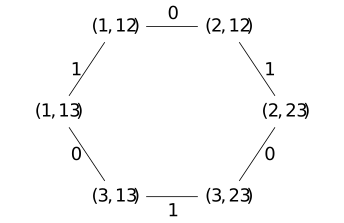
Each vertex in this flag graph records the vertex and edge of one flag; the common empty and greatest faces are suppressed. Edge labels give the rank changed by adjacency.
A tetrahedron has all subsets of \(\{1,2,3,4\}\) as faces, ordered by inclusion; a nonempty face with \(k\) vertices has rank \(k-1\). Its flag \(\varnothing <1<12<123<1234\) exhibits all five ranks. The vertex figure at \(1\) is a triangle: its vertices correspond to the three incident edges. A cube also has a triangular vertex figure, although its facets are squares. Local and global shapes carry different information.