Proxy reward and verifier fidelity [ftip-007F]
✍️sourceAGENTDRAFTED
Proxy reward and verifier fidelity [ftip-007F]
✍️sourceAGENTDRAFTED
A proxy can guide an update or rank sampled candidates without agreeing with the independently declared utility of the resulting output. This subsection separates pointwise proxy error from average error under a shifted law. It then distinguishes repeated false-accept events from the output of a candidate selector. Pointwise approximation and explicit probability assumptions support different guarantees; an average audit number alone supplies neither.
Definition 1. Uniform proxy approximation [ftip-007G]AGENTDRAFTED
Definition 1. Uniform proxy approximation [ftip-007G]AGENTDRAFTED
Let \(\mathcal Y_0\) be a nonempty finite set of candidate outcomes. Let \(U:\mathcal Y_0\to \mathbb R\) be an independently declared utility and \(\widehat U:\mathcal Y_0\to \mathbb R\) a proxy score. The proxy is a uniform approximation to \(U\) on \(\mathcal Y_0\) with error \(\varepsilon \) when \(\varepsilon \geq 0\) and
\[ \sup _{y\in \mathcal Y_0}\lvert \widehat U(y)-U(y)\rvert \leq \varepsilon . \]The candidate set is part of the claim. Approximation on training outcomes, on one policy's support, or in expectation is not uniform approximation on a larger set reached after optimization.
Theorem 2. Uniform proxy error gives two-epsilon selection regret [ftip-007H]AGENTDRAFTED
Theorem 2. Uniform proxy error gives two-epsilon selection regret [ftip-007H]AGENTDRAFTED
Under the conditions of Definition 1, choose
\[ y^\star \in \operatorname *{arg\,max}_{y\in \mathcal Y_0}U(y), \qquad \widehat y\in \operatorname *{arg\,max}_{y\in \mathcal Y_0}\widehat U(y). \]Then the utility regret of selecting by the proxy satisfies
\[ 0\leq U(y^\star )-U(\widehat y)\leq 2\varepsilon . \]
Proof.
Proof.
Optimality of \(\widehat y\) for the proxy and the two pointwise error bounds give
\[ \begin {aligned} U(y^\star ) &\leq \widehat U(y^\star )+\varepsilon \\ &\leq \widehat U(\widehat y)+\varepsilon \\ &\leq U(\widehat y)+2\varepsilon . \end {aligned} \]Optimality of \(y^\star \) for \(U\) gives the lower bound.
This finite statement follows from the displayed hypotheses.
Remark 3. The two-epsilon theorem is a decision bound [ftip-007I]AGENTDRAFTED
Remark 3. The two-epsilon theorem is a decision bound [ftip-007I]AGENTDRAFTED
The bound in Theorem 2 follows directly from the uniform approximation condition. It compares two maximizers on one fixed finite candidate set. It does not describe how either score was learned or how a policy changes when that score becomes a training objective.
The result is useful because its transfer assumption is visible. To apply it after an update or a larger search, the uniform bound must hold on the outcomes that the new procedure can actually select. The verifier evidence of Definition [ftip-0047] can support such an audit, but reproducible evidence alone does not establish the bound.
Example 4. Counterexample: Small average proxy error fails after distribution shift [ftip-007J]AGENTDRAFTED
Example 4. Counterexample: Small average proxy error fails after distribution shift [ftip-007J]AGENTDRAFTED
Let the finite decision set be \(\mathcal Y_0=\{y_{\rm safe},y_{\rm exploit}\}\). Define its utility and proxy utility by the following table.
\[ \begin {array}{c|cc} &y_{\rm safe}&y_{\rm exploit}\\ \hline U&1&0\\ \widehat U&1&2. \end {array} \]For \(0<\delta <1\), let a reference law \(P_\delta \) assign probability \(\delta \) to \(y_{\rm exploit}\). Its mean absolute proxy error is
\[ \mathbb E_{P_\delta }\lvert \widehat U-U\rvert =2\delta , \]which tends to zero with \(\delta \). Nevertheless, proxy maximization selects \(y_{\rm exploit}\) and incurs utility regret \(1\). Under the shifted law concentrated on that selected outcome, the mean error is \(2\). Thus no vanishing selection-regret bound can depend only on average error under the reference law.
This two-outcome construction isolates the distribution-shift warning in Remark [ftip-0061]. It does not claim that a particular learned verifier has this error profile; Example [ftip-0060] gives a source-linked checker instance with the same proxy-versus-utility separation.
Definition 5. Repeated verifier audit [ftip-007K]AGENTDRAFTED
Definition 5. Repeated verifier audit [ftip-007K]AGENTDRAFTED
A repeated verifier audit of size \(N\geq 1\) records pairs \((S_i,A_i)\in \{0,1\}^2\) for candidates \(1\leq i\leq N\). Here \(S_i\) is an independently defined success label and \(A_i\) is the verifier decision, as in Definition [ftip-005Z]. Define
\[ C_i^{\rm fa}=\{S_i=0,\ A_i=1\}, \qquad \mathcal E_N^{\rm fa}=\bigcup _{i=1}^N C_i^{\rm fa}. \]The event \(\mathcal E_N^{\rm fa}\) says that at least one invalid candidate was accepted. It does not say which candidate a downstream selector returns. Write \(\phi _i=\Pr (C_i^{\rm fa})\). When \(\iota _i=\Pr (S_i=0)>0\), the conditional false-accept rate \(\eta _{+,i}=\Pr (A_i=1\mid S_i=0)\) is defined and \(\phi _i=\iota _i\eta _{+,i}\).
Theorem 6. Independent false accepts amplify with candidate count [ftip-007L]AGENTDRAFTED
Theorem 6. Independent false accepts amplify with candidate count [ftip-007L]AGENTDRAFTED
In the repeated audit of Definition 5, suppose the pairs \((S_i,A_i)\) are independent and identically distributed. Assume
\[ \iota =\Pr (S_i=0)>0, \qquad \eta _+=\Pr (A_i=1\mid S_i=0). \]Then the probability that at least one accepted invalid candidate exists among the \(N\) audited candidates is
\[ \Pr (\mathcal E_N^{\rm fa})=1-(1-\iota \eta _+)^N. \]It is strictly increasing in \(N\) when \(0<\iota \eta _+<1\), and it converges to \(1\) when \(\iota \eta _+>0\).
Proof.
Proof.
Each \(C_i^{\rm fa}\) has probability \(\iota \eta _+\). Independence of the audited pairs makes the events \(C_i^{\rm fa}\) independent. Therefore
\[ \Pr \left ((\mathcal E_N^{\rm fa})^c\right ) =\Pr \left (\bigcap _{i=1}^N (C_i^{\rm fa})^c\right ) =\prod _{i=1}^N(1-\iota \eta _+) =(1-\iota \eta _+)^N. \]Taking complements gives the equality. The monotonicity and limit follow from the elementary powers of \(1-\iota \eta _+\).
This finite statement follows from the displayed hypotheses.
Theorem 7. A false-accept union bound without independence [ftip-007M]AGENTDRAFTED
Theorem 7. A false-accept union bound without independence [ftip-007M]AGENTDRAFTED
For any joint law of a repeated verifier audit,
\[ \Pr (\mathcal E_N^{\rm fa})\leq \sum _{i=1}^N \phi _i. \]If \(\iota _i=\Pr (S_i=0)>0\) for every \(i\), this becomes
\[ \Pr (\mathcal E_N^{\rm fa})\leq \sum _{i=1}^N \iota _i\eta _{+,i}. \]
Proof.
Proof.
Apply the union bound to \(\mathcal E_N^{\rm fa}=\bigcup _i C_i^{\rm fa}\). The factorization \(\phi _i=\iota _i\eta _{+,i}\) follows from conditional probability whenever \(\iota _i>0\). If \(\iota _i=0\), then \(\phi _i=0\) while the corresponding conditional rate is undefined, so the first display remains the unconditional statement.
Without a dependence assumption, matching marginal error rates do not give the equality in Theorem 6; the events \(C_i^{\rm fa}\) could coincide.
This finite statement follows from the displayed hypotheses.
Example 8. Weight updates and candidate selection are different proxy operators [ftip-007N]AGENTDRAFTED
Example 8. Weight updates and candidate selection are different proxy operators [ftip-007N]AGENTDRAFTED
A proxy score can enter a training operator or a selection operator. In the first route it changes the policy; in the second it ranks a finite sample from a policy whose weights remain fixed.
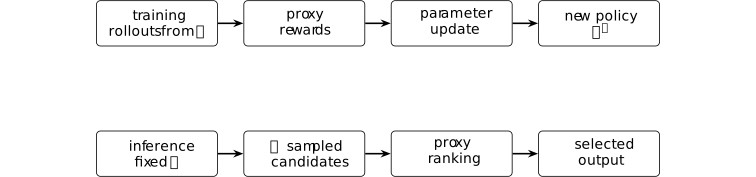
The lifecycle accounting of Definition [ftip-005H] places the first route's rollout and update work in separate coordinates. The second route incurs rollout and evaluation work but no parameter update. Consequently, the event \(\mathcal E_N^{\rm fa}\) in Definition 5 concerns the candidate set presented to selection; it is not a claim about the selected output or a training-time policy change.
Remark 9. What verifier error rates do not identify [ftip-007O]AGENTDRAFTED
Remark 9. What verifier error rates do not identify [ftip-007O]AGENTDRAFTED
The rates in Definition [ftip-005Z] are properties of a declared audit law. They do not identify where errors occur within the task family, how error events depend across repeated candidates, or which accepted candidate a selector returns. Theorem 6 adds identical marginals and independence; Theorem 7 retains only the union bound.
Nor do these rates determine the effect of optimizing against the verifier. That effect depends on how the induced policy or selection law moves mass toward particular outcomes. The incomplete-checker example Example [ftip-0060] demonstrates one such movement, while Example 4 shows why an average reference-law error cannot rule it out. These are local finite statements. Any claim about a named verifier still requires its own audit distribution, evidence, and transfer argument.
The deterministic regret lemma Theorem 2, the independent-audit identity Theorem 6, and the union bound Theorem 7 follow from uniform approximation, independent trials, and subadditivity, respectively. Their hypotheses need not hold for a verifier chosen only for its empirical performance.