Example. The PPO clipping cases for positive and negative advantage [ftip-003I]
Example. The PPO clipping cases for positive and negative advantage [ftip-003I]
Positive and negative advantages select different branches of the PPO clipped minimum.
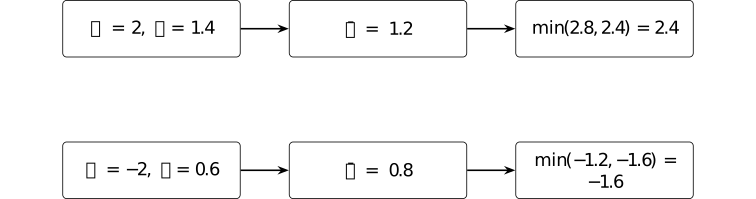
With \(\epsilon =0.2\), write \(\bar r=\operatorname {clip}(r,0.8,1.2)\) and \(L(r,A)=\min (rA,\bar rA)\). For positive advantage and \(r=1.4\), the gain is capped at \(2.4\). For negative advantage and \(r=0.6\), the clipped term \(-1.6\) is smaller than \(-1.2\), so the objective retains the penalty.
The pointwise surrogate comes from [schulman2017proximal, Section 3]. The two sign cases check only its arithmetic; they provide no monotone-improvement result for a neural policy or finite minibatch.