Proposition. Transfer computes total local orientation [frap-000X]
Proposition. Transfer computes total local orientation [frap-000X]
Let \(G\) act transitively on a finite nonempty position set \(I\), and on a tagged union of fibers \(X_i\), carrying \(X_i\) bijectively to \(X_{g i}\). Fix \(i_0\in I\) and put \(H=G_{i_0}\). Let \(K\) act faithfully on a nonempty set \(\Omega \); choose a bijective base frame \(c_0:\Omega \to X_{i_0}\) and a homomorphism \(\rho :H\to K\) satisfying \(h c_0=c_0\rho (h)\) for every \(h\in H\). Choose \(r_i\in G\) with \(r_i i_0=i\), and set \(c_i=r_i c_0\). Then the total-orientation character of this framed transport is
\[\chi =\rho _{\mathrm {ab}}\circ T_{G,H}:G\longrightarrow K_{\mathrm {ab}},\]where \(T_{G,H}\) is transfer and \(\rho _{\mathrm {ab}}([h])=[\rho (h)]\). This identifies the coset construction in [mayer2015artin, Section 3.3, p. 6] with the local-frame coordinates of [marchetti2025rubik, Section 3.1, pp. 6--7].
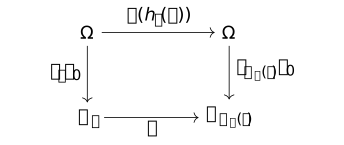
The vertical arrows are the transported frames. The equality \(g r_i=r_{\pi _g(i)}h_i(g)\) makes the square commute: after the destination representative is removed, the remaining motion fixes \(i_0\) and acts through \(\rho \). Changing representatives changes these frames within \(K\), so the character is unchanged.
The induced map is Abelianization.map. Naturality of
transfer is MonoidHom.transfer_comp, with
\(\phi :H\to H_{\mathrm {ab}}\) the quotient map and the target map
\(\rho _{\mathrm {ab}}\). That algebraic identity supports the last
equality; the identification with the actual fiber action is the
transported-frame argument above.