Example. The Lorentz Spin action is Hermitian matrix congruence [fcap-0040]
Example. The Lorentz Spin action is Hermitian matrix congruence [fcap-0040]
In the Pauli model Example [fcap-002L], an odd vector becomes an even element after multiplication by \(e_0\). Encode \(v=te_0+x_1e_1+x_2e_2+x_3e_3\) by \[X(v)=\Psi (ve_0)=t1-\sum _{j=1}^3x_j\sigma _j =\begin {pmatrix}t-x_3&-x_1+i x_2\\-x_1-i x_2&t+x_3\end {pmatrix}.\] A matrix is Hermitian when \(Z^*=Z\), where \(*\) denotes conjugate transpose. Every Hermitian two-by-two matrix has the form \(Z=\begin {pmatrix}a&z\\\overline z&d\end {pmatrix}\) with \(a,d\in \mathbb R\). The inverse coordinates are \[X^{-1}(Z)=\left (\frac {a+d}{2},-\operatorname {Re}z, \operatorname {Im}z,\frac {d-a}{2}\right ).\] Thus \(X\) is a real linear equivalence, and direct expansion gives \[\det X(v)=t^2-x_1^2-x_2^2-x_3^2=Q_{1,3}(v).\]
For \(s\in \operatorname {Spin}(Q_{1,3})\), put \(M=\Psi (s)\in SL_2(\mathbb C)\). Then the vector action is \[X(svs^{-1})=M X(v)M^*.\] To prove it, conjugation by \(e_0\) defines an automorphism \(\gamma (x)=e_0xe_0\) of the even algebra. It negates each \(A_j=e_0e_j\) and the volume element \(I=e_0e_1e_2e_3\). On the matrix side, \(M\mapsto \operatorname {adj}(M)^*\) has the same effect on \(\sigma _j\) and \(-i1\). It is a real algebra automorphism: both adjugation and conjugate transpose reverse products, and in size two adjugation is linear. Checking the even generators therefore gives \[\Psi (\gamma (x))=\operatorname {adj}(\Psi (x))^*.\] Now multiply the Clifford action by \(e_0\): \[(svs^{-1})e_0=s(ve_0)\gamma (s^{-1}).\] Since \(\det M=1\), we have \(\operatorname {adj}(M^{-1})=M\). Applying \(\Psi \) proves the congruence formula. It preserves Hermitian matrices, and its determinant is unchanged because \(\det M=\det M^*=1\).
The square makes the coordinate meaning of the action explicit:
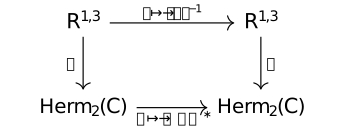
For comparison with the formal opposite-signature model, use
\(T\) and \(E\) from Lemma [fcap-003Z]. TauCeti's vector equivalence has
coordinates
\[H(y)=\begin {pmatrix}y_3+y_2&-y_1-i y_0\\
-y_1+i y_0&y_3-y_2\end {pmatrix},\qquad
\det H(y)=-Q_{3,1}(y)\]
TauCeti.coe_realCliffordThreeOneVectorEquivHermitian_apply
TauCeti.realCliffordThreeOneVectorEquivHermitian_det.
Substitution gives \(H(Tv)=X(v)\). In the even algebra this is the
same identity as \(E(ve_0)=-T(v)f_3\), since
\(H(y)=\Phi (-yf_3)\). The group coercion formula
TauCeti.coe_realSpinThreeOneEquivSpecialLinear_apply
identifies the matrix of \(E(s)\) with \(\Phi (E(s))=\Psi (s)=M\).
Consequently the action dictionary in Lemma [fcap-003Z] translates
TauCeti's exact Hermitian congruence theorem
TauCeti.realSpinThreeOneEquivSpecialLinear_action
into the displayed Pauli action. This checks both the signature sign
and the matrix axes, not just the abstract group type.
Multiplication by a fixed nonisotropic vector is the even-algebra action mechanism of [porteous1995clifford, Chapter 16, Proposition 16.9, pp. 143--144]. His Lorentz group calculation uses adjugation and the norm-one carrier [porteous1995clifford, Chapter 17, Proposition 17.5, pp. 151--152]. The coordinates and conjugate-transpose action above are derived in our chosen axes. The orthogonal image retains the spinor-norm condition of Theorem [fcap-0023]; a topological component identification is separate.