Starting-policy interventions [ftip-009N]
✍️sourceAGENTDRAFTED
Starting-policy interventions [ftip-009N]
✍️sourceAGENTDRAFTED
A comparison among starting policies is meaningful only after the task, training grid, feedback rule, and evaluation procedure have been declared. Observed differences are conditional on those experimental coordinates.
Remark 1. The source experiment as an intervention matrix [ftip-009O]AGENTDRAFTED
Remark 1. The source experiment as an intervention matrix [ftip-009O]AGENTDRAFTED
[clay2026demystifying, Sections 4.1--4.3 and Figure 1] organize the reported experiments along three declared axes: a starting model distribution, a training-prompt distribution, and a reward function. Each reported measurement therefore belongs to a cell of a matrix rather than to an unqualified ``RL post-training'' condition. The source holds its broad training recipe fixed while varying selected axes; it does not study variation among RL algorithms.
Each experimental comparison is conditional on its model, task, prompt law, executable reward rule, training budget, and evaluation procedure. The reward rule is especially consequential here because the main text and Appendix C do not state identical sparse-reward semantics. Section 4.2 describes target containment with a length penalty. Appendix C's prose says an exact target receives unit reward, but its displayed equation requires the response to be strictly longer than the target for any positive reward. These two descriptions do not identify a single sparse-reward implementation.
Definition 2. Target-response event [ftip-009P]AGENTDRAFTED
Definition 2. Target-response event [ftip-009P]AGENTDRAFTED
Fix an evaluation instance \(x\), a response space \(\mathcal Y_x\), and a declared target predicate \(h_x^\star :\mathcal Y_x\to \{0,1\}\). For a sampled response \(Y\), the target-response event is
\[ E_x^\star =\{h_x^\star (Y)=1\}. \]The predicate is part of the evaluation specification. It may test exact string equality after a declared normalization, containment of a target substring, equality of a parsed answer, or another explicitly typed condition. These predicates are not interchangeable. The movie-quote and AIME experiments in [clay2026demystifying, Sections 4.1--4.2] use different response objects and therefore require different target predicates.
Remark 3. Exact-string success and task utility are different predicates [ftip-009Q]AGENTDRAFTED
Remark 3. Exact-string success and task utility are different predicates [ftip-009Q]AGENTDRAFTED
Let \(y_x^\star \) be a designated string and let \(N_x\) be a declared normalizer. Exact-string success is the specialization \(h_x^\star (y)=\mathbf 1\{N_x(y)=N_x(y_x^\star )\}\) of Definition 2. A task utility may instead accept semantically equivalent answers, assign partial credit, invoke a verifier, or depend on evaluator randomness as in Convention [ftip-005D].
Consequently, a change in target-string match rate is not automatically a change in task utility. [clay2026demystifying, Sections 4.1--4.2] deliberately use narrow target behaviours to study controlled coverage. Transferring their measurements to broader capability requires a separately justified evaluator.
Definition 4. Base, SFT-positive, and SFT-negative starting-policy triple [ftip-009R]AGENTDRAFTED
Definition 4. Base, SFT-positive, and SFT-negative starting-policy triple [ftip-009R]AGENTDRAFTED
For one declared model family and target predicate, a starting-policy triple is
\[ \left (\pi ^{\mathrm {base}},\pi ^+,\pi ^-\right ). \]Here \(\pi ^{\mathrm {base}}\) is the unmodified starting policy, \(\pi ^+\) is obtained by a declared supervised update intended to increase target-response frequency, and \(\pi ^-\) is obtained by a declared update intended to decrease it. The superscripts name producing interventions, not mathematical order relations between the resulting policies.
[clay2026demystifying, Section 4.1] instantiates the triple with the source's Base, SFT-positive, and SFT-negative checkpoints. For the movie quote, its SFT mixture places twenty percent weight on the target quote and eighty percent on other quotes from the Cornell Movie-Dialogs corpus; the negative intervention maximizes cross-entropy loss on the target.
Remark 5. SFT-positive and SFT-negative are composite weight interventions [ftip-009S]AGENTDRAFTED
Remark 5. SFT-positive and SFT-negative are composite weight interventions [ftip-009S]AGENTDRAFTED
The policies \(\pi ^+\) and \(\pi ^-\) of Definition 4 are produced by optimization. Their weights, output probabilities, representations, and off-target behaviours can all change together. Calling one intervention ``positive'' and the other ``negative'' describes its intended effect on the declared target response; it does not assert that only one probability mass was edited.
The comparisons in [clay2026demystifying, Sections 4.1 and 5.1] therefore test dependence on three constructed starting checkpoints. They do not identify a causal effect of initial target probability alone without an additional intervention model.
Definition 6. Controlled post-training experiment cell [ftip-009T]AGENTDRAFTED
Definition 6. Controlled post-training experiment cell [ftip-009T]AGENTDRAFTED
A controlled post-training experiment cell is a record
\[ \mathfrak c= (M,\pi ^{\mathrm {init}},\mathsf T,\mathcal D_{\mathrm {tr}}, r^{\mathrm {id}},\mathcal A,b_{\mathrm {tr}},\mathsf E), \]where \(M\) identifies the model architecture and checkpoint lineage, \(\pi ^{\mathrm {init}}\) is its starting policy, \(\mathsf T\) is the task, \(\mathcal D_{\mathrm {tr}}\) is the training-prompt law, \(r^{\mathrm {id}}\) identifies an executable reward rule and version, \(\mathcal A\) is the update procedure, \(b_{\mathrm {tr}}\) is the training budget, and \(\mathsf E\) is the evaluation interface. Random seeds and hyperparameters belong to the relevant record fields even when suppressed from the notation.
[clay2026demystifying, Figure 1 and Sections 4.1--4.3] motivates the coordinates. The source varies starting distribution, prompt distribution, and reward while using a common broad RL setup. Because its main-text and Appendix-C sparse rewards differ, the reward field is an identifier for an executable rule, not merely the word ``sparse.''
Definition 7. Matched cells and held-fixed coordinates [ftip-009U]AGENTDRAFTED
Definition 7. Matched cells and held-fixed coordinates [ftip-009U]AGENTDRAFTED
Let \(J\) index the coordinates of an experiment cell \(\mathfrak c\) from Definition 6. For \(S\subseteq J\), two cells \(\mathfrak c\) and \(\mathfrak c'\) are matched outside \(S\) when
\[ \mathfrak c_j=\mathfrak c'_j\qquad \text {for every }j\in J\setminus S. \]The coordinates in \(J\setminus S\) are the held-fixed coordinates; those in \(S\) are the declared intervention coordinates. Equality means equality at the resolution recorded by the experiment, including evaluation sample size when that size affects the reported statistic.
A matched comparison licenses a contrast between the recorded cells. It does not show that a named coordinate is internally atomic. In particular, matching outside the starting-policy coordinate leaves the composite-checkpoint qualification of Remark 5 in force.
Example 8. Three starting laws under one declared training grid [ftip-009V]AGENTDRAFTED
Example 8. Three starting laws under one declared training grid [ftip-009V]AGENTDRAFTED
A source comparison may place the three starting policies of Definition 4 into cells matched outside the starting-policy coordinate. The shared boxes below mean equality of the declared grid fields, not that the three checkpoints differ in only one scalar probability.
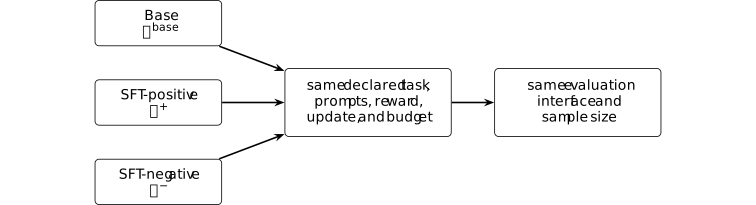
This is the comparison pattern used in [clay2026demystifying, Sections 4.1 and 5.1]. An actual cell still needs its model, task, reward implementation, and numerical record; the diagram is not a claim that all experiments in the paper instantiate one identical grid.
Remark 9. What the starting-policy comparison can and cannot identify [ftip-009W]AGENTDRAFTED
Remark 9. What the starting-policy comparison can and cannot identify [ftip-009W]AGENTDRAFTED
Within a declared model, task, training grid, and evaluation procedure, the three-cell comparison can establish that the measured post-training outcome differs across the source's constructed starting checkpoints. The movie-quote and AIME entries in [clay2026demystifying, Section 5.1, Tables 1--2] are empirical records of that form.
The comparison does not isolate initial target probability from every other SFT-induced weight change, prove that an observed zero has zero support, or establish acquisition of a broader capability. The reported model sets differ across the paper: [clay2026demystifying, Section 4.1] names OLMo 3, Qwen2-7B, Qwen3-1.7B, and Qwen2.5-7B-Instruct, while Table 1 and Appendix G also report Qwen3-8B and Qwen2-1.5B. Each measurement is specific to the model and configuration in its table row.