Transfer and the effect of dimension [frap-000B]
✍️sourceAGENTDRAFTED
Transfer and the effect of dimension [frap-000B]
✍️sourceAGENTDRAFTED
The total-orientation character detects one conservation law, but it does not explain how to compare frames chosen at different positions. The motivating question is how to transport that comparison through a transitive action. Transfer uses the same cancellation as the total-orientation character for coset representatives [mayer2015artin, Sections 3.1--3.3]. The first section identifies the connection through an actual transitive action and its stabilizer; the second computes how the local rotation groups of simplices and cubes change with dimension, following [marchetti2025rubik, Sections 4--5].
1. Transfer and local orientation [frap-0012]AGENTDRAFTED
1. Transfer and local orientation [frap-0012]AGENTDRAFTED
Left multiplication permutes the cosets of a finite-index subgroup. Representatives record the motion between cosets, leaving one residual subgroup element at each position. Abelianizing their product gives transfer [mayer2015artin, Sections 3.1--3.3]. Transported frames then identify its local image with the total-orientation character of an action.
Theorem 1.1. Finite-index transfer [frap-000W]
Theorem 1.1. Finite-index transfer [frap-000W]
Let \(H\leq G\) have finite index. Choose representatives \(r_i\) for the left cosets \(r_iH\), indexed bijectively by a finite set \(I\). For \(g\in G\), left multiplication permutes the cosets, so uniquely write
\[g r_i=r_{\pi _g(i)}h_i(g),\qquad h_i(g)\in H.\]Write \(H_{\mathrm {ab}}=H/[H,H]\) and \([h]\) for the class of \(h\in H\). The abelianization is the target of the transfer
\[T_{G,H}:G\longrightarrow H_{\mathrm {ab}},\qquad T_{G,H}(g)=\prod _{i\in I}[h_i(g)]\]is a homomorphism independent of the chosen representatives. This is the left-coset construction of [mayer2015artin, Definition 3.1, Proposition 3.1 and Theorem 3.1, pp. 4--6]. Neither finiteness of \(G\) nor normality of \(H\) is required.
Proof.
Proof.
We compose left actions rightmost first. Multiplication on cosets gives \(\pi _{gk}=\pi _g\pi _k\). Expanding \(gkr_i\) in two steps yields
\[h_i(gk)=h_{\pi _k(i)}(g)h_i(k).\]Taking classes and multiplying over \(i\) gives \(T_{G,H}(gk)=T_{G,H}(g)T_{G,H}(k)\), because \(\pi _k\) reorders the first factors. Replace \(r_i\) by \(r_i t_i\), with \(t_i\in H\). The new residual factor is \(t_{\pi _g(i)}^{-1}h_i(g)t_i\). Its total class contains each \([t_i]\) and its inverse exactly once, so they cancel. Reindexing the cosets also only reorders an abelian product. This proves independence of all choices.
The linked transfer definitions specialize the homomorphism \(\phi :H\to A\) to the quotient \(H\to H_{\mathrm {ab}}\). The indexed formula takes \(f(i)=r_i\) and \(\pi =\pi _g\); its factor \(r_{\pi _g(i)}^{-1}g r_i\) is precisely \(h_i(g)\). Its finite-index instance follows from the finite bijective family of cosets.
Proposition 1.2. Transfer computes total local orientation [frap-000X]AGENTDRAFTED
Proposition 1.2. Transfer computes total local orientation [frap-000X]AGENTDRAFTED
Let \(G\) act transitively on a finite nonempty position set \(I\), and on a tagged union of fibers \(X_i\), carrying \(X_i\) bijectively to \(X_{g i}\). Fix \(i_0\in I\) and put \(H=G_{i_0}\). Let \(K\) act faithfully on a nonempty set \(\Omega \); choose a bijective base frame \(c_0:\Omega \to X_{i_0}\) and a homomorphism \(\rho :H\to K\) satisfying \(h c_0=c_0\rho (h)\) for every \(h\in H\). Choose \(r_i\in G\) with \(r_i i_0=i\), and set \(c_i=r_i c_0\). Then the total-orientation character of this framed transport is
\[\chi =\rho _{\mathrm {ab}}\circ T_{G,H}:G\longrightarrow K_{\mathrm {ab}},\]where \(T_{G,H}\) is transfer and \(\rho _{\mathrm {ab}}([h])=[\rho (h)]\). This identifies the coset construction in [mayer2015artin, Section 3.3, p. 6] with the local-frame coordinates of [marchetti2025rubik, Section 3.1, pp. 6--7].
Proof.
Proof.
The map \(G/H\to I\), \(rH\mapsto r i_0\), is a bijection: \(r i_0=s i_0\) exactly when \(s^{-1}r\in H\). Thus \(H\) has finite index \(|I|\), and the \(r_i\) are left-coset representatives. Write \(\pi _g(i)=g i\) and \(g r_i=r_{\pi _g(i)}h_i(g)\). Then
\[g c_i=g r_i c_0=r_{\pi _g(i)}h_i(g)c_0 =c_{\pi _g(i)}\rho (h_i(g)).\]Consequently every local factor belongs to \(K\), and its source-indexed coordinate is \(a_i(g)=\rho (h_i(g))\). A homomorphism sends commutators to commutators, so \(\rho _{\mathrm {ab}}\) is well defined. Multiplying the local classes gives
\[\chi (g)=\prod _i[\rho (h_i(g))] =\rho _{\mathrm {ab}}\left (\prod _i[h_i(g)]\right ).\]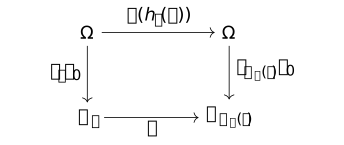
The vertical arrows are the transported frames. The equality \(g r_i=r_{\pi _g(i)}h_i(g)\) makes the square commute: after the destination representative is removed, the remaining motion fixes \(i_0\) and acts through \(\rho \). Changing representatives changes these frames within \(K\), so the character is unchanged.
The induced map is Abelianization.map. Naturality of
transfer is MonoidHom.transfer_comp, with
\(\phi :H\to H_{\mathrm {ab}}\) the quotient map and the target map
\(\rho _{\mathrm {ab}}\). That algebraic identity supports the last
equality; the identification with the actual fiber action is the
transported-frame argument above.
Example 1.3. Corner and edge stabilizers of the cube [frap-000Y]AGENTDRAFTED
Example 1.3. Corner and edge stabilizers of the cube [frap-000Y]AGENTDRAFTED
Let \(G\) be the actual permutation group generated by the six outer-face quarter-turns of the ordinary cube, with its frame of reference fixed. Use the corner and edge fibers: cyclic corner labels with local group \(C_3\), and edge labels with local group \(C_2\). This specializes the local-orientation construction of [marchetti2025rubik, Section 3.1]; the orbit argument below identifies the stabilizers needed for transfer.
The action on eight corner positions is transitive. Adjacent corners share a face whose quarter-turn takes one to the other, and the cube's edge graph is connected. Hence a corner stabilizer \(H_c\) has index eight. Its action on the three cyclically ordered labels gives a homomorphism \(\rho _c:H_c\to C_3\). The action on twelve edge positions is also transitive: the four edges of one face form a single orbit under its quarter-turn; neighboring faces share an edge; and the face-adjacency graph is connected. Thus an edge stabilizer \(H_e\) has index twelve, with local action \(\rho _e:H_e\to C_2\).
Choose a frame at the fixed corner or edge and transport it using coset representatives. The transfer comparison gives
\[\chi _c=(\rho _c)_{\mathrm {ab}}\circ T_{G,H_c},\qquad \chi _e=(\rho _e)_{\mathrm {ab}}\circ T_{G,H_e}.\]We identify the abelianizations of \(C_3\) and \(C_2\) with those groups. The face-turn calculation proves that the twist and flip characters vanish on every legal generator, hence on \(G\). It follows that these two local images of transfer vanish. It does not follow that \(T_{G,H_c}\) or \(T_{G,H_e}\) is trivial in the larger stabilizer abelianizations. No classification of \(G\) was needed.
2. Dimension and local rotation groups [frap-0013]AGENTDRAFTED
2. Dimension and local rotation groups [frap-0013]AGENTDRAFTED
The local corner groups of simplices and cubes are alternating groups. Their commutator subgroups determine the information that survives the total-orientation character [marchetti2025rubik, Sections 4--5].
Proposition 2.1. Local rotations of simplices and cubes [frap-000Z]AGENTDRAFTED
Proposition 2.1. Local rotations of simplices and cubes [frap-000Z]AGENTDRAFTED
For \(d\geq 3\), a vertex figure of a \(d\)-simplex or a \(d\)-cube is a \((d-1)\)-simplex. Its automorphism group is \(S_d\), and its rotation subgroup is \(A_d\). These are the local corner groups used in [marchetti2025rubik, Section 4, p. 10, and Section 5, p. 14].
Proof.
Proof.
At a vertex of either polytope there are \(d\) incident edges. Faces containing that vertex correspond to subsets of those edges: for a simplex one chooses the other vertices, and for a cube one chooses the coordinate directions in which the face varies. This is the face poset of a simplex on \(d\) vertices, of dimension \(d-1\). An automorphism permutes its vertices, and every vertex permutation extends uniquely to the subsets, giving \(S_d\).
A base flag orders these \(d\) vertices. Its distinguished involutions are adjacent transpositions. They generate \(S_d\), and the even words are precisely the even permutations. Thus the rotation subgroup is \(A_d\).
Here \(d\) is abstract dimension. Varying the layer count of an \(N\times N\times N\) cube leaves the ambient dimension equal to three; it changes the piece orbits and allowed layer moves instead.
Theorem 2.2. Abelianizations of the local alternating groups [frap-0010]AGENTDRAFTED
Theorem 2.2. Abelianizations of the local alternating groups [frap-0010]AGENTDRAFTED
Let \(A_d\) be the alternating group on \(d\) letters, with composition rightmost first. Then
\[(A_3)_{\mathrm {ab}}\cong C_3,\qquad (A_4)_{\mathrm {ab}}\cong C_3,\qquad (A_d)_{\mathrm {ab}}=1\quad (d\geq 5).\]The corresponding commutator subgroups are stated after Proposition 4.1 in [marchetti2025rubik, Section 4.1, p. 11]. We give the elementary calculation, using \([g,h]=ghg^{-1}h^{-1}\).
Proof.
Proof.
The group \(A_3\) is cyclic of order three, so already abelian. In \(A_4\), let \(V=\{1,(12)(34),(13)(24),(14)(23)\}\). Products and inverses stay in this four-element set, and conjugation permutes its three nonidentity elements. Hence \(V\) is normal. The quotient has order three, so it is cyclic and \([A_4,A_4]\subseteq V\). Direct multiplication gives \([(123),(124)]=(12)(34)\). Conjugating this element by the three-cycle \((123)\) gives the other two double transpositions. The commutator subgroup is normal, so it contains all of \(V\); equality follows.
For \(d\geq 5\), put \(g=(12)(34)\) and \(h=(12)(35)\) in \(A_d\). Multiplication gives \([g,h]=(345)\). Every three-cycle is conjugate to this one within \(A_d\): first choose a conjugating permutation in \(S_d\); if it is odd, compose on the right with a transposition of two symbols outside \(\{3,4,5\}\). This centralizes \((345)\) and changes the parity. Thus the normal subgroup \([A_d,A_d]\) contains every three-cycle.
Three-cycles generate all even permutations. Write an even permutation as a product of an even number of transpositions and pair them. Equal transpositions cancel; two sharing one symbol give a three-cycle; a disjoint pair satisfies \((ab)(cd)=(acb)(acd)\). Hence every pair is a product of three-cycles, proving \([A_d,A_d]=A_d\).
The three cases have separate formalized ingredients.
alternatingGroup.isCyclic_of_card_le_three gives the
cyclicity of \(A_3\). For four letters,
alternatingGroup.kleinFour_eq_commutator identifies \(V\)
with the commutator subgroup, and
TauCeti.card_abelianization_alternatingGroup gives
the quotient's cardinality three; the displayed cyclic isomorphism
then uses the elementary classification of groups of prime order.
For \(d\geq 5\), commutator_alternatingGroup_eq_top is the
perfection statement. These links concern alternating groups, not
the entire puzzle group.
Remark 2.3. What the corner character can detect [frap-0011]AGENTDRAFTED
Remark 2.3. What the corner character can detect [frap-0011]AGENTDRAFTED
For a \(d\)-simplex or \(d\)-cube with \(d\geq 3\), the local corner groups have rotation subgroup \(A_d\). Their contribution to the total-orientation character passes through \((A_d)_{\mathrm {ab}}\). The abelianization calculation therefore measures exactly what this detector can see, as in [marchetti2025rubik, Section 4.1, p. 11, and equation (19), p. 14].
In dimension three the target is \(C_3\), the familiar corner twist sum. In dimension four the local group has grown to the nonabelian \(A_4\), but the character still sees only a \(C_3\) quotient: every local change in the Klein four group disappears from it. In dimensions five and above the local group is perfect, so this corner character is identically trivial on the ambient framed transports.
A lost detector does not classify the legal moves. Other piece types, permutation signs and the subgroup actually generated by facet turns may still impose constraints. Even when the target is nontrivial, conservation requires a generator check; the local abelianization alone does not supply one.