Finite initial-coverage measurement [ftip-009X]
✍️sourceAGENTDRAFTED
Finite initial-coverage measurement [ftip-009X]
✍️sourceAGENTDRAFTED
A finite evaluation records hits, not mathematical support. This subsection introduces the hit count and its sampling law, derives the exact zero-hit bound under independent sampling, and then returns to the limits of the source measurement.
Definition 1. Initial evaluation hit count [ftip-009Y]AGENTDRAFTED
Definition 1. Initial evaluation hit count [ftip-009Y]AGENTDRAFTED
Fix a starting policy, an evaluation sampling law, and the target predicate of Definition [ftip-009P]. Before post-training, draw evaluation records \((X_j,Y_j)_{j=1}^m\). Define the hit indicators and the initial evaluation hit count by
\[ I_j^\star =h_{X_j}^\star (Y_j), \qquad K_m=\sum _{j=1}^{m}I_j^\star . \]The sampling law determines whether the instances \(X_j\) are fixed, resampled, or stratified. The adjective ``initial'' locates the measurement before the post-training intervention; it does not assert that the samples are independent or that the starting policy is a foundation checkpoint.
Definition 2. Empirical initial success rate [ftip-009Z]AGENTDRAFTED
Definition 2. Empirical initial success rate [ftip-009Z]AGENTDRAFTED
For a nonempty initial evaluation sample of size \(m\), the empirical initial success rate is
\[ \widehat p_m=\frac {K_m}{m} =\widehat {\mathbb E}_{j\in \{1,\ldots ,m\}}[I_j^\star ], \]using the empirical-average convention of Convention [ftip-006Z]. This is a statistic of the declared sample. It is not, without a sampling model and an uncertainty statement, the exact successful-support probability \(p_P(x)\) of Definition [ftip-005U].
Remark 3. Zero observed hits are not zero probability [ftip-00A0]AGENTDRAFTED
Remark 3. Zero observed hits are not zero probability [ftip-00A0]AGENTDRAFTED
The equality \(K_m=0\) says that no target response occurred in one finite sample. Every success probability \(0\leq p<1\) assigns positive probability \((1-p)^m\) to this observation under independent Bernoulli sampling. Thus \(\widehat p_m=0\) does not imply \(p=0\), absence from mathematical support, or impossibility of discovery under a larger budget.
The entries printed as 0.00 percent in [clay2026demystifying, Section 5.1, Tables 1--2] are empirical rates at the stated evaluation sizes. They must not be rewritten as exact support claims.
Theorem 4. Zero-hit likelihood under iid evaluation [ftip-00A1]AGENTDRAFTED
Theorem 4. Zero-hit likelihood under iid evaluation [ftip-00A1]AGENTDRAFTED
Let \(m\in \mathbb N_{\geq 1}\). Assume the hit indicators from Definition 1 are independent Bernoulli variables with a common success probability \(p\). Then \(K_m\) has the binomial law and
\[ \Pr _p(K_m=0)=(1-p)^m. \]
Proof.
Proof.
The event \(K_m=0\) is \(\bigcap _{j=1}^m\{I_j^\star =0\}\). Independence and \(\Pr _p(I_j^\star =0)=1-p\) give the displayed product.
This finite statement follows from the displayed hypotheses. Applying it to a source table requires the additional iid and stationary-success assumptions stated above.
Corollary 5. Exact one-sided bound after zero hits [ftip-00A2]AGENTDRAFTED
Corollary 5. Exact one-sided bound after zero hits [ftip-00A2]AGENTDRAFTED
Assume Theorem 4 with \(m\in \mathbb N_{\geq 1}\) and fix \(0<\delta <1\). If \(K_m=0\), inversion of the exact zero-count likelihood gives the one-sided upper endpoint
\[ u_{m,\delta }=1-\delta ^{1/m}. \]Indeed, \(\Pr _{u_{m,\delta }}(K_m=0)=\delta \), and for every \(p>u_{m,\delta }\) one has \(\Pr _p(K_m=0)<\delta \). Thus the observed zero count excludes probabilities above \(u_{m,\delta }\) at exact level \(\delta \) under the declared iid model.
Proof.
Proof.
By Theorem 4, the zero-count likelihood is \((1-p)^m\), which is strictly decreasing in \(p\). Solving \((1-p)^m=\delta \) gives the endpoint and the stated strict inequality.
This is a likelihood inversion derived from the displayed finite setup, not a source theorem and not a support certificate.
Example 6. The 128-sample zero-hit bound [ftip-00A3]AGENTDRAFTED
Example 6. The 128-sample zero-hit bound [ftip-00A3]AGENTDRAFTED
Take \(m=128\) and \(\delta =0.05\) in Corollary 5. After zero hits, the exact one-sided upper endpoint is
\[ u_{128,0.05} =1-0.05^{1/128} \approx 0.02313. \]Under the iid Bernoulli model, probabilities above approximately 2.313 percent make a zero count less than five percent likely. The calculation does not turn a recorded \(0/128\) into proof that the true probability is zero, and it does not apply if the 128 evaluations have a different joint sampling law.
Definition 7. First positive sparse-reward time [ftip-00A4]AGENTDRAFTED
Definition 7. First positive sparse-reward time [ftip-00A4]AGENTDRAFTED
Fix an executable sparse-reward rule and let \(r_j^{\mathrm {sp}}\) be the reward returned on rollout \(j\). The first positive sparse-reward time is the extended-valued index
\[ J_+=\inf \{j\geq 1:r_j^{\mathrm {sp}}>0\}, \qquad \inf \varnothing :=\infty . \]This definition concerns the reward implementation named by an experiment cell. The event \(r_j^{\mathrm {sp}}>0\) coincides with a target-response event only when that equality is part of the declared reward semantics. In particular, a length penalty or partial-credit rule can separate positive reward from exact target match.
Corollary 8. Sparse-reward discovery within a rollout budget [ftip-00A5]AGENTDRAFTED
Corollary 8. Sparse-reward discovery within a rollout budget [ftip-00A5]AGENTDRAFTED
Suppose the events \(\{r_j^{\mathrm {sp}}>0\}\) are independent and have a common probability \(q\). For every positive rollout budget \(B\),
\[ \Pr (J_+\leq B)=1-(1-q)^B. \]
Proof.
Proof.
Apply the independent-attempt theorem Theorem [ftip-0078] with \(E_j=\{r_j^{\mathrm {sp}}>0\}\). Its discovery event is exactly \(\{J_+\leq B\}\).
This is a specialization proved from the displayed hypotheses. It does not supply independence, stationarity, or the value of \(q\) for a training run, and it does not equate positive proxy reward with task utility.
Example 9. The AIME 128-sample measurement record [ftip-00A6]AGENTDRAFTED
Example 9. The AIME 128-sample measurement record [ftip-00A6]AGENTDRAFTED
[clay2026demystifying, Section 5.1, Table 2] reports the following empirical target-answer rates for AIME Problem 4 with Qwen2.5-7B-Instruct and evaluation size \(m=128\). The task asks for the number of integer pairs \((x,y)\in [-100,100]^2\) satisfying \(12x^2-xy-6y^2=0\); the target answer is \(117\).
\[ \begin {array}{c|ccc} &\mathrm {SFT{+}}&\mathrm {Base}&\mathrm {SFT{-}}\\ \hline \text {No Reward}&26.6&3.92&0.00\\ \text {Sparse Reward}&85.9&10.2&0.00\\ \text {Dense Reward}&86.7&92.2&0.00 \end {array} \]Every entry in the displayed array is a percentage.
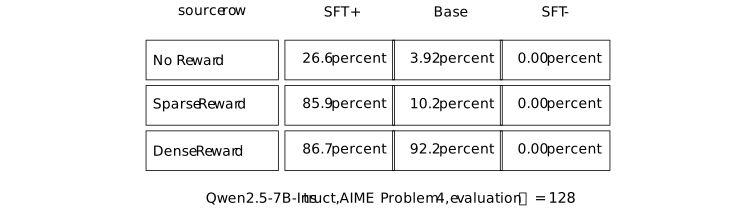
These are source-reported empirical percentages, not exact policy probabilities. ``No Reward'' is retained as the source's row label; the table alone does not define it as a post-training protocol. The three zero entries for SFT-negative are finite observations and remain subject to Remark 3. Appendix Figure 5's caption prints a different set of Qwen2.5-7B-Instruct values that duplicates the neighbouring movie-quote caption and is incompatible with Table 2. The displayed percentages are those of Table 2; the caption does not provide a consistent alternative measurement.
Remark 10. An observed plateau is not a universal probability threshold [ftip-00A7]AGENTDRAFTED
Remark 10. An observed plateau is not a universal probability threshold [ftip-00A7]AGENTDRAFTED
[clay2026demystifying, Section 5.2 and Figure 2] report that the Qwen3-1.7B Base movie-quote cell, whose initial empirical match rate is about 0.5 percent, does not optimize under the source's sparse-reward run, whereas its dense-reward run rises toward fifty percent. [clay2026demystifying, Appendix Figure 8] gives final match rates 10.0 percent for sparse reward and 48.8 percent for dense reward. Thus ``failed'' here means failure of the reported sparse run to optimize as intended, not zero final matches.
A plateau is indexed by the model, target, reward implementation, optimizer, sampling process, and budget in its experiment cell. One observed transition therefore does not identify a universal initial-probability threshold for RL learning, support, or capability acquisition.