Common-scalar flows, clock changes, and momentum [ftip-00BK]
✍️sourceAGENTDRAFTED
Common-scalar flows, clock changes, and momentum [ftip-00BK]
✍️sourceAGENTDRAFTED
One narrow class of continuous-time preconditioners follows the gradient-flow path at a different speed. The clock change transfers path properties, but not rates, and it does not encompass a stateful momentum method.
Definition 1. Common-scalar preconditioned flow [ftip-00BL]AGENTDRAFTED
Definition 1. Common-scalar preconditioned flow [ftip-00BL]AGENTDRAFTED
Let \(\theta =(U,V)\) and let \(a(t)>0\) be measurable with \(1/a\) locally integrable. A common-scalar preconditioned flow is a locally absolutely continuous trajectory satisfying
\[ \dot \theta (t)=-\frac {\nabla L(\theta (t))}{a(t)} \]for almost every \(t\). The same scalar multiplies every coordinate of both factor gradients. For gauge-uniform conclusions, the source additionally requires \(a(t)\) to be determined by gauge-invariant statistics of the trajectory up to time \(t\).
Definition 2. Effective optimizer clock [ftip-00BM]AGENTDRAFTED
Definition 2. Effective optimizer clock [ftip-00BM]AGENTDRAFTED
For the flow of Definition 1, define the effective optimizer clock
\[ \tau (t)=\int _0^t\frac {du}{a(u)}, \qquad \tau _{\max }=\int _0^\infty \frac {du}{a(u)}, \qquad 0<\tau _{\max }\leq \infty . \]The clock is strictly increasing on its domain. If \(\tau _{\max }=\infty \), it reaches every gradient-flow time; otherwise it traverses only the prefix with effective time below \(\tau _{\max }\).
Theorem 3. Common-scalar flow is a time-reparameterized gradient flow [ftip-00BN]AGENTDRAFTED
Theorem 3. Common-scalar flow is a time-reparameterized gradient flow [ftip-00BN]AGENTDRAFTED
Let \(\theta (t)\) satisfy Definition 1, let \(t(\tau )\) be the inverse of the clock in Definition 2, and put \(\widetilde \theta (\tau )=\theta (t(\tau ))\). Then, for almost every \(\tau \),
\[ \widetilde \theta '(\tau )=-\nabla L(\widetilde \theta (\tau )). \]
Proof.
Proof.
The chain rule for absolutely continuous changes of variable gives \(dt/d\tau =a(t)\) almost everywhere. Multiplying \(\dot \theta =-\nabla L/a(t)\) by \(dt/d\tau \) yields the displayed gradient flow.
See Theorem 4.6 and its proof in Appendix B.9 of The loss does not see the basis, but Adam does[singh2026lossbasis]. Gauge invariance of \(a\) is not needed for this single-trajectory clock identity; it makes the clock common across a gauge orbit.
Corollary 4. Transfer of path and limit properties [ftip-00BO]AGENTDRAFTED
Corollary 4. Transfer of path and limit properties [ftip-00BO]AGENTDRAFTED
Every property depending only on the portion of the gradient-flow path traversed before \(\tau _{\max }\) transfers to the common-scalar flow. If \(\tau _{\max }=\infty \) and gradient flow converges, both flows have the same limit point. A sufficient condition for clock divergence is an eventual finite upper bound on \(a(t)\).
For shallow factorization, the source cites Implicit regularization in matrix factorization[gunasekar2017implicit]. For deep factorization, it cites Implicit regularization in deep matrix factorization[arora2019implicit]. For greedy low-rank dynamics, it cites Towards resolving the implicit bias of gradient descent for matrix factorization: Greedy low-rank learning[li2021greedy].
Those conclusions transfer only when both this clock theorem and every hypothesis of the original result hold. This corollary supplies no missing matrix-sensing assumption.
Remark 5. Rates and hitting times do not survive time reparameterization [ftip-00BP]AGENTDRAFTED
Remark 5. Rates and hitting times do not survive time reparameterization [ftip-00BP]AGENTDRAFTED
Two flows can traverse the same curve with arbitrarily different physical clocks. A convergence rate, finite-step budget, or hitting time stated in \(t\) therefore does not transfer through Theorem 3 without quantitative bounds on \(a\) and its integral. If \(\tau _{\max }<\infty \), even the tail and limit of the gradient-flow path are not reached.
Remark 6. Scalar-Adam is outside the common-scalar flow theorem [ftip-00BQ]AGENTDRAFTED
Remark 6. Scalar-Adam is outside the common-scalar flow theorem [ftip-00BQ]AGENTDRAFTED
The shared-scalar Adam variant in Proposition [ftip-00B9] retains a first-moment exponential moving average. It is stateful and is not the memoryless flow in Definition 1. Remark 4.7 of The loss does not see the basis, but Adam does[singh2026lossbasis] treats its agreement with gradient flow as empirical rather than as a consequence of Theorem 4.6.
The theorem likewise does not apply to discrete Adam, PPO, RLVR update loops, clipping, weight decay, and mixed optimizers. Gauge equivariance and time reparameterization are separate properties.
Example 7. Equivariance neither guarantees nor precludes recovery [ftip-00BR]AGENTDRAFTED
Example 7. Equivariance neither guarantees nor precludes recovery [ftip-00BR]AGENTDRAFTED
The source records controls on both sides of the proposed implication. Its ScaledGD-inspired control is equivariant but equalizes the spectral schedule and does not recover the planted low-rank target at the declared budget. A long-anneal sign update is non-equivariant but eventually reaches a low-recovery-error regime.
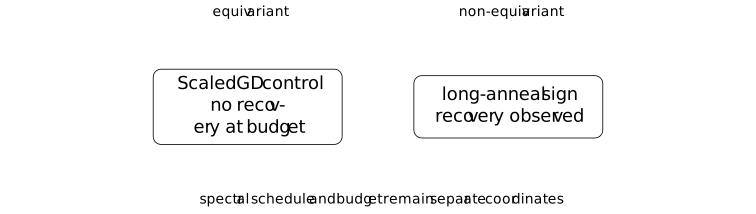
The controls are reported in Remark 4.7 and Appendix D.10 of The loss does not see the basis, but Adam does[singh2026lossbasis]. The source reports no tuned reproducibility baseline for the ScaledGD control. The diagram is not a convergence theorem.