Feedback, replay, and update control [ftip-004Y]
✍️sourceAGENTDRAFTED
Feedback, replay, and update control [ftip-004Y]
✍️sourceAGENTDRAFTED
Post-training systems often reuse historical trajectories. This section separates what happened during a rollout from quantities recomputed when that rollout is considered for another update.
Definition 1. Policy stamp [ftip-004Z]AGENTDRAFTED
Definition 1. Policy stamp [ftip-004Z]AGENTDRAFTED
A policy stamp \(\nu \) is a content-addressed description of an executable policy: model artifact, tokenizer, action serializer, decoding settings, and implementation revision. Resolving the stamp produces the action law \(\pi ^\nu (\,\cdot \mid \mathsf H_t)\) for every public history in its declared domain.
Two stamps are equal only when every component that may change the action law is equal. A display name or checkpoint step is therefore insufficient.
Remark 2. Behavior policies and executable-policy identity [ftip-0050]AGENTDRAFTED
Remark 2. Behavior policies and executable-policy identity [ftip-0050]AGENTDRAFTED
Off-policy methods distinguish the behavior and current policies, while language-model artifacts also depend on tokenization and decoding. Section 3 of When to stop reusing: Dynamic gradient gating for sample-efficient RLVR[miao2026when] records the behavior/current distinction. The additional artifact and implementation fields in the proposed policy stamp make the executable law reproducible.
The stamp identifies an executable law; it does not claim that two implementations with different stamps must behave differently on every task.
Definition 3. Immutable rollout record [ftip-0051]AGENTDRAFTED
Definition 3. Immutable rollout record [ftip-0051]AGENTDRAFTED
An immutable rollout record is a tuple
\[R=(q,\nu _b,\tau ,e),\]where \(q\) is the sampled task, \(\nu _b\) is the behavior-policy stamp, \(\tau \) is the stopped trajectory of Definition [ftip-0025], and \(e\) is the verifier evidence of Definition [ftip-0047]. The tuple records facts fixed when the rollout finishes.
Current-policy likelihood ratios, clipping decisions, reuse counts, and acceptance decisions are excluded because they may change on a later update attempt.
Remark 4. A historical event is not an update attempt [ftip-0052]AGENTDRAFTED
Remark 4. A historical event is not an update attempt [ftip-0052]AGENTDRAFTED
An immutable historical record prevents an update attempt from rewriting the facts attached to its reused samples. The sample-reuse setup in [miao2026when, Section 3] retains behavior-policy rollouts while recomputing current-policy ratios. Dynamic Gradient Gating (DGG), defined in [miao2026when, Section 5 and Algorithm 1], is one such reuse protocol, while the complete immutable tuple is a proposed interface for such protocols.
Recorded facts and estimates recomputed for an attempted update are different objects; errors in the latter do not alter the former.
Definition 5. Feedback operator [ftip-0053]AGENTDRAFTED
Definition 5. Feedback operator [ftip-0053]AGENTDRAFTED
Let \(\mathcal R\) be the set of immutable rollout records and \(\mathcal F\) a typed set of feedback events. A feedback operator is a possibly randomized kernel
\[\mathsf {Feed}:\mathcal R\rightsquigarrow \mathcal F.\]A feedback event may contain an outcome score, step labels, a preference, or an abstention. Its type records which observations were available when it was produced.
Definition 6. Credit-assignment rule [ftip-0054]AGENTDRAFTED
Definition 6. Credit-assignment rule [ftip-0054]AGENTDRAFTED
Let \(R\) be a rollout record with \(\tau _{\rm stop}\) actions, and let \(f\) be its feedback event. A credit-assignment rule returns indexed training targets
\[\mathsf {Credit}(R,f)=(c_0,\ldots ,c_{\tau _{\rm stop}-1}).\]Each \(c_t\) is attached to an action or token position declared by the rule. It may be a return, an advantage estimate, a binary label, or a structured target. The rule is distinct from the feedback source that supplied \(f\).
Remark 7. Observed feedback and assigned credit [ftip-0055]AGENTDRAFTED
Remark 7. Observed feedback and assigned credit [ftip-0055]AGENTDRAFTED
Terminal returns, process labels, preference observations, and verifier rewards determine what information is observed. A credit rule determines where that information enters an objective. Treating them as separate inputs is a proposed common description of these different methods.
Separating the interfaces permits questions about delayed, noisy, or misallocated credit without changing the underlying evidence.
Definition 8. Replay pool [ftip-0056]AGENTDRAFTED
Definition 8. Replay pool [ftip-0056]AGENTDRAFTED
At update index \(n\), a replay pool \(\mathcal R_n\) is a finite multiset of immutable rollout records eligible for selection. Its management rule specifies insertion, eviction, and any partition by task or behavior stamp.
The pool is persistent state of the training protocol. It is not the minibatch selected for one update.
Definition 9. Attempt-local replay annotation [ftip-0057]AGENTDRAFTED
Definition 9. Attempt-local replay annotation [ftip-0057]AGENTDRAFTED
Selecting \(R\in \mathcal R_n\) under a current policy stamp \(\nu _n\) produces an attempt-local replay annotation
\[a_n(R)=(\nu _n,\rho ,\kappa ,m,u),\]where \(\rho \) is the declared collection of behavior/current likelihood ratios, \(\kappa \) records clipping status, \(m\) is the record age, and \(u\) is its prior reuse count. Every component is computed for this attempt and may change at the next one.
Remark 10. Replay selection and current-policy annotations [ftip-0058]AGENTDRAFTED
Remark 10. Replay selection and current-policy annotations [ftip-0058]AGENTDRAFTED
The proposed replay interface separates a persistent pool from annotations computed for an update attempt. DGG in [miao2026when, Section 3; Section 5 and Algorithm 1] recomputes policy ratios and a gradient diagnostic while reusing a rollout batch. Those quantities depend on the current policy and therefore belong to the attempted update rather than the historical record.
The split also exposes the cost of selecting, scoring, and rejecting reused records.
Example 11. Selecting a historical rollout under a current policy stamp [ftip-0059]AGENTDRAFTED
Example 11. Selecting a historical rollout under a current policy stamp [ftip-0059]AGENTDRAFTED
Reusing one historical rollout recomputes current-policy annotations without mutating the stored record.
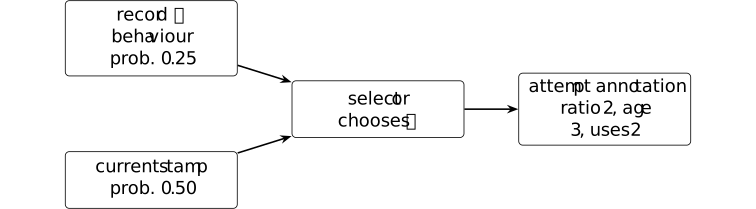
Let the stored record be \(R=(q,\nu _b,\tau ,e)\) and suppose its behaviour policy assigned the recorded action probability \(0.25\). Under the current stamp the same action has probability \(0.50\), so this attempt records importance ratio \(0.50/0.25=2\). Its age \(3\) and prior-use count \(2\) are also attempt-time metadata; none of these three values rewrites \(R\).
The behaviour/current-policy distinction is required by the reuse analysis in [miao2026when, Section 3]. The finite annotation makes provenance explicit. Statistical safety of ratio \(2\), age \(3\), or a second reuse is left undecided.
Definition 12. Update proposal [ftip-006C]AGENTDRAFTED
Definition 12. Update proposal [ftip-006C]AGENTDRAFTED
Given a current parameter--optimizer state \((\theta _n,z_n)\), selected records, their attempt annotations, and credit targets, an update proposal is a candidate next state
\[(\widetilde \theta _{n+1},\widetilde z_{n+1}, \delta _n^{\rm diag}).\]The diagnostic record \(\delta _n^{\rm diag}\) contains the quantities required by the declared acceptance rule. It is distinct from the accept--reject decision \(d_n\) recorded for the proposal. Constructing the proposal incurs update cost even if the proposal is later rejected.
Definition 13. dynamic gradient gate [miao2026when, Section 5 and Algorithm 1] [ftip-005A]AGENTDRAFTED
Definition 13. dynamic gradient gate [miao2026when, Section 5 and Algorithm 1] [ftip-005A]AGENTDRAFTED
Dynamic gradient gating computes the language-model-head gradient before the optimizer step. It compares the change in squared Frobenius norm with a trailing-window Z-score. When the score crosses its threshold after a reused update, the method discards that gradient and returns to fresh rollouts.
The gate is an empirical stopping rule for reuse. The source does not prove that its Z-score is a calibrated divergence test or a general safety certificate.
Remark 14. Rejected updates still consume computation [ftip-006D]AGENTDRAFTED
Remark 14. Rejected updates still consume computation [ftip-006D]AGENTDRAFTED
A gate may reject a computed gradient even though its computation has already consumed resources. The DGG definition in Definition 13 supplies the motivating pre-optimizer discard operation. Other protocols may inspect held-out loss, divergence, or resource limits.
The generic proposal interface does not transfer DGG's empirical detector to those other diagnostics. Each gate needs its own assumptions and calibration evidence.
Example 15. Two proposed updates under a DGG-style gate [ftip-005B]AGENTDRAFTED
Example 15. Two proposed updates under a DGG-style gate [ftip-005B]AGENTDRAFTED
Two candidate reused-gradient updates fall on opposite sides of a declared DGG-style gate.
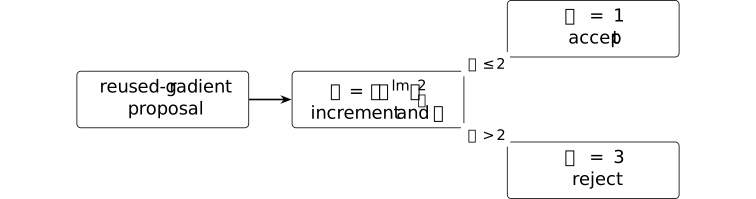
Declare a trailing-window increment mean \(\mu =1\), standard deviation \(s=0.5\), and toy threshold \(z_\star =2\). Proposal A has increment \(1.5\), so \(Z_A=(1.5-1)/0.5=1\) and is committed. Proposal B has increment \(2.5\), so \(Z_B=3\) and is rejected before an Adam transition. Rejection therefore leaves both parameters and optimizer moments unchanged in this protocol.
The monitored last-layer gradient energy, trailing-window Z-score, and pre-optimizer rejection order are modeled on [miao2026when, Section 5 and Algorithm 1]; the numeric threshold and window statistics above are locally declared. Acceptance is a reuse heuristic; it supplies neither a safety certificate nor a guarantee of improved independent evaluation.
Definition 16. checkpoint-trajectory extrapolation [chen2026lowrank, Sections 4 and 5.1] [ftip-0069]AGENTDRAFTED
Definition 16. checkpoint-trajectory extrapolation [chen2026lowrank, Sections 4 and 5.1] [ftip-0069]AGENTDRAFTED
NExt forms global and local parameter differences from saved low-rank adaptation (LoRA) checkpoints, approximates each matrix difference by leading singular factors, and trains a predictor on those representations to estimate a future difference. It adds a scaled predicted difference to a checkpoint; the reported experiments then resume RLVR updates.
The construction replaces some realized rollout-and-update steps with a learned parameter jump. It does not introduce a new verifier signal.
Remark 17. Trajectory compression and feedback acquisition [ftip-006A]AGENTDRAFTED
Remark 17. Trajectory compression and feedback acquisition [ftip-006A]AGENTDRAFTED
The NExt construction Low-rank optimization trajectories modeling for LLM RLVR acceleration[chen2026lowrank] motivates a distinction between following a predictable parameter path and acquiring information from new rollouts. Low-rank dominance of saved differences does not imply linear future motion, invariance across parameterizations, or preservation of optimizer state.
A cost comparison includes checkpoint storage, decomposition, predictor training, extrapolation, and recovery updates. Bounding independent-evaluation regret additionally requires stability assumptions connecting parameter forecasts to the evaluated outcome.
Example 18. A sign-invariant checkpoint-trajectory forecast [ftip-006B]AGENTDRAFTED
Example 18. A sign-invariant checkpoint-trajectory forecast [ftip-006B]AGENTDRAFTED
Leading rank-one projectors encode a checkpoint direction without inheriting the arbitrary signs of singular vectors.

For either singular-vector representation \((u,v)\) or \((-u,-v)\), the projectors \(P_u=uu^\top \) and \(P_v=vv^\top \) are unchanged. A trajectory forecaster can extrapolate the observed projector-aligned deltas to a next checkpoint, after which a measured recovery update can correct the forecast without changing the represented one-dimensional subspace.
The history-to-delta-to-recovery order is a toy illustration of NExt, described in [⧉]. NExt models signed singular value decomposition (SVD) factors rather than the projector construction used here. Accordingly, the calculation supplies neither a theorem about checkpoint trajectories nor evidence of capability acquisition.