Fixed-weight harness adaptation [ftip-00C3]
✍️sourceAGENTDRAFTED
Fixed-weight harness adaptation [ftip-00C3]
✍️sourceAGENTDRAFTED
The executable model artifact, active context, explicitly managed computation, and persistent harness state are distinct parts of an agent. Replayability depends on the rule that materializes state from events, as well as the recorded inputs and execution versions.
Definition 1. Parameter, context, compute, and persistent state [ftip-00C4]AGENTDRAFTED
Definition 1. Parameter, context, compute, and persistent state [ftip-00C4]AGENTDRAFTED
Let \(\mathcal C_{\rm act}\) be an active-context space, \(\mathcal Z_{\rm man}\) an explicitly managed computation-state space, and \(\mathcal H_{\rm pers}\) a persistent harness-state space. A four-layer harness state is
\[ \Xi =(M,c,z,h)\in \mathcal M_{\rm exec}\times \mathcal C_{\rm act} \times \mathcal Z_{\rm man}\times \mathcal H_{\rm pers}. \]The coordinates are, respectively, the executable model artifact, the token-visible context, explicitly managed values or sessions, and state that can survive the present invocation. A transition may change any declared subset of these coordinates. A fixed-weight harness transition holds \(M\) fixed while changing one or more of \(c,z,h\).
Remark 2. State layers are access mechanisms, not capability levels [ftip-00C5]AGENTDRAFTED
Remark 2. State layers are access mechanisms, not capability levels [ftip-00C5]AGENTDRAFTED
Prime Agent Section 2.2 names model weights, active context, explicitly managed computation, and retained state as levels L0--L3, and describes the operations that move information between them [karten2026prime, Section 2.2]. The formulation in Definition 1 preserves that operational separation without treating the labels as an ordering of intelligence or capability.
Two runs with identical weights and different persistent state can induce different policies. That observation does not say that either run acquired a new circuit in the fixed artifact, and it does not compare their independently evaluated utility.
Definition 3. Versioned harness configuration [ftip-00C6]AGENTDRAFTED
Definition 3. Versioned harness configuration [ftip-00C6]AGENTDRAFTED
Let \(\mathcal I_{\rm har}\) be a content-identifier space. A versioned harness configuration is a finite record \(\kappa ^{\rm har}\in \mathcal I_{\rm har}\) that resolves the active-context assembly rule, managed-computation interface, tool permissions, session and message semantics, compaction policy, persistent-state schema, refinement policy, recovery rule, and implementation versions.
Together with a state \(\Xi \), the record resolves a non-anticipating harness policy. Changing one field produces a different declared intervention even when the executable model artifact is unchanged. The record does not include an evaluation binding; that is a separate record coordinate.
Definition 4. Persistent event stream [ftip-00C7]AGENTDRAFTED
Definition 4. Persistent event stream [ftip-00C7]AGENTDRAFTED
Fix a finite event alphabet \(\mathcal E_{\rm har}\). A persistent event stream of length \(n\) is
\[ L_n=(e_0,\ldots ,e_{n-1})\in \mathcal E_{\rm har}^{n}. \]The append operation is \(L_{n+1}=\operatorname {append}(L_n,e_n)\). Write \(L_i\preceq _{\rm pref}L_j\) when \(L_i\) is a prefix of \(L_j\). An append-only stream satisfies \(L_i\preceq _{\rm pref}L_j\) for every \(i\leq j\); branching creates distinct continuations with a common prefix rather than rewriting that prefix.
Events may record model or tool calls, messages, interventions, retries, verifier outcomes, harness edits, and resource use. The event schema and its exact version belong to the configuration of Definition 3.
Definition 5. Materialized harness state [ftip-00C8]AGENTDRAFTED
Definition 5. Materialized harness state [ftip-00C8]AGENTDRAFTED
Let \(\mathcal V_{\rm fold}\) be a space of fold versions. For each \(v\in \mathcal V_{\rm fold}\), fix a deterministic map
\[ F_v:\mathcal H_{\rm pers}\times \mathcal E_{\rm har} \longrightarrow \mathcal H_{\rm pers}. \]Given an initial persistent state \(h_0\), event stream \(L_n=(e_0,\ldots ,e_{n-1})\), and version sequence \(\boldsymbol v=(v_0,\ldots ,v_{n-1})\), its materialized harness state is obtained recursively by
\[ h_{i+1}=F_{v_i}(h_i,e_i),\qquad 0\leq i<n. \]The materialization record is the tuple \((h_0,L_n,\boldsymbol v,(F_v)_v)\). Omitting a version or the initial state defines a family of possible materializations, not one replayable state.
Theorem 6. Deterministic event folding gives replayable state [ftip-00C9]AGENTDRAFTED
Theorem 6. Deterministic event folding gives replayable state [ftip-00C9]AGENTDRAFTED
For a materialization record in Definition 5, replaying the same initial state, event sequence, version sequence, and fold maps produces the same state \(h_n\).
This finite result follows from the displayed hypotheses. It assumes exact equality of all recorded inputs and deterministic fold maps.
Proof.
At step zero both replays have state \(h_0\). If their states agree at
step \(i\), both apply the same function \(F_{v_i}\) to the same pair
\((h_i,e_i)\), so their states agree at step \(i+1\). Finite induction gives
equality at step \(n\).Proof.
Remark 7. Replayability is not correctness [ftip-00CA]AGENTDRAFTED
Remark 7. Replayability is not correctness [ftip-00CA]AGENTDRAFTED
The result in Theorem 6 is an identity about a declared transition system. It does not show that the event stream is complete, that an external process can be reconstructed, that the fold is faithful to the environment, or that the resulting state is useful or safe.
Prime Agent reports append-only events, versioned state, recovery, and rollback in Sections 2.2 and 2.5 [karten2026prime, Sections 2.2 and 2.5]. Those implementation claims motivate the event record; Theorem 6 proves the finite replay identity directly from the declared transition rule.
Example 8. One artifact and two harness policies [ftip-00CB]AGENTDRAFTED
Example 8. One artifact and two harness policies [ftip-00CB]AGENTDRAFTED
The same executable artifact can be paired with two persistent states and therefore two resolved harness policies. The harness state changes while the executable model remains fixed.
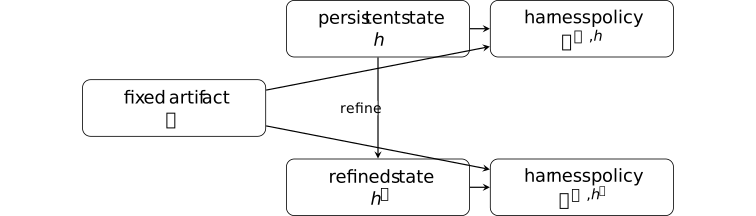
Different policies here establish only that harness state is an intervention coordinate. An independent evaluation is still required to compare their outcomes.
Remark 9. Fixed-weight self-improvement is not weight training [ftip-00CC]AGENTDRAFTED
Remark 9. Fixed-weight self-improvement is not weight training [ftip-00CC]AGENTDRAFTED
Prime Agent Section 2.5 uses the phrase ``self-improvement'' for execution evidence converted into persistent prompts, memories, skills, or subagent specifications while model weights remain fixed [karten2026prime, Section 2.5]. In the notation of Definition 1, this is a change to \(h\) with \(M\) held fixed.
The term therefore does not establish a change to the model artifact, a new learned circuit, or capability acquisition in the sense of Definition [ftip-0007]. It describes persistent harness adaptation.