Let \(R\) be a commutative ring in which \(2\) is a unit,
\(M\) any \(R\)-module with quadratic form \(q\), and \(A\) any
commutative \(R\)-algebra. Extend the symmetric half-polar form
\[b(v,w)=\frac {q(v+w)-q(v)-q(w)}2\]
to \(M_A=A\otimes _R M\), and let \(q_A\) be its diagonal.
Thus
\[q_A(a\otimes v)=a^2q(v),\]
where \(q(v)\) on the right is mapped into \(A\). There is a
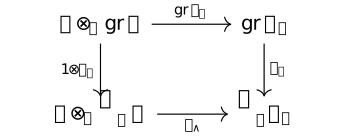
canonical \(A\)-algebra isomorphism
\[\begin {aligned}
\beta _A:A\otimes _R\operatorname {Cl}_R(q)
&\longrightarrow \operatorname {Cl}_A(q_A),\\
\beta _A(a\otimes \iota _q(v))
&=a\,\iota _{q_A}(1\otimes v).
\end {aligned}\]
No flatness, nondegeneracy, finite generation, or injectivity of
\(R\to A\) is required. This extends the displayed field case
of scalar extension to the declared commutative
rings, using the same universal property.
Mathlib's marked equivalence has the reverse direction,
\[\operatorname {Cl}_A(q_A)
\simeq A\otimes _R\operatorname {Cl}_R(q).\]
Its inverse is \(\beta _A\), and
CliffordAlgebra.ofBaseChange_tmul_ι
gives the displayed generator formula.
QuadraticForm.baseChange constructs \(q_A\); its
QuadraticForm.baseChange_tmul computes pure tensors.
These declarations have exactly the commutative-ring and
invertible-two hypotheses above. The marker concerns the
generic algebra equivalence, not the arithmetic domain
calculations or the sheaf multiplication below.
Scalar extension is compatible with a further commutative
algebra \(A\to B\). Identify
\[\begin {aligned}
B\otimes _A(A\otimes _R M)&\longrightarrow B\otimes _R M,\\
b\otimes (a\otimes v)&\longmapsto ba\otimes v.
\end {aligned}\]
The inverse inserts \(1\) in the middle tensor factor.
Under this identification the direct and successive Clifford
maps both send \(b\otimes (a\otimes \iota _q(v))\) to
\(ba\,\iota _{q_B}(1\otimes v)\). These elements and scalars
generate, proving equality of the algebra maps. TauCeti's
QuadraticForm.baseChangeBaseChange
uses the inverse identification, from direct to successive
extension. With compatible \(R\)- and \(A\)-algebra structures
on \(B\), its
CliffordAlgebra.ofBaseChangeAux_baseChange
states the same compatibility in that direction.
For an \(R\)-linear form-preserving map \(P:M\to M\), put
\(P_A(a\otimes v)=a\otimes Pv\). The two orders of applying
\(\beta _A\) and the induced Clifford map both
take \(a\otimes \iota _q(v)\) to
\(a\,\iota _{q_A}(1\otimes Pv)\). Generation again proves
equivariance. In particular the arithmetic half-turn
and its \(C_2\) action commute with every allowed scalar extension.
Apply this to \(C=\operatorname {Cl}_{R_q}(q)\) on the
arithmetic base \(X_q\). Write
\(\mathcal O_{X_q}\) for its structure sheaf: regular functions
on \(D_{X_q}(g)\) form \((R_q)_g\). The
associated module sheaf \(\widetilde C\) has
\[\Gamma (D_{X_q}(g),\widetilde C)
=C_g\simeq (R_q)_g\otimes _{R_q}C.\]
Its restriction maps are the localization maps; compatible
local sections glue uniquely. This construction and the
standard-open formula are
[stacks2017stacks, Section 26.5 and Lemma 26.5.4], Tag 01HR.
Mathlib's AlgebraicGeometry.tilde, with its
standard-open localized-module instance, supplies the underlying
module sheaf. It does not by itself give the algebra structure.
Multiplication and unit on a standard open are
\[\frac {c}{g^m}\frac {d}{g^n}
=\frac {cd}{g^{m+n}},\qquad 1=\frac 11.\]
The denominators are central, so these operations are
well-defined even though \(C\) need not be commutative.
Restriction maps preserve them. On an arbitrary open, cover
by standard opens and multiply the restrictions of two sections.
The products agree on overlaps, so the module-sheaf axiom
glues them uniquely; the same argument glues the unit.
Associativity, additivity, the unit law and central
\(\mathcal O_{X_q}\) action hold locally and hence globally.
Thus \(\widetilde C\) is a sheaf of unital associative
\(\mathcal O_{X_q}\)-algebras. No spectrum of the
noncommutative algebra \(C\) is taken.
The isomorphisms \(\beta _{(R_q)_g}\) identify these
standard-open sections with
\[\operatorname {Cl}_{(R_q)_g}(q_g).\]
Scalar-tower compatibility
makes the identifications commute with restrictions. This
constructs the Clifford algebra sheaf of
\(\mathcal O_{X_q}^4\) with matrix \(Q\). The half-turn acts
on every localization by the same generator formula and
commutes with restrictions, giving a \(C_2\) action on the sheaf.
Restricting to \(X_{\mathrm {elim}}\) or \(X_{\mathrm {obs}}\)
uses exactly these base-change maps.
At the real specialization \(t=1\), put
\(q_1(x)=x^TQ(1)x\) and let
\(c_i=\iota _{q_1}(\delta _i)\) with the coordinate notation of
the configuration Clifford algebra. Then
\[c_i^2=3\,1,\qquad
c_ic_j+c_jc_i=2Q(1)_{ij}\,1.\]
The map \(\beta _{\mathbb R}\) identifies these relations with
\(\mathbb R\otimes _{R_q}C\); direct evaluation or evaluation
through either localization gives the same algebra and action.
This evaluation is not injective: it kills the nonzero element
\(t-1\) of \(R_q\). The isomorphism requires no injectivity.
The effective rank-two form has its own Clifford
algebra on \(X_{\mathrm {elim}}\); it is separate from this
rank-4 construction.