Equivariant and basis-sensitive update rules [ftip-00B6]
✍️sourceAGENTDRAFTED
Equivariant and basis-sensitive update rules [ftip-00B6]
✍️sourceAGENTDRAFTED
Gradient covariance supplies a test for update rules. Linear and full-matrix operations can commute with a latent rotation, whereas a fixed nonlinear map applied separately to coordinates selects a preferred basis.
Definition 1. Memoryless right-equivariant update [ftip-00B7]AGENTDRAFTED
Definition 1. Memoryless right-equivariant update [ftip-00B7]AGENTDRAFTED
A memoryless factor-update map is a function \(\Phi :\mathbb R^{n\times k}\to \mathbb R^{n\times k}\) applied to a current gradient \(G\) without a persistent optimizer state. It is right-equivariant when
\[ \Phi (GQ)=\Phi (G)Q \qquad (G\in \mathbb R^{n\times k},\ Q\in \mathrm O(k)). \]This local definition is the input of Theorem 4.5 in The loss does not see the basis, but Adam does[singh2026lossbasis]. It does not classify stateful optimizers such as Adam.
Proposition 2. Gradient descent and momentum preserve the orthogonal gauge [ftip-00B8]AGENTDRAFTED
Proposition 2. Gradient descent and momentum preserve the orthogonal gauge [ftip-00B8]AGENTDRAFTED
Gradient descent and Polyak or Nesterov momentum are gauge-equivariant when their factor gradients, momentum buffers, schedules, and look-ahead points are transformed consistently.
Proof.
Proof.
By Lemma [ftip-00B1], \(G_t\) becomes \(G_tQ\). Gradient descent therefore sends \(U_tQ\) to \((U_t-\eta _tG_t)Q\). A momentum buffer initialized at zero and formed by linear combinations of covariant gradients transforms as \(M_tQ\); a Nesterov look-ahead point is likewise the reference look-ahead right-multiplied by \(Q\). Induction proves the claim.
Proposition 4.2(1) and its proof are in Appendix B.3 of The loss does not see the basis, but Adam does[singh2026lossbasis].
Proposition 3. A shared scalar second moment preserves the orthogonal gauge [ftip-00B9]AGENTDRAFTED
Proposition 3. A shared scalar second moment preserves the orthogonal gauge [ftip-00B9]AGENTDRAFTED
Replace Adam's entrywise second-moment denominator by one scalar whose updates depend only on gauge-invariant quantities such as the pooled mean of the squared entries of both factor gradients. With a covariant first-moment buffer, the resulting stateful update is gauge-equivariant.
Proof.
Proof.
The first moment is a linear exponential average and transforms by right multiplication by \(Q\). The pooled squared-entry mean is the joint squared Frobenius norm divided by the entry count, hence is unchanged by \(G\mapsto GQ\). Its bias correction and positive scalar denominator are unchanged, so the complete update transforms covariantly.
Proposition 4.2(2) and its proof are in Appendix B.3 of The loss does not see the basis, but Adam does[singh2026lossbasis]. The result concerns this declared shared-scalar variant, not stock Adam.
Proposition 4. Full-matrix Muon and Shampoo preserve the orthogonal gauge [ftip-00BA]AGENTDRAFTED
Proposition 4. Full-matrix Muon and Shampoo preserve the orthogonal gauge [ftip-00BA]AGENTDRAFTED
Fix one factor, write \(n\in \{d_1,d_2\}\) for its row dimension, and let \(G_t,M_t\in \mathbb R^{n\times k}\) be its gradient and Muon momentum buffer. For \(0\leq \beta <1\), \(M_{-1}=0\), and the source's linear momentum update \(M_t=\beta M_{t-1}+G_t\), Muon's direction is \(\Delta _t=\operatorname {msign}(M_t)\). Under real arithmetic this stateful update and the source's damped Shampoo update are right-equivariant. The Muon claim includes the stated finite Newton--Schulz approximations; the Shampoo claim uses its complete left and right accumulators.
Proof.
Proof.
By Lemma [ftip-00B1], the primed gradient is \(G'_t=G_tQ\). Starting from \(M'_{-1}=M_{-1}Q=0\), induction through the linear momentum update gives \(M'_t=M_tQ\). If \(M_t=A\Sigma B^{\mathsf T}\) is a compact singular-value decomposition, then \(M_tQ=A\Sigma (Q^{\mathsf T}B)^{\mathsf T}\), so \(\operatorname {msign}(M_tQ)=\operatorname {msign}(M_t)Q\). For \(\epsilon _{\rm NS}>0\), the Newton--Schulz initialization \(X_0=M_t/(\lVert M_t\rVert _F+\epsilon _{\rm NS})\) is covariant because its Frobenius normalization is invariant; each polynomial iterate formed from \(X_j\) and \(X_jX_j^{\mathsf T}\) preserves the same covariance. For Shampoo, the left accumulator is invariant while the right accumulator transforms by \(R_t\mapsto Q^{\mathsf T} R_t Q\). Orthogonal functional calculus conjugates the right matrix function, so the transformed update is the original update right-multiplied by \(Q\).
Proposition 4.2(3)--(4) and its proof are in Appendix B.3 of The loss does not see the basis, but Adam does[singh2026lossbasis]. Variable splitting, coordinatewise clipping, mixed update rules, finite precision, and different damping conventions lie outside this statement. The Muon part is stateful; it does not replace the momentum buffer by the current gradient or invoke the memoryless classification of Definition 1.
Proposition 5. Coordinatewise equivariance forces linearity [ftip-00BB]AGENTDRAFTED
Proposition 5. Coordinatewise equivariance forces linearity [ftip-00BB]AGENTDRAFTED
Let \(k\geq 2\) and let a memoryless update have the fixed entrywise form \(\Phi (G)_{ij}=\phi (G_{ij})\). If \(\Phi (GQ)=\Phi (G)Q\) for every \(G\) and \(Q\in \mathrm O(k)\), then \(\phi (x)=cx\) for some \(c\in \mathbb R\).
Proof.
Proof.
It suffices to use one row and rotations in the first two coordinates. Equivariance at zero gives \(\phi (0)=0\). Rotating \((x,0)\) through an angle whose cosine is \(a\in [-1,1]\) gives \(\phi (ax)=a\phi (x)\). For nonzero \(x,y\), compare each with a third number of at least their absolute magnitudes; the ratio \(\phi (x)/x\) is constant.
Proposition 4.3 and its proof are in Appendix B.4 of The loss does not see the basis, but Adam does[singh2026lossbasis]. No continuity assumption is needed.
Corollary 6. Fixed nonlinear coordinatewise updates break the gauge [ftip-00BC]AGENTDRAFTED
Corollary 6. Fixed nonlinear coordinatewise updates break the gauge [ftip-00BC]AGENTDRAFTED
A nonlinear fixed entrywise update applied at a zero optimizer state is not gauge-equivariant when \(k\geq 2\). In particular, the source applies Proposition 5 to the first-step maps of Adam, RMSProp, signSGD, and Lion; it checks Adafactor separately because its factored statistics are not an entrywise map.
This is a first-step obstruction. It suffices to disprove equivariance of the full run, but it does not classify every later state or say that such an optimizer cannot reach a particular solution.
Definition 7. First-step Adam map and gauge defect [ftip-00BD]AGENTDRAFTED
Definition 7. First-step Adam map and gauge defect [ftip-00BD]AGENTDRAFTED
Fix \(\epsilon >0\). For zero-state, bias-corrected Adam define the entrywise first-step direction
\[ D_\epsilon (G)=G\mathbin {\oslash }(|G|+\epsilon ) \]and, for \(Q\in \mathrm O(k)\), define its gauge-aligned defect by
\[ E_Q(G)=D_\epsilon (GQ)Q^{\mathsf T}-D_\epsilon (G). \]Here \(|G|\), addition, and division are entrywise. Bias correction makes the first direction independent of Adam's two decay coefficients under the declared convention [singh2026lossbasis, Proposition 4.4].
Proposition 8. Exact represented-matrix defect after one Adam step [ftip-00BE]AGENTDRAFTED
Proposition 8. Exact represented-matrix defect after one Adam step [ftip-00BE]AGENTDRAFTED
Let \(G_U=\nabla _UL(U_0,V_0)\), \(G_V=\nabla _VL(U_0,V_0)\), \(D_U=D_\epsilon (G_U)\), and \(D_V=D_\epsilon (G_V)\). Let \(W_1\) be the product after one Adam step from \((U_0,V_0)\) and \(\widetilde W_1\) the product after one step from \((U_0Q,V_0Q)\). Then
\[ \begin {aligned} \widetilde W_1-W_1={}&-\eta \bigl (E_Q(G_U)V_0^{\mathsf T} +U_0E_Q(G_V)^{\mathsf T}\bigr )\\ &+\eta ^2\bigl (E_Q(G_U)D_V^{\mathsf T} +D_UE_Q(G_V)^{\mathsf T} +E_Q(G_U)E_Q(G_V)^{\mathsf T}\bigr ). \end {aligned} \]
Proof.
Proof.
Gauge-align the rotated factors back by \(Q^{\mathsf T}\). They are \(U_0-\eta (D_U+E_Q(G_U))\) and \(V_0-\eta (D_V+E_Q(G_V))\). Multiply, subtract \((U_0-\eta D_U)(V_0-\eta D_V)^{\mathsf T}\), and collect powers of \(\eta \).
Proposition 4.4 and its proof are in Appendix B.5 of The loss does not see the basis, but Adam does[singh2026lossbasis].
Example 9. A two-coordinate Adam defect witness [ftip-00BF]AGENTDRAFTED
Example 9. A two-coordinate Adam defect witness [ftip-00BF]AGENTDRAFTED
Take \(d_1=d_2=1\), \(k=2\), \(f(w)=w^2/2\), \(U_0=V_0=(1,0)\), and
\[ Q=2^{-1/2}\begin {pmatrix}1&1\\-1&1\end {pmatrix}. \]The original and rotated products after one zero-state Adam step are
\[ W_1=\left (1-\frac {\eta }{1+\epsilon }\right )^2, \qquad \widetilde W_1=\left (1-\frac {\eta }{2^{-1/2}+\epsilon }\right )^2. \]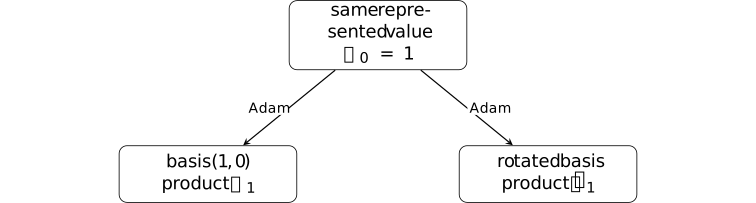
They differ when \(0<\eta <2^{-1/2}+\epsilon \). This is the explicit witness in Proposition 4.4 of The loss does not see the basis, but Adam does[singh2026lossbasis]; it is a statement about one factored quadratic, not about language-model performance.
Example 10. A rotated sign update fails to commute [ftip-00BG]AGENTDRAFTED
Example 10. A rotated sign update fails to commute [ftip-00BG]AGENTDRAFTED
For \(G=(1,1)\) and the 45-degree rotation matrix \(Q\) of Example 9, one has \(GQ=(0,\sqrt 2)\). With \(\operatorname {sign}(0)=0\),
\[ \operatorname {sign}(GQ)=(0,1), \qquad \operatorname {sign}(G)Q=(0,\sqrt 2). \]Thus even this two-coordinate update violates the commuting equation in Definition 1. The calculation is the explicit Appendix B.4 witness of The loss does not see the basis, but Adam does[singh2026lossbasis].
Theorem 11. Full-rank memoryless equivariant rules are Gram-determined [ftip-00BH]AGENTDRAFTED
Theorem 11. Full-rank memoryless equivariant rules are Gram-determined [ftip-00BH]AGENTDRAFTED
Let \(k\leq n\), and let \(\Phi \) be defined on full-column-rank matrices \(G\in \mathbb R^{n\times k}\). Then \(\Phi (GQ)=\Phi (G)Q\) for every \(Q\in \mathrm O(k)\) if and only if there is a matrix-valued function \(H\) of \(GG^{\mathsf T}\) such that
\[ \Phi (G)=H(GG^{\mathsf T})G. \]
Proof.
Proof.
The displayed form is immediately equivariant. Let \(G^+\) denote the Moore--Penrose pseudoinverse. Conversely, set \(X(G)=\Phi (G)G^+\). Then \(X(G)G=\Phi (G)\) and \(X(GQ)=X(G)\). Two full-column-rank matrices with the same left Gram matrix have the same range and differ by a right orthogonal factor. Hence \(X(G)\) depends only on \(GG^{\mathsf T}\); take \(H=X\).
See Theorem 4.5 and its proof in Appendix B.6 of The loss does not see the basis, but Adam does[singh2026lossbasis]. It classifies the full-rank stratum only.
Corollary 12. The square invertible preconditioner representation [ftip-00BI]AGENTDRAFTED
Corollary 12. The square invertible preconditioner representation [ftip-00BI]AGENTDRAFTED
In the specialization \(k=n\) with \(G\) invertible, let \(P^{1/2}\) denote the unique positive-definite square root of \(P\). The function in Theorem 11 has the unique canonical representative
\[ H(P)=\Phi (P^{1/2})P^{-1/2}, \qquad P=GG^{\mathsf T}>0. \]
Proof.
Proof.
The polar decomposition writes \(G=P^{1/2}Q\). Equivariance gives \(\Phi (G)=\Phi (P^{1/2})Q=H(P)G\). Evaluating at \(G=P^{1/2}\) proves uniqueness in this square invertible case.
For rectangular \(G\), the action of \(H(P)\) away from the range needed to multiply \(G\) is not determined by \(\Phi \). The proof above establishes uniqueness in the square invertible specialization.
Remark 13. What the structure theorem leaves unresolved at rank deficiency [ftip-00BJ]AGENTDRAFTED
Remark 13. What the structure theorem leaves unresolved at rank deficiency [ftip-00BJ]AGENTDRAFTED
In the ambient matrix space, full-column-rank matrices form an open dense subset whose complement has Lebesgue measure zero. A probability-one claim requires the random gradient law to be absolutely continuous and not confined to a lower-rank set; random initialization alone does not supply that premise.
Theorem 11 therefore makes no classification claim on a general rank-deficient stratum. Equivariance still constrains values within each orthogonal orbit, and it forces \(\Phi (0)=0\), but it does not determine the rule there by continuity unless continuity is separately assumed. The source's generic-rank discussion therefore does not establish a classification at rank deficiency.