Sparse, dense, and process feedback [ftip-00A8]
✍️sourceAGENTDRAFTED
Sparse, dense, and process feedback [ftip-00A8]
✍️sourceAGENTDRAFTED
Sparse, dense, and process rewards expose different observations about a response. This subsection treats that difference as a change in the feedback channel, rather than as a free change in the smoothness of one fixed objective.
Definition 1. Sparse exact reward [ftip-00A9]AGENTDRAFTED
Definition 1. Sparse exact reward [ftip-00A9]AGENTDRAFTED
Let \(\mathcal Y\) be a finite response set and fix a target response \(\tau \in \mathcal Y\). The sparse exact reward is the map \(r_{\rm exact}:\mathcal Y\to \{0,1\}\) defined by
\[ r_{\rm exact}(y)=\mathbf 1\{y=\tau \}. \]This idealized reward exposes one bit: whether the whole response equals the target. It does not expose a prefix, edit location, or partial milestone. The movie-quote source uses related but textually inconsistent substring and length-penalized rewards; the distinct formulas are compared in Remark 2.
Remark 2. Main-text and Appendix-C sparse-reward discrepancy [ftip-00AA]AGENTDRAFTED
Remark 2. Main-text and Appendix-C sparse-reward discrepancy [ftip-00AA]AGENTDRAFTED
Section 4.2 of Demystifying Reinforcement Learning Post-Training of Language Models[clay2026demystifying] displays a substring indicator \(\mathbf 1\{\tau \subseteq y\}\) and says that a length penalty is applied. In Appendix C, \(n\) is the maximum generation length and \(s\) is the number of tokens beyond the target. The appendix first defines the excess-length penalty
\[ p(s)= \begin {cases} 0,&s=0,\\ s/n,&s>0, \end {cases} \]and then gives Equation (3):
\[ r_{\rm C}(y,\tau )= \begin {cases} \max \{0.5,1-p(s)\},&\tau \text { occurs in }y \text { and }|y|>|\tau |,\\ 0,&\text {otherwise}. \end {cases} \]As printed, Equation (3) assigns zero when \(y=\tau \), because its first branch requires strict excess length. This conflicts with the immediately preceding Appendix-C prose, which assigns base reward one when the target is generated, and it is not the exact-match reward of Definition 1. The two printed descriptions therefore specify different reward rules.
Definition 3. Edit-distance reward [ftip-00AB]AGENTDRAFTED
Definition 3. Edit-distance reward [ftip-00AB]AGENTDRAFTED
Let \(y=y_1\cdots y_m\) and a nonempty target \(\tau =\tau _1\cdots \tau _n\) be finite strings. Their Levenshtein distance is determined by \(D(0,j)=j\), \(D(i,0)=i\), and, for \(i,j>0\),
\[ D(i,j)=\min \left \{ \begin {aligned} &D(i-1,j)+1,\\ &D(i,j-1)+1,\\ &D(i-1,j-1)+\mathbf 1\{y_i\neq \tau _j\} \end {aligned} \right \}. \]Set \(L(y,\tau )=\max \{|y|,|\tau |\}\). The edit-distance reward is
\[ r_{\rm edit}(y,\tau ) =\max \left \{0,1-\frac {D(|y|,|\tau |)}{L(y,\tau )}\right \}. \]The recurrence is Equation (1) in the main text and Equation (4) in Appendix C of Demystifying Reinforcement Learning Post-Training of Language Models[clay2026demystifying]; the normalized reward is its Equation (5). The nonempty-target assumption makes the displayed denominator positive. This reward does not establish that edit similarity is the correct utility for a different task.
Remark 4. Dense reward imports target structure [ftip-00AC]AGENTDRAFTED
Remark 4. Dense reward imports target structure [ftip-00AC]AGENTDRAFTED
The edit reward of Definition 3 is not obtained from the binary value in Definition 1 by a numerical smoothing operation. It also receives the target string, a character-level edit model, and the ordering of symbols. Two non-target responses that both receive sparse reward zero can therefore receive different edit rewards.
That extra resolution can improve credit assignment, but it changes the feedback channel and its assumptions. The source calls edit distance a dense proxy and reports controlled movie-quote experiments [clay2026demystifying, Sections 4.2 and 5.2]. Neither the formula nor those observations establish that edit proximity is an independent measure of general response quality.
Definition 5. Milestone process reward [ftip-00AD]AGENTDRAFTED
Definition 5. Milestone process reward [ftip-00AD]AGENTDRAFTED
For the source's fixed AIME problem, let
\[ M(y)=(m_1(y),\ldots ,m_5(y))\in \{0,1\}^5 \]record whether a completed response contains five declared milestones: a valid algebraic setup, correct root relations, correct integer bounds, a correct count for at least one branch, and correct subtraction of the overlap at the origin. With
\[ (w_1,\ldots ,w_5)=(0.05,0.05,0.10,0.15,0.25), \]the milestone process reward is
\[ r_{\rm proc}(y)=\sum _{i=1}^{5}w_i m_i(y). \]Appendix D.1 of Demystifying Reinforcement Learning Post-Training of Language Models[clay2026demystifying] gives Equation (6) and the milestone list above. In the experiment, a 32-billion-parameter instruction-tuned model classifies the completed trajectory. The displayed map is therefore richer than a deterministic final-answer verifier, even though it returns one scalar after the rollout.
Remark 6. Process feedback assumptions and milestone-weight discrepancy [ftip-00AE]AGENTDRAFTED
Remark 6. Process feedback assumptions and milestone-weight discrepancy [ftip-00AE]AGENTDRAFTED
Appendix D.2 of Demystifying Reinforcement Learning Post-Training of Language Models[clay2026demystifying] supplements \(r_{\rm proc}\) with an extracted-answer override and two penalties. Translating its notation, let \(\tau =117\), \(\tau _{\rm near}=118\), and define
\[ r_{\rm base}(y)= \begin {cases} 1.0,&\operatorname {extract}(y)=\tau ,\\ 0.6,&\operatorname {extract}(y)=\tau _{\rm near},\\ r_{\rm proc}(y),&\text {otherwise}. \end {cases} \]Let \(p_{\rm loop}(y)=-0.3\) when the judge flags a loop without the exact answer, and zero otherwise. Let \(p_{\rm format}(y)=-0.5\) when the response lacks the required boxed delimiter, and zero otherwise. Equations (7)--(8) then give
\[ r_{\rm PRM}(y) =\max \{0,r_{\rm base}(y)+p_{\rm loop}(y)+p_{\rm format}(y)\}. \]These clauses assume a reliable milestone judge, parser, near-miss choice, loop flag, and formatting rule. They are part of the feedback definition, not consequences of reinforcement learning. The main text describes ``exponentially increasing'' dense rewards, and Appendix D calls the weights ``exponential scaling.'' The printed vector \((0.05,0.05,0.10,0.15,0.25)\) is neither strictly increasing at every milestone nor a geometric progression. We preserve the exact weights and do not infer an exponential law from that wording.
Definition 7. Reward-induced observational equivalence [ftip-00AF]AGENTDRAFTED
Definition 7. Reward-induced observational equivalence [ftip-00AF]AGENTDRAFTED
Let \(\mathcal Y\) be a finite response set and \(r:\mathcal Y\to \mathcal R\) any reward map. Two responses are observationally equivalent under \(r\), written \(y\sim _r y'\), when
\[ y\sim _r y'\quad \Longleftrightarrow \quad r(y)=r(y'). \]Equality makes \(\sim _r\) an equivalence relation. Its quotient \(\mathcal Y/{\sim _r}\) is the finite set of response classes distinguished by the reward alone. This proposed equivalence relation ignores any information in the response that is not returned by \(r\); equal rewards need not imply equal latent utility.
Lemma 8. Refining feedback separates at least as many responses [ftip-00AG]AGENTDRAFTED
Lemma 8. Refining feedback separates at least as many responses [ftip-00AG]AGENTDRAFTED
Let \(\mathcal Y\) be finite and let \(r_1:\mathcal Y\to \mathcal R_1\) and \(r_2:\mathcal Y\to \mathcal R_2\). Say that \(r_2\) refines \(r_1\) when
\[ r_2(y)=r_2(y')\quad \Longrightarrow \quad r_1(y)=r_1(y') \qquad (y,y'\in \mathcal Y). \]If \(r_2\) refines \(r_1\), then
\[ \left |\mathcal Y/{\sim _{r_2}}\right | \geq \left |\mathcal Y/{\sim _{r_1}}\right |. \]
Proof.
Proof.
Send the \(r_2\)-class of \(y\) to the \(r_1\)-class of \(y\). The refinement condition makes this map well defined. It is surjective because every \(r_1\)-class contains some \(y\), whose \(r_2\)-class maps to it. A surjection between finite sets has a domain at least as large as its codomain.
This finite lemma compares observational partitions only. It does not say that the refined reward is cheaper, more accurate, or better aligned with utility.
Example 9. Counterexample: equal sparse reward, unequal dense reward [ftip-00AH]AGENTDRAFTED
Example 9. Counterexample: equal sparse reward, unequal dense reward [ftip-00AH]AGENTDRAFTED
Take the target string \(\tau =\texttt {abc}\) and two responses \(y=\texttt {abx}\) and \(y'=\texttt {xyz}\). Both fail exact matching, while their edit distances and normalized edit rewards are
\[ \begin {array}{c|c|c|c} \text {response}&r_{\rm exact}&D(\,cdot\,,\tau )&r_{\rm edit}\\ \hline \texttt {abx}&0&1&2/3\\ \texttt {xyz}&0&3&0 \end {array} \]Thus \(y\sim _{r_{\rm exact}}y'\) but \(y\not \sim _{r_{\rm edit}}y'\). The example witnesses a strict separation inside one sparse-reward class. It does not claim that every dense proxy refines every sparse verifier.
Example 10. Three feedback resolutions on one response set [ftip-00AI]AGENTDRAFTED
Example 10. Three feedback resolutions on one response set [ftip-00AI]AGENTDRAFTED
One finite response set can be observed through three different maps. The arrows below share a domain; they do not assert that the three codomains form a refinement chain.
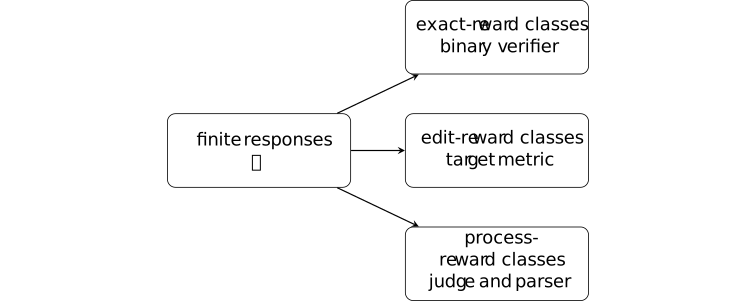
The exact reward forgets every difference among failures. Edit reward can retain character-level proximity, while the source process reward retains a declared milestone vector only after judge, override, and penalty choices. The partition lemma Lemma 8 applies to a pair only after its refinement hypothesis has been checked.
Remark 11. Reward density is not cost-free smoothing [ftip-00AJ]AGENTDRAFTED
Remark 11. Reward density is not cost-free smoothing [ftip-00AJ]AGENTDRAFTED
A denser reward can distinguish more responses and supply more frequent update signal. It can also require information absent from a sparse verifier. In the controlled source, edit feedback assumes the full target and computes a string metric; process feedback uses a 32-billion-parameter judge, five problem-specific milestones, answer extraction, an enumerated near miss, and loop and format penalties [clay2026demystifying, Appendices C--D].
The richer feedback channel incurs specification, computation, and validation costs. Replacing sparse feedback by dense feedback can alter both the information available to training and the objective being optimized. The resulting comparison is an intervention on feedback resolution, not evidence that one fixed reward was smoothed at zero cost.