How the notes are organized [frap-000C]
How the notes are organized [frap-000C]
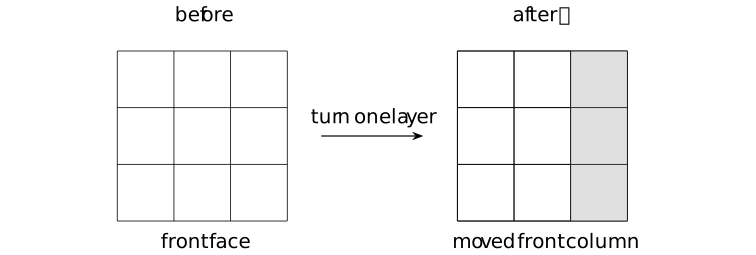
The developed mathematics follows one practical question: what data must a move carry so that we can later compose moves and test reachability? Incidence, symmetry and moves answers it in order. First, polytopes, flags and facet symmetry describe the shape and show their role in triangle and tetrahedron examples. Next, facet moves turn a local facet rotation into an action on incidence positions, with tetrahedron and cube calculations that make the construction concrete. Only then do positions, orientations and global constraints separate a piece's destination from transport in its local frame, while transfer and the effect of dimension connect that transport with a group homomorphism and compute the relevant local abelianizations.
The cube examples above connect the general mathematics with solving and play. The later accounts use those concrete states and moves as their starting point:
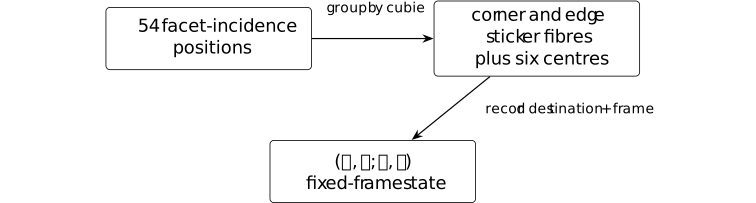
The transition between the abstract facet action and the fixed-frame cube coordinates is recorded in how the cube models connect. Read it before the all-\(N\) law if the distinction between incidence positions, cubie fibres and observations is new.
- General Rubik puzzles: the incidence actions, framed orientations and transfer developed below.
- The layered-cube family: piece types, layer turns and conventions as \(N\) varies.
- The layered-cube law: all-\(N\) state coordinates and a constructive characterization of reachability.
- The complete three-layer cube: explicit outer generators, impossible states, the standard count and a worked cleanup.
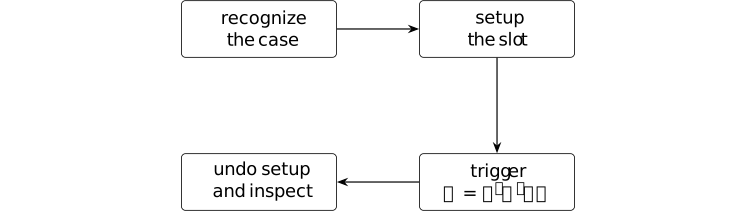
- Human methods and computer search: recognizable cases, algebraic effects, usability, move costs and optimality. The complete layer-first method supplies one full human construction, and computer solving and efficiency supplies exact small search, admissible bounds and subgroup reduction.
- From move sequences to play: notation, scrambling, recognition, replay and complete solves, including the worked replay and projected lower bound.
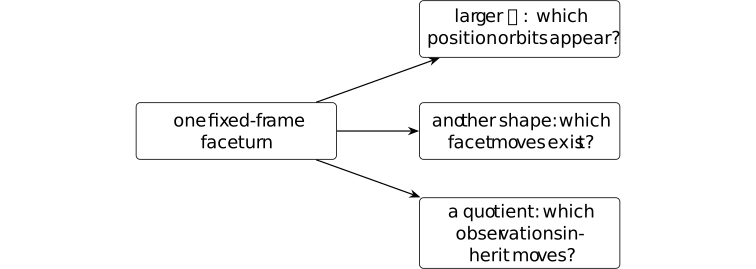
Further connections relate the developed orientation and transfer calculations to label transport and topology and scrambling and search functions. The quotient-compatible move account gives the criterion for an identification of observations to inherit a puzzle action. Together these results compare transport, randomization and information loss around the same concrete move.