Example. Two turns of a tetrahedron [frap-000O]
Example. Two turns of a tetrahedron [frap-000O]
Represent the faces of a tetrahedron by subsets of \(\{1,2,3,4\}\). We calculate facet moves from [marchetti2025rubik, Definitions 5--6]. For the facet \(H=123\), take an element of the rotation subgroup with global extension \(\widehat \alpha =(123)\), fixing \(4\). The vertex-edge records follow the cycle
\[(1,12)\longmapsto (2,23)\longmapsto (3,13)\longmapsto (1,12).\]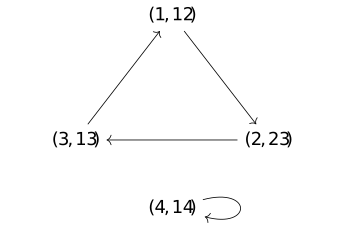
Every arrow is the local move \(\mu _{H,\alpha }\). The record \((4,14)\) stays fixed because \(4\not \leq H\), although the global shape symmetry sends it to \((4,24)\). The diagram records this permutation of incidence positions, rather than the tetrahedron's face graph.
For records whose second entry is a facet, the same move gives
\[(1,124)\longmapsto (2,234),\qquad (12,124)\longmapsto (23,234),\qquad (4,124)\longmapsto (4,124).\]The last record is fixed even though the global symmetry changes its second entry. Now let \(K=124\) and take an element of the rotation subgroup with global extension \(\widehat \beta =(124)\). Applying the \(H\)-move and then the \(K\)-move sends
\[(1,124)\xrightarrow {\mu _{H,\alpha }}(2,234) \xrightarrow {\mu _{K,\beta }}(4,134).\]Reversing their order gives \((1,124)\mapsto (2,124)\mapsto (3,234)\), so the two moves do not commute. Each has order three: its cube is the identity on both branches, and its displayed action is nontrivial.