Faces, flags, and the symmetry of a shape [frap-0008]
✍️sourceAGENTDRAFTED
Faces, flags, and the symmetry of a shape [frap-0008]
✍️sourceAGENTDRAFTED
A local turn needs a shape-level answer to two questions: which faces are incident, and which symmetries preserve those incidences? An abstract polytope retains the incidence of vertices, edges and faces without prescribing distances or angles. Schulte's flag formulation [schulte2017regular, Section 2] leads from these incidences to symmetries and to the extension of a facet symmetry used in local puzzle moves.
Definition 1. Abstract polytopes and flags [schulte2017regular, Section 2] [frap-000D]AGENTDRAFTED
Definition 1. Abstract polytopes and flags [schulte2017regular, Section 2] [frap-000D]AGENTDRAFTED
An abstract \(n\)-polytope, for \(n\geq 0\), is a partially ordered set \(P\) of faces with a least face \(F_{-1}\) and greatest face \(F_n\). Every chain extends to a maximal chain, called a flag, with exactly \(n+2\) faces. Faces in each flag have ranks \(-1,0,\ldots ,n\), consistently across flags. Faces other than the least and greatest are proper; vertices, edges and facets have ranks \(0,1,n-1\).
The diamond condition requires exactly two faces of rank \(i\) between faces \(F<G\) of ranks \(i-1\) and \(i+1\), for \(0\leq i<n\). Two flags are adjacent if they differ in exactly one proper face. Strong flag connectivity requires any two flags to be joined by adjacent flags, each containing their intersection.
Thus, for each \(0\leq i<n\), each flag has a unique adjacent flag differing in rank \(i\). Strong flag connectivity restricts paths to these adjacent flags, each containing the endpoint flags' intersection; arbitrary paths through the least face would connect every pair without imposing an axiom. These conditions prescribe incidence without choosing lengths or angles.
A rank-zero polytope is a two-element chain. A rank-one polytope has two vertices between its least and greatest faces. These low-rank cases occur as sections of higher-rank polytopes.
Definition 2. Sections and vertex figures [schulte2017regular, Section 2] [frap-000E]AGENTDRAFTED
Definition 2. Sections and vertex figures [schulte2017regular, Section 2] [frap-000E]AGENTDRAFTED
Let \(P\) be a abstract polytope. For faces \(F\leq G\) of ranks \(i,j\), its section \(G/F\) is the interval \(\{H:F\leq H\leq G\}\), with ranks shifted so that \(F\) has rank \(-1\). For \(F<G\), it is an abstract polytope of rank \(j-i-1\geq 0\). For \(F=G\), the singleton section is called the rank-\(-1\) polytope. These low ranks allow all intervals, including vertex figures of polygons and intervals between consecutive faces.
The section \(F_n/v\) at a vertex \(v\) is its vertex figure. Its vertices are the edges through \(v\); its faces record the incidences above \(v\). A facet \(H\) is viewed as the section \(H/F_{-1}\).
Example 3. Flags of a triangle and a tetrahedron [frap-000F]AGENTDRAFTED
Example 3. Flags of a triangle and a tetrahedron [frap-000F]AGENTDRAFTED
The face-poset construction of [schulte2017regular, Section 2] gives the following elementary examples of flags. A triangle has the empty face, three vertices, three edges and the whole triangle, of ranks \(-1,0,1,2\). The flag \(\varnothing <1<12<123\) has rank-zero neighbor \(\varnothing <2<12<123\) and rank-one neighbor \(\varnothing <1<13<123\). There are \(3\cdot 2=6\) flags.
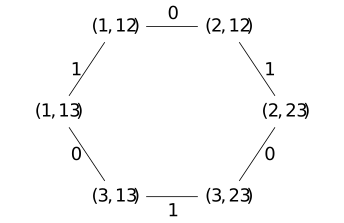
Each vertex in this flag graph records the vertex and edge of one flag; the common empty and greatest faces are suppressed. Edge labels give the rank changed by adjacency.
A tetrahedron has all subsets of \(\{1,2,3,4\}\) as faces, ordered by inclusion; a nonempty face with \(k\) vertices has rank \(k-1\). Its flag \(\varnothing <1<12<123<1234\) exhibits all five ranks. The vertex figure at \(1\) is a triangle: its vertices correspond to the three incident edges. A cube also has a triangular vertex figure, although its facets are squares. Local and global shapes carry different information.
The triangle and tetrahedron calculation now supplies a concrete check: the flag graph records which flags are adjacent; a vertex figure records the local neighborhood seen from one vertex. With those objects in hand, the next steps ask which incidence-preserving maps act on all flags and how a symmetry of one facet can be extended.
Definition 4. Automorphisms and regularity [schulte2017regular, Section 2] [frap-000G]AGENTDRAFTED
Definition 4. Automorphisms and regularity [schulte2017regular, Section 2] [frap-000G]AGENTDRAFTED
An automorphism of a abstract polytope \(P\) is a bijection \(a:P\to P\) satisfying \(F\leq G\iff a(F)\leq a(G)\). Automorphisms form a group \(\Gamma (P)\) under composition; in \(ab\), the map \(b\) acts first. They preserve ranks and act on flags face by face.
The polytope is regular if this action is transitive on flags. The tetrahedron is regular: a permutation of its four vertices sends any flag to any other.
The underlying order automorphism is represented by
OrderIso with equal source and target. This declaration does
not impose the polytope axioms or assert regularity.
Lemma 5. A flag determines an automorphism [schulte2017regular, Section 2, p. 4] [frap-000H]AGENTDRAFTED
Lemma 5. A flag determines an automorphism [schulte2017regular, Section 2, p. 4] [frap-000H]AGENTDRAFTED
An automorphism of an abstract polytope fixing every face of one flag is the identity. Consequently the automorphism group of a regular polytope acts freely and transitively on its flags.
The cited paragraph preceding Lemma 2.1 states simple transitivity for regular polytopes. The elementary argument below also proves freeness without assuming regularity.
Proof.
Proof.
For a flag adjacent to a pointwise fixed flag, only one rank has changed. The unchanged neighboring ranks bound a diamond condition with two possible faces. One is fixed, so the other is fixed too. The adjacent flag is therefore fixed pointwise. Propagating along the connected flag graph fixes every flag. Every face belongs to a flag, so every face is fixed. Transitivity is the definition of being regular.
Remark 6. Distinguished generators and the intersection property [frap-000I]AGENTDRAFTED
Remark 6. Distinguished generators and the intersection property [frap-000I]AGENTDRAFTED
Choose a base flag \(\Phi \) in a regular abstract polytope \(P\) of rank \(n\). By flag freeness, there is a unique automorphism \(\rho _i\) taking \(\Phi \) to its rank-\(i\) neighbor, for \(0\leq i<n\). The diamond condition and uniqueness give \(\rho _i^2=1\). For \(|i-j|>1\), the two rank changes are independent; \(\rho _i\rho _j\) and \(\rho _j\rho _i\) agree on \(\Phi \), hence are equal. Connectivity shows that the \(\rho _i\) reach every flag, so they generate \(\Gamma (P)\). These are the distinguished generators of [schulte2017regular, Section 5, pp. 13--14].
For \(I\subseteq \{0,\ldots ,n-1\}\), put \(G_I=\langle \rho _i:i\in I\rangle \). They also satisfy
\[G_I\cap G_J=G_{I\cap J}.\]This intersection property is part of the string C-group description [schulte2017regular, Section 5, equation (18)]. Involution and nonadjacent commutation relations alone do not reconstruct a polytope; the group-theoretic characterization includes this additional condition [schulte2017regular, Section 5, p. 14].
Lemma 7. Extending a symmetry of one facet [frap-000J]AGENTDRAFTED
Lemma 7. Extending a symmetry of one facet [frap-000J]AGENTDRAFTED
Let \(H\) be a facet of a regular abstract polytope \(P\) of rank \(n\geq 2\). Restriction gives an isomorphism
\[\operatorname {Stab}_{\Gamma (P)}(H)\cong \Gamma (H/F_{-1}).\]In particular the facet is regular, and each of its automorphisms has a unique extension fixing \(H\). This is a consequence of the flag action in [schulte2017regular, Section 2 and Lemma 2.1]; the argument follows.
Proof.
Proof.
Extend a flag of the facet section by the greatest face of \(P\). A stabilizer element restricting to the identity fixes this whole flag and is the identity by flag freeness. Restriction is therefore injective.
Given a facet automorphism \(\alpha \), the regular action supplies an automorphism of \(P\) taking the extended flag to the extension of its image under \(\alpha \). It fixes \(H\). Its restriction agrees with \(\alpha \) on the chosen facet flag, so flag freeness in the facet makes these restrictions equal. This proves surjectivity. The same use of same regular action with any two facet flags shows that the facet is regular.