Inference intervention coordinates [ftip-00DB]
✍️sourceAGENTDRAFTED
Inference intervention coordinates [ftip-00DB]
✍️sourceAGENTDRAFTED
A context intervention is a change to what a fixed model can attend to while it generates a rollout. The intervention is meaningful only after the prompt law, decoding rule, token budget, and retained-state rule are named.
Definition 1. Retained-context policy [ftip-00DC]AGENTDRAFTED
Definition 1. Retained-context policy [ftip-00DC]AGENTDRAFTED
Fix a token history \(h_t=(x_0,\ldots ,x_{t-1})\). A retained-context policy is a deterministic map \(\kappa _t(h_t)\) that selects an ordered subsequence of the history, together with a decoder that conditions its next token on that subsequence. The policy, rather than the model weights, names which prior tokens remain available at step \(t\).
A comparison of two policies is conditional on the same model, prompt law, decoding law, stopping rule, and budget unless the comparison includes a second declared intervention coordinate.
Definition 2. Prefix-window retained state [ftip-00DD]AGENTDRAFTED
Definition 2. Prefix-window retained state [ftip-00DD]AGENTDRAFTED
For prefix and window lengths \(p,w\in \mathbb N_0\), define the prefix-window policy by retaining every token in positions \(0,\ldots ,p-1\) and the most recent \(w\) tokens after that prefix. If the history is shorter than either region, the available positions are retained without padding.
The policy is a context rule only. It does not assert that omitted tokens are irrelevant, nor that the resulting continuation distribution equals the full-history distribution.
Remark 3. Prefix Sliding is a source-reported intervention [ftip-00DE]AGENTDRAFTED
Remark 3. Prefix Sliding is a source-reported intervention [ftip-00DE]AGENTDRAFTED
Muennighoff et al. describe Prefix Sliding in Sections 2--5, Figures 6--9, and the Limitations section of [muennighoff2026prefixsliding, Sections 2--5, Figures 6--9, and Limitations]. Their method preserves a prefix while sliding a recent attention window during test-time scaling. The reported experiments change retained context and runtime, and may also change rollout horizon and the training gradient approximation. These are source observations, not a theorem of universal speedup or capability.
The source studies named model and task configurations. It does not by itself establish support expansion, latent capability acquisition, or a deployment-shift guarantee.
Example 4. One trace under full and prefix-window attention [ftip-00DF]AGENTDRAFTED
Example 4. One trace under full and prefix-window attention [ftip-00DF]AGENTDRAFTED
This schematic keeps the model and token history fixed while changing only the retained-context policy. It is a local illustration, not a source figure.
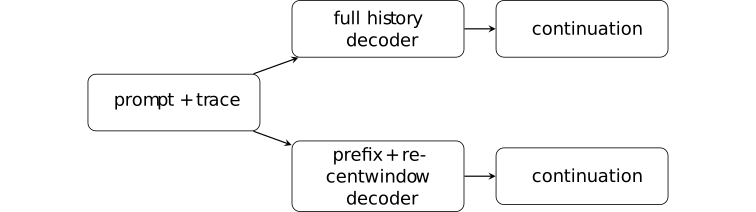
The two outputs can differ even though the represented weights and visible prompt are identical. Any claim about improvement must therefore name the retained-context intervention and its evaluation law.
Remark 5. Retained context is not weight learning [ftip-00DG]AGENTDRAFTED
Remark 5. Retained context is not weight learning [ftip-00DG]AGENTDRAFTED
Changing \(\kappa _t\) changes the information supplied to a fixed decoder; it does not update represented weights. A successful continuation can therefore be an elicitation effect, a context effect, or both. Weights, optimizer and feedback, inference state, and evaluation remain distinct intervention coordinates, as in § [ftip-0001].