Functors [tt-0013]
Functors [tt-0013]
Definition 1. (covariant) functor [kostecki2011introduction, 3.1] [tt-0014]
Definition 1. (covariant) functor [kostecki2011introduction, 3.1] [tt-0014]
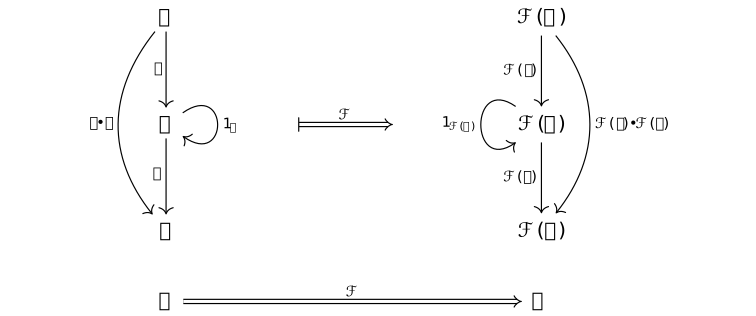
A (covariant) functor \(\mathscr {F}: {\cal C} \to {\cal D}\) is given by the diagram
Definition 2. contravariant functor [kostecki2011introduction, 3.1] [tt-0015]
Definition 2. contravariant functor [kostecki2011introduction, 3.1] [tt-0015]
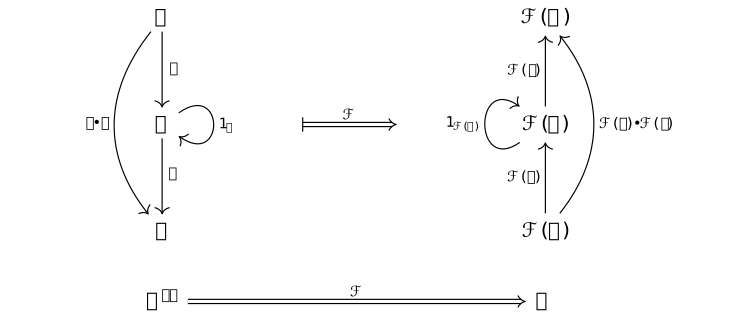
A functor \(\mathscr {F}\) is called a contravariant functor from \({\cal C}\) to \({\cal D}\), and denoted \(\mathscr {F} : {\cal C}^{op} \to {\cal D}\), if it obeys the definition given by the (covariant) functor for \({\cal C}\) replaced by \({\cal C}^{op}\), i.e. it's given by the diagram
Definition 3. functorial in [leinster2016basic, sec. 4.1] [tt-0041]
Definition 3. functorial in [leinster2016basic, sec. 4.1] [tt-0041]
For some expression \(E(X)\) containing \(X\), when we say \(E(X)\) is (covariant) functorial in \(X\), we mean that there exists a functor \(\mathscr {F}\) such that

Dually, we use the term contravariantly functorial in.
Convention 4. functors [tt-001D]
Convention 4. functors [tt-001D]
For simplicity, when there is no confusion, we use \(\bullet \) to represent corresponding objects, and omit the arrow names in the codomain of a functor, e.g.

Definition 5. full and faithful [kostecki2011introduction, 3.2] [tt-0017]
Definition 5. full and faithful [kostecki2011introduction, 3.2] [tt-0017]
A functor \(\mathscr {F}: {\cal C} \to {\cal D}\) is full iff for any pair of objects \(X, Y\) in \({\cal C}\) the induced map \(F_{X, Y}: {\cal C}(X, Y) \to {\cal D}(\mathscr {F}(X), \mathscr {F}(Y))\) is surjective (onto). \(\mathscr {F}\) is faithful if this map is injective (one-to-one).
Definition 6. preserve and reflect [kostecki2011introduction, 3.3] [tt-0018]
Definition 6. preserve and reflect [kostecki2011introduction, 3.3] [tt-0018]
A functor \(\mathscr {F}: {\cal C} \to {\cal D}\) is called to preserve a property \(\wp \) of an arrow iff for every \(f \in \operatorname {Arr}({\cal C})\) that has a property \(\wp \) it follows that \(\mathscr {F}(f) \in \operatorname {Arr}({\cal D})\) has this property. A functor \(\mathscr {F}: {\cal C} \to {\cal D}\) is called to reflect a property \(\wp \) of an arrow iff for every \(\mathscr {F}(f) \in \operatorname {Arr}({\cal D})\) that has a property \(\wp \) it follows that \(f \in \operatorname {Arr}({\cal C})\) has this property.
Example 7. full, faithful, preserve and reflect [kostecki2011introduction, 3.3] [tt-0019]
Example 7. full, faithful, preserve and reflect [kostecki2011introduction, 3.3] [tt-0019]
Every inclusion functor is faithful.
Every functor preserves isomorphisms.
Every faithful functor reflects monomorphisms and epimorphisms.
Every full and faithful functor reflects isomorphisms.