Turning a facet into a puzzle move [frap-0009]
✍️sourceAGENTDRAFTED
Turning a facet into a puzzle move [frap-0009]
✍️sourceAGENTDRAFTED
Once the shape symmetries are known, the next question is local: how can a turn change only the positions incident to one chosen facet while carrying their labels along? A facet rotation extends to a symmetry of the whole shape, but a puzzle move applies it only at positions incident to the chosen facet. Marchetti's construction retains both entries of each incidence pair [marchetti2025rubik, Definitions 5--6]. We use finite regular abstract polytopes of rank at least three; the extension lemma itself does not require finiteness.
Definition 1. The rotation subgroup [marchetti2025rubik, Definition 4] [frap-000K]AGENTDRAFTED
Definition 1. The rotation subgroup [marchetti2025rubik, Definition 4] [frap-000K]AGENTDRAFTED
Let \(Q\) be a regular abstract polytope of rank \(m\geq 2\). Choose a base flag and its distinguished generators (involutions) \(\rho _0,\ldots ,\rho _{m-1}\). Its rotation subgroup is
\[\Gamma ^+(Q)=\langle \rho _{j-1}\rho _j:1\leq j<m\rangle .\]The index starts at \(1\): for a polygon, the single adjacent pair \(\rho _0\rho _1\) generates its rotations. For triangles and squares these are the usual cyclic rotation groups.
Equivalently, \(\Gamma ^+(Q)\) consists of the elements represented by even-length words in the distinguished involutions. Indeed every pair \(\rho _i\rho _j\) is a product of adjacent pairs or their inverses, by cancellation along the index interval. Conjugating an even word by a distinguished involution again gives an even word, so this subgroup is normal. A change of base flag conjugates the distinguished generators and therefore leaves the subgroup unchanged. We do not require it to have index two for every abstract polytope.
Definition 2. Incidence positions and facet moves [marchetti2025rubik, Definitions 5--6] [frap-000L]AGENTDRAFTED
Definition 2. Incidence positions and facet moves [marchetti2025rubik, Definitions 5--6] [frap-000L]AGENTDRAFTED
Let \(P\) be a finite regular abstract polytope of rank \(n\geq 3\), with least and greatest faces \(F_{-1},F_n\). Write \(P^\circ =P\setminus \{F_{-1},F_n\}\). The incidence positions are
\[\mathcal R(P)=\{(F,G)\in P^\circ \times P^\circ :F\leq G\}.\]Choose a facet \(H\) and an element \(\alpha \) of the rotation subgroup \(\Gamma ^+(H/F_{-1})\). The facet extension lemma gives its unique extension \(\widehat \alpha \in \Gamma (P)\) fixing \(H\). The corresponding facet move is
\[\mu _{H,\alpha }(F,G)= \begin {cases} (\widehat \alpha (F),\widehat \alpha (G)),&F\leq H,\\ (F,G),&F\not \leq H. \end {cases}\]The first entry decides where the shape automorphism is applied; the second entry is transported with it. The facet is part of the move's name: one shape automorphism may stabilize several facets and give different local moves. Each move is a permutation of \(\mathcal R(P)\).
Lemma 3. The inverse of a facet move [frap-000M]AGENTDRAFTED
Lemma 3. The inverse of a facet move [frap-000M]AGENTDRAFTED
Let \(P\) be a finite regular abstract polytope of rank \(n\geq 3\), \(H\) a facet and \(\alpha \in \Gamma ^+(H/F_{-1})\) a facet rotation. The facet move \(\mu _{H,\alpha }\) is a permutation of \(\mathcal R(P)\), with
\[\mu _{H,\alpha }^{-1}=\mu _{H,\alpha ^{-1}}.\]This follows directly from the construction in [marchetti2025rubik, Definitions 5--6].
Proof.
Proof.
An automorphism preserves proper faces and the order relation, so the moving branch remains in \(\mathcal R(P)\). Since \(\widehat \alpha (H)=H\), the condition \(F\leq H\) holds exactly when \(\widehat \alpha (F)\leq H\). Thus the moving and fixed subsets are preserved separately. On the moving subset the extension of \(\alpha ^{-1}\) is \(\widehat \alpha ^{-1}\) by uniqueness, and cancels the first map. On the fixed subset both maps are the identity.
The general construction combining permutations of complementary
subsets is Equiv.Perm.subtypeCongr; its inverse formula is
Equiv.Perm.subtypeCongr.symm. Here the predicate is \(F\leq H\),
the moving permutation is the restricted shape automorphism and the other
permutation is the identity. These declarations supply that general
combination; the polytope-specific preservation argument is the proof above.
The inverse lemma makes the local action reversible. The tetrahedron calculation that follows is a small witness for why the facet is part of a move's identity: two locally valid turns can act differently on the same incidence record and need not commute.
Example 4. Two turns of a tetrahedron [frap-000O]AGENTDRAFTED
Example 4. Two turns of a tetrahedron [frap-000O]AGENTDRAFTED
Represent the faces of a tetrahedron by subsets of \(\{1,2,3,4\}\). We calculate facet moves from [marchetti2025rubik, Definitions 5--6]. For the facet \(H=123\), take an element of the rotation subgroup with global extension \(\widehat \alpha =(123)\), fixing \(4\). The vertex-edge records follow the cycle
\[(1,12)\longmapsto (2,23)\longmapsto (3,13)\longmapsto (1,12).\]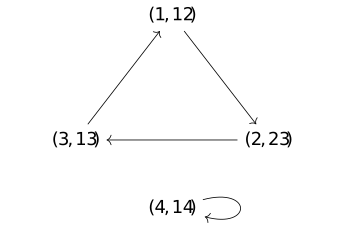
Every arrow is the local move \(\mu _{H,\alpha }\). The record \((4,14)\) stays fixed because \(4\not \leq H\), although the global shape symmetry sends it to \((4,24)\). The diagram records this permutation of incidence positions, rather than the tetrahedron's face graph.
For records whose second entry is a facet, the same move gives
\[(1,124)\longmapsto (2,234),\qquad (12,124)\longmapsto (23,234),\qquad (4,124)\longmapsto (4,124).\]The last record is fixed even though the global symmetry changes its second entry. Now let \(K=124\) and take an element of the rotation subgroup with global extension \(\widehat \beta =(124)\). Applying the \(H\)-move and then the \(K\)-move sends
\[(1,124)\xrightarrow {\mu _{H,\alpha }}(2,234) \xrightarrow {\mu _{K,\beta }}(4,134).\]Reversing their order gives \((1,124)\mapsto (2,124)\mapsto (3,234)\), so the two moves do not commute. Each has order three: its cube is the identity on both branches, and its displayed action is nontrivial.
The tetrahedron witness motivates the generated move group: reachable labelled configurations are products of these reversible local turns. The ordinary cube calculation then shows how the same definition compares with visible stickers and which data it leaves out.
Definition 5. The Rubik group and labelled configurations [frap-000N]AGENTDRAFTED
Definition 5. The Rubik group and labelled configurations [frap-000N]AGENTDRAFTED
For a finite regular abstract polytope \(P\) of rank \(n\geq 3\), the Rubik group is the subgroup generated by all facet moves:
\[\operatorname {Rub}(P)= \langle \mu _{H,\alpha }:H\text { a facet},\quad \alpha \in \Gamma ^+(H/F_{-1})\rangle \leq \operatorname {Sym}(\mathcal R(P)).\]This is Marchetti's generated group of permutations [marchetti2025rubik, Section 3, p. 6, following Definition 6]. The inverse lemma ensures that the generators are permutations.
Give each incidence position its own initial label. A labelled configuration can be represented by the permutation carrying each initial label to its current position. The identity is the solved configuration; the reachable labelled configurations are the elements of \(\operatorname {Rub}(P)\). A new move acts on the left: applying \(\mu \) to configuration \(g\) gives \(\mu g\), with \(g\) acting first. A visible coloring may identify several labelled configurations, so a solved visible coloring need not determine the labelled permutation.
Example 6. One ordinary cube face turn [frap-000P]AGENTDRAFTED
Example 6. One ordinary cube face turn [frap-000P]AGENTDRAFTED
Realize the cube as \([-1,1]^3\) and let \(H\) be the facet \(z=1\). The facet move construction of [marchetti2025rubik, Definitions 5--6] gives the following explicit outer-face action. The shape rotation
\[q(x,y,z)=(y,-x,z)\]is a clockwise quarter-turn when viewed from positive \(z\), with \(x\) rightward and \(y\) upward. Its restriction to \(H\) supplies our move. The corner \((1,1,1)\) goes to \((1,-1,1)\), and its color on \(y=1\) goes to the color position on \(x=1\). The corresponding corner at \(z=-1\) is fixed by the puzzle move, although the global map \(q\) moves it.
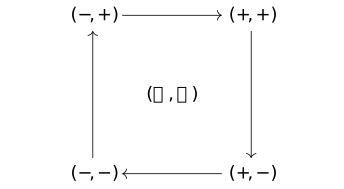
The signs give the \(x,y\) coordinates of the four corners on \(z=1\). The arrows show their clockwise motion; the central incidence record \((H,H)\) stays fixed. No orientation of a marked center is recorded.
Restricting the second entry to facets gives \(8\cdot 3+12\cdot 2+6=54\) incidence positions: three per corner, two per edge and one per face center. The turn moves twelve corner stickers and eight edge stickers, fixing the other thirty-four positions, including the unmarked center of the turned face. This is the usual outer-face action on visible stickers of a \(3\times 3\times 3\) cube in a fixed frame.
The full incidence set has \(8\cdot 7+12\cdot 3+6=98\) elements: above each vertex are that vertex, three edges and three facets; above each edge are itself and two facets. The facet-colored subset is invariant under every move. Its restricted action supplies the comparison with ordinary stickers; a faithful restriction for all abstract polytopes is not needed. Marked center orientations and inner-layer turns are additional data, absent from this comparison.
The local action determines which positions participate and how their incident labels travel. Frames and orientation separate this transport into a destination and a local orientation.