Research-state compaction and observability [ftip-00CN]
✍️sourceAGENTDRAFTED
Research-state compaction and observability [ftip-00CN]
✍️sourceAGENTDRAFTED
A research harness cannot place its complete archive into every model invocation. A summary can make distinct archives indistinguishable to later evaluators. The source record of a lost evaluator caveat illustrates how omitted information can affect subsequent research.
Definition 1. Active research state [ftip-00CO]AGENTDRAFTED
Definition 1. Active research state [ftip-00CO]AGENTDRAFTED
Let \(\mathcal A_{\rm res}\) be a space of complete research archives and \(\mathcal S_{\rm res}\) a space of bounded working summaries. Let \(\mathcal Q_{\rm claim}\) be a typed claim-ledger space and \(\mathcal G_{\rm res}\) a research-goal space. An active research state is
\[ R=(A,s,q,g)\in \mathcal A_{\rm res}\times \mathcal S_{\rm res} \times \mathcal Q_{\rm claim}\times \mathcal G_{\rm res}. \]The archive \(A\) may exceed the context budget. The summary \(s\) is the representation actually supplied to a new bounded session. The claim ledger \(q\) records declared statuses such as proved, numerically supported, conjectural, or heuristic. The goal \(g\) records the currently selected research direction.
Definition 2. Technical executor and research-judgment kernel [ftip-00CP]AGENTDRAFTED
Definition 2. Technical executor and research-judgment kernel [ftip-00CP]AGENTDRAFTED
Let \(\mathcal P_{\rm res}\) be a proposal space and \(\mathcal D_{\rm res}\) a finite research-decision space. A technical executor is a kernel that produces candidate calculations, experiments, lemmas, or implementations from the active summary and goal. A research-judgment kernel is
\[ J:\mathcal S_{\rm res}\times \mathcal Q_{\rm claim} \times \mathcal G_{\rm res}\times \mathcal P_{\rm res} \longrightarrow \Delta (\mathcal D_{\rm res}). \]The kernel chooses among actions such as continue, reframe, verify, merge, withdraw, or stop. It is typed separately from the executor because producing a technically valid local step and choosing the globally useful next step are different intervention coordinates.
Definition 3. Research-state summary operator [ftip-00CQ]AGENTDRAFTED
Definition 3. Research-state summary operator [ftip-00CQ]AGENTDRAFTED
A research-state summary operator is a declared map
\[ C:\mathcal A_{\rm res}\longrightarrow \mathcal S_{\rm res}. \]At a session boundary the harness supplies \(s=C(A)\). The operator may select, merge, compress, or omit archive content. Its input archive and exact version belong to the persistent event record. A stochastic summarizer is represented by adjoining its random seed to the archive coordinate, leaving \(C\) deterministic on the augmented input.
Definition 4. Summary-equivalent research archives [ftip-00CR]AGENTDRAFTED
Definition 4. Summary-equivalent research archives [ftip-00CR]AGENTDRAFTED
For the summary operator \(C\) of Definition 3, two complete archives \(A,A'\in \mathcal A_{\rm res}\) are summary-equivalent, written \(A\sim _C A'\), when
\[ C(A)=C(A'). \]This is equivalence relative to one declared summary version. It is not the protocol-level observational equivalence of Definition [ftip-007R]: the complete archives can differ in facts that a later retrieval operator or independent evaluator can still observe.
Theorem 5. A summary-only harness cannot distinguish summary-equivalent archives [ftip-00CS]AGENTDRAFTED
Theorem 5. A summary-only harness cannot distinguish summary-equivalent archives [ftip-00CS]AGENTDRAFTED
Fix the claim ledger \(q\), goal \(g\), and proposal \(p\). Suppose a research-decision kernel uses the complete archive only through \(C(A)\). If \(A\sim _C A'\), then its decision laws under \(A\) and \(A'\) are equal.
This finite information-boundary result follows from the displayed setup. It does not assume that the two complete archives induce the same independent utility.
Proof.
Proof.
By hypothesis, the two decision laws are related by
\[ J(C(A),q,g,p)=J(C(A'),q,g,p). \]Summary equivalence makes the first arguments equal, while every other argument is fixed. The two probability laws are therefore identical.
Lemma 6. An omitted constraint cannot affect a summary-only decision [ftip-00CT]AGENTDRAFTED
Lemma 6. An omitted constraint cannot affect a summary-only decision [ftip-00CT]AGENTDRAFTED
Let \(b:\mathcal A_{\rm res}\to \{0,1\}\) be a constraint bit. If there exist \(A\sim _C A'\) with \(b(A)\neq b(A')\), then no decision rule that factors only through \(C\) can condition its output law on the value of \(b\) for both archives.
Proof.
The result in Theorem 5 gives the same output law for \(A\) and \(A'\).
A rule that conditioned on the differing bit values would require different
output laws for at least one declared decision event. Both requirements cannot
hold simultaneously.Proof.
Example 7. A lost evaluator caveat reverses admissibility [ftip-00CU]AGENTDRAFTED
Example 7. A lost evaluator caveat reverses admissibility [ftip-00CU]AGENTDRAFTED
Take two complete archives \(A_{\rm exp}\) and \(A_{\rm cert}\). Both contain the same numerical score and candidate record. The first additionally states that the evaluator is safe only for exploration; the second states that the score is independently certified. Let the summary operator omit that status sentence, so \(A_{\rm exp}\sim _C A_{\rm cert}\).
The independently correct decision is ``audit'' for \(A_{\rm exp}\) and ``merge'' for \(A_{\rm cert}\). A summary-only kernel has the same decision law in both cases by Theorem 5; hence it cannot be correct on both archives with probability one.
This finite witness models an information loss. It does not assert that every compaction loses a decisive caveat.
Definition 8. Full-log recovery witness [ftip-00CV]AGENTDRAFTED
Definition 8. Full-log recovery witness [ftip-00CV]AGENTDRAFTED
For a constraint bit \(b\) omitted by \(C\), a full-log recovery witness is a query \(u\), retrieval map
\[ R_u:\mathcal A_{\rm res}\longrightarrow \mathcal O_u, \]and decoder \(d_u:\mathcal O_u\to \{0,1\}\) such that \(d_u(R_u(A))=b(A)\) on the declared archive class. A harness that invokes this retrieval before judgment can condition on \(b\); a harness restricted to \(C(A)\) cannot when the hypothesis of Lemma 6 holds.
The witness establishes recoverability from the retained archive, not that the harness will ask the right query or trust the recovered record.
Example 9. From evaluator caveat to withdrawn record [ftip-00CW]AGENTDRAFTED
Example 9. From evaluator caveat to withdrawn record [ftip-00CW]AGENTDRAFTED
The Grothendieck case study gives a concrete chronology. An early evaluator carried an exploration-only caveat; the working summary later lost that caveat and a feasibility condition; a later session recorded an unsupported upper bound; a subsequent audit withdrew it.
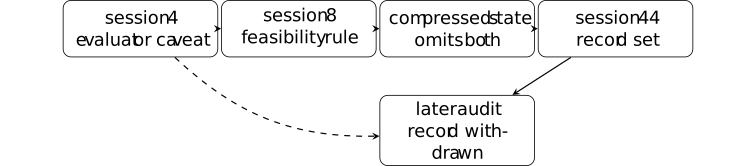
The source reports this sequence in Section 5 and Section 7.1; the complete archive retained the facts while the compressed decision state did not [li2026longhorizon, Section 5 and Section 7.1]. The diagram is a source-grounded chronology, not a measured error rate for compaction systems.
Remark 10. More inference compute is not a monotone research-judgment theorem [ftip-00CX]AGENTDRAFTED
Remark 10. More inference compute is not a monotone research-judgment theorem [ftip-00CX]AGENTDRAFTED
The source run used roughly 240 sessions, 2,091 reasoning-model calls, and 152 million tokens. It also reports repeated continuation of an upper-bound search until human operators redirected the program toward a universal obstruction [li2026longhorizon, Sections 5--7].
This is one human-steered case with changing models, harnesses, goals, and research state. It supports the distinction between technical execution and research judgment. It does not establish a monotone or anti-monotone law from inference compute to mathematical progress.