Preference acquisition and reward modeling [ftip-002J]
✍️sourceAGENTDRAFTED
Preference acquisition and reward modeling [ftip-002J]
✍️sourceAGENTDRAFTED
Preference data records a judge's choice between displayed alternatives. Reward modeling adds a statistical representation of those choices. This section keeps the acquisition procedure, observation law, score model, and validation law separate so that a scalar predictor is not mistaken for the preferences it was fitted to represent.
Notation 1. Comparison queries, judges, and response pairs [ftip-002K]AGENTDRAFTED
Notation 1. Comparison queries, judges, and response pairs [ftip-002K]AGENTDRAFTED
Use the prompt and response spaces from Notation [ftip-002A]. A comparison query is a displayed triple \(c=(x,y^0,y^1)\) with \(y^0,y^1\in \mathcal Y(x)\). Let \(\mathcal J\) be the declared judge population, and let \(j\in \mathcal J\) identify the human, model, or rule that returns a comparison label \(b_{\mathrm {pref}}\in \{0,1\}\).
When \(b_{\mathrm {pref}}=1\), write \(y^+=y^1\) and \(y^-=y^0\); when \(b_{\mathrm {pref}}=0\), reverse those names. Thus \(y^+\) means selected in this observation, not objectively or uniquely best. The acquisition mechanism may also record a tie, abstention, or invalid comparison, but those outcomes must use an enlarged label space rather than being silently forced into \(\{0,1\}\).
Definition 2. Pairwise comparison observation [ftip-002L]AGENTDRAFTED
Definition 2. Pairwise comparison observation [ftip-002L]AGENTDRAFTED
Restrict attention to a comparison for which the judge selects one displayed alternative rather than reporting indifference or incomparability. For a query \(c=(x,y^0,y^1)\) and a judge \(j\), a pairwise comparison observation is the displayed pair together with the judge's selected alternative. In winner--loser notation it is recorded as
\[ o=(x,y^+,y^-,j). \]The observation reports a choice made under the declared presentation and query procedure. It does not by itself provide a numerical reward, a complete ranking of responses, or a judgment about alternatives that were not shown.
Definition 3. Preference query selection [christiano2017deep, Section 2.2.4] [ftip-002M]AGENTDRAFTED
Definition 3. Preference query selection [christiano2017deep, Section 2.2.4] [ftip-002M]AGENTDRAFTED
Preference learning may choose which trajectory segments or responses to show to a judge rather than sampling every pair uniformly. The query-selection procedure assigns candidate comparisons a priority derived from the current reward-model ensemble and requests labels for selected pairs.
Because selection depends on the current model and candidate pool, the resulting comparison data reflect an acquisition policy. Active selection can concentrate labels on uncertain pairs, but it does not make the collected comparisons representative of an undeclared target population.
Remark 4. Preference acquisition and judge provenance [ftip-002N]AGENTDRAFTED
Remark 4. Preference acquisition and judge provenance [ftip-002N]AGENTDRAFTED
A preference observation depends on the query presented and the judge who evaluates it. Concrete elicitation procedures include [christiano2017deep, Sections 2.2.2 and 2.2.4] and the language-model comparison pipeline of [ouyang2022training, Sections 3.2 and 3.4].
The response generator, pair-selection rule, presentation order, judge population, and aggregation rule can each change the observed law. A later sample-complexity or population claim must condition on those choices rather than treating comparison labels as an unqualified source of ground truth.
Definition 5. Preference data law [ftip-002O]AGENTDRAFTED
Definition 5. Preference data law [ftip-002O]AGENTDRAFTED
A preference data law \(\mathcal D_{\mathrm {pref}}\) is a probability law on pairwise comparison observations \(o=(x,y^+,y^-,j)\) from Definition 2. It includes the randomness of prompt selection, response generation, pair selection, judge selection, and the judge's reported label.
A finite training multiset \(D_{\mathrm {pref}}=(o_1,\ldots ,o_N)\) is sampled or adaptively collected under that law and its acquisition history. When queries are adaptive, the records need not be independent or identically distributed.
Definition 6. Scalar reward-model score [ouyang2022training, Section 3.5 and Appendix C.2] [ftip-002P]AGENTDRAFTED
Definition 6. Scalar reward-model score [ouyang2022training, Section 3.5 and Appendix C.2] [ftip-002P]AGENTDRAFTED
A scalar reward model is a parameterized function
\[ r_\phi :\{(x,y):x\in \mathcal X_{\mathrm {pr}},\ y\in \mathcal Y(x)\} \longrightarrow \mathbb R, \]whose score is fitted from comparison observations. The score orders or weights responses for a specified training procedure; it is not automatically the independent utility of the response. Ouyang et al. initialize the model from the supervised policy and replace its language-model head with a scalar output for this stage.
Definition 7. Bradley--Terry comparison law [bradley1952rank, Page 325, equation (1)] [ftip-002Q]AGENTDRAFTED
Definition 7. Bradley--Terry comparison law [bradley1952rank, Page 325, equation (1)] [ftip-002Q]AGENTDRAFTED
Given scalar scores for two alternatives, the Bradley--Terry comparison law assigns the probability
\[ \Pr _\phi (y^+\succ y^-\mid x) =\frac {\exp r_\phi (x,y^+)} {\exp r_\phi (x,y^+)+\exp r_\phi (x,y^-)} =\sigma \left (r_\phi (x,y^+)-r_\phi (x,y^-)\right ), \]where \(\sigma (a)=(1+\exp (-a))^{-1}\). Conditioning the scores on a language-model prompt is the contextual specialization used in modern reward modeling; see also [rafailov2023direct, Section 3, equation (1)].
Definition 8. Pairwise reward-model loss [ouyang2022training, Section 3.5, equation (1), and Appendix C.2] [ftip-002R]AGENTDRAFTED
Definition 8. Pairwise reward-model loss [ouyang2022training, Section 3.5, equation (1), and Appendix C.2] [ftip-002R]AGENTDRAFTED
For comparison observations sampled from \(\mathcal D_{\mathrm {pref}}\), the pairwise reward-model loss is
\[ L_{\mathrm {rm}}(\phi ) =\mathbb E_{(x,y^+,y^-,j)\sim \mathcal D_{\mathrm {pref}}} \left [-\log \sigma \left ( r_\phi (x,y^+)-r_\phi (x,y^-) \right )\right ]. \]The empirical objective replaces the expectation by a declared weighting of the collected comparisons. It fits score differences under the Bradley--Terry law of Definition 7; it does not observe an absolute reward target for either response.
Remark 9. Representability, non-identifiability, and heterogeneous preferences [ftip-002S]AGENTDRAFTED
Remark 9. Representability, non-identifiability, and heterogeneous preferences [ftip-002S]AGENTDRAFTED
Fitting a Bradley--Terry predictor is an assumption about representation, not a consequence of observing comparisons. Cyclic choices, context effects, and mixtures of judges can fail to agree with one shared scalar ordering.
Even within the model, scores are not identified absolutely: replacing \(r_\phi (x,y)\) by \(r_\phi (x,y)+c(x)\) leaves every pairwise probability and the loss unchanged. Ouyang et al. give one normalization in [ouyang2022training, §3.5; App. C.2]. Other uses must state their own normalization, judge population, and validation law.
Example 10. A Bradley--Terry comparison calculation [ftip-002T]AGENTDRAFTED
Example 10. A Bradley--Terry comparison calculation [ftip-002T]AGENTDRAFTED
A declared difference between two reward scores maps to one Bradley--Terry preference probability.

Under the Bradley--Terry link, \[ \Pr (y^+\succ y^-\mid x) =\frac {\exp r(y^+)}{\exp r(y^+)+\exp r(y^-)} =\sigma (2-0.5) =\sigma (1.5)\approx 0.8176. \] Reversing the pair gives probability \(1-0.8176=0.1824\).
The fixed scores instantiate Definition 7 and determine the displayed probability. Whether one scalar reward can represent every judge is a separate modeling question.
Definition 11. Reward-model validation law [ftip-002U]AGENTDRAFTED
Definition 11. Reward-model validation law [ftip-002U]AGENTDRAFTED
A reward-model validation law \(\mathcal D_{\mathrm {rm}}^{\mathrm {val}}\) is a held-out law on comparison observations used to evaluate the fitted score model rather than to update \(\phi \). A declared validation statistic may be Bradley--Terry log loss or the probability that \(r_\phi (x,y^+)>r_\phi (x,y^-)\).
The validation population and acquisition procedure are part of the quantity. Accuracy on comparisons drawn from the same collection process does not establish calibration under a new judge population or agreement with an independent task-success criterion.
Remark 12. Reward-model validation depends on its population [ftip-006O]AGENTDRAFTED
Remark 12. Reward-model validation depends on its population [ftip-006O]AGENTDRAFTED
Ouyang et al. hold out comparison data and report reward-model validation accuracy and loss in [ouyang2022training, Section 3.5 and Appendix C.2]. Representing the validation population by a probability law makes the estimand depend explicitly on the judge population and acquisition procedure.
This law belongs to reward-model validation. It is not the independent task evaluation used later to compare post-training protocols.
Example 13. Cyclic preferences that no scalar ordering represents [ftip-002V]AGENTDRAFTED
Example 13. Cyclic preferences that no scalar ordering represents [ftip-002V]AGENTDRAFTED
Three strict comparisons arranged in a directed cycle obstruct representation by a single scalar ordering.
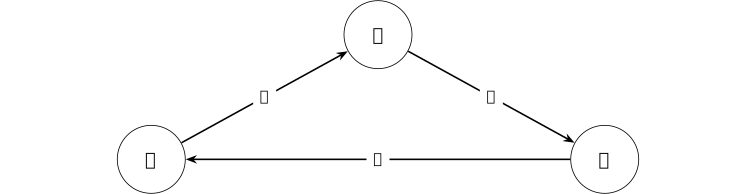
Declare \(A\succ B\), \(B\succ C\), and \(C\succ A\). If a scalar \(r\) represented all three comparisons by strict inequalities, then \[ r(A)>r(B)>r(C)>r(A), \] which implies \(r(A)>r(A)\), a contradiction. Thus no real-valued score can represent this cycle by ordinary greater-than.
Scalar pairwise reward modeling is used in [christiano2017deep, Section 2]; the finite cycle marks one assumption needed for that reduction. No empirical cycle is attributed to a particular dataset or population, and the obstruction concerns scalar orderings rather than all preference models.