Positions, orientations, and global constraints [frap-000A]
✍️sourceAGENTDRAFTED
Positions, orientations, and global constraints [frap-000A]
✍️sourceAGENTDRAFTED
After a facet move, a piece can reach the right position with the wrong local orientation. The first question is therefore what data records both the destination and the frame carried by the piece. Local frames turn this transport into group coordinates, as in [marchetti2025rubik, Section 3.1]. We then derive the composition law, a frame-independent total-orientation character, and the additional test that makes this character a conserved quantity for cube face turns.
Definition 1. Framed transports [frap-000Q]AGENTDRAFTED
Definition 1. Framed transports [frap-000Q]AGENTDRAFTED
Let \(I\) be a finite set of positions, \(\Omega \) a nonempty set, and \(K\) a group acting faithfully on \(\Omega \). At each position \(i\), choose a set \(X_i\) of local labels and a bijective local frame \(c_i:\Omega \to X_i\). Keep the fibers distinct by using the tagged union
\[E=\coprod _{i\in I}X_i=\{(i,y):i\in I,\ y\in X_i\}.\]A framed transport is a permutation of \(E\) given by a position permutation \(\pi \in \operatorname {Sym}(I)\) and elements \(a_i\in K\), with
\[g(i,c_i(x))=(\pi (i),c_{\pi (i)}(a_i x)).\]Write \(g=(\pi ,a)\). Its local factors are indexed by the source position. Nonempty fibers determine \(\pi \) uniquely, and faithfulness determines each \(a_i\) uniquely. Conversely every such pair gives a permutation: in framed coordinates its inverse sends \((j,x)\) to \((\pi ^{-1}(j),a_{\pi ^{-1}(j)}^{-1}x)\).
This finite-position model isolates the coordinate mechanism of [marchetti2025rubik, Section 3.1, Definition 7 and equation (5)]. Which local label sets and local group describe a particular puzzle must still be justified for that puzzle. The requirement that a transport moves whole fibers is part of the model.
Under composition these transports form a wreath product
\(K\wr \operatorname {Sym}(I)\). The normal subgroup \(K^I\) acts within
fibers, and position permutations reorder its factors. In
TauCeti.WreathProduct, a pair is stored using the
destination-indexed function \(A_j=a_{\pi ^{-1}(j)}\). Its permutation
action is TauCeti.WreathProduct.imprimitiveToPerm_apply;
the nonempty-fiber and faithful-action hypotheses give its injectivity in
TauCeti.WreathProduct.imprimitiveToPerm_injective.
The bijections \(c_i\) identify that action on \(I\times \Omega \) with
the action on \(E\) above.
Lemma 2. Composition of framed transports [frap-000R]
L∃∀NAGENTDRAFTED
Lemma 2. Composition of framed transports [frap-000R]
L∃∀NAGENTDRAFTED
Let \(I\) be finite and let \(K\) act faithfully on a nonempty \(\Omega \), with bijective frames \(c_i:\Omega \to X_i\). Write two framed transports as \(g=(\pi ,a)\) and \(h=(\sigma ,b)\), acting in coordinates by \(g(i,x)=(\pi (i),a_i x)\) and \(h(i,x)=(\sigma (i),b_i x)\). With left actions, applying \(g\) and then \(h\) gives the composition law
\[hg=(\sigma \pi ,(b_{\pi (i)}a_i)_{i\in I}).\]
Proof.
Proof.
The intermediate coordinates are \((\pi (i),a_i x)\). Applying \(h\) evaluates its local map at that intermediate position, giving \((\sigma \pi (i),b_{\pi (i)}a_i x)\). Thus a local factor must be multiplied at its transported position index.
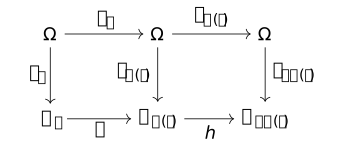
The vertical arrows are the chosen frames; the bottom arrows are the restrictions of the actual transports. Each square commutes. Along the top row, the second factor is evaluated at \(\pi (i)\), explaining the shifted index in the composite. This expands the wreath-product coordinates of [marchetti2025rubik, Section 3.1, pp. 6--7]. The wreath product uses destination-indexed factors in the linked formalization.
The linked multiplication theorem uses destination-indexed factors. Set \(A_j=a_{\pi ^{-1}(j)}\) and \(B_j=b_{\sigma ^{-1}(j)}\). Its factor for \(hg\) at destination \(j\) is
\[B_j A_{\sigma ^{-1}(j)} =b_{\sigma ^{-1}(j)}a_{\pi ^{-1}\sigma ^{-1}(j)}.\]Putting \(i=(\sigma \pi )^{-1}(j)\) makes this exactly \(b_{\pi (i)}a_i\). Thus the theorem and the displayed source-indexed law use the same multiplication order.
Theorem 3. The abelianized total orientation [frap-000S]AGENTDRAFTED
Theorem 3. The abelianized total orientation [frap-000S]AGENTDRAFTED
Let \(I\) be finite, let \(K\) act faithfully on a nonempty \(\Omega \), and choose bijective frames \(c_i:\Omega \to X_i\). For a framed transport \(g=(\pi ,a)\), let \(K_{\mathrm {ab}}=K/[K,K]\) be its abelianization, where \([K,K]\) is generated by \(uvu^{-1}v^{-1}\), and write \([a]\) for the class of \(a\). The total-orientation character
\[\chi (g)=\prod _{i\in I}[a_i]\quad \hbox {in }K_{\mathrm {ab}}\]is a homomorphism, independent of replacing the frames by \(c_i'=c_i t_i\) for \(t_i\in K\). This is the canonical character in [marchetti2025rubik, Section 3.1, p. 7]; the proof below gives both assertions directly in source-indexed coordinates.
Proof.
Proof.
For \(h=(\sigma ,b)\), the composition law and commutativity of the target give
\[\chi (hg)=\prod _i[b_{\pi (i)}][a_i] =\left (\prod _j[b_j]\right )\left (\prod _i[a_i]\right ) =\chi (h)\chi (g).\]The middle equality reindexes using the bijection \(\pi \). In the new frames the local map is \(a_i'=t_{\pi (i)}^{-1}a_i t_i\). Its abelianized product contains each \([t_i]\) and its inverse exactly once, so these cancel and leave \(\chi (g)\).
Frame independence here concerns changes within the chosen group of
frames. Reversing a common orientation convention can also change the
identification of the target group. The target and its quotient map are
Abelianization and Abelianization.of; the total
product and its frame independence are the argument above.
Remark 4. When a character is conserved [frap-000T]AGENTDRAFTED
Remark 4. When a character is conserved [frap-000T]AGENTDRAFTED
For finite \(I\), the ambient coordinate group \(W=K\wr \operatorname {Sym}(I)\) has the total-orientation character \(\chi (\pi ,a)=\prod _i[a_i]\in K_{\mathrm {ab}}\). If a puzzle's allowed moves form a set \(S\subseteq W\), its legal group is \(G=\langle S\rangle \), usually a proper subgroup of \(W\). Then
\[G\subseteq \ker \chi \quad \Longleftrightarrow \quad \chi (s)=1\quad \hbox {for every }s\in S.\]The forward implication includes each generator. Conversely the kernel of a homomorphism is a subgroup, so it contains all products and inverses of generators lying in it. This is the generator-check step discussed after the canonical character in [marchetti2025rubik, Section 3.1, p. 7]. Its premise must be verified for the chosen moves.
The nonabelian product of local factors need not be independent of order or frames. Abelianization makes reindexing and frame cancellation valid, but neither of those operations says that \(\chi (s)=1\). The cycle criterion supplies a sufficient test, applied explicitly to cube face turns.
Lemma 5. Orientation checked cycle by cycle [frap-000U]AGENTDRAFTED
Lemma 5. Orientation checked cycle by cycle [frap-000U]AGENTDRAFTED
Let \(g=(\pi ,a)\) be a framed transport on finitely many positions \(I\), with a faithful local group \(K\) on nonempty \(\Omega \) and bijective local frames. On a cycle
\[i_0\longmapsto i_1\longmapsto \cdots \longmapsto i_{r-1} \longmapsto i_0\]of \(\pi \), the return transport in the first fiber has framed map \(a_{i_{r-1}}\cdots a_{i_1}a_{i_0}\). Its class in \(K_{\mathrm {ab}}\) is that cycle's contribution to \(\chi (g)=\prod _{i\in I}[a_i]\). Consequently, identity return transport on every position cycle implies \(\chi (g)=1\). This is the cycle criterion.
Proof.
Proof.
Apply the coordinate action \(r\) times. Each local map is applied after the preceding one, giving the stated product with the first map on the right. In the abelianization its factors may be reordered; multiplying over disjoint cycles uses each factor exactly once. A fixed position is a cycle of length one and must also be checked.
This is a sufficient test derived from the canonical character of [marchetti2025rubik, Section 3.1, p. 7]. A generator's finite order alone does not make its return map on each shorter position cycle the identity; the local transport on that cycle is the quantity to check.
Example 6. Corner twists and edge flips on the cube [frap-000V]AGENTDRAFTED
Example 6. Corner twists and edge flips on the cube [frap-000V]AGENTDRAFTED
Use the unmarked-center, fixed-frame sticker model of one cube face turn. We apply the canonical character of [marchetti2025rubik, Section 3.1, p. 7] to this explicit action. At a corner the three incident sticker directions have a cyclic order inherited from the ambient orientation. Choose bijective cyclic frames at all eight positions. Rotations preserve that order, giving local group \(C_3\); at each of the twelve edges an ordering of its two stickers gives local group \(C_2\). Both actions on the local stickers are faithful. Writing these groups additively, the two characters are
\[\chi _c=\sum _{i=1}^{8}a_i\pmod 3,\qquad \chi _e=\sum _{j=1}^{12}b_j\pmod 2.\]A quarter-turn has one four-cycle of affected corners and one of affected edges. Four applications restore every sticker, so the return transport on each of these cycles is the identity. Every other corner and edge is fixed with identity local transport. The cycle criterion gives \(\chi _c=0\) and \(\chi _e=0\) for every face quarter-turn. The kernel argument extends this to every word in those turns, including inverses and half-turns.
For a concrete cyclic frame, choose any frame at corner \(i_0\) of the upper face and define the next three by transporting it with the shape rotation \(q\). Since \(q^4=1\), all four local factors of this turn become zero. This frame checks that one generator; the frame-independence theorem transfers the conclusion to any fixed choice of cyclic frames used for the other generators.
A configuration with a corner twist of just one corner by \(1\) has \(\chi _c=1\) and is impossible under these moves. Twisting two corners by \(1\) and \(-1\) passes this test, but the calculation alone does not construct a legal sequence. Likewise, flipping exactly one edge fails the second test. An edge flip of exactly one edge therefore fails the second test. Reachability needs additional arguments.
Transfer gives a group-theoretic form of the same frame cancellation and shows how the local group limits what total orientation can detect.