Example. Two proposed updates under a DGG-style gate [ftip-005B]
Example. Two proposed updates under a DGG-style gate [ftip-005B]
Two candidate reused-gradient updates fall on opposite sides of a declared DGG-style gate.
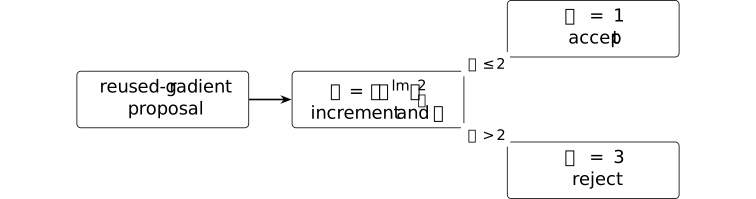
Declare a trailing-window increment mean \(\mu =1\), standard deviation \(s=0.5\), and toy threshold \(z_\star =2\). Proposal A has increment \(1.5\), so \(Z_A=(1.5-1)/0.5=1\) and is committed. Proposal B has increment \(2.5\), so \(Z_B=3\) and is rejected before an Adam transition. Rejection therefore leaves both parameters and optimizer moments unchanged in this protocol.
The monitored last-layer gradient energy, trailing-window Z-score, and pre-optimizer rejection order are modeled on [miao2026when, Section 5 and Algorithm 1]; the numeric threshold and window statistics above are locally declared. Acceptance is a reuse heuristic; it supplies neither a safety certificate nor a guarantee of improved independent evaluation.