Example. A two-coordinate Adam defect witness [ftip-00BF]
Example. A two-coordinate Adam defect witness [ftip-00BF]
Take \(d_1=d_2=1\), \(k=2\), \(f(w)=w^2/2\), \(U_0=V_0=(1,0)\), and
\[ Q=2^{-1/2}\begin {pmatrix}1&1\\-1&1\end {pmatrix}. \]The original and rotated products after one zero-state Adam step are
\[ W_1=\left (1-\frac {\eta }{1+\epsilon }\right )^2, \qquad \widetilde W_1=\left (1-\frac {\eta }{2^{-1/2}+\epsilon }\right )^2. \]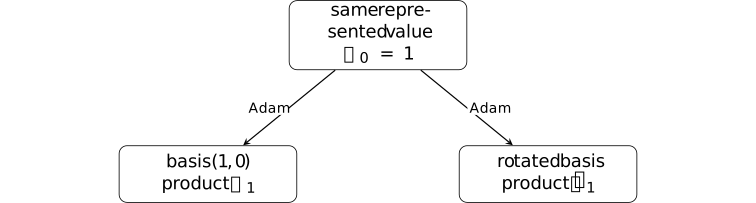
They differ when \(0<\eta <2^{-1/2}+\epsilon \). This is the explicit witness in Proposition 4.4 of The loss does not see the basis, but Adam does[singh2026lossbasis]; it is a statement about one factored quadratic, not about language-model performance.