Remark. How to read these notes [ftip-00NW]
AGENTDRAFTED
The seven chapters connect learning mechanisms, computational constraints,
agent reliability, evaluation, capability growth and economic conditions.
The diagram shows
their main logical relationships. Solid arrows indicate concepts used by
another analysis. The dashed branch supplies architecture-specific detail
for comparisons involving a particular model implementation or optimizer.
Within that branch, the mechanism map identifies which capability bottleneck
changes and what evidence would show the change; the second dashed edge marks
its possible consequences for representations and discovery across model
generations.
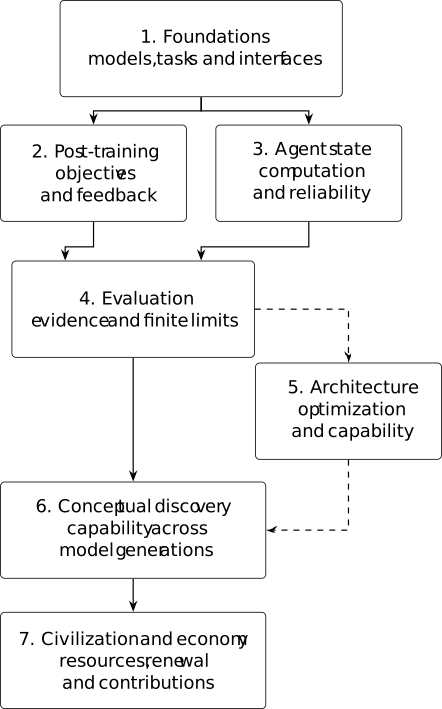
Post-training and agent state are complementary sources of capability
change: one changes learned parameters, while the other manages interaction,
computation and retained artifacts. Evaluation studies the evidence for
those changes and their limits. Architecture analysis connects the
comparison to the model's computation and optimization. The lineage
analysis extends it to discovery and learning across generations. Economic
analysis then asks how productive capacity, knowledge renewal and financing
make the required resources available, and how learning changes those
conditions.
- Foundations and interfaces introduces capability claims,
token probabilities, pretraining, tasks and environments. These interfaces
allow the later analysis to specify a model without requiring a particular
neural architecture.
- Post-training, alignment, and feedback develops
fine-tuning, preference learning, RLHF, DPO, RLVR and agentic training,
with concrete objectives, feedback mechanisms and update procedures.
- Agent state, computation, and reliability studies
persistent state, retained context, recursive execution, failure modes and
reliability. It separates changes to agent behavior from changes to model
weights while examining their interaction.
- Evaluation, evidence, and finite limits fixes the
comparison law and costs, studies transport to other evaluations, and
develops finite results about discovery, support, feedback and proxy error.
Its closing synthesis collects the consequences and counterexamples.
- Architecture-conditioned potential and computation
begins with a decoder-only Transformer, then uses the
mechanism-family map to ask which capability bottleneck a
design changes. Its optimization-geometry and matched-compute sections use
the evaluation framework to make implementation-specific claims. The core
panel is the default comparison path; the adjunct panel supplies optional
objective, temporal-dynamics and function-space lenses.
- Conceptual discovery across model generations studies
discovery and learning across successive artifacts. It develops
the complete lineage, independently developed contributions,
representation learning, curricula and mathematical research settings,
alongside the conjecture and arguments that could establish or defeat it.
- Civilization, economic reproduction and capability
conditions learning on feasible economic paths. It develops knowledge
renewal and financing bounds, reliable acquisition from contributors,
shared preparation costs, and alternative models with different implications
for continued learning.
The research question and scope introduces the common
distinctions between elicitation, acquisition, computation and evaluation.
Questions about fine-tuning, preferences, rewards and interaction lead to
the post-training chapter. Questions about memory, tools,
recursive execution and reliability lead to the agent chapter.
Both use the model, task and environment interfaces in the foundations.
Questions about a particular model implementation or optimizer are
developed in the architecture chapter. Begin with its
mechanism-family map when the question is which bottleneck a
mechanism changes and what evidence could establish the change. Then follow
the frontier and protocol route through architecture-indexed ceilings and
matched compute, published paired measurements,
paired model measurements, conditional frontiers
and study design. The shared evaluation framework supplies the
task laws and resource comparisons used in that analysis.
A mechanism-first route reads the core panel before the
frontier sections. Its adjunct panel is optional: it changes an objective,
temporal law or function-space bias and should be compared under the same
interfaces rather than treated as another architecture family. Questions
about representations, curricula and discovery continue through
conceptual discovery; questions about costs, stability,
monitorability and transfer return to evaluation and finite limits
and its comparison controls.
Claims about a capability gain or limit are examined in
independent evaluation and post-training potential and the
following finite results and counterexamples. These sections distinguish
training reward from evaluation evidence, examine transport to other task
laws, and make the assumptions behind a bound explicit. Training, search
and deployment costs have distinct roles in those comparisons.
Questions about reusable concepts and capability growth across
generations are developed in conceptual discovery. Its
complete lineage, acquisition criterion and
conjecture specify the autonomous and contributed processes
being compared. Contributor development, learned representations, curricula
and mathematical research provide concrete settings for that open question.
Questions about the origin of a learning budget begin with
economic state and admissible paths and the
uniform resource envelope. The
knowledge-renewal model and financing account
give distinct constraints; the automation game studies an
equilibrium effect under a narrower institutional assumption. The
contribution protocol and portfolio comparison
specify possible cost advantages. Read these with the
alternative mathematical models: they show which
maintenance, investment, substitution and simulation assumptions can
prevent a proposed separation. Each proved implication is conditional;
none alone establishes a universal training ceiling or the open
conceptual-discovery lower bound.