Optimizer geometry in training interventions [ftip-00BS]
✍️sourceAGENTDRAFTED
Optimizer geometry in training interventions [ftip-00BS]
✍️sourceAGENTDRAFTED
Equivalent parameterizations need not follow equivalent training trajectories. Their evolution also depends on the update geometry; the scalar loss and represented starting object do not always suffice.
Definition 1. Objective-equivalent parameterizations [ftip-00BT]AGENTDRAFTED
Definition 1. Objective-equivalent parameterizations [ftip-00BT]AGENTDRAFTED
Two factor pairs \((U,V)\) and \((\widetilde U,\widetilde V)\) are objective-equivalent for \(L=f\circ W\) when
\[ W(U,V)=W(\widetilde U,\widetilde V). \]They then have the same scalar loss for every objective depending only on that represented matrix. Orthogonal gauge-related pairs are objective-equivalent by Lemma [ftip-00AY]; objective equivalence need not imply membership in the same orthogonal orbit.
Definition 2. Parameterization-stable training intervention [ftip-00BU]AGENTDRAFTED
Definition 2. Parameterization-stable training intervention [ftip-00BU]AGENTDRAFTED
Fix a factorized objective, an update algorithm, hyperparameter schedule, randomness coupling, stopping rule, and initial optimizer state. The resulting training intervention is parameterization-stable on an orthogonal orbit when every two gauge-related initial states have identical represented trajectories:
\[ \widetilde U_t\widetilde V_t^{\mathsf T}=U_tV_t^{\mathsf T} \qquad \hbox {at every compared step }t. \]This is a local stability property of a fully declared intervention. It does not say that arbitrary objective-equivalent pairs outside the orbit must agree.
Proposition 3. Gauge equivariance gives parameterization stability [ftip-00BV]AGENTDRAFTED
Proposition 3. Gauge equivariance gives parameterization stability [ftip-00BV]AGENTDRAFTED
Every gauge-equivariant optimizer is parameterization-stable on each orthogonal orbit, provided the remaining protocol coordinates are coupled as in Definition 2.
Proof.
Proof.
Definition [ftip-00B3] gives \((\widetilde U_t,\widetilde V_t)=(U_tQ,V_tQ)\). Hence
\[ \widetilde U_t\widetilde V_t^{\mathsf T} =U_tQQ^{\mathsf T}V_t^{\mathsf T}=U_tV_t^{\mathsf T}. \]This is a sufficient condition on a declared orbit, not a claim that equivariance is necessary for every possible equality of represented trajectories.
Proposition 4. A first-step defect falsifies a loss-only protocol specification [ftip-00BW]AGENTDRAFTED
Proposition 4. A first-step defect falsifies a loss-only protocol specification [ftip-00BW]AGENTDRAFTED
Suppose two orthogonally gauge-related initializations have equal represented object and scalar objective, but a declared update produces different represented objects after one step. Then the training intervention is not determined by the represented initialization and scalar objective alone.
Proof.
Proof.
If those two objects determined the intervention, equal inputs would give the same represented next state. The witnessed inequality contradicts that factorization.
Proposition Proposition [ftip-00BE] and Example [ftip-00BF] instantiate its premise for one factored quadratic and zero-state Adam. It proves underspecification, not a capability difference.
Example 5. The orthogonal gauge of an attention head [ftip-00BX]AGENTDRAFTED
Example 5. The orthogonal gauge of an attention head [ftip-00BX]AGENTDRAFTED
For the row-vector attention weights of Definition [ftip-000P], let \(W^Q,W^K\in \mathbb R^{d\times d_h}\) and \(Q_h=XW^Q\), \(K_h=XW^K\). Attention logits depend on these weights through
\[ Q_hK_h^{\mathsf T}=XW^Q(W^K)^{\mathsf T}X^{\mathsf T}. \]For \(A\in \mathrm O(d_h)\), the right action \((W^Q,W^K)\mapsto (W^QA,W^KA)\) preserves the middle product.

Section 6 of The loss does not see the basis, but Adam does[singh2026lossbasis] uses column-vector weights and the invariant \(W_Q^{\mathsf T}W_K\). Transposition gives the row-vector invariant \(W^Q(W^K)^{\mathsf T}\), with the action on the right as displayed.
Remark 6. What the attention-twin experiment observes [ftip-00BY]AGENTDRAFTED
Remark 6. What the attention-twin experiment observes [ftip-00BY]AGENTDRAFTED
Section 6 and Table 3 of The loss does not see the basis, but Adam does[singh2026lossbasis] compare two function-equivalent initializations of a two-layer, four-head transformer on modular addition. The reported relative logit distance after one Adam step is \(3.6\times 10^{-3}\), versus \(2.9\times 10^{-7}\) for a same-basis noise twin; the final per-head invariant distance is reported as 56 percent.
The exact first-step defect has an algebraic explanation, but later drift, scale robustness, and downstream behavior are empirical. The tested small transformers, precision, optimizer allocation, seeds, and task do not establish a frontier-wide law.
Example 7. One loss quotient and two optimizer trajectories [ftip-00BZ]AGENTDRAFTED
Example 7. One loss quotient and two optimizer trajectories [ftip-00BZ]AGENTDRAFTED
A loss-only description collapses a gauge orbit to one represented starting point. A basis-sensitive optimizer can split that quotient back into different represented trajectories.
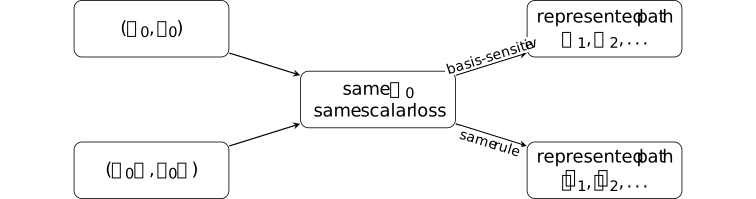
The right-hand split is possible only because the centre box omits the factor basis and optimizer geometry. An FTIP admissible protocol in Definition [ftip-005J] must retain those intervention coordinates when they affect the executable result.
Remark 8. Product symmetry and the scope of optimizer conclusions [ftip-00C0]AGENTDRAFTED
Remark 8. Product symmetry and the scope of optimizer conclusions [ftip-00C0]AGENTDRAFTED
The relevant optimizer results appear in version 1 of [⧉], submitted 5 August 2026: Sections 3--4 and 6, Appendices B.1--B.6 and B.9, with limitations in Section 11.
The full product symmetry acts on the factors by
\[ (U,V)\longmapsto (UA,VA^{-\mathsf T}). \]It does not use \((UA,VA)\). For row-vector attention weights, the corresponding action uses right multiplication, as in Example 5.
The general rectangular preconditioner representation need not have the square-case uniqueness. A probability-one full-rank claim additionally needs a law for the gradient; a generic full-rank observation does not specify one.
The coordinatewise theorem is a zero-state, memoryless obstruction. The clock theorem is continuous-time and excludes scalar-Adam's momentum. Experimental optimizer and attention results remain observations reported by the source. Equivariance is not identified with low-rank recovery.
Remark 9. Continuous-flow conclusions and discrete optimization [ftip-00C1]AGENTDRAFTED
Remark 9. Continuous-flow conclusions and discrete optimization [ftip-00C1]AGENTDRAFTED
The factored-model results prove that update geometry can be a genuine intervention coordinate even when objective and represented initialization are fixed. They do not prove transformer or RLVR convergence, practical optimizer superiority, a scaling law, or any change in reliable capability. Different represented trajectories are not by themselves an acquisition witness of Definition [ftip-005X].
The memoryless theorem does not describe Adam's full state, and the continuous-flow result does not supply discrete rates or finite-step bounds. The source also notes that fixed-rank LoRA changes the learned-rank mechanism; no LoRA transfer is made here.
A dynamic-compute comparison also depends on active research state, persistent harness state, retained history, evaluation configuration, and descendant and retry costs. One realized chain and an archive-best envelope are different outcomes, even at the same declared budget.