Definition. Components of a split endomorphism [fdip-001T]
AGENTDRAFTED
To eliminate part of a field, first choose which part is retained.
Let \(R\) be a commutative unital ring and
\(M,X,Y\) unital \(R\)-modules. A
chosen binary splitting of \(M\) consists of ordinary
\(R\)-linear maps
\[\iota _X:X\to M,\quad \iota _Y:Y\to M,\qquad
\pi _X:M\to X,\quad \pi _Y:M\to Y\]
satisfying all 5 identities
\[\begin {aligned}
\pi _X\iota _X&=I_X,&\pi _Y\iota _Y&=I_Y,\\
\pi _X\iota _Y&=0,&\pi _Y\iota _X&=0,\\
\iota _X\pi _X+\iota _Y\pi _Y&=I_M.
\end {aligned}\]
Products apply the right factor first, as in
composition and field multiplication.
The maps \((x,y)\mapsto \iota _Xx+\iota _Yy\) and
\(z\mapsto (\pi _Xz,\pi _Yz)\) are inverse linear maps by these identities.
We consequently write \(M=X\oplus Y\) and \(z=(x,y)\) relative to
this chosen identification.
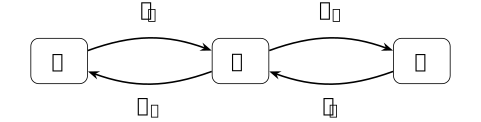
Each summand is included in \(M\) and recovered by its projection.
The composite \(\pi _X\iota _X\) is \(I_X\), whereas
\(\iota _X\pi _X\) is an endomorphism of \(M\). In the
partition realization, these are restriction and
extension by zero; the latter composite is the support projection.
For an endomorphism \(Q:M\to M\), its
components for the chosen splitting are
\[\begin {aligned}
A&=\pi _XQ\iota _X:X\to X,&B&=\pi _XQ\iota _Y:Y\to X,\\
E&=\pi _YQ\iota _X:X\to Y,&C&=\pi _YQ\iota _Y:Y\to Y.
\end {aligned}\]
Inserting \(I_M=\iota _X\pi _X+\iota _Y\pi _Y\) gives
\[Q(x,y)=(Ax+By,Ex+Cy).\]
If the eliminated component \(C\) is an
isomorphism, define the
split Schur map, relative to this splitting and pivot, by
\[S=A-BC^{-1}E:X\longrightarrow X.\]
Changing the splitting or the pivot changes the construction.
The module convention is
[stacks2017stacks, Section 10.10], Tag 0581.
Mathlib's CategoryTheory.Biprod.ofComponents gives
components in a preadditive category with binary biproducts.
Its arguments index source then target; after ordering summands
\((Y,X)\), the arguments corresponding to \(Q\) are \((C,B,E,A)\).
[boyd2004convex, Appendix A.5.5, pp. 650-651] treats the real
Schur complement.
The source eliminates its first block: exchanging its variables to
\((y,x)\) makes its block order \((C,E,B,A)\) and its residual
\(A-BC^{-1}E\). The chosen-splitting definition above uses only linear
maps; it does not assume a basis, pairing or positivity.
The ring elimination example computes the components
and Schur map for a concrete chosen splitting.