Theorem. Exterior pairings determine compact spinor reality [fcap-0041]
AGENTDRAFTED
Let \(W=\mathbb C^m\), \(m\geq 1\), with ordered basis
\(e_1,\ldots ,e_m\), and use the exterior action on \(S=\bigwedge W\)
from Theorem [fcap-002V]. Write \([u]_{\mathrm {top}}\) for the coefficient
of \(e_1\wedge \cdots \wedge e_m\), and let \(r\) reverse exterior products:
\(r|_{\wedge ^kW}=(-1)^{k(k-1)/2}\). Then
\[B(s,t)=[r(s)\wedge t]_{\mathrm {top}},\qquad
B(t,s)=\epsilon _e B(s,t),\qquad
\epsilon _e=(-1)^{m(m-1)/2}\]
defines a nondegenerate complex bilinear Spin-invariant form in dimension
\(2m\). It pairs complementary degrees. Hence for even \(m\) it restricts
nondegenerately to each half-spin module; for odd \(m\) it pairs the two
halves perfectly and vanishes on either half alone. In dimension \(2m+1\),
use the odd action Proposition [fcap-002W] and the adjusted form
\[B_o(s,t)=B(\alpha ^m s,t),\qquad
B_o(t,s)=\epsilon _o B_o(s,t),\qquad
\epsilon _o=(-1)^{m(m+1)/2},\]
where \(\alpha |_{\wedge ^kW}=(-1)^k\). This form is again nondegenerate
and Spin-invariant.
In the exterior basis the matrix of \(B\) has one entry \(\pm 1\)
in each row and column, pairing an index set with its complement; this
proves nondegeneracy. The underlying perfect wedge pairing has the formal
counterpart
exteriorPower.instIsPerfPairWedgePairing,
for complementary exterior powers of a finite free module over a
commutative ring with a chosen top-degree trivialization. Reversal supplies
the additional signs here. For degrees \(k\) and \(m-k\), commuting the
two wedge factors and comparing their reversal signs gives
\(\epsilon _e\). Also
\(B(\alpha s,t)=(-1)^mB(s,\alpha t)\), proving the stated odd flip sign.
Every creation and contraction operator is self-adjoint for \(B\):
\[B(c_i s,t)=B(s,c_i t),\qquad B(a_i s,t)=B(s,a_i t).\]
For creation, \(r(e_i\wedge s)=r(s)\wedge e_i\). For contraction on
degree \(k\), \(r(a_i s)=(-1)^{k-1}a_i r(s)\). Apply the contraction
derivation rule to \(r(s)\wedge t=0\) in degree \(m+1\); its two terms
give the second identity. All other degree combinations vanish on both
sides. Thus
\(B(\rho (x)s,t)=B(s,\rho (\operatorname {rev}x)t)\).
The reverse-norm-one condition in Remark [fcap-0028] proves invariance
under the actual Spin group. For \(B_o\), every hyperbolic vector has
adjoint sign \((-1)^m\), because it anticommutes with \(\alpha \); the
extra generator \(\alpha \) has the same sign. These signs cancel on
even words, giving the same reversion identity and Spin invariance.
These bilinear forms also determine conjugate-linear structures
for the compact real form \(\operatorname {Spin}(n,0)\), where \(n=2m\) or \(2m+1\).
Give \(S\) the positive Hermitian form
\(H(s,t)=\overline {s}^{\,T}t\) in the exterior basis, conjugate-linear
in its first argument. The operators
\(c_i+a_i\), \(i(c_i-a_i)\), and, in odd dimension, \(\alpha \),
are self-adjoint, square to \(1\), and anticommute pairwise. They realize
the positive real Clifford generators. Consequently reversion is
Hermitian adjunction on this real algebra, and \(H\) is Spin-invariant.
Let \(M\) be the real signed permutation matrix of \(B\) or \(B_o\),
and let \(\epsilon \) be its flip sign. Then
\[J(s)=M^T\overline {s},\qquad
H(Js,t)=s^TMt,\qquad J^2=\epsilon \,1.\]
Indeed, \(M^T=\epsilon M\) and \(MM^T=1\). Invariance of both forms
and nondegeneracy of \(H\) imply that \(J\) commutes with compact Spin.
Writing \(\mathcal B\) for the chosen bilinear form, the comparison is
the following commuting triangle of complex linear maps:
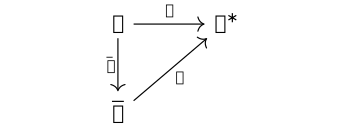 Here \(\beta (s)=\mathcal B(s,-)\), \(\overline J(s)=\overline {Js}\),
and \(\eta (\overline u)=H(u,-)\); \(\overline S\) is the conjugate
complex vector space, and \(S^*\) is the complex linear dual of \(S\).
Here \(\beta (s)=\mathcal B(s,-)\), \(\overline J(s)=\overline {Js}\),
and \(\eta (\overline u)=H(u,-)\); \(\overline S\) is the conjugate
complex vector space, and \(S^*\) is the complex linear dual of \(S\).For \(\epsilon =1\), \(J\) is a real structure as in
Example [fcap-003W], and its fixed vectors form a real Spin module whose
complexification is \(S\)
Representation.IsRealStructure.isRealForm. Explicitly,
\[s=\frac {s+Js}{2}+i\frac {s-Js}{2i},\]
with both displayed components fixed by \(J\). For \(\epsilon =-1\),
\(J\) is a quaternionic structure: a conjugate-linear equivariant
map squaring to \(-1\)
Representation.IsQuaternionicStructure.
It has no nonzero fixed vector; together with multiplication by \(i\)
it gives the quaternion relations on the underlying real space.
To apply this to irreducible compact spinors, the restriction to
Spin needs justification. Every even monomial in an orthonormal positive
real Clifford basis has reverse norm one and lies in Spin. Such monomials
span the real even algebra, hence their complex span is the complex even
algebra. Therefore the block descriptions in Theorem [fcap-002V] and
Proposition [fcap-002W] give irreducible compact half-spin modules in even
dimension and an irreducible compact spin module in odd dimension.
The even-dimensional halves are inequivalent because their two matrix
blocks have different central supports.
In even dimension \(n=2m\), \(J\) preserves each half when \(m\) is
even and exchanges them when \(m\) is odd. In the latter case no
equivariant conjugate-linear bijection of one half to itself can exist:
composing it with \(J\) would give a
complex linear equivalence between the inequivalent halves. Thus the
compact types follow directly from the two flip signs:
\[\begin {array}{c|c}
n\bmod 8&\text {type of an irreducible complex spinor}\\\hline
0,1,7&\text {real}\\
3,4,5&\text {quaternionic}\\
2,6&\text {two conjugate, inequivalent half-spin modules}
\end {array}\]
In the even rows the statement applies to each half-spin module.
The general passage from an invariant nondegenerate complex bilinear
form, symmetric or alternating, and a supplied positive definite
invariant Hermitian form to a real or quaternionic structure is
formalized, for finite-dimensional
irreducible complex representations, by
Representation.exists_isRealStructure_of_isInvariantForm_of_isInvariantSesqForm
and
Representation.exists_isQuaternionicStructure_of_isInvariantForm_of_isInvariantSesqForm.
The explicit \(M\), odd adjustment, and compact residue calculation
are the exterior-basis proof above.
The reversal pairing and its covariance are
[meinrenken2013clifford, Section 3.4, Definition 3.6, Example 3.5, and Proposition 3.14,
pp. 66--67].
The compact reality classification agrees with
[lawson2016spin, Chapter I, items 5.12--5.16, pp. 35--37].
Their negative-square Clifford convention is translated in
Proposition [fcap-0042]. The positive Hermitian argument here is specific to
the compact real form; it does not assign the same types to other signatures.
Definition [ca-000J]Definition [ca-0012]