Example. One ordinary cube face turn [frap-000P]
AGENTDRAFTED
Realize the cube as \([-1,1]^3\) and let \(H\) be the facet \(z=1\).
The facet move construction of
[marchetti2025rubik, Definitions 5--6] gives the following explicit
outer-face action. The shape rotation
\[q(x,y,z)=(y,-x,z)\]is a clockwise quarter-turn when viewed from positive \(z\), with
\(x\) rightward and \(y\) upward. Its restriction to \(H\) supplies our move.
The corner \((1,1,1)\) goes to \((1,-1,1)\), and its color on \(y=1\)
goes to the color position on \(x=1\). The corresponding corner at
\(z=-1\) is fixed by the puzzle move, although the global map \(q\) moves it.
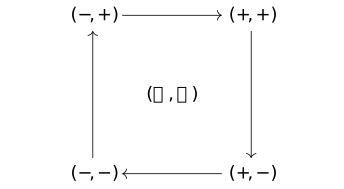
The signs give the \(x,y\) coordinates of the four corners on \(z=1\).
The arrows show their clockwise motion; the central incidence record
\((H,H)\) stays fixed. No orientation of a marked center is recorded.
Restricting the second entry to facets gives
\(8\cdot 3+12\cdot 2+6=54\) incidence positions: three per corner,
two per edge and one per face center. The turn moves twelve corner
stickers and eight edge stickers, fixing the other thirty-four positions,
including the unmarked center of the turned face. This is the usual
outer-face action on visible stickers of a \(3\times 3\times 3\) cube in
a fixed frame.
The full incidence set has \(8\cdot 7+12\cdot 3+6=98\) elements:
above each vertex are that vertex, three edges and three facets;
above each edge are itself and two facets. The facet-colored subset is
invariant under every move. Its restricted action supplies the comparison
with ordinary stickers; a faithful restriction for all abstract polytopes
is not needed. Marked center orientations and inner-layer turns are
additional data, absent from this comparison.