Training and evaluation confounds [ftip-00DO]
✍️sourceAGENTDRAFTED
Training and evaluation confounds [ftip-00DO]
✍️sourceAGENTDRAFTED
A retained-context comparison can alter both inference and training. Attribution to either mechanism depends on the joint intervention and the coordinates held fixed by a matched evaluation.
Definition 1. Joint intervention cell [ftip-00DP]AGENTDRAFTED
Definition 1. Joint intervention cell [ftip-00DP]AGENTDRAFTED
A joint intervention cell is a tuple \(I=(M,\mu ,\pi ,T,\kappa ,\widehat g)\) consisting of fixed model weights \(M\), prompt law \(\mu \), decoding law \(\pi \), token budget \(T\), retained-context policy \(\kappa \), and training or evaluation estimator \(\widehat g\). Two cells differ in a declared coordinate only when all other coordinates are held fixed.
Definition 2. Estimator-changing training coordinate [ftip-00DQ]AGENTDRAFTED
Definition 2. Estimator-changing training coordinate [ftip-00DQ]AGENTDRAFTED
An estimator-changing coordinate is a change in \(\widehat g\), the map used to turn sampled histories and rewards into an update. A context mask can change this coordinate when it changes which tokens contribute to the sampled loss or gradient. The notation does not assume a particular optimizer.
Remark 3. Training masks change more than attention cost [ftip-00DR]AGENTDRAFTED
Remark 3. Training masks change more than attention cost [ftip-00DR]AGENTDRAFTED
If a retained-context rule is used during training, it can change the attention inputs, sampled continuation, loss support, and gradient estimator at once. A lower value of Definition [ftip-00DJ] is therefore not an isolated compute intervention unless the training estimator and all other coordinates are matched explicitly.
Example 4. Equal terminal score, different trajectory exposure [ftip-00DS]AGENTDRAFTED
Example 4. Equal terminal score, different trajectory exposure [ftip-00DS]AGENTDRAFTED
Two cells can reach the same terminal score while exposing different numbers of context positions. This finite counterexample blocks an inference from equal endpoint score to equal trajectory cost.
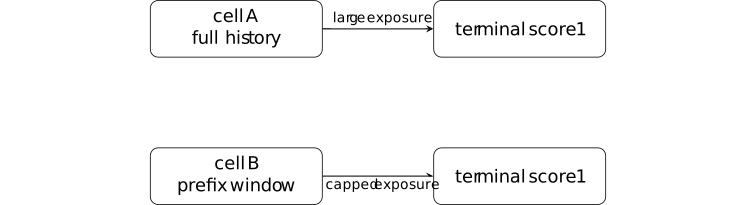
The score equality is compatible with unequal intermediate histories and unequal exposure counts.
Remark 5. What a retained-context comparison can identify [ftip-00DT]AGENTDRAFTED
Remark 5. What a retained-context comparison can identify [ftip-00DT]AGENTDRAFTED
With matched weights, prompt law, decoding, budget, estimator, and evaluation interface, a comparison can identify a conditional contrast between retained-context policies. Without those controls it identifies only the joint cell, not a causal effect of context alone.
Definition 6. Retained-context evaluation protocol [ftip-00DU]AGENTDRAFTED
Definition 6. Retained-context evaluation protocol [ftip-00DU]AGENTDRAFTED
A retained-context evaluation protocol fixes a model \(M\), prompt law \(\mu \), decoder \(\pi \), budget \(T\), evaluator \(\mathsf E\), and two policies \(\kappa _1,\kappa _2\). It reports the paired outcomes under the same sampled prompts and declared randomization coupling, together with exposure counts from Definition [ftip-00DJ].
Lemma 7. Matched protocols isolate a conditional policy contrast [ftip-00DV]AGENTDRAFTED
Lemma 7. Matched protocols isolate a conditional policy contrast [ftip-00DV]AGENTDRAFTED
Let \(m\in \mathbb N_{\geq 1}\) and let \(Y_{1j},Y_{2j}\in \mathbb R\) for \(j=1,\ldots ,m\) be the paired scalar evaluator outcomes generated by the protocol of Definition 6. Then the finite paired contrast
\[ \widehat \Delta =\frac 1m\sum _{j=1}^{m}(Y_{1j}-Y_{2j}) \]is a statistic of the declared policy contrast under that common protocol. It is not an unconditional capability effect and does not identify what would happen after changing any held-fixed coordinate.
Remark 8. Separating horizon, cache, and estimator effects [ftip-00DW]AGENTDRAFTED
Remark 8. Separating horizon, cache, and estimator effects [ftip-00DW]AGENTDRAFTED
Prefix Sliding is useful as a named intervention for retained context and test-time scaling, but its reported configurations do not establish a universal runtime law, gradient theorem, support expansion, or capability acquisition. The next questions are to measure horizon, cache, estimator, and evaluation effects separately, while preserving the controls in Definition 6.
The finite conclusions depend on the declared protocols. They do not describe a full optimizer or establish a result for all language models.