Transfer and local orientation [frap-0012]
✍️sourceAGENTDRAFTED
Transfer and local orientation [frap-0012]
✍️sourceAGENTDRAFTED
Left multiplication permutes the cosets of a finite-index subgroup. Representatives record the motion between cosets, leaving one residual subgroup element at each position. Abelianizing their product gives transfer [mayer2015artin, Sections 3.1--3.3]. Transported frames then identify its local image with the total-orientation character of an action.
Theorem 1. Finite-index transfer [frap-000W]
Theorem 1. Finite-index transfer [frap-000W]
Let \(H\leq G\) have finite index. Choose representatives \(r_i\) for the left cosets \(r_iH\), indexed bijectively by a finite set \(I\). For \(g\in G\), left multiplication permutes the cosets, so uniquely write
\[g r_i=r_{\pi _g(i)}h_i(g),\qquad h_i(g)\in H.\]Write \(H_{\mathrm {ab}}=H/[H,H]\) and \([h]\) for the class of \(h\in H\). The abelianization is the target of the transfer
\[T_{G,H}:G\longrightarrow H_{\mathrm {ab}},\qquad T_{G,H}(g)=\prod _{i\in I}[h_i(g)]\]is a homomorphism independent of the chosen representatives. This is the left-coset construction of [mayer2015artin, Definition 3.1, Proposition 3.1 and Theorem 3.1, pp. 4--6]. Neither finiteness of \(G\) nor normality of \(H\) is required.
Proof.
Proof.
We compose left actions rightmost first. Multiplication on cosets gives \(\pi _{gk}=\pi _g\pi _k\). Expanding \(gkr_i\) in two steps yields
\[h_i(gk)=h_{\pi _k(i)}(g)h_i(k).\]Taking classes and multiplying over \(i\) gives \(T_{G,H}(gk)=T_{G,H}(g)T_{G,H}(k)\), because \(\pi _k\) reorders the first factors. Replace \(r_i\) by \(r_i t_i\), with \(t_i\in H\). The new residual factor is \(t_{\pi _g(i)}^{-1}h_i(g)t_i\). Its total class contains each \([t_i]\) and its inverse exactly once, so they cancel. Reindexing the cosets also only reorders an abelian product. This proves independence of all choices.
The linked transfer definitions specialize the homomorphism \(\phi :H\to A\) to the quotient \(H\to H_{\mathrm {ab}}\). The indexed formula takes \(f(i)=r_i\) and \(\pi =\pi _g\); its factor \(r_{\pi _g(i)}^{-1}g r_i\) is precisely \(h_i(g)\). Its finite-index instance follows from the finite bijective family of cosets.
Proposition 2. Transfer computes total local orientation [frap-000X]AGENTDRAFTED
Proposition 2. Transfer computes total local orientation [frap-000X]AGENTDRAFTED
Let \(G\) act transitively on a finite nonempty position set \(I\), and on a tagged union of fibers \(X_i\), carrying \(X_i\) bijectively to \(X_{g i}\). Fix \(i_0\in I\) and put \(H=G_{i_0}\). Let \(K\) act faithfully on a nonempty set \(\Omega \); choose a bijective base frame \(c_0:\Omega \to X_{i_0}\) and a homomorphism \(\rho :H\to K\) satisfying \(h c_0=c_0\rho (h)\) for every \(h\in H\). Choose \(r_i\in G\) with \(r_i i_0=i\), and set \(c_i=r_i c_0\). Then the total-orientation character of this framed transport is
\[\chi =\rho _{\mathrm {ab}}\circ T_{G,H}:G\longrightarrow K_{\mathrm {ab}},\]where \(T_{G,H}\) is transfer and \(\rho _{\mathrm {ab}}([h])=[\rho (h)]\). This identifies the coset construction in [mayer2015artin, Section 3.3, p. 6] with the local-frame coordinates of [marchetti2025rubik, Section 3.1, pp. 6--7].
Proof.
Proof.
The map \(G/H\to I\), \(rH\mapsto r i_0\), is a bijection: \(r i_0=s i_0\) exactly when \(s^{-1}r\in H\). Thus \(H\) has finite index \(|I|\), and the \(r_i\) are left-coset representatives. Write \(\pi _g(i)=g i\) and \(g r_i=r_{\pi _g(i)}h_i(g)\). Then
\[g c_i=g r_i c_0=r_{\pi _g(i)}h_i(g)c_0 =c_{\pi _g(i)}\rho (h_i(g)).\]Consequently every local factor belongs to \(K\), and its source-indexed coordinate is \(a_i(g)=\rho (h_i(g))\). A homomorphism sends commutators to commutators, so \(\rho _{\mathrm {ab}}\) is well defined. Multiplying the local classes gives
\[\chi (g)=\prod _i[\rho (h_i(g))] =\rho _{\mathrm {ab}}\left (\prod _i[h_i(g)]\right ).\]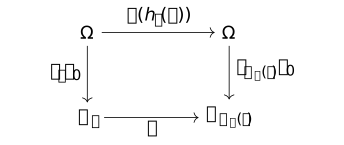
The vertical arrows are the transported frames. The equality \(g r_i=r_{\pi _g(i)}h_i(g)\) makes the square commute: after the destination representative is removed, the remaining motion fixes \(i_0\) and acts through \(\rho \). Changing representatives changes these frames within \(K\), so the character is unchanged.
The induced map is Abelianization.map. Naturality of
transfer is MonoidHom.transfer_comp, with
\(\phi :H\to H_{\mathrm {ab}}\) the quotient map and the target map
\(\rho _{\mathrm {ab}}\). That algebraic identity supports the last
equality; the identification with the actual fiber action is the
transported-frame argument above.
Example 3. Corner and edge stabilizers of the cube [frap-000Y]AGENTDRAFTED
Example 3. Corner and edge stabilizers of the cube [frap-000Y]AGENTDRAFTED
Let \(G\) be the actual permutation group generated by the six outer-face quarter-turns of the ordinary cube, with its frame of reference fixed. Use the corner and edge fibers: cyclic corner labels with local group \(C_3\), and edge labels with local group \(C_2\). This specializes the local-orientation construction of [marchetti2025rubik, Section 3.1]; the orbit argument below identifies the stabilizers needed for transfer.
The action on eight corner positions is transitive. Adjacent corners share a face whose quarter-turn takes one to the other, and the cube's edge graph is connected. Hence a corner stabilizer \(H_c\) has index eight. Its action on the three cyclically ordered labels gives a homomorphism \(\rho _c:H_c\to C_3\). The action on twelve edge positions is also transitive: the four edges of one face form a single orbit under its quarter-turn; neighboring faces share an edge; and the face-adjacency graph is connected. Thus an edge stabilizer \(H_e\) has index twelve, with local action \(\rho _e:H_e\to C_2\).
Choose a frame at the fixed corner or edge and transport it using coset representatives. The transfer comparison gives
\[\chi _c=(\rho _c)_{\mathrm {ab}}\circ T_{G,H_c},\qquad \chi _e=(\rho _e)_{\mathrm {ab}}\circ T_{G,H_e}.\]We identify the abelianizations of \(C_3\) and \(C_2\) with those groups. The face-turn calculation proves that the twist and flip characters vanish on every legal generator, hence on \(G\). It follows that these two local images of transfer vanish. It does not follow that \(T_{G,H_c}\) or \(T_{G,H_e}\) is trivial in the larger stabilizer abelianizations. No classification of \(G\) was needed.