The compatibility test as a definition [fdip-009Y]
✍️sourceAGENTDRAFTED
- November 2, 2026
The compatibility test as a definition [fdip-009Y]
✍️sourceAGENTDRAFTED
- November 2, 2026
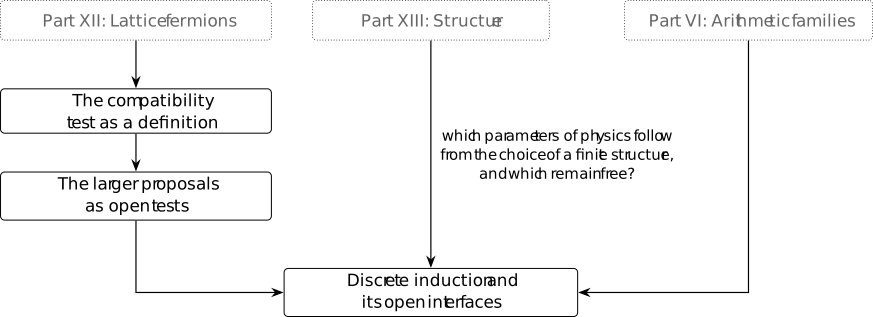
Which declared group, representation, selector and comparison fit together, and which proposed correspondences are still missing? A finite symmetry can act on a spinor, on a rotation space, or on values at the vertices. Those actions are different data.
The test uses the representation datum, the binary tetrahedral quotient and its two fibers, the central idempotent of the real group algebra of \(2T\), and the separation of spinor and internal factors in the covariant Dirac operator. The identities proved here do not use the structure questions.
A compatibility datum names the group, the coefficient field, the representation, the action on the finite graph, the selector and one reference comparison. Then 5 criteria say what has been proved, what is only conditional, and what is open. The worked case is the binary tetrahedral spinor. Correspondences for the larger classical groups are not constructed. They are recorded as open tests.
Definition 1. A five-part compatibility datum [fdip-009Z]AGENTDRAFTED
- November 2, 2026
Definition 1. A five-part compatibility datum [fdip-009Z]AGENTDRAFTED
- November 2, 2026
A compatibility datum is a tuple \[(G,\mathbb K,\rho ,\alpha ,\sigma ,C).\] Here \(G\) is a group, \(\mathbb K\in \{\mathbb R,\mathbb C\}\) is its coefficient field, and \(\rho :G\to GL_{\mathbb K}(F)\) is a finite-dimensional representation on a fiber \(F\). The map \(\alpha \) is an action of \(G\) on a finite graph substrate, in the sense of a representation datum. The selector \(\sigma \) is an idempotent in a declared algebra of operators on \(F\), or on a finite direct sum of such fibers. The reference comparison \(C\) is a stated homomorphism, quotient, or numerical identification against one named object. The coefficient field is scalar data for \(F\). It is not a residual gauge group. When \(\mathbb K=\mathbb R\), a complex representation enters only after realification, as a real representation on the underlying real vector space. A direct sum of that real fiber with another real fiber is then one real representation.
The datum is tested against 5 criteria.
- Exactness. The group, the field, the representation and the substrate action are all specified. An inclusion into a matrix group is not a substitute for the missing slot.
- Declared maps. Each comparison with a Dirac, Lorentz, gauge or gravitational structure names the homomorphism, kernel, cover or branching rule that is actually used.
- Separation. A spinor or Dirac action is identified with a gravitational action only when a separate compatibility law is proved. Sharing a name, or an inclusion into \(SU(2)\), is not that law.
- Selector effect. The selector is given, and there is a proof of the change it makes to the operator or parameter named in the datum.
- Reference recovery. The comparison names the ordinary object recovered in the chosen reference sector, or it records that the datum claims no such recovery.
For a fixed datum, each criterion is marked proved, conditional or open. Proved means the finite obligation stated in that criterion is established. Conditional means a stated part is established and the complementary part is unresolved. Open means the required map or recovery is not constructed. An open mark records that absence. It is not a theorem that no later construction exists.
Proposition 2. Finite identities for the binary tetrahedral spinor [fdip-00A0]AGENTDRAFTED
- November 2, 2026
Proposition 2. Finite identities for the binary tetrahedral spinor [fdip-00A0]AGENTDRAFTED
- November 2, 2026
Let \(2T\) be the group of 24 Hurwitz units in the binary tetrahedral quotient. In this model the central group element is the quaternion \(-1\). The distinguished central involution of the abstract group is the preimage of that quaternion under the comparison isomorphism, not the quaternion itself. Let \(\pi :SU(2)\to SO(3)\) be the conjugation homomorphism of Proposition [fdip-007G], and write \(R_T=\pi (2T)\). Let \(\rho _s\) be the defining representation on \(\mathbb C^2\) through the matrix map \(M\) of the same statement, and let \(\tau \) be the three-dimensional representation on \(\operatorname {span}_{\mathbb R}\{i,j,k\}\) given by \(\tau (q)v=qvq^{-1}\). Both are the fibers of the two-fiber example. The substrate action \(\alpha \) is trivial. On the sum \(F=\mathbb C^2\oplus \mathbb R^3\), with \(\rho =\rho _s\oplus \tau \), the selector \(\sigma \) of the compatibility datum is the idempotent \[P=\frac {I-\rho (-1)}2.\] The abstract involution \(z\) maps to the quaternion \(-1\), so \(P\) is the image of the central idempotent \(e_-=(1_A-[z])/2\) under \(\rho \). That idempotent is the one in the real group algebra. The reference comparison \(C\) is the pair of homomorphisms \(\pi :SU(2)\to SO(3)\) and the vertex identification \(R_T\cong A_4\) proved below.
Then \(\ker (\pi |_{2T})=\{1,-1\}\), the vertex action induces \(R_T\cong A_4\), and \[P=I_2\oplus 0.\] Left multiplication by the quaternion \(-1\) is \(-1\) on the quaternion module, so that module is fixed by \(e_-\) and annihilated by \(e_+=(1_A+[z])/2\). The products of the \(d=3\) Clifford matrices of the spatial Dirac operator reproduce the quaternion multiplication table. None of these identities supplies a covariance law for that Dirac operator.
Proof.
- November 2, 2026
Proof.
- November 2, 2026
The kernel statement is the restriction of \(\ker \pi =\{1,-1\}\) from Proposition [fdip-007G]. The same source identifies \(2T\) with the full preimage \(\pi ^{-1}(R_T)\) and gives \(|R_T|=12\). The matrix \(M(-1)=-I_2\), so \(\rho _s(-1)=-I_2\). Conjugation by the quaternion \(-1\) is the identity, so \(\tau (-1)=I_3\). Therefore \[P=I_2\oplus 0.\] On the quaternion module, left multiplication by the quaternion \(-1\) is \(-1\), so that module's algebra action sends \(e_-\) to \(1\) and \(e_+\) to \(0\). The abstract involution maps to that quaternion, and \(\rho =\rho _s\oplus \tau \), so \[\rho (z)=-I_2\oplus I_3.\] Hence \(\rho (e_-)=(I-\rho (z))/2=P\), while \[\rho (e_+)=(I+\rho (z))/2=0\oplus I_3.\] The scalar \(0\) is the quaternion-module action of \(e_+\), not this operator.
Label the 4 imaginary vectors of Proposition [fdip-007G] by \[v_1=(1,1,1),\; v_2=(1,-1,-1),\; v_3=(-1,1,-1),\; v_4=(-1,-1,1).\] Their differences \[v_2-v_1=(0,-2,-2),\; v_3-v_1=(-2,0,-2),\; v_4-v_1=(-2,-2,0)\] are linearly independent: after removing the common factor \(-2\), the determinant of \[\begin {pmatrix}0&1&1\\1&0&1\\1&1&0\end {pmatrix}\] equals \(2\). A rotation fixing all 4 vertices therefore fixes a basis of \(\mathbb R^3\) and is the identity. The vertex action gives an injective homomorphism \(R_T\to S_4\).
Conjugation by \(i\) is the coordinate map \((x,y,z)\mapsto (x,-y,-z)\). Indeed, for \(v=xi+yj+zk\), \[iv=(-x)+(yk-zj),\qquad (iv)(-i)=xi-yj-zk,\] where the last step uses \(ji=-k\) and \(ki=j\). The same expansion with cycled units gives \[j:(x,y,z)\mapsto (-x,y,-z),\qquad k:(x,y,z)\mapsto (-x,-y,z).\] On the 4 vertices these are the permutations \[(1\;2)(3\;4),\qquad (1\;3)(2\;4),\qquad (1\;4)(2\;3).\] Each is even. Let \(u=-1+i+j+k\) and \(\omega =u/2\in 2T\). Direct multiplication yields \[\begin {array}{c|c} v&uv\overline u/4\\\hline v_1&v_1\\ v_2&v_4\\ v_3&v_2\\ v_4&v_3 \end {array}\] so \(\pi (\omega )\) fixes \(v_1\) and acts by the cycle \((2\;4\;3)\). This cycle is even. Conjugation by it permutes the three double transpositions: \[\begin {aligned} (2\;4\;3)(1\;2)(3\;4)(2\;4\;3)^{-1}&=(1\;4)(2\;3),\\ (2\;4\;3)(1\;4)(2\;3)(2\;4\;3)^{-1}&=(1\;3)(2\;4),\\ (2\;4\;3)(1\;3)(2\;4)(2\;4\;3)^{-1}&=(1\;2)(3\;4). \end {aligned}\] The cycle has order \(3\), while every non-identity element of that Klein subgroup has order \(2\), so the two subgroups meet only at the identity. These 12 permutations are the vertex permutations of products in \(R_T\). They are distinct, and \(|R_T|=12\), so they exhaust the vertex image. All 12 are even. Combined with injectivity, the vertex map is an isomorphism \(R_T\cong A_4\). The composite \(2T\to R_T\to A_4\) has kernel \(\{1,-1\}\).
For the \(d=3\) matrices of Definition [fdip-000R], \(\gamma _a^2=I\) and \(\gamma _a\gamma _b=-\gamma _b\gamma _a\) whenever \(a\ne b\). Set \[I\mapsto 1,\quad \gamma _1\gamma _2\mapsto i,\quad \gamma _2\gamma _3\mapsto j,\quad \gamma _1\gamma _3\mapsto k.\] Then \[(\gamma _1\gamma _2)^2=-\gamma _1^2\gamma _2^2=-I,\] and the same sign occurs for the other two products. Also \[(\gamma _1\gamma _2)(\gamma _2\gamma _3)=\gamma _1\gamma _3,\] and the two cyclic products match \(jk=i\) and \(ki=j\). These are the quaternion relations. They identify an action of the same abstract group on the even products. They do not state an intertwiner between left multiplication and the spatial operator \(\sum _j\gamma _j\nabla _j\).
Proposition 3. Status of the five criteria [fdip-00A1]AGENTDRAFTED
- November 2, 2026
Proposition 3. Status of the five criteria [fdip-00A1]AGENTDRAFTED
- November 2, 2026
For the binary tetrahedral datum of the finite spinor identities, the 5 criteria of the compatibility datum have the following status. Exactness, the selector effect and reference recovery are proved. The declared maps and the spinor separation are conditional. The unresolved part of the declared maps is the absence of the larger classical correspondences. That absence is not a nonexistence theorem.
The worked test in the background plan was left multiplication of \(2T\) on the spinor module \(\mathbb H\) of \(Cl^+(3)\). The test published in Proposition 2 is \(\rho _s\oplus \tau \) on \(\mathbb C^2\oplus \mathbb R^3\). Left multiplication on \(\mathbb H\cong \mathbb R^4\) is the realification of \(\rho _s\). The rotation summand \(\tau \) is additional.
Proof.
- November 2, 2026
Proof.
- November 2, 2026
Exactness is proved. The group is the Hurwitz model of \(2T\), and the coefficient field is \(\mathbb R\). The spinor fiber \(\mathbb C^2\) is realified as \(\mathbb R^4\), and the rotation fiber is \(\mathbb R^3\), so \(T(g)=\rho _s^{\mathbb R}(g)\oplus \tau (g)\) lies in \(GL_7(\mathbb R)\). Realification carries \(\rho _s(-1)=-I_2\) to \(-I_4\), and \(\tau (-1)=I_3\), so \(T(-1)=-I_4\oplus I_3\). The complex block form \(P=I_2\oplus 0\) in Proposition 2 realifies to \(I_4\oplus 0\). The graph action is the trivial action declared with these representations.
The declared maps are conditional. The two maps that are constructed are \(\pi :SU(2)\to SO(3)\) with kernel \(\{1,-1\}\), and \(2T\to A_4\) with the same kernel. Both are the finite identities of Proposition 2. No homomorphism, kernel, cover or branching rule is constructed here for \(Sp(3,1)\), \(SU(3,1)\), \(SU(3,2)\), \(SL(4,\mathbb R)\), or a Hessian extension. Those comparisons remain open. Their absence is not a nonexistence theorem.
Separation is conditional. The spinor representation sends the quaternion \(-1\) to \(-I_2\), while the rotation representation sends it to \(I_3\). The representation datum already separates an internal factor \(1\otimes \rho \) from an action on the spinor factor, and the covariant Dirac operator requires Clifford compatibility before a binary rotation group can act as a gauge transformation. The quaternion multiplication table of Proposition 2 does not provide that compatibility law. The gravitational comparison available here is only the quotient \(SU(2)\to SO(3)\). A larger gravitational identification is unresolved.
The selector effect is proved for the operator named in the datum. With \(P=I_4\oplus 0\) the realified selector, \[PT(g)P=\rho _s^{\mathbb R}(g)\oplus 0.\] This is the block identity for that projection: it retains the realified spinor block and removes the rotation block. The same idempotent is not a link variable of the covariant Dirac operator, so this identity makes no claim about the kernel of that operator.
Reference recovery is proved for the declared comparison \(C\). That comparison is \(\tau :2T\to A_4\subset SO(3)\), the tetrahedral rotation representation. The kernel is \(\{1,-1\}\) and the image has order \(12\), as proved in Proposition 2. The spinor fiber does not factor through that quotient. That caveat is stated under separation, above. It does not leave the recovery of this rotation representation unproved. The datum claims no lattice measure, continuum quantum field, or laboratory observable beyond this finite rotation representation.