Example. Short periods add winding terms [fdip-0073]
Example. Short periods add winding terms [fdip-0073]
Start with all links equal to one on an \(L\times L\) square torus, then change one horizontal link to minus one. Keep the real scalar convention, \(D=4+m^2\), and write \(\Delta W=W(U_{\mathrm {flip}})-W(1)\). Two adjacent plaquettes change sign, so \(\Delta \sum _pU_p=-4\). For \(L\ge 6\), the induced plaquette theorem gives \[\Delta W=\frac 4{D^4}+O(D^{-6}),\qquad \frac {\Delta W}{4/D^4}\longrightarrow 1.\] The constants in the error bound may depend on the fixed volume.
For \(L=4\), there are also straight four-step walks winding around a periodic row or column. The changed edge lies in one horizontal winding cycle. It has 4 starting vertices and two orientations, so 8 based walks change holonomy from one to minus one. Their contribution to \(\Delta \operatorname {tr}H^4\) is \(-16\), in addition to the plaquettes' \(8(-4)=-32\). There are no odd closed walks because this torus is bipartite. The same convergent series therefore gives \[\Delta W=\frac 6{D^4}+O(D^{-6}),\qquad \frac {\Delta W}{4/D^4}\longrightarrow \frac 32.\] The extra leading term is winding holonomy, not a different local plaquette coefficient.
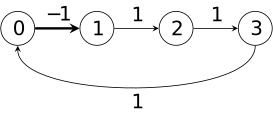
The diagram shows one horizontal row of the \(4\times 4\) torus; vertical edges are omitted. The curved edge is the periodic join. The four-step winding product is minus one, independently of the two neighboring plaquette products.
For \(L=5\), length-4 winding is absent, but each periodic row or column has straight winding walks of length 5. The changed row has 10 such based oriented walks, so \(\Delta \operatorname {tr}H^5=-20\). No other five-step return can wind: displacement 5 requires all 5 steps along that axis. The plaquette change remains \(\Delta \operatorname {tr}H^4=-32\). Consequently \[\Delta W=\frac 4{D^4}+\frac 2{D^5}+O(D^{-6}).\] Thus a period-5 hypothesis would leave an order \(D^{-5}\) term outside the claimed order \(D^{-6}\) remainder. This is why the preceding theorem requires both periods to be at least 6.