Definition. Reflections, halves and the positive-time domain [fdip-007M]
AGENTDRAFTED
Let \(Y\) be a finite spatial torus with coordinate periods at
least three, or a point. Put
\(X=Y\times \mathbb Z/(2M)\), where \(M\ge 2\); the second coordinate
is the chosen time direction. The nearest-neighbor graph joins sites
differing by one coordinate step, with each undirected edge counted
once. Time indices below are taken modulo \(2M\). Define the
site reflection and link reflection by
\[\theta _s(y,t)=(y,-t),\qquad
\theta _\ell (y,t)=(y,1-t).\]
Their positive halves and fixed sets are
\[\begin {aligned}
X_+^s&=Y\times \{0,\ldots ,M\},&
X_0^s&=Y\times \{0,M\},\\
X_+^\ell &=Y\times \{1,\ldots ,M\},&
X_0^\ell &=\varnothing .
\end {aligned}\]
In either case set \(X_-=\theta X_+\). Then
\(X_+\cup X_-=X\) and \(X_+\cap X_-=X_0\); sites in \(X_0\)
are fixed individually.
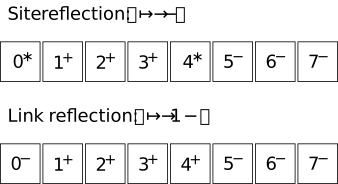
The diagram shows one time circle of length 8. A plus or
minus marks an interior site of that half; a star marks a fixed
site shared by both halves. Time \(7\) is adjacent to time \(0\).
The boxes display membership in the halves, not separate field copies.
For a real scalar configuration \(\phi \in \mathbb R^X\), write
\((\theta \phi )_v=\phi _{\theta v}\). On complex observables define
\[(\Theta f)(\phi )=\overline {f(\theta \phi )}.\]
Thus \(\Theta \) is an antilinear multiplicative involution.
Let \(\mathcal A_+\) be the algebra of bounded complex measurable
functions depending only on \(\phi |_{X_+}\). Let \(\mu \) be a
probability measure on \(\mathbb R^X\). Reflection invariance means
\(\theta _*\mu =\mu \). In addition, reflection positivity
means
\[B_\mu (f,f):=\int (\Theta f)f\,d\mu \ge 0
\qquad (f\in \mathcal A_+).\]
The inequality includes the assertion that the integral is real.
Under reflection invariance, \(B_\mu (f,g)=\int (\Theta f)g\,d\mu \)
is Hermitian and conjugate-linear in its first argument. These are
the complex-observable conventions corresponding to
[friedli2017statistical, Definition 10.5, p. 441].
The larger positive-time domain is
\(\mathcal H_+=L^2(\mathbb R^X,\mu ;\mathbb C)\)
restricted to functions measurable in the coordinates of \(X_+\).
It is a closed vector subspace, generally not an algebra under
pointwise multiplication. Reflection invariance gives
\[|B_\mu (f,g)|\le \|f\|_{L^2(\mu )}\|g\|_{L^2(\mu )}.\]
Truncating the values of a function shows that \(\mathcal A_+\)
is dense in \(\mathcal H_+\). Consequently positivity on
\(\mathcal A_+\) extends to this domain. For a reflection-positive
law, the quotient by
\(\mathcal N=\{f:B_\mu (f,f)=0\}\), with the induced pairing,
has a Hilbert-space completion. This definition supplies no
translation operator on that quotient.