Equivariant precision and real types [fdip-004Y]
✍️sourceAGENTDRAFTED
- November 1, 2026
Equivariant precision and real types [fdip-004Y]
✍️sourceAGENTDRAFTED
- November 1, 2026
A symmetry sector need not have a single precision eigenvalue. Several copies of the same irreducible representation can mix, as the half-turn commutant already shows. The real isotypic projectors separate inequivalent types; within each sector a matrix over the reals, complexes or quaternions records the remaining freedom.
The commutant and positive cone determine the size of these matrices. The Frobenius-Schur indicator then identifies their scalar algebra, with an explicit passage from complex invariant forms to real modules. A twisted prism exhibits a complex multiplicity matrix, and the binary tetrahedral Cayley graph exhibits all three scalar types. Throughout, a Laplacian block becomes a positive precision block only after the specified mass shift.
Theorem 1. The real commutant and multiplicity matrices [fdip-004Z]AGENTDRAFTED
- November 1, 2026
Theorem 1. The real commutant and multiplicity matrices [fdip-004Z]AGENTDRAFTED
- November 1, 2026
Let a finite group \(G\) act orthogonally on a finite-dimensional real space \(H\). In its isotypic decomposition, write \(H_\Xi \cong W_\Xi ^{\oplus m_\Xi }\), where \(W_\Xi \) is irreducible and \(m_\Xi >0\) is its multiplicity. The commutant consists of all linear maps commuting with \(G\). With multiplication given by composition, put \(D_\Xi =\operatorname {End}_G(W_\Xi )\). Then \[\begin {aligned} D_\Xi &\cong \mathbb R,\ \mathbb C\ \text {or}\ \mathbb H,\\ \operatorname {End}_G(H)&\cong \prod _\Xi M_{m_\Xi }(D_\Xi ). \end {aligned}\] The isomorphism can be chosen to carry adjunction to conjugate transpose. If \(H=\mathbb R^V\) is a vertex permutation representation, the real dimension of \(\operatorname {End}_G(H)\) is the number of orbits of the diagonal action \(g(u,v)=(gu,gv)\) on \(V\times V\). These orbits are called orbitals.
Proof.
- November 1, 2026
Proof.
- November 1, 2026
Maschke's theorem decomposes \(H\) orthogonally into irreducibles. The kernel and image of an intertwiner are invariant. Hence an intertwiner between inequivalent irreducibles is zero, and every nonzero endomorphism of one irreducible is invertible. Thus \(D_\Xi \) is a finite-dimensional associative real division algebra; Frobenius's division-algebra theorem gives the three displayed possibilities. Between \(m_\Xi \) identified copies the intertwiners are precisely matrices of elements of \(D_\Xi \), acting by \((Aw)_i=\sum _j A_{ij}(w_j)\). This proves the algebra statement. The real classification and its representation-theoretic use are [serre1977linear, Section 13.2, pp. 106-109]; compare the real-type distinction.
Adjunction preserves \(D_\Xi \). A self-adjoint element of it has real eigenspaces invariant under \(G\), so irreducibility makes it a real scalar. In particular \(d^*d=cI\) with \(c>0\) for \(d\ne 0\). The resulting positive adjoint on \(\mathbb R\), \(\mathbb C\) or \(\mathbb H\) is the usual conjugation: for an imaginary unit \(j^2=-1\), write \(j+j^*=2aI\) with \(a\in \mathbb R\). Then \(j^*j=2aj+I\) is scalar, forcing \(a=0\). Thus \(j^*=-j\). Identifications between equivalent orthogonal copies can be made isometric by dividing an intertwiner by the positive square root of its scalar \(T^*T\). In those coordinates the block adjoint is conjugate transpose.
For vertex permutations, a matrix \(A\) commutes with every \(\rho (g)\) exactly when \(A_{gu,gv}=A_{u,v}\). Its entries are therefore constant on orbitals. The indicator matrices of distinct orbitals have disjoint supports and form a real basis of the commutant, proving the dimension formula.
The scalar-side convention matters for \(\mathbb H\). Here \(D_\Xi \) acts on \(W_\Xi \) on the left by endomorphisms. If instead \(W_\Xi \) is presented as a left module for a simple matrix algebra, its commuting scalars act on the right and form an opposite algebra, as in Proposition [fcap-0042]. Quaternion conjugation identifies that opposite algebra with \(\mathbb H\); it does not license reversing the order of quaternion products.
Corollary 2. Positive multiplicity blocks and real dimensions [fdip-0050]AGENTDRAFTED
- November 1, 2026
Corollary 2. Positive multiplicity blocks and real dimensions [fdip-0050]AGENTDRAFTED
- November 1, 2026
Under the commutant identification, an equivariant self-adjoint positive definite precision \(Q\) is specified by \(Q_\Xi \in M_{m_\Xi }(D_\Xi )\) with \(Q_\Xi ^*=Q_\Xi >0\). Thus all such precisions form an open cone in a real vector space of dimension \[\sum _\Xi h(m_\Xi ,D_\Xi ),\qquad \begin {array}{c|ccc} D&\mathbb R&\mathbb C&\mathbb H\\\hline h(m,D)&m(m+1)/2&m^2&2m^2-m. \end {array}\] For a vertex permutation representation this dimension also counts \(G\)-orbits on unordered pairs \(\{u,v\}\), including \(u=v\). This is the full cone of equivariant precisions; graph Laplacians with prescribed edges and positive weights generally form a smaller family.
Proof.
- November 1, 2026
Proof.
- November 1, 2026
Choose an orthonormal basis of \(W_\Xi \) as a left \(D_\Xi \)-space, using the positive adjoint of Theorem 1. Explicitly, an orthonormal real set \(e,ie\) or \(e,ie,je,ke\) spans one such scalar line; its real orthogonal complement is \(D_\Xi \)-stable, so induction constructs the basis. Put \(r_\Xi =\dim _{D_\Xi }W_\Xi \) and \(d_D=\dim _{\mathbb R}D\in \{1,2,4\}\). Expanding each of the \(m_\Xi \) vectors in this basis identifies \(H_\Xi \) with \(r_\Xi \) columns in \(D_\Xi ^{m_\Xi }\). The same matrix \(Q_\Xi \) acts on every column by left multiplication. The real inner product is the sum of \(\operatorname {Re}(z^*w)\) on these columns. Consequently positivity of \(Q|_{H_\Xi }\) is exactly positivity of \(Q_\Xi \).
A Hermitian matrix has \(m\) real diagonal entries and \(m(m-1)/2\) freely chosen off-diagonal entries in \(D\); the opposite entries are their conjugates. This gives \(h(m,D)=m+d_Dm(m-1)/2\). Positive definiteness is open because \(\langle Qx,x\rangle \) has a strictly positive minimum on the unit sphere. In permutation coordinates a symmetric commuting matrix is constant on unordered-pair orbits, whose indicator matrices again form a basis.
These coordinates fix the determinant convention without a noncommutative determinant ambiguity: \[\begin {aligned} \dim _{\mathbb R}H_\Xi &=m_\Xi r_\Xi d_{D_\Xi },\\ \det _{\mathbb R}(Q|_{H_\Xi }) &=\det _{\mathbb R}(Q_\Xi :D_\Xi ^{m_\Xi }\to D_\Xi ^{m_\Xi })^{r_\Xi }. \end {aligned}\] For a positive Hermitian block with eigenvalues \(\lambda _1,\ldots ,\lambda _m\), the latter real determinant is \(\prod _j\lambda _j^{d_D}\). The spectral assertion follows by taking an eigenvector of the real self-adjoint operator: its eigenspace is stable under right scalar multiplication on \(D^m\); its scalar line has an invariant orthogonal complement, and induction gives a \(D\)-orthonormal eigenbasis. In particular a complex determinant is squared, and the product of quaternionic Hermitian eigenvalues is raised to the fourth power, before taking the exponent \(r_\Xi \). This is the positive-matrix specialization of the real block classification in [serre1977linear, Section 13.2, pp. 108-109].
For a graph write \(L=d^*Wd\) and \(Q=L+m^2I\), with \(m^2>0\). The multiplicity matrices obey \(Q_\Xi =L_\Xi +m^2I\). A zero Laplacian eigenvalue therefore gives a strictly positive precision eigenvalue \(m^2\), not a normalized massless Gaussian.
Theorem 3. the Frobenius-Schur trichotomy [fgap-0021]
Theorem 3. the Frobenius-Schur trichotomy [fgap-0021]
Let \(\rho \) be an irreducible finite-dimensional representation of a finite group over an algebraically closed field of characteristic 0. Its Frobenius-Schur indicator \[ \nu _2(\rho )=\frac 1{|G|}\sum _{g\in G}\chi _\rho (g^2) \] takes exactly 1 of the values \(1\), \(0\), and \(-1\). The value \(1\) is equivalent to the existence of a nondegenerate invariant symmetric bilinear form; \(-1\) is equivalent to a nondegenerate invariant alternating form; and \(0\) is equivalent to the absence of a nonzero invariant bilinear form. See [james2001representations, def. 23.13, the proof of thm. 23.14, and thm. 23.16, pp. 273-277]. James and Liebeck state the alternatives using nonzero invariant forms; for an irreducible representation, a nonzero invariant symmetric or alternating form has zero radical and is therefore nondegenerate.
This trichotomy classifies the invariant-form behavior of the complex irreducible representation. It does not by itself compute a Schur index or a complete decomposition after descent to \(\mathbb R\).
Proposition 4. From Frobenius-Schur indicators to real Gaussian types [fdip-0051]AGENTDRAFTED
- November 1, 2026
Proposition 4. From Frobenius-Schur indicators to real Gaussian types [fdip-0051]AGENTDRAFTED
- November 1, 2026
Let \(W\) be an irreducible real representation of a finite group, \(D=\operatorname {End}_G(W)\), and \(\chi \) an irreducible constituent of \(W_{\mathbb C}=W\otimes _{\mathbb R}\mathbb C\). The Frobenius-Schur indicator gives exactly the following possibilities, where \(X_\chi \) denotes a complex module of character \(\chi \): \[\begin {array}{c|c|c|c} \nu _2(\chi )&D&W_{\mathbb C}&\dim _{\mathbb R}W\\\hline 1&\mathbb R&X_\chi &\chi (1)\\ 0&\mathbb C&X_\chi \oplus X_{\bar \chi }&2\chi (1)\\ -1&\mathbb H&X_\chi \oplus X_\chi &2\chi (1). \end {array}\] In the middle row \(\chi \ne \bar \chi \). In the last row \(\chi (1)\) is even and \(\dim _{\mathbb H}W=\chi (1)/2\). The form trichotomy alone is not the real descent argument; these assertions use the bridge proved below. They agree with [serre1977linear, Section 13.2, Proposition 39, p. 109].
Proof.
- November 1, 2026
Proof.
- November 1, 2026
Commutation with the finitely many real group matrices is a system of real linear equations. Complexifying its solution space therefore gives \[\operatorname {End}_G(W_{\mathbb C}) \cong D\otimes _{\mathbb R}\mathbb C.\] For \(D=\mathbb R,\mathbb C,\mathbb H\) the right side is respectively \(\mathbb C\), \(\mathbb C\times \mathbb C\), \(M_2(\mathbb C)\). For the middle identity use \(z\otimes a\mapsto (za,\bar z a)\); for the last use the usual quaternion two-by-two complex matrices, whose complex span is all \(M_2(\mathbb C)\), as in Proposition [fcap-0042]. Complex semisimplicity identifies the left side with \(\prod _\psi M_{n_\psi }(\mathbb C)\), where \(n_\psi \) is the constituent multiplicity. Its simple factors and their dimensions force one constituent once, two distinct constituents once each, or one constituent twice, respectively.
Let \(c(w+iv)=w-iv\). It exchanges the \(\psi \) and \(\bar \psi \) components. If \(D=\mathbb R\), the single complex irreducible has the real form \(W\). Averaging a real inner product and complexifying it supplies an invariant nondegenerate symmetric bilinear form, so \(\nu _2=1\). If \(D=\mathbb C\) and either of the two inequivalent components were fixed by \(c\), its fixed vectors would be a nonzero proper real invariant subspace of \(W\). Indeed, for a \(c\)-stable space every vector is uniquely \((x+cx)/2+i(x-cx)/(2i)\) with both components fixed by \(c\). Irreducibility excludes this, so the two characters are a nonreal conjugate pair and \(\nu _2=0\).
If \(D=\mathbb H\), conjugation fixes the sole constituent type, so \(\chi =\bar \chi \) and \(\nu _2=\pm 1\). Suppose \(\nu _2=1\). Choose a nondegenerate invariant symmetric complex bilinear form \(B\) on \(X_\chi \) and an averaged invariant positive Hermitian form \(h\), conjugate-linear in its first argument. There is a unique antilinear map \(J\) with \(B(x,y)=h(Jx,y)\), and it commutes with \(G\). In an \(h\)-orthonormal basis write \(B(x,y)=x^TAy\). Then \(A^T=A\), \(Jx=\bar A\bar x\) and \(J^2=\bar A A=A^*A>0\). By complex Schur's lemma \(J^2=tI\) for a positive real \(t\). Replacing \(J\) by \(t^{-1/2}J\) makes \(J^2=I\). Its fixed space \(U\) is a real form of \(X_\chi \), by the same two-component formula. This is the irreducible specialization of [serre1977linear, Section 13.2, Theorem 31, pp. 106-108].
The real module \(U\) is irreducible, since a proper real invariant subspace would complexify to a proper subspace of \(X_\chi \). There is a nonzero complex intertwiner \(U_{\mathbb C}\to W_{\mathbb C}=X_\chi ^{\oplus 2}\). In real bases its real or imaginary part gives a nonzero real intertwiner \(U\to W\), which must be an isomorphism by irreducibility. But \(\dim _{\mathbb R}U=\chi (1)\) and \(\dim _{\mathbb R}W=2\chi (1)\), a contradiction. Thus \(\nu _2=-1\). The three division algebras exhaust the cases and give distinct indicators, so all implications reverse. Finally \(W\) is a left \(\mathbb H\)-space, making its real dimension a multiple of 4; hence \(\chi (1)\) is even.
For an equivariant centered real Gaussian on an isotypic sector, use the coordinates \(z_1,\ldots ,z_r\in D^m\) of Corollary 2. Its real density is proportional to \[\exp \left (-\frac 12\sum _{a=1}^r \operatorname {Re}(z_a^*Q_\Xi z_a)\right ).\] The real covariance is the Hermitian multiplicity matrix \(Q_\Xi ^{-1}\) acting on each column. For \(D=\mathbb C\), multiplication of a column by \(e^{i\theta }\) preserves this real law: this is circular symmetry. With the displayed real normalization the complex second moment is \(\mathbb E[z_a z_a^*]=2Q_\Xi ^{-1}\). For \(D=\mathbb H\), right multiplication \(z_a\mapsto z_a q\) by a unit quaternion likewise preserves the real quadratic form and Lebesgue measure. This is the asserted quaternionic symmetry; left multiplication by an arbitrary quaternion need not commute with the entries of \(Q_\Xi \). These coordinate symmetries need not be additional graph symmetries. The real Gaussian normalization and covariance are those of Theorem [fdip-000H].
TauCeti's
Representation.frobeniusSchurIndicator_eq_one_iff_isRealizableOverReal
proves the indicator-one/real-realizability equivalence for an
irreducible complex representation of a finite group. It supports
the real-form step; the full commutant identification, all three
real dimensions and the Gaussian coordinate statements are the
arguments above.
Example 5. A twisted prism with a complex multiplicity block [fdip-0052]AGENTDRAFTED
- November 1, 2026
Example 5. A twisted prism with a complex multiplicity block [fdip-0052]AGENTDRAFTED
- November 1, 2026
Take two triangles with vertices \(x,x'\) indexed by \(x\in \mathbb Z/3\mathbb Z\). Give the upper triangle weight \(a=1\), the lower triangle weight \(b=2\), the edges \(\{x,x'\}\) weight \(u=1\), and the edges \(\{x,(x+1)'\}\) weight \(v=1/2\). The graph precision is \(Q=L+I\). Each edge is undirected for the energy; arbitrary chosen orientations are transported with the signed convention.
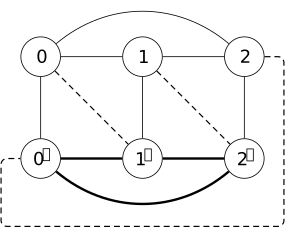
Thin solid edges have weight \(1\); the thick lower triangle has weight \(2\); dashed edges have weight \(1/2\). The outer dashed edge joins \(2\) to \(0'\), completing the shift modulo three. Crossings without a circle are not vertices.
The simultaneous rotation \(x\mapsto x+1\) generates \(C_3\). It is the entire weight-preserving vertex automorphism group. The weighted degrees \(7/2\) and \(11/2\) distinguish the two layers. The interlayer edges of weight \(1\) force the same permutation \(\pi \) on both layers, and those of weight \(1/2\) force \(\pi (x+1)=\pi (x)+1\). Thus only the three rotations remain.
The real representation is \(\mathbb R^6\cong \mathbb R^{\oplus 2}\oplus W^{\oplus 2}\), where \(W\) is the two-dimensional rotation representation and has \(D=\mathbb C\) by Proposition 4. The commutant is \(M_2(\mathbb R)\times M_2(\mathbb C)\), of real dimension \(4+8=12\). Its orbitals are the 4 choices of ordered layers and three differences \(y-x\). The symmetric dimension is \(3+4=7\): there are two diagonal orbits, two within-layer edge orbits and three interlayer pair orbits.
Use normalized constant vectors on the two layers for the trivial sector. For the other sector put \(\zeta =e^{2\pi i/3}\) and represent its upper values by \(f(x)=\sqrt {2/3}\operatorname {Re}(z\zeta ^{-x})\), and its lower values by the same formula with \(z'\). This is an isometry from \(\mathbb C^2\) with its real Euclidean inner product to the four-dimensional sector. Evaluating the edge energy gives \[\begin {aligned} Q_{\mathrm {triv}}&= \begin {pmatrix}5/2&-3/2\\-3/2&5/2\end {pmatrix},\\ Q_{\mathbb C}&= \begin {pmatrix} 11/2&-3/4+i\sqrt3/4\\ -3/4-i\sqrt3/4&17/2 \end {pmatrix}. \end {aligned}\] Indeed the diagonal Fourier entries are \(1+3a+u+v\) and \(1+3b+u+v\); the upper-right entry is \(-u-v\zeta ^{-1}\). The trivial eigenvalues are \(1,4\). The complex block has trace \(14\), determinant \(46\), and eigenvalues \(7-\sqrt 3,7+\sqrt 3\), each repeated twice over the reals. Hence \[\det _{\mathbb R}Q=4\cdot 46^2=8464.\] The square is required by the real determinant convention.
The imaginary entry records the shift in the declared Fourier coordinates. Rephasing one coordinate can make this single Hermitian matrix real; the intrinsic complex feature is the full commutant \(M_2(\mathbb C)\), not an obstruction to diagonalizing one positive operator. This calculation adapts the cyclic Fourier modes of Example [fdip-004W], based on [serre1977linear, Section 5.1, p. 35].
Example 6. All real types in a binary tetrahedral Cayley graph [fdip-0053]AGENTDRAFTED
- November 1, 2026
Example 6. All real types in a binary tetrahedral Cayley graph [fdip-0053]AGENTDRAFTED
- November 1, 2026
Let \(T=2T\) be the 24 Hurwitz units, with \(\omega =(-1+i+j+k)/2\), and take the inverse-closed generating set \[S=\{i,-i,j,-j,k,-k,\omega ,\bar \omega \}.\] Give each unordered edge \(\{g,gs\}\) weight one, counting it once. There are no loops, the degree is 8, and left multiplication acts by signed graph symmetries. On \(\mathbb R^T\) the Laplacian is \[(Lf)(g)=8f(g)-\sum _{s\in S}f(gs).\] The underlying group construction is [voight2021quaternion, Section 11.2, pp. 166-168]. The following spectrum and blocks are calculations for this particular generating set.
The quotient \(T/Q_8\cong C_3\) gives the character \(\lambda (\omega )=\zeta =e^{2\pi i/3}\), \(\lambda |_{Q_8}=1\). Let \(\sigma \) be the defining two-dimensional complex quaternion representation, with \(\chi _\sigma (q)=2\operatorname {Re}q\), and let \(\tau \) act by quaternion conjugation on \(\operatorname {span}_{\mathbb R}\{i,j,k\}\). Its character is \(4(\operatorname {Re}q)^2-1\). The 7 conjugacy classes and their characters are \[\begin {array}{c|rrrrrrr} q&1&-1&i&\omega &-\omega &\omega ^2&-\omega ^2\\\hline |[q]|&1&1&6&4&4&4&4\\ \lambda ^j&1&1&1&\zeta ^j&\zeta ^j&\zeta ^{2j}&\zeta ^{2j}\\ \sigma \lambda ^j&2&-2&0&-\zeta ^j&\zeta ^j&-\zeta ^{2j}&\zeta ^{2j}\\ \tau &3&3&-1&0&0&0&0 \end {array}\] with \(j=0,1,2\). The class of \(i\) comprises \(\{\pm i,\pm j,\pm k\}\); each remaining class is determined by its \(Q_8\)-coset and real part. These descriptions follow by conjugating the explicit Hurwitz units.
Using the displayed sizes, the character inner products are \(\delta _{\alpha \beta }\) and the sum of squared degrees is \(3\cdot 1^2+3\cdot 2^2+3^2=24\). Thus the 7 characters are irreducible, inequivalent and complete. Squaring sends the first three classes to \(1,1,-1\), the two \(\pm \omega \) classes to \([\omega ^2]\), and the two \(\pm \omega ^2\) classes to \([\omega ]\). Substitution into \(|T|^{-1}\sum _g\chi (g^2)\) gives indicators \(1,0,0\) for \(1,\lambda ,\lambda ^2\), \(-1,0,0\) for \(\sigma ,\sigma \lambda ,\sigma \lambda ^2\), and \(1\) for \(\tau \). For example the numerator for \(\sigma \) is \(2+2-12-16=-24\); for \(\sigma \lambda \) it is \(4-12-8(\zeta +\zeta ^2)=0\). The real-type bridge therefore gives \[\operatorname {End}_T(\mathbb R^T) \cong \mathbb R\times \mathbb C\times M_3(\mathbb R) \times \mathbb H\times M_2(\mathbb C).\] Here the regular real multiplicity is \(m_\Xi =\dim _{D_\Xi }W_\Xi \): a real simple matrix algebra \(M_r(D)\) has \(r\) column copies of its defining module, as in Proposition [fcap-0042].
Fourier decomposition of right translation gives, up to the chosen dual-basis convention, the block \(8I-\sum _{s\in S}\pi (s)\). Its adjoint or transpose gives the same spectra and determinants, since \(S=S^{-1}\). The multiplicity matrices are as follows; in the table \(m\) is multiplicity, not the mass parameter: \[\begin {array}{c|c|c|c|c} W\text { type}&D&m&\dim _{\mathbb R}W&L_\Xi \\\hline 1&\mathbb R&1&1&0\\ \lambda ,\bar \lambda &\mathbb C&1&2&3\\ \tau &\mathbb R&3&3&11I_3-J_3\\ \sigma &\mathbb H&1&4&9\\ \sigma \lambda ,\sigma \bar \lambda &\mathbb C&2&4&\operatorname {diag}(6,9) \end {array}\] Here \(J_3\) is the all-ones matrix. For \(\tau \), the 6 \(\pm i,\pm j,\pm k\) contribute \(-2I_3\), while \(\tau (\omega )+\tau (\bar \omega )=J_3-I_3\); the block has eigenvalues \(8,11,11\). For \(\sigma \) the 6 contributions cancel and \(\sigma (\omega )+\sigma (\bar \omega )=-I_2\), giving \(9\). For \(\sigma \lambda \), diagonalize \(\sigma (\omega )\) with eigenvalues \(\zeta ,\zeta ^2\). The twisted adjacency sum has eigenvalues \(-1,2\), giving \(9,6\). The nonreal linear pair has adjacency eigenvalue \(6+\zeta +\zeta ^2=5\).
The real sector dimensions are \(1,2,9,4,8\), summing to \(24\). Consequently \[\operatorname {spec}(L)=\{0,3^{[2]},6^{[4]},8^{[3]},9^{[8]},11^{[6]}\},\] where brackets denote eigenvalue multiplicity. For a mass squared \(a>0\), set \(Q=L+aI\); every block receives the same shift and \[\begin {aligned} \det _{\mathbb R}Q={}&a(a+3)^2(a+6)^4\\ &\cdot (a+8)^3(a+9)^8(a+11)^6. \end {aligned}\] The complex and quaternionic exponents are real dimensions, not complex degrees copied without descent. The commutant dimension is \(24\); the symmetric dimension is \(13\), also the number of inversion orbits in \(T\), since only \(1,-1\) are self-inverse. These are finite graph calculations; the possible physical interpretations discussed in Remark [fgap-0018] are separate hypotheses.