Example. Cycle decimation and periodic covariance [fdip-0057]
AGENTDRAFTED
Take the unit-weight cycle on \(\mathbb Z/(2N)\), with
\(N\ge 3\) and precision \(Q=L_{C_{2N}}+a\mathbb {I}\), where
\(a=m^2>0\). The neighbor coefficient is \(1\) and the diagonal
coefficient is \(2+a\), so the shape is \(t=(2+a)/2\). Thus
\(Q=P_t\), the unit-coupling cycle operator
on this cycle, and the decimation factor is \(2\). The group
\(G=C_N\) acts by two-site rotations. It preserves the even
retained vertices and the odd eliminated vertices. Write
\(x_j=\phi _{2j}\), \(y_j=\phi _{2j+1}\); indices \(j\) lie in
\(\mathbb Z/N\). For the shift \((Tz)_j=z_{j-1}\) on the
retained cycle, the blocks are
\[A=C=(2+a)\mathbb {I},\qquad B=-(\mathbb {I}+T),\qquad B^{\dagger }=-(\mathbb {I}+T^{-1}).\]
Thus the equivariant Schur formula gives
\[\begin {aligned}
S&=(2+a)\bbI -(2+a)^{-1}(2\mathbb {I}+T+T^{-1})\\
&=\frac {1}{2+a}\,P^K_{T_2(t)},
\end {aligned}\]
where \(T_2(t)=2t^2-1\) and
\(P^K_s=2s\,\bbI -(T+T^{-1})\) is the same operator on the retained
sites. Since \(2t=2+a\), the diagonal
\(2T_2(t)/(2+a)\) equals \((2+a)-2/(2+a)\), so the two
displays agree. The retained shape is \(T_2(t)\) and the
retained coupling is \(1/(2+a)\). The retained mass, the
diagonal minus twice that coupling, equals
\[\frac {a(a+4)}{a+2}=(2+a)-\frac {4}{2+a}>0.\]
The restriction \(Q_{RR}=(2+a)\mathbb {I}\) has no off-diagonal entries,
while \(S\) has entries \(-1/(2+a)\) between adjacent retained
vertices. The retained set is stable under \(G\), but the
marginal precision is induced by elimination. This is the
\(q=2\) case of Proposition [fdip-00B3], with neighbor value \(1\) and
diagonal \(2+a\).
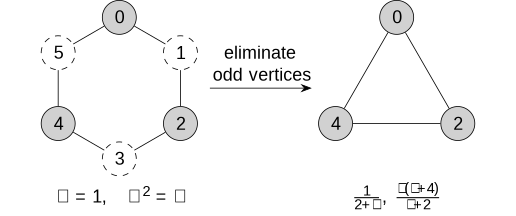
The six-cycle illustrates \(N=3\). Shaded even vertices remain;
dashed odd vertices are integrated out. Each triangle edge has
coupling \(1/(2+a)\), and the mass squared changes from \(a\) to
\(a(a+4)/(a+2)\).
The finite Gaussian normalization is retained exactly:
\(Z_Q=Z_CZ_S\) with
\(Z_C=\bigl (\frac {2\pi }{2+a}\bigr )^{N/2}\), and the retained
law is \(\mu _S\). The retained coupling and the retained mass
are both part of this law. Dividing \(S\) by the coupling
\(1/(2+a)\) compares the shape, but changes the field
covariance by a scalar unless the corresponding field
rescaling is also made.
Put \(2+a=2\cosh \omega \) with \(\omega >0\). The shape is then
\(t=\cosh \omega \), and the retained shape is
\(T_2(t)=\cosh (2\omega )\). Twice that shape equals
\[(2+a)^2-2=2\cosh (2\omega ).\]
The doubled parameter has an exact finite-ring interpretation.
For \(M\ge 3\), the covariance of precision
\(w(2\cosh \eta \,\bbI -T-T^{-1})\) on \(\mathbb Z/M\), with
\(w,\eta >0\), is the periodic kernel
\[\begin {aligned}
K_{M,w,\eta }(r)
&=\frac {\mathrm {e}^{-\eta r}+\mathrm {e}^{-\eta (M-r)}}
{2w\sinh \eta \,(1-\mathrm {e}^{-M\eta })},\\
&\hspace {24mm}0\le r\le M-1.
\end {aligned}\]
For the original and retained fields this gives
\[(Q^{-1})_{0,2r}
=K_{2N,1,\omega }(2r)
=K_{N,\,1/(2+a),\,2\omega }(r)
=(S^{-1})_{0,r}.\]
The equality is between covariances with their actual
couplings. Here \(1/(2+a)=1/(2\cosh \omega )\).
Remark. The same kernel is the sum of
\(h(n)=\mathrm {e}^{-\eta |n|}/(2w\sinh \eta )\) over the periods
\(n=r+kM\). That sum is not used above.
In the convention that correlation length is the reciprocal
decay rate of these two-exponential kernels, it changes from
\(1/\omega \) fine lattice units to \(1/(2\omega )\) coarse
lattice units. The finite ring has two winding directions, so
its covariance is not a single exponential in separation. If
the old spacing is \(\ell \), the new spacing is \(2\ell \); the
physical decay length \(\ell / \omega =(2\ell )/(2\omega )\) is
unchanged.
The bound \(N\ge 3\) keeps the reduced graph a simple cycle.
At \(N=2\), \(T=T^{-1}\) and two eliminated vertices connect the
same retained pair, producing two parallel edges of coupling
\(1/(2+a)\), or one edge of coupling \(2/(2+a)\). At \(a=0\),
the algebraic formula still gives retained coupling \(1/2\)
and retained mass \(0\), the two-resistors-in-series limit.
The full precision then has a constant zero mode and no
normalized full-space Gaussian law. Pinning or a mean-zero
constraint must be specified as in
constrained massless laws; the positive-mass covariance
formula is not a finite limit on the full field space.
This is a direct cycle calculation within
Kron reduction, the Schur reduction of graph Laplacians
with possible positive diagonal terms.
Closure follows from [dorfler2011kron, Lemma 2.1, pp. 5-6].
Successive and simultaneous eliminations agree by
[dorfler2011kron, Lemma 3.3, p. 14].
In that source the diagonal mass corresponds to a
shunt conductance or graph self-loop. In the incidence convention
used here an edge with identical endpoints has zero difference;
the mass is therefore kept as the separate term \(a\mathbb {I}\).
The source supplies the general reduction context, while the
periodic covariance and scale statements are proved above.