Example. The alternating four-cycle [fdip-0003]
AGENTDRAFTED
Let \(V=\mathbb Z/4\mathbb Z\) and
\(E=\{e_0,e_1,e_2,e_3\}\), with \(s(e_i)=i\) and \(h(e_i)=i+1\)
modulo \(4\). For \(t>0\), assign weights
\[w_t(e_0)=w_t(e_2)=1,\qquad w_t(e_1)=w_t(e_3)=t.\]
This is a weighted finite incidence presentation:
the parameter \(t\) is supplied, and every edge weight is positive.
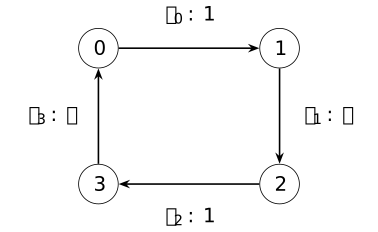
Each arrow points from source to head; the label gives its edge name
and weight. A half-turn exchanges opposite vertices and edges.
On the real four-cycle, order vertices as \(0,1,2,3\) and edges as
\(e_0,e_1,e_2,e_3\). The incidence matrix \(B\) of \(D\),
and the coordinate array \(W_t\) of the weights, are
\[B=\begin {pmatrix}
-1&1&0&0\\
0&-1&1&0\\
0&0&-1&1\\
1&0&0&-1
\end {pmatrix},\qquad W_t=\operatorname {diag}(1,t,1,t).\]
Thus a field with ordered values \((a,b,c,d)\) has edge differences
\((b-a,c-b,d-c,a-d)\). For \(f=\delta _1\), the edge values of \(Df\)
are \((1,-1,0,0)\): the field rises along \(e_0\) and falls along \(e_1\).
The quadratic action of Example [fdip-002P] uses these same edge
orientations and weights, with a positive mass term.
Define the half-turn on both sets by
\[r_V(i)=i+2,\qquad r_E(e_i)=e_{i+2}.\]
Applying either map twice adds 4, so both are involutions, and
\(r_V(0)=2\) shows that the map on vertices is not the identity. Moreover,
\[s(r_E(e_i))=i+2=r_V(s(e_i)),\]
\[h(r_E(e_i))=i+3=r_V(h(e_i)).\]
The half-turn therefore preserves the directed incidence data. Since
\(i\) and \(i+2\) have the same parity, it also preserves the weights:
\(w_t(r_E(e_i))=w_t(e_i)\). In contrast, a one-step rotation sends
\(e_0\) to \(e_1\) and fails to preserve weights when \(t\ne 1\).
After forgetting orientations and weights, the underlying graph is
Mathlib's SimpleGraph.cycleGraph at 4 vertices, identifying
\(\operatorname {Fin}(4)\) with the residue classes modulo \(4\). That
declaration specifies the unweighted graph. The displayed matrix and
weight-preserving half-turn follow from the substitutions above.