Grassmann variables and finite fermion integrals [fdip-008E]
✍️sourceAGENTDRAFTED
- November 1, 2026
Grassmann variables and finite fermion integrals [fdip-008E]
✍️sourceAGENTDRAFTED
- November 1, 2026
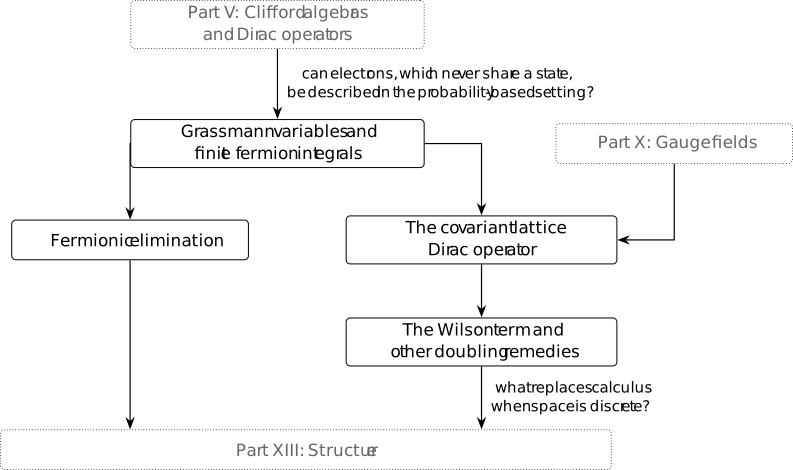
Can electrons, which never share a state, be described in the probability-based setting? The spatial Dirac operator has a real matrix in its chosen basis and is skew-adjoint, so its real restriction satisfies \(D^T=-D\). For commuting real coordinates \(x\), transposition gives \(x^TDx=-x^TDx=0\). The weight \(e^{-x^TDx/2}\) is therefore constant, and adding a scalar mass leaves only \(m x^Tx\) in \(x^T(D+mI)x\): this quadratic expression loses the spatial operator.
Electrons are fermions: their multiparticle amplitudes change sign when two identical particles are exchanged [etingof2024mathematical, v2, Section 9.1, pp. 121-122]. Exclusion concerns the same complete one-particle state, including spin, not merely the same spatial orbital. The exterior algebra encodes the alternating sign through generators satisfying \(\psi _i\psi _j=-\psi _j\psi _i\) and \(\psi _i^2=0\) over \(\mathbb R\) or \(\mathbb C\). These are Grassmann variables. Their use here is an algebraic model of that sign rule, not a derivation of electron physics or a claim that measured fermion outcomes lack ordinary probabilities.
Integrating commuting Gaussian fields produces inverse powers of a determinant. For Grassmann variables, ordered top-coefficient extraction instead gives a determinant for independent paired variables and a Pfaffian for an alternating quadratic form. Two generators fix the signs before the general identities; the normalized Wick rule additionally requires invertibility. This algebraic integration is not a positive measure. Its relation to the earlier Clifford algebra is a vector-space comparison. Elimination, covariant lattice Dirac operators and their doubling problem are the later questions.
Definition 1. Ordered Berezin coefficients [fdip-008F]AGENTDRAFTED
- November 1, 2026
Definition 1. Ordered Berezin coefficients [fdip-008F]AGENTDRAFTED
- November 1, 2026
Let \(V\) be an \(N\)-dimensional vector space over \(\mathbb k=\mathbb R\) or \(\mathbb C\), with an ordered basis \(\xi _1,\ldots ,\xi _N\) of \(V^*\). The Grassmann algebra on these generators is the exterior algebra \(\Lambda (V^*)\). Multiplication is written by juxtaposition, so \[\xi _i\xi _j=-\xi _j\xi _i,\qquad \xi _i^2=0.\] Its basis consists of \(1\) and the increasing words \(\xi _{i_1}\cdots \xi _{i_r}\) with \(i_1<\cdots <i_r\); its dimension is \(2^N\). A word of length \(r\) has degree \(r\). Elements of even degree commute with every homogeneous element; two homogeneous elements of degrees \(r,s\) commute with sign \((-1)^{rs}\).
The Berezin integral with reversed top order is the linear functional \[I_\xi (f)=\text {coefficient of }\xi _N\cdots \xi _1 \text { in }f.\] Thus \(I_\xi (\xi _N\cdots \xi _1)=1\) and it vanishes on all lower degrees. Relative to the increasing top coefficient it has the sign \((-1)^{N(N-1)/2}\). For \(N=0\) it is the identity on \(\mathbb k\). This is the purely odd coefficient definition of [etingof2024mathematical, v2, Definition 9.6, p. 128], with the top order stated explicitly.
For \(n\) complex pairs, take \(2n\) independent generators \(\psi _1,\bar \psi _1,\ldots ,\psi _n,\bar \psi _n\) and use the paired functional \[J_n(f)=\text {coefficient of } \psi _1\bar \psi _1\cdots \psi _n\bar \psi _n \text { in }f.\] The bars label independent generators, not complex conjugates. The symbols \(I_\xi \) and \(J_n\) keep these two top-order conventions distinct. They are coefficient functionals, not positive measures on ordinary field configurations.
For a positive-degree nilpotent element \(q\), define
\(e^q=\sum _{r\ge 0}q^r/r!\); only finitely many terms survive.
For a quadratic \(q\) in \(N\) generators, terms with \(2r>N\)
vanish. No analytic convergence is involved. The ordered
monomial basis is supplied formally by
Module.Basis.ExteriorAlgebra; this supports the
algebraic coordinates, not the Berezin or Gaussian identities.
Example 2. Two generators fix the integration signs [fdip-008G]AGENTDRAFTED
- November 1, 2026
Example 2. Two generators fix the integration signs [fdip-008G]AGENTDRAFTED
- November 1, 2026
Take two generators and the alternating matrix \[A=\begin {pmatrix}0&a\\-a&0\end {pmatrix}.\] Anticommutation gives \[\tfrac 12\xi ^TA\xi =a\xi _1\xi _2.\] Since \((\xi _1\xi _2)^2=0\), \[e^{-\frac 12\xi ^TA\xi } =1-a\xi _1\xi _2=1+a\xi _2\xi _1.\] The reversed coefficient therefore gives \(I_\xi (e^{-\xi ^TA\xi/2})=a\). Selecting the increasing word \(\xi _1\xi _2\) instead would give \(-a\).
For one independent complex pair and any \(k\in \mathbb C\), \[e^{-k\bar \psi \psi }=1-k\bar \psi \psi =1+k\psi \bar \psi ,\qquad J_1(e^{-k\bar \psi \psi })=k.\] Both calculations use only the finite expansion and the ordered functionals in the definition, including when \(a=0\) or \(k=0\).
Theorem 3. Paired Grassmann integration gives a determinant [fdip-008H]AGENTDRAFTED
- November 1, 2026
Theorem 3. Paired Grassmann integration gives a determinant [fdip-008H]AGENTDRAFTED
- November 1, 2026
For any complex \(n\times n\) matrix \(K\), use the independent generators and paired top order. Then \[J_n\left (e^{-\bar \psi K\psi }\right )=\det K, \qquad \bar \psi K\psi =\sum _{i,j=1}^n\bar \psi _iK_{ij}\psi _j.\] No invertibility or positivity assumption is needed. The empty case has \(J_0(1)=1\), equal to the determinant of the empty matrix.
Proof.
- November 1, 2026
Proof.
- November 1, 2026
Move each barred generator to the right and put \[q_i=\sum _{j=1}^nK_{ij}\psi _j\bar \psi _i, \qquad -\bar \psi K\psi =\sum _iq_i.\] Each \(q_i^2=0\), because every term repeats \(\bar \psi _i\). The \(q_i\) have even degree and commute, so finite expansion gives \[e^{\sum _iq_i}=\prod _{i=1}^n(1+q_i).\] Only \(q_1\cdots q_n\) can contribute to the top degree. A nonzero term in that product chooses every unbarred generator once, hence is indexed by a permutation \(\sigma \in S_n\).
The associated word is \(\psi _{\sigma (1)}\bar \psi _1\cdots \psi _{\sigma (n)}\bar \psi _n\). Moving all barred factors to the right gives \((-1)^{n(n-1)/2}\). Sorting the unbarred factors gives \(\operatorname {sgn}(\sigma )\). Returning the bars to the paired top order gives the same first sign again. Their product is \(\operatorname {sgn}(\sigma )\). Thus the required coefficient is \[\sum _{\sigma \in S_n}\operatorname {sgn}(\sigma ) \prod _{i=1}^nK_{i,\sigma (i)}=\det K.\]
Selecting the grouped top word \(\psi _1\cdots \psi _n\bar \psi _1\cdots \bar \psi _n\) would instead give \((-1)^{n(n-1)/2}\det K\). There is a local ordering discrepancy in [etingof2024mathematical, v2, Proposition 9.10, p. 131]: the volume displayed immediately before the proposition is interleaved, whereas its printed determinant sign is the grouped one under Definition 9.6's coefficient rule. For \(n=2,K=I\), the exponential is \((1+\psi _1\bar \psi _1)(1+\psi _2\bar \psi _2)\); its interleaved coefficient is \(+1\) and its grouped coefficient is \(-1\). The direct expansion above fixes the convention used here.
Definition 4. The Pfaffian records signed pairings [fdip-008I]AGENTDRAFTED
- November 1, 2026
Definition 4. The Pfaffian records signed pairings [fdip-008I]AGENTDRAFTED
- November 1, 2026
Let \(A^T=-A\) be a \(2m\times 2m\) matrix over \(\mathbb R\) or \(\mathbb C\). A perfect matching of \(\{1,\ldots ,2m\}\) partitions it into pairs \((i_1,j_1),\ldots ,(i_m,j_m)\), written with \(i_r<j_r\) and \(i_1<\cdots <i_m\). Let \(\varepsilon (M)\) be the sign of the permutation with word \(i_1,j_1,\ldots ,i_m,j_m\). The Pfaffian is \[\operatorname {Pf}(A) =\sum _M\varepsilon (M)\prod _{r=1}^m A_{i_rj_r}.\] The empty Pfaffian is \(1\). This is the matching formula in [etingof2024mathematical, v2, Section 9.9, pp. 130-131].
Grouping matchings by the partner \(j\) of \(1\) gives \[\operatorname {Pf}(A)= \sum _{j=2}^{2m}(-1)^j A_{1j} \operatorname {Pf}(A_{\widehat 1\widehat j}),\] where the indicated two rows and columns are deleted, retaining the original order. Indeed, moving \(j\) immediately after \(1\) crosses \(j-2\) entries. In dimensions two and 4 this reads \[\operatorname {Pf}\begin {pmatrix}0&a\\-a&0\end {pmatrix}=a,\] \[\operatorname {Pf}(A)=A_{12}A_{34}-A_{13}A_{24}+A_{14}A_{23}.\] Each term pairs every index exactly once; unlike a determinant expansion, it sums over pairings rather than all permutations.
Theorem 5. An odd quadratic integral is a Pfaffian [fdip-008J]AGENTDRAFTED
- November 1, 2026
Theorem 5. An odd quadratic integral is a Pfaffian [fdip-008J]AGENTDRAFTED
- November 1, 2026
Let \(A^T=-A\) on \(2m\) generators and use the reversed top coefficient. Then \[I_\xi \left (e^{-\frac 12\xi ^TA\xi }\right ) =\operatorname {Pf}(A).\] This holds for singular as well as invertible \(A\). If \(A\) is invertible, then \(\operatorname {Pf}(A)\ne 0\).
Proof.
- November 1, 2026
Proof.
- November 1, 2026
Put \(\Omega =\sum _{i<j}A_{ij}\xi _i\xi _j =\xi ^TA\xi/2\). In \(\Omega ^m\), a nonzero top word uses each generator exactly once. The even two-letter factors commute; every matching appears in \(m!\) orders. Reordering its word to \(\xi _1\cdots \xi _{2m}\) gives its matching sign. Therefore \[\frac {\Omega ^m}{m!} =\operatorname {Pf}(A)\xi _1\cdots \xi _{2m}.\] The top term of \(e^{-\Omega }\) is \((-1)^m\Omega ^m/m!\). Reversing \(2m\) generators has sign \((-1)^{m(2m-1)}=(-1)^m\); the two signs cancel. This proves the integral identity, without an inverse.
For the nonvanishing assertion, regard \(A\) as a nondegenerate alternating form on the vector space dual to the generators. Choose a nonzero \(u\) and then \(v\) with \(A(u,v)=1\). The plane they span is nondegenerate, and its orthogonal complement for \(A\) is a direct complement on which \(A\) remains nondegenerate. Induction gives a basis of such pairs. In the dual basis \(\alpha _1,\beta _1,\ldots ,\alpha _m,\beta _m\), \[\Omega =\sum _{r=1}^m\alpha _r\beta _r,\qquad \frac {\Omega ^m}{m!}=\alpha _1\beta _1\cdots \alpha _m\beta _m\ne 0.\] An invertible change of generators multiplies a top word by a nonzero determinant. The displayed top coefficient is therefore nonzero in the original basis as well, proving \(\operatorname {Pf}(A)\ne 0\). The zero-dimensional case is \(1\).
In [etingof2024mathematical, v2, Proposition 9.9, p. 131], the increasing top order accompanies a positive quadratic exponent. Replacing \(A\) by \(-A\) contributes \((-1)^m\) to the Pfaffian, and reversing the top order contributes the same sign. Thus the convention conversion agrees with the direct proof.
Theorem 6. The odd Wick rule pairs inverse alternating entries [fdip-008K]AGENTDRAFTED
- November 1, 2026
Theorem 6. The odd Wick rule pairs inverse alternating entries [fdip-008K]AGENTDRAFTED
- November 1, 2026
Let \(A^T=-A\) be an invertible \(2m\times 2m\) matrix. Its nonzero Pfaffian defines the normalized linear functional \[W_A(f)=\frac {I_\xi (f e^{-\xi ^TA\xi/2})} {\operatorname {Pf}(A)}.\] For linear Grassmann elements \(\lambda _a=\sum _i\ell _{ai}\xi _i\), put \(C_{ab}=\ell _aA^{-1}\ell _b^T\). For every \(r\ge 0\), \[W_A(\lambda _1\cdots \lambda _{2r})=\operatorname {Pf}(C),\] where \(C\) is the \(2r\times 2r\) alternating matrix just defined. Every odd product has value zero. Repeated or dependent \(\lambda _a\) are allowed. The inverse formula requires invertible \(A\); it asserts no singular extension.
Proof.
- November 1, 2026
Proof.
- November 1, 2026
Define the left derivative on a monomial by \[\partial _i(\xi _{j_1}\cdots \xi _{j_s}) =\sum _{a=1}^s(-1)^{a-1}\delta _{i,j_a} \xi _{j_1}\cdots \widehat {\xi _{j_a}}\cdots \xi _{j_s}.\] This respects the exterior relations. Splitting the removed positions between two factors gives the graded product rule \[\partial _i(fg)=(\partial _i f)g+(-1)^s f(\partial _i g)\] when \(f\) is homogeneous of degree \(s\). It lowers degree, so \(I_\xi (\partial _i h)=0\) for every \(h\).
Write \(E=e^{-\xi ^TA\xi/2}\). Differentiating its finite series, using that its quadratic exponent is even, gives \[\partial _iE=-\sum _jA_{ij}\xi _jE.\] For odd homogeneous \(f\), the product rule and coefficient of the total derivative imply \[\begin {aligned} 0&=I_\xi ((\partial _i f)E+f\sum _jA_{ij}\xi _jE),\\ \sum _jA_{ij}W_A(\xi _jf)&=W_A(\partial _i f). \end {aligned}\] The second line uses \(f\xi _j=-\xi _jf\). Multiplying by \(A^{-1}\) gives \[W_A(\xi _kf)=\sum _i(A^{-1})_{ki}W_A(\partial _i f).\]
Apply this to \(f=\lambda _2\cdots \lambda _{2r}\) and expand \(\lambda _1\). The derivative removes its \(a\)-th listed factor with sign \((-1)^{a-2}\), yielding \[\begin {aligned} W_A(\lambda _1\cdots \lambda _{2r}) &=\sum _{a=2}^{2r}(-1)^a C_{1a}\\ &\quad \cdot W_A(\lambda _2\cdots \widehat {\lambda _a} \cdots \lambda _{2r}). \end {aligned}\] Starting from \(W_A(1)=1\), this is exactly the Pfaffian recursion. Odd products have odd degree, while \(E\) has only even degrees and the selected top degree \(2m\) is even; hence their integrals vanish.
The left derivative is contraction by the coordinate functional
\(\xi _j\mapsto \delta _{ij}\). TauCeti's
TauCeti.ExteriorAlgebra.contractLeft_ιMulti
gives the alternating deletion formula. At zero quadratic form,
CliffordAlgebra.contractLeft_mul
gives the product rule: the grade involution acts by \((-1)^s\)
in degree \(s\). These support the contraction identities;
the Berezin normalization and Wick recurrence are the direct
argument above.
For \(A=\left (\begin {smallmatrix}0&a\\-a&0\end {smallmatrix}\right )\) with \(a\ne 0\), the two-generator calculation gives \(W_A(\xi _1\xi _2)=-1/a=(A^{-1})_{12}\). This checks the inverse-pairing sign. In [etingof2024mathematical, v2, Theorem 9.11, p. 132], the increasing top order gives normalization \(\operatorname {Pf}(-A)\). Changing the volume multiplies both numerator and normalization by the same sign, leaving this normalized Wick rule unchanged.
Remark 7. Exterior symbols preserve vectors, not Clifford products [fdip-008L]AGENTDRAFTED
- November 1, 2026
Remark 7. Exterior symbols preserve vectors, not Clifford products [fdip-008L]AGENTDRAFTED
- November 1, 2026
The Grassmann algebra and the earlier
configuration Clifford algebra share an exterior
vector-space model. For a quadratic form \(q\) on \(V^*\),
the symbol map is a linear isomorphism
\[\operatorname {Cl}(V^*,q)\cong \Lambda (V^*).\]
This is [meinrenken2013clifford, Proposition 2.5, pp. 32-33]
and the equivalence used in the
transported exterior-basis coordinates.
The formal declaration CliffordAlgebra.equivExterior
supplies a module equivalence over any commutative ring in which
\(2\) is invertible; it does not identify the products.
For example, an exterior generator satisfies \(\xi ^2=0\), while the corresponding Clifford generator satisfies \(\iota _q(\xi )^2=q(\xi )1\). For \(q(\xi )\ne 0\) these cannot be the same multiplication under a unit-preserving map. The quadratic form remains in Clifford contraction terms. The associated graded algebra forgets those lower terms, but the Clifford algebra itself does not. Therefore the Berezin functional and its determinant formulas belong to the exterior product; the vector-space comparison alone does not transfer them to a Clifford product.