Example. A boundary site retains four bonds [fdip-00HV]
AGENTDRAFTED
Choose the site-indicator basis of the square field space.
It is orthogonal with squared norm \(\epsilon ^2\). For the values
\(\phi _x=\phi (x)\), the precision and its coordinate quadratic matrix are
\[\begin {aligned}
(Q_{\epsilon ,D}\phi )_x
&=m_0^2\phi _x+\epsilon ^{-2}
\left (4\phi _x-\sum _{|y-x|=\epsilon }(j\phi )_y\right ),\\
A_{\epsilon ,D}&=\epsilon ^2Q_{\epsilon ,D},&
C_{\epsilon ,D}&=A_{\epsilon ,D}^{-1}
=\epsilon ^{-2}Q_{\epsilon ,D}^{-1}.
\end {aligned}\]
The entries of \(C_{\epsilon ,D}\) are covariances of the site evaluations;
\(Q_{\epsilon ,D}^{-1}\) remains the covariance operator for the weighted
Hilbert metric.
At a retained corner \(x\), only two nearest neighbors are retained.
The diagonal of \(A_{\epsilon ,D}\) is still \(4+m_0^2\epsilon ^2\):
the two zero-exterior bonds contribute \(2\phi _x^2\) to the form.
Using the internal-edge graph alone would give
\(2+m_0^2\epsilon ^2\) at this corner and a different law.
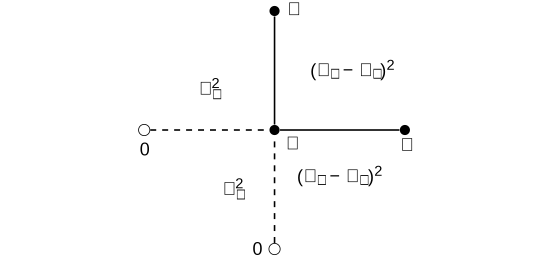
Solid bonds join retained sites; dashed bonds end at prescribed zero
values. Each label gives its contribution to the quadratic form before
the action's factor \(1/2\).
On the same \(N=5\) site set, periodic identification adds wrap
couplings. The next picture shows the 25 sites, internal bonds, and one
horizontal and one vertical wrap bond; the same wrap construction is
repeated in every row and column. Each site then still has degree 4.
In the killed form the two boundary penalties for a paired pair of edge
sites are replaced by \((\phi _x-\phi _y)^2\); the diagonal is preserved
and the term \(-2\phi _x\phi _y\) is added.
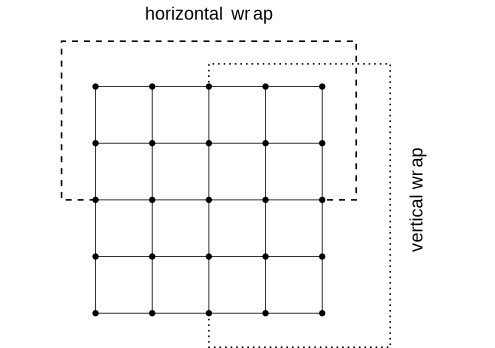
The crossing of the two exterior wrap paths is not a vertex;
only the 25 filled dots carry field values.
For a one-site algebraic illustration the variance is
\((4+m_0^2\epsilon ^2)^{-1}\), rather than \((m_0^2\epsilon ^2)^{-1}\).
The periodic comparison uses \(N\ge 5\); no one-site or two-site periodic
edge convention is substituted. These calculations unpack
[guerra1975euclideanII, Theorem IV.9] for the stated form.