Reflection positivity on a finite time lattice [fdip-007L]
✍️sourceAGENTDRAFTED
- November 1, 2026
Reflection positivity on a finite time lattice [fdip-007L]
✍️sourceAGENTDRAFTED
- November 1, 2026
Where could time evolution come from when a law describes all lattice sites at once? Choose one direction to test as Euclidean time. Reflection positivity asks whether observables on one half of the lattice have a positive semidefinite pairing with their reflected partners. Quotienting the vectors of zero length and completing gives a Hilbert space. Reflection positivity is stronger than invariance of the probability law under reflection. The two-site Gaussian makes the sign of a crossing interaction visible.
The scalar result below uses a finite nearest-neighbor torus, reflection-invariant nonnegative weights and positive mass. Its proof first treats a bounded field range, then removes that cutoff. Site reflections retain shared boundary coordinates; link reflections split the sites into disjoint halves. Neither choice makes a time translation an operator on the resulting quotient without further assumptions.
A step of evolution therefore needs more than this positive pairing. The later Gaussian transfer operator uses a nearest-neighbor kernel with positive weight and mass and a specified reference measure; the gauge transfer construction specifies a positive character kernel and gauge projection. Their spectral hypotheses and normalizations permit a Hamiltonian logarithm. These are Euclidean transfer constructions, not an automatic normalized real-time probability evolution.
Definition 1. Reflections, halves and the positive-time domain [fdip-007M]AGENTDRAFTED
- November 1, 2026
Definition 1. Reflections, halves and the positive-time domain [fdip-007M]AGENTDRAFTED
- November 1, 2026
Let \(Y\) be a finite spatial torus with coordinate periods at least three, or a point. Put \(X=Y\times \mathbb Z/(2M)\), where \(M\ge 2\); the second coordinate is the chosen time direction. The nearest-neighbor graph joins sites differing by one coordinate step, with each undirected edge counted once. Time indices below are taken modulo \(2M\). Define the site reflection and link reflection by \[\theta _s(y,t)=(y,-t),\qquad \theta _\ell (y,t)=(y,1-t).\] Their positive halves and fixed sets are \[\begin {aligned} X_+^s&=Y\times \{0,\ldots ,M\},& X_0^s&=Y\times \{0,M\},\\ X_+^\ell &=Y\times \{1,\ldots ,M\},& X_0^\ell &=\varnothing . \end {aligned}\] In either case set \(X_-=\theta X_+\). Then \(X_+\cup X_-=X\) and \(X_+\cap X_-=X_0\); sites in \(X_0\) are fixed individually.
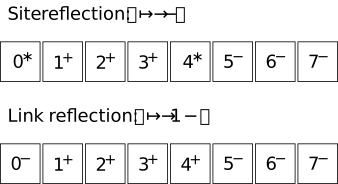
The diagram shows one time circle of length 8. A plus or minus marks an interior site of that half; a star marks a fixed site shared by both halves. Time \(7\) is adjacent to time \(0\). The boxes display membership in the halves, not separate field copies.
For a real scalar configuration \(\phi \in \mathbb R^X\), write \((\theta \phi )_v=\phi _{\theta v}\). On complex observables define \[(\Theta f)(\phi )=\overline {f(\theta \phi )}.\] Thus \(\Theta \) is an antilinear multiplicative involution. Let \(\mathcal A_+\) be the algebra of bounded complex measurable functions depending only on \(\phi |_{X_+}\). Let \(\mu \) be a probability measure on \(\mathbb R^X\). Reflection invariance means \(\theta _*\mu =\mu \). In addition, reflection positivity means \[B_\mu (f,f):=\int (\Theta f)f\,d\mu \ge 0 \qquad (f\in \mathcal A_+).\] The inequality includes the assertion that the integral is real. Under reflection invariance, \(B_\mu (f,g)=\int (\Theta f)g\,d\mu \) is Hermitian and conjugate-linear in its first argument. These are the complex-observable conventions corresponding to [friedli2017statistical, Definition 10.5, p. 441].
The larger positive-time domain is \(\mathcal H_+=L^2(\mathbb R^X,\mu ;\mathbb C)\) restricted to functions measurable in the coordinates of \(X_+\). It is a closed vector subspace, generally not an algebra under pointwise multiplication. Reflection invariance gives \[|B_\mu (f,g)|\le \|f\|_{L^2(\mu )}\|g\|_{L^2(\mu )}.\] Truncating the values of a function shows that \(\mathcal A_+\) is dense in \(\mathcal H_+\). Consequently positivity on \(\mathcal A_+\) extends to this domain. For a reflection-positive law, the quotient by \(\mathcal N=\{f:B_\mu (f,f)=0\}\), with the induced pairing, has a Hilbert-space completion. This definition supplies no translation operator on that quotient.
Lemma 2. A sufficient positive-half decomposition [fdip-007N]AGENTDRAFTED
- November 1, 2026
Lemma 2. A sufficient positive-half decomposition [fdip-007N]AGENTDRAFTED
- November 1, 2026
Let a finite set \(X\) have an involution \(\theta \) and halves \(X_-=\theta X_+\) with \(X_+\cup X_-=X\) and \(X_+\cap X_-=\operatorname {Fix}(\theta )=X_0\). Use the observable conventions of Definition 1; both torus reflections there have these properties. Let \(\nu \) be a probability measure supported on a compact interval of \(\mathbb R\), and put \(\mu _0=\bigotimes _{v\in X}\nu \). Suppose a real Hamiltonian has the form \[-H=A+\Theta A+\sum _{\alpha =1}^q C_\alpha \Theta C_\alpha ,\] where \(A,C_1,\ldots ,C_q\) are bounded real functions in \(\mathcal A_+\); the sum may be empty. Then the probability law \[d\mu =Z^{-1}e^{-H}\,d\mu _0,\qquad Z=\int e^{-H}\,d\mu _0\] is reflection invariant and reflection positive. This is the complex-observable version of [friedli2017statistical, Lemma 10.8, pp. 442–443].
Proof.
- November 1, 2026
Proof.
- November 1, 2026
First consider the product reference. Conditional on the field \(b=\phi |_{X_0}\) at the fixed sites, the two interiors are independent and have matching product laws under reflection. The boundary field is a single shared variable. For any bounded positive-half observable \(F\), therefore, \[\int (\Theta F)F\,d\mu _0 =\int \left |\int F(\phi _+,b)\,d\nu _+(\phi _+)\right |^2 \,d\nu _0(b)\ge 0.\] Here \(\nu _+\) is the product over \(X_+\setminus X_0\) and \(\nu _0\) the product over \(X_0\). When \(X_0\) is empty the outer integral is evaluation at the unique empty configuration. This also proves the product case of [friedli2017statistical, Lemma 10.7, p. 442].
The displayed decomposition is invariant under reflection because its functions are real and multiplication commutes. The reference law is invariant as well. Boundedness makes \(0<Z<\infty \) and permits uniform absolute expansion of the crossing exponential. For \(f\in \mathcal A_+\), this gives \[\begin {aligned} ZB_\mu (f,f) &=\sum _{n\in \mathbb N^q}\frac 1{n!} B_{\mu _0}\left (fe^A C^n,fe^A C^n\right ),\\ n!&=\prod _\alpha n_\alpha !,\qquad C^n=\prod _\alpha C_\alpha ^{n_\alpha }. \end {aligned}\] Every summand is nonnegative by the conditional product identity. The sum converges absolutely by the bounded exponential majorant, so the claimed positivity follows.
Theorem 3. Reflection positivity of a massive scalar lattice [fdip-007O]AGENTDRAFTED
- November 1, 2026
Theorem 3. Reflection positivity of a massive scalar lattice [fdip-007O]AGENTDRAFTED
- November 1, 2026
On the nearest-neighbor torus of Definition 1, choose either reflection \(\theta \). Give every undirected edge a nonnegative weight \(w_e\) with \(w_{\theta e}=w_e\), and fix \(m>0\). The real scalar law \[\begin {aligned} H(\phi )&=\frac 12\sum _{e=\{u,v\}}w_e(\phi _u-\phi _v)^2 +\frac {m^2}{2}\sum _{v\in X}\phi _v^2,\\ d\mu (\phi )&=Z^{-1}e^{-H(\phi )} \prod _{v\in X}d\phi _v \end {aligned}\] is reflection invariant and reflection positive on \(\mathcal A_+\) and its positive-time \(L^2\) domain. Every polynomial in the positive-half field coordinates belongs to that domain. This is the massive scalar precision with zero-weight edges omitted. It uses ordinary differences, equivalently trivial transport in the connection energy.
Proof.
- November 1, 2026
Proof.
- November 1, 2026
Since \(H(\phi )\ge (m^2/2)\|\phi \|^2\), the normalizer is finite and positive, and every polynomial moment exists. Reflection is a permutation of the coordinates, preserves Lebesgue measure and preserves \(H\) by the weight hypothesis. This proves invariance separately from positivity.
For a site reflection, no nearest-neighbor edge joins \(X_+\setminus X_0\) directly to \(X_-\setminus X_0\). Partition the terms of \(H\) into \(H_+\), those supported in \(X_+\) but not wholly in \(X_0\); their reflected partners \(H_-=\Theta H_+\); and \(H_0\), those supported wholly in \(X_0\). Include onsite mass terms in the same partition. Because reflection fixes every boundary coordinate, \[-H=A+\Theta A,\qquad A=-H_+-\tfrac 12H_0.\] In particular the boundary terms are counted once.
For a link reflection the halves are disjoint. The only crossing edges are the time bonds at the two cuts, and each has the form \(e=\{v,\theta v\}\) with a unique \(v\in X_+\). Its contribution to \(-H\) is \[-\frac {w_e}{2}\phi _v^2 -\frac {w_e}{2}\phi _{\theta v}^2 +w_e\phi _v\phi _{\theta v}.\] Put its first term into \(A\), its second into \(\Theta A\), and write the last as \(C_e\Theta C_e\), where \(C_e=\sqrt {w_e}\phi _v\). All within-half edge energies and onsite mass terms are assigned to their own half, with a minus sign. Reflection invariance of the weights then gives the positive-half decomposition.
For \(R>0\), restrict every coordinate to \([-R,R]\) and use the uniform probability on this interval as the product reference. On that cube the functions \(A,C_e\) are bounded, so the lemma proves reflection positivity of the normalized cutoff law \(\mu _R\). The constant reference-density factor cancels from normalization; thus \(\mu _R\) is exactly \(\mu \) conditioned on \(\max _v|\phi _v|\le R\). For bounded \(f,g\), dominated convergence in the integrable Gaussian density gives \[B_{\mu _R}(f,g)\longrightarrow B_\mu (f,g).\] For polynomials the same argument uses a polynomial times the dominating massive Gaussian. In particular positivity survives the limit. Finally, bounded value truncations are dense in \(\mathcal H_+\); the norm bound in Definition 1 extends the pairing and its positivity to all of that domain.
Compare [friedli2017statistical, pp. 443–444], Examples 10.9–10.10, for the half decompositions. The cutoff argument above supplies the noncompact Gaussian step. Arbitrary inhomogeneous weights need not respect the chosen reflection. Arbitrary fixed connections need not have the displayed nonnegative crossing terms. Neither case is asserted by this theorem.
Example 4. The two-site reflection Gram matrix [fdip-007P]AGENTDRAFTED
- November 1, 2026
Example 4. The two-site reflection Gram matrix [fdip-007P]AGENTDRAFTED
- November 1, 2026
Take two real field coordinates \(x,y\), interchanged by reflection, and the centered Gaussian precision \[Q=\begin {pmatrix}a&-w\\-w&a\end {pmatrix}, \qquad a>|w|.\] The positive-half observables depend on \(x\). The covariance is \[G=Q^{-1} =\frac 1{a^2-w^2}\begin {pmatrix}a&w\\w&a\end {pmatrix}.\] For \(a=2,w=1\), this becomes \[G=\begin {pmatrix}2/3&1/3\\1/3&2/3\end {pmatrix}.\] The energy has positive mass squared \(a-w=1\) and crossing weight \(w=1\), so the same cutoff criterion proves reflection positivity.
For \(f_0=1,f_1=x,f_2=x^2\), the reflection Gram matrix is \[\left (B_\mu (f_j,f_k)\right )_{j,k=0}^2 =\begin {pmatrix} 1&0&2/3\\ 0&1/3&0\\ 2/3&0&2/3 \end {pmatrix}.\] Odd Gaussian moments vanish, and \(\mathbb E[x^2y^2]=(2/3)^2+2(1/3)^2=2/3\) by the four-factor Gaussian calculation. The leading principal minors are \(1\), \(1/3\) and \(2/27\), so this finite Gram matrix is positive definite. Positivity of this one matrix is an illustration; the criterion proves the claim for all positive-half observables.
TauCeti's
TauCeti.Probability.integral_mul_mul_mul_multivariateGaussian
proves the fourth-moment identity for a finite coordinate index set
and a positive-semidefinite covariance, including repeated indices.
Apply it with the displayed \(G\) and indices \(x,x,y,y\).
This correspondence supports the moment calculation; the reflected
pairing and its Gram-matrix positivity are computed here.
If instead \(a=2,w=-1\), the precision remains positive definite and its Gaussian remains reflection invariant. But \[B_\mu (x,x)=\mathbb E[xy]=-\frac 13<0.\] Thus reflection invariance and ordinary Gaussian positivity do not imply reflection positivity. The witness \(x\) is square-integrable; bounded value truncations also have a negative pairing once the cutoff is large enough, by continuity of \(B_\mu \).
Example 5. Reflection positivity without a quotient time shift [fdip-007Q]AGENTDRAFTED
- November 1, 2026
Example 5. Reflection positivity without a quotient time shift [fdip-007Q]AGENTDRAFTED
- November 1, 2026
On time sites \(\mathbb Z/6\), let \(\phi _t\) be independent centered real Gaussians with variances \[(v_0,v_1,v_2,v_3,v_4,v_5)=(1,1,2,3,3,2).\] Use the link reflection \(\theta (t)=1-t\) and positive half \(X_+=\{1,2,3\}\). Since \(v_{\theta t}=v_t\), the product law is reflection invariant. The halves are independent and their laws agree under reflection, so for every positive-half square-integrable \(F\), \[B_\mu (F,F)=|\mathbb E_\mu F|^2\ge 0.\] This proves reflection positivity directly, without a translation-invariance assumption.
Define a one-step shift of a coordinate expression by replacing each \(\phi _t\) by \(\phi _{t+1}\). On expressions whose sites remain in \(X_+\), this at least gives another positive-half function. In particular, \[F=\phi _1^2-1,\qquad \tau F=\phi _2^2-1\] both belong to the positive-time \(L^2\) domain. Their pairings are \[B_\mu (F,F)=0,\qquad B_\mu (\tau F,\tau F)=1.\] Indeed their expectations are \(v_1-1=0\) and \(v_2-1=1\). The centering constant is part of the shifted expression and does not change from \(1\) to \(v_2\).
Thus a zero vector in the reflection quotient would be sent to a nonzero one. The shift cannot descend even on this pair of positive-half polynomials. A transfer operator requires additional structure; reflection positivity alone does not construct it.
Remark 6. The scalar result and the gauge transfer question [fdip-007R]AGENTDRAFTED
- November 1, 2026
Remark 6. The scalar result and the gauge transfer question [fdip-007R]AGENTDRAFTED
- November 1, 2026
The sufficient criterion here comes from the compact-spin argument of Friedli–Velenik [friedli2017statistical, Lemma 10.8, pp. 442–443], with an explicit Gaussian cutoff passage. It concerns an ordinary scalar field with a chosen reflection. The classical small-spacing expansion of the Wilson action supplies no reflection-positive probability law by itself. Nor does integrating matter into a connection marginal establish such a property.
For gauge fields, the positive-character kernel conditions give a different starting point for an explicit finite-volume transfer construction. One must specify the convolution kernel, gauge projection and time-boundary convention and prove the operator properties. The failure of a quotient shift explains why those steps cannot be replaced by reflection positivity alone.
Osterwalder–Seiler [osterwalder1978gauge] provides historical context for gauge and fermion positivity. It is cited here for that context only; no theorem or proof from it is used to extend the scalar result. General gauge–fermion reflection positivity, an infinite-time vacuum construction and continuum reconstruction require separate hypotheses and arguments. Time here remains a chosen lattice direction, rather than an additional field observable.