Example. The groupoid of enriched four-cycle backgrounds [fdip-000X]
AGENTDRAFTED
A classification of Gaussian backgrounds must retain the maps that
transport their observables. Consider the alternating four-cycle
with vertices \(V=\mathbb Z/4\mathbb Z\), forward edges \(e_i:i\to i+1\),
and weights \((a,b,a,b)\), where \(a,b>0\). Choose \(m>0\) and one of
\(R_0=\{0,2\}\), \(R_1=\{1,3\}\) as retained vertices. Write
\(x=(a,b,m,R_j)\) and let \(X\) be the set of all these tuples.
The tuple specifies a finite Gaussian background, together
with its named half-turn.
More explicitly, retain the carrier, counting reference pairing,
weight matrix \(W_x=\operatorname {diag}(a,b,a,b)\), and
\[L_x=B^TW_xB,\qquad Q_x=L_x+m^2I.\]
Here \((B\phi )_i=\phi _{i+1}-\phi _i\). For \(\phi \ne 0\),
\[\begin {aligned}
\phi ^TQ_x\phi &=\sum _iw_i(\phi _{i+1}-\phi _i)^2\\
&\quad +m^2\|\phi \|^2>0.
\end {aligned}\]
The normalized Gaussian \(\mu _{Q_x}\) is determined
by this precision and coordinate Lebesgue measure. Also retain the
measurable coordinate projection \(\pi _{R_j}:\mathbb R^V\to \mathbb R^{R_j}\)
and the named action \(\rho (h)\delta _i=\delta _{i+2}\) of
\(C_2=\{1,h\}\). The vertex basis \(\delta _i(v)=\mathbf 1_{v=i}\)
is distinct from the edges \(e_i\) and the spectral vectors
\(u_a\). These structures are specified or determined, rather than
additional freely variable coordinates of \(X\).
Allow rotations and reflections of the underlying cycle. Put
\[D_4=\langle r,s\mid r^4=s^2=1,\ srs=r^{-1}\rangle ,\]
where \(r(i)=i+1\) and \(s(i)=-i\). A reflection reverses the forward
orientation. Thus these arrows use the signed endpoint convention
and extend the earlier strictly directed exact relabelings.
For \(g=r^ks^\varepsilon \), with \(k\in \mathbb Z/4\) and
\(\varepsilon \in \{0,1\}\), set
\[\begin {aligned}
g(i)&=k+(-1)^\varepsilon i,\\
P_g\delta _i&=\delta _{g(i)},\\
\tau _g(i)&=\begin {cases}k+i&\varepsilon =0,\\k-i-1&\varepsilon =1,\end {cases}\\
U_g\eta _i&=(-1)^\varepsilon \eta _{\tau _g(i)}.
\end {aligned}\]
Here \(\eta _i\) is the edge-field coordinate basis. All indices are
modulo \(4\). The 8 vertex maps are distinct because their values
at \(0,1\) determine \(k,\varepsilon \).
The edge indexed by \(\tau _g(i)\) has endpoints \(g(i),g(i+1)\),
in forward order for a rotation and reverse order for a reflection.
Consequently, for every field \(\phi \),
\[\begin {aligned}
(BP_g\phi )_{\tau _g(i)}&=(-1)^\varepsilon (B\phi )_i,\\
BP_g&=U_gB.
\end {aligned}\]
If \(k'\) denotes a second group element, endpoint transport and
multiplication of the orientation signs give
\[P_{k'g}=P_{k'}P_g,\qquad U_{k'g}=U_{k'}U_g.\]
For an explicit group-law check, composition of
\((k,\varepsilon )\) followed by \((\ell ,\eta )\) gives
\[\begin {aligned}
(\ell ,\eta )(k,\varepsilon )
&=(\ell +(-1)^\eta k,\eta +\varepsilon ).
\end {aligned}\]
The second coordinate is taken modulo two.
Both coordinate maps are orthogonal, and their inverses are indexed
by \(g^{-1}\).
Transport weights by \(W_{gx}=U_gW_xU_g^T\) and the retained set
by \(R\mapsto gR\). The signs cancel in the diagonal weight matrix.
The weights swap exactly when \(k+\varepsilon \) is odd, while
\(R_j\mapsto R_{j+k\bmod 2}\). In particular,
\[\begin {aligned}
r(a,b,m,R_j)&=(b,a,m,R_{j+1}),\\
s(a,b,m,R_j)&=(b,a,m,R_j).
\end {aligned}\]
The family is closed under these maps, with mass unchanged.
Using \(BP_g^T=U_g^TB\) gives
\[\begin {aligned}
L_{gx}&=B^TU_gW_xU_g^TB=P_gL_xP_g^T,\\
Q_{gx}&=P_gQ_xP_g^T.
\end {aligned}\]
Moreover \(g(i+2)=g(i)+2\), so every arrow commutes with the
same named half-turn: \(P_g\rho (h)=\rho (h)P_g\).
Form the action groupoid \(D_4\ltimes X\) by setting
\[\operatorname {Hom}(x,y)=\{g\in D_4:g x=y\}.\]
The group element remains part of an arrow. Compose \(g:x\to y\)
and \(k:y\to z\) as \(kg:x\to z\); the action law gives its target.
The identity is \(1:x\to x\), the inverse is
\(g^{-1}:gx\to x\), and the two inverse identities and associativity
follow from the group laws. Thus every arrow is invertible, as in
[stacks2017stacks, Definition 4.2.5], Tag 0018.
The source, target and composition follow the set-level pattern in
[stacks2017stacks, Lemma 78.15.1], Tag 0444; that lemma is
stated for algebraic spaces, whereas the axioms here were checked
directly for sets. \(X\) is infinite, but each orbit and its restricted
groupoid is finite.
The stabilizer of the weights at \(a\ne b\) is
\(\{1,r^2,rs,r^3s\}\cong C_2\times C_2\); preserving weights
requires \(k+\varepsilon \) even. The stabilizer of either retained
partition is \(\{1,r^2,s,r^2s\}\cong C_2\times C_2\), since
preserving the partition requires \(k\) even. Intersecting these
conditions gives the following automorphism groups.
When \(a\ne b\),
\[\operatorname {Aut}(x)=\{1,r^2\}\cong C_2.\]
When \(a=b\),
\[\begin {aligned}
\operatorname {Aut}(x)&=\{1,r^2,s,r^2s\}\\
&\cong C_2\times C_2.
\end {aligned}\]
At equal weights the first condition disappears. In each four-element
subgroup the two indicated generators are distinct commuting
involutions. No further condition comes from the named half-turn,
which commutes with all 8 elements. The kernel \(\{1,r^2\}\)
of the parameter action is retained as distinct arrows:
\(P_{r^2}\delta _0=\delta _2\ne \delta _0\).
For unequal weights the orbit consists of both weight orders and
both partitions, at fixed mass. Write
\(x_j=(a,b,m,R_j)\) and \(y_j=(b,a,m,R_j)\). The drawing shows
selected generator arrows; it does not draw all arrows or isotropy loops.
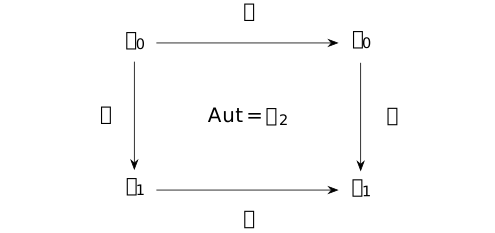
At \(a=b\), put \(z_j=(a,a,m,R_j)\). There are two objects,
each with automorphism group \(C_2\times C_2\):

The generators \(s,r\) reach every displayed object; there are
exactly 4 objects when \(a\ne b\) and two when \(a=b\).
It follows in both directions that the coarse isomorphism classes are
\((m,\{a,b\})\). The coarse orbit set forgets the isotropy just
computed, as in Example [fgap-000P]. On the strict slice
\((1,t,m,R_0)\), isomorphism requires the same mass and
\(\{1,t\}=\{1,t'\}\), whose products give \(t=t'\).
Thus reciprocal parameters are not identified there unless \(t=1\).
This is a set-level groupoid, within the boundary before stacks.
Mathlib's CategoryTheory.ActionCategory constructs
the generic action category; a group action makes it a groupoid.
CategoryTheory.ActionCategory.stabilizerIsoEnd
identifies the stabilizer monoid with endomorphisms, which are invertible
in the group case. MulAction.orbitRel and
MulAction.stabilizer provide the generic coarse relation
and subgroup. DihedralGroup.card gives 8 elements
at \(n=4\), and DihedralGroup.center_eq_closure_of_even_ne_two
gives the central half-turn. In its constructor convention our
\(r^ks\) corresponds to \(\texttt {sr}(-k)\), while \(r^k\)
corresponds to \(\texttt {r}(k)\). These declarations support the
group constructions; the particular parameter action, signed incidence
and stabilizer intersections are the calculations above.