Example. Eliminating alternate vertices of the four-cycle [fdip-000F]
AGENTDRAFTED
In the alternating four-cycle, take \(t,m>0\) and
\(Q=Q_{t,m}=m^2\bbI -L_t\). Its counting-pairing energy is
\[\begin {aligned}
&\langle \phi ,Q\phi \rangle \\
&\quad =(\phi _1-\phi _0)^2+t(\phi _2-\phi _1)^2\\
&\qquad +(\phi _3-\phi _2)^2+t(\phi _0-\phi _3)^2\\
&\qquad +m^2\sum _v\phi _v^2.
\end {aligned}\]
It is positive for every nonzero field. Retain \(R=(0,2)\) and eliminate \(U=(1,3)\),
with coordinates \(x=(\phi _0,\phi _2)\) and \(y=(\phi _1,\phi _3)\) in
these orders. The maps \(x\mapsto x_0\delta _0+x_2\delta _2\)
and \(y\mapsto y_1\delta _1+y_3\delta _3\) are isometries from
ordinary \(\mathbb R^2\); their sum is the specified orthogonal
splitting, and product volume is \(\mathrm {d} x\,\mathrm {d} y\).
Write \(a=m^2\) and \(s=1+t+a\). Reordering
\(m^2\bbI -L_t\), the precision built from the
explicit Laplacian, gives
\[\begin {aligned}
A=C&=s\mathbb {I}_2,\\
B=H&=-\begin {pmatrix}1&t\\t&1\end {pmatrix}.
\end {aligned}\]
The elimination theorem therefore gives
\[\begin {aligned}
S&=\begin {pmatrix}\alpha &-\beta \\-\beta &\alpha \end {pmatrix},\\
\alpha &=s-\frac {1+t^2}{s},\qquad
\beta =\frac {2t}{s}>0.
\end {aligned}\]
Indeed \(HH^T\) has diagonal \(1+t^2\) and off-diagonal \(2t\), so
\(S=s\mathbb {I}_2-s^{-1}HH^T\).
[boyd2004convex, Appendix A.5.5], pp. 650-651, gives the
general Schur complement. Here the chosen blocks make its entries
explicit.
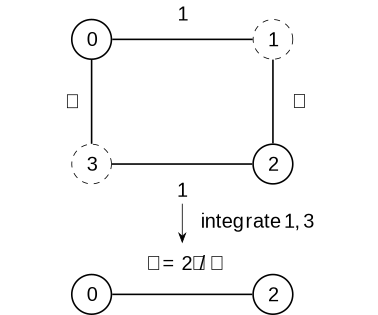
Solid circles are retained; dashed circles are integrated out.
Orientations are suppressed because the quadratic energy is
orientation independent. The bottom edge represents
the induced coupling \(\beta \); its precision also has the diagonal
term computed below.
The vectors \((1,1)^T/\sqrt 2\) and \((1,-1)^T/\sqrt 2\) diagonalize
\(S\). Their eigenvalues are
\[\begin {aligned}
\sigma _+&=\alpha -\beta
=\frac {s^2-(1+t)^2}{s}\\
&=\frac {a(a+2+2t)}{s},\\
\sigma _-&=\alpha +\beta
=\frac {s^2-(1-t)^2}{s}\\
&=\frac {(a+2)(a+2t)}{s}.
\end {aligned}\]
Both are positive. The factorizations follow from \(s=1+t+a\);
they also check positivity without appealing again to the general
theorem. Put
\[\mathcal D=a(a+2)(a+2t)(a+2+2t).\]
Then
\[\begin {aligned}
\det C&=s^2,\qquad \det S=\mathcal D/s^2,\\
\det Q&=\det C\det S=\mathcal D,\\
c_C&=\frac {2\pi }{s},\qquad
Z_S=\frac {2\pi s}{\sqrt {\mathcal D}},\\
Z_Q&=c_CZ_S=\frac {(2\pi )^2}{\sqrt {\mathcal D}}.
\end {aligned}\]
This reproduces the four-mode determinant and partition function.
The effective action is
\[\mathcal A_{\mathrm {eff}}(x)=\tfrac 12x^TSx+\log \frac {s}{2\pi }.\]
Its constant records the integrated block.
A retained observable checks more than normalization. For
\(F(x)=x_0x_2\), polynomial integrability and the
marginal identity give
\[\begin {aligned}
\langle \phi _0\phi _2\rangle _Q
&=\langle x_0x_2\rangle _S
=(S^{-1})_{02}\\
&=\frac {\beta }{\alpha ^2-\beta ^2}
=\frac {2ts}{\mathcal D}.
\end {aligned}\]
The indices \(0,2\) here name retained vertices. Inverting the displayed
two-by-two matrix gives its off-diagonal entry
\(\frac {\beta }{\det S}\), which proves the last equalities. Independently, the
four-cycle spectral table gives
\[\begin {aligned}
4\langle \phi _0\phi _2\rangle _Q
&=\frac 1a-\frac 1{a+2}\\
&\quad -\frac 1{a+2t}+\frac 1{a+2+2t}\\
&=\frac {8ts}{\mathcal D}.
\end {aligned}\]
For the last equality, pair the first two terms and the last two:
their difference has numerator
\(2((a+2t)(a+2+2t)-a(a+2))=8ts\) over \(\mathcal D\).
At \(t=m=1\), one obtains
\[\begin {aligned}
S&=\begin {pmatrix}7/3&-2/3\\-2/3&7/3\end {pmatrix},\\
S^{-1}&=\frac 1{15}\begin {pmatrix}7&2\\2&7\end {pmatrix},\\
\langle \phi _0\phi _2\rangle _Q&=\frac {2}{15},\\
c_C&=\frac {2\pi }{3},\quad Z_S=\frac {2\pi }{\sqrt 5},\quad
Z_Q=\frac {4\pi ^2}{3\sqrt 5}.
\end {aligned}\]
Fixing the eliminated fields to zero instead gives
precision \(A=3\mathbb {I}_2\), covariance \(\mathbb {I}_2/3\) and zero off-diagonal
covariance. At \(t=2,m=1\), the same formulas give
\[\begin {aligned}
S&=\begin {pmatrix}11/4&-1\\-1&11/4\end {pmatrix},\\
\det S&=105/16,\\
S^{-1}&=\frac 1{105}\begin {pmatrix}44&16\\16&44\end {pmatrix}.
\end {aligned}\]
These are the parameters used in the symmetry comparison.
In the orthonormal sector coordinates
\(x_\pm =(x_0\pm x_2)/\sqrt 2\) and
\(y_\pm =(y_1\pm y_3)/\sqrt 2\), the couplings are
\(-(1+t)\) and \(-(1-t)\). Their two eliminated pivots are both
\(s\); each contributes \(\sqrt {2\pi/s}\), whose product is
\(2\pi/s\). The factors \(1/\sqrt 2\) make these changes orthogonal,
so there is no extra volume factor. The retained variance is
\(\frac 12(\sigma _+^{-1}+\sigma _-^{-1})\), and the opposite
covariance is \(\frac 12(\sigma _+^{-1}-\sigma _-^{-1})\).
This agrees with the sector calculation.
There was no edge between vertices \(0\) and \(2\) in the supplied
cycle. Elimination induces one in the effective quadratic form:
\[S=\beta \begin {pmatrix}1&-1\\-1&1\end {pmatrix}
+\sigma _+\mathbb {I}_2.\]
Thus \(\beta \) is an effective edge weight and \(\sigma _+\) an effective
mass coefficient. This is a finite instance of fill-in: eliminating
a single vertex joined to retained vertices with weights \(w_i\)
and diagonal precision \(c>0\) subtracts \(ww^T/c\), creating
off-diagonal entries \(-w_iw_j/c\) where no retained edge existed.
The formula is the same Schur complement with \(H=-w\) and \(C=(c)\).
Locality in the original graph need not survive elimination.
The half-turn preserves both sets \(R,U\) and swaps the two
coordinates within each. For the swap matrix \(J\), the displayed
\(S\) satisfies \(JSJ=S\); the induced two-site form retains this
symmetry. The density and orthogonal-volume invariance then show
that the retained law is invariant as well.
At \(m=0\), \(C=(1+t)\mathbb {I}_2\) remains positive. Square completion
and integration over the eliminated block still give
\[S=\frac {2t}{1+t}\begin {pmatrix}1&-1\\-1&1\end {pmatrix},
\qquad c_C=\frac {2\pi }{1+t}.\]
The retained constant mode has zero energy, so its full integral
diverges by the kernel-box argument. The finite fiber
factor cannot be divided by a finite retained partition function.
The global mean-zero law instead uses the space
\(H=\{\phi :\sum _v\phi _v=0\}\) with its own induced volume.
Its constraint \(x_0+x_2+y_1+y_3=0\) couples the two parts;
\(H\) is neither their unrestricted product nor the product of their
separate mean-zero lines. At \(t=1\), write a field in the
three positive orthonormal modes as
\(\phi =z_1u_1+z_2u_2+z_3u_3\). The coordinates are independent
centered Gaussians of precisions \(2,2,4\). Put
\[r=\frac {z_1+z_2}{\sqrt 2},\qquad
v=\frac {z_1-z_2}{\sqrt 2}.\]
This orthogonal change preserves \(z_1^2+z_2^2=r^2+v^2\) and
two-dimensional volume. Thus \(r,v,z_3\) still have independent
centered Gaussian laws of precisions \(2,2,4\). The retained unit
coordinates satisfy
\[\begin {aligned}
x_-&=(\phi _0-\phi _2)/\sqrt 2=r,\\
x_+&=(\phi _0+\phi _2)/\sqrt 2=z_3/\sqrt 2.
\end {aligned}\]
Integrating the normalized \(v\) factor and changing variable
\(z_3=\sqrt 2x_+\) give independent retained Gaussian densities
of precisions \(2\) and \(8\). This density calculation identifies
the law, not merely its covariance. Returning orthogonally to
\((x_0,x_2)\) gives
\[\begin {aligned}
\operatorname {Cov}(x)&=\frac 1{16}
\begin {pmatrix}5&-3\\-3&5\end {pmatrix},\\
Q_{H\to R}&=\begin {pmatrix}5&3\\3&5\end {pmatrix}.
\end {aligned}\]
These matrices multiply to the identity. The projected normalizer
for this precision is \(\frac {2\pi }{\sqrt {16}}=\frac \pi 2\).
In contrast, directly setting \(m=0,t=1\) in the Schur formula
gives the singular precision
\(\begin {pmatrix}1&-1\\-1&1\end {pmatrix}\).
Separately constraining that retained model to \(x_0+x_2=0\)
leaves unit direction \((1,-1)/\sqrt 2\) with precision \(2\),
normalizer \(\sqrt \pi \) and ambient covariance
\(\frac 14\begin {pmatrix}1&-1\\-1&1\end {pmatrix}\).
These are three distinct specified measures. The
pinned affine law is another constraint with its own
induced volume; fixing a vertex is not the marginal operation above.
The arithmetic pivot boundary is separate from
the positive-real case. At \(m^2=1,t=-2\), \(s=t+2=0\), whereas
\(\det Q=1\cdot 3\cdot (-3)\cdot (-1)=9\). Thus the full map can
be invertible while this eliminated pivot is not. At \(t=-1\),
the pivot exists but the later ratio denominator
\(t+1\) vanishes. Neither value satisfies the positive-weight
hypotheses used for the Gaussian laws here.