Proposition. Zero modes and the nearest-neighbor mismatch [fdip-000T]
AGENTDRAFTED
On the periodic grid, let \(e\) be the number
of even periods among \(N_1,\ldots ,N_n\).
The centered Dirac operator has exactly \(2^e\) zero momentum
blocks and
\[\dim _{\mathbb C}\ker D=2^{n+e}.\]
This is the kernel dimension for the explicitly chosen
reducible module \(S\), whose dimension is \(2^n\).
The unit-weight graph Laplacian
\[L_{\mathrm {nn}}=-\sum _{j=1}^n
(2\mathbb {I}_H-T_j-T_j^{-1})\]
has only the zero momentum in its scalar kernel.
Moreover \(-D^2\ne \mathbb {I}_S\otimes (-L_{\mathrm {nn}})\) on every
permitted grid, including grids with all periods odd.
These are finite consequences of the
Fourier blocks; the centered-difference convention
comes from [wingate2025lattice, Section 9.1, Equations (9.2), (9.6)-(9.7),
pp. 19-20].
For \(n=1,N=4\), the alternating scalar field
\(a(x)=(-1)^x\) has momentum \(p=\pi \). Its centered
difference is zero, whereas \((-L_{\mathrm {nn}})a=4a\).
Consequently every field \(x\mapsto a(x)v\), \(v\in S\),
is killed by \(D\). Together with the constant fields these
give the four-dimensional kernel. Write
\(K_2=(2\mathbb {I}_H-T^2-T^{-2})/4\), so \(-D^2=\mathbb {I}_S\otimes K_2\).
The two scalar Laplacians have the following weighted graphs:
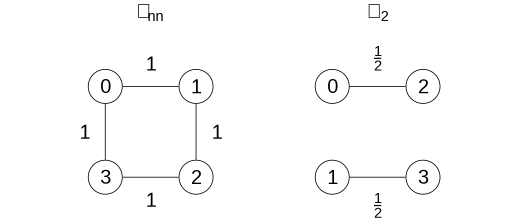
Left: the 4 unit-weight nearest-neighbor edges.
Right: the two-step edges, with vertices rearranged to display
the parity classes \(\{0,2\}\) and \(\{1,3\}\).
At period \(4\), \(T^2=T^{-2}\), so
\(K_2=(\mathbb {I}_H-T^2)/2\): the two shift contributions of weight
\(1/4\) combine into one undirected edge of weight \(1/2\)
for each opposite pair. The alternating field is constant on
each right-hand component, explaining its zero energy there.
For \(n=1,N=3\), momentum \(p=2\pi/3\) instead gives
\[s(p)=\tfrac 34,\qquad \ell (p)=3.\]
Only \(r=0\) is a zero momentum, yet the operators still differ.
Thus extra exact zero momenta occur precisely when at least
one period is even, whereas the square mismatch always occurs.
The excluded case \(N=2\) has \(T=T^{-1}\), making its centered
difference identically zero.
The finite kernel dimension above is not a physical species
or chirality count. Friedan's Nielsen-Ninomiya theorem concerns
free fermions on the infinite lattice \(\mathbb Z^n\) for odd
\(n\), with continuous torus momenta. Its Hamiltonian is
quadratic, phase invariant, translation invariant and local,
with a Hermitian momentum symbol. The locality discussion
reduces the Hamiltonian requirement to continuity; the
internal-charge projections must be smooth. The zero set is
finite and isolated, with specified relativistic
Clifford-linear behavior near each zero. Under these hypotheses
the total chiral index vanishes separately for each charge
[friedan1982nielsen, Sections 1-2, pp. 481-484; Equations (6), (10)-(11)].
A finite sampled grid in arbitrary dimension with the chosen
reducible module computes a different quantity. The odd-period
example neither contradicts that theorem nor establishes a
continuum limit. No Lorentzian model or factorization of the
earlier weighted precision is supplied by this centered
operator.