Example. A triangle boundary and a filled triangle [fdip-004N]
AGENTDRAFTED
Take the simple undirected triangle on vertices \(\{0,1,2\}\).
Give its three edges any orientations, then forget them here;
any parallel copies would also have to be merged before this simple
undirected comparison. The
one-dimensional realization retains the three edges
without a face. In the nonempty-face convention of
[maypishevar2025finitespaces, Definition 6.1.1, p. 61],
its boundary complex and the filled complex have faces
\[\begin {aligned}
K_{\partial }
&=\{\{0\},\{1\},\{2\},\{0,1\},\{1,2\},\{0,2\}\},\\
K_{\Delta }&=K_{\partial }\cup \{\{0,1,2\}\}.
\end {aligned}\]
The added face consists of three pairwise adjacent vertices: it is
the filled clique triangle. This specifies these two complexes,
without declaring a general clique-construction functor.
Choose three noncollinear points \(v_0,v_1,v_2\) in the plane.
Realize each listed face by the convex hull of its vertices, as in
[maypishevar2025finitespaces, Definitions 6.2.1 and 6.2.6, pp. 62-63].
Then \(|K_{\partial }|\) is the perimeter and \(|K_{\Delta }|\)
is the closed triangular region. Traversing the three line segments
identifies the perimeter with \([0,3]/(0\sim 3)\): the induced map
is a continuous bijection from a compact space to a Hausdorff space,
hence a homeomorphism. The map \(t\mapsto \exp (2\pi i t/3)\)
gives the same identification with \(S^1\).
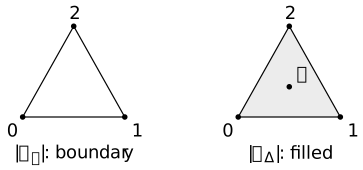
The filled triangle contracts to its barycenter
\(b=(v_0+v_1+v_2)/3\) by
\[H(x,t)=(1-t)x+tb,\qquad 0\leq t\leq 1.\]
Convexity keeps \(H(x,t)\) in the triangle, and the formula is
continuous, with \(H(x,0)=x\) and \(H(x,1)=b\).
The two constructions have the same vertices and edges, but only
the second supplies a two-dimensional face. Incidence alone therefore
does not choose between keeping the perimeter and filling it. Each
specified realization is nevertheless a well-defined construction.
These comparisons are elementary deductions from the cited
realization definitions. Mathlib's AbstractSimplicialComplex
uses nonempty faces and includes each vertex; its
Convex.contractibleSpace supplies contractibility of a
nonempty convex subset of a real topological vector space. These
support the conventions and the contraction step, not the complete
incidence-to-triangle comparison.