The two-cell circle and its field reflection [fdip-00XL]
✍️sourceAGENTDRAFTED
- November 17, 2026
The two-cell circle and its field reflection [fdip-00XL]
✍️sourceAGENTDRAFTED
- November 17, 2026
Reflection exchanges the two vertices and fixes each unoriented edge. Reversing edge orientation and changing its source determine the cochain reflection and its extension to the full paired exterior algebra.
Discussion 1. Two distinct temporal arcs [fdip-00XM]AGENTDRAFTED
- November 17, 2026
Discussion 1. Two distinct temporal arcs [fdip-00XM]AGENTDRAFTED
- November 17, 2026
The torus reflections assume a temporal period of at least \(4\). A cellular circle can instead have two vertices and two distinct arcs joining them. Reversing time exchanges the vertices and reverses each arc. Which connection data and which field locations remain fixed by that operation?
Definition 2. The period-two cellular sign model [fdip-00XN]AGENTDRAFTED
- November 17, 2026
Definition 2. The period-two cellular sign model [fdip-00XN]AGENTDRAFTED
- November 17, 2026
The period-two cellular sign model has vertices \(v_0,v_1\) and distinct oriented edges \(e_0:v_0\to v_1\), \(e_1:v_1\to v_0\). The gauge group is \(C_2=\{1,-1\}\), acting on the one-dimensional fiber \(F=k\), where \(k=\mathbb R\) or \(\mathbb C\). A connection is \(U=(u_0,u_1)\in \Omega =\{1,-1\}^2\). The reflection \(\vartheta :t\mapsto 1-t\) on the circle of period \(2\) exchanges the vertices and fixes each unoriented edge while reversing its orientation. It sends each link to its inverse, hence fixes every \(U\in \Omega \).
All vertex and edge fields are periodic. Give the cochain space \(V=C^0\oplus C^1\) its orthonormal cell basis, with vertices before edges. The source-based differential is \[(\mathrm {d}_U f)(e_0)=u_0f(v_1)-f(v_0),\qquad (\mathrm {d}_U f)(e_1)=u_1f(v_0)-f(v_1).\] Set \(\mathbf {D}_U=\mathrm {d}_U+\mathrm {d}^{\dagger }_U\) and \(K_U=5\mathbb {I}_V+\mathbf {D}_U\). Here \(\mathrm {d}^{\dagger }_U\) is the adjoint for the declared cell pairing. The pure-gauge weight is \(1\), and connection summation is counting over \(\Omega \). The paired field algebra at each connection is the ring paired coefficient construction \(\mathcal A(V)=\Lambda _k(V^*\oplus V)\).
Example 3. The cellular operator [fdip-00XO]AGENTDRAFTED
- November 17, 2026
Example 3. The cellular operator [fdip-00XO]AGENTDRAFTED
- November 17, 2026
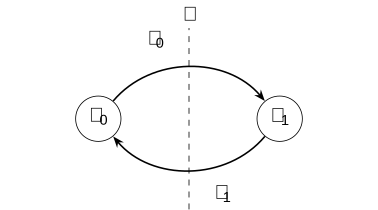
Reflection in the dashed line exchanges the vertices and fixes each arc as an unoriented cell. The arrows specify the two declared edge orientations.
In the ordered vertex and edge bases of the cellular sign model, \[\mathrm {d}_U=\begin {pmatrix}-1&u_0\\u_1&-1\end {pmatrix}, \qquad \mathbf {D}_U=\begin {pmatrix}0&\mathrm {d}_U^{\mathsf t}\\ \mathrm {d}_U&0\end {pmatrix}.\] For the trivial connection the two edge rows are negatives of one another. For \((u_0,u_1)=(1,-1)\), the two rows are orthogonal. Both assignments belong to the same cellular model; the labeled edges remain distinct in each case.
Discussion 4. Returning an edge coefficient to its source [fdip-00XP]AGENTDRAFTED
- November 17, 2026
Discussion 4. Returning an edge coefficient to its source [fdip-00XP]AGENTDRAFTED
- November 17, 2026
An edge coefficient is based at its source. Reflection reverses that edge, so its new source is the original head. The orientation sign alone therefore does not return the coefficient to its declared fiber. How does the link transport enter the pullback, and how does that pullback act on the paired field generators?
Definition 5. The cellular paired anti-reflection [fdip-00XQ]AGENTDRAFTED
- November 17, 2026
Definition 5. The cellular paired anti-reflection [fdip-00XQ]AGENTDRAFTED
- November 17, 2026
For the cellular sign model, define the cochain reflection \(\mathscr R_U\) by \[\begin {aligned} (\mathscr R_0 f)(v_j)&=f(v_{1-j}),\\ (\mathscr R_1(U)a)(e_j)&=-u_ja(e_j)\qquad (j=0,1),\\ \mathscr R_U&=\mathscr R_0\oplus \mathscr R_1(U). \end {aligned}\] The edge sign reverses orientation; its link factor transports from the reflected source back to the declared source.
Use the common algebra \(\mathscr A=\operatorname {Fun}(\Omega ,\mathcal A(V))\) with pointwise exterior multiplication. Its cellular paired anti-reflection is conjugate-linear on coefficients, fixes the link functions, and has generator rules \[\begin {aligned} \Theta _U(\psi _c)&=\sum _a(\mathscr R_U)_{ac}\bar \psi _a,\\ \Theta _U(\bar \psi _c)&=\sum _a(\mathscr R_U)_{ac}\psi _a,\\ \Theta _U(ab)&=\Theta _U(b)\Theta _U(a). \end {aligned}\] Thus \((\Theta a)(U)=\Theta _U(a(U))\). Its strict positive half-algebra \(\mathscr A_+\) consists of constant families generated over \(k\) by \(\psi _{v_1},\bar \psi _{v_1}\). The edge generators belong to the full algebra, not this open half.
Let \(\mathcal I_V\) be the ring paired coefficient. The cellular paired functional is \[\begin {aligned} Z&=\sum _{U\in \Omega }\det K_U,\\ \ell (a)&=Z^{-1}\sum _{U\in \Omega } \mathcal I_V\bigl (a(U)\operatorname {Exp}_{\Lambda }(\theta _{K_U})\bigr ) \qquad \text {when }Z\ne 0. \end {aligned}\] Here \(\operatorname {Exp}_{\Lambda }\) is the finite exterior exponential and \(\theta _{K_U}=-\bar \psi (K_U\psi )\).
Example 6. Vertex and boundary generators [fdip-00XR]AGENTDRAFTED
- November 17, 2026
Example 6. Vertex and boundary generators [fdip-00XR]AGENTDRAFTED
- November 17, 2026
The cellular anti-reflection acts on every paired generator by \[\begin {aligned} \Theta \psi _{v_j}&=\bar \psi _{v_{1-j}},& \Theta \bar \psi _{v_j}&=\psi _{v_{1-j}},\\ \Theta \psi _{e_j}&=-u_j\bar \psi _{e_j},& \Theta \bar \psi _{e_j}&=-u_j\psi _{e_j} \qquad (j=0,1). \end {aligned}\] The strict positive half has basis \(1,\psi _{v_1},\bar \psi _{v_1},b_1\), where \(b_j=\bar \psi _{v_j}\psi _{v_j}\). Its even subalgebra is spanned by \(1,b_1\). Each \(b_j\) is invariant under the local sign gauge action, and order reversal gives \(\Theta b_1=b_0\).
Both edges are reflection-boundary cells. Their generators are integrated in \(\ell \), even though neither edge is in an open half. Exchanging their barred and unbarred labels does not move those geometric cells off the boundary.
Lemma 7. Cochain reflection and gauge transport [fdip-00XS]AGENTDRAFTED
- November 17, 2026
Lemma 7. Cochain reflection and gauge transport [fdip-00XS]AGENTDRAFTED
- November 17, 2026
The cochain reflection is an orthogonal involution and commutes with \(\mathbf {D}_U\) and \(K_U\). For a vertex gauge \(g=(g_0,g_1)\in C_2^2\), its joint covariance is \[\mathscr R_{U^g}G_g=G_{\vartheta g}\mathscr R_U,\qquad \vartheta g=(g_1,g_0),\] where \(G_g\) multiplies each cell coefficient by the sign at that cell's source.
Proof.
- November 17, 2026
Proof.
- November 17, 2026
The vertex swap and signed edge actions square to the identity and preserve the cell pairing. Directly from the source-based edge formula, \[\mathrm {d}_U\mathscr R_0 =\begin {pmatrix}u_0&-1\\-1&u_1\end {pmatrix} =\mathscr R_1(U)\mathrm {d}_U.\] Transposing gives \(\mathscr R_0\mathrm {d}_U^{\mathsf t} =\mathrm {d}_U^{\mathsf t}\mathscr R_1(U)\). These are the two off-diagonal blocks of commutation with \(\mathbf {D}_U\); adding the scalar mass preserves commutation.
Gauge transformation replaces both links by \(u_j^g=g_0g_1u_j\). On vertices the covariance equation is \(\mathscr R_0\operatorname {diag}(g_0,g_1) =\operatorname {diag}(g_1,g_0)\mathscr R_0\). On edges it is \[-\operatorname {diag}(g_0g_1u_0,g_0g_1u_1) \operatorname {diag}(g_0,g_1) =-\operatorname {diag}(g_1,g_0) \operatorname {diag}(u_0,u_1).\] Each equality follows entry by entry from \(g_j^2=1\). Together they prove the joint identity.
Lemma 8. Compatibility of the full paired functional [fdip-00XT]AGENTDRAFTED
- November 17, 2026
Lemma 8. Compatibility of the full paired functional [fdip-00XT]AGENTDRAFTED
- November 17, 2026
The cellular paired anti-reflection is an algebraic anti-reflection. Whenever \(Z\ne 0\), its normalized functional satisfies \(\ell (\Theta a)=\overline {\ell (a)}\). Consequently its reflection form is Hermitian on the strict positive half and on its even gauge-invariant part.
Proof.
- November 17, 2026
Proof.
- November 17, 2026
The generator images are odd, square to zero and anticommute, so order reversal extends through the exterior relations. Since the links are fixed and \(\mathscr R_U\) is real with square \(\mathbb {I}_V\), applying the map twice fixes every generator and coefficient. It fixes the unit.
Order reversal sends a barred-first quadratic term to another barred-first term. Its coefficient operator becomes \(\mathscr R_U K_U^{\mathsf t}\mathscr R_U^{\mathsf t}\). The real symmetry of \(K_U\) and Lemma 7 identify this operator with \(K_U\), so \(\Theta _U\theta _{K_U}=\theta _{K_U}\). The finite exponential is therefore fixed.
In the cell basis put \(\theta =\sum _c\psi _c\bar \psi _c\). Orthogonality gives \[\Theta _U\theta =\sum _{a,b,c}(\mathscr R_U)_{ac}(\mathscr R_U)_{bc} \psi _a\bar \psi _b =\theta .\] Thus the paired top generator \(\Omega _V=\theta ^4/4!\) is fixed. The map preserves exterior degree, hence \(\mathcal I_V(\Theta _U a)=\overline {\mathcal I_V(a)}\). The finite exponential is even and central, so reversing its order with \(a\) changes nothing. Summing the coefficient identity over the pointwise fixed connection space and dividing by the real nonzero \(Z\) proves compatibility. The Hermitian assertion is Theorem [fdip-00XH].
Remark 9. Boundary cells and the declared action [fdip-00XU]AGENTDRAFTED
- November 17, 2026
Remark 9. Boundary cells and the declared action [fdip-00XU]AGENTDRAFTED
- November 17, 2026
The cellular sign model uses the full cochain operator \(5\mathbb {I}+\mathbf {D}_U\), periodic fields and counting link weights. Its edge pullback contains source transport, and its strict half contains only a vertex. A Wilson spinor action with time projectors, or a reflection that mixes cochain degrees, would define a different quadratic-form problem. Positivity for either construction requires its own action, reflection and observable correspondence.