Definition. Plaquette transport and Wilson loops [fdip-006N]
AGENTDRAFTED
Let \(G\) be a finite group on a square complex.
A connection is \(U\in G^E\), with
\(U_{\bar e}=U_e^{-1}\) on a reversed edge. For a traversed path
\(C=(e_1^{\epsilon _1},\ldots ,e_k^{\epsilon _k})\), define
\[U_C=U_{e_k}^{\epsilon _k}\cdots U_{e_1}^{\epsilon _1}.\]
The first transport acts on the right. The
plaquette holonomy is \(U_p=U_{\partial p}\).
The gauge group \(\mathcal G=G^V\) acts by
\[(gU)_e=g_{h(e)}U_eg_{s(e)}^{-1}.\]
Cancellation at successive vertices gives
\[(gU)_C=g_{h(C)}U_Cg_{s(C)}^{-1}.\]
For a closed path based at \(v\), this is conjugation by \(g_v\).
Choose a finite-dimensional complex Hermitian space \(F\)
with \(\dim _{\mathbb C}F>0\), and a unitary representation
\(\rho :G\to U(F)\). Let
\(\chi _\rho (g)=\operatorname {tr}\rho (g)\) be its
character.
The Wilson loop of a closed path is the unnormalized trace
\[W_\rho (C)=\chi _\rho (U_C).\]
It is gauge invariant. Changing the starting vertex conjugates the
holonomy, so it does not change this trace. Reversing the path replaces
\(U_C\) by \(U_C^{-1}\), hence replaces \(W_\rho (C)\) by its complex
conjugate. In particular \(\operatorname {Re}W_\rho (C)\) is independent
of the chosen boundary orientation. These are the transport and trace
conventions of [wingate2025lattice, equations (6.14)–(6.19), pp. 7–8].
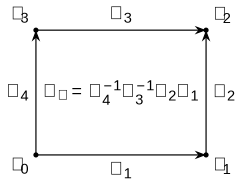
The arrows show the chosen edge orientations and the labels are
connection values, not scalar weights. The boundary traversal is
\[v_0\to v_1\to v_2\to v_3\to v_0.\]
It uses the top and left edges backwards, accounting for both inverses.