Theorem. Eliminating a positive Gaussian block [fdip-000D]
AGENTDRAFTED
Let \(E=X\mathbin \perp Y\) be a specified orthogonal sum of
finite-dimensional real inner-product spaces. Write \(h_E,h_X,h_Y\)
for their pairings, \(i_X,i_Y\) for inclusion and \(p_X,p_Y\) for
orthogonal projection. The addition isometry is
\(J(x,y)=i_Xx+i_Yy\). Use canonical Euclidean volume on
uncompleted Borel sets. Then product volume gives
\(J_*(\lambda _X\otimes \lambda _Y)=\lambda _E\).
Zero summands are allowed; their volume is unit mass on a singleton.
Let \(Q:E\to E\) be a self-adjoint
positive precision parameter. Its
components for this splitting are
\[\begin {aligned}
A&=p_XQi_X:X\to X,\\
B&=p_XQi_Y:Y\to X,\\
C&=p_YQi_Y:Y\to Y.
\end {aligned}\]
The fourth component is \(p_YQi_X=B^\dagger \), where the adjoint
uses the specified pairings. Both \(C\) and the
effective precision, or real Schur complement,
\[S=A-BC^{-1}B^\dagger :X\to X\]
are positive definite and invertible. This is the real positive
specialization of the split Schur map.
Put \(w_Q(z)=\exp (-h_E(z,Qz)/2)\) and \(q=\dim Y\).
For every \(x\in X\), the exact fiber integral is
\[\begin {aligned}
I_Q(x)&=\int _Y w_Q(J(x,y))\,d\lambda _Y(y)\\
&=c_C\exp (-h_X(x,Sx)/2),\\
c_C&=\frac {(2\pi )^{q/2}}{\sqrt {\det C}}=Z_C>0.
\end {aligned}\]
Moreover \(\det Q=\det C\det S\). Thus elimination induces both
\(S\) and a positive finite scalar \(c_C\).
Taking minus the logarithm of the positive fiber integral defines
an exact effective action:
\[\begin {aligned}
\mathcal A_{\mathrm {eff}}(x)
&=\tfrac 12h_X(x,Sx)-\log c_C\\
&=\tfrac 12h_X(x,Sx)+\tfrac 12\log \det C\\
&\quad -\tfrac q2\log (2\pi ).
\end {aligned}\]
The constant cancels from normalized retained expectations but belongs
to the unnormalized weight. Rescaling the two reference volumes by
\(a_X,a_Y>0\) multiplies \(c_C\) by \(a_Y\), \(Z_S\) by \(a_X\) and
\(Z_Q\) by \(a_Xa_Y\); normalized laws remain unchanged.
For \(Y=0\), \(c_C=1\); for \(X=0\), \(Z_S=1\). In each case the
unique zero-space endomorphism is invertible and has determinant one.
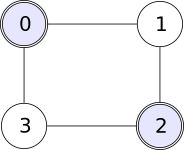
For counting fields on \(V=R\sqcup U\), the delta bases identify
\(X=\mathbb R^R\), \(Y=\mathbb R^U\), \(B=H\) and \(B^\dagger =H^T\).
Coordinate volume splitting recovers the usual
\(dx\,dy\) formula. The carrier, split, input precision and volumes
are supplied; \((S,c_C)\) is induced relative to those choices.
The singular-pivot boundary requires a separate argument.
[boyd2004convex, Appendix A.5.5, pp. 650-651] gives square
completion with the first block as pivot. Exchanging its order to
\((y,x)\) gives the present eliminated pivot \(C\).
[rasmussen2006gaussian, Appendix A.2, equation (A.4), p. 200]
gives the Gaussian density with covariance as parameter. Substituting
\(C^{-1}\) gives the normalizer used here. The invariant integration
and determinant argument above reconstruct these ingredients with
specified pairings and volume.
Mathlib's Matrix.schur_complement_eq₂₂ supports square
completion in compatible finite coordinates, with a Hermitian
invertible eliminated block. Its Matrix.det_fromBlocks₂₂
supports the determinant identity. TauCeti's
Matrix.PosDef.gaussianCondCov supports strict Schur
positivity for a real positive-definite block matrix. Despite its
conditional-covariance name, this algebraic conclusion can be applied
to the precision \(Q\). These ingredients do not supply the integral
or its reference-volume convention.
The operation is algebraic: it acts on vertex and edge sets that are
supplied, and carries neither a dynamical carrier nor an effective metric,
which are additional data.