Definition. The one-step Gaussian kernel [fdip-007T]
AGENTDRAFTED
Fix \(w>0\) and \(m>0\). On
\(\mathcal H=L^2(\mathbb R,\mathrm {d} x;\mathbb C)\), define the
Gaussian transfer operator by
\[\begin {aligned}
K(x,y)&=\exp \left [-\frac w2(x-y)^2
-\frac {m^2}{4}(x^2+y^2)\right ],\\
(Tf)(x)&=\int _{\mathbb R}K(x,y)f(y)\,\mathrm {d} y.
\end {aligned}\]
The reference measure is exactly Lebesgue measure \(\mathrm {d} y\); no
normalizing factor is included in \(K\). This is the one-coordinate
instance of the slice-kernel construction in
[wingate2025lattice, Eqs. (5.1)–(5.3), p. 4].
Write \(a=w/2+m^2/4\), so
\(K(x,y)=\mathrm {e}^{-a(x^2+y^2)+wxy}\) and \(2a>w\).
Thus \(K\in L^2(\mathbb R^2)\). Cauchy–Schwarz makes \(T\) bounded,
and symmetry of the real kernel makes it self-adjoint.
An integral operator with a square-integrable kernel is
Hilbert–Schmidt. Its squared norm of this kind is
\(\|T\|_{\mathrm {HS}}^2=\operatorname {tr}(T^{\dagger }T)\).
For this kernel the trace equals \(\int |K|^2\).
Remark [fdip-00M8] gives the same value as a sum over every
orthonormal basis. Approximation of \(K\) by finite sums
of products of one-variable square-integrable functions also
shows that \(T\) is compact. Operator positivity will follow from
its explicit spectrum in Theorem [fdip-007U].
For \(N\ge 3\), let \(x_N=x_0\) and define the periodic chain by
\[\begin {aligned}
H_N(x)&=\frac w2\sum _{j=0}^{N-1}(x_{j+1}-x_j)^2
+\frac {m^2}{2}\sum _{j=0}^{N-1}x_j^2,\\
Z_N&=\int _{\mathbb R^N}\mathrm {e}^{-H_N(x)}\,\mathrm {d}^Nx,\qquad
\mathrm {d}\mu _N=Z_N^{-1}\mathrm {e}^{-H_N(x)}\,\mathrm {d}^Nx.
\end {aligned}\]
Each undirected edge of the ordinary cycle \(C_N\) occurs once.
Splitting each onsite mass term between its two incident edges gives
\[\mathrm {e}^{-H_N(x)}=\prod _{j=0}^{N-1}K(x_j,x_{j+1}).\]
Positive mass makes \(0<Z_N<\infty \). The identity
\(Z_N=\operatorname {tr} T^N\) is proved in Theorem [fdip-007V].
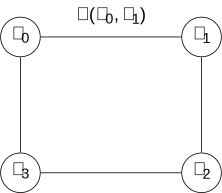
The four-cycle illustrates the kernel product. Every edge
contributes the same function \(K\) of its endpoints. Each site's
two mass contributions add to \(m^2x_j^2/2\); closing the last edge
identifies \(x_4\) with \(x_0\).